




Abstract
Understanding public distrust of science is both theoretically and practically important. While previous research has focused on the association between political ideology and trust in science, it is at best an inconsistent predictor. This study demonstrates that two dimensions of political ideology—attitudes towards governments and corporations—can more precisely predict trust in science across issues. Using a survey in the United States and Germany on the science of climate change and genetically modified foods, we find that an individual’s trust in science varies across issues and that attitudes towards government and corporations are important predictors of this trust.
Introduction
Increasingly, public opinion on scientific issues does not reflect the near consensus view of the scientific community. On the question of whether genetically modified organism (GMO) foods are safe to consume, for example, 88% of scientists in the American Association for the Advancement of Science (AAAS) agree that GMOs are safe to eat (Funk & Rainie, 2015). Similarly, an examination of available research by the National Academies of Science, Engineering, and Medicine (2016) found no substantiated evidence that GMO foods are any less safe to eat than non-GMO foods. Yet public opinion vastly diverges from this near scientific consensus. Almost two thirds of both Americans and Europeans believe that GMOs are unsafe to eat (European Commission, 2010b; Funk & Rainie, 2015). This gap between public and scientific opinion is not limited to the safety of GMOs. On the issue of climate change, 87% of AAAS scientists agree that climate change is mostly due to human activity (Funk & Rainie, 2015), a finding supported by the review of climate change research in the latest Intergovernmental Panel on Climate Change report (2014). Yet recent polling shows that one third to one half of Americans disagree with this statement (Funk & Kennedy, 2016; Saad, 2017), and fewer than half (49%) of Germans attribute climate change mainly to human activity (Steentjes et al., 2017).
This gap between public and scientific opinion has major consequences for evidence-based policy making. While science certainly does play a role in the policy process—through scientific advisory committees, for example—public opinion is also a powerful force in policy making, particularly surrounding environmental or science issues (Anderson, Böhmelt, & Ward, 2017). Evidence shows that policies are frequently passed and implemented that reflect public opinion and conflict with scientific evidence (Bernauer, 2003; Freedman, 2013). Despite near scientific consensus that GMOs are safe to eat, pressure from consumer groups in the United States has led to legislation requiring that food products containing GM ingredients be labeled as such (Bittman, 2016). Similar laws regulating GMO foods have been in place in Europe since 2003 (European Commission, 2017), and the European Union has also begun to allow individual member states to unilaterally ban GMO crop cultivation (Frenson, 2015). Most striking, the gap between public opinion and the prevailing scientific view on climate change in the United States has made it possible for political leaders to call the issue a “hoax,” stall legislative efforts to restrict greenhouse gas emissions, roll back environmental regulations, and withdraw from the Paris Accord. Certainly, we should not expect science alone to determine public policy (proper evaluation of science should also consider and prioritize the ethical and moral implications of science and technology), but public rejection of science also poses severe policy challenges.
The disjuncture between science and public opinion cannot be attributed solely to a lack of public awareness of scientific evidence (Kahan, 2014). Citizens often know what scientists think, but it seems that a substantial (and by some measures growing) portion of the public simply does not trust science in general (Blake, 2015; Hopkins, 2014). Recent polls in the United States show that only 40% of citizens have a great deal of confidence in the scientific community (General Social Survey, 2016). Similarly, in Europe, a European Commission (2010a) study found that only 42% of European Union citizens trust scientists to tell the truth about controversial scientific and technological issues. For this reason, there has been considerable interest in understanding why people do or do not trust science.
Much of the research on public trust in science has focused on the role played by political ideology—an individual’s self-identification as liberal or conservative (or political left or right)—in determining trust science. As Resnick and Huddleston (2015) have argued, “When there is societal debate, public trust [in science] often becomes a function more of political identity than of scientific fact” (p. 21). Most notably, American political conservatism has been found to be correlated with lower levels of trust in science (Mooney, 2006), and the decline of trust in science in the United States over the past 35 years has been observed primarily among political conservatives (Gauchat, 2012).
Recent work, however, challenges the proposition that political ideology is a consistent predictor of trust in science. Nisbet, Cooper, and Garrett (2015), for instance, find that liberals and conservatives can exhibit similarly low levels of trust in science when confronted with scientific messages that are dissonant with their ideological worldviews. Moreover, McCright, Dentzman, Charters, and Dietz (2013) find that when asked about the science of a particular issue, liberals are more likely than conservatives to trust science regarding the impact of economic production on health or the environment, while conservatives are more likely than liberals to trust science that leads to innovation for greater economic productivity. Taken together, these findings suggest that individuals may not inherently distrust science and the scientific process in general, but that distrust of science on a particular issue may stem from an aversion to the source or the policy implications of that science.
In this article, we explore how motivated reasoning drives trust in the science of two issues: climate change and GMOs. We first build on recent work to demonstrate that varying levels of trust in science can be observed within individuals, that individuals can trust the science on one issue more than on another, and that trust in science depends on the type of science in question. Second, we propose that two specific dimensions of political ideology—an individual’s attitudes towards government and corporations—have important but understudied effects on trust in science. Specifically, we argue that once a particular type of science is specified, an individual’s level of trust is shaped by her or his understanding of and support for the source of that science and his or her anticipation of implications of that science.
Attitudes towards two different entities—governments and corporations—are the focus of our analysis. These two institutions tend to be the primary funders of scientific research, and therefore attitudes towards each may color an individual’s trust in scientific findings. Additionally, the implications of scientific research often have different consequences for the role of governments and corporations in society. Scientific findings that require a regulatory response imply a greater role for government, whereas findings in support of more of a free market approach imply a greater role for the private sector. We argue, therefore, that attitudes towards government and corporations may be more closely associated with what types of science an individual will trust or distrust than broader measures of political ideology and, importantly, may offer clearer explanations for patterns of trust in science.
To assess these arguments, we conducted surveys in the United States and Germany on climate change and GMOs. This cross-cultural comparison allows us to understand whether the theoretical assumptions hold up in different cultures, expanding its external validity. Previous work on trust in science has been primarily U.S.-centric. However, public understanding of, trust in, and support for policies in line with the scientific consensus varies dramatically in different cultural contexts. Whereas public opinion and policies tend to better match scientific opinion on the issue of climate change in Germany than the United States, the reverse tends to be true on the issue of GMOs. Additionally, the different regulatory environments in the United States and Europe likely reflect different relationships between the public and science, government, and corporations in those countries. Our study therefore expands on previous work on trust in science by evaluating patterns in both the U.S. and European (specifically German) contexts, allowing us to expand the external validity a broad theory of what motivates public trust in science.
We find evidence to support both of our main arguments. First, we find that individuals commonly have greater trust in the science on one issue than on another. Second, we find that attitudes towards government and corporations are significantly associated with trust in climate change and GMO science, even controlling for a broad measure of political ideology. Specifically, the more favorable an individual’s attitude is towards corporations, the more that individual will trust the science of GMOs, and the more favorable an individual is towards government, the more likely it is that this individual will trust the science of climate change. Finally, we find that these relationships vary considerably by country, emphasizing the need to include more cross-cultural studies in science communication research.
These findings have both theoretical and practical implications. For theory, they demonstrate the value of going beyond general measures of political ideology to consider more specific ideological attitudes that affect trust in science. By comparing attitudes in two countries with similar levels of economic development but different political contexts, they also suggest the extent to which these attitudes, and therefore patterns of trust, are shaped by particular political contexts. For practice, the findings have implications both for the framing of messages about science and for the choice of messenger to deliver these messages.
In the following sections, we first develop the theoretical basis for our hypotheses. We then describe our research design, including the survey design and the execution of the survey in Germany and the United States. We subsequently present our results in three parts: through descriptive statistics, bivariate correlations, and ordinary least squares (OLS) regressions. Finally, we discuss the implications of our findings for the broader understanding of what drives public trust in science, as well as lessons for science communicators and policy makers who seek to increase public trust in science.
Theoretical Framework
While political ideology (defined here as an individual’s self-identification on a liberal-conservative, or left-right, spectrum) has been identified as an important predictor of trust in science (Gauchat, 2012; Mooney, 2006). However, this explanation has also met with critiques, that it is an imprecise or incomplete driver and that liberal or conservative ideologies may lead individuals to trust or distrust science in different ways. McCright et al. (2013) found, for instance, that political liberals in the United States are more likely to trust science that focuses on the negative consequences of the current economic system (e.g., for the environment and public health). Meanwhile, political conservatives are more likely to trust science that provides new inventions or innovations for economic production (e.g., GMOs). Others have found that when individuals are presented with scientific information on particular subjects, liberals and conservatives can report similar levels of distrust in science, depending on what scientific issue is invoked. For example, while conservatives report lower levels of trust in science when prompted with messages about the scientific consensus on climate change and evolution, liberals report equally low levels of trust when prompted with messages about the scientific consensus on fracking and nuclear power (Hamilton, 2015; E. C. Nisbet et al., 2015). These findings suggest that broad measures of political ideology (i.e., liberal or conservative, left or right) may not inherently predict trust or distrust in science. Instead, what matters is the way in which the science in question supports or threatens an individual’s cultural worldview.
This conclusion reflects a broader movement in the risk communications literature to understand the cultural drivers of public understanding of science. Over the past decade, the concept of cultural cognition of risk (Kahan & Braman, 2006) has called into question the power of political ideology broadly as predictor of risk perceptions and policy support among the mass public. This concept emphasizes how cultural values (worldviews that guide preferences, interests, and ways of life; Douglas, 1970) and perceptions of trusted sources are more powerful predictors of risk perceptions than political ideology (Kahan & Braman, 2006; Kahan, Jenkins-Smith, & Braman, 2011; Thompson, Ellis, & Wildavsky, 1990; Wildavsky & Dake, 1990). The mechanism behind this effect is a form of motivated reasoning—the tendency for an individual’s prior preferences to shape how he or she understands new information (Kunda, 1990; Lord, Ross, & Lepper, 1979). Instead of independently weighing scientific arguments, most individuals rely on social values, identities, and worldview to influence how they interpret the information (Hart & Nisbet, 2012; Nisbet, 2010; Nisbet & Scheufele, 2009). Therefore, whether an individual accepts scientific information depends on her or his orientation towards the source of that information and the implications of those findings for her or his cultural values and identities.
Our focus on attitudes towards governments and corporations as important elements of an individual’s worldview stems from their unique roles as sponsors and organizers of science, as well as from the implications that science has on the role of each entity in society. As pointed out by van der Linden (2016), a key aspect of cultural motivations of risk perceptions involves preferences for the role of government in society. Science is often seen as deeply embedded in government through both funding and the institutionalization of scientific advisory committees (Jasanoff, 1990). Particularly since World War II, scientific research has been heavily funded by governments, and science has become an important driver of government policy (Gauchat, 2012). This historical institutionalization of science in governments and the role of governments as major sponsors and organizers of scientific research have likely led to an association between these two entities in the minds of the mass public.
Meanwhile, the increase of science and technology in the marketplace in recent decades has also created an incentive for corporations to become involved in the production and use of science. Governments, facing budget cuts and changing priorities, have been less involved in the production of science related to consumer goods, leaving space for corporations to become increasingly involved in the production of scientific knowledge (Washburn, 2007). Therefore, particularly for certain types of science that produce marketable knowledge, corporations are likely to be viewed as sources of this science.
Beyond their role as sources of science, the findings of various types of science have different implications for the role governments and corporations in society, and the regulation versus free market values that each represents. Often, scientific research identifies the risks of certain technologies or practices, requiring more regulation and a larger role for government regulation in the marketplace. For example, one major implication of climate change science is the need for greater government regulation of greenhouse gas emissions. This growth in regulatory state power threatens the values of those individuals who prioritize free and open markets and those who have low levels of trust in government. In other instances, the findings of scientific research may result in an expansion of the role and influence of corporations. For example, the near scientific consensus that GMOs are safe to consume implies a larger role for corporations (that produce and sell GMO foods) in the market and society. This implication threatens the values of individuals who distrust corporations.
While distinctly associated with trust in science, attitudes towards governments and corporations can also be considered dimensions of political ideology. This relationship between the concepts could in part account for the observed relationship between trust in science and political ideology (Gauchat, 2012; Mooney, 2006). While there are different strains of modern conservatism, an element of conservative ideology that cuts across many of these strains is a pronounced distrust of government and preference for minimizing the role of government in society (Cook & Gronke, 2005; Dyck, 2009; Wills, 2002). This view of government is a characteristic of what Gauchat (2012) refers to as the New Right, a group that he identifies as the primary driver of the decline in trust in science among conservatives. Conversely, although liberals (in the United States) have a less favorable view of government than they once had, they are considerably more likely to trust government than conservatives (Pew Research Center, 2015).
Similarly, attitudes towards corporations are to some degree also a reflection of political ideology. A corollary of conservative distrust of government is greater trust in the market and private enterprise (Mayer, 2014), and Gauchat (2012) identifies transnational corporations as a major constituency of the New Right. Meanwhile, contemporary American liberal and European left political ideologies in Europe tend to share a distrust of large corporations (Pew Research Center, 2007). Corporations are often thought by liberals to be the cause of economic inequality, hostile to welfare-improving government regulation, and at best indifferent to social justice and environmental concerns.
Attitudes towards government and corporations are, therefore, associated with both science and political ideology and can serve as an important clarification of the observed, but challenged, association between political ideology and trust in science. The key to this relationship is that various types of science are differentially related to governments and corporations and therefore are likely to engender varying levels of trust among political liberals (political center to left) and political conservatives (political right). Our survey data bear this differential association out: Among our respondents who see governments and corporations as sources of science, 65% view governments as the main source of climate science (compared to 35% selecting corporations), while 68% view corporations as the main source of GMO science (compared to 32% selecting governments). The close link between government involvement in the production of, and its role in addressing the findings of, climate science (Lorenzoni & Pidgeon, 2006) leads us to predict a close relationship between attitudes towards government and trust in climate science. Moreover, the link between corporations as a main source of GMO science (Lim, 2014) and a benefactor of the currently prevailing scientific opinion on GMOs leads us to expect an association between attitudes towards corporations and trust in GMO science. Therefore we expect that, as dimensions of political ideology that are more precisely linked to trust in science, attitudes towards government and corporations may be a mechanism through which political ideology affects trust in science.
Data and Method
Sample
To test the association between attitudes towards government and corporations and trust in climate change and GMO science, we implemented an original survey of 3,000 German and U.S. adults. The survey was fielded in Germany and the United States from February 22 to March 2, 2016 by the survey firm YouGov. 1 YouGov sampled and interviewed 1,600 German and 1,541 U.S. respondents online. They were then matched down to a representative sample of 1,500 from each country to produce the final data set (n = 3,000). The respondents were matched to a nationally representative sampling frame on gender, age, race, education, party identification, ideology, and political interest. Because respondents were not required to answer all survey questions, some data were missing for certain variables. This resulted in sample sizes of slightly less than 1,500, depending on the variables in each analysis. Observations with missing values on some variables were excluded from the analysis through listwise deletion, and no significant patterns of missing data were observed. The survey instrument was initially developed in English and then translated into German for the German sample.
Measures
The two dependent variables were trust in climate science and trust in GMO science. These were measured as composite variables on a continuous scale, calculated as the average response to seven statements measuring trust in each scientific community, adapted from measures from Nisbet et al. (2015) and the American National Election Survey. The statements included the following 2 :
I have very little confidence in the climate [GMO] science community. (reverse coded)
Information from the climate [GMO] science community is trustworthy.
I trust the climate [GMO] science community to do what is right.
The climate [GMO] science community has too much power and influence in society. (reverse coded)
The findings of climate [GMO] scientists are influenced by who pays them. (reverse coded)
The climate [GMO] science community often does not tell the public the truth. (reverse coded)
I am suspicious of the climate [GMO] science community. (reverse coded)
Respondents indicated how well each statement described their views on a scale from 1 to 6 (1 = completely false, 6 = completely true). Then the mean score was taken from the seven items to form a single score for trust in climate and GMO science, respectively. Cronbach’s α for each composite variable was above .9. Whether respondents first received the trust in climate science questions or the trust in GMO science questions was randomized to account for potential priming effects.
The independent variables included political ideology, attitudes towards government, and attitudes towards corporations. Political ideology was measured in the U.S. sample on a 5-point scale, where 1 = very liberal and 5 = very conservative. 3 In the German sample, political ideology was initially measured on a 10-point left-right scale ranging from 1 = left and 10 = right. These data were then converted down to a 5-point scale for comparability with the U.S. sample. Throughout the analysis, an increase in the political ideology item represents an individual being more politically conservative. Attitudes towards government and attitudes towards corporations were also composite variables on a continuous scale, calculated as the average response to seven statements measuring favorability of and trust in each entity. The statements included the following:
I have very little confidence in the federal government [corporations]. (reverse coded)
Information from the federal government [corporations] is trustworthy.
I trust the federal government [corporations] to do what is right.
The federal government [corporations] has too much power and influence in society. (reverse coded)
The federal government [corporations] looks out for my interests.
The federal government [corporations] often does not tell the public the truth. (reverse coded)
I am suspicious of the federal government [corporations]. (reverse coded)
As with the trust in science composite variables, respondents indicated how well each statement described their own views on a scale from 1 to 6 (1 = completely false, 6 = completely true). Then the mean score was taken from the seven items to form a single score for attitudes towards government and corporations. Cronbach’s α for each composite variable was at least .85. These variables (political ideology, attitudes towards government, and attitudes towards corporations) were standardized in the regression equations to allow for comparison of coefficients.
We also included several control variables to account for additional variation in the outcome variables. We controlled for four demographic variables that are often correlated with attitudes towards climate change and GMOs: age, gender, family income, and education. Since trust in institutions may be associated with personality, we also controlled for several aspects of an individual’s personality. Using a short version of the Five Index (BFI-K; Kovaleva, Beierlein, Kemper, & Rammstedt, 2013), we controlled for extraversion, agreeableness, conscientiousness, neuroticism, and openness. We also controlled for attitudes towards risk (measured using the question: “How well does the following statement describe you? ‘I am generally willing to take risks’”; 1 = very untrue of me, 7 = very true of me) and general trust (measured using the question: “To what extent does the following statement apply to you? ‘I see myself as someone who is generally trusting’”; 1 = very untrue of me, 5 = very true of me). Finally, to account for differences in familiarity with climate change and GMOs we controlled for prior awareness of the issue (measured using the question: “How much have you thought about climate change [GMO foods] before today?” 1 = not at all, 4 = a lot).
Analytic Strategy
Our analytical approach involved three steps. First, to understand how the two samples differed on the key variables, we computed and compared the means of the German and U.S. samples on each independent and dependent variable (see the section Descriptive Statistics). Next, to examine whether trust in science varies across issues within individuals, we report the bivariate correlations between trust in climate science and trust in GMO science. We also report the correlations between political ideology, attitudes towards government, and attitudes towards corporations with trust in both types of science to examine the relationship between these variables, and how that relationship may also vary between the two cultures. Finally, we used OLS regression models (including our control measures) to examine how attitudes towards government and corporations attenuate the association between political ideology and trust in science. To assess this, we estimated two regression models. The first included only political ideology as a predictor variable. The second model added in attitudes towards government and corporations. We looked specifically for changes in coefficient size, direction, and model goodness of fit (adjusted R2) between the models.
Results
Descriptive Statistics
We first compared means of our variables of interest across the German and U.S. samples, which are displayed in Table 1. In both samples, respondents trusted climate science more than they trusted GMO science. This difference was larger in the German sample. While average trust in climate science was similar in the two countries, trust in GMO science was significantly (p < .001) lower in the German sample than in the United States. On political ideology, the German sample leaned more to the left than did the U.S. sample, and this difference was statistically significant (p < .001). Germans also had more favorable attitudes towards both government and corporations than Americans did, a difference that was statistically significant for attitudes towards governments (p < .01) and towards corporations (p < .001). In both samples, individuals tended to have slightly more favorable attitudes towards government than towards corporations.
Means of Key Variables.

Note. GMO = genetically modified organism.
Bivariate Correlations
We next looked at the correlations between trust in climate science and trust in GMO science to understand whether individuals’ “trust in science” varied across issues and to establish the relationship between attitudes towards government and corporations and trust in each type of science. In both samples, trust in climate science was significantly correlated with trust in GMO science (r = .54, p < .001, in the German sample and r = .53, p < .001, in the U.S. sample). The correlations between trust in the two types of science were only moderate, suggesting that even within an individual, levels of trust in science vary depending on the issue in question.
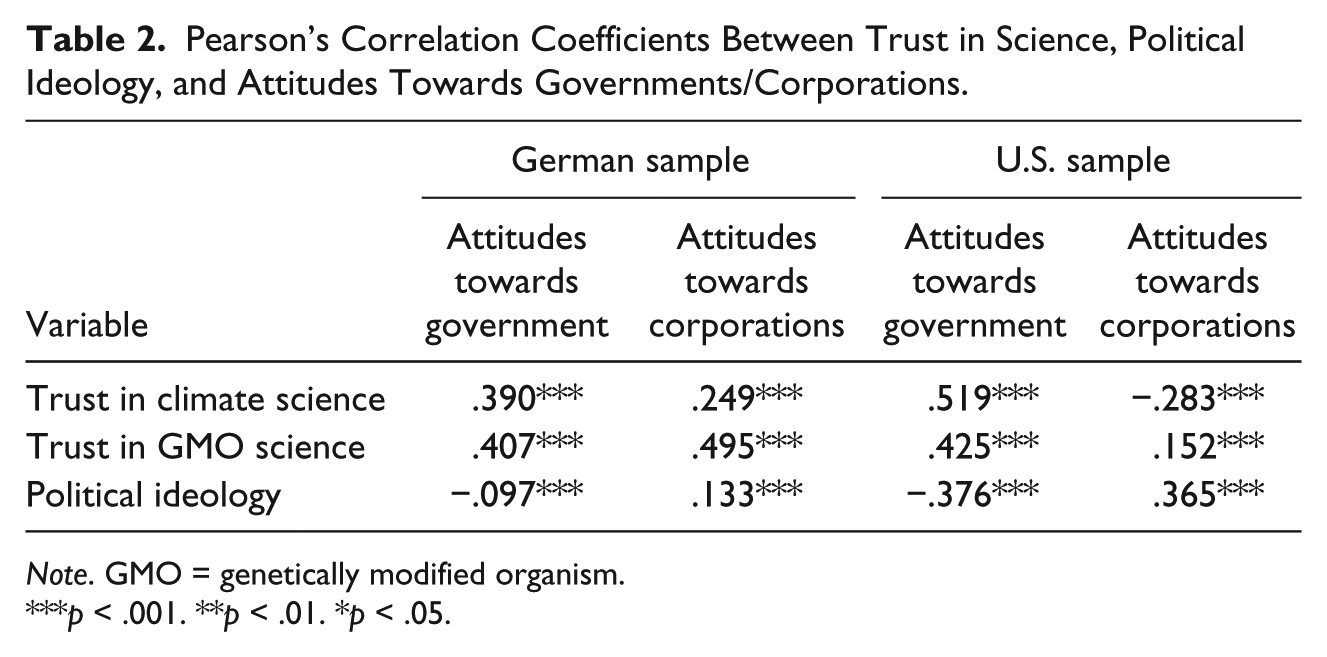
Our theoretical framework suggests that trust in climate science is likely to be associated with positive attitudes towards government, while trust in GMO science is likely to be associated with positive attitudes towards corporations. To investigate this assertion, we examined the correlations between these variables across countries. We also examined the correlations between political ideology and attitudes towards government and corporations to understand how these components of political culture reflect broader measures of political ideology. Pearson’s correlation coefficients and significance levels for these relationships are presented in Table 2.
Pearson’s Correlation Coefficients Between Trust in Science, Political Ideology, and Attitudes Towards Governments/Corporations.
Note. GMO = genetically modified organism.
p < .001. **p < .01. *p < .05.
As expected, attitudes towards government were positively correlated with trust in climate science (r = .390, p < .001, in the German sample and r = .519, p < .001, in the U.S. sample), and attitudes towards corporations were positively correlated with trust in GMO science (r = .495, p < .001, in the German sample and r = .152, p < .001, in the U.S. sample). In both samples, trust in climate science was more strongly correlated with attitudes towards government than attitudes towards corporations. And while trust in GMO science was more strongly correlated with attitudes towards corporations than government in German sample, the opposite was observed in the U.S. sample.
Although distinct from our initial expectations, we also observed a positive relationship between attitudes towards government and trust in GMO science in both samples (r = .407, p < .001, in the German sample and r = .425, p < .001, in the U.S. sample). Similarly, in the German sample, positive attitudes towards corporations were correlated with trust in climate science (r = .249, p < .001). In the U.S. sample, favorable attitudes towards corporations were negatively correlated with trust in climate science (r = −.283, p < .001).
Supporting the assertion that attitudes towards government and corporations are dimensions of political culture, these constructs were significantly correlated with political ideology in both samples, although to varying degrees. The correlation coefficients were quite small in the German sample (r = −.097, p < .001, for attitudes towards government and r = .133, p < .001, for attitudes towards corporations) but moderate in the U.S. sample (r = −.376, p < .001, for attitudes towards government and r = .365, p < .001, for attitudes towards corporations). Also, as expected, a higher political ideology score (more conservative than liberal) was associated with less positive attitudes towards government and more positive attitudes towards corporations in both samples.
Regression Results
To understand the combined impacts of political ideology, attitudes towards government, and attitudes towards corporations on trust in climate change and GMO science, while also controlling for various demographic and personality variables that are known to affect trust in these types of science, we estimated two OLS models. Model 1 included only political ideology, while Model 2 also included attitudes towards government and corporations. The OLS regression results for each sample are presented in Table 3.
Regression Models to Predict Trust in Climate Science and Trust in GMO Science.

Note. GMO = genetically modified organism. All postestimate VIF (variance inflation factor) values are less than 2.0, signifying a low risk of multicollinearity.
All models include controls for age, gender, family income, education, openness to risk, personality (Big Five), general trust, and prior awareness of the issue.
p < .001. **p < .01. *p < .05.
Model 1 presents the regression results when only political ideology is included along with the controls. Political ideology was significantly associated with trust in climate science in both samples but was only significantly associated with trust in GMO science in the U.S. sample. Increased political ideology decreased trust in climate science by 0.119 (p < .001) in the German sample and 0.625 (p < .001) in the U.S. sample. This translates to a decrease in trust in climate science of 2% (Germany sample) and 10% (U.S. sample) as the respondents moved 1 point more conservative (or less liberal) on a 5-point scale. For trust in GMO science, political ideology was only significantly associated with this outcome in the U.S. sample. In this sample, as respondents got 1 point more conservative, their trust in GMO science decreased by 0.256 points, or 4% (p < .001). Political ideology was not significantly associated with trust in GMO science in Germany. The adjusted R2 for Model 1 was also very low in three of the four subgroups, signifying that political ideology alone does not provide a good model for predicting trust in climate change and GMO science in either country. The exception is trust in climate science in the U.S. sample, which had an adjusted R2 of .403.
Model 2 added in attitudes towards government and corporations to understand their impact on trust in climate science and GMO science, controlling for political ideology and the demographic and personality control variables discussed previously. Favorable attitudes towards government increased trust in climate science across both samples. A 1-point increase in attitudes towards government was associated with a 0.251-point (4%) increase in trust in climate science in the German sample, and a 0.460-point (8%) increase in the U.S. sample (p < .001). Meanwhile, favorable attitudes towards corporations decreased trust in climate science in the U.S. sample but increased trust in climate science in the German sample. A 1-point increase in attitudes towards corporations was associated with a 0.151-point (3%) increase in trust in climate science in the German sample, and a 0.228-point (4%) decrease in trust in climate science in the U.S. sample, controlling for political ideology, attitudes towards corporations and demographics (p < .001).
Model 2 for trust in GMO science showed a significant, positive association between attitudes towards both government and corporations and trust in GMO science. In the German sample, attitudes towards corporations were more strongly associated with trust in GMO science than were attitudes towards government, with a 1-point increase in attitudes towards corporations associated with a 0.331-point (or 6%) increase in trust in GMO science (p < .001). A 1-point increase in attitudes towards government was associated with a 0.202-point (or 3%) increase in trust in GMO science in Germany (p < .001). In the U.S. sample, this relationship was reversed, with attitudes towards government more strongly associated with trust in GMO science than attitudes towards corporations. A 1-point increase in attitudes towards government was associated with a 0.309-point (5%) increase in trust in GMO science, while more favorable attitudes towards corporations were associated with only a 0.136-point (or 3%) increase in trust in GMO science.
An important part of this analysis is the comparison between Models 1 and 2. As partial mediators between political ideology and trust in science, we expected that adding in attitudes towards government and corporations in Model 2 would decrease the association between political ideology and trust in climate change and GMO science, while increasing the goodness of fit of the models. The regression results support these hypotheses, although to varying degrees based on the subgroup. We found that political ideology remained significantly associated with trust in climate science in Model 2 in both samples, although the magnitude of the coefficient decreased substantially in the U.S. sample (the coefficient for political ideology decreased by .245, or 4%, between Models 1 and 2) and less substantially in the German sample (decreasing by .004, or less than 1%, between Models 1 and 2). We also found evidence that including attitudes towards government and corporations in Model 2 increased the goodness of fit of the models predicting trust in climate science, increasing the adjusted R2 by .132 (144%) in the German sample and .105 (26%) in the U.S. sample.
Comparing Models 1 and 2 for trust in GMO science, we observed important differences between the two samples. Political ideology was not significantly associated with trust in GMO science in the German sample in Model 1, and this lack of significance continues for Model 2. Model 2 shows that both attitudes towards government and corporations were highly significantly associated with trust in GMO science in the German sample, however. In the U.S. sample, we found that including attitudes towards government and corporations in the model decreased the association between political ideology and trust in GMO science by .075, or 28%, although this relationship remained significant. Considering the adjusted R2 for each model, we found that Model 2 is a much better fit than Model 1 in the German sample and a moderately better fit in the U.S. sample. Model 2 increased the adjusted R2 by .246 (293%) in the German sample and by .112 (69%) in the U.S. sample.
Discussion
Increasing public trust in science is important if societies wish to achieve evidence-based public policies. A clearer understanding of what factors determine trust or distrust in science is therefore vital to increasing public support for scientific work. While previous research has predominantly emphasized the role of political ideology as a predictor of overall trust in science, we advance the literature in three ways: first, by demonstrating that within an individual, levels of trust in science vary across issues; second, by identifying two dimensions of political ideology—attitudes towards government and towards corporations—that better predict whether an individual will trust the science of a particular issue than do traditional measures of political ideology; and third, by evaluating how the impact of these constructs on trust in science varies across political cultures.
Building on prior findings that liberal and conservatives trust in science differently based on the issue at hand (e.g., McCright et al., 2013; E. C. Nisbet et al., 2015), we demonstrate that this variation in trust in science can also be seen within citizens themselves, based on the issue in question. This is an important finding suggesting that scholars should not consider public trust in science as a single, homogenous construct. Individuals may trust science on some issues but not others, depending on how the source and implications of that science correspond to the individual’s prior attitudes and values. This finding opens up the question of what, then, drives someone to believe in science on a particular issue? Our study presents support for the argument that attitudes towards government and corporations, as entities closely associated with the funding and execution of science, offer one way to answer this question.
In our correlational analysis, we find evidence that positive attitudes towards government are associated with greater trust in climate science, and positive attitudes towards corporations are associated with greater trust in GMO science. These findings are consistent with our theoretical predictions. We also find, however, some additional and unexpected relationships between attitudes towards government, corporations, and trust in science. First, we find that attitudes towards government are positively associated with trust in GMO science in both samples, and attitudes towards corporations are positively associated with trust in climate science in the German sample. One potential explanation for these relationships is that citizens may perceive a closer relationship between governments and GMO science on the one hand, and corporations and climate science on the other hand, than we predicted. These findings point to a need for more research into how the relationships between these variables are perceived by the public. Another unexpected finding was the negative association observed between attitudes towards corporations and trust in climate science in the United States. This association likely reflects a perception that the implications of climate science (increased regulation of greenhouse gases) would negatively affect corporations, which also aligns with our theoretical framework.
The regression analysis supports our hypothesis that attitudes towards government and corporations serve as mechanisms through which the observed relationship between political ideology and trust in science runs. We observe a notable decrease in the coefficient for political ideology in predicting trust in science when attitudes towards governments and corporations are included in the models. We also note that the adjusted R2 rises in the second models, indicating that including attitudes towards governments and corporations increases explanatory power of the respective model. Overall, the results provide compelling evidence that attitudes towards governments and corporations, as components of political ideology, may offer more precision in predicting levels of trust in science across issues.
It is also important to note that by including a measure of general trust as a control variable in our regression models, we can be confident that the results are not simply a reflection of misanthropy or general distrust. That is, by controlling for general trust in the models and observing that it was not significantly associated with trust in climate or GMO science in the full regression models in either country sample, we can be confident that trust in science is not driven by a general personality trait of being trusting. Instead, the key factors of political ideology, attitudes towards government, and attitudes towards corporations are much more closely associated with trust in science.
By testing our argument in the United States and Germany, we also obtain some insights into the external validity (generalizability) of the argument. While in general the observed relationships between the key variables of interest were fairly consistent across the two countries, some differences stand out. One significant difference is that political ideology alone is more closely associated with trust in both types of science in the United States than in Germany—a sign that trust science may be more polarized in the United States than in Germany and that alternative drivers (e.g., those tested here) may be of greater relevance in non-U.S. contexts. Additionally, the correlation between attitudes towards corporations and trust in GMO science is much higher in the German sample than the U.S. sample. This may be due to an overall greater awareness among Germans of GMOs than among Americans, as well as the lack of association between political ideology and trust in GMO science in Germany. These differences across the two countries highlight the need for more survey research along the lines reported here across a wider range of countries to truly understand the drivers of public trust in science.
From a practical perspective, our findings suggest that efforts to increase trust in science and gain public support for scientifically informed policies should take attitudes towards government and corporations into consideration, both when designing and when communicating about science policy. For example, citizens with more positive attitudes towards corporations and less favorable attitudes towards the government may react more positively to policy proposals that focus on nongovernmental solutions, such as market-based climate change solutions or investments by private industries in renewable energy technologies. They may also be more receptive when the message comes from a corporate rather than a governmental actor. Conversely, those with more positive attitudes towards government and less positive attitudes towards corporations may respond better to regulatory solutions and to messages from publicly funded scientists. Future research should investigate the role of these source effects on reactions to scientific messages, as well as how the findings presented here may translate into preferences for particular government- or corporation-focused policy solutions to policy issues where scientific evidence plays a major role in conflicts among stakeholders over policy objectives and policy instruments.
It is also important to note that while we maintain the assumption that evidence-based policies are important, science is just one part of the policy-making process. Both of the cultures in this study are democracies, not technocracies, and there are a number of other important considerations, such as ethical, equity, sustainability or environmental concerns, that should and do play into the policy-making process. While science should be one of many considerations when creating policies, it is also important to ensure that policies are made in opposition to science or based on incorrect science. Science is not everything in the policy process, but it is important, and public trust in the scientific consensus is a vital part of science’s role in policy making.
Footnotes
Declaration of Conflicting Interests
The author(s) declared no potential conflicts of interest with respect to the research, authorship, and/or publication of this article.
Funding
The author(s) disclosed receipt of the following financial support for the research, authorship, and/or publication of this article: Funding for this research was provided by the European Research Council (ERC grant 295456) and the Sanford School of Public Policy. Any opinions, findings, and conclusions are those of the authors and do not necessarily reflect the views of the funding sources.
