



Abstract
Sarcastic content is prevalent in online social media, although little research has explored its effects. In this study, we examine how exposure to one-sided versus two-sided sarcastic perspectives on climate change shapes beliefs about climate change. We find that exposure to one-sided messages that use irony to deride those who believe that climate change is a hoax (presented in The Onion) raises belief certainty in and perceived risk of climate change for those who do not already believe climate change is an important issue (N = 141). The two-sided message (presented by The Weather Channel) does not show any effects.
Those who want to communicate about controversial scientific topics such as climate change, vaccines, and gene editing have particular hurdles to overcome. Research shows individuals turn to their political orientations and social values to understand and act on these issues (e.g., Scheufele, 2013). When political orientations guide interpretation of scientific issues, the science behind the issue may be overlooked if it does not align with the political orientation of the topic. As such, exposure to science-based information on topics such as climate change can have a boomerang effect by turning off those with conservative political orientations to the topic—given that conservative politicians have eschewed science-based information in the past—while reinforcing liberals’ engagement with the issue (Hart & Nisbet, 2011). These dynamics are amplified in our polarized political sphere, when politicians interfere with scientific consensus, ordering the removal of terms such as “evidence-based” from official language allowed by government agencies, including the Centers for Disease Control and Prevention (Cohen, 2017).
At the same time, researchers have started to examine how nontraditional forms of communication, such as comedy and satire, engage individuals on polarizing topics such as climate change (Brewer & McKnight, 2017; Feldman, Leiserowitz, & Maibach, 2011; Skurka, Niederdeppe, Romero-Canyas, & Acup, 2018). These studies primarily examine the effects of television broadcasts of late-night comedy shows, but social media are also a popular and important outlet for humorous and sarcastic messages about climate change and other controversial topics. Highly visual digital content shared via videos and memes are particularly relevant for younger audiences, the majority of whom actively use image-based social media platforms such as Instagram, Snapchat, and YouTube (Pew Research Center, 2018).
The political perspectives of these messages in social media contexts is important, as individuals tend to engage primarily with like-minded perspectives when they seek out and share information in online contexts (e.g., Sunstein, 2017). In addition, most previous research has examined the effects of exposure to satirical content from late-night comedy shows such as The Daily Show or Last Week Tonight With John Oliver, all of which present political and scientific issues from a one-sided perspective. As such, this study examines how sarcastic tones from viral videos that present a one-sided view of the topic versus a two-sided perspective shape public perceptions on the topic of climate change.
Echo Chambers Within Social Media
Scholars have paid a lot of attention to the issue of echo chambers in social media (e.g., Adamic & Glance, 2005; Messing & Westwood, 2014; Sunstein, 2017). The primary concerns presented in this literature encompass (a) the tendency of individuals to seek out and interpret messages in accordance with their existing viewpoints and opinions—which is exacerbated in the online context where individuals have more control over their information consumption than a traditional mass mediated environment—and (b) social media algorithms that take advantage of these tendencies in order to drive more traffic to their platforms. In the science communication context, the concern is that social media environments exacerbate existing divides on polarized topics such as climate change (Brossard, 2013).
For the topic of climate change—the focus of this study—there is an important history of how “sides” of the topic have emerged. First, the issue entered the media and public agenda only after receiving prominent attention in political spheres (Boykoff, 2011). Thus, politicians have been major players in shaping how climate change is framed (Weingart, Engels, & Pansegrau, 2000). Second, journalists have a tendency to cover varying perspectives on an issue equally in their everyday routines (Hiles & Hinnant, 2014). As a result, news coverage of the topic has covered both the view that climate change exists and is the result of human-caused activities and the view that it does not exist or is primarily the cause of natural activities, or some combination of the two, thus leading to a false balance in the coverage of the science behind climate change (Boykoff & Boykoff, 2004, 2007). These events that inform how the public agenda portrays the topic of climate change have led to a predominant focus in public opinion research on key beliefs such as certainty of whether climate change exists, the risks of climate change, and the perceived scientific agreement on the issue (Ding, Maibach, Zhao, Roser-Renouf, & Leiserowitz, 2011; van der Linden, Leiserowitz, Feinberg, & Maibach, 2015).
Both threads of scholarship—echo chambers on social media and public opinion toward climate change—inform how scholars have examined climate change in social media discourse. Research shows that individuals do tend to engage primarily with like-minded others in social media settings on the topic of climate change, and when cross-cutting viewpoints are engaged they tend to carry negative sentiments (Williams, McMurray, Kurz, & Hugo Lambert, 2015). Sarcasm is one such negative sentiment prevalent in social media discussions, although communication scholars have not studied it extensively on its own. Next, we explore how sarcasm has been defined and examined in past research, turning in part to a related construct—satire.
Effects of Sarcasm and Climate Change
Sarcasm is considered a negative type of social media discussion (Anderson & Huntington, 2017), although it is often coupled with impoliteness rather than harsher negative orientations such as incivility (Papacharissi, 2004; Rowe, 2015). The attack that sarcasm undertakes is much more subtle than that present in uncivil discussions (Papacharissi, 2004) and is often invoked through the use of irony and humor (Whalen, Pexman, & Gill, 2009). The humor literature defines sarcasm as a type of irony. Specifically, it is a type of “verbal irony” that involves making statements opposite of their meaning that express a negative attitude toward another person or group (Kreuz & Roberts, 1993, p. 99). Notably, some consider sarcasm to be separate from irony, given that sarcasm is more “overt and aggressive,” while irony is more nuanced, requiring greater cognitive effort to fully understand and process this complicated content (e.g., Polk, Young, & Holbert, 2009, p. 204). A related body of work has examined effects of humor and satire specifically related to the issue of climate change.
Evidence indicates that satirical news programming on the topic of climate change from sources such as Last Week Tonight With John Oliver, The Daily Show, and The Colbert Report bolsters existing beliefs in global warming (Brewer & McKnight, 2015, 2017). This is particularly true for people who have low interest in climate change (Brewer & McKnight, 2017). One of the studies did find, however, that conservatives in particular who viewed The Colbert Report held less certainty that global warming is happening, suggesting they took the ironic messages at face value (Brewer & McKnight, 2015). Another study found that using humor about climate change in the context of a weather report effectively increased intention to participate in activism among young people in the United States (Skurka et al., 2018). These initial studies suggest that sarcastic tones could encourage viewer engagement with the issue of climate change.
Effects of sarcasm in social media contexts, on the other hand, have not been studied extensively. One study that examined sarcasm as a response to incivility in a newspaper commenting section found that those sarcastic comments extend the negative effects of incivility (Ziegele & Jost, 2016). This paints a more deleterious picture of how sarcasm may affect individuals’ perceptions on a politically polarizing topic such as climate change.
Most of the literature has explored satirical messages that poke fun at those who are skeptical of climate change’s existence (e.g., from more liberal outlets such as The Daily Show or the Last Week Tonight With John Oliver). Given the evidence that sarcastic and satirical messages bolster beliefs that climate change exists (Feldman, 2017), we analyze the effects of exposure to a piece of The Onion that sarcastically presents climate change as a hoax:
Existing research shows that satire bolsters climate change beliefs for individuals with low engagement toward the issue (Brewer & McKnight, 2017), by making complicated science topics easier for audiences to understand since the science information piggybacks upon engaging entertainment content (Feldman, 2017). Being introduced to the climate change debate via satire acts as a gateway for viewers who subsequently pay more attention and learn about the issue from traditional news media content (Baum, 2003; Feldman et al., 2011). Given prior research on the potential of satire to act as a catalyst for less-engaged individuals, we pose the following moderating relationship:
Past research has started to explore how conflicting information—presented as two-sided content versus one-sided or heavily framed communication—shapes issue perceptions (e.g., Borah, 2011; Nisbet, Hart, Myers, & Ellithorpe, 2013). This body of research suggests that exposure to multiple points of view is akin to what individuals experience in their daily information environments that reflect competition among elites (Chong & Druckman, 2007). Some research suggests that exposure to multiple frames can sometimes cancel out framing effects, resulting in little to no attitude change following exposure to competing messages (Borah, 2011). Research on the topic of climate change in particular, however, provides evidence that individuals’ attitudes can be shaped by competing frames on an issue as long as they hold an open mind (Nisbet et al., 2013). This points to the importance of taking existing cognitions on a topic into account when examining the effects of exposure to more than one viewpoint.
Scholarship has yet to explore, however, whether sarcasm and humor effectively engages individuals outside of this one-sided perspective presented in much of the late-night comedy literature. Therefore, we explore the following research question regarding a video of The Weather Channel (TWC) about climate change that presents messages that are sarcastic about both those who believe in climate change and those who do not believe in climate change (i.e., a two-sided sarcastic video).
Method
A three-group experiment (2 conditions; 1 control) was created using Qualtrics. Undergraduates (N = 142) were recruited from a large public university in the West and a private liberal arts college in the East. Students completed the online study between October 23 and November 9, 2017, in exchange for a small amount of extra credit. The study was approved as exempt by both university institutional review boards.
After a pretest questionnaire measuring political interest and issue importance, participants were randomly assigned to watch one of two experimental video clips or a control video. Participants in the first experimental condition (n = 47) watched an April 2017 two-minute sarcastic video titled, “WARNING: We’re Saving Small Talk,” produced by TWC about rising temperatures and the impact on casual small talk about the weather at work and in the community given climate change. The short clip was two-sided in orientation in that it showcased sarcastic behavior and conversation surrounding both the positive and negative aspects of rising temperatures and climate change. Participants in the second experimental condition (n = 48) watched a September 2017 two-minute video produced by The Onion titled, “Climate Change Researcher Describes Challenge of Pulling Off Worldwide Global Warming Conspiracy.” In the video, Blair Fine, a fake climate scientist, presents a one-sided sarcastic argument about the effort to create a conspiracy to persuade the public and scientists that global warming is a hoax. The video claims that scientists, the public, celebrities, and the media have accepted the conspiracy that climate change is manufactured. Participants in the control (n = 47) viewed a September 2017 two-minute video news report from ABC News’ Good Morning America about a worker falling from a broken Ferris wheel as he tries to help two boys at a North Carolina fair.
All of the videos were captured via YouTube and edited to remove comments, ads, or related video suggestions. A validation mechanism was set so that participants had to remain on the video screen for at least 240 seconds before advancing the survey. The videos were disabled so that the participants could not scroll forward through sections of the video clips. Manipulation checks followed immediately after the video clips, confirming that the videos were received and interpreted correctly and that adequate recall of content was present. A posttest questionnaire measured key concepts such as global warming belief certainty and risk perceptions, political efficacy, and demographics.
Key measures used in the analyses that follow are outlined below.
Dependent Variables
Global Warming Risk Perceptions was measured as an index of six risk perception items for which participants were asked to respond on a 4-point scale (1 = not at all, 2 = only a little, 3 = a moderate amount, 4 = a great deal): “How much do you think global warming will harm . . .?” (a) you personally, (b) your family, (c) people in your community, (d) people in the United States, (e) people in developing countries, and (f) future generations of people. These items were combined into a mean index (M = 3.00; SD = 0.64; Cronbach’s α = .89).
Global warming belief certainty was measured by responses to two items. The first item asked, “Do you think global warming is happening?” The second item asked, “How sure are you global warming [is/is not] happening?” Responses to these items were then combined to become an item with a 9-point scale, where 9 = extremely sure global warming is happening and 1 = extremely sure global warming is not happening (M = 7.63; SD = 1.62).
Independent Variables
Demographics
Controls for gender (the sample was 61.3% female [coded as 1] and 38.7% male), age (M = 19.51; SD = 2.15), identifying as a Democrat (41.5% of the sample [coded as 1]; 23.2% of the sample identified as Republican; 26.1% as Independent), and conservative political ideology (M = 3.54; SD = 1.57) were included in the analysis.
Predispositions
A measure of general political interest (M = 3.55; SD = 1.07) was included in the analysis, based on a response to the question, “Some people follow what’s going on in government and public affairs most of the time, even when there’s not an election. Others aren’t that interested. Would you say that you follow what’s going on in politics and government?” (1 = never, 2 = hardly at all, 3 = only now and then, 4 = some of the time, and 5 = most of the time). Participants were also asked to indicate how important a series of issues, including climate change, were to them personally (M = 7.59; SD = 2.17; 1 = not at all important to 10 = very important).
Media Evaluations
Participants were asked to evaluate the media organization sponsoring the video across four attributes commonly associated with media credibility and trust (1 = untrustworthy to 7 = trustworthy, 1 = unreliable to 7 = reliable, 1 = dishonest to 7 = honest, and 1 = not credible to 7 = credible). A media evaluation index (M = 4.66; SD = 1.54; overall Cronbach’s α = .96) was based on the combined mean score for these four attributes per organization. The mean media evaluation scores for The Onion (M = 4.23; SD = 1.67) and TWC (M = 4.12; SD = 1.46) were comparable.
Assignment to Experimental Condition
Dummy variables for viewing either the one-sided sarcasm of The Onion (n = 48) or the two-sided sarcasm from TWC (n = 48) were included in the analysis. Assignment to the control (n = 47) was treated as the default and left out of the specified models.
Analytical Plan
Hierarchical ordinary least squares regression was utilized for the analysis. Hierarchical regression enters blocks of variables based on their presumed causal order, allowing researchers to assess the relative contribution of each variable block in explaining variation in the dependent variable over and above previously entered variable blocks. For this particular study, hierarchical regression was ideal given the ability to isolate the differential effect of exposure to one-sided versus two-sided sarcasm after controlling for other antecedent variables such as political interest, perceived importance of climate change, demographics, and media evaluations.
Demographic variables were entered as the first block, followed by predispositions in the second block. Evaluation of the media organizations was included as Block 3, with dummy variables for the two experimental stimuli (The Onion and TWC) making up Block 4. A fifth and final block was added to test for any potential interaction effects between perceived importance of climate change and assignment to the experimental conditions given the expectation that response to the comedy stimuli might depend on how much importance an individual places on climate change as a political issue (Hypothesis 2 and Research Question 2). The interaction terms were created by multiplying the standardized values of the key main effect variables (climate change importance and assignment to condition) in an effort to minimize any concerns about multicollinearity (Cohen, Cohen, West, & Aiken, 2003).
Results
The results for the analysis of global warming risk perceptions are displayed in Table 1. As the data in Table 1 show, demographics explain a large portion of the variance in perceptions of global warming risk with conservatives being significantly less likely to perceive the risks of global warming (β = −.38, p < .001; Block 1 incremental R2 = 19.2%). While both political interest and perceived importance of climate change were both initially significant, these predisposition variables were not significant in the final model (Block 2 incremental R2 = 8.9%). While the data failed to yield a significant direct effect for exposure to either the one-sided sarcasm of The Onion or the two-sided sarcasm of TWC on global warming risk perceptions, there is a significant interaction effect between importance of the climate change issue and exposure to the one-sided sarcasm of The Onion (β = −.26, p < .001; Block 5 incremental R2 = 6.0%).
Hierarchical Ordinary Least Squares Regression Predicting Global Warming Risk.
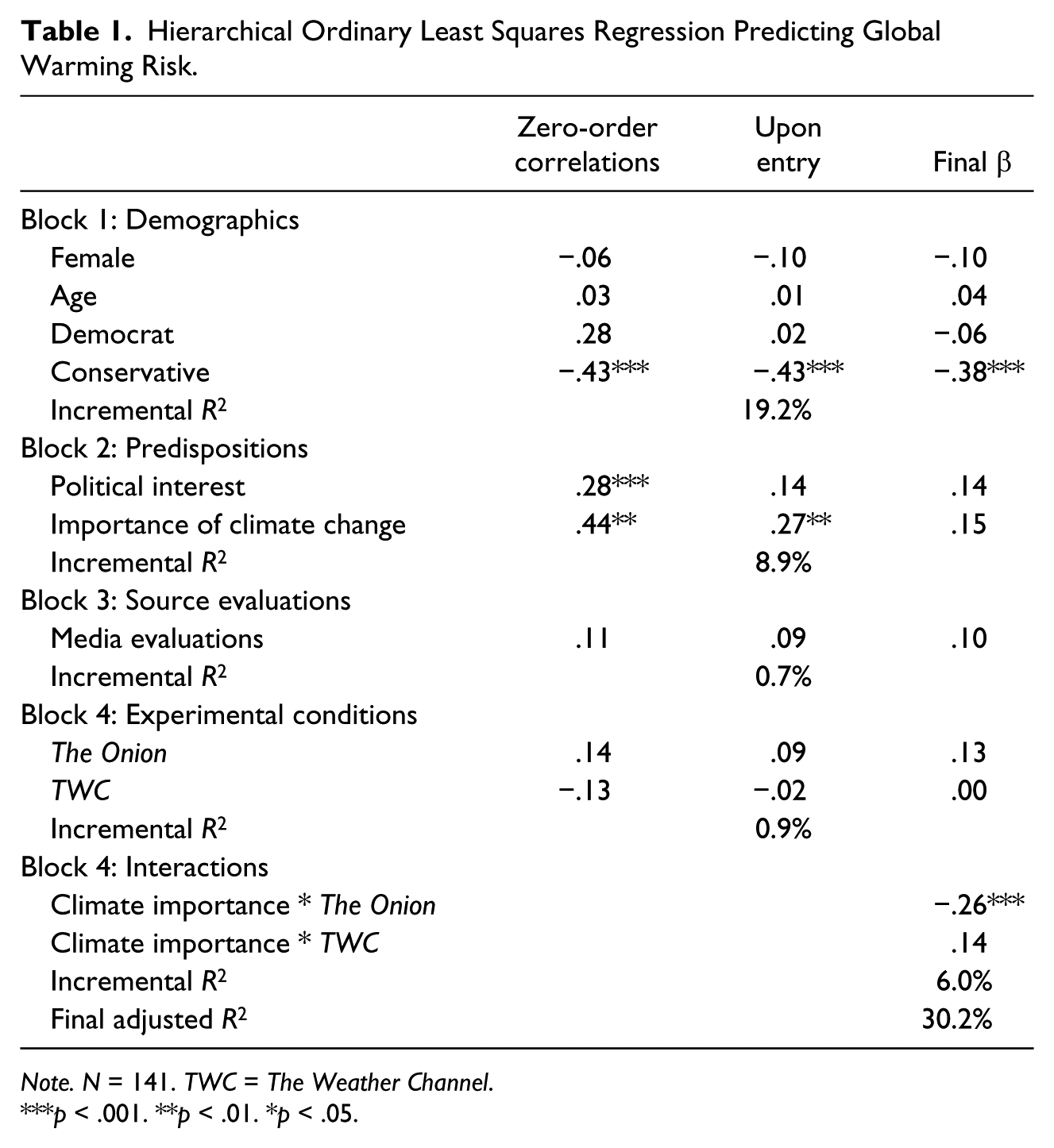
Note. N = 141. TWC = The Weather Channel.
p < .001. **p < .01. *p < .05.
Displayed graphically in Figure 1, the results suggest that exposure to the one-sided sarcasm of The Onion encourages those who are less interested in the issue of climate change to perceive greater global warming risk (M = 3.11), making them on par with those who perceive the issue of climate change as highly important and are exposed to The Onion (M = 3.17). In contrast, there is a gap in global warming risk perceptions for those who do not see the issue as important and were not exposed to the one-sided sarcasm of The Onion and those who do perceive the issue to be of high importance yet were also not randomly assigned to view The Onion clip (M = 2.54 vs. M = 3.29). In effect, viewing the one-sided sarcasm of The Onion helps increase global warming risk perceptions among those who are less interested in the issue of climate change, mirroring the classic gateway effect (Baum, 2003). The final regression model, including the interaction terms, explains 30.2% of the variance in perceived global warming risk.
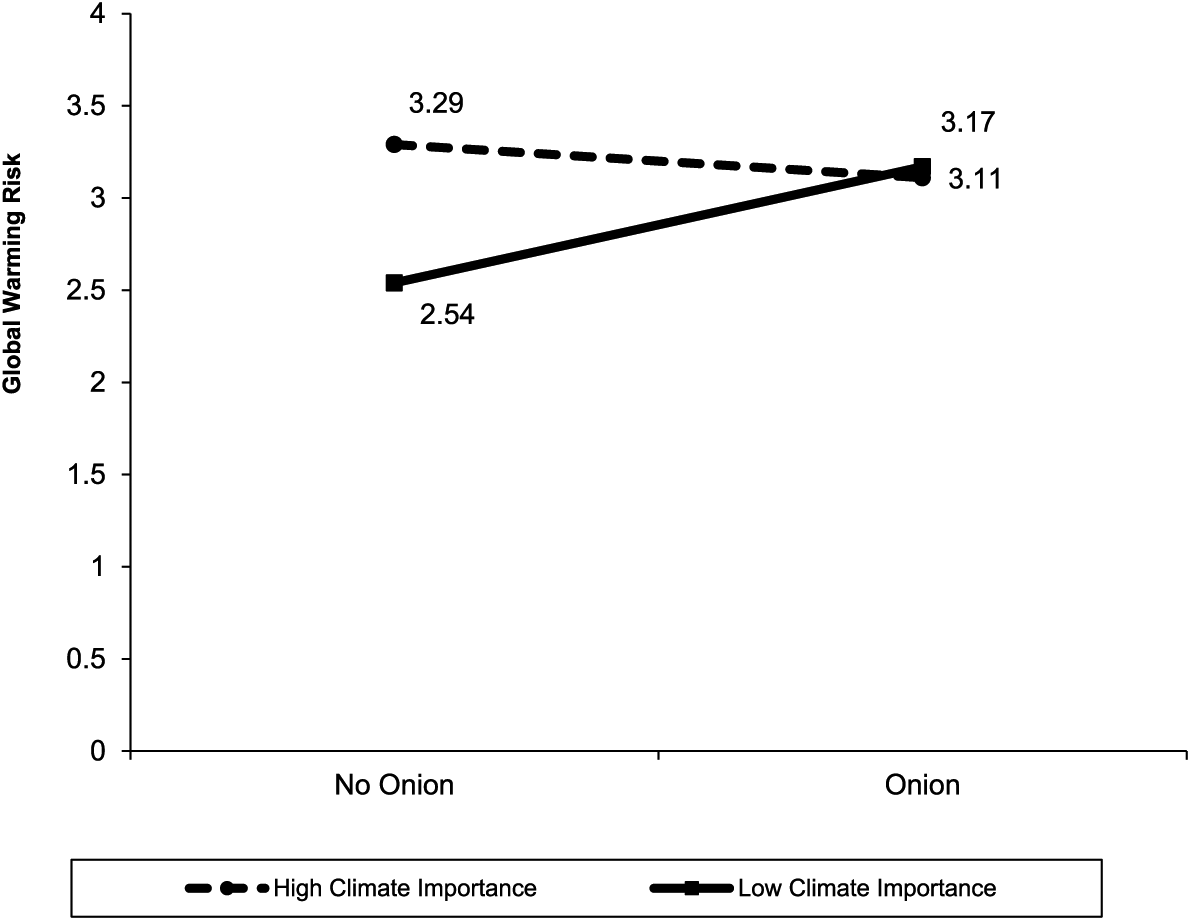
Global warming risk, importance of climate change, and The Onion.
The results for the analysis of global warming belief certainty follow in Table 2. As the data in Table 2 show, demographics again explain a large proportion of the variance in the dependent variable. In the final model, women are significantly less likely to feel greater belief certainty in global warming (β = −.15, p < .05; Block 1 incremental R2 = 15.8%). While importance of the climate change issue is a significant predictor of belief certainty (β = .30, p < .01; Block 2 incremental R2 = 12.1%), we yet again fail to see a significant direct effect for exposure to either the one-sided sarcasm of The Onion or the two-sided sarcasm of TWC. However, similar to our earlier analysis, we see a significant interaction effect between importance of the climate change issue and exposure to The Onion (β = −.17, p < .05; Block 5 incremental R2 = 2.7%).
Hierarchical Ordinary Least Squares Regression Predicting Belief Certainty.
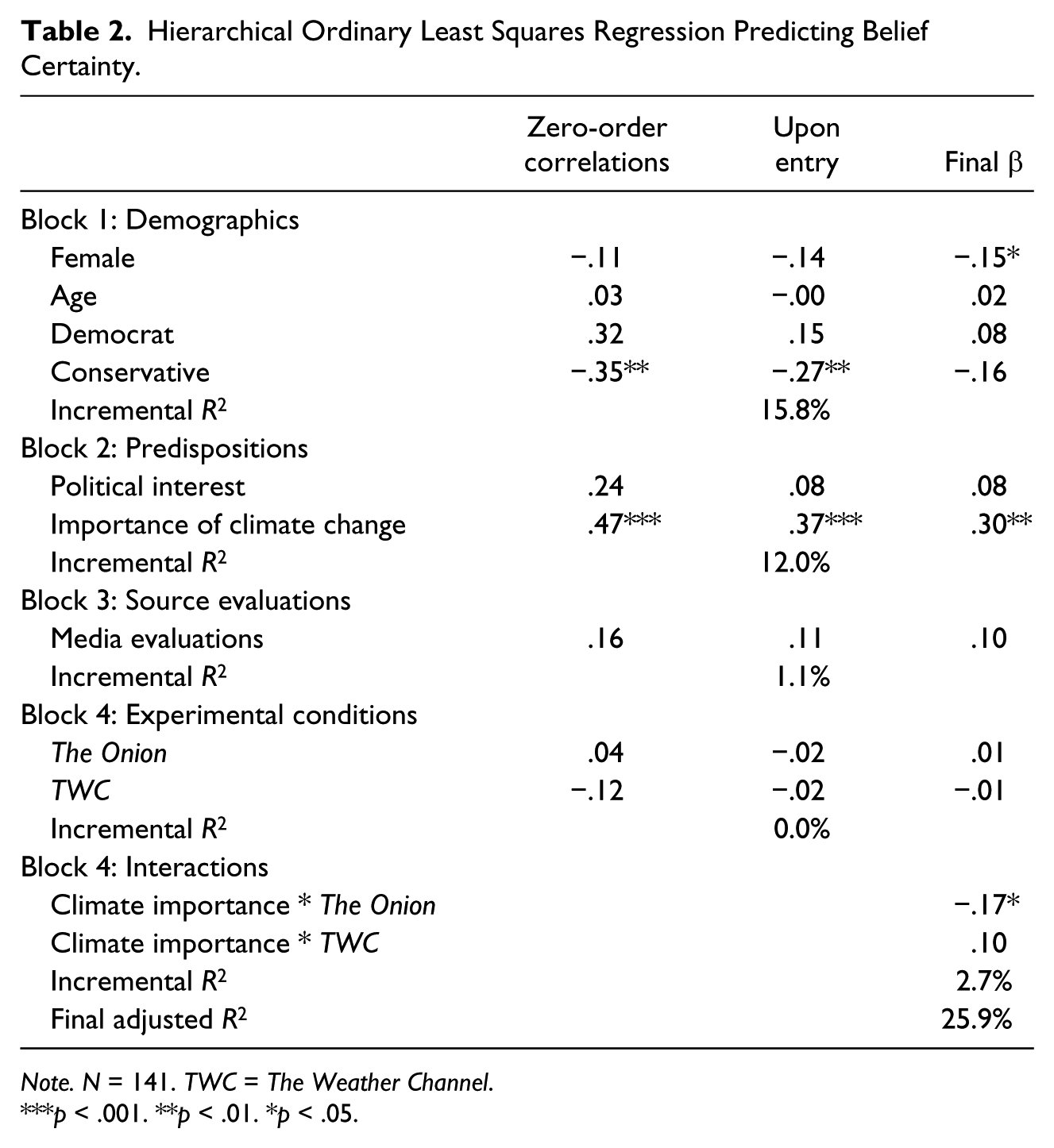
Note. N = 141. TWC = The Weather Channel.
p < .001. **p < .01. *p < .05.
Displayed graphically in Figure 2, the results again suggest that exposure to The Onion helps raise concerns about global warming (in this case certainty that global warming is real) among those who perceive the issue as less important. In effect, viewing the one-sided sarcasm of The Onion lowers the gap in belief certainty among those who see climate change as more versus less important (M = 8.35 vs. M = 7.60), while the gap in belief certainty is larger among those who did not view The Onion (M = 6.67 for low-importance individuals; M = 7.81 for high-importance individuals). The final regression model explains 25.9% of the variance in global warming belief certainty. While Hypothesis 1 was not supported by the data, we did find support for Hypothesis 2.
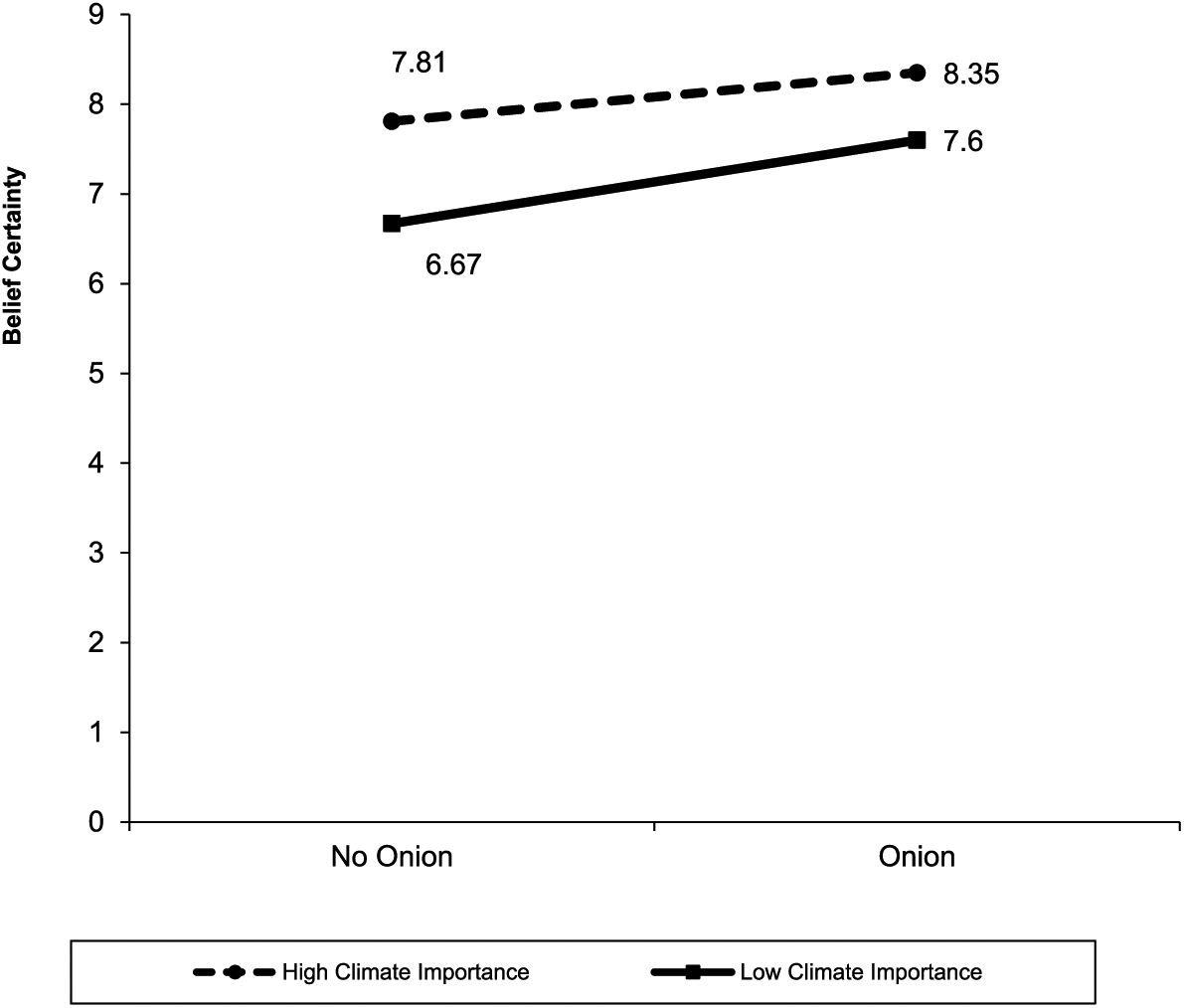
Global warming belief certainty, importance of climate change, and The Onion.
Discussion
Can sarcastic humor serve as a catalyst for engagement on the issue of climate change? The results suggest that one-sided sarcasm from sources such as The Onion can in fact encourage greater issue engagement, particularly among those who find climate change to be a less important political issue at the outset. In many respects, our findings offer added support for the application of the gateway hypothesis to satirical climate change communication (Baum, 2003; Feldman, 2017). Two-sided sarcasm from sources such as TWC that present both the perspective that climate change is real and the perspective that climate change is fake, is not an effective type of message for further issue engagement, as exposure to this type of content had no effect on risk perceptions or belief certainty. In sum, it seems that one-sided sarcasm can activate less interested individuals to engage with the climate change issue, even after controlling for demographics and other antecedent variables. This pattern of findings aligns with prior work on the effect of exposure to humorous messages and engagement with climate change (Brewer & McKnight, 2017), yet extends this current line of research by considering the effect of social media content. It also explores the effects of two-sided sarcastic content.
Chong and Druckman (2007) argue that issues can have stronger or weaker frames, with the former being more persuasive. It is possible that our study did not find effects from the two-sided TWC video, because it presents weak frames on the benefits versus disadvantages of changes in the weather. Future research should study the effects of sarcasm and humor on the topic of climate change using a stronger frame such as public health effects from extreme weather events that are increasing in frequency due to climate change (e.g., hospitalizations from exposure to wildfire smoke). Past research also suggests that individuals are more motivated to engage in information-seeking behaviors and interpersonal discussion after exposure to multiple sides of an issue, likely due to an increased motivation or need to process the competing information (Borah, 2011). Future research should go beyond examining attitudinal outcomes as we do here to explore how exposure to two-sided sarcastic messages about science shapes message processing and elaboration.
It is certainly possible that our study would produce different outcomes on a less polarized topic, one that is not as prominent as climate change. Sarcastic messages on climate change presented from a two-sided perspective may not be as effective due to the existing predispositions, such as political ideology, upon which people rely to form opinions on climate change. Two-sided messages on a topic for which individuals do not have as much previous exposure might encourage individuals to shift their attitudes toward one side based on one of the perspectives that resonates with their existing attitudes.
Before concluding, it is important to point out some limitations of the current study. First, we relied on an undergraduate-only sample. While we sampled students at two very different types of universities, we of course recognize that the generalizability of our results to the larger population is limited. Second, we exposed participants to just one short video clip rather than a larger body of stimuli content. At the same time, featuring multiple examples of one-sided versus two-sided sarcasm would have introduced a fair amount of noise into the experimental design. Worth noting, this study privileges real video content from trusted and known media sources (e.g., The Onion and TWC) rather than content that was created for the sole purposes of experimentation (Skurka et al., 2018). Thus, the content featured in our experiment works to achieve external validity.
Despite these limitations, our study lends a better understanding to how sarcastic content in online social media contexts engages individuals. The sarcastic tones present in our stimuli are similar to the incongruity theory of humor, which assumes humor is elicited when different meanings are used for a message (Wyer & Collins, 1992). This plays out in The Onion video, in particular, when the audience expects one message (for the featured climate scientist to deliver scientifically based information) and receives another (that the existence of climate change is one big hoax carried out over many years by many public figures). As Wyer and Collins (1992) note, understanding this humor requires the message recipient to draw upon an existing body of knowledge to process the varying meanings. For the individual less interested in climate change, who has presumably not spent as much time thinking about the topic, the humor is likely activating and reinforcing risk and belief certainty perceptions, rather than leading to deeper, more effortful processing (Young, 2008).
In sum, our findings paint a complex picture for how humorous and attack-based tones such as sarcasm in social media contexts shape public opinion toward controversial scientific issues such as climate change. On one hand, our findings suggest a positive outlook for climate advocates who want to use the avenue of social media for engaging people with the issue. Humor and sarcasm in online video content can reach those low-interest individuals, and this is likely bolstered by the tendency for individuals to engage with like-minded perspectives in social media content. On the other hand, our study also points to the difficulty in reaching individuals with neutral, or cross-cutting, content. Our results suggest that attempts to address both sides (like TWC’s) are not successful. While our study does not suggest that two-sided arguments are harmful to engagement with the issue, it does wash out any engaging effects of humor or sarcasm. As such, our study does not suggest an overall positive picture for the effects of sarcastic tones on social media on engagement with the climate change issue.
Footnotes
Declaration of Conflicting Interests
The author(s) declared no potential conflicts of interest with respect to the research, authorship, and/or publication of this article.
Funding
The author(s) received no financial support for the research, authorship, and/or publication of this article.