



Abstract
This study investigates the types of humor embedded in funny scientific posts on social media and their effects on engagement. We mapped the landscape of such posts on Twitter and Instagram through content analysis of their message attributes. Regression analyses were then conducted to examine how different humor types, communicative functions, and visual attributes were associated with liking, retweeting, and commenting. On Twitter, wordplay and satire were found to be positively related to posts’ engagement levels, while anthropomorphic humor was negatively associated with the presence of comments. On Instagram, humor had no relation to engagement.
Social media provide a platform for promoting science outside of traditional settings, facilitating public engagement with and understanding of science, and encouraging interaction among users. One proposed method of increasing the effectiveness of science communication on social media is to craft messages that can attain greater audience reach through user engagement (Alhabash & McAlister, 2015; J. W. Kim, 2018). Such efforts are quantifiable through social media metrics: the numbers of likes, shares, and comments garnered by posts. Studies have examined factors that drive message popularity in health communication (e.g., Chung, 2017) and marketing (e.g., Araujo et al., 2015), but the literature lacks similar systematic empirical explorations of scientific messages.
Humor has been endorsed as an avenue for scientific outreach by communication scholars (e.g., Goodwin & Dahlstrom, 2014; Yeo et al., 2020) and scientific organizations (e.g., Science Riot, 2018). While the positive impact of humor on engagement with science has been demonstrated empirically, most relevant studies have either relied on a unitary or generalized conception of it (e.g., Cacciatore et al., 2020), or focused exclusively on satire and/or sarcasm (e.g., Anderson & Becker, 2018; Skurka et al., 2019). Buijzen and Valkenburg (2004) highlighted the importance of not treating humor as monolithic, arguing that a narrow focus on the effect of the presence or absence of humor could explain inconsistent findings in the literature (see also Futerfas & Nan, 2017). Indeed, it has long been recognized that different communicative goals may be achieved through the use of varied types of humor (Speck, 1987; Weinberger & Gulas, 1992). Nevertheless, studies that have sought to demonstrate the attitudinal effects of exposure to varied types of humor have mostly focused on political humor (e.g., Becker, 2012; Holbert et al., 2011; Polk et al., 2009) or humor in advertising (e.g., Hoffmann et al., 2014; Ivanov et al., 2019), with few emerging from science communication (Yeo et al., 2020, 2021). Therefore, a finer-grained look at humor’s use in science communication on social media, including the association between specific humor types and user engagement, is overdue. In addition, past literature on this topic consists mostly of experimental designs that are vulnerable to low external validity. The current study addresses these issues by using content analysis to examine the humor attributes, communicative functions, and visual features of funny scientific posts on Twitter and Instagram, and by building regression models to analyze how each such attribute is associated with multidimensional post engagement.
As such, it contributes to the emerging body of literature on the uses and effects of science humor (e.g., Simis-Wilkinson et al., 2018; Skurka et al., 2019; Yeo et al., 2020) by mapping the landscape of humorous scientific content on two globally popular social media platforms, shedding light on the types of humor embedded in science-related social media posts, and ascertaining whether/how these humor types differentially relate to user engagement. Practically, it provides science communicators and social media account managers with insights into specific humor techniques that are associated with higher social media post engagement.
Literature Review
Theorization of Social Media Engagement
Social media have emerged as important channels for science information dissemination and public engagement. In contrast to top-down, one-way approaches to the dissemination of information, the interactive nature of social media—particularly their participatory features such as embedded like, share, and comment buttons—helps facilitate and encourage user engagement (Su, Scheufele, et al., 2017; Walther & Jang, 2012).
Scholarly conceptualizations of user engagement with online messages have had various foci. Some revolve around information experience, highlighting information-gathering and exchange behaviors (e.g., Su et al., 2020), while others examine users’ interactive experiences with actionable features of social media (e.g., Ksiazek et al., 2016; Yeo et al., 2020). Such engagement behaviors can be classified as effective evaluation, viral reach, and message deliberation (see Alhabash & McAlister, 2015). Affective evaluation refers to explicit emotional responses to, and attitudinal judgments about, messages that are visible to other users (Alhabash & McAlister, 2015). Common features such as “likes” on Twitter and Instagram enable users to quickly express affective evaluations of content. Viral reach, according to Alhabash and McAlister (2015), is similar to the traditional concepts of word-of-mouth (WOM) and electronic WOM (eWOM). However, viral reach is a more direct quantification of active information exchange, diffusion, and retransmission among social media users, generally measured by the number of shares (on Twitter: retweets) that are associated with each post (Chung, 2017; Wang et al., 2019). Finally, message deliberation comprises active, public discussions about social media content, often via commenting (e.g., J. W. Kim, 2018). The volume of comments on a given message can be used to operationalize the degree of deliberation about it (Alhabash & McAlister, 2015).
These interactive behaviors are reflected in engagement metrics (e.g., numbers of likes, shares, and comments; Stavrositu & Kim, 2014), which allow users to implicitly infer the prevalence of opinions and behaviors among others. As such, these metrics provide social-normative cues and have been found to shape audience perceptions of issue importance (Spartz et al., 2017), as well as intentions to adopt behaviors (J. W. Kim, 2018). Studies of the factors driving engagement metrics have thus emerged as an important basis of strategies to effectively encourage user engagement with social media messages, expand message audiences, and increase messages’ societal influence (Araujo et al., 2015; Chung, 2017; Wang et al., 2019).
In the same vein, we conceptualize engagement on social media as a multidimensional behavior that encompasses liking, sharing, and commenting on a post, and examine how message characteristics, particularly embedded humor, are related to user engagement on Twitter and Instagram.
Conceptualizing and Operationalizing Humor
Several frameworks have been proposed to explain the underlying psychological pathways of humorous content. Relief theory, or arousal-safety, posits that individuals laugh to reduce anxiety, stress, or levels of arousal that cause unease (Martin, 2007; Speck, 1991), and are thus likely to laugh about topics that produce guilt or discomfort, turning an uncomfortable moment into one of pleasure (Freud, 1960). Superiority theory holds that people laugh to express their accomplishments or dominance over others (Meyer, 2000); amusement may result from self-esteem enhancement achieved through social comparison with inferior others (Ferguson & Ford, 2008). The somewhat similar disparagement theory of humor (Speck, 1991; Weinberger & Gulas, 2019) holds that humorists ridicule or insult a given target based on that target’s characteristics—and often, stereotypes—to elicit amusement (Ferguson & Ford, 2008). Incongruity theory argues that laughter is the result of unexpected events connected in an incongruous and perhaps inappropriate way (Suls, 1972). Individuals find incongruity funny only when it involves partial resolution, requiring the viewer to engage in problem-solving and reintegration of meaning to transform incongruous parts into congruous ones (Speck, 1991; Suls, 1972). More recently, the benign-violation hypothesis proposes that humor is elicited by situations that are simultaneously appraised as rule-breaking and nonthreatening (see McGraw & Warren, 2010).
Humor, then, is a multidimensional construct that can rely on one or more of these underlying processes (Speck, 1991). Martin et al. (2003) further distinguished between “humor that is relatively benign and benevolent” and “humor that is potentially detrimental or injurious” (p. 52), with wordplay and anthropomorphism tending to fall into the former category, and satire into the latter (Speck, 1991; van der Wal et al., 2020). Thus, drawing on two recent classifications of humor types (Buijzen & Valkenburg, 2004; Martin et al., 2003) and prior examinations of humor in science communication (e.g., Anderson & Becker, 2018; Skurka et al., 2019; Yeo et al., 2020), the present study focuses on the use of three of the more popular humor types on social media—wordplay, anthropomorphism, and satire—to communicate about science.
Wordplay is a common humor type that includes pun-creation (Martin, 2007). It involves the use of words or phrases that have more than one meaning (Buijzen & Valkenburg, 2004; van der Wal et al., 2020) or words that are pronounced similarly but evoke different meanings (e.g., Yeo et al., 2020). Puns require incongruity resolution for viewers to comprehend their underlying humor (Speck, 1991). The benign-violation hypothesis has also been used to explain the humorous effect of puns, on the grounds that puns can violate language conventions, but that technically correct alternative interpretations of them can also be made (McGraw & Warren, 2010; see also Veatch, 1998). A well-known example is Pi Day, held annually on March 14 (3/14) to honor the number pi, rounded as 3.14, which often is celebrated by eating pie.
Anthropomorphism is the attribution of human-like characteristics and traits to objects or animals (Buijzen & Valkenburg, 2004). It is often used to make science communication more engaging (e.g., cartoons/comics that feature smiling proteins and talking viruses) (Farinella, 2018; Joubert & Wasserman, 2020). The popularity of anthropomorphism was underscored by its presence in 58% of coronavirus-related cartoons published in South African newspapers between January and May 2020, with the viruses typically being depicted with human facial features, and frequently with evil-looking expressions (Joubert & Wasserman, 2020).
Satirical television programs such as The Daily Show and digital media such as The Onion can also be vehicles for engaging viewers with polarized scientific issues (Anderson & Becker, 2018; Brewer & McKnight, 2015). Scientists also use the satirical hashtag, #overlyhonestmethods, to joke about methodological issues in their various domains on Twitter (Simis-Wilkinson et al., 2018). The definitive aspect of satire is “making a fool of or poking fun at well-known things, situations, or public figures” (Buijzen & Valkenburg, 2004, p. 154). There are different subtypes of satire associated with varied positions on the spectrum of aggressiveness (see Holbert et al., 2011). Juvenalian satire is more hostile and acidic, primarily comprising aggression and judgment, whereas Horatian satire is more light-hearted and playful in tone (Becker, 2012; Gray et al., 2009). Thus, it is important to note that in strict terms, modern definitions of satire from the field of advertising and media studies are more aligned to Juvenalian satire than to its Horatian counterpart, and our operationalization of satire reflects this.
Satire is commonly paired with incongruity (Speck, 1991; Weinberger & Gulas, 2019) to point out the inappropriateness of a human target’s arguments or behaviors (Kreuz & Roberts, 1993). As such, satire is often intermingled with sarcasm, which has even been deemed “a rhetorical device of satire” (Ziegele & Jost, 2020, p. 896). Sarcasm emphasizes overt contempt and hostility (Polk et al., 2009), notably for individuals, and often involves saying the opposite of what is meant (Kreuz & Roberts, 1993). Both satire and sarcasm are primarily verbal (Berger, 1976) and “overlap more than slightly” (Fine & Martin, 1990, p. 90). Unsurprisingly, they are often used interchangeably by scholars (e.g., Anderson & Becker, 2018; Ziegele & Jost, 2020). This is also evident in practical efforts to develop algorithmic approaches to detecting satire, which have drawn few or no distinctions between satire and sarcasm (e.g., Reganti et al., 2016; Salas-Zárate et al., 2017). While we recognize the difference between these two humor types, our method—rooted in Buijzen and Valkenburg’s (2004) and Martin’s (2007) conceptualizations of satire as neo-Juvenalian aggressive humor that targets individuals or institutions in a hostile tone—did not empirically allow us to distinguish clearly between satire and sarcasm. Thus, it is important to bear in mind that, in the discussions of our approaches and findings that follow, our use of the term “satire” should be understood to include sarcasm.
Studying wordplay, anthropomorphism, and satire is warranted for several reasons. First, they exhibit high practical external validity, as they are commonly used for public science communication (Anderson & Becker, 2018; Joubert & Wasserman, 2020; Simis-Wilkinson et al., 2018; Yeo et al., 2020). While satire/sarcasm has been adopted to communicate about politicized issues such as climate change (e.g., Anderson & Becker, 2018; Skurka et al., 2019), wordplay and anthropomorphism hold the potential for standardization in strategies for science communication with a wide public, given the relative ease of adopting them and their lack of disparaging elements that could repel some audiences. Moreover, the exploration of how these humor types are associated with user engagement allows us to differentiate between the effects of benign and aggressive humor; a distinction that has rarely been considered in the field of science communication. Also, while scholars have analyzed humor types used in commercials (e.g., Buijzen & Valkenburg, 2004; Speck, 1991) and television series (Polk et al., 2009; van der Wal et al., 2020), there have not, to our knowledge, been any systematic analyses of humor types embedded in scientific content on social media. As a result, we ask:
Research Question 1 (RQ1): To what extent are (a) wordplay, (b) anthropomorphism, and (c) satire used in scientific posts on Twitter and Instagram?
Humor and Its Persuasive Impact
Much extant research on humor’s persuasive effects has focused on advertising and reflects a consensus that humor boosts attention and influences source perceptions (e.g., Weinberger & Gulas, 1992). A meta-analysis showed that the presence of humor tended to enhance viewers’ attention to advertising and their positive effect, while reducing their negative effect (Eisend, 2009). Importantly, humor was positively associated with attitudes toward individual advertisements, the brands they represented, and purchasing intentions. However, there is no conclusive evidence about humor’s impact on recall or actual purchase behaviors.
Recently, there has been increasing interest in other applications of humor, notably in political and health communication. The increasing popularity of satirical political programming has been matched by a growth in political-satire research, focused on such programming’s influence on its viewers’ political attitudes and behaviors. Feldman and Chattoo (2019) found that satirical news segments were more effective than a serious one at encouraging positive attitudes toward refugees. Hoffman and Young (2011) found that exposure to satirical TV programs such as The Daily Show and The Colbert Report increased individuals’ sense of political efficacy, which in turn motivated their participation in political activities. Moyer-Gusé et al.’s (2018) empirical findings revealed that a satirical message, as compared with a non-humorous one, could reduce psychological reactance, leading to lower vaccine hesitancy. Another research has suggested that exposure to humorous health messages can reduce people’s intentions to engage in undesirable health behaviors (Futerfas & Nan, 2017). Nevertheless, the persuasive impact of humor in political and health contexts is far from strong. A recent meta-analysis of studies across various contexts revealed that humor conditions (vs. nonhumor conditions) were associated with significant and positive, yet weak, effects on attitudes and behavioral intentions, but the link between humor and persuasion outcomes was weaker in the spheres of politics and health than in marketing and education (Walter et al., 2019).
Although humor has been widely advocated in the scientific community because of its intuitive potential to build trust and engagement (e.g., Goodwin & Dahlstrom, 2014), research into the use of humor in science communication is still in its infancy. Much of this work has focused on the persuasive effects of satire in the context of a single contentious scientific issue, usually climate change. Skurka et al. (2019), who operationalized satire as humor plus indignation, showed that exposure to a satirical video clip about climate change had positive indirect effects on activism and personal mitigation-behavior intentions, both of which were linked to its humorousness. However, the same clip—by reducing feelings of fear—also had negative indirect effects on those same intentions. Other scholars have reported that exposure to satirical television news confirming the existence of global warming was associated with greater certainty in people’s belief that it is occurring (Brewer & McKnight, 2015). While this body of work has generally confirmed satire’s ability to shape public attitudes and behavioral intentions toward climate change, it is unclear how scientific messages containing satire and sarcasm influence user engagement, particularly with messages about nonpoliticized science, on social media. A sarcastic message may breed hostility, and/or be interpreted as an impolite or even offensive mode of criticism (Toplak & Katz, 2000). Such hostility has been found to be positively correlated with willingness to participate (Borah, 2014). However, it sometimes induces a backlash and discourages participation (Muddiman et al., 2017; Ziegele & Jost, 2020). Given the above findings, coupled with the fact that social media users are often just looking for entertaining ways to pass the time (Alhabash & Ma, 2017), it is unclear whether exposure to satirical scientific messages is associated with positive engagement intentions.
Meanwhile, relatively few studies have empirically examined whether and how humor other than satire can engage the public with general science. One of them, by Cacciatore et al. (2020), showed empirically that a video featuring science-themed stand-up comedy, with audience laughter, had a positive effect on its viewers’ self-reported amusement, which, in turn, was significantly correlated with their intentions to engage with the underlying scientific content. In another experiment (Yeo et al., 2020), exposure to wordplay and anthropomorphism embedded in a scientific Twitter conversation was positively linked to users’ experience of mirth, which again was associated with stronger engagement intentions. Notably, Yeo et al. showed that anthropomorphism elicited less mirth than wordplay. Nevertheless, the empirical evidence regarding the links between social media user engagement and the use of satire, wordplay, and anthropomorphism for science communication remains sparse. Therefore, we ask the following research question.
Research Question 2 (RQ2): How is the presence of (a) wordplay, (b) anthropomorphism, and (c) satire in scientific posts on Twitter and Instagram associated with engagement metrics?
Other Message Factors Driving Social Media Engagement
Communicative Functions
Message authors may construct funny messages not only to engage audiences on an emotional level but also to actively increase the reach of their posts via specific communicative functions. Through their study of 100 U.S. nonprofit organizations’ Twitter accounts, Lovejoy and Saxton (2012) identified three major communicative functions that such messages served: information, community-building, and calls to action.
Tweets with informational content have been shown to be positively associated with user engagement, as measured by likes, retweets, and comments (e.g., Menon et al., 2019). More specifically, Araujo and colleagues (2015) reported that tweets containing product cues—informational details about products such as links to their websites—were retweeted more than those lacking such cues, and concluded that the perceived value or helpfulness of the content was the reason for this. Social media posts’ authors also routinely attempt to boost engagement by being collegial to others online, thereby building a sense of community. Studies have shown that organizations adopting such an approach can successfully cultivate trust and engagement among message recipients (S. Kim & Lee, 2012; Peters et al., 2009). Tweets calling their readers to action have also been linked to the spread of content online (Guidry et al., 2014). In short, the literature demonstrates that informational, community-building, and call-to-action functions all have the potential to motivate user engagement.
Extending this line of research to the context of public communication about science, Su, Scheufele, et al. (2017) reported that, among scientific organizations communicating online about an annual science festival, informational functions always predominated, but the proportion of community-building functions grew as the years passed. Yet little or no research has examined whether and how the three broad types of communicative functions relate to engagement with funny scientific messages. Therefore, we ask:
Research Question 3 (RQ3): To what extent do humorous scientific posts on Twitter and Instagram integrate informational, community-building, and call-to-action functions?
Research Question 4 (RQ4): How is the presence of (a) informational, (b) community-building, and (b) call-to-action content embedded in humorous scientific posts on Twitter and Instagram associated with engagement metrics?
Visual Attributes
Elements such as images and videos have become increasingly important in the social media landscape. Messages with visuals have a high level of vividness that can elicit a “sensorially rich” experience (Steuer, 1992, p. 80), and thus encourage viewer engagement (de Vries et al., 2012; see also D. -H. Kim et al., 2015). Chung (2017) confirmed the positive association between the use of still images and retweetability, but reported no impact from the use of videos. de Vries et al. (2012), however, found no effect of image inclusion on the number of likes social media posts received, but a positive effect of video presence on those like counts. Taken together, these lines of research suggest that the use of visual elements can positively affect social media engagement, albeit in a complex, context-dependent way. We speculate that the presence of visual elements in scientific social media messages is likely to be positively correlated with user engagement with those messages. Given that Instagram users are required to upload a photo or a video when creating posts, we focused on Twitter to examine how the presence of visuals shapes engagement. Thus,
Research Question 5 (RQ5): To what extent do humorous scientific posts on Twitter and Instagram use different visual elements?
Hypothesis 1 (H1): The presence of visual elements in humorous scientific posts on Twitter will be positively associated with engagement metrics.
Attributes of Users
In the present study, we controlled for the quantifiable characteristics of content authors: specifically, their numbers of followers (signaling the magnitude of their audiences) and the number of users they were following (indicating the variety of the sources from which they drew content). Both these characteristics have been found to be associated with whether messages generate buzz, and to consistently predict information dissemination, on social media (e.g., Chung, 2017; Wang et al., 2019). By reflecting post authors’ connectedness and centrality to their social networks, these attributes can also affect their perceived credibility and influence (e.g., Wang et al., 2019).
Method
We developed keywords based on Boolean search logic to collect tweets and Instagram posts that contained scientific humor hashtags 1 and were posted between July 1, 2016, and June 30, 2017. Using Crimson Hexagon ForSight, 2 10,000 random tweets and Instagram posts were extracted from among the 110,779 that met both the above search criteria. 3 From those posts, 1,200 were randomly selected for manual content analysis and coded by three student coders in February 2018. The criteria for these 1,200 posts to be included in our data analysis were: (a) the coding sheet contained an accessible link to the post (Krippendorff’s alpha [α] = .98); (b) the post was written in English (α = .95); and (c) the post was science-related, that is, explicitly mentioned scientific concepts or methods (α = .81). The resulting 528 posts were checked for duplication and any duplicates were removed, 4 leaving a final sample size of 495 (347 tweets and 148 Instagram posts). Coders received extensive training on the coding procedures. After it became clear that satire and sarcasm were empirically indistinguishable from each other using our conceptual definitions, we coded both under the label “satire.” Therefore, as noted above, the label “satire” in the present study covers both satire and sarcasm. The team achieved acceptable intercoder reliability on a random subset of 100 posts among the 1,200 randomly selected posts. 5 The numeric values associated with engagement metrics were as reported on each post and therefore did not necessitate assessing intercoder reliability.
Coding Scheme
Engagement Metrics
Coders counted the number of likes on each post and the number of retweets of each Twitter post. 6 The coders also counted the number of comments on the post as listed by the source platform. 7 The results were dichotomized according to whether any comments were present.
Message Attributes
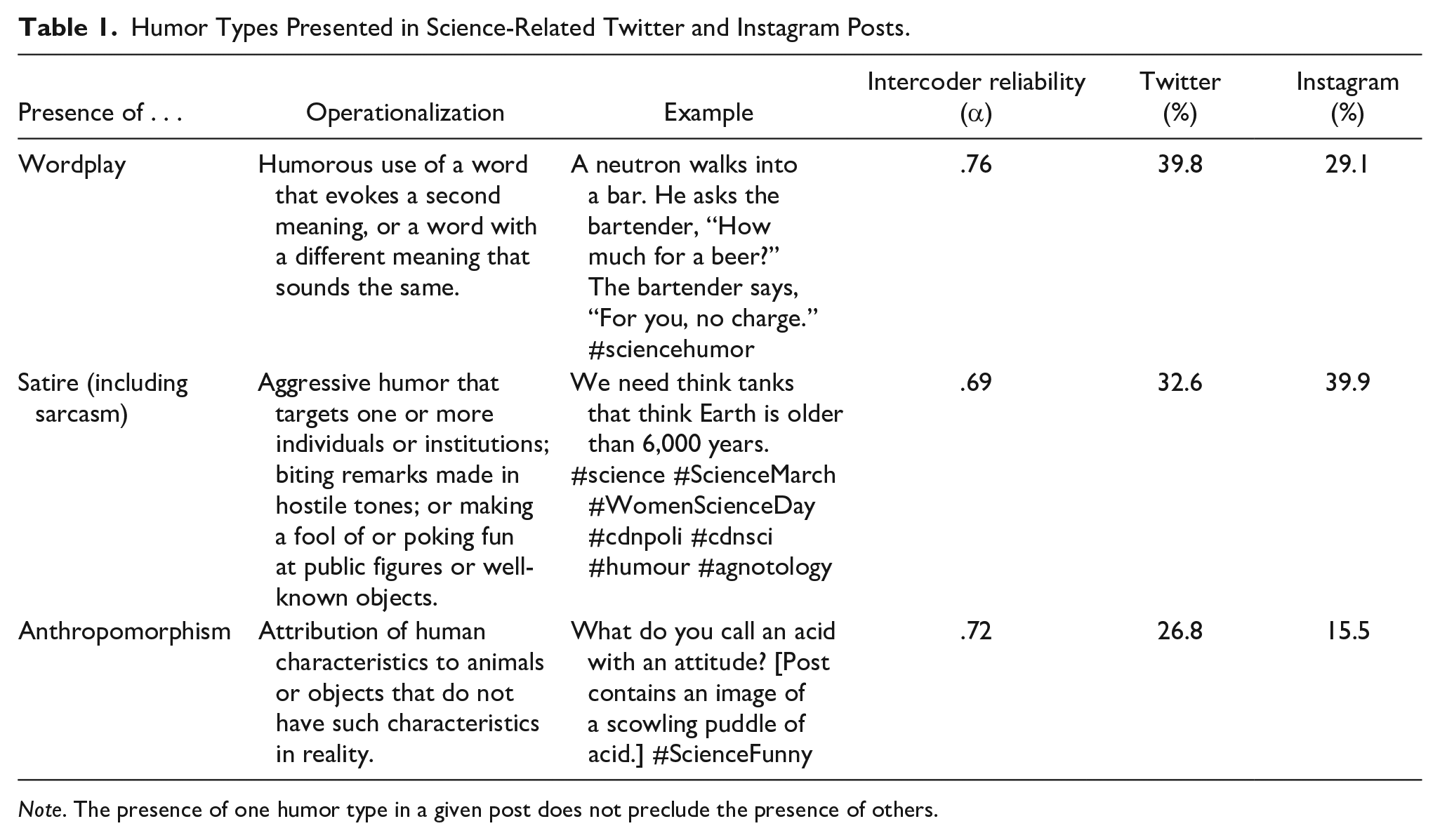
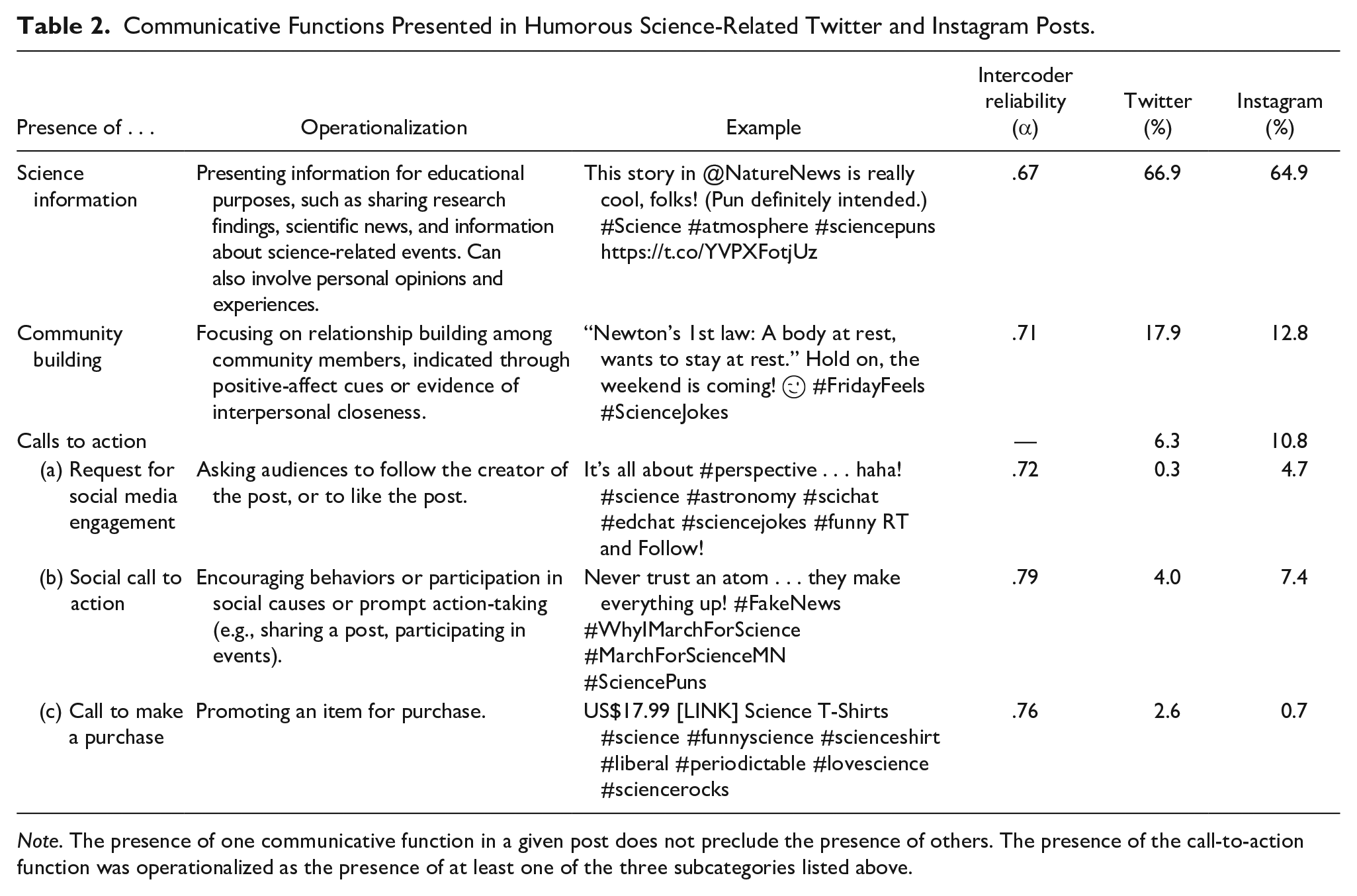
The presence of wordplay, anthropomorphism, and satire was coded following the schema proposed by Buijzen and Valkenburg (2004) and Martin (2007). We identified six types of humor in our data including wordplay, anthropomorphism, satire (including sarcasm), parody, clownish humor, and slapstick. We decided to focus on the first three as (a) they were the most popular across both of our focal social media platforms and (b) from a theoretical standpoint, wordplay and anthropomorphism are relatively benign types of messages, considered easy to create and deploy, and used often in public communication (Yeo et al., 2021). Satire, however, is commonly used to communicate about scientific issues such as climate change that are the subject of intense public contestation (e.g., Skurka et al., 2019). We expected our focus on these humor types to be of practical relevance, yielding a deeper understanding of the downstream effects of benign versus aggressive humor types on user engagement. Both textual and visual elements were considered during the coding process, as audiences are likely to be exposed to both when viewing social media posts, and such posts’ humor could depend on either of them or both conjointly. The presence of informational, community-building, and call-to-action functions was coded following Lovejoy and Saxton (2012) and Su, Scheufele, et al. (2017). In particular, the presence of a call-to-action function was operationalized as the presence of at least one of its subcategories, that is, a request for social media engagement, a social call to action, or a call to make a purchase. The operationalizations and intercoder reliabilities for the presence of each humor type and communicative function are shown in Tables 1 and 2, along with examples.
Humor Types Presented in Science-Related Twitter and Instagram Posts.
Note. The presence of one humor type in a given post does not preclude the presence of others.
Communicative Functions Presented in Humorous Science-Related Twitter and Instagram Posts.
Note. The presence of one communicative function in a given post does not preclude the presence of others. The presence of the call-to-action function was operationalized as the presence of at least one of the three subcategories listed above.
Next, the coders decided which, if any, of eight types of visual elements (comic, meme, photo, infographic/data representation, text-based image, 8 video, GIF, and other) were present in each post (α = .70). For analysis purposes, the results were divided into two groups, according to whether any visual element was present.
Attributes of Users
To obtain post authors’ number of followers and accounts followed, coders checked each author’s social media profile. 9
Analytical Approach
Analyses were conducted using IBM SPSS Statistics 25. We employed (a) descriptive statistics to understand the proportions of the variables of research interest; (b) hierarchical ordinary least squares (OLS) regressions to predict the numbers of likes and retweets received by Twitter posts and the numbers of likes received by Instagram posts; and (c) logistic regressions to predict the presence of comments.
Independent variables were entered in blocks with number of followers and number followed entered first. The next block covered the presence of visual elements on Twitter only, as Instagram users are required to upload a visual element when creating posts; the presence of each of our three focal communicative functions; and the presence of each of our three focal humor types. Following Chung (2017) and Kim et al. (2015), before entering the variables into the models, we log-transformed all the variables that had skewed distributions (i.e., whose absolute values of skewness and kurtosis were > 1), including the numbers of likes received by tweets, their numbers of retweets, the number of likes received by Instagram posts, and—on both platforms—the numbers of followers of, and accounts followed by, the users who posted.
Results
Descriptive Analysis
The highest number of likes a tweet received was 484 (M = 19.31, SD = 55.42) and the highest number of retweets was 515 (M = 14.66, SD = 50.84). Fewer than one tweet in five (19.9%) received even one comment. The post authors’ number of Twitter followers ranged from 13 to 614,000 (M = 11,909.99, SD = 40,204.56), and their number of accounts followed ranged from 0 to 80,400 (M = 6,269.08, SD = 10,519.21). Almost three-fourths of the Twitter posts (i.e., 74.6%) incorporated some attempt at wordplay, anthropomorphism, or satire, with 51% of them using just one of these humor types, and an additional 22.8%, two types. The sampled Instagram posts received up to 2,384 likes (M = 202.77, SD = 438.61) and 60.8% received at least one comment. Their authors’ follower numbers ranged from 11 to 748,000 (M = 18,438.98, SD = 76,710.15), and the number of accounts they followed ranged from 0 to 62,387 (M = 1,541.91, SD = 5,389.07). Slightly more than two-thirds of these Instagram posts involved some attempt to incorporate at least one of the three types of humor, with 52.7% of them including just one humor type, and a further 14.9%, two types.
In response to RQ1, more tweets included wordplay (39.8%) than any other humor type, with satire being the next most prevalent (32.6%; see Table 1). Interestingly, wordplay and anthropomorphism were used together in 14.4% of tweets, making this combination more popular than wordplay plus satire (4.9%) or anthropomorphism plus satire (3.5%). On Instagram, satire (39.9%) and wordplay (29.1%) were the most prevalent humor types (see Table 1). Slightly under 7% of the sampled Instagram posts concurrently included wordplay and anthropomorphism or wordplay and satire, but only 1.4% copresented anthropomorphism and satire.
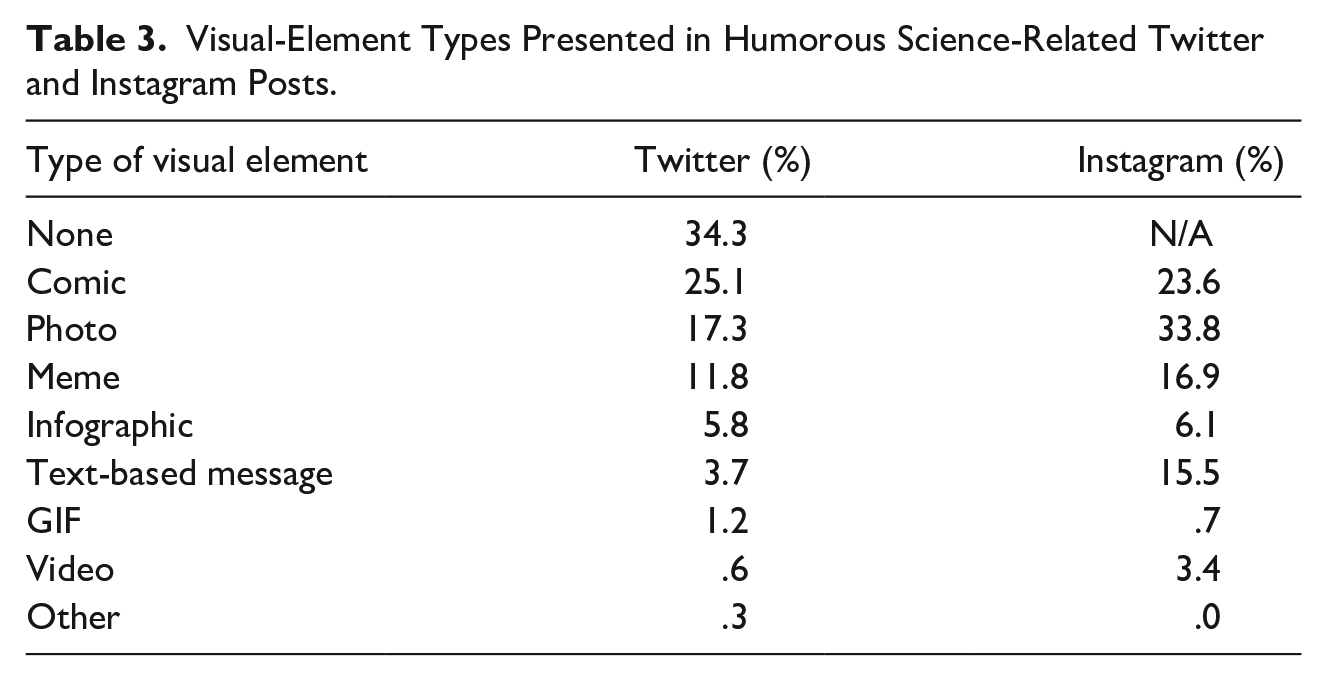
The sampled posts’ primary communicative function (RQ3) was to share scientific information, on both Twitter (66.9%) and Instagram (64.9%) (Table 2). To answer RQ5, visuals were included in 65.7% of tweets, with the majority being comics (25.1%), photos (17.3%), and memes (11.8%; see Table 3). On Instagram, 33.1% of posts included a photo, and the next three most prevalent types of images were comics (23.6%), memes (16.9%), and files that, while in image formats, depicted only text (15.5%).
Visual-Element Types Presented in Humorous Science-Related Twitter and Instagram Posts.
Predicting Social Media Engagement Metrics
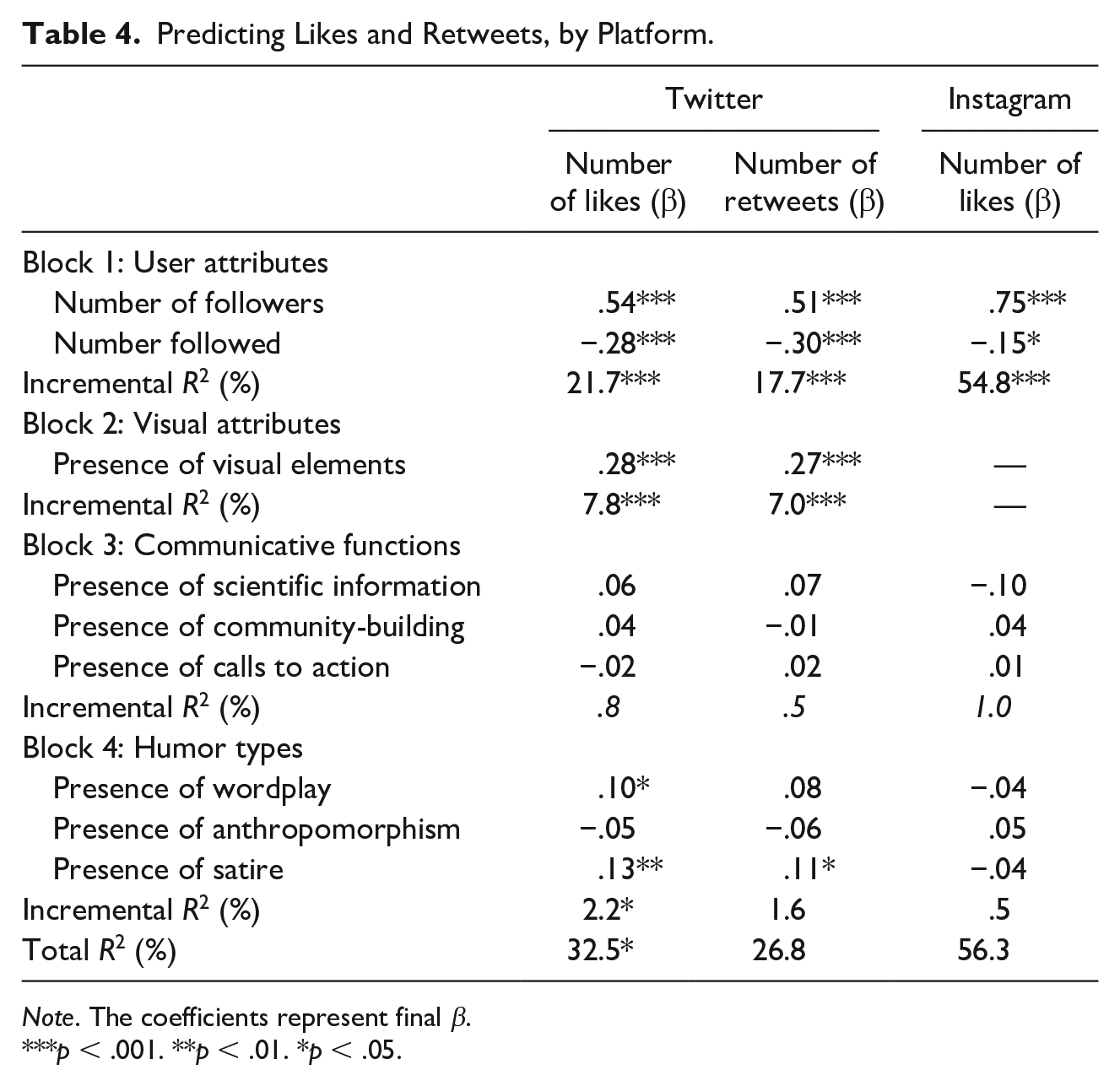
To answer RQ2 and RQ4, and test H1, we built OLS regression models, which explained 32.5%, 26.8%, and 56.3% of the total variance in Twitter likes, retweets, and Instagram likes, respectively (see Table 4). Having more followers was associated with more likes on both tweets (β = .54, p < .001) and Instagram posts (β = .75, p < .001) as well as more retweets (β = .51, p < .001). However, the more users a content author followed, the less likely their own tweets were to have been liked (β = −.28, p < .001) or retweeted (β = −.30, p < .001), and the less likely their Instagram posts were to have been liked (β = −.15, p = .013).
Predicting Likes and Retweets, by Platform.
Note. The coefficients represent final β.
p < .001. **p < .01. *p < .05.
The presence of visual elements was linked to the number of likes (β = .28, p < .001) and retweets (β = .27, p < .001) that Twitter posts received. However, none of the communicative-function variables were significantly associated with likes and retweets on Twitter, or with likes on Instagram.
The presence of humor types was significantly related to the numbers of engagement metrics only on Twitter. More specifically, the presence of wordplay was positively associated with numbers of likes (β = .10, p = .038), and the presence of satire was positively associated with numbers of both likes (β = .13, p = .009) and retweets (β = .11, p = .039).
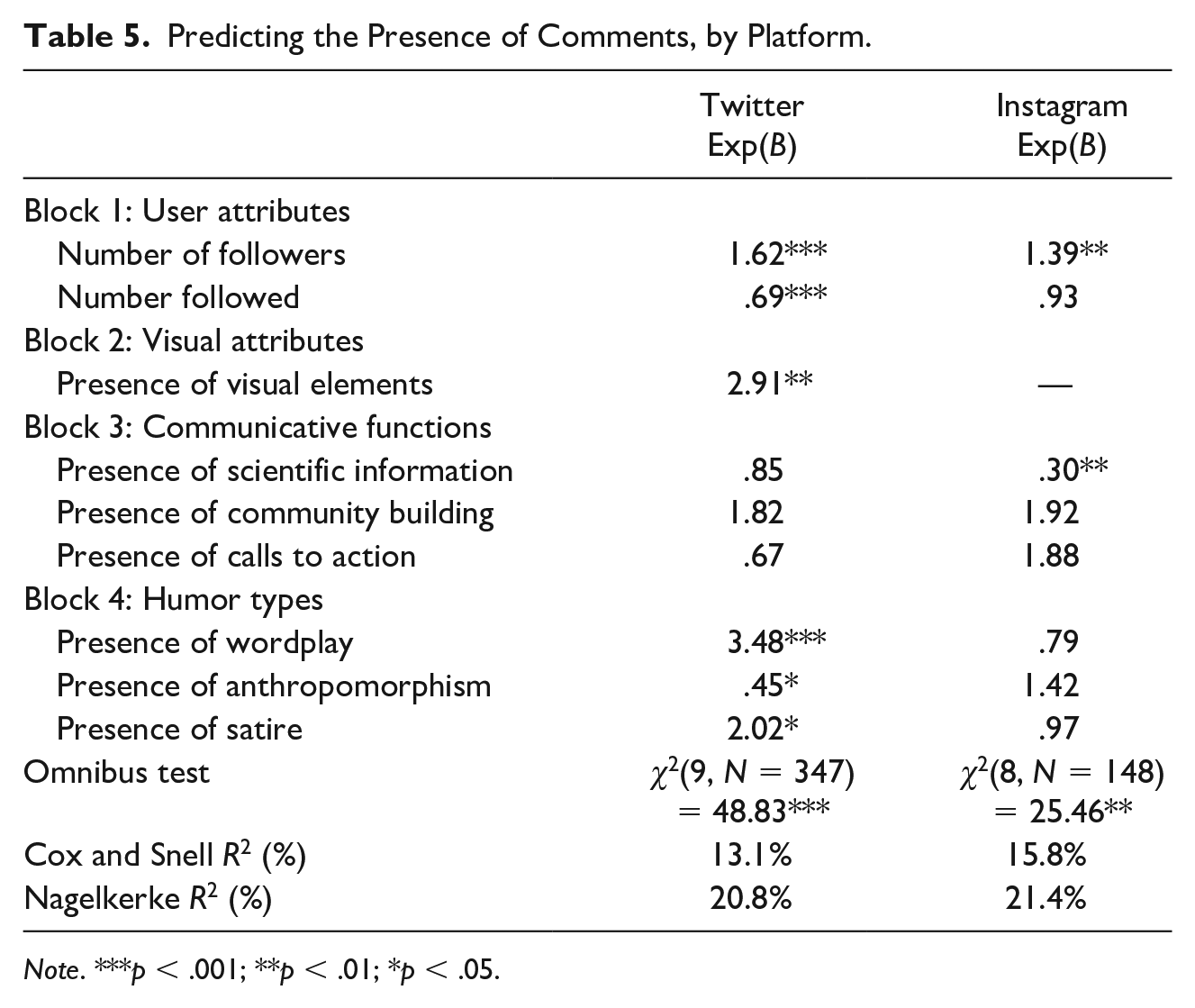
Nagelkerke pseudo-R 2 indicated that our logistic regression models accounted for 20.8% and 21.4% of the total variance in the presence of comments on Twitter (χ2 = 48.83, df = 9, p < .001) and on Instagram (χ2 = 25.46, df = 8, p = .001; see Table 5). Follower numbers were positively associated with the presence of comments on both Twitter (odds ratio [OR] = 1.62, p < .001) and Instagram (OR = 1.39, p = .002), while the number of accounts followed was negatively associated with comment presence on Twitter (OR = .69, p < .001).
Predicting the Presence of Comments, by Platform.
Note. ***p < .001; **p < .01; *p < .05.
On Twitter, the presence of visuals was associated with a greater likelihood that comments had been received (OR = 2.91, p = .008). On Instagram, posts that contained informational scientific content were less likely to have attracted comments (OR = .30, p = .004) than those without such informational content. The presence of humor was not related to the presence of Instagram comments; but on Twitter, the presence of wordplay (OR = 3.48, p < .001), anthropomorphism (OR = .45, p = .033), and satire (OR = 2.02, p = .041) were all significantly associated with the presence of comments. Specifically, tweets incorporating wordplay and satire were more likely to have received comments, and those featuring anthropomorphism were less likely to have attracted any. Taken together, the results support H1.
Discussion
This study is a preliminary mapping of the landscape of humorous scientific social media content. We identify key message attributes and explore the roles that humor types, communicative functions, and visual elements can play in shaping engagement. We employed a multidimensional measure of social media engagement behaviors that distinguished among three dimensions and demonstrated that different factors drove each. This answers calls (e.g., Alhabash & McAlister, 2015; J. W. Kim, 2018) to move beyond the existing literature’s lumping together of these behavioral outcomes under the single catch-all, “social media engagement.” Instead, we acknowledge the distinctions among behavioral outcomes both theoretically and practically, given that they represent different intentions and signal varied agentic actions.
Our in-depth examination of the humor types embedded in Twitter and Instagram posts found that satire and wordplay were the prevailing humor types, while anthropomorphism had only a modest presence. Satire and wordplay were shown to be positively related to scientific tweets’ engagement metrics, but anthropomorphism was negatively related to the presence of comments on such tweets. We also found that the presence of visual elements in tweets was positively linked to engagement with them. While the association between the communicative functions and user engagement with tweets was not significant, the presence of informational content appeared to be negatively related to commenting on science-related Instagram posts. These findings deepen our understanding of how humor affects science communication in social media environments and have practical implications for how Twitter and Instagram can be used strategically to increase audience engagement with funny scientific messages.
Before elaborating on this study’s key findings and contributions, it is important to acknowledge its limitations. First, our keyword search focused not on the entire universe of science content on Twitter and Instagram, but more narrowly on science content with a humorous slant; we searched for hashtags that simultaneously dealt with science and humor. While our approach undoubtedly resulted in some relevant content being missed, a more inclusive one that did not require hashtags to be related to both science and humor would likely have led to the collection of a sizable quantity of posts about science that did not attempt humor, and of humorous content that was not relevant to science. 10 Such an approach would increase the methodological barrier to human coders finding and analyzing truly scientific posts with humor embedded in them. In any case, the sheer volume of content that we found in a relatively short time period, more than 110,000 posts, suggests that a large number of users of both platforms were using such combinations of hashtags: a strong indication of the external validity of our findings. It is also important to note that, although our keyword search was designed to capture humorous scientific content, not all of the collected posts were identified as including any humor type. It may be that humor-themed hashtags are used to increase audience interest. However, future research should explore other types of humor linked to those hashtags that might not have been captured by the present study’s approach. In addition, while our approach was methodologically feasible, it could constrain the study’s implications, insofar as we focused on the presence of the target humor types in scientific posts that were self-labeled as attempts to be humorous, rather than in all scientific posts. Researchers should, therefore, consider analyzing humor types embedded in all scientific posts, perhaps from a single platform and/or a shorter time period to make this more feasible.
Second, though our keyword search string yielded more than 110,000 pieces of humorous scientific content across Twitter and Instagram, our extraction method, which relied on ForSight, limited us to a random sample of 10,000 posts, from which we randomly sampled 1,200 for coding—that is, about 1% of the total content that our keyword search uncovered—to avoid coder fatigue, which can impair the reliability of results (e.g., Krippendorff, 2012). Although manual content analysis allows latent coding that maximizes validity, future researchers should consider adopting intelligent algorithm-based approaches that can reliably and efficiently process large amounts of social media data while preserving validity (Su, Cacciatore, et al., 2017). Such approaches could also facilitate a more efficient classification of humor types embedded in a large volume of all scientific posts, to better confirm the practical implications of the findings, as noted above.
A third limitation is our approach of lumping sarcasm with satire, and our use of a broad definition of the latter that emphasizes its contemptuous nature. Some scholars have called for satire not to be described “as a single entity” (Holbert et al., 2011, p. 192), given that Juvenalian and Horatian satire can differentially influence the mechanisms whereby political messages are processed (LaMarre et al., 2014). Future studies should strive for a clearer distinction between satire and sarcasm and to classify different types of satire when examining the effects of humor in shaping engagement with science. It is also important for researchers to examine the mechanisms underlying the effect of humor types, including different satire subtypes, on participation intentions. This is because such intentions may not always operate primarily via elicited mirth but through other factors such as political efficacy (Hoffman & Young, 2011). This point may be particularly relevant when a message centers on a polarizing or politicized issue (e.g., environmental-focused thinktanks or flat earthers).
Finally, our study focused on the links between message attributes and engagement metrics, including the presence of comments, without analyzing comment content. The presence or volume of comments has previously been used as a proxy for the degree of user deliberation (Alhabash & McAlister, 2015) and thus as a signal of engagement levels. However, the valence and content of comments can be just as important, as they indicate user attitudes and opinions that may not always be positive or civil (e.g., Su et al., 2018; Yeo et al., 2020). Future research should, therefore, examine how humor types and other post attributes are associated with comment content.
Bearing the above limitations in mind, the present study offers a systematic analysis of the use of various humor types for science communication on Twitter and Instagram, and sheds light on how such use is associated with the engagement metrics that posts receive. Specifically, wordplay and satire were prevalent on both platforms, with about a third of the collected posts including one or both of these humor types, while approximately one-quarter deployed anthropomorphism. Tweets using wordplay to communicate about science were sometimes co-presented with anthropomorphic features, possibly because wordplay appears emotionally cohesive with the cartoonish tone of anthropomorphic humor. While most prior science communication research on attitude formation via humor has focused exclusively on satire (often including sarcasm, e.g., Anderson & Becker, 2018; Skurka et al., 2019), our findings highlight the probable relevance of other humor types—especially wordplay and its copresentation with anthropomorphism—to the design and propagation of science-focused content.
Nevertheless, not all types of humor relate to user engagement. Our findings showed that the use of wordplay and satire was positively associated with Twitter posts’ engagement metrics. However, anthropomorphism on Twitter was negatively related to the presence of user comments. In this context, it should be remembered that wordplay tends to be perceived as witty and inventive, whereas satire is often characterized by disparagement or indignation (Speck, 1991). Yet, both wit and satire require a process of incongruity-resolution, also referred to as “Ah-Ha humor” (Speck, 1991, p. 10), whereby information is reintegrated before comprehension can occur. An elaborative process of this kind may encourage participation behaviors via emotional involvement (Heiss & Matthes, 2019). This finding is also consistent with one by Yeo et al. (2020): that anthropomorphism on Twitter was not thought to be as funny as wordplay. Anthropomorphism consists chiefly of caricatures of animals or inanimate objects, and commonly appears in commercials aimed at children (Buijzen & Valkenburg, 2004). Twitter users, being mostly adults and more highly educated than the general public (Wojcik & Hughes, 2019), could have judged such humor to be childish and therefore felt that deliberative commenting posts containing it was relatively less necessary.
Interestingly, while the presence of humor was found to be associated with Twitter users’ engagement, there were no significant relationships between any humor type we investigated and Instagram engagement. This could be due to the distinctive characteristics of Instagram’s user community and its platform culture. Many users of this platform view it as a “mindless” medium that takes less cognitive effort to use than its rivals (Chen, 2018, p. 32). Alhabash and Ma (2017), meanwhile, noted that Instagram’s users are motivated by desires for self-documentation and self-expression. These user aims could result in lower attentiveness to informational content that may require additional elaboration, including the embedded humor that was the focus of the present research.
These Instagram-specific characteristics may also relate to our finding of a negative association between the inclusion of science information in Instagram posts and the presence of comments on those posts. Instagram, in contrast to Twitter, is dedicated to visual culture and is often used for entertainment purposes (Alhabash & Ma, 2017; Chen, 2018). Thus, informational content there may be neglected, or may even negatively affect engagement behaviors, particularly if it requires relatively high levels of cognitive effort. Conversely, while Twitter is often perceived as an abundant source of information (e.g., Su, Scheufele, et al., 2017), science information may be lost in this sea of information. A competing-attention effect might also affect the relationship between humor and the three studied communicative functions, which could render the latter nonsignificant as predictors of engagement.
Unsurprisingly, given that it has been expressly designed for visual content, and that its users are required to upload a visual to create posts, Instagram emerged as more heavily visual than Twitter. In the sampled Twitter and Instagram posts alike, the top three visual features were comics, photos, and memes. The presence of visual attributes was found to shape Twitter engagement, confirming the strategic role that visual elements can play in motivating user responses and serving persuasive purposes (Chung, 2017; de Vries et al., 2012).
While communication scholars and scientific institutions have promoted the use of humor in science communication efforts, our findings demonstrate that not all humorous scientific messages are equally effective in prompting user engagement or increasing content visibility. Mirroring the findings of previous studies (e.g., Alhabash & Ma, 2017), the present research has further demonstrated the uniqueness of each social media platform and the importance of distinguishing among them when formulating message strategies. Twitter and Instagram are characterized by different platform cultures and user characteristics, resulting in distinct user expectations about, and responses to, funny scientific messages and message features. Distinct messaging strategies will be required to achieve different hoped-for behavioral outcomes across varied platforms, insofar as varied message attributes in our data were associated with differential levels of user approval, information dissemination, and deliberation. Practitioners should bear this in mind when designing humorous materials for science communication on social media.
Footnotes
Declaration of Conflicting Interests
The author(s) declared no potential conflicts of interest with respect to the research, authorship, and/or publication of this article.
Funding
The author(s) disclosed receipt of the following financial support for the research, authorship, and/or publication of this article: This material is based on work supported by a funding incentive seed grant from the University of Utah and the National Science Foundation under Grant Number DRL-1906864. Any opinions, findings, and conclusions or recommendations expressed in this material are those of the authors and do not necessarily reflect the views of the University of Utah or the National Science Foundation.
