



Abstract
Chatbots have been used to achieve persuasive goals in various communication contexts. This research investigates how chatbot anthropomorphism intersects with emotional appeals to influence persuasive outcomes in science communication by conducting two experiments in the contexts of skin cancer prevention and biodiversity conservation. The findings showed a matching effect between emotional appeals and anthropomorphic cues: For a chatbot with more anthropomorphic cues, fear appeals were more persuasive than hope appeals; in contrast, for a less anthropomorphic chatbot, hope appeals were more effective. A key psychological mechanism underlying the relationships was personal risk perceptions but only for fear appeals.
Science communication has gone beyond the idea of disseminating scientific information; instead, it considers persuasive intent a key component in engaging the public and changing their attitudes, beliefs, and behaviors (Priest, 2019). One of the most widely adopted persuasion strategies in the field of science communication is appealing to human emotions (e.g., Chadwick, 2015; O’Neill & Nicholson-Cole, 2009; Skurka et al., 2019), as message-induced emotional responses, such as fear, amusement, hope, and anger, are likely to change thoughts and drive actions (Dillard & Nabi, 2006; Lazarus, 1991; Tannenbaum et al., 2015).
Although the effects of different emotional appeals have been investigated in topics ranging from health protective behaviors to climate change (e.g., Chadwick, 2015; Nabi & Myrick, 2019; O’Neill & Nicholson-Cole, 2009; Skurka et al., 2019), one area remaining to be explored is the use of conversation-based chatbots, an emerging communication source, to deliver emotional appeals. Today, chatbots can interact with human users in an increasingly natural and intelligent way. Their social ability has thus been deployed in communication scenarios with persuasive goals, showing promise for influencing attitudes and behaviors (e.g., Ischen et al., 2020; Shi et al., 2020; Zhang et al., 2020). However, despite growing attention to the use of interactive media and chatbots’ potential for persuasive communication, the effects of chatbots being a source of science communication remain understudied.
Similar to human sources, the message strategies adopted by a chatbot can influence its persuasiveness (e.g., Shi et al., 2020). Distinct characteristics of chatbots, such as the level of anthropomorphism, can also shape interaction experiences and persuasive outcomes accordingly (e.g., M. Li & Suh, 2021; Ling et al., 2021). More importantly, the interplay between source factors and message frames (i.e., “who says what”) can matter greatly in determining the persuasiveness of communication (e.g., Diamond & Zhou, 2021; Major & Coleman, 2012). Therefore, it is critical to examine how chatbots’ message strategies and design features jointly influence persuasion outcomes.
In this paper, by conducting two experimental studies, we examined the effectiveness of chatbots in two different persuasion topics of science communication: Study 1 focused on a personal health issue (i.e., promoting sunscreen use to reduce the risks of skin cancer), and Study 2 was about biodiversity preservation, an environmental issue of public interest. This research aims to investigate how emotional appeals (fear vs. hope) adopted by a chatbot and anthropomorphic cues presented by the chatbot (more vs. fewer) shape persuasion outcomes and unpack the underlying psychological mechanisms. The research findings can also inform science communication practices by suggesting how to incorporate emerging media channels to communicate topics concerning personal health and public interests with greater influence.
Literature Review
Persuasive Effects of Chatbots
With chatbots taking up important roles in daily life, their persuasive effects, a fundamental component of social interaction, have been evaluated in recent research (e.g., Ahn et al., 2021; Ischen et al., 2020; Voorveld & Araujo, 2020). As a new source of information, chatbots are compared with more traditional sources in terms of persuasiveness. A study found that recommendations from a chatbot can lead to more enjoyment of the interaction than a website providing equivalent information, which contributes to stronger positive attitudes toward the recommendation and higher recommendation adherence (Ischen et al., 2020). However, when participants perceive their conversation partner as a bot versus a human being, they are less likely to be persuaded to make charitable donations (Shi et al., 2020).
Studies have also investigated different design elements that can affect chatbot persuasiveness. One study revealed the positive effect of adding social cues to the chatbot, such as voice and human name, on persuasion effectiveness (Voorveld & Araujo, 2020). The social role played by the chatbot may also matter. For instance, framing a voice-based chatbot as a friend vs. a secretary is more effective in promoting consumers’ willingness to follow product recommendations, especially for low-involvement products (Rhee & Choi, 2020). Additionally, Ahn et al. (2021) showed that perceived similarity and psychological distance played crucial roles in the message persuasion of chatbots; hence, manipulating the anthropomorphic features of chatbots can be an effective persuasion strategy by inducing different levels of perceived similarity.
Different message strategies used by chatbots can also affect persuasion outcomes. For example, when users are aware of the bot’s identity, inquiries for personal information from the chatbot could undermine its persuasiveness in the context of charitable donations (Shi et al., 2020). Zalake et al. (2021) conducted an experimental study to test Cialdini’s persuasion strategies with virtual humans, showing that strategies that implemented the liking and reciprocity principles were the most effective in influencing users’ intentions to follow a recommendation.
To date, limited research has paid attention to the effects of the emotional appeals adopted by chatbots on their persuasiveness. To fill this gap, the present study examines the persuasion outcomes of chatbots using different types of emotional appeals.
Fear Versus Hope Appeals
Emotional appeals, as one of the most widely adopted message strategies, emphasize the role of emotions in motivating attitude and behavior changes (e.g., Chadwick, 2015; Dillard & Peck, 2000; Nabi, 2003; Nabi & Myrick, 2019; O’Neill & Nicholson-Cole, 2009; Skurka et al., 2019). By varying the salience of different information in content design, messages can evoke distinct emotions and affect subsequent information processing (Nabi, 2003). A plethora of research has explored the use of emotional appeals instead of rational, evidenced-based frames for persuasive communication, and its efficacy is well documented (e.g., Krishen & Bui, 2015; Nisbet, 2009).
Emotions stem from people’s appraisals of a situation relative to their goals and help them deal with specific problems (Lazarus, 1991). When certain emotions are aroused, they can shape the message recipient’s perceived message effectiveness, thus driving attitudinal and behavioral changes (Dillard & Nabi, 2006). Moreover, discrete emotions may produce distinct effects on persuasion, as they are associated with different action tendencies (Dillard & Peck, 2000). In this study, we focus on the comparison between fear appeals and hope appeals adopted by chatbots, as both are commonly used in practice but are on the opposite ends of the valence spectrum—fear as a negative emotion and hope as a positive one (Chadwick, 2015; Lee et al., 2017). These two emotions are also associated with competing framing strategies (hope: gain frame; fear: loss frame) and distinct motivations for actions (hope: efficacy; fear: threat) (Nabi & Myrick, 2019).
Specifically, fear, an emotion resulting from perceived harm, loss, and threat may motivate individuals to engage in adaptive or preventive actions (Lazarus, 1991). Messages using fear appeals often confront recipients with a threat, attempting to elicit concerns about one’s own well-being or others’ well-being (Brooker, 1981). For example, climate change is often described with alarming visuals and words as an urgent, enormous, and catastrophic crisis that is out of human control (O’Neill & Nicholson-Cole, 2009). Despite its popularity, there is conflicting evidence about the effectiveness of fear appeals in the literature. Earlier research argued that fear appeals did not work in green advertising (O’Neill & Nicholson-Cole, 2009). However, a meta-analysis showed that fear appeals successfully changed attitudes, intentions, and behaviors in most situations (Tannenbaum et al., 2015).
In contrast, hope, as a feeling of “wishing and yearning for relief from a negative situation, or for the realization of a positive outcome,” often serves to encourage goal pursuit (Lazarus, 1991, p. 826). Messages evoke hope by presenting an opportunity for realizing an important and positive future outcome and encouraging recipients to capitalize on the opportunity (Chadwick, 2015), which is often achieved by highlighting efficacy information (Feldman & Hart, 2016; Nabi & Myrick, 2019). For instance, hope appeals used in vaccination campaigns usually emphasize that being vaccinated is an effective way to prevent illness. In the context of climate change, efficacy information about participating in the decision-making of the climate change plan could also elicit hope, leading to strong climate activism (Feldman & Hart, 2016).
Prior studies have shown that the persuasion effects of fear versus hope appeals vary by circumstance and context. For instance, Chadwick (2015) argued that hope appeals were a better option than fear appeals for communicating climate change because they helped reduce affective reactance (i.e., anger), which was negatively associated with behavioral intentions. In comparison, Ettinger et al. (2021) argued that neither a single fear appeal nor a hope appeal used in video narratives appeared to be effective in changing individuals’ attitudes or behavioral intentions in climate change communication. In addition, the scope of the issue may also matter. Fear appeals were more effective in persuading consumers regarding a global environmental issue than hope appeals, whereas hope appeals outperformed fear appeals for a local environmental issue (Lee et al., 2017). Regarding health-related news, Nabi and Prestin (2016) found that fear frames with low response-efficacy information could elicit a higher intention to perform advocated behaviors. In comparison, the opposite pattern was revealed for the hope frame, which was more effective when used in tandem with high response-efficacy information. Given these mixed findings, it is less clear how the persuasion effects of chatbots vary across different types of emotional appeals, which is also rarely studied. Therefore, we propose a research question instead of a hypothesis:
Research Question 1 (RQ1): What are the persuasion effects of different emotional appeals (fear vs. hope) used by chatbots?
Anthropomorphic Cues in Chatbot Design
As a unique source of communication, different chatbot designs, especially the extent to which it appears “machine-like” or displays anthropomorphic attributes, can complicate persuasion. Anthropomorphism is the assignment of human-like characteristics to nonhuman entities (Epley et al., 2007). This is an important aspect of chatbot design to determine users’ acceptance and perceptions of the system (M. Li & Suh, 2021; Ling et al., 2021). There are many design strategies to enhance the human-likeness of chatbots, such as through names and identities (e.g., Araujo, 2018), visual appearance, linguistic cues (e.g., voice and human-like expressions), psychological features (e.g., autonomy and personalities) (Cao et al., 2019), and behaviors (e.g., von der Pütten et al., 2010).
From the user’s perspective, anthropomorphism can be a mindful or mindless process. As Kim and Sundar (2012) argued, mindful anthropomorphism represents a thoughtful belief that “computers are human and/or deserving of human attributions” (p. 241), whereas mindless anthropomorphism occurs when individuals unconsciously attribute human characteristics (e.g., friendly and sociable) to computers. Both have been used to explain why people apply social rules to human–machine interactions. The mindless anthropomorphism explanation has its root in the computers are social actors paradigm, which proposes that people tend to respond socially to nonhuman agents and apply social rules to interactions (Nass & Moon, 2000). People often refuse to admit that they consider computers as human beings despite their social reactions to machines (Nass & Moon, 2000), suggesting a possibly mindless process.
Although both mechanisms sound plausible, empirical findings suggest that neither can fully account for users’ social responses to machines (e.g., Araujo, 2018; Ischen et al., 2020; Zarouali et al., 2021). Lombard and Xu (2021) proposed that the explanatory power of the two mechanisms may hinge upon the quality and quantity of anthropomorphic social cues presented by the machine, such that only when the machine demonstrates sufficient social cues will it be able to elicit mindless anthropomorphism. The above discussion points to the importance of acknowledging the distinction between these two explanations (explicit and conscious beliefs vs. automatic and unconscious responses) and encourages scholars to address how they separately or jointly shape perceptions. Therefore, in this study, we adopt broader conceptualizations of anthropomorphism by incorporating two possible mechanisms: mindful and mindless anthropomorphism.
Moreover, this tendency to respond socially to nonhuman agents is likely to be amplified when the agent exhibits more anthropomorphic cues. For instance, participants showed social responses that were more aligned with the rules of human-to-human interaction, such as in-group favoritism, when interacting with human-like robots than with machine-like robots (Fraune, 2020). In a similar vein, agents with higher behavioral realism achieved better social effects, such as feelings of mutual awareness, and gained more input from users than agents with less human-like behaviors (von der Pütten et al., 2010). Following this line of thought, anthropomorphic design can be a better match for emotional appeals than machine-like design, as it is more likely for people to respond emotionally to a chatbot’s messages when it is designed with more human-like features. Thus, anthropomorphic cues may enhance the persuasiveness of emotional appeals of chatbots through intensified emotional reactions, regardless of the valence.
In addition, anthropomorphic design is likely to induce positive perceptions of the chatbot, which can augment its persuasiveness as a source. For instance, a chatbot with more human-like cues is more likely to trigger a sense of emotional connection with the user, thereby laying a good foundation for relationship building (Araujo, 2018). In addition, researchers have found that a higher level of anthropomorphism leads to more trust beliefs toward a robo-advisor chatbot, which can enhance the likelihood of following the chatbot’s investment recommendation (Morana et al., 2020). Of note, being human-like is not always associated with positive outcomes. There are also occasions where users’ privacy concerns, self-awareness (e.g., Sah & Peng, 2015), or uncanny-valley perceptions (Mori et al., 2012) are triggered by anthropomorphic agents. However, a meta-analysis showed that anthropomorphism is positively associated with a bot agent’s characteristics, such as perceived intelligence and likability, hence facilitating human–bot interaction (Blut et al., 2021). Therefore, a more human-like chatbot is likely to be more persuasive than a less human-like chatbot, which may be applicable to both positive and negative emotional appeals. Therefore, we propose the following hypothesis:
Hypothesis 1 (H1): Participants who interact with the chatbot with more anthropomorphic cues will be more persuaded than those who interact with the chatbot with fewer anthropomorphic cues, regardless of emotional appeals.
Study 1
Method
Study Design
We chose sunscreen use promotion for skin cancer prevention as the persuasion topic in Study 1 because skin cancer is the most common of all cancers in the United States (Centers for Disease Control and Prevention, (n.d.), and both fear and hope can be appropriately evoked in this context (Spears et al., 2012). A 2 (Emotional Appeals: Fear vs. Hope) × 2 (Anthropomorphic Cues: High vs. Low) between-subject, web-based experiment was conducted. The study was approved by the relevant institution’s ethics review board prior to data collection.
Participants
A power analysis in G*Power 1 assuming a medium effect size (f2 ≥ 0.25) and a full factorial design with four conditions in an analysis of variance yields a sample size of 210 to achieve a statistical power of 95%. In this study, adult participants (N = 287) in the United States were recruited through Dynata, 2 a global survey panel provider. The final sample consisted of 122 males (42.51%), 163 females (56.79%), 1 nonbinary/third gender participant (0.35%), and 1 participant who preferred not to answer (0.35%). The average age of the participants was 38.13 years old (SD = 13.69). The majority identified themselves as White (68.99%), followed by Black or African American (11.50%), Hispanic or Latino (9.06%), mixed races/ethnicities (7.67%), Asian (5.57%), and American Indian or Alaska Native (0.35%).
Stimuli and Procedures
In total, four chatbots were built with the Landbot app (https://landbot.io/) for four experimental conditions. Eligible and consented participants were directed to a Qualtrics questionnaire and randomly assigned to interact with one of the four chatbots for approximately 5 min. The participants were explicitly told that they were going to interact with a chatbot before entering the conversation. The interaction was designed as back-and-forth communication, where the chatbot would take the lead to initiate the conversation and ask for user input occasionally to keep the conversation on track.
Based on prior literature (Araujo, 2018; Morana et al., 2020), we manipulated different types of anthropomorphic cues in chatbot design. The more anthropomorphic chatbot was designed with a human-like chat agent avatar, in contrast to a nonhuman-like graphic for the less anthropomorphic chatbot (see Figure 1 for comparison). In addition, the more anthropomorphic chatbot used a dynamic typing indicator (i.e., the typing duration would change according to the conversation length), whereas the less anthropomorphic chatbot gave responses immediately, regardless of the conversation length. In addition, we manipulated the way they talked to users such that a more anthropomorphic chatbot would use first-person pronouns (e.g., we) when referring to humans (e.g., “Skin cancer will no longer be a threat if we take action to protect ourselves from it.”) and address the user’s name directly based on the name the user entered. In comparison, a less anthropomorphic chatbot used second-person pronouns when referring to humans (e.g., “Skin cancer will no longer be a threat if you take action to protect yourself from it.”) and did not address users by their names.
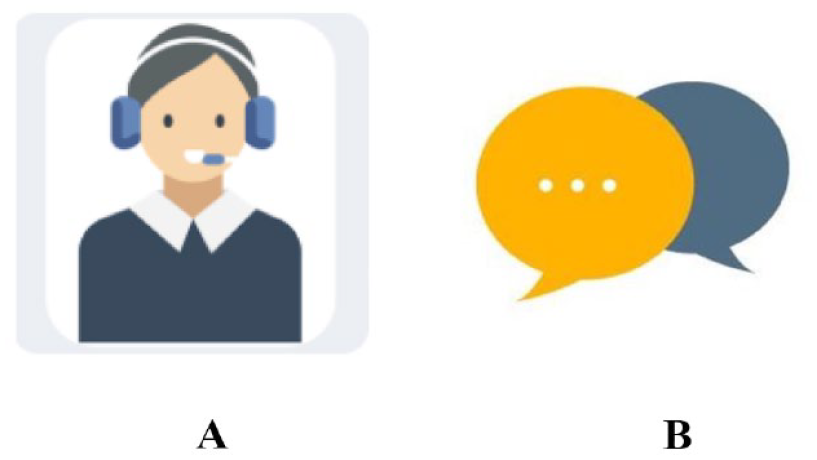
Chatbot Avatars Used in (A) the More Anthropomorphic Condition and (B) the Less Anthropomorphic Condition.
The communication scripts of fear versus hope appeals were designed based on related materials on the websites of the Centers for Disease Control and Prevention (n.d.) and the American Academy of Dermatology Association (n.d.). Specifically, the fear appeal emphasized the threat of ultraviolet exposure and the danger of skin cancer. In contrast, the hope appeal highlighted the effectiveness of wearing sunscreen to prevent people from developing skin cancer. 3 The accompanying visuals were selected based on the associations between concepts (e.g., disease vs. sun) and emotions (Mohammad & Turney, 2013). A pretest using the perceived informativeness scale (“I learned something from the conversation with the chatbot” and “The conversation with the chatbot was informative”; Cho & Boster, 2008) showed no significant difference in perceived informativeness across different conditions.
After interacting with the chatbot, the participants were asked to fill out the rest of the questionnaire. To ensure that the participants completed the interaction with the chatbot, a graphic picture was assigned at the end of the chatbot interaction, and the participants’ surveys would be terminated if they could not identify the picture immediately after the interaction. Those who correctly identified the picture then responded to questions assessing their interaction with the chatbot and persuasion outcomes. Finally, they reported their demographic information.
Measures
Emotions
Fear was assessed using an established three-item measure: “How much did the above information provided by the chatbot make you feel fearful/afraid/scared?” (Dillard & Shen, 2018) on a 7-point scale (1 = not at all; 7 = a great deal). The items were averaged into a composite score (M = 3.28, SD = 1.77, α = .90). Hope was also assessed with three items: hopeful, encouraged, and optimistic (M = 4.25, SD = 1.67, α = .91; Nabi & Myrick, 2019).
Mindful Anthropomorphism
The participants reported the perceived human-likeness of chatbots using three items on a 7-point Likert-type scale ranging from 1 (strongly disagree) to 7 (strongly agree). Items included “the chatbot is natural/has a mind/is like a human” (M = 4.03, SD = 1.65, α = .80). Mindless anthropomorphism was assessed using four 7-point Likert-type items (i.e., the chatbot is gentle/cheerful/friendly/sociable) adapted from Kim and Sundar (2012). The scale showed good reliability (M = 4.42, SD = 1.59, α = .90).
Attitude Toward Using Sunscreen
Post-interaction attitude toward wearing sunscreen every time before going outside was assessed using four bipolar items (unimportant: important/a bad idea: a good idea/foolish: wise/harmful: beneficial) on a 1 to 7 scale. This measure achieved good reliability (M = 5.66, SD = 1.42, α = .83).
Behavioral Intention
The participants reported their behavioral intention by rating their agreement on two statements, including “I plan to wear sunscreen” and “I am going to make an effort to wear sunscreen,” before going outside in the next month (1 = strongly disagree, 7 = strongly agree; M = 5.27, SD = 1.53, α = .90).
Previous Sunscreen Use
To control for past sunscreen use behaviors, the participants were asked to report approximately how many days (0–31) they wore sunscreen to protect their skin in the past month (M = 5.12, SD = 8.35) prior to the study. This was used as a covariate in the analysis.
Study 1 Results
Manipulation Check
Fear and Hope
We proposed that the message using a fear appeal would elicit more fear than the message using a hope appeal, which was confirmed by an independent sample t-test (Mfear = 3.65, Mhope = 2.95), t(285) = 3.37, p = .001. However, the two groups did not differ in their elicited hope (Mfear = 4.28, Mhope = 4.23), t(285) = 0.28, p = .78. Therefore, in the interest of accuracy, we refer to these two conditions as high-fear and low-fear groups in Study 1.
Mindful and Mindless Anthropomorphism
We did not find significant differences in mindful anthropomorphism between groups with more anthropomorphic cues (M = 4.07, SD = 1.60) and groups with fewer cues (M = 3.98, SD = 1.71), t(285) = −0.47, p = .64. However, the participants in the high anthropomorphism groups demonstrated a significantly higher level of mindless anthropomorphism (M = 4.92, SD = 1.39) than those in the low anthropomorphism groups (M = 4.57, SD = 1.53), t(285) = −2.04, p = .04.
Effects on Persuasion Outcomes
Attitude
To test the main effects of emotional appeals and anthropomorphic cues on persuasion outcomes, we specified an ANCOVA model with both emotional appeals and anthropomorphic cues (more vs. less) as the independent variables and attitude toward using sunscreen as the dependent variable while controlling for the participants’ previous sunscreen use habits.
The results revealed a significant two-way interaction between the two independent variables (F [1, 282] = 4.70, p = .03, η2 = .02). Specifically, the participants in the high-fear condition showed a more positive attitude toward using sunscreen when they interacted with a chatbot with more anthropomorphic cues than those in the low-anthropomorphism condition. In comparison, an opposite pattern was observed in the low-fear condition: the participants were more likely to be persuaded by a less anthropomorphic chatbot than by a more anthropomorphic chatbot (see Figure 2). Neither emotional appeals (F [1, 282] = 0.29, p = .59, η2 = .001) nor anthropomorphic cues (F [1, 282] = 0.11, p = .73, η2 < .001) had a significant main effect on attitude toward using sunscreen.
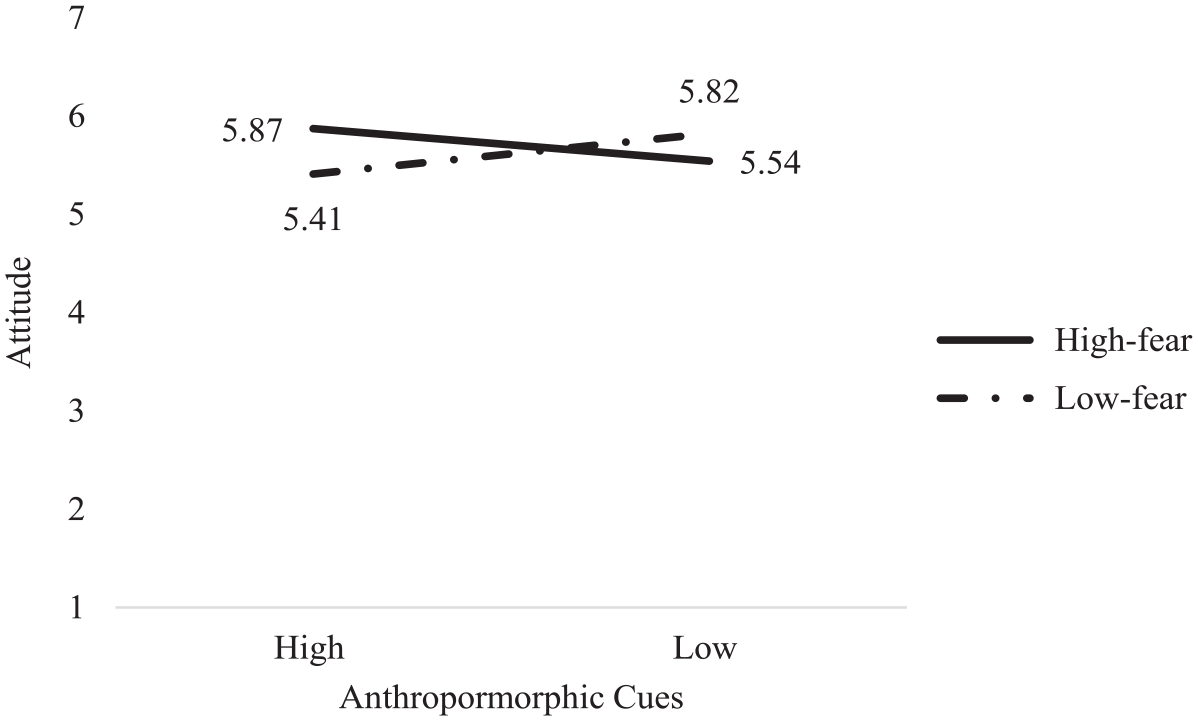
Interaction Effects of Anthropomorphic Cues and Emotional Appeals on Attitude Toward Using Sunscreen in Study 1.
Behavioral Intention
When entering behavioral intention as the dependent variable in the ANCOVA model, we did not find significant main effects of independent variables (emotional appeals: F [1, 282] = 0.16, p = .69, η2 = .001; anthropomorphic cues: F [1, 282] = 2.55, p = .11, η2 = .01) or an interaction effect between the independent variables (F [1, 282] = 2.22, p = .14, η2 = .01).
Psychological Mechanisms
To examine whether aroused fear mediates the relationship between emotional appeals and attitudes, and the extent to which anthropomorphic cues moderate the relationship, we ran a moderated mediation analysis using PROCESS Macro in SPSS with 95% bias-corrected confidence intervals (CIs) using 5,000 bootstrap resamples, controlling for previous sunscreen use. The results of Model 8 showed that fear was positively associated with attitude toward using sunscreen (b = 0.12, SE = 0.05, p = .02). It was a significant mediator between emotional appeals and attitudes for the participants in the more anthropomorphic chatbot condition (b = 0.09, SE = 0.05, 95% CI [0.01, 0.20]) but not in the less anthropomorphic chatbot condition (b = 0.07, SE = 0.05, 95% CI [−0.00, 0.18]). However, the index of moderated mediation (0.02) was not significant (SE = 0.05, 95% CI [−0.08, 0.14]). This suggests that although we did observe a difference in the mediation path between the more vs. less anthropomorphic chatbot condition, the difference was not statistically significant, meaning that fear played a similar mediating role in both conditions. No significant direct effect of emotional appeals on attitude was found.
We ran another moderated mediation analysis to explore whether mindless anthropomorphism mediates the relationship between anthropomorphic cues and attitude and the extent to which emotional appeals moderate the relationship. The index of moderated mediation (0.16) was not significant (SE = 0.13, 95% CI [−0.43, 0.08]). For the participants in the low-fear condition, mindless anthropomorphism was a positive mediator connecting anthropomorphic cues and attitude toward sunscreen use (b = 0.19, SE = 0.09, 95% CI [0.03, 0.38]). Besides this mediating path, there was also a direct negative effect of anthropomorphic cues on the attitude in the low-fear condition (b = −0.61, SE = 0.22; p < .01). This suggests that being more anthropomorphic undermines the persuasiveness of the low-fear message by the chatbot. Neither the direct nor indirect effect of anthropomorphic cues on attitude was found in the high-fear condition.
Study 1 Discussion
The results of Study 1 imply that the persuasive effect of fear appeals (high vs. low) is contingent on the level of anthropomorphism shown in a chatbot. For a chatbot with more anthropomorphic cues, a stronger fear appeal is more effective in persuading users than a strategy that elicits less fear. However, for a less anthropomorphic chatbot, a low-fear message appears more persuasive in changing users’ attitudes than a high-fear message. The mediation analysis offers some insight into this interaction effect: the role of fear in motivating users to accept the suggestion of wearing sunscreen is more evident in the high-anthropomorphism condition than in the low-anthropomorphism condition. However, the mediation difference is not statistically significant. Moreover, the analysis could not satisfactorily explain why anthropomorphic cues influenced attitude toward sunscreen use.
There are several possible explanations for the interaction effect. First, it could be that anthropomorphic cues of a chatbot in the low-fear condition can undermine perceived risk, which is a critical factor that drives attitudinal and behavioral changes (Rimal & Real, 2003). Fear appeal messages inherently involve an imminent threat and are more likely to induce risk perceptions than non-fear-based messages (Skurka et al., 2018). Furthermore, chatbot anthropomorphism may interact with message frames (e.g., fear vs. hope appeals) to influence risk perceptions (e.g., Y. Li et al., 2022). Study 1 showed that more anthropomorphic cues induced a higher level of mindless anthropomorphism, meaning that the chatbot was perceived to be more gentle, friendly, cheerful, and sociable. A nice and friendly chatbot vs. a machine-like chatbot may further reduce risk perceptions in the hope appeal condition, rendering hope appeals more lighthearted and less compelling. On the other hand, anthropomorphic cues may not necessarily hurt the persuasiveness of fear appeals because the negative consequences that will befall due to noncompliance are salient in fear appeal messages and may offset the effect of anthropomorphism. Taken together,
Hypothesis 2 (H2): We propose that a chatbot with more anthropomorphic cues may reduce risk perceptions in the hope- but not the fear-appeal condition, lowering people’s message compliance.
Another potential mechanism is that anthropomorphic cues decrease the psychological reactance evoked by a high-fear message. Psychological reactance is a motivational state that occurs when a person’s freedom is threatened to be eliminated, leading to resistance to persuasion (Brehm & Brehm, 1981). Prior research consistently suggests that fear appeals can trigger perceived threats to freedom and result in psychological reactance (Shen, 2011). In this study,
Hypothesis 3 (H3): More (vs. less) anthropomorphism cues of chatbots may serve as a positive heuristic and minimize the psychological reactance induced by fear appeals, increasing the effectiveness of the high-fear message but not the low-fear one.
We decided to conduct Study 2 to examine whether the findings could be replicated and to explore possible psychological mechanisms. To increase the external validity and test the consistency of findings across topic domains, we replicated and extended Study 1 by changing the science communication topic from promoting sunscreen use to promoting biodiversity preservation in Study 2. Biodiversity loss, as a severe health and environmental threat facing the world, also provides an opportunity to examine both negative and positive emotional appeals as communication strategies (Kidd et al., 2019).
Study 2
Method
Study Design
Study 2 adopted the same 2 (Emotional Appeals: Fear vs. Hope) × 2 (Anthropomorphic Cues: High vs. Low) between-subject design as in Study 1. Message scripts for promoting biodiversity conservation were developed based on related information on the websites of the World Wildlife Fund (n.d.), the United Nations (n.d.), and relevant news reports (Ulick & Umlauf, 2021). The accompanying visuals were black and white for the fear-appeal condition and colorful for the hope-appeal condition, selected based on the associations between bright/chromatic colors and positive feelings (Wilms & Oberfeld, 2018) and between black and fear (Fugate & Franco, 2019). Other procedures and stimuli development were consistent with Study 1.
Participants
In Study 2, we recruited adult participants (N = 289) in the United States through Amazon Mechanical Turk (49.8% male, Mage = 37.53, SDage = 11.51). The majority of participants were White (65.70%), and the rest included 10.0% Black or African American, 9.7% Asian, 7.61% mixed races/ethnicities, 5.5% Hispanic or Latino, and 1% American Indian or Alaska Native.
Measures
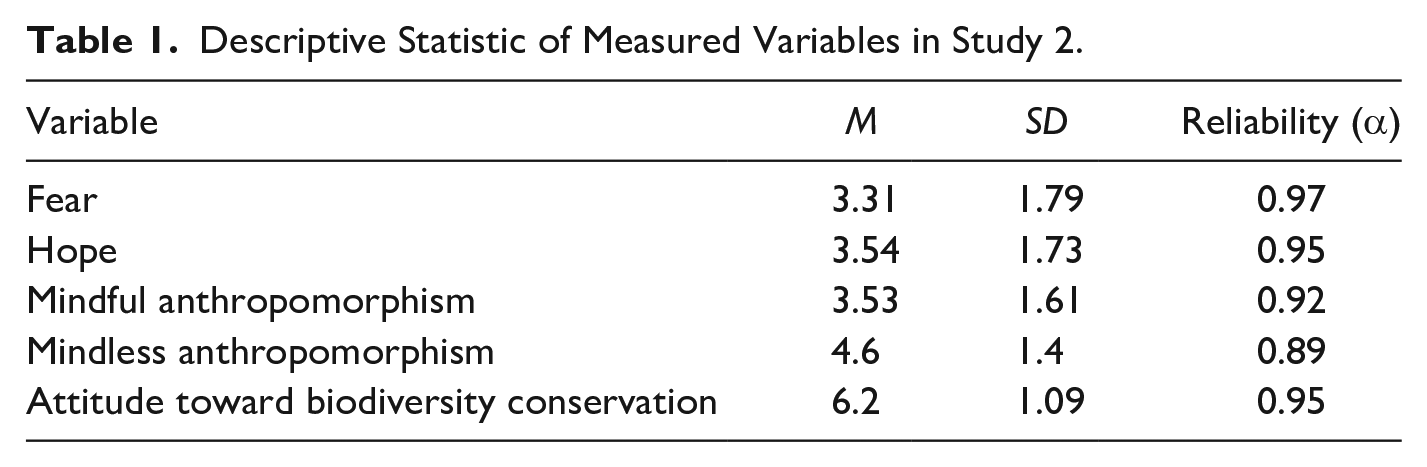
We measured the same variables listed in Study 1 but changed the topic to biodiversity conservation (see Table 1 for means, standard deviations, and reliability statistics). In addition, the behavioral intention measured in Study 2 was adapted to a donation-seeking scenario. The participants were asked to imagine that they had won US$50 and then to decide how much they would donate to the World Wildlife Fund to support biodiversity conversation efforts, from $0 to $50 (M = 18.38, SD = 16.07).
Descriptive Statistic of Measured Variables in Study 2.
To test H2, we added measures for perceived social risk and perceived personal risk of biodiversity loss (Bord et al., 2000). The participants reported their judgment (1 = extremely unlikely, 7 = extremely likely) of two statements, including “you will personally experience serious threats to your health or overall well-being as a result of biodiversity loss” (personal risk, M = 4.53, SD = 1.65) and “biodiversity loss will have extremely harmful long-term impacts on our society” (social risk, M = 5.69, SD = 1.49).
To test H3, perceived threat of freedom was assessed using an established four-item measure (e.g., “The chatbot tried to make a decision for me” or “The chatbot tried to pressure me”) adapted from Dillard and Shen (2005) on a 7-point scale (1 = strongly disagree, 7 = strongly agree). The items were averaged into a composite score (M = 2.03, SD = 1.41, α = .92).
In addition, the participants’ past biodiversity-preservation behaviors were measured by asking them whether they had engaged (0 = no, 1 = yes) in any of the following activities in the past 6 months: (a) actively seeking information related to biodiversity, (b) donating to any charitable organizations to support biodiversity conversation efforts, and (c) joining or volunteering with an organization working to support biodiversity conservation. Their “yes” answers were then added and used as a control variable (M = 0.50, SD = 0.91).
Findings
Manipulation Check
Fear and Hope
The participants who interacted with the chatbot using fear appeals reported a higher level of fear (M = 3.73, SD = 1.94) than those who interacted with the hope-appeal chatbot (M = 2.88, SD = 1.52), t(287) = 4.15, p =.00. The two groups also showed a significant difference in their elicited hope (Mfear = 3.03, SDfear = 1.69, Mhope = 4.06, SDhope = 1.62), t(287) = 5.28, p = .00, suggesting successful manipulation of emotional appeals.
Mindful and Mindless Anthropomorphism
Similar to Study 1, no significant differences in mindful anthropomorphism were found between groups with more anthropomorphic cues (M = 3.63, SD = 1.60) and groups with fewer cues (M = 3.43, SD = 1.61), t(287) = −1.01, p = .31. Still, the participants in the high-anthropomorphism group demonstrated a significantly higher level of mindless anthropomorphism (M = 4.81, SD = 1.35) than the participants in the low-anthropomorphism group (M = 4.39, SD = 1.42), t(287) = 2.59, p = .01.
Effects on Persuasion Outcomes
Attitude
An ANCOVA model was run with emotional appeals and anthropomorphic cues (more vs. fewer) being the independent variables and attitude toward biodiversity conservation being the dependent variable while controlling for the participants’ past biodiversity-preservation behaviors. The results showed that neither a significant main effect of emotional appeals (F [1, 283] = 0.02, p = .96, η2 = .00) nor anthropomorphic cues (F [1, 283] = 0.04, p = .84, η2 = .00) was found on attitude toward biodiversity conservation. The interaction term was also not significant (F [1, 283] = 0.73, p = .39, η2 = .003).
Donation Intention
Donation intention was entered as the dependent variable, and past biodiversity-preservation behaviors along with income were controlled for in the model. A significant interaction effect between emotional appeals and anthropomorphic cues was found (F [1, 273] = 3.97, p = .047, η2 = .014). Specifically, the participants who interacted with more anthropomorphic chatbots reported a higher level of donation intention when the chatbot used a fear appeal versus a hope appeal. However, for less anthropomorphic chatbots, the hope appeal was more effective in eliciting donation intention than the fear appeal (see Figure 3). Emotional appeals (F [1, 273] = 0.09, p = .76, η2 = .00) or anthropomorphic cues (F [1, 273] = 0.32, p = .57, η2 = .001) did not have a significant main effect on donation intention.
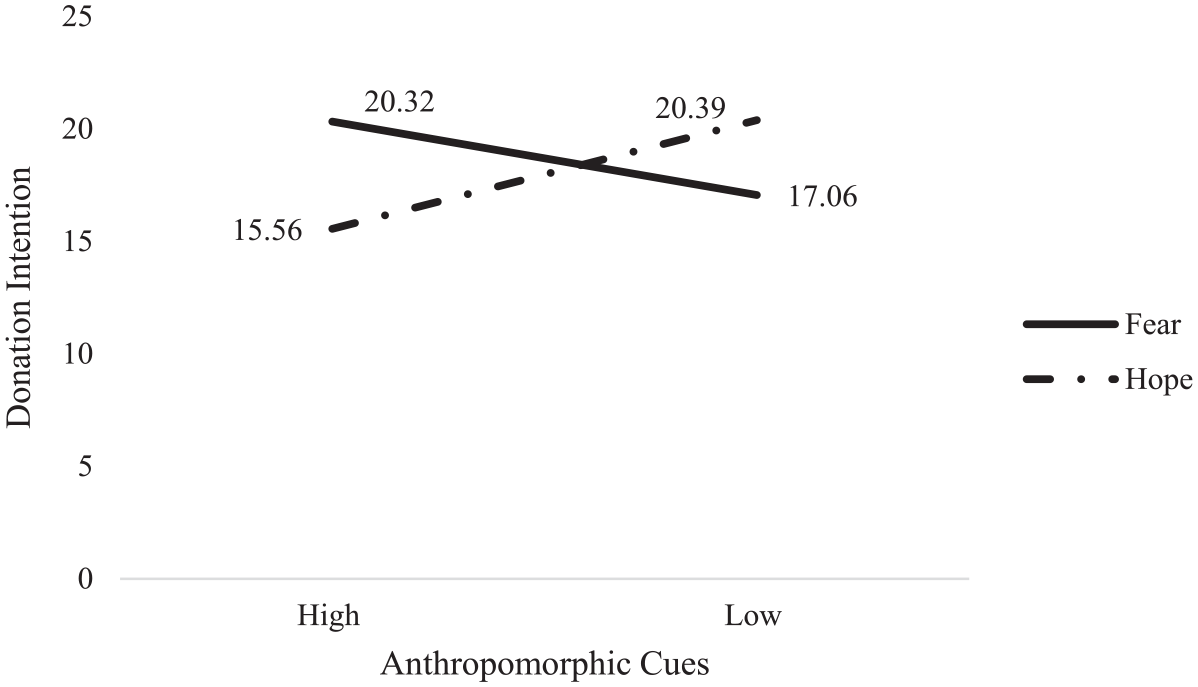
Interaction Effects of Anthropomorphic Cues and Emotional Appeals on Donation Intention in Study 2.
Psychological Mechanisms
To test H2 and H3, we examined whether aroused fear, hope, perceived personal risk, perceived social risk, and perceived threat to freedom mediate the relationship between mindless anthropomorphism and donation intention and the extent to which emotional appeals moderate the relationship, controlling for past behaviors in biodiversity conservation. A moderated mediation analysis was conducted using PROCESS Macro in SPSS with 95% bias-corrected CIs using 5,000 bootstrap resamples. The results from Model 8 showed a significant moderated mediation effect of perceived personal risk. Specifically, when the chatbot used the fear appeal, mindless anthropomorphism intensified perceived personal risk, leading to a higher donation intention. However, when the chatbot highlighted the hopeful aspects of biodiversity conservation in their conversations, perceived personal risk was no longer a significant mediator. This finding did not support H2. In addition, mindless anthropomorphism was also positively related to aroused hope, regardless of emotional appeals, which was then positively associated with donation intention. Figure 4 shows detailed statistics for the conditional indirect effects in the two emotional appeal conditions.

Moderated Mediation Effects of Perceived Personal Risk Being the Mediator in Study 2.
Fear, perceived social risk, or perceived threat to freedom did not mediate the relationship between mindless anthropomorphism and donation intention, rejecting H3 (see Table 2). It is also worth noting that when the chatbot used the fear appeal, mindless anthropomorphism had a direct positive effect on donation intention (b = 1.98, SE = 0.93, 95% CI [0.16, 3.80]). This was not found in the hope appeal condition.
Indirect Effects of Mindless Anthropomorphism and Emotional Appeals on Donation Intention.

Note. Standardized estimates (beta) are included in parentheses. Indirect effect confidence intervals apply to unstandardized estimates.
General Discussion
The two studies set out to extend the investigation of how different types of emotional appeals can be used in human–chatbot interaction to achieve persuasive goals in science communication and the extent to which anthropomorphic cues moderate the relationship. The results of Studies 1 and 2 highlighted a matching effect between emotional appeals (fear vs. hope) and anthropomorphic cues (more vs. fewer). Specifically, when a chatbot is designed with more anthropomorphic cues, using fear appeals is more effective in persuading users than using hope appeals. However, when a chatbot is less anthropomorphic, communicating with a positive and hopeful frame is more persuasive. This finding suggests that neither the message appeals nor the anthropomorphic cues of chatbots can determine persuasion outcomes independently; instead, an integrated perspective on “who says what” matters more.
By investigating the psychological mechanisms underlying the identified relationship, we found that, given different emotional appeals, personal risk perceptions can play distinct roles in connecting mindless anthropomorphism and the intention to follow a chatbot’s message advocacies. According to the results of Study 2, when individuals mindlessly attribute more human traits to a chatbot due to the presence of anthropomorphic cues, personal risk perceptions elicited by fear appeals can be intensified, which then promotes behavioral intention. In comparison, this anthropomorphic perception did not magnify risk perceptions in hope-framed communications. Although we did test an alternative explanation based on psychological reactance theory, it was not supported. The results, thus, indicate that in the context of biodiversity conservation, it is vital to present the risks as affecting individuals personally rather than society as a whole to drive desired intentions and actions.
From the perspective of human–chatbot interaction, we found that the participants in the more versus less anthropomorphic condition did not show significantly different levels of human-like perceptions (i.e., mindful anthropomorphism) but demonstrated a difference in mindless anthropomorphism: those who interacted with the more anthropomorphic chatbots rated them as possessing more human characteristics, such as friendly and sociable. This finding aligns with the mindless hypothesis (Kim & Sundar, 2012; Nass & Moon, 2000) that while individuals mindfully refuse to consider chatbots as human-like, they apply social rules in their interactions with chatbots unconsciously, which further influences information processing and persuasive outcomes. It may also suggest that our manipulations provided sufficient social cues to trigger automatic social responses (Lombard & Xu, 2021).
Our results also support the proposition that when a media agent exhibits more human-like cues, people generate more social responses and apply social rules to a greater extent (Frauen, 2020; von der Pütten et al., 2010). Our finding in the fear condition revealed that anthropomorphic cues amplified perceived personal risk and aroused hope, thus enhancing the effectiveness of fear appeals. That is, individuals tended to feel a more intense threat to their personal health or safety and, simultaneously, greater hope when the chatbot was more anthropomorphic, complementing the persuasion effects of the fear appeal. This also supports the claim that fear appeals often include a hope-arousing component when calling for desired actions (Nabi & Myrick, 2019). In comparison, when a chatbot underscores the negative aspect of the issue to arouse fear, displaying cold, machine-like attributes may disengage users cognitively and affectively.
Being more anthropomorphic also elicited more hope for the participants in the hope-appeal condition. However, while this is in line with our hypothesis that individuals generally show stronger emotional reactions to more (vs. less) anthropomorphic agents, it could not fully explain why being more anthropomorphic did not enhance, if not undermine, the effectiveness of the hope appeal. In Study 1, mindless anthropomorphism even showed a negative association with attitude toward advocacy when a chatbot used low-fear messages. These findings challenge prior research findings wherein anthropomorphic cues of chatbots lead to more positive communication outcomes (Araujo, 2018; Morana et al., 2020; Voorveld & Araujo, 2020). It also implies that anthropomorphic cues may have elicited different psychological mechanisms in the fear and hope conditions: in the fear appeal condition, it was personal risk perception; in the hope appeal condition, it was some mechanisms that had not been captured by our measures. A possible explanation is that more anthropomorphic cues accompanied by a hope appeal can reduce the sense of urgency or personal responsibility for the discussed issue, thus decreasing the persuasiveness of the interaction. Future research could further explore these mechanisms.
It is also worth noting that there are some differences between the two topics across studies: skin health and biodiversity conservation. Compared with personal health issues, individuals are more sensitive to different levels of hope for environmental issues, according to our manipulation check results. These results are consistent with what Hartmann et al. (2014) argued: when faced with environmental threats compared with personal health risks, individuals are more likely to feel a lack of efficacy because they can only make marginal contributions to environmental issues. Therefore, it is likely that they are more sensitive to the positive prospects and efficacy information mentioned in the hope appeal condition for biodiversity conservation compared with skin health protection, which is a personal issue that they can fully manage by themselves.
In a nutshell, the two studies answer the recent call for research in applying advanced communication technologies to persuasive communication and investigating the interplay between message features and technological variables to influence persuasion (Dehnert & Mongeau, 2022). The results contribute to the body of literature on both human–chatbot interaction and persuasion by offering the first examination of the persuasiveness of emotional appeals from a chatbot. In addition, the interaction effects discovered in our studies connect the two lines of research and add to our knowledge of the matching effect between message and technological features: the types of messages used by chatbots can be further shaped by their technological features.
Practically, the results can be used to inform persuasive science communication campaigns that deploy chatbots. When appealing to negative emotions such as fear, the design of the chatbot should include more anthropomorphic cues. However, when highlighting hopeful opportunities for taking advocated actions, the chatbot can be equipped with less “human touch” during the interaction and thus appears more like a machine. Given recent advancements in artificial intelligence chatbots (e.g., ChatGPT), we see great prospects for disseminating essential science information through chatbots and personalizing science communication messages or conversations in the future.
There are some limitations to this research. Although we tried to keep the informativeness and content of the chatbot conversation consistent across conditions, the way each participant interacted with the chatbot was not fully controlled in the online experiments. In addition, how we manipulated typing indicators (dynamic vs. instant) might introduce a confound—the amount of time spent with the chatbot—that could influence the user experience in a way that was not captured by our studies. Future research could extend the investigation by collecting data in a lab, controlling for time chatting with the bot, retrieving real-time responses, and analyzing the conversation content. Moreover, the current measures for mindless anthropomorphism focused on the perceptual consequences of mindless anthropomorphism rather than on the process and therefore did not capture more automatic social responses. Future research should consider adopting more advanced measurements (e.g., psychophysiological measures) to detect the mindless process. Furthermore, we examined a chatbot’s persuasiveness using two different emotional appeals with only two topics: sunscreen use and biodiversity conservation. Future research could systematically investigate the effects of various message strategies delivered by persuasive agents in more diversified topic domains. Finally, our findings were based on a one-time interaction with the chatbot. We encourage future research to consider how repeated interactions with a chatbot or a long-term relationship with a social agent can shape the agent’s role in promoting behaviors with personal and societal benefits.
Footnotes
Declaration of Conflicting Interests
The author(s) declared no potential conflicts of interest with respect to the research, authorship, and/or publication of this article.
Funding
The author(s) disclosed receipt of the following financial support for the research, authorship, and/or publication of this article: This work was partially supported by China Postdoctoral Science Foundation [grant number 2022M721259] awarded to LP.
