




Abstract
To date, counseling is far behind many other helping professions in terms of producing scholarly literature highlighting and informing gifted Black male students’ needs and how to meet them. In particular, very little has been written about opportunity gaps that disproportionately place gifted Black male students at an academic disadvantage. Without such information, school counselors are left with an inadequate or less than comprehensive understanding of the potential issues associated with being Black, male, and identified as a gifted student. Therefore, the purpose of this article is to draw attention to common opportunity gaps in relation to gifted Black male students and ways school counselors can address them in and out of schools.
Keywords

“Educational gaps are defined as the differential achievement or academic performance of students . . . with Black students often lagging behind White students.”
A great deal of attention has been paid to the various achievement or educational gaps between Black and White students in scholarly and popular discourse (Erwin & Worrell, 2012; Schott Foundation for Public Education, 2012). Educational gaps are defined as the differential achievement or academic performance of students from the two groups, with Black students often lagging behind White students. Although closing educational gaps is obviously important, it would seem wise to first investigate disparities in educational opportunities between Black and White students. Indeed, such longstanding inequalities have contributed to White students’ academic success and served as barriers to achievement for Black students.
Rather than focusing on “achievement” gaps, there is a growing body of literature that has, instead, focused more on “opportunity” gaps. This shift is more than mere semantics; it is designed to steer emphasis from student outcomes—poor academic achievement—to systems that help create those outcomes—a lack of opportunities and experiences necessary to perform on par with White students (Uwah, McMahon, & Furlow, 2008). As such, the purpose of this article is to raise awareness to particular opportunity gaps associated with gaps in achievement and opportunity, and suggest school counselor-specific interventions designed to level the playing field and increase the likelihood that gifted Black male students will have the same opportunities to achieve academic success as any other student.
Gaps in Achievement and Opportunities
To date, much of the focus has been on achievement gaps between Black and White students as a whole (Ford, 2012). What we know is that Black males frequently perform less well academically than any other group of students according to a variety of accountability measures (Henfield, Owens, & Moore, 2008). It is important to note, however, that gaps in achievement also exist between Black and White students who perform at advanced academic levels. Achievement gaps between racial groups as a whole have steadily declined (Rampey, Dion, & Donahue, 2009), whereas those between advanced groups of students are growing in some cases and shrinking at very low rates in other cases (Plucker, Burroughs, & Song, 2010). In their latest report documenting national data collected on a wide variety of student data during the 2009-2010 school year, the U.S. Department of Education, Office for Civil Rights (2012) determined that Black students had less access to a number of opportunities in comparison with all other students. According to the report, Black males (20%) were found to be almost twice as likely to receive out-of-school suspensions as Black females (11%). Students who are removed from the school environment for whatever reason are denied the opportunity participate in class discussions, for example, which is an integral part of the learning process. Black male students’ disproportionate representation among those extracted from school settings suggests the presence of stubborn structural inequalities (Ferguson, 2000). As a result, Black males, in many instances, have less of an opportunity to learn in the most optimal conditions as a result of systemic issues rooted in a fear of negative stereotypes and racism.
Even among those Black male students who are not removed from school, the odds of receiving equal opportunities to learn are still, unfortunately, stacked against them. For instance, according to the U.S. Department of Education, Office for Civil Rights (2012), among those high schools serving most Black and Hispanic students, less than a third offer calculus and only 40% offer physics. Many of the schools that do not offer challenging courses such as physics and calculus are woefully under-resourced (Schwalbach & Dosemagen, 2000) and located in neighborhoods that are predominantly populated by Black and Hispanic students (Ford, 2012). As such, these students, by virtue of living in certain areas are less likely to have opportunities to enroll in courses designed to prepare them for success beyond high school.
Black and Hispanic students were the only students found to be disproportionately represented among those enrolled in gifted and talented education (GATE) programs, according to the U.S. Department of Education, Office for Civil Rights (2012). This trend is not new. According to previous U.S. Department of Education, Office for Civil Rights (2006) data, Black males, in particular, were the student subgroup most underrepresented among those participating in GATE programs based on their representation among students attending all schools. Much has been written about Black students’ underrepresentation in GATE programs and how this relates to the achievement gap (Ford, 2013). In essence, the literature seems to suggest that educators are oftentimes guilty of trying to figure out ways to keep students out of advanced programming instead of truly exploring the possibility whether all students have the capability to do well in more rigorous learning programs. McBee (2006), for example, in his investigation of student referrals for GATE programs in Atlanta, found that teachers were less likely to recommend Black students be considered for possible inclusion than other students.
When considering the disparity in achievement levels between White and Black students, in addition to in-school factors, the connection (or lack thereof) between parents’ involvement in their children’s education is often debated. Referred to as parental or familial involvement, these interactions between families, school stakeholders, and students in an effort to encourage academic success and support plays a pivotal role in developing students’ academic identities and achievement. Indeed, a number of research studies have explored the impact of family involvement in student’s academic progress and found a positive correlation between such involvement and students’ academic achievement.
Over the years, many researchers have developed models to describe the many facets of parental involvement. Most notably, Epstein (1987) proposed a theoretical framework of six types of involvement (i.e., parenting, volunteering, communicating, learning at home, decision making, and collaborating with the community). This framework acknowledges different types of partnerships designed to support student development and academic success and has been utilized by researchers to categorize and explore different types of familial involvement.
It should be noted that for a number of reasons, many families are unable to be involved in their children’s education, which can serve to hinder their access to important educational opportunities. In an analysis of research evaluating parental partnerships with schools, for example, it was found that most families care about their children’s academic success but factors such as family and community socioeconomic status, number of parents in the household, and students’ age were found to hinder families’ involvement level. For example, parents from lower socioeconomic backgrounds tend to work longer hours or more jobs and as a consequence place more value on providing for the family monetarily. The assumption among school stakeholders and outsiders may be that these parents devalue education or lack understanding of the educational system. In actuality, though, these parents may actually be in a position, due to societal barriers (e.g., living in poverty), that hinders their ability to meet anything beyond their child’s basic physiological needs. Black parents from middle-class backgrounds, for example, tend to be more hands-on with their children’s education as a function of having a better understanding of educational systems, and having the privilege of time, which enables them to demonstrate their level of involvement in ways educators find easy to assess and comprehend. To be clear, Black parents living in poverty and those living in middle-class circumstances have been found to have similar degrees of appreciation for education; however, those from middle-class backgrounds have the ability to be involved in more traditional ways as a function of their financial circumstances.
Implications for School Counselors
Given the strong connection between opportunity gaps and achievement gaps (Carter & Welner, 2013), denying Black male students opportunities afforded to other students, many schools are guilty of systematically placing Black males in positions to fail and otherwise not reach their potential. School counselors are charged with meeting the needs of all students (Holcomb-McCoy, 2007) and, as such, should be held just as accountable for closing opportunity gaps as any other educator in school settings—teachers, support staff, and administrators. Unfortunately, school counseling-specific approaches for meeting Black males’ needs, specifically, have only been discussed by a handful of scholars in the gifted education literature (see Henfield, 2013, 2012a, 2012b). If this is to change, much more must be addressed.
It is clear that Black male students have much to process and consider such as the attempt to successfully navigate their schools and, in particular, the gifted classrooms where they receive instruction. These variables, which can be psychosocial (e.g., constructing a well-integrated social and academic identity, and so on) and institutional (e.g., prejudice and discrimination from teachers, classmates, and so on), can have profound immediate and long-term implications for gifted Black males’ academic and social life trajectories (Bonner, Jennings, Marbley, & Brown, 2008; Moore, 2006). Because school counselors have such close proximity to students, the opportunity to proactively broach discussions with gifted Black male students about these issues is frequent and should be fully maximized.
While the design and implementation of services specifically for gifted Black males are important, school counselors can engage in a bevy of supplementary services for educators, administrators, families, and community stakeholders to assist in the holistic support and development of gifted Black male learners. In the following sections, the authors provide suggestions for school counselors to consider when working with gifted Black males, their colleagues, families, and community stakeholders.
Professional School Counselors Serving Gifted Black Male Students
A significant component of school counselors’ responsibilities is the alleviation of barriers that interfere with students’ ability to thrive and flourish. For gifted Black male students, these barriers exist in the form of lowered teacher expectations, teachers’ disinclination to nominate Black male students to gifted programs, and socio-emotionally unwelcoming gifted classrooms. To rectify these barriers, school counselors can consider the following recommendations to create an atmosphere within schools that is more inviting and hospitable to gifted Black male students.
Multicultural counseling
Multicultural school counseling is premised on the belief that a litany of historical events has had disparate impacts on different groups of people. As members of these different groups, counselors and the students they serve, not surprisingly, often operate from divergent worldviews (e.g., values, beliefs, and so on), which inform perceptions of self, others, and the world. As the phenomenological figurative lenses through which we see the world, our cultural worldview has tremendous bearing on our interactions with others.
With regard to gifted Black male students, multiculturally competent school counselors recognize these cultural variables and how they manifest in their interactions with gifted Black male students, especially when cultural differences are most pronounced. For example, like their mainstream counterparts, the patterns and styles of communications of gifted Black males may stand in stark contrast to those held in highest regard within the school setting (Day-Vines & Day-Hairston, 2005). Multiculturally competent school counselors recognize the importance of respecting the ways of being and interacting of culturally different Black males and then utilizing those ways of being to connect empathically during counseling interactions. Moreover, these school counselors develop ways of utilizing those ways of being and interacting to connect empathically with gifted Black males during their counseling interactions. This would include different counseling modalities (e.g., individual counseling, group counseling, and so on) that can address various topics and foci, which are salient to the educational outcomes for gifted Black males. The following suggestions reflect these concerns.
First, not unlike mainstream Black male students, academically gifted Black male students must forge an academic identity that also includes other salient aspects of their identity (e.g., racial/ethnic, gender, class, and so on), particularly during adolescence (for example, see Whiting, 2009). This identity formation can be unique for gifted adolescent Black male students for two reasons: first, educational settings often provide few male models in the form of teachers and administrators to emulate, and second, “authentic” Black male personas depicted in popular culture rarely demonstrate intellectual prowess. School counselors can work with gifted Black males to engage this convergence of variables—identity formation in adolescence, virtual absence of Black male role models, and overly simplified “authentic” Black personas perpetuated in popular culture— in a way that promotes academic identity and assists gifted Black males’ ability to navigate their social lives effectively. School counselors with multicultural training can assist gifted Black males in forging an identity that is advantageous to their educational outcomes by consistently providing historical (e.g., Ronald McNair, Charles Drew, and so on) and contemporary (e.g., Barack Obama, Freeman A. Hrabowski III, and so on) images of Black males who have achieved success through educational endeavors. Rather than relegating these images to the Black history month, as is so often the case (Ford, 2011), school counselors can see to it that attention to such role models is ongoing.
Academic opportunities and exposure
Professional school counselors can investigate supplementary out-of-school activities in which gifted Black male students can participate; these important activities can and should support gifted Black male students’ immediate and long-range educational and professional aspirations. Summer Science, Technology, Engineering, and Math (STEM) institutes and pipeline programs at nearby universities for underrepresented and minority students are such options. For instance, all three authors are aware of summer institutes like these at historically Black colleges and universities (HBCUs) and predominantly White universities (PWIs) where they currently reside. In addition to the educational opportunities that may be immediately transferable to school materials, these programs can also introduce gifted Black male students to campuses they could conceivably apply to as undergraduates. School counselors can maximize pre-existing relationships with college/university faculty and administrators so that gifted Black males can gain access to these opportunities.
Whereas summer initiatives may certainly be available to a number of school counselors, it is conceivable that such summer initiatives may not be available to others. If this is the case, school counselors will have to pursue other avenues to provide academic opportunities and exposure to gifted Black males. Consistent with the beliefs of others, Moore (2006) encouraged school counselors to arrange “shadowing experiences, mentoring programs and other sponsored initiatives (e.g., career day) to expose students” (p. 261). However, rather than providing these services and opportunities infrequently, school counselors can consider coordinating these shadowing experiences and mentoring programs on an ongoing basis that exposes gifted Black males to practical experiences they can connect, when possible, with classroom material.
Building a sense of community
Community building constitutes as intervention that fosters positive learning environments that support the academic, career, and social success of all students (American School Counselor Association [ASCA], 2012). Thus, one of the primary goals of professional school counselors is to cultivate a sense of community within their school. Unfortunately, for Black males, it is not at all uncommon for them to be perceived as threats to a school’s educational mission (Ferguson, 2000). As such, school counselors can play a critical role in mitigating this and helping create an inclusive and supportive environment where students can thrive and gifted Black males can excel. To nurture this feeling among gifted Black males, school counselors can invite individual or groups of gifted Black males for discussions about their school experiences (Day-Vines & Day-Hairston, 2005) or to facilitate culturally relevant counseling groups that would meet the needs of the population (Wyatt, 2009). This exchange not only contributes to a healthy school environment, but also allows the professional school counselor to build a one-on-one relationship and rapport with the student and allows them to share feelings about their individual experience. Although this nature of support proves to be beneficial for all students, it is particularly significant to gifted Black males who face many challenges and barriers in educational settings. Professional school counselors can also encourage gifted Black male students to participate in activities traditionally disassociated with the stereotypical anti-intellectual Black male student trope (e.g., debate team, science club, chess club, and so on) as these activities “give young people a chance to know each other in situations that are not racially loaded” (Noguera, 2008, p. 14). In those instances where these activities are unavailable or nonexistent, professional school counselors can assist and empower gifted Black males to initiate these themselves.
Another way to foster a community in which gifted Black males feel integrated could entail school counselors soliciting gifted Black males to discuss their experiences of entering and navigating the talented and gifted program. Among other things, school counselors can inquire about teachers and administrators who have made them feel like welcomed and contributing members of the school population. Conversely, it may be just as helpful to learn of those things gifted Black males considered impediments to the sense of community school counselors ideally seek to accomplish.
In addition to working directly with students, school counselors have a responsibility to collaborate and build relationships with Black gifted students’ families. Regardless of the reasons associated with families’ inabilities to be involved in their children’s education resulting in opportunities for academic success, it is important educators do not assume that families do not care; instead, school counselors, specifically, should facilitate parental involvement interventions designed to level the playing field and increase opportunities for gifted Black males similar to those of any other student. This can be achieved by first engaging parents in discussions about a student’s current academic performance and post–high school plans. Once this has been done, it is incumbent on the school counselor to be prepared to provide resources that will enable families to support the maximization of their children’s talents. When working with families living in poverty, in particular, school counselors must be in a position to suggest funding opportunities that will enable these families to take advantage of the many programs at their disposal. Essentially, both educators and families have a strong influence on student’s access to opportunities leading to academic success.
Data collection
Exemplary comprehensive school counseling programs are data driven, meaning that insights gleaned from students are utilized to inform counseling practice (ASCA, 2012). With regard to gifted Black male students, professional school counselors should consider accumulating data on gifted Black males and use these information to help support this specific student group. For instance, school counselors’ efforts to support gifted Black males may be advanced by learning which teachers these students enjoy most and why. Similarly, school counselors may be better equipped to nurture gifted Black males if they learn when they feel most and least supported. These data can be vital in creating a profile of the school from the vantage point of gifted Black male students, as well as better understanding how schools can be more responsive to them.
To collect these data, school counselors can use any number of approaches individually or in conjunction. School counselors may consider conducting individual interviews with gifted Black males to explore variables relevant to their educational progress. If gifted Black males are reticent to speak candidly, school counselors can frame these conversations in much the same way they prepare students for individual counseling sessions (e.g., “this is a confidential conversation,” “your anonymity is ensured,” and so on). To supplement these individual encounters, school counselors can also create avenues for gifted Black males to submit information about their experiences when they feel comfortable (e.g., a suggestion box).
Multicultural training and professional development
Due to the academic success they have achieved, educationally speaking, gifted Black males are the literal antithesis to the pervasive portrayals of Black males en masse, which necessitates multicultural training and professional development (Whiting, 2009). In other words, school counselors need to facilitate periodic professional development on topics germane to the development of gifted Black males’ potential (e.g., how the activation of stereotypes and bias affect Black males, and so on). To develop a comprehensive school counseling program that emphasizes aspects of multiculturalism vis-à-vis gifted Black males, school counselors should consider developing training and professional development opportunities that benefit their colleagues as well as themselves. This intentional, two-pronged approach is discussed in greater detail below.
Rather than reactive and infrequent discussions about the significance of stereotypes and bias with regard to the performance of gifted Black males, school counselors can proactively integrate multicultural training and professional development opportunities as a facet of school counseling system support. As a system support intervention, school counselors’ provision of multicultural training and professional development seminars can supplement student-centered counseling interventions (e.g., classroom guidance, individual planning, individual and group counseling), which can help increase the counseling programs’ efficiency and effectiveness in relation to gifted Black males. By facilitating these conversations, school counselors can work alongside teachers to promote positive outcomes for gifted Black males, a role Grantham (2011) referred to as upstanding. This can entail encouraging colleagues avoid bias by relying on the narratives of gifted Black males who have successfully traversed nonsupportive K-16 educational settings in pursuit of success (Ford, 2013; Moore, Henfield, & Owens, 2008). This dialogue could entail an examination of Steele and Aronson’s (1995) salient research on the adverse impact activated stereotypes have on academically gifted Black students’ performance and consideration for how these findings are applicable to the experiences of gifted Black males within their school.
To effectively serve in this capacity, though, professional school counselors cannot neglect their own continuing professional development. As important as membership in counseling organizations is to school counselors’ ongoing professional development opportunities (e.g., access to scholarly literature, conference attendance, and so on), these organizations may not provide a sufficient amount of content that is relevant to the unique experiences of gifted Black males navigating K-16 educational settings. Therefore, in addition to counseling-specific organizations such as ASCA, school counselors may consider organizations (i.e., National Black Child Development Institute; the Schott Foundation, and so on) and scholarly journals (i.e., Journal of African American Males in Education) that address, specifically, matters correlated with the educational trajectory and personal/social development of Black students in the K-16 pipeline. Last, as Holcomb-McCoy (2004) pointed out, professional school counselors should use an interdisciplinary approach to their professional development because “Focusing on areas such as bilingual, urban and multicultural education are possible requisites in developing multicultural counseling competence” (p. 181).
As important as it is for the multiculturally competent school counselor to be knowledgeable and skillful with respect to academically gifted racially different students (i.e., Black males), the counseling literature also places a premium on school counselors’ awareness of their own personal and social development/identities (e.g., race, class, gender, and so on) and how these variables can influence how racially and culturally different clients are perceived and treated during the counseling experience. As the school counseling profession, like the teaching profession, is composed overwhelmingly of adults who differ significantly and have had limited contact with the diverse students with whom they work, it is, indeed, imperative for professional school counselors to recognize how these realities can manifest during their counseling interactions. For instance, those school counselors who had limited interactions and contacts with a diverse group of Black males should seriously consider and examine how this lack of familiarity may inform counseling interactions with gifted Black male students.
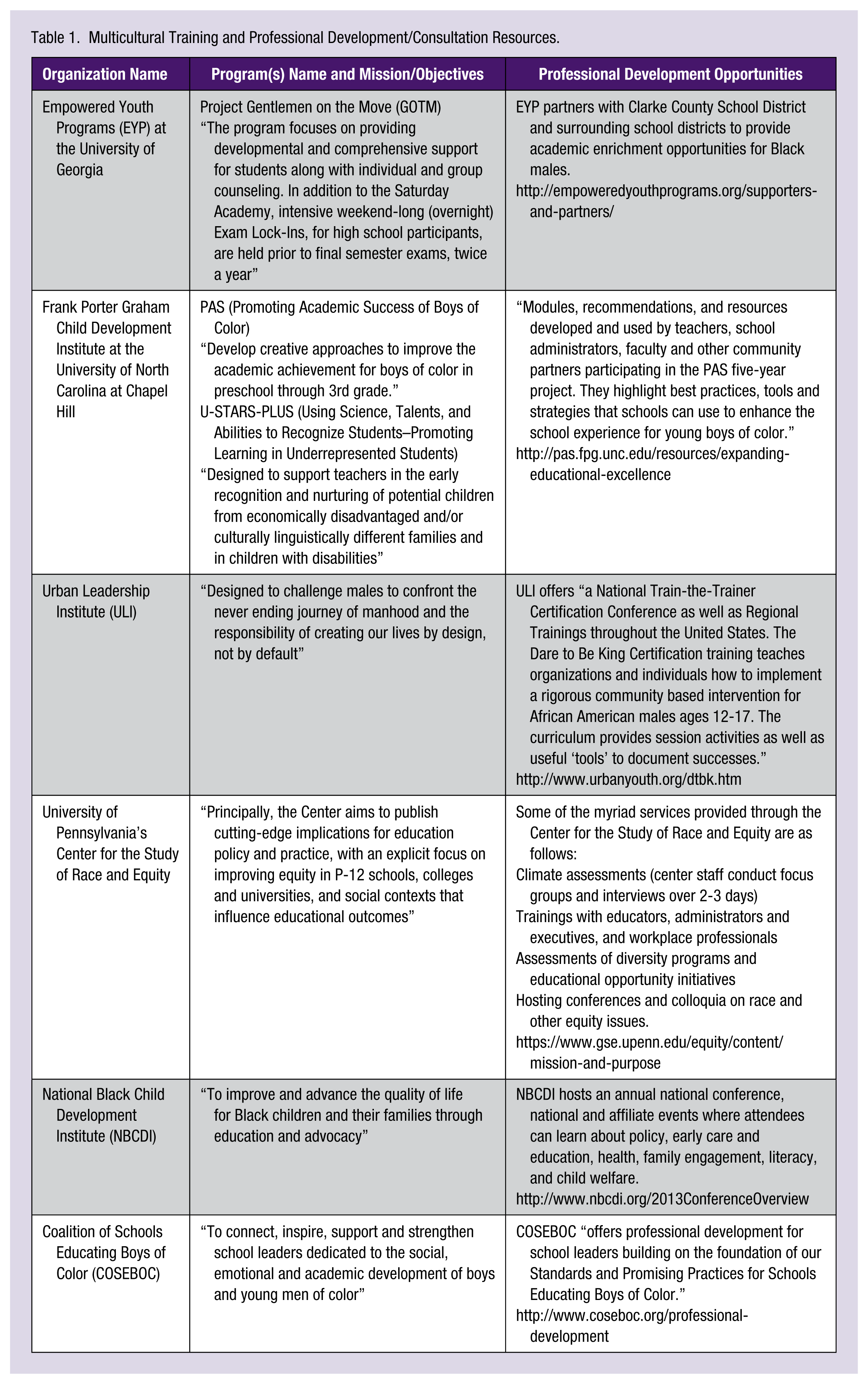
With regard to best practices, there is an array of public and private organizations that finance and/or produce evidence-based scholarship that can inform school counselors’ professional development as well as the design and implementation of programs specifically for gifted Black males. In addition, many of these organizations offer seminars/professional development opportunities that professional school counselors could conceivable take advantage of. Table 1 illustrates some of these organizations. By no means is this table exhaustive; instead the reader is encouraged to see it as a condensed list of organizations that have shown promise in serving as professional development resources that can translate into practical strategies to support gifted Black males, educationally.
Multicultural Training and Professional Development/Consultation Resources.
Conclusions
Make no mistake, we all suffer when the academic potential of gifted Black male students go underdeveloped. Indeed, the inadequate support of the academic gifts of school-age Black male students has negative impacts on every conceivable facet of the American society—school, college, employment, to name but three. Moreover, the continued underdevelopment of gifted Black males’ academic potentials (e.g., Black males’ limited access to gifted programs, receiving inadequate support after entering gifted programs, and so on) is emblematic of the ongoing miscarriage of educational justice that assails too many non-White students. Professional school counselors can work to remove impediments to educational opportunity for gifted Black males by standing in solidarity with these students and advocating on their behalf. Professional school counseling interventions can assist in reducing achievement and opportunity gaps that currently plague gifted Black males.
Footnotes
Conflict of Interest
The author(s) declared no potential conflicts of interest with respect to the research, authorship, and/or publication of this article.
Funding
The author(s) received no financial support for the research, authorship, and/or publication of this article.
Bios
Malik S. Henfield, PhD, is an associate professor and program coordinator of the School Counseling and Counselor Education & Supervision programs in the College of Education at the University of Iowa. His research interests focus on high-achieving ethnic minority students in K-12 educational settings and ethnic minority students in graduate-level counseling programs.
Ahmad R. Washington, PhD, is an assistant professor in the Counselor Education program in the College of Graduate and Professional Studies at South Carolina State University. His research interests focus on Black males in K-12 educational settings with an emphasis on hip-hop culture.
Janice A. Byrd is a doctoral student in the Counselor Education & Supervision program in the College of Education at the University of Iowa.