




Abstract
Talent development plans are well-articulated representations of a district’s or school’s advanced learning opportunities. These plans show how a bright student progresses through the available programming and provide families with information about their child’s options and opportunities. In addition to reviewing the basic pieces of a talent development plan, this article describes the experiences of one school district that uses such a plan to help guide its improvement efforts, which include extensive use of community and private sector partnerships. Examples of district talent development plans are included.
“TD plans can also be useful to guide external partnerships and ensure that equity-focused actions are being actively promoted . . .”
Conceptual barriers also play a role in limiting the effectiveness of gifted education programs. Researchers argue each learner and teacher are inseparable from the context in which student learning occurs (Hardesty et al., 2014; Plucker, McWilliams, & Guo, 2017). For instance, consider the hypothetical example of two fourth-grade students who are very similar in ability but attending school in different districts. Even if their teachers are equally caring and instructionally skilled, we wouldn’t expect the students to achieve similarly as they move through their K-12 education. If they didn’t, we would ask questions about the curriculum (Sufficiently rigorous? Pre-differentiated? Place-based?), attitude toward excellence and excellence gaps within the school, presence of additional enrichment and acceleration options, and the extent to which community partnerships were in place to support advanced learning. We would be curious about the students’ family situation, examining aspects of race, ethnicity, social and economic class, and personal safety, and attitudes toward education and learning. We would want to see how each student interacts with all of these variables and their various peer groups. Last but not least, we would be interested in how the education context changes as the students move from preschool to elementary then middle and high school. Context matters as students move through our education system.
These practical and conceptual factors can often serve as barriers to successful programming, leaving educators demoralized—after fighting to maintain or expand advanced services, having those services not lead to the expected, positive outcomes can be frustrating. In our experiences, many of these barriers can be addressed with a creative approach to planning, which Plucker et al. (2018) referred to as talent development (TD) plans—a strategy for aligning identification and instruction, acknowledging and providing consistent contexts, and pursuing equity in advanced learning programs. In this article, we describe TD plans and illustrate their use with a case study of a school district that has made significant strides in rethinking its approach to advanced education.
TD Plans
In a review of state policies and student outcomes focused on closing excellence gaps, Plucker et al. (2018) concluded that states do not take a comprehensive approach to supporting advanced achievement or attacking excellence gaps. They noted that even states doing relatively well in addressing excellence gaps struggle to do so comprehensively:
they treat gifted education separately from Advanced Placement, which they address separately from dual enrollment and early graduation, which they see as distinct from school accountability issues. Approaching talent development in such a piecemeal, uncoordinated fashion leads to the patchwork policies that we witness in most states. (p. 30)
Plucker et al. (2018) also noted that, even in states making concerted efforts to support advanced education and close excellence gaps, there were few to no statewide documents or other resources describing “how a talented child might receive a rigorous, advanced education from preschool through high school graduation” (p. 30).
We see similar patterns in school districts: Gifted education policies and interventions focus on mid-to-late elementary grades; advanced learning in middle school tends to be overlooked; AP policies are treated separately, as are dual enrollment policies. The lack of coordination among these moving parts leads to dysfunctional TD systems that successfully address neither academic excellence nor excellence gaps. Districts should develop comprehensive TD plans that provide stakeholders with a comprehensive sense of how all pieces of the schools’ advanced learning work together to promote student development.
At a workshop on TD plans that we both attended, a superintendent commented that he clearly saw the need for such a plan—even as a superintendent with a child in the district’s gifted program, the superintendent had trouble answering their spouse’s questions about how their son would access the district’s advanced programs as he progressed into middle then high school! In our experience, this is rather typical: P-12 education tends to occur in silos, with little coordination across the various levels. Having a TD plan that maps out a student’s potential progression from preschool through high school graduation provides continuity, identifies holes in your current identification and programming, and makes it easier to engage community partners who can more easily understand your program’s activities and goals. We would also argue that a good TD plan helps you identify sources of inequity in your advanced program’s participation and outcomes.
Developing TD Plans for Your School
We often start our work with districts by asking two questions: How does a talented young child move through your schools from K-12? How would you describe the process/services to a parent of a talented child? In other words, if a parent of a bright, early elementary-aged child approached you at a back-to-school meeting, could you describe to them how advanced students are identified and move through each level of education in your district? Even better, could you hand them a one-page picture of the plan? In working with one district, we produced something similar to the basic plan included in Figure 1 (identifying details have been changed).
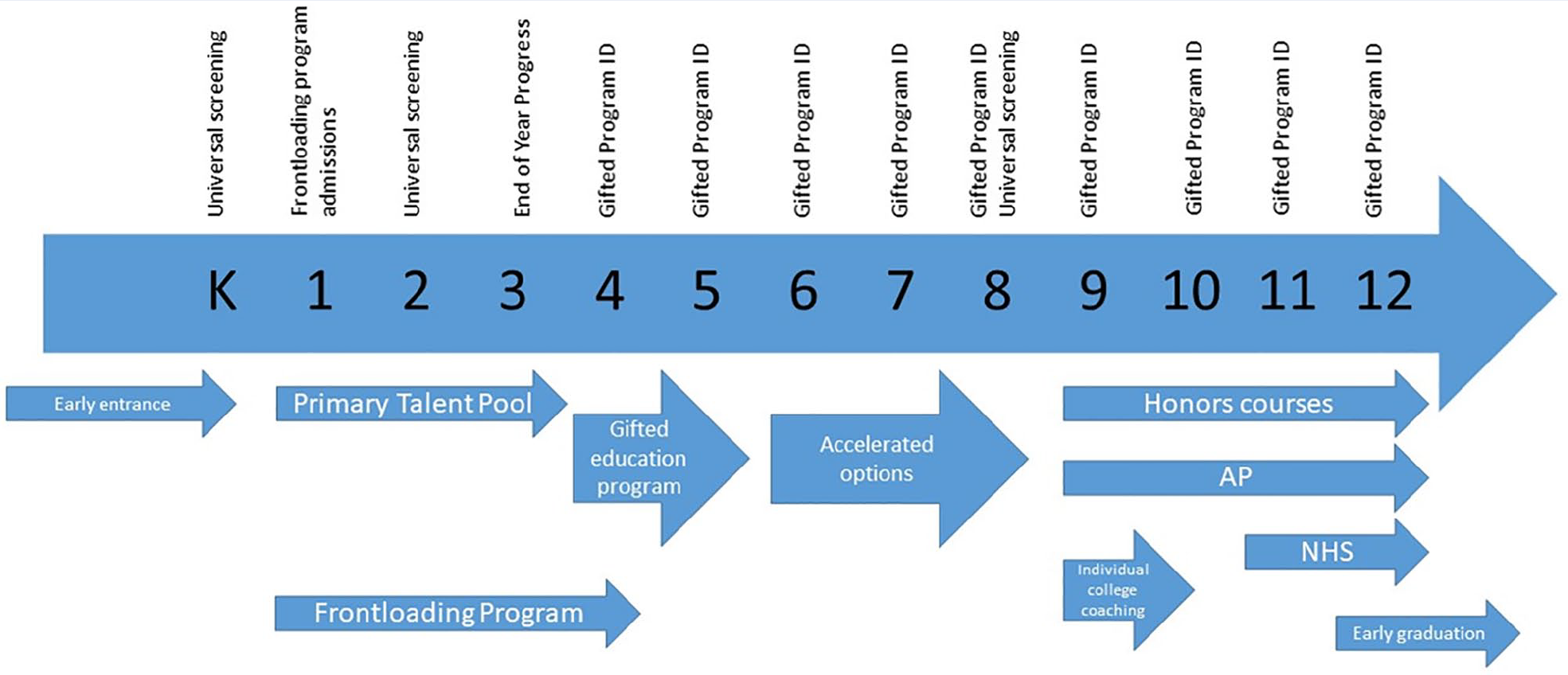
Sample talent development plan.
The process of creating this draft TD plan was fairly typical. The district’s leadership team drew the arrow that includes the grade levels, then the principals and gifted education coordinators decided to note pathways into advanced programming (i.e., identification systems) at each grade level. After that, they included relevant practices and programming. After completing this version of their TD plan, a lively discussion ensued: A teacher noted that they had not put much thought into transitions into and out of middle school for advanced students, wondering out loud if the teachers in each content area were talking to their colleagues at the other levels. This form of curriculum and programming articulation has been identified as a key strategy for closing excellence gaps (Plucker & Peters, 2016). Later in the process, a principal noted that strategies for honoring advanced achievement (e.g., academic honor societies, various academic awards) were concentrated in certain grades, most in late elementary and late high school (vs. athletic awards, which were more evenly distributed through middle and high school). This led to the district eventually adding a third row to their TD plan for academic awards and honors.
Creating TD plans is rarely easy. Many educators head into the process with enthusiasm, only to learn quickly that sketching out the pathway through their district’s advanced learning opportunities is difficult. Of course, that is why the process of thinking through alignment of services and transitions between levels is so critically important: If we struggle with creating TD plans as experienced educators and leaders, how are parents without that experience—and without knowledge of the entire school system—going to understand their child’s options and opportunities? This form of social capital is a type of educational privilege that does not need to exist; as educators we need to be able to show parents the plan to level that playing field.
When working with educators to create TD plans, we encourage them to follow the model of the district included above and include at least three distinct types of information across all grade levels: service delivery, points of entry (formal or informal identification), recognitions, and honors for advanced achievement. In addition, after initial drafts of the plans are created, we suggest educators ask themselves the following questions:
Did you include all of your excellence programs in your TD plan? (e.g., gifted, honors, AP, acceleration, grouping, academic counseling, dual credit, aid for economically vulnerable families)
Does your TD plan address transitions among grade levels? (often a key parent concern)
Have you included interventions and strategies for ensuring equity in participation and closing excellence gaps? (illustrated in Figure 1 by the elementary school frontloading program)
Once you are satisfied your TD plan accurately represents your district’s approach to advanced learning, the next stage is to examine it for gaps and things that have been overlooked. Should you be doing more in a certain area? If something is not working at, say, the high school level, does the plan suggest ways in which the high school program is less than ideally supported earlier in the timeline? Of course, TD plans are living documents, which should be continually revised and reconsidered as the school district strives to increase advanced achievement and eliminate excellence gaps.
Putting the Principles Into Practice
In the Frankfort (KY) Independent Schools (FIS), the gifted child has been positioned to accelerate their talents and forgo the traditional learning models of the 18th-century school house. Students and families in this small district of less than 1,000 students with a very diverse setting (over 65% free and reduced lunch) are provided with opportunities to ignite a child’s passion and deliver a pathway that is personalized. FIS has exploited the realities of using a congruence model (O’Reilly & Tushman, 2016) in ways that created a network effect of growth, significant positive culture changes, and ultimately reduced opportunity and excellence gaps (Plucker, Peters, & Schmalensee, 2017). This approach created a “new” way of teaching and learning thereby discovering unknown gifts and talents of students and unleashing the ambidextrous learner.
FIS engaged in a process in 2015 to determine the actual context of several categories: (a) operations and logistics, (b) teaching and learning, (c) equity justice, and (d) opportunities and access for each and every child. As a result, the district analyzed areas in depth using processes such as equity audits; Strengths, Weaknesses, Opportunities, and Threats (SWOT) analyses; process improvement practices; root cause analysis; smarter spending protocols; and other strategies. Part of these efforts focused on creating the district’s first TD plan (Figure 2). Collectively, these processes shaped the context and allowed FIS leaders (FIS Board Members and the FIS Leadership Team) to rework policies, practices, and procedures so every child would have a personalized learning pathway.
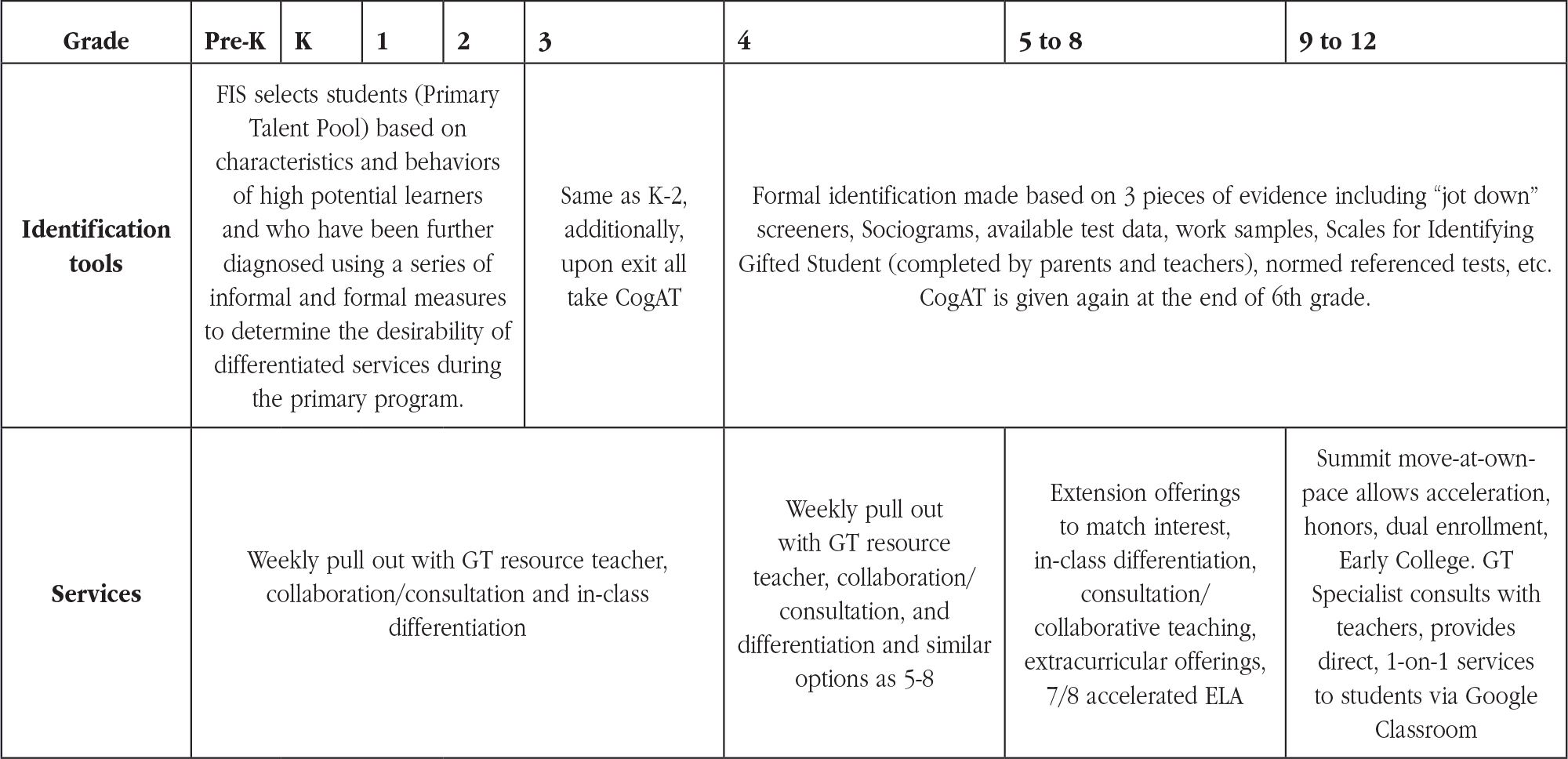
Frankfort (KY) Independent Schools talent development plan (selected sections).
By rigorously examining current practices and identifying weaknesses, the district was able to focus on creating actions, tactics, and implementation plans that created the best possible context for helping each students to become an ambidextrous learner—one who could be self-directed and think critically on their own, both in the classroom and in real-world situations. FIS embarked on a journey through an approach in which all students received social/emotional supports, academic/behavioral supports, and access to opportunity supports based on each and every child’s needs, much of which is supported by partnerships. Examples include full-time in-school counseling for each child and their family, partnerships to bring Mandarin instruction to the school system, and internship opportunities for each high school senior.
In addition, Frankfort High School began a personalized and self-directed learning program in 2016 in partnership with Summit Learning. Other examples of strategic actions include (a) partnership with Kentucky State University (KSU) with an emphasis on mentoring, early college, and Science, Technology, Engineering, and Math (STEM) education for students, with an emphasis on dual credit experiences; (b) Summit Learning partnership extending into fifth to eighth grades beginning fall 2020; (c) extension opportunities for students with creative learning goals; (d) 1:1 technology with free internet for each and every child in need (through a partnership with the City of Frankfort and T-Mobile’s EmpowerED); (e) collaboration with other local school districts on career pathways so that each child can choose any passion and not be penalized because we don’t offer directly at our schools; (f) Birth to Five development academies, training and development, and focus on early childhood supports; and (g) strategic partnerships with local businesses to focus on experiences and exposure for each and every child. All of these activities have been worked into the FIS TD plan. And as noted above, FIS educators do not see their TD plan as a static document; rather, they continually consult, revise, and improve both the plan and related activities.
One of the most in-depth partnerships was with KSU, which began as a result of a grant funded by the Kenan Charitable Trust. The primary goal of the grant was to engage our students and families of African American boys to experiment and grow beyond their comfort zones. KSU and FIS created a center for STEM so that these young men and others participated in highly robust learning experiences in STEM. The program removed barriers to access, which is a key component of efforts to reduce excellence gaps (Plucker, Peters, & Schmalensee, 2017). The FIS-KSU partnership became the foundation for additional joint activities, including the creation of programs for Early College, student mentoring, and teacher preparation.
This new approach to education—of which the FIS TD plan is only a part—gave birth to the vision of an ambidextrous learner—one who is self-directed, code switches back and forth across contexts, and gains access to opportunities in their areas of passion but with greater demand for effort to succeed in the face of rigorous challenges.
Conclusion
TD plans are not—and are not intended to be—a panacea. But as the example and case study illustrate, determining how all of a district’s advanced learning opportunities work together can be an invaluable planning aid for educational improvement, a communication tool that helps parents (and students!) understand the opportunities available to them, and a lens through which educators can examine their current programming and identify gaps and areas in need of improvement. TD plans can also be useful to guide external partnerships and ensure that equity-focused actions are being actively promoted, as shared in the description of FIS’ considerable recent progress in these areas. Finally, TD plans can be helpful evaluation tools, allowing educators to pinpoint possible causes when student outcomes are not achieved. Although creating TD plans is not easy—our colleagues always find it more difficult than anticipated!—the benefits of having a carefully constructed and maintained plan for advanced students’ learning and development are considerable and worth the effort.
Footnotes
Conflict of Interest
The author(s) declared no potential conflicts of interest with respect to the research, authorship, and/or publication of this article.
Funding
The author(s) received no financial support for the research, authorship, and/or publication of this article.

Bios
Jonathan A. Plucker, PhD, the Julian C. Stanley Endowed Professor of Talent Development at Johns Hopkins University, works in both the Center for Talented Youth and School of Education. He is the current president of the National Association for Gifted Children. His research examines education policy and talent development, with over 200 publications to his credit. He is the recipient of the 2012 Arnheim Award for Outstanding Achievement from the American Psychological Association and of the 2013 Distinguished Scholar Award from the National Association for Gifted Children.
Houston Barber, PhD, is the superintendent of Frankfort Independent Schools. He was formerly principal, science teacher, and coach in the Jefferson County Public Schools. He received his PhD from the University of Louisville in Educational Leadership and Organizational Change. His professional focal points include classroom administration and instructional design, organizational change initiatives, academic and athletic coaching, and numerous facets of educational technology, consultation, and program management.