




Abstract
Research suggests that experts and beginners use qualitatively different writing processes when given the same text to write. Throughout their writing, experts tend to create a network of executive, structural, and content problems that they continually refine and coordinate as they bring the text to fruition. Novices, in contrast, tend to focus on shallow, singular goals one at a time. This article reviews this research and then suggests instructional models to help talented writers develop this expert writing process across the elementary grade levels.
“A defining characteristic of expert writers is that they spend a great deal of time engaging in problem analysis and goal setting.”
Introduction
Testimonies of published authors are replete with comments that writing fiction never gets easy (M. L’Engle, personal communication, October 1, 1993; Weiland, 2013). And why should it? Over the course of a career, as one aspect of an author’s text construction process becomes effortless, there are always more constraints, more ways to make language precise, to tax cognitive capacity. As novelist Ali Luke (2011) wrote in a discussion of her process, when writing a single scene,
I have a heck of a lot to do. The characters need to feel real—they need to live and breathe on the page. The scene needs to be paced correctly—not too fast, not too slow. The dialogue has to sound natural, without actually being natural (have you ever listened to a transcription of real speech?) The voice needs to be mine—but filtered through the head of a character who might be nothing like me. The plot has to be moved on . . .
Luke does not even mention the integration of all these constraints, other considerations beyond character and pace, or how each decision she makes affects other decisions already made and decisions yet to come—all of which would place additional demands on her cognition.
Luke’s description of her writing process supports research findings that skilled writers use a complex problem-solving model in which a variety of cognitive operations are activated simultaneously. According to this model, experts view writing as a set of open-ended problems that must be solved and coordinated over time to produce a unified text.
The next part of this article details the contrasting models used by beginner and expert writers. This is followed by a differentiated instructional design for encouraging students to adopt the expert model across the grade levels.
The Beginners’ and Experts’ Writing Models
According to Berkenkotter (2001), writers’ problem solutions (i.e., their text) will be “determined by how they frame their problems, the goals they set for themselves, and the means or plans they adopt for achieving those goals” (p. 33). Bereiter, Burtis, and Scardamalia (1988) and Smith (1995, 2008, 2010) characterized the different ways beginners and expert writers engage in these processes as the knowledge telling and the knowledge transformation model, respectively.
Knowledge telling is the thinking process that guides beginning writers. This model is essentially a think-write method of composition in which text segments are retrieved directly from memory with little editing. Writers operating under this model begin by taking cues from the assignment or an understanding of the relevant genre to generate their first sentences. These sentences then provide cues for the next segment. The beginners’ model is characterized by focusing on one idea at a time (Bereiter et al., 1988; Smith, 1995). According to the knowledge telling model, beginners tend to create oversimplified, problem representations of the writing task at hand (Kozma, 1991).
The knowledge transformation model used by experts represents a very different intellectual way for engaging in the writing process. Writers operating under this model produce text by breaking the overall goal into three kinds of subproblems that must be continually coordinated, refined, and solved over time. The first kind is executive subproblems. These constrain or guide the entire writing process. Examples of executive problems might be “write for a knowledgeable audience” or “maintain a Shakespearean feel throughout.” The other two kinds of subproblems are structural and content. Structural problems relate to genre elements and literary devices that give the piece its form and style, but are content free. Examples of this might be “include an extended metaphor” (i.e., a conceit) or “include a child who solves the dilemma.” Content problems are those whose solution leads to the exact text the reader reads. Examples of these might be “compare love to a rose” or “have a young girl dance to ask the nature spirits to bring rain.”
The more problems the writer establishes, the more cognitively demanding the writing process becomes. This is because each solution can affect all the others. For example, deciding a main character’s personality could affect the setting. A depressed personality might have a dark, disorganized home. The setting and character, in turn, could constrain images used in metaphors, and so on and so on . . . Decisions are always tentative until the end—thus rewriting and continuity issues continue throughout the process.
For many students, beginning with the knowledge telling model is a normal step in their cognitive development. The problem comes when, as they progress through the years, they do not make the transition to knowledge transformation, but rather become efficient at the less demanding model. Therefore, as teachers, we need to provide differentiated instruction that guides all children to make this intellectual transition to the knowledge transformation model. This is particularly important for talented young writers because they can often make this transition at surprisingly young ages.
The rest of this article illustrates two projects that were both designed to help students discover and internalize the knowledge transformation model. I conducted the first one with a group of gifted second graders. These students wrote legends in the style of Native American folklore and published these in original pop-up books. I conducted the second with a group of gifted seventh graders. They wrote a modern “Shakespearean” play consistent with the five-act format and language of his romantic comedies. They performed it as readers’ theater.
In many ways, these projects could not appear more different, yet both followed the same format and made similar cognitive demands on the writer. This project format can be applied to any genre and any grade level. These sample lessons are presented as models for developing knowledge transformation skills across the grades.
The Curriculum Models
Phase 1: Structuring the Model
The goal of this introductory phase is for students to form an initial set of problems that are specific to the genre being studied. This set should include all three kinds of problems in the knowledge transformation mode: overriding executive problems, structural problems, and content problems. Regardless of grade, students begin by deconstructing quality examples of the relevant genre. These extracted features serve as the basis for forming the problems that will guide students’ own writing process. Before introducing this phase to your students, decide the project’s genre or model structure and have sample examples, both professionally created and student-created, if possible.
Begin the introduction by giving students a sense of the overall project and intended audience. I start by holding up one of the example texts and eliciting from students what they might know about the piece before reading it. If it is legend, for instance, they might know that some parts will be true and other parts fantastic. Students then read or listen to the piece to see which elements they correctly predicted. Later, students connect these elements to the three kinds of problems that expert writers address.
Second-grade instruction
All students in the grade had been studying Native Americans and were divided into project groups according to student interest, teacher recommendations, and previously completed writing samples. I took a group of strong writers. To begin, I explained that students were going to write a story in the style of a Native American legend. 1 Moreover, they were going to publish these stories as student-made pop-up books.
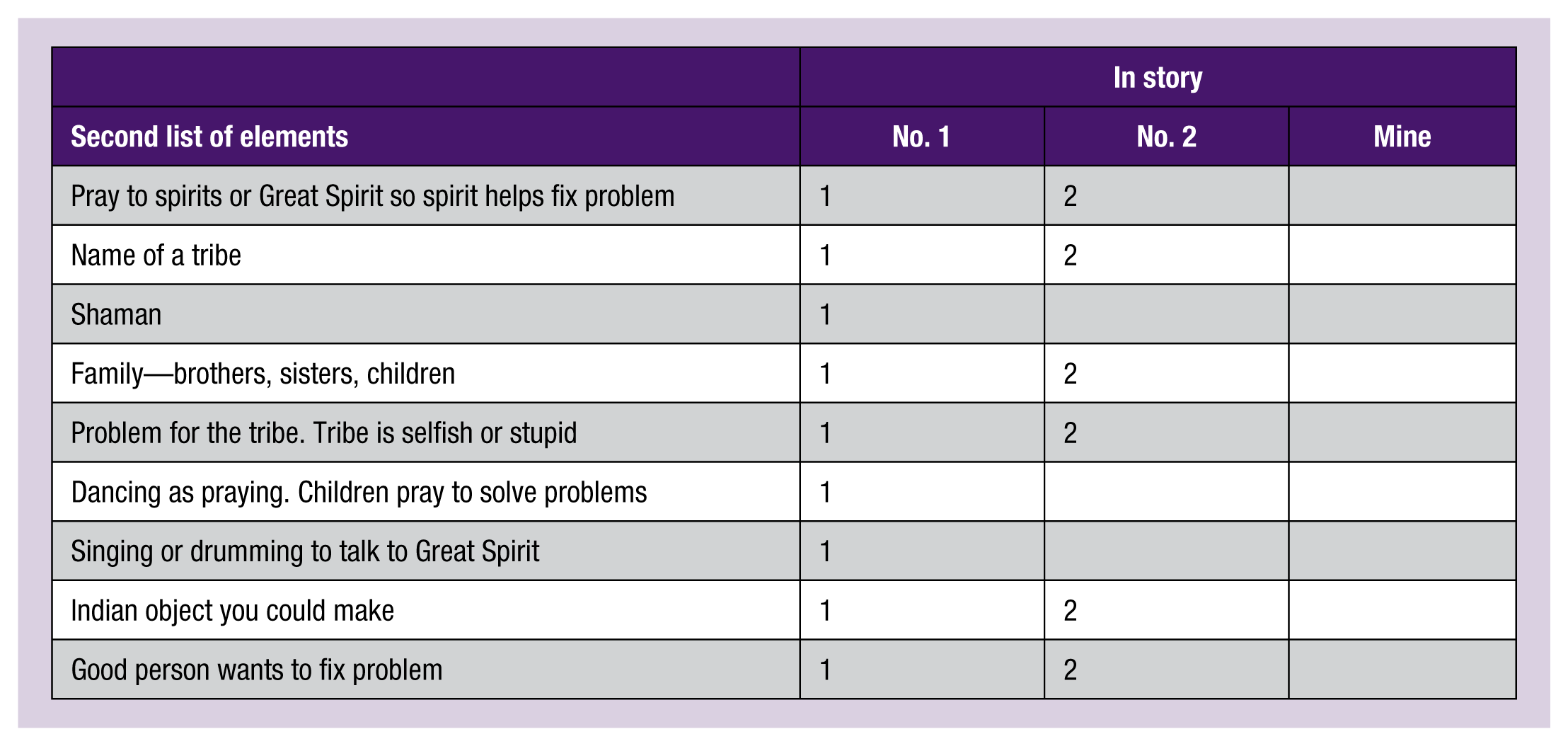
I numbered from 1 to 20 on the board, showed them a copy of Tomie dePaola’s (1983) The Legend of the Blue Bonnet, and asked students to predict both the features in the story that would make it a legend and those that would make it seem like a Native American story. These features could be either content items or items that characterized the way the story was structured. Group members proffered the following three items: partly true, Native American characters, and a problem. After writing these on the board, I explained that they had five mins to work in partners to list as many other items as possible. After five mins, I had them combine their lists to come up with what they agreed on were the 15 most likely items to be found in the story. (At this point, it is important to accept student’s own words, which may be quite general; that is, good characters, a problem.) I added the items to the list on the board; students only came up with nine items (see Appendix A for the list). I then told them that I was going to read the story aloud. When I had finished, we would see how many of the listed items were included in the story.
After having heard the story and discussing the moral which was “Sometimes a person needs to give up something important for the good of the group,” students wrote a number one next to each item on their composite list that was in The Legend of Blue Bonnet. I explained that in the next class, they would hear another Native American legend and that we would see if some of the numbered items appeared again or if some of the unnumbered items appeared for the first time.
For homework, students were to think if there were any other items that they might want to add to the list before hearing the second story. They were also to decide whether they wanted to make any of the items more specific—for example, they could say something about the kind of Native American characters they expected to find in the next legend.
Seventh-grade instruction
This was a differentiated language arts unit in which some students worked with the classroom teacher to study modern American playwrights while I worked with the remainder of the class on an Introduction to Shakespeare that I billed as “The Shakespearience.” Students were initially grouped according to test scores and writing samples, but all students in the class had the option to change to the other group.
As with the second-grade project, the goal for this phase was for students to form an initial understanding of the genre, the potential content, and the overriding executive constraints. So that students understood the context in which Shakespeare wrote, I began by introducing the playwright’s time. Because it was most students’ first experience with Shakespeare, I also introduced the general structure of his comedies so that they would know what to expect when they began to read.
The playwright’s time
I began by explaining that many people consider Shakespeare one of the greatest playwrights ever—a master of plot, character, and language. Although many people today think of his works as “high art,” in his day, he wrote for the everyday person. People went to his plays in the early 1600s much like people today go to the movies. Only in those days people brought rotten vegetables with them to throw at the actors if the play became boring. Therefore, Shakespeare had to grab an audience early and hold its interest.
The general structure
In laying out the goals of the project, I explained that students were going to study two of Shakespeare’s (2003, 2004) comedies, Much Ado About Nothing and A Midsummer Night’s Dream, 2 so that they could write their own play in his style. However, in doing so, students would gain insight into his use of structure, content, and language that would help them whenever they read any of his works in future classes.
I continued that all his plays begin in medias res, which is Latin for “in the middle of things,” meaning all the plays start after events that affect the story have already taken place. As students began reading, they were to pay particular attention to how the author informed the audience about these previous events. Besides telling pre-play plot events, act one also presents new events that lead to the central problem, or as I explained, “When writing your play include a ‘What could possibly go wrong with that?’ event.” A grand example of this is when Don Pedro says he will woo Hero on Claudio’s behalf. The high probability that this will go wrong is obvious.
I also explained that all his plays follow a five-act structure, but that the playwright never marked the end or beginnings of acts. Editors added these when the plays were published. (After all, where would people go during intermission? There were no bathrooms at the time.) The real transition from act to act is fluid, not abrupt (like the changing of the seasons), but each act has a particular function.
The language
Next, I explained that to appreciate Shakespeare fully, they had to appreciate his use of language. On the board, I listed the following: simile, metaphor, personification, puns, alliteration, and oxymoron. 3 Then, I elicited a definition and examples of each one that was familiar and supplied definitions for any terms that were not. I told students we would talk about Shakespeare’s use of these kinds of literary devices in detail later in the unit. For now, however, they should simply note any good examples of them that they came across in their reading.
Finally, I gave them a vocabulary handout and told them to keep it as a handy reference as they read (see Appendix B for the vocabulary handout). They could add words to it that they found difficult to understand and we would discuss these later.
Students then worked as a whole group to read aloud Act 1 of Much Ado About Nothing. 4 As they read, they paused after each scene to complete the following questions:
List the main characters. Write two or three words describing these people, focusing on their status, age, and personality.
What key events have taken place before the play begins? How do the characters find out about these events?
What new problems or events are introduced?
What is the setting?
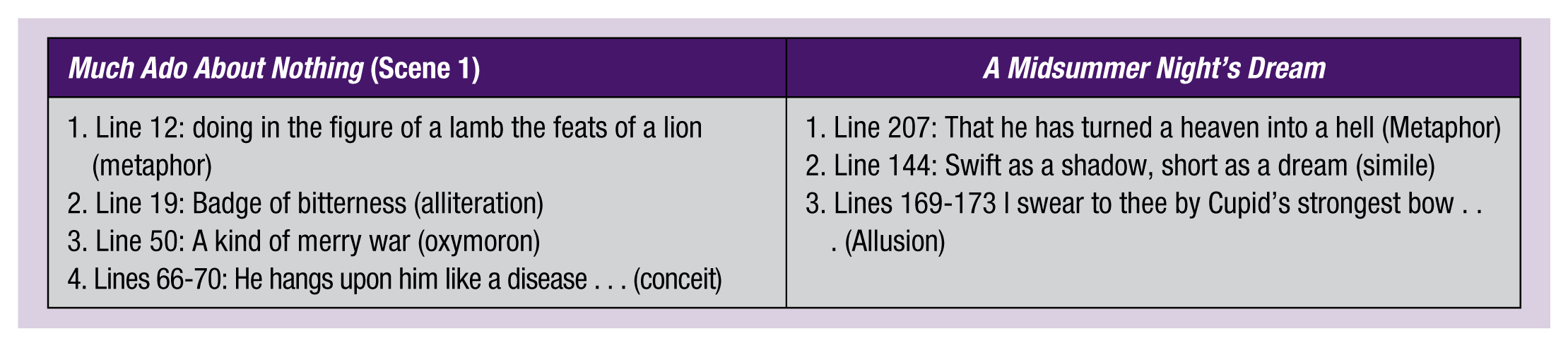
List any outstanding examples of metaphors, similes, or other literary devices that are in the act? (See Appendix C for their responses.)
After students completed Act 1, I hung up five sheets of chart paper that had been divided in half with a horizontal fold, each sheet being labeled with a number from one to five representing the acts in the plays. On the top half of sheet one, students compiled their notes and listed the answers to the five questions listed above. I explained that next students would repeat this process with Act 1 of A Midsummer Night’s Dream. In the follow-up lessons for this phase, we repeated this process for each act (see Appendix C for the completed chart).
Summary
According to the knowledge transformation model, a defining characteristic of expert writers is that they spend a great deal of time engaging in problem analysis and goal setting, particularly as it relates to genre and content problems (Deane, 2010). Therefore, in this phase of any writing project students learn that writers often begin by making initial decisions about the genre or structural components and the content components. Moreover, in this phase students also formulate executive problems. I present sample texts and guides students to deconstruct the writing process that result in the samples at hand. Students then emulate these steps to establish tentative goals for their own writing.
Phase 2: Defining the Set of Problem
In this phase students confirm, reject, or refine the tentative set of problems that they have already developed to guide their writing. Students begin by reading further examples of the goal text. If an element related to an overriding, structure, or content subproblem appears in all the studied examples, students should assume that it is a defining element and should be emulated in their original work. If something appears in one or only some of the sample texts, then students assume that it is a choice element and should consider it optional to include it in their original work.
Second-grade instruction
I told students that they were going to hear a second example of Native American legends. For the second example, each student read to the group from the book Dragon Fly’s Tale by Kristina Rodanas (1991; if you have class sets of the model text at hand, which I did not, students could read independently instead).
Before students read, I asked them to think about what topics, content, or themes were absolutely needed to be in the story to make it seem like a Native American legend. As an example of these kinds of defining elements, I asked whether or not there could be a Native American legend in which nature or animals did not play an important role. The group agreed that nature or animals would most likely play an important role in the story. They then decided that the story probably would not be about pineapples because the Native Americans did not value this food. I said we would come back to this idea of defining elements after reading the second story and decide which elements were essential to their legends.
After students finished reading the second legend, I asked if they wanted to make any elements in their first list more specific. As an example, I suggested stating the kinds of Native American characters they might expect to find (see Appendix A for this revised list of elements). In deciding this list, students were guided to replace such general phrases as “A problem and a solution” with ones more specific to the legends such as “A problem for the tribe because they are selfish or rude.” Sometimes, groups seem quite adroit at refining this list. At others, they seem stymied when asked to generate specific terms. In this latter case, I have students categorize the items on the list (e.g., supplies, people, and animals) and then list further category exemplars found in the books.
Finally, I explained that for homework, they had to decide in which region they wanted their story to take place and what was the problem around which they would focus their plots. I reminded them that their choice of region could affect the entire story. To illustrate this point, I explained how one writer in a previous year had two woodland tribes arriving at the same spot at the same time and holding a contest to see which tribe could grow a better crop. He had to change the contest in his story, however, because tribes in this area were nomadic. I then elicited other ways that their choice of region could affect their story (e.g., It tells what kind of houses they had. It tells what foods they ate and how they got it). Thus, “be true to region” is an overriding executive constraint.
Seventh-grade instruction
Second graders discussed the elements of the story but did not use the words “overriding,” “structural,” or “content subproblems” to classify these elements. Seventh graders, in contrast, learned these words to help them articulate their writing process. For example, the older student should have been able to recognize and label content-free structural element (e.g., multiple marriages) that reoccured in both comedies at hand. Similarly, at any point in the process, they should have been able to articulate the growing list of overriding subproblems that focused their entire effort (e.g., maintain a humorous mood, or maintain glamorous imagery).
I gave students copies of A Midsummer Night’s Dream and told them that as they read Act 1, they were to find ways that this play was similar to and different from Much Ado About Nothing. Before beginning, students were asked to write down a major way they thought that the two plays might be similar. Some responses to this activity included the following:
A couple who hate each other. They will end up together.
It would begin in the middle of things. This means something important to the story will have just happened.
A main character will be a prince.
Students next read Act I of A Midsummer Night’s Dream, acting some passages out as they read aloud and reading other passages silently before discussing them. They then returned to the bottom half of the piece of chart paper labeled Act 1 and answered the five questions for this play. In a whole-group activity, students decided which items were similar in both plays. These were color coded. For example, Beatrice and Benedict in Much Ado About Nothing and Oberon and Titania in A Midsummer Night’s Dream were both underlined in red and in a key at the bottom of the page, red was coded “an older couple who are fighting.” Similarly, “an Italian villa” and “a wood near Athens” were both underlined in green and labeled “romantic settings.”
The remaining four acts of both plays were read in this fashion; first they read an act in one play and then compared it with the same act in the second play. As with the second-grade project, defining elements were those in both works, and choice elements were those found in only one.
Before students read beyond Act 1, I overviewed the structures of Acts 2 through 5 as follows:
After comparing each act from the two plays, students worked in small groups to write brief summaries of the content as it fleshed out the structure they were given. They then met as a whole group to share their summaries of each act. 5
Summary
According to the knowledge transformation model, texts are generated as students solve three kinds of interactive problems: overriding executive problems, content problems, and genre or structural problems. For expert writers, much of this intellectual effort takes place before they take pen to paper—or fingers to the keyboard. Therefore, in this phase of the writing process, I encourage students to analyze more examples so that they can surmise further how the authors have narrowed and defined these three kinds of problems. This prepares students to establish similar kinds of decisions when writing their own pieces in the style at hand.
Phase 3: Understanding Figurative Language
In this phase students are guided to appreciate and create images and moods through figurative language. Apart from being part of the English Language Common Core Standards beginning in Grade 2 (L.2.5. Demonstrate understanding of figurative language, word relationships, and nuances in word meanings), figurative-language options help the writer create an exacting impact on the reader.
From a cognitive perspective, figurative-language options are created through the knowledge transformation model, but on a micro level: The overriding goal is to create an image that evokes a particular response from the reader. This goal is achieved by selecting a certain figurative-language structure and fleshing it out with content. Through the images in the figurative language, the author encourages the readers connect something familiar with something with which it is not usually associated (see Smith, 2010, for a discussion of teaching the tenors and vehicles in metaphorical language).
Students typically enjoy the additional intellectual dimension these add to their writing. Regardless of grade, to introduce students to literary devices, I simply offer the first two student-written examples listed below. With older students, I also include the third one, which is excerpted from Martin Luther King’s I Had a Dream speech. After students decide the tenor (the original subject) and the vehicle (what the original subject is being compared with), students write their own examples.
To read plants a seed. (metaphor by Gunner S.)
A child waited alone in the harsh desert climate, a gentle warrior in the wind storm, standing still, like a fortress against an attack. (oxymoron and simile by Roger H.)
One hundred years later, the life of the Negro is still sadly crippled by the manacles of segregation and the chains of discrimination. (metaphors)
Second-grade instruction
From The Legend of the Blue Bonnet, a student reread the following simile: “ . . . beautiful flowers, as blue as the feathers in the hair of the doll, as blue as the feather of the bird that cries ‘Jay-jay-jay (,).’” After explaining why this is a simile, I asked the students why the author might have included these comparisons in his writing. The group came up with the following explanation, “It makes the readers feel and see something like the author does.” Students then picked something important to Native Americans and use this to create two similes with the same vehicle—following the style of Tomie dePaola in the model. For example, “as free as the wind in the desert, as free as the wild horses that run in the hills” (Naya R.). I then told the students that for their stories, they could either include these similes or create new ones using the same form.
Seventh-grade instruction
I began by explaining that Shakespeare was a master of language, one of the best ever, and that his words often had double or even triple interpretations. The first device I introduced was oxymoron, the juxtaposition of two contradictory terms. I then had someone read Romeo’s speech from Act 1, Scene 1 of Romeo and Juliet, where Romeo is describing his unrequited love for Juliet’s cousin: “O brawling love! O loving hate! / O anything of nothing first create! / O heavy lightness, serious vanity! / Misshapen chaos of well-seeming forms! / Feather of lead, bright smoke, cold fire, sick health!”
More than recognizing oxymorons or simply thinking these examples are clever, students need to understand that they represent moments in which the speaker feels contradictory sentiments. Therefore, I focus the discussion of this passage on two questions. First, I ask, “What might be Romeo’s conflicting feelings about love?” Then I ask the key question for an author, “Why does Shakespeare have Romeo use oxymorons to describe his feelings for Rosiline?” Their answers generally focused on the fact that he was both tormented and enraptured by love and that by juxtaposing opposite images, Shakespeare heightens Romeo’s conflicting feelings. Next, students read the beginning of Much Ado About Nothing, where Leonato characterized Beatrice and Benedict’s relationship as a “merry war.” Students first discussed how the relationship is a battle and that this alone would be a metaphor, but by adding “merry,” Shakespeare adds another dimension to the description—that the battle is one the characters enjoy.
This kind of discussion was repeated throughout the reading with other literary devices. Students generated examples of each that reflected moments of strong emotions in their anticipated plots. Which ones and how many you choose to discuss depends on the level of complexity you expect in students’ writing. Following is one of my favorite examples of a student-created extended metaphor. It is from the groups’ final script, and is an expression by a hockey star of his love:
Oh Hannah
Seeing you makes me feel the way I did when I was drafted by the Blackhawks. When you laugh, it is like a thousand fans cheering. Your eyes sparkle like the ice I skate on. You hair is more beautiful and glamorous than a dozen playoff beards. Your smile makes me smile bigger than my playoff hat trick did . . . Oh Hannah, you make me feel like a slap shot has hit me in the heart.
Lily H. and Bryna C.
Summary
Metaphorical use of language is a hallmark of many great writers (Thompson, 2007). One cannot emulate Shakespeare without it. Moreover, creating such literary devices is a demanding cognitive problem that requires the “projection of one schema (the source domain of the metaphor) onto another schema (the target domain of the metaphor)” (Moser, 2000).
Such literary devices align well with the knowledge transformation model as they require both an understanding of the device’s structure and of particular content. The more a writer strives to include a variety of figurative language, the more the processing load. Thus, by adjusting the requirements for figurative language the teacher can lessen or increase the intellectual demand that is required to complete a text.
Phase 4: Creating the Text
By this time, writers should have completed much of what good writers do before drafting text—determining a set of problems that will do the following: guide the overall drafting process, structure the story, provide a sense of content, and suggest particular literary devices to be included. In this next phase, students make tentative attempts to solve and coordinate their solutions to these problems before drafting.
Second-grade instruction
Students had to complete two steps before they began to draft their stories. First, they were given a Legends Worksheet. This was a photocopied sheet divided into quadrants. These were labeled Characters, Setting, Problem, and Solution. In each quadrant, students listed or summarized the appropriate aspects from their planned stories. Erica, for example, listed “boy, girl, two spirits, and towns people” under character and “an Indian village in a cornfield in the desert” under setting. On the back of the sheet, students listed a reason for the legend. This was the moral or value the story would teach. Next, students each received a copy of the list of elements that they had generated from reviewing the two stories. In the fourth column (the one to the left of the two columns containing the numbers for the elements found in the two studied legends), they wrote their initials next to elements that they would use in their writing (see Appendix A). For example, in the row labeled “Dancing as praying. Children pray to solve problems” students wrote their initials if they were going to include this element in their stories. In their own legends, students had to include all the essential elements that were in both legends. Students could include any other listed elements that they wished.
Once these two sheets were completed, students shared their ideas with the entire group. Group members and I made suggestions, usually dealing with continuity or specificity. Surprisingly, few changes were needed in all but one of the legend plans. Students then began word processing their stories.
Seventh-grade instruction
Students began this phase by formulating their own play in a whole-group brainstorming session. First, they discussed possibilities for their play’s five most essential structural elements: (a) end with at least two weddings, (b) have the main characters be important, (c) pick a glamorous setting, (d) have something significant take place before the first act begins, and (e) include a plan that involves a disguise and have it go terribly wrong. Students then selected three choice elements: (a) two muses to fulfill the role of fantasy characters, (b) one couple would be young and inexperienced and one would be older, and (c) Madonna would be the villain who at the end would be punished for her misbehavior.
Students next developed a list of characters for their play. Highlights from this follow below.
Character List
secretly dating Madonna. Love has made him stupid. Recently broke up with Hannah Montana.
hockey star, shy, nice, secret crush on Hannah. Friend of Spiderman
Threatened by Hannah, secret deal with muse to trade a boyfriend for a hit record. Does anything to stay on top.
muse of dance, angry because of bad experience with human man. Wants her sister to stay away from them.
After students completed the character list, I hung a 6-ft length of white butcher paper on the wall. The paper was divided into six equal-sized columns. In column one, students listed key overriding constraints that would unify the play and maintain a Shakespearean feeling. These were (a) maintain characters’ personality throughout or have characters learn a lesson that changes their personality, (b) include at least three literary devices in each Scene and have these match the personality of the speaker, and (c) follow the five-act structure. Throughout the rest of the writing process, students often had to articulate how they were achieving these constraints.
Next, I wrote the numbers one through five across the top of the remaining columns. The group reviewed the function (i.e., the structure) of each act. Under the act’s corresponding number on the chart, students generated a list of short sentences describing the content that would flesh out the act’s structure. These sentences were divided into related groups to establish the scenes within the act. For example, Act 1 always begins in medias res, introduces the characters and establishes their relationships, reveals the glamorous setting, and provides new events that need to go wrong later in the play. In providing the content for this act’s structure, students listed the following details:
Act 1
The 1st phone call
Spidey and Madonna argue on the phone. He wants to go public about their relationship. She says it is too soon after his breakup with Hannah Montana.
Madonna is focused on winning the Video Music Awards (VMA) that night. She is up against Hannah.
Madonna had a soliloquy about her hatred for Hannah. (A conceit about a weed in a garden.)
The 2nd phone call
Spidey calls Patrick Kane (PK). He tells PK that he no longer has a date for the VMA.
PK agrees to go with him.
On the red carpet outside VMA
Fashion commentary with focus on Madonna.
She is snubbed when Hannah arrives. Hannah’s dress is eco-friendly.
Spidey and PK arrive. PK loves Hannah after hearing her speech on eco-friendly clothing. (A conceit comparing her to all things beautiful.)
PK and Spidey fight over Hannah.
In Madonna’s dressing room.
Madonna and Terpsichore fight because Madonna has not found Terpsichore a boyfriend and the muse has not given Madonna a number one recording.
Madonna tests Spidey’s love by asking him to trap Hannah in a web.
Madonna plans disguise herself as Hannah and then ruin Hannah’s live song presentation.
Students then worked either alone or in partners to draft the scenes.
Summary
In this phase, students use what they have discovered from deconstructing model texts to set up the problems and tentative solutions that will become their texts. This allows students to put the knowledge transformation model into operation. That is, they begin solving these problems either by fleshing out chosen structures with specific content or organizing content with selected structures. They have also articulated the overriding executive constraints that focus this interaction between content and structure.
Phase 5: Production
According to the knowledge transformation model, extensive planning and establishing a network of problems is characteristic of expert writing. The more problems writers have to solve and coordinate, the more complex the task becomes. This is the key to differentiating the unit. I have found that all students in the group can participate in the previous phases, and that I can differentiate instruction at this point by adjusting the number of problems that each student should strive to solve.
Students now generate text to solve their established problems. At any grade, when I am trying to have students internalize the knowledge transformation model, I like to have them draft and share about a page of text a day. In younger grades, students use bigger fonts so less writing per page. Each editing session starts with someone offering a comment on an aspect of the proffered text that was particularly successful. Comments such as “I liked it,” while typical of all grade levels, do not help writers know if they are achieving their goals. Therefore, listeners or readers are encouraged to explain precisely what was successful about the segment. Similarly, the next comment needs to focus on a suggestion for bringing the piece more in line with a specific essential or choice feature. Comments such as “The metaphor doesn’t seem to match the character’s personality” or “I don’t understand why the boy took the corn” let the writer know how a reader might respond to the piece. Such comments thus offer specific suggestions for bringing the text more in line with the goals.
Second-grade instruction
Students took three sessions to write and edit. Before students printed their final copies, I went through each story and parenthetically added questions for the author to answer wherever something was unclear or missing. I explained that these were questions that readers might want answered when reading the books. Following is a sample of a student’s first and corrected versions.
When they got there, they found no buffalo. They (WHO? THE HUNTERS OR THE BUFFALO?) went away. (WHERE DID THEY GO?)
When they got there, they found no buffalo. The hunters thought they could not find any buffalo so they returned back to the circle of teepees. Ilanna F.
After making their final corrections, students made pop-up books with their legends. To make the cover, each student completed the following steps:
Cut two 10 × 7 inch rectangles from an empty cereal box.
Center these rectangles side by side (with longer sides touching each other) on a 14 × 18 inch piece of upside-down wallpaper. (Try getting hold of wallpaper sample book.)
Fold two inches of the wallpaper overall round the edge of the cardboard and glued down.
Glue a piece of 8.5 × 11.5 colored construction paper over the remaining exposed cardboard to complete the cover. The wallpaper side becomes the outside cover and the construction-paper side the inside.
To make the book pages, students had typed their stories (some with my help) in a Word document using a 24 font. They reset the format to landscape with two columns; each column then becomes a book page. Be sure each of these pages is numbered and the total number of pages is a multiple of four. To make this multiple happen, students may need to add a title page or have a final page that just read, “The End.” If there is still a need for another page, students can add an illustration. To assemble the pages for the book, each student completed the following steps:
Cut the columns apart. Each column will be a page in the book. Pile the pages in order.
Collect one sheet of typing paper for 4 pages each. If, for example, you have 12 columns (i.e., 12 pages,) you will need three pieces of typing paper.
Lay the typing paper in a pile with the 11-inch edge being the width. Fold each sheet of paper in half.

Glue one column from step one to each side of the page. Begin with number one on the first half sheet, number two on the back, number three on the front of the next page, etc.

To make the pop-up,fold a piece of construction paper in half as you did the typing paper. Near the center of the fold, make two 1-inch horizontal cuts 1 inch apart into the page though both halves, creating the top and bottom of a square. Push this square into the page so that when it is open, there is a 1-inch square cube sticking up.
Students should think of the fold as the horizon. Above the fold, they can draw cacti, teepees, sky, clouds, and so on. Below the fold, they can draw ground, rivers, flowers, grass, and so on. Whatever they want to pop up (e.g., teepees, characters) should be drawn on a separate sheet of paper, cut out, and glued to the cube (see YouTube video on this process: http://www.youtube.com/watch?v=686DHL5kCC4 or go the following web site: http://www.wikihow.com/Make-a-Pop-Up-Card). For some students, making the pop-up seemed a particularly challenging part of the project. Many of them had difficulty understanding that the fold was the horizon and below the fold was the ground. One very talented writer kept drawing grass and trees above the fold and the roots of these plants below. For these children, I found it best to make specific suggestions about what to draw on each part of the picture.
To fasten the pop-up into their books, students first put the open cover wallpaper-side down on a table. Next, they placed the pages on top of the book cover so that the centerfold of the pages lined up with the center seam of the cover. They then placed pop-up between the middle pages of the book with half the pages on one side of it and half on the other. They then stapled through the pop-up, the book pages and the cover, using three evenly spaced staples. The staples went through the aligned folds of all three components. Finally, they folded the book closed and ran a piece of colored duct or bookbinding tape along the middle of the cover on the wallpaper side. This ran the length of the fold and covered the staples on the outside of the book.
Students shared their books with the entire grade and then placed them in the school library for a week before taking them home. Below is an excerpt from one student writer’s book.
From The First Rainbow
By Erica E.
Many years ago, when the people traveled the plains and lived in a circle of teepees, there lived a mom and her child. One day the mom and her child were painting as they loved to do. As always, they painted with just black and white colors that they made from crushed stones. And of course the rest of the tribe was pestering them to cook and not waste time painting . . .
Seventh-grade instruction
Throughout the final weeks, students always started with a review of the structure, language, content, and language constraints that hung on the wall. They then read their most recent works aloud and evaluated each other’s writing in light of how effectively it met the constraints and moved the entire work toward completion.
Finally, they held a fundraiser for the local animal shelter by hosting a play reading at night in the school cafeteria. There was never a clean final copy of the performed play because students were editing for language and continuity until the final dress rehearsal. The play took slightly less than 3 weeks to complete and prepare for the performance. I strongly believe that plays need to be performed; however, when the project’s emphasis is more on writing than acting, I am a proponent of a good oral reading in which the authors read the character parts.
Summary
In accordance with the model, students focus much of their writing process on delineating a network of problems. Once students have brought enough specificity and coordination to their problem network, they draft their texts. At this point, drafting and editing merged together into an iterative process. With each iteration, as some text takes shape, it may alter both previously drafted text as well as plans for upcoming segments. In repeating this cycle, students learn that writing may not be a linear process. This process continues until the text is finished and published.
“Finished” is a vague term for a writer and is often determined by time constraints set down by the publisher. From the beginning, students always knew when the piece was due. I always explain that this limitation is exactly what I had to experience when I wrote my books and what they will face if they become published authors. Therefore, no matter the format, I try to hold students to a deadline for sharing their work with an audience. Whether this means placing the book in the school library or performing it in front of an audience, the sharing of the finished work should be as close to those experienced by published writers as possible.
Conclusion
My philosophy for teaching children to write can be reduced to the following sentence: First find out how gifted and expert writers think, then develop curriculum that fosters this kind of thinking in students. Therefore, regardless of grade or genre, when teaching writing, I have students first deconstruct the expert’s writing process. Then, by reversing this process, they construct their own text.
By engaging students in this process over the years, I have seen them make the knowledge transformation model their own. In doing so, they come to understand that the fundamentals of writing are based on developing and coordinating a hierarchy of problems. At the top of the hierarchy are the executive, overriding problems that establish, coordinate, and focus the entire process. The other two types are structural and content. Structural problems are solved when the author selects content to flesh out selected formats; content problems are solved when students organize selected content is according to particular language patterns. Even for talented writers, however, composing never really gets easy. This may be because as some aspects of writing take less effort, there are always new problems to integrate into the mix.
Thus, the goal of school writing assignments should be to continually reinforce the dialogue among the three kinds of problem. This is what good writers do and what student should emulate (see Smith, 2008, for a sixth-grade instructional unit using this model to help students create original mysteries). In 1938, Somerset Maugham wrote that “good style should show no signs of effort. What is written should seem a happy accident.” Some of the writing process will always seem a mystery. Instruction in the use of the knowledge transformation model, however, should give your students some insight into how this “happy accident” happens.
Footnotes
Appendix A
| In story |
|||
|---|---|---|---|
| Second list of elements | No. 1 | No. 2 | Mine |
| Pray to spirits or Great Spirit so spirit helps fix problem | 1 | 2 | |
| Name of a tribe | 1 | 2 | |
| Shaman | 1 | ||
| Family—brothers, sisters, children | 1 | 2 | |
| Problem for the tribe. Tribe is selfish or stupid | 1 | 2 | |
| Dancing as praying. Children pray to solve problems | 1 | ||
| Singing or drumming to talk to Great Spirit | 1 | ||
| Indian object you could make | 1 | 2 | |
| Good person wants to fix problem | 1 | 2 | |
Appendix B
Appendix C
| Much Ado About Nothing (Scene 1) | A Midsummer Night’s Dream |
|---|---|
| 1. Line 12: doing in the figure of a lamb the feats of a lion (metaphor) | 1. Line 207: That he has turned a heaven into a hell (Metaphor) |
| 2. Line 19: Badge of bitterness (alliteration) | 2. Line 144: Swift as a shadow, short as a dream (simile) |
| 3. Line 50: A kind of merry war (oxymoron) | 3. Lines 169-173 I swear to thee by Cupid’s strongest bow . . . (Allusion) |
| 4. Lines 66-70: He hangs upon him like a disease . . . (conceit) |
Acknowledgements
The author thanks the GATE teachers of the Las Vegas school system for their input into the content of this article and Mitchell Putlack for his proofreading.
Conflict of Interest
The author(s) declared no potential conflicts of interest with respect to the research, authorship, and/or publication of this article.
Funding
The author(s) received no financial support for the research, authorship, and/or publication of this article.
Notes
Bio
Kenneth J. Smith, PhD, works at Sunset Ridge School District 29 in Northfield, Illinois, a suburb of Chicago. He currently runs the district-wide enrichment program. He has also taught language arts at the Latin School of Chicago and educational statistics at National-Louis University. In 1995, Ken earned his PhD in cognitive psychology from Columbia University in New York. His work has appeared in journals such as The Middle School Journal and Gifted Child Today. Ken is the author of the book series, Teaching the Way Gifted Students Think, for which he received the NAGC Curriculum studies award. His new book, Engaging Gifted Readers and Writers has just been published.