



Abstract
With recent increased attention to engaging students in written mathematical communication, the Elementary Mathematical Writing Task Force has recommended specific types of and purposes for mathematical writing with the ultimate goals of communicating and reasoning: Exploratory, Informative/Explanatory, Argumentative, and Mathematically Creative. While it is recommended that all students engage in all types of writing, the mathematically creative type has specific implications for mathematically talented students. Justification for and ways to engage talented students in mathematically creative writing are presented and address the following questions: What is mathematical creativity? How can mathematically creative writing help meet the needs of talented students? And, what are the characteristics of a learning environment that fosters mathematical creativity and written communication?
Keywords
“Engaging students in written communication of their mathematically creative ideas positions them as practicing professionals.” The essence of mathematics is thinking creatively, not simply arriving at the right answer.
Over the past few decades, there has been increasing attention to the importance of developing communication skills within specific domains, including mathematics.
An important part of learning to be mathematical, whether in primary school or the university, is learning to take part in the discourse of mathematics, becoming a consumer and a producer of texts that are recognized as legitimately mathematical within one’s community. (Burton & Morgan, 2000, p. 450, emphasis added)
Organizations such as the National Council of Teachers of English have touted written communication in mathematics as an important tool for students to explore and share ideas (Whitin & Whitin, 2000). Yet, while oral discourse based on students’ reasoning and problem solving is a well-established recommendation in mathematics instruction (National Council of Teachers of Mathematics [NCTM], 1991, 2000), formal recommendations for engaging students in mathematical writing are limited, and the curriculum resources related to mathematical writing are widely varied. Furthermore, there is often a disconnect between recommendations and practice. For instance, these recommendations include engaging students in “constructing viable arguments and critiquing the reasoning of others” (Common Core State Standards Initiative [CCSSI], 2010b, p. 6) and “justify[ing] and explain[ing] ideas in order to make their reasoning clear” (National Research Council, 2001, p. 130). However, an analysis of nine third-grade student books from mathematics curriculum series uncovered that the frequency of mathematical writing prompts ranged from as few as one writing task per week to as many as two per day, and the types of prompts included asking students to explain what or why, describe observations, compose word problems, rewrite sentences, define vocabulary, write questions, or compare/contrast (Casa, Firmender, Colonnese, LaMonica, & MacSwan, 2015).
To address the lack of coherence among recommendations for engaging students in mathematical writing, the Elementary Mathematical Writing Task Force (Casa et al., 2016) considered the purposes for which students might be asked to write in their mathematics classes and recommended four specific types of mathematical writing (Figure 1) to leverage elementary students’ mathematical learning. The resulting recommendations have the overarching goals of students reasoning about mathematics and communicating their mathematical ideas through writing.
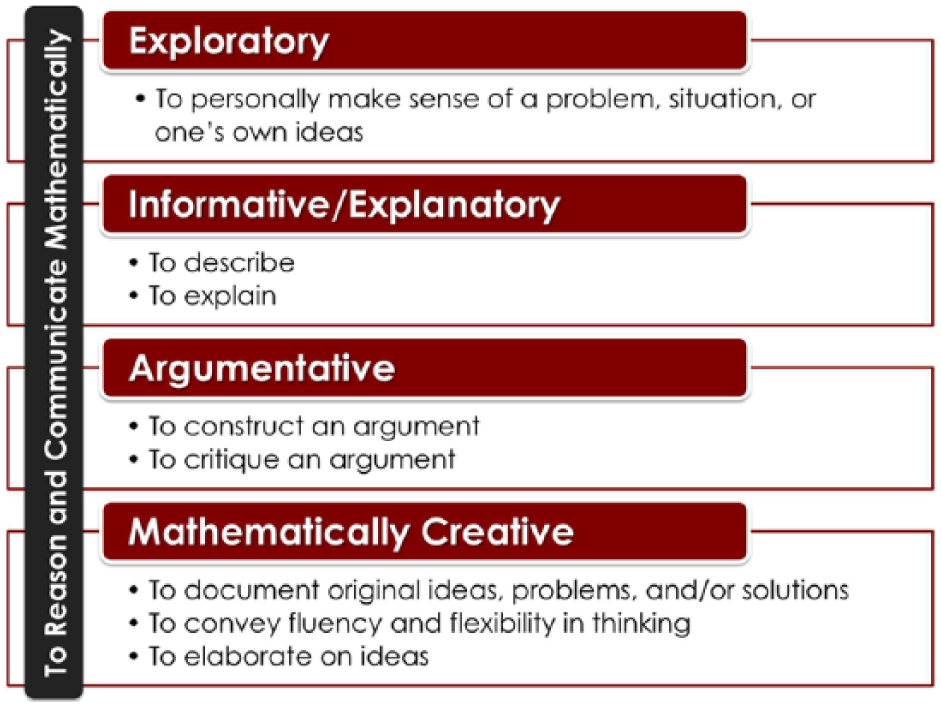
Types of mathematical writing.
Each of these types of writing provides students the opportunity to express their mathematical reasoning through written discourse, albeit for different purposes. While the informative/explanatory and argumentative writing are likely familiar to most teachers, as these types of thinking are embedded within many curricular materials and even the Common Core State Standards for English Language Arts (CCSSI, 2010a), exploratory and mathematically creative writing may be less familiar, but no less important. 1 Mathematically creative writing encourages students to think creatively in mathematics and to document their creative ideas. In an elementary context, this form of mathematical writing serves to help engage students in reasoning about and communicating originality, fluency, and flexibility of ideas, problems, or solutions. Recognizing the importance of engaging students in mathematically creative writing reflects the increased focus in recent years on creativity across domains, including mathematics (Johnsen & Sheffield, 2013; Kaufman, 2012).
While written communication and creativity in mathematics are important skills for all learners, the development of mathematically creative writing is especially relevant to meeting the needs of mathematically talented students who may have a tendency to be flexible in their thinking and demonstrate fluency and originality of mathematical ideas (Greenes, 1981; Mann, 2006). When creativity and written discourse come together in the form of mathematically creative writing, students are challenged to engage with high-level mathematical reasoning, discovery, and communication. Engaging students in written communication of their mathematically creative ideas positions them as practicing professionals who use mathematically creative writing as a tool to theorize or pose complex problems and to communicate proposed solutions and ideas to others.
For teachers striving to engage talented students in mathematically creative writing, there are several essential questions that must be explored: What is mathematical creativity? How can mathematically creative writing help meet the needs of talented students? And, what are the characteristics of a learning environment that fosters mathematical creativity and written communication?
Mathematical Creativity
Creativity is a vital part of advanced mathematical reasoning (Hadamard, 1945; Kaufman, 2012; Poincaré, 1910; Sriraman, 2009) and, therefore, mathematically creative writing. “Creative thinking [in mathematics] might be defined as a combination of logical thinking and divergent thinking which is based on intuition but has a conscious aim” (Pehkonen, 1997, p. 65). As in other domains, originality, fluency, and flexibility are inherent to creativity in mathematics (Balka, 1974; Guilford, 1957). These are demonstrated through divergent thinking and require the elaboration of ideas that are many, varied, and unique. In addition, originality is demonstrated through the generation of new and appropriate problems and solutions or approaches to problems (Plucker, Beghetto, & Dow, 2004)—whether imposed on or proposed by students. This “newness” or originality may be novel only to the student (e.g., a student discovering a well-known formula to solve a problem), or it could be new to the field of mathematics as a whole (e.g., positing a new conjecture; Kaufman & Beghetto, 2009).
Originality, fluency, and flexibility can play out in students’ mathematics experiences through both problem-solving and problem-posing applications. In problem solving, mathematical creativity is demonstrated when students approach problems in novel ways or find new solutions to existing problems through “engaging in a task for which the solution method is not known in advance” (NCTM, 2000, p. 52). When engaged in solving rich, complex problems, students are also engaged in mathematical reasoning—thinking analytically to “note patterns, structures, or regularities in real-world situations and symbolic objects” (p. 56). These problem-solving processes require students to understand the problem, develop and carry out a solution strategy, evaluate whether the solution strategy was effective, and revise the process if necessary (Polya, 1945). Therefore, it is important for students and teachers to remain open to the fluent and/or flexible use of strategies to solve problems in original ways.
In problem posing, also known as problem finding or problem formulation, mathematical creativity is demonstrated when students initiate the exploration of new questions. In fact, many of the problems addressed by practicing professionals are genuine inquiries posed by mathematicians themselves, often emerging as what-ifs that are inspired by existing problems, or that come about when attempting to generalize other patterns and ideas (Silver, 1997). Guiding students to “pose new mathematical questions of interest to investigate” (Johnsen & Sheffield, 2013, p. 16) or reformulate existing problems to explore may help nurture mathematical talent and develop more creative approaches by extending essential understandings to new situations and ideas. Through intentional opportunities for students to engage in both problem-solving and problem-posing applications, educators can foster mathematical creativity. “It is in this interplay of formulating, attempting to solve, reformulating, and eventually solving a problem that one sees creative activity” (Silver, 1997, p. 76).
Whether applied during problem solving or problem posing, mathematical creativity unfolds in a recognizable, albeit sometimes meandering process. Historically, it has been suggested that the mathematical creativity process generally consists of four stages: preparation, incubation, illumination, and verification (Hadamard, 1945; Poincaré, 1910; Wallas, 1926). More recent work provides further evidence that the process of mathematical creativity unfolds in such ways (Hansen, Lumpkin, & Hills, 2011; Lubart, 2009; Sriraman, 2009). These stages may progress naturally in order, or one may need to move back and forth between them numerous times before being able to find a solution. The preparation stage can be thought of as gathering materials needed to solve the problem, including activating background knowledge, setting the groundwork for incubation to occur. Incubation is a stage of rest, wherein one walks away from the problem for a while to allow the brain to continue working on the problem subconsciously. Illumination, which is the stage many people associate with creativity, is the “ah-ha!” moment that occurs often unexpectedly or while doing another task. Finally, verification is the stage when the mathematician tests the solution or strategy to determine whether it is a useful and appropriate solution. This is when mathematically creative writing is especially applicable as communicating mathematically creative ideas in writing allows students to share ideas and receive feedback from others to inform the verification process.
Developing Talent Through Mathematically Creative Writing
While quick fact recall and computation are often seen as indicators of mathematics ability, these are only two potential skills of mathematically talented students. Instead, characteristics of mathematically talented students include demonstrating the “ability to work with mathematical concepts in fluent, flexible, and creative ways; ability to transfer learning to novel situations; and tendency to formulate mathematical questions not just to answer them” (Sheffield, 1999, p. 3). These skills related to mathematical creativity are also mirrored by practicing mathematicians for whom “doing” mathematics is not enough; they also engage in mathematical communication to share ideas with others.
The field of gifted education provides a framework for meeting the needs of mathematically talented students—by engaging them as practicing professionals in a field (Renzulli, Leppien, & Hays, 2000; Tomlinson et al., 2009). By doing so, students are offered authentic learning experiences where they can think, feel, and act as practicing professionals. This means that teachers can engage “students as mathematicians” (Gavin, Casa, Adelson, Carroll, & Sheffield, 2009; Gavin, Casa, Adelson, & Firmender, 2013) by attending to the practices and processes that are authentic to the field of mathematics, including problem solving, reasoning, problem posing, communication (NCTM, 2000), and creativity (Johnsen & Sheffield, 2013; Pehkonen, 1997).
Engagement of mathematically talented students as practicing mathematicians can be evidenced in the ways teachers promote problem posing, problem solving, reasoning, creativity, and, ultimately, mathematical communication. By establishing the expectation that students should and providing opportunities for students to communicate their mathematically creative ideas through writing, teachers encourage mathematically talented students to communicate in ways similar to practicing mathematicians. The act of committing mathematically creative ideas to paper for communication to and verification from others mirrors the professional review and publication process of practicing mathematicians, where, “through their writing, individual mathematicians establish their identities within the academic community” (Burton & Morgan, 2000, p. 450).
Fostering a Learning Environment for Mathematically Creative Writing
Mathematical creativity cannot flourish, nor can mathematical writing take place, without an environment that supports it. It would therefore be unfair to suddenly request creative output from students when creativity was not previously encouraged. To maximize the potential for mathematically creative writing, a mathematically creative environment should be cultivated, one in which students are “expected to propose and defend mathematical ideas and conjectures” (Goos, 2004, p. 259) and engage in creative thinking.
A classroom community that fosters mathematical creativity emphasizes the importance of the process by providing adequate time, space, and opportunity for students to explore multiple perspectives, generate many ideas, or develop generalizations. Providing sufficient time for the creative process to unfold is a key characteristic of the mathematically creative learning environment because the creative process is not completed on-demand or on a preset schedule. Expecting students to have fully fleshed out mathematically creative ideas in a given class period will undoubtedly lead to disappointment. It is also important to recognize the spontaneous nature of the process, as “ah-ha!” moments, or instances of illumination, may occur at any time as students explore tasks and discuss mathematical ideas. These creative insights should be seized and celebrated in the moment whenever possible. This implies a need for classroom structures that are flexible enough to invite and honor time for development and sharing of mathematically creative ideas.
Similarly, the process of writing about mathematically creative ideas requires ample time, and it is these mathematically creative ideas about which students should be encouraged to write. The expectation that students engage in this type of writing may then be developed through encouragement and effort to promote not only the act of writing but also time to share, question, and respond to mathematically creative writing. When students develop and communicate mathematically creative ideas, it should be recognized publicly and positively in the classroom or to an authentic outside audience. This provides students with valuable encouragement and feedback, while also providing peer models of what mathematically creative thinking and writing can look like. As students piggyback on one another’s ideas and examples, they further enhance their own mathematically creative community.
In addition to attending to the time needed for mathematically creative thinking and writing, there are other strategies that teachers can use to establish a supportive and respectful mathematical learning community. These address ways in which to encourage mathematical creativity, engage students as practicing mathematicians, and foster mathematically creative writing. Table 1 highlights several strategies that could be used to promote such a learning community.
Strategies for Establishing a Supportive Mathematically Creative Learning Community

Note. NCTM = National Council of Teachers of Mathematics.
To highlight how these strategies may be used in the classroom, the following scenarios present ways in which teachers across the primary and elementary grade levels could encourage students to write about their mathematically creative ideas. The first scenario focuses on how a kindergarten teacher could engage her students in mathematically creative writing.
As Ms. Redd’s kindergarten class investigates strategies for adding within 5, she asked the students to determine the sum of 2 + 3. Partners were encouraged to explore their ideas by using manipulatives or drawing the situation and then to write or draw about their strategies. One pair’s strategy is to clap first by starting at 1 and calling out, “One, two,” then adding on three more. They discuss how they could just start with the number “two” then clap and count on three more: “three, four, five!” observing this group’s interaction, Ms. Redd noticed that Ross was excited to write about his ideas. He began by recording the numeral “2” and then drawing three hands to represent the clapping. The teacher also overheard his partner, Vera, wonder aloud about how she thought that the strategy might also work when adding hundreds. Ms. Redd asked Vera to explain this further, and she elaborated, “You start with two hundred, then [as she claps] you get 300, 400, 500!” Wanting to encourage Vera’s flexibility in applying the addition strategy from single-digit to multidigit numbers, Ms. Redd asked her to write about her strategy for how she determined the sum of 200 and 300 (see Figure 2) instead of the original 2 + 3 prompt that other students were working on.

This shows Vera’s mathematically creative writing to explain her addition strategy. The teacher originally asked the kindergarten class to write about their strategies for adding 2 + 3, and she encouraged Vera to record her application of these ideas.
Vera’s writing in this scenario would demonstrate mathematically creative writing because she had the opportunity to document how she flexibly applied the addition strategy to greater, multidigit numbers. In addition, while Ms. Redd encouraged multiple approaches and strategies to solving 2 + 3 and encouraged all of her students to engage in mathematical writing, she also recognized the creative ideas of her student and provided the time, opportunity, and encouragement for them to do so.
In this next scenario, Mr. Otero’s second-grade class has been working on analyzing the relationships between two- and three-dimensional shapes. During a free play period, his student Marco approached him holding the white parallelogram shape from the pattern block set. Marco continued to say that he did not think they should call this shape a “parallelogram” anymore because it was actually a three-dimensional shape. He suggested that it therefore should be called a “parallelepiped.” Another student, Jordan, overheard this and disagreed, stating that they had been calling it a parallelogram for years and should not change the name of it now. Mr. Otero, instead of telling Marco that he was correct about the shape being three-dimensional, encouraged both students to develop their arguments and record their points to present to the class. The students did so eagerly and presented the cases to the class, shown in Figure 3. The class subsequently reasoned that they should call the “white parallelogram” from the pattern block set by its more mathematically accurate name of “parallelepiped.”

These are the ideas Jordan and Marco recorded and presented to the class. They represent mathematically creative writing as they expand upon on an original problem posed by Marco.
Mathematically creative writing is highlighted in this scenario, when Marco and Jordan outlined their arguments because they were writing to elaborate on an original problem posed by Marco. This scenario also highlights several teacher strategies for encouraging mathematically creative writing. For example, Mr. Otero acknowledged that the students could pose and work on solving their own mathematical problems (in this case, What should we call this shape?). He also provided the time and space for mathematically creative writing (sharing their notes for a written argument), as well as an authentic audience (the class) with whom the students could share their mathematically creative writing.
In this last scenario, the students in a fourth-grade class have been investigating the properties of three-dimensional shapes. Recently, they learned that the definition of “vertex” is the point at which two sides of a two-dimensional shape or three edges of a three-dimensional shape meet. However, when analyzing the characteristics of a cone, the students were curious about why the “point” of the cone was also a called a vertex when it did not meet the definition they had learned. Recognizing that this was an important concept for this group of students, Ms. Turner told the class that they could further investigate why this may or may not be the case. While doing so, the students came across a website where they could ask a mathematician their question. Ms. Turner encouraged them to develop their question and send it in. The students developed their submission as an argument, stating that the “point” of a cone should have a different name because it did not meet the definition of a vertex.
This scenario highlights mathematically creative when the students developed their argument and question to send to the mathematician. Ms. Turner provided her students the time to pose new questions about mathematics, explore their question about the definition of the term vertex, and then to identify an authentic audience for their writing.
Conclusion
Mathematically talented students are “those who have the potential to become leaders and problem solvers of the future” (Sheffield, 1999, p. 310). Positioning students as mathematicians by promoting mathematical creativity and mathematically creative writing allows mathematically talented students to extend their understandings; seek new solutions, strategies, and applications; and actively participate in authentic mathematical discourse. By establishing supportive learning communities and creating intentional opportunities for mathematically creative writing, all students—and especially mathematically talented students—can gain experience and understanding of the art and practice of mathematics.
Footnotes
Conflict of Interest
The author(s) declared no potential conflicts of interest with respect to the research, authorship, and/or publication of this article.
Funding
The author(s) disclosed receipt of the following financial support for the research, authorship, and/or publication of this article: This material is based on work supported by the National Science Foundation under Grant No. 1545908, Task Force on Conceptualizing Elementary Mathematical Writing: Implications for Mathematics Education Stakeholders. Any opinions, findings, and conclusions or recommendations expressed in this material are those of the author(s) and do not necessarily reflect the views of the National Science Foundation.
Notes
Bios
Janine M. Firmender, PhD, is an associate professor at Saint Joseph’s University.
Anna Dilley, MA, is a doctoral student in the Department of Educational Psychology/Giftedness, Creativity, and Talent Development in the Neag School of Education at the University of Connecticut.
Christina Amspaugh, PhD, was a doctoral student and graduate research assistant in the Department of Educational Psychology/Giftedness, Creativity, and Talent Development in the Neag School of Education at the University of Connecticut at the time this work was completed. She is now an assistant professor at the University of Virginia.
Kathryn Field, MEd, is a doctoral candidate in the Department of Educational Psychology/Giftedness, Creativity, and Talent Development in the Neag School of Education at the University of Connecticut.
Steven LeMay, MA, was a doctoral candidate in the Department of Mathematics at the University of Connecticut at the time this work was completed.
Tutita M. Casa, PhD, is an associate professor in the Department of Curriculum and Instruction in the Neag School of Education at the University of Connecticut.