




Abstract
Federal attention is focused currently on investing and improving the quality of early childhood education, so that children’s potential and talent development can be used as a natural resource for the future of our country. This article engages readers in transitioning their thinking about early childhood gifted education from a traditional advanced skills-based approach that introduces young children to academic standards earlier and faster, to an education that honors the developmental stages of young children and the experiential emphasis that parallels how they learn. The framework proposed empowers teachers to design learning contexts that elicit talent, potential, and emerging abilities, and challenges all learners to display their strengths. Practical suggestions are given to develop a pedagogy that enables young children to learn in developmentally appropriate play-based and student-focused environments.
“It is more challenging for teachers to identify children’s strengths, interests, and abilities through curricular and instructional practices.”
The United States is focusing on early childhood education as proactive planning for a “better future.” States have changed their emphasis from educational policies that affect K-12 to those that affect prekindergarten. Many have initiated funding for “preschool for all” and universal kindergarten. The White House website confirms this priority: Expanding access to high-quality early childhood education is among the smartest investments that we can make. Research has shown that the early years in a child’s life—when the human brain is forming—represent a critically important window of opportunity to develop a child’s full potential and shape key academic, social, and cognitive skills that determine a child’s success in school and in life (Whitehouse, 2013). Together with federal awards, this amounts to a collective investment of over $1 billion in the education and development of America’s youngest learners (Whitehouse, 2014).
The time is right to attend to the quality of early childhood programs that develop talent and potential—to embrace pedagogies from gifted education that focus on challenge and student-directed learning. These are high expectations for early childhood programs to develop children’s full potential; unfortunately, practice does not always reflect engaging curriculum and instruction that truly develops and elicits students’ strengths and talents.
What Is Quality Early Childhood Education?
What are the components that determine quality in early childhood education? How can quality be monitored, measured, and improved? How do policy makers, administrators, and communities come to understand what’s best for their children? Highly controversial viewpoints surround these questions and the field. Katz (2008) in her speech to educators articulated four critical questions for early childhood educators:
What should be learned?
When should it be learned?
How is it best learned, taking into account our answers to the first two questions? These answers are usually captured by the term pedagogy.
How can we assess how well we have accomplished our goals?
Early childhood gifted education revolves around the facilitation of intellectual engagement and challenge in meaningful activities for young children. In this article, a framework is provided to design high-quality early childhood learning environments that develop talent and potential and respond to emergent abilities. They are appropriate activity-based environments where children are exploring the world through play with the active presence of teachers, where there is high teacher involvement and rich student-initiated learning (Miller & Almon, 2009). To develop these contexts for talent development, teachers, administrators, and gifted program coordinators must not only change their current focus on traditional academic skill acquisition but they must also change their thinking and assumptions about how gifts and talents should and could be identified and addressed in the early school years.
The current trend of a standards-based, test-driven curriculum at the kindergarten level contradicts what early childhood educators know about how young children learn. This framework argues against the assumption that to challenge young learners, they need more and/or accelerated traditional academic work to advance their cognitive development. Miller and Almon (2009) cited international research: “A cross-national study of more than 1500 young children in ten countries found that in every country children’s language performance at age seven improved when teachers let children choose their activities rather than impose didactic lessons” (p. 19). The same international study found that young children’s cognitive performance at age 7 improved when children spent less time in whole-group activities and more time working or playing individually or in small groups.
All young children need intellectually stimulating environments that optimally blend teacher-facilitated and child-initiated exploration. Play-based activities, project investigations, and artistic expressions facilitate explorations of the disciplines that make the context for students to think critically, creatively, and through a variety of perspectives. Katz advocated for in-depth learning for all children.
Unless children have early and frequent experience of what it feels like to understand something in depth, they cannot acquire the disposition to seek in-depth knowledge and understanding—to engage in life-long learning. (Katz, 2008)
Life-long learning and success in college and beyond start in the early years. Creating, implementing, and evaluating curriculum that challenges young children are not new but are based on ideas from Martinson, Piaget, Dewey, Vygotsky, and more recently aspects of the philosophy emerging from Reggio Emilia, Italy. The role that pedagogy plays in identifying and developing students’ strengths is the perspective advocated for early childhood gifted education.
Advocating for appropriate curriculum and instruction for advanced young learners is not the same as advocating for early identification of giftedness. Rather, we advocate for teachers to gain the knowledge, skills, and dispositions to create dynamic learning environments that promote students’ dispositions to learn. There tends to be reliance on intelligence or ability testing to identify and label gifted children because there is an assumption that giftedness is inherent and needs to be recognized formally. In early childhood classrooms, giftedness manifests itself as potential and needs to be stimulated. It is more challenging for teachers to identify children’s strengths, interests, and abilities through curricular and instructional practices than to rely on a score from aptitude or intelligence tests. Informal and ongoing assessment that recognizes the development of strengths and abilities is a goal of all early childhood educators. The focus on emphasizing student autonomy through experiential learning creates a difference between socializing students in school and socializing them on how to learn. It is critically important to model and support the disposition of “how to learn” at an early age.
Teaching children how to learn does not mean more worksheets, more didactic teaching, or acceleration of basic academic skills. Vygotsky would argue that children’s learning begins with play. Through play, children go beyond their proximal zone of development and push their thinking (Nicolopoulou, Barbosa de Sá, Ilgaz, & Brockmeyer, 2009). There is often confusion about the distinction between activity and play, so that it is perceived as meaningless rather than meaningful experiences for children. A misconception held by educators is that play is not educationally productive classroom time. Transitions to more activity-based learning that follows patterns described in the theories espoused by Dewey and others, and the need to place aside traditional concepts of what and when “giftedness” can and should be recognized, enable educators to rethink and restructure the curriculum and pedagogy for young children. Three critical beliefs and values shape the framework for early childhood gifted pedagogy:
All children should have provisions for challenge.
Challenge provides recognition for teachers and students of their strengths, needs, and their interests.
Teachers who create contexts to recognize strengths, needs, and interests respond to the variance in levels of readiness among learners.
Imagine entering these three early childhood classrooms (see Figure 1). Consider which of the following depictions of classrooms is most aligned to the current philosophical thrusts for students in Grades Pre-K-2 (the early years), and which of these classrooms could most answer these contemporary questions regarding early childhood:
What are the essential tenets of an early childhood curriculum and pedagogy that promote uncovering potential, talent, and/or emerging aptitude?
How can curriculum and pedagogy be used as a catalyst to uncover and challenge potential, talent, and emergent abilities?
How can teachers and parents of young students be helped to comprehend changes in the early childhood curriculum and pedagogy without affecting their concern for the teaching and learning of the perceived “basics?”
How can educators be assisted to realize that college readiness begins in the early years?
How can educators and parents be helped to understand and appreciate that activity-based learning or play is an appropriate learning strategy and the fundamental of the curriculum and pedagogy for students in the early years?
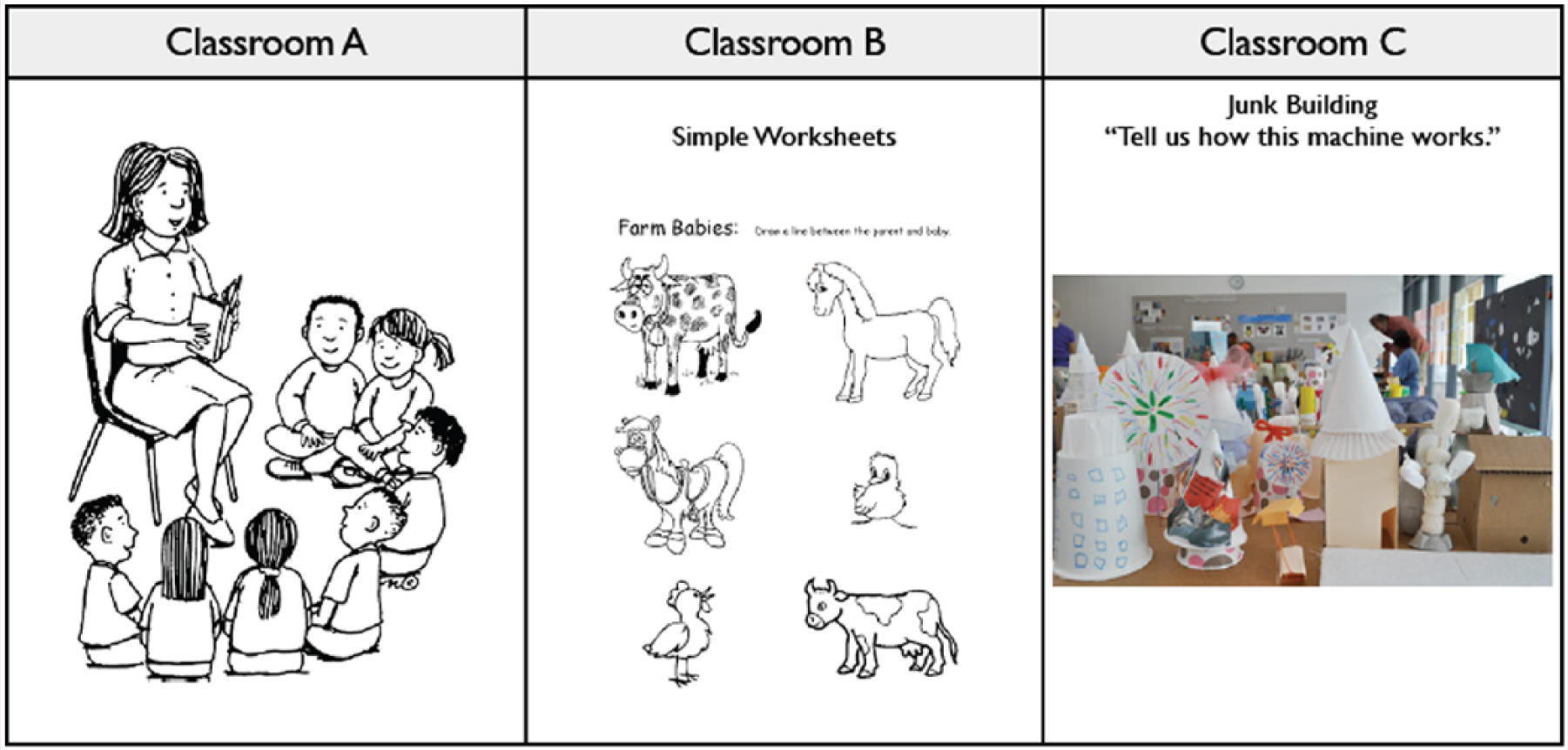
Three ways of learning.
MindShift—Transitions in Thinking About Early Childhood Gifted Education
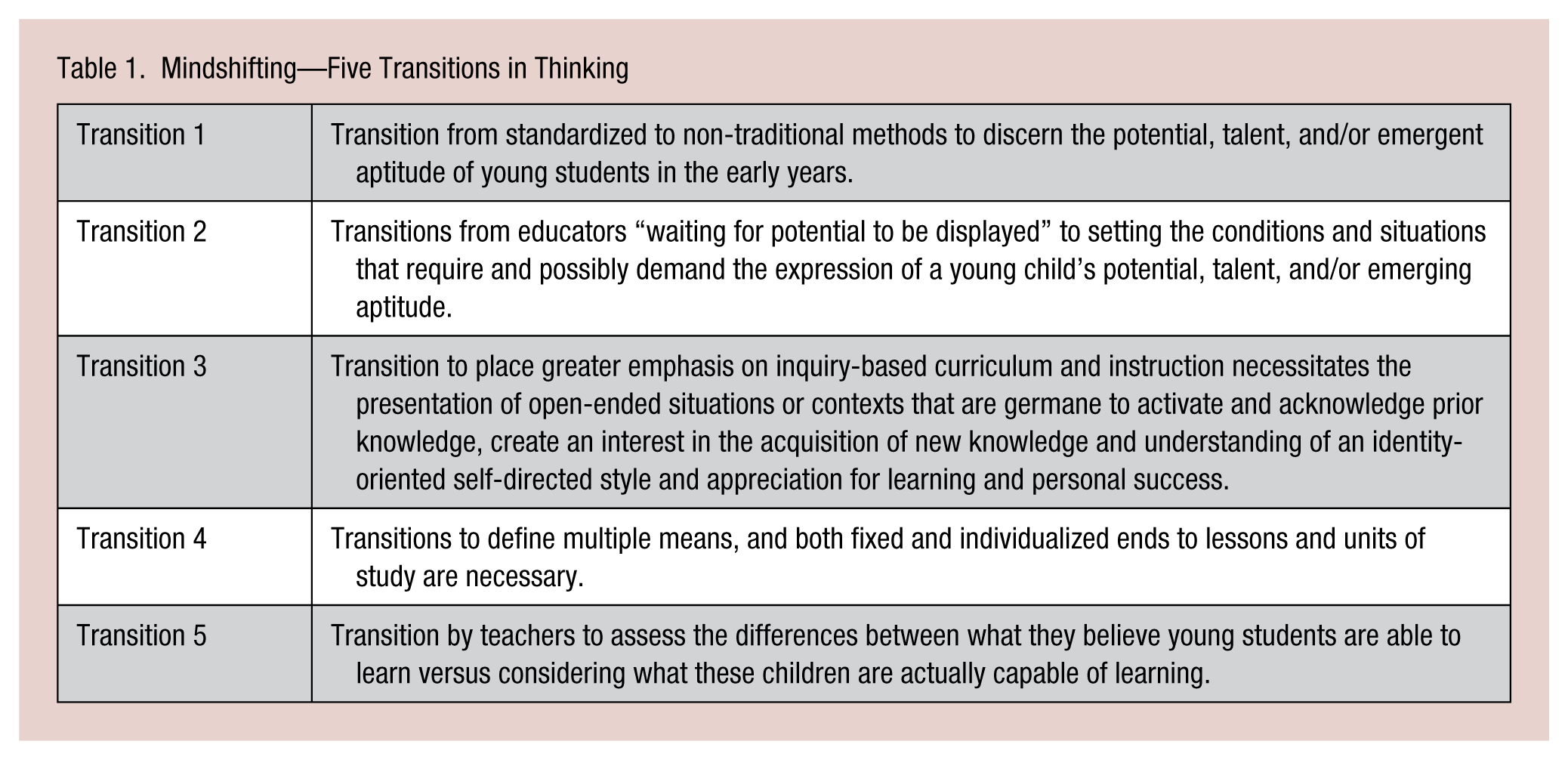
There are many transitions that are expected if the early childhood curriculum is going to be appropriate for all learners within this age group, and for the specific need to recognize and respond to potential, talent, and emerging aptitude or abilities of these students. The balance between traditional and transitional curriculum and pedagogy will be a worthy yet testing experience for educators. Following are five transitions that require intellectual dialogue and action among educators (see Table 1).
Mindshifting—Five Transitions in Thinking
Transition 1
Transition from standardized to non-traditional methods to discern the potential, talent, and/or emergent aptitude of young students in the early years. The literature is replete with controversies about both the age and instrument suggestions for identification. While many educators profess that the issues of early identification rely on factors extraneous to the process of schooling, there are many educators who profess that the identification of young children is dependent on schooling: curriculum, instruction, environment, and the attitude of educators about children and learning in the early years. There are many alternatives advocated to identify early childhood students, and these need consideration.
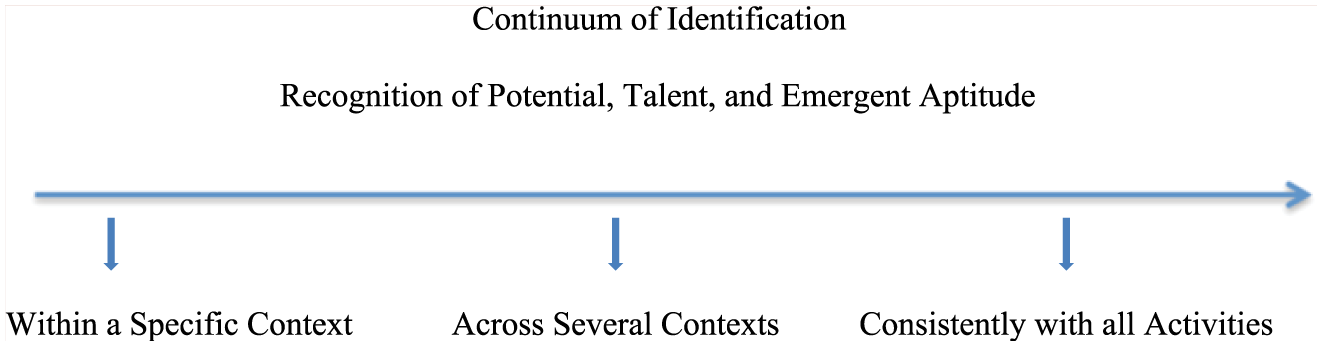
One suggestion is related to the concept of a Continuum of Identification stipulating a range of possible indicators to recognize potential, talent, and emergent aptitude. The process of identification associated with a continuum perspective allows educators to recognize students within a range of possibilities rather than relying on an absolute set of characteristics or single index. Implementing the Continuum of Identification places greater responsibility on educators to accept a more extensive and inclusive process to recognize and respond to potential, talent, and emerging aptitude.
Transition 2
Transitions from educators “waiting for potential to be displayed” to setting the conditions and situations that serve as a catalyst and potentially require, and possibly demand, the expressions of a young child’s potential, talent, and/or emerging aptitude. This transition transfers the responsibility for the display of potential to teachers who plan and construct an environment inclusive of learning experiences that promote and encourage the opportunities to display students’ abilities.
Transition 3
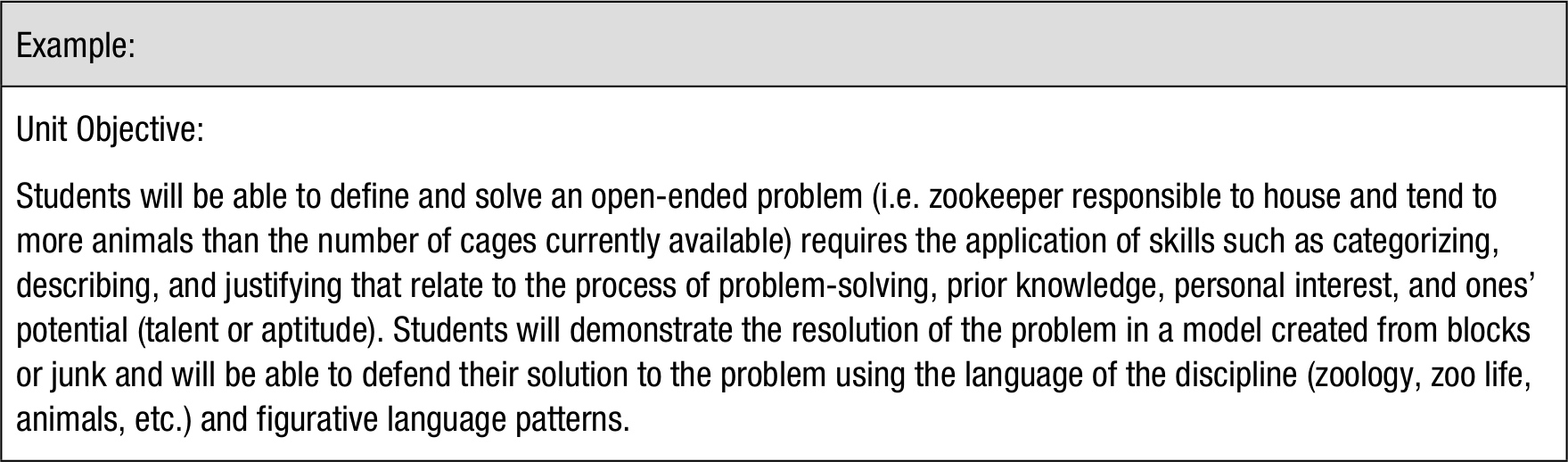
Transition to placing greater emphasis on inquiry-based curriculum and instruction necessitates the presentation of open-ended situations or contexts that are germane to activate and acknowledge prior knowledge, create an interest in the acquisition of new knowledge, and understand and enact an identity-oriented self-directed style and appreciation for learning and personal success. Inquiry-based strategies strengthen intellectual dispositions, as defined by Da Ros-Voseles and Fowler-Haughey (2007).
These dispositions include making and checking predictions, solving problems, surmising about cause-and-effect relationships, to name a few. In a science center in a kindergarten classroom, a poster features a portrait of Albert Einstein. “Being a Scientist” is its bold heading, followed by a list of ideal dispositions for science: being curious, investigating, collecting and recording precise data, cooperation, communication, seeking answers, asking new questions, and persistence (p. 2).
Continuum of identification.
Children in early childhood not only need to gain knowledge and skills, but most importantly, they also need to develop the dispositions to be curious, creative, persistent, and motivated. If basic skill acquisition is the primary curriculum outcome, it limits opportunities that stimulate curiosity and creative thinking.
Transition 4
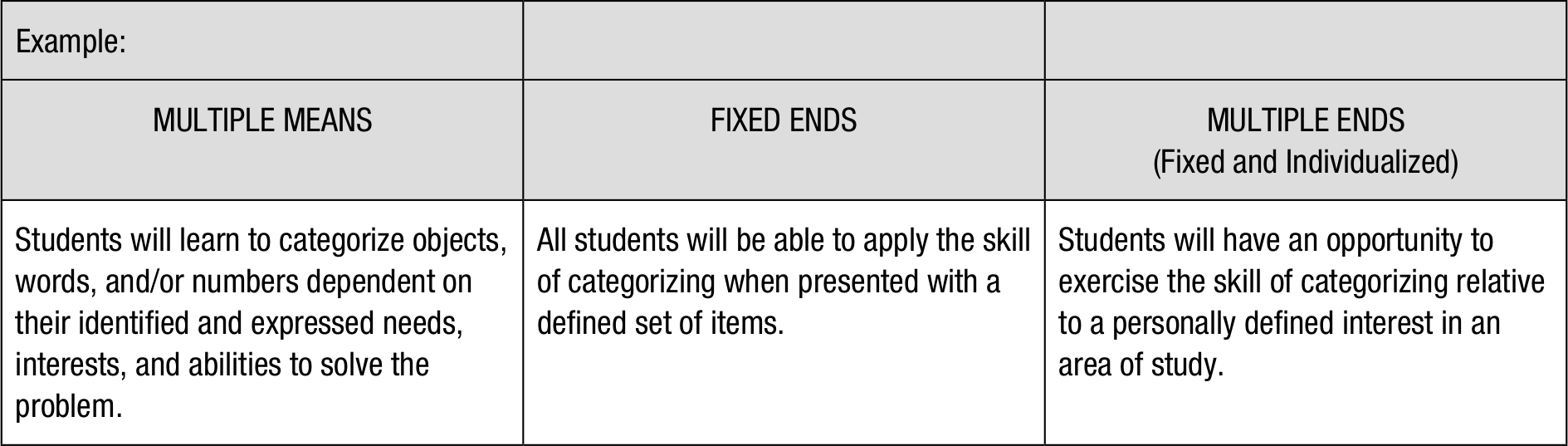
Transition to define multiple means, and both fixed and individualized ends to lessons and units of study is necessary. The concept of providing a single pathway to teach and learn a defined and absolute end to assess the learning for all students inhibits rather than encourages the individualization necessary to recognize and respond to emergent potential, talent, or aptitudes. The concept of transitioning to both fixed and individualized ends for assessment provides an age/grade norm reference, a relative peer-related norm reference, and a personally defined growth reference. In this way, the young student is assessed with respect to a variety of indicators that encourage educators, parents, and students to gain a complete understanding of their numerous interests and capabilities.
Transition 5
Transition by teachers to assess the differences between what they believe young students are able to learn versus considering what these children are actually capable of learning. This transition necessitates redefining expectations for early age children limited to theoretical ideas that are incongruent to the background and experiences of today’s young students. Teachers need to consider the affects of media and technology on today’s young learners. In addition, the young students’ opportunities within their own culture and peers of diverse cultures have shaped their awareness of the world. It is critical that teachers plan and implement curriculum aligned to the sophistication young children express in their play, discussions, and interests, and release some of their reliance on developmental scales that are not always “up to date” with the contemporary abilities of early learners and their potential, talent, or emerging aptitude. Importantly, teachers need to recognize their “academic prejudicial” attitudes about what may be too difficult for “these learners” rather than adjusting their pedagogy to facilitate the students’ readiness to learn.
Contexts for eliciting creativity and critical thinking.
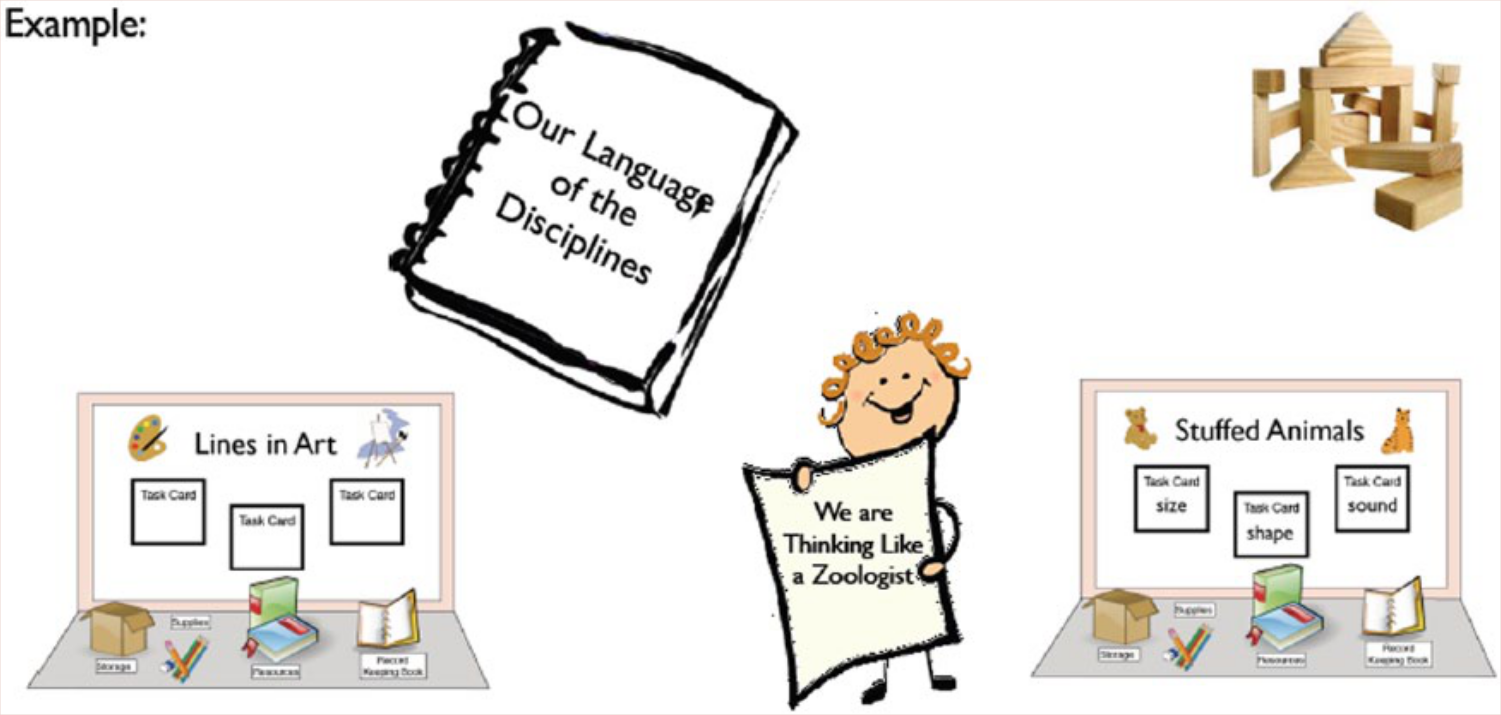
Sample learning inquiry-focused objective.
Multiple learning pathways.
Curriculum Development Considerations
Although there are many models to develop early childhood curriculum, educators are encouraged to be adaptive and eclectic to new sources of curriculum development to be responsive to the children in their classrooms. This concept infers that the following ideas and beliefs need to be reexamined:
A scope and sequence, the traditionally planned curriculum, is the most effective way for students to reach academic achievement.
There is a single curriculum or singular pedagogical approach that can provide for the variance of needs of young children.
Students from economic, linguistic, and cultural diversity are more in need of traditional curriculum and rote and drill instructional activities.
Identification is a consequence of the instruments used rather than the curriculum provided.
Taking Action: Responsive Teaching and Emergent Curriculum
Teachers who facilitate the exploration of students’ ideas and interests encourage children to extend their thinking. They have developed the “pedagogy of listening and observing” (Reggio Emilia) as a means to discover and document the needs, interests, and strengths of students. They design learning environments that provide a catalyst to nurture and identify potential, talent, and emergent abilities in young children. These learning environments have the following:
A variety of resources such as raw materials, prompts for play, books, and photographs to stimulate independent inquiry.
Opportunities for children to solve problems within, between, and across disciplines alone, in small groups, or with the entire class.
Opportunities for students to utilize their current understandings to hypothesize about topics and to engage in role-playing their relationship to the topic.
A curriculum that allows for differentiated challenges to be conducted independently (independent study).
Summary
Gifted education has generally started after second grade once students have taken standardized achievement tests—and now, more states are requiring early identification. The state of Washington, for example, has a mandate to identify and serve children in gifted programs K-12. This puts pressure on teachers to identify and serve their young students within developmentally appropriate play-based environments.
Many teachers have been socialized to believe by institutions and peers that a “good teacher” is one who has total academic control rather than being empowered to negotiate learning experiences with the learner. The transitions discussed in this article suggest that teachers have a repertoire of possibilities to engage students, and have the ability to spontaneously question and provoke children’s thinking. Teachers need to be mindshifters to follow the transitions necessary to design environments that truly engage and challenge all children, even the most precocious young ones.
Footnotes
Conflict of Interest
The author(s) declared no potential conflicts of interest with respect to the research, authorship, and/or publication of this article.
Funding
The author(s) received no financial support for the research, authorship, and/or publication of this article.
Bios
Sandra Kaplan, EdD, is a clinical professor at the University of Southern California and past president of the National Association for Gifted Children.
Nancy B. Hertzog, PhD, is a professor of educational psychology at the University of Washington. She is the director of the Robinson Center for Young Scholars.