



Abstract
The experience that students gain through creative thinking contributes to their readiness for the 21st century. For this and other reasons, educators have always considered creative thinking as a desirable part of any curriculum. The focus of this article is on teaching creative thinking in K-12 science as a way to serve all students and, especially, creatively gifted students. The premise is that teaching creativity through science is a good learning motivator and can lead to more meaningful science learning. Included is a model for teaching creative thinking through science with examples that show how a teacher can, at a minimum, start with an established series of inquiry lessons and incorporate more creative thinking. It is hoped that teachers with this experience can begin to include more creative aspects in the curriculum at the initial planning stages.
“By including creative thinking processes in all content areas, teachers can provide students with 21st-century life skills in creative thinking and production”
The experience that students gain through application of creative thinking contributes to their readiness for the 21st century. The ability to use creative thinking, both inborn and developed, has always been considered a desirable part of any curriculum by many educators. Because any curriculum contains at the least basic required content, which must be addressed, the teaching of creative thinking should be integrated into that content. Here, the focus will be on embedding creative thinking within the science curriculum, and more specifically in the science taught in Grades K through 6.
The choice of science as a companion of creativity may seem an odd one. Can one actually teach creativity through science instruction? Science is considered a backbone of 21st-century readiness and a valuable source of technical content. The proper study of science includes the scientific process, which requires the use of both creative and critical thinking. These two thinking forms, often classified as divergent (the expansion of the range of possibilities, withholding judgment) and convergent (critical, judging, narrowing solutions from many to few) thinking, are used together to enable practitioners to create meaningful products.
Teaching creative thinking to gifted students is necessary and desirable as an enhancement of their overall creative skills. In addition, some creatively gifted students may be recognized in situations where thinking creatively is part of the lesson. It is important for teachers of all subjects, including the non-artistic areas, to consider these students for further assessment. It is possible that when gifted students use creative thinking in conjunction with more rigorous, complex content, they develop a confidence in thinking creatively and could become more comfortable with practices like withholding conclusions and accepting some degree of ambiguity.
Incorporating Creative Thinking in Science Instruction
Creative thinking may take place in the science class on a preliminary basis without the use of an inquiry process. Some of the components of creative thinking are directly teachable (Sparks, 2011). Others, like directing one’s attention to the non-obvious, are more difficult to instill in students. Students can be taught some of the processes, such as being flexible, in a less direct way usually through practice. In some cases, students may exhibit some of the behaviors that indicate creative thinking without realizing it. However, the full expression of creative thinking comes with science inquiry in which students acquire information and apply it to form conclusions and create products. This process can take place through assigned activities that require creative thinking to various degrees.
An activity that involves creative thinking can be complex with multiple steps leading to a finished product. Other activities can be very short term, such as observing an event in the classroom. Such short activities can familiarize students with skills, including creative thinking, which may fit into the more complex activities.
Process Skills in Inquiry Science
Integrating creative thinking into the teaching of science works best when the teacher uses activities involving inquiry since science process skills can be linked to creative thinking. Meador (2005) matches science process skills at three levels—basic, intermediate, and advanced—with specific creative skills and dispositions. For example, she notes that inferring requires, “flexibility: thinking about various meanings before deciding on the inference” (p. 18).
In The Parallel Curriculum, Tomlinson et al. (2002) describe the Curriculum of Practice as the teaching of those thinking patterns and practices in which the professionals in the field are likely to engage. For scientists, these processes may include consideration of information that has already been discovered and explained, informal and formal observation, finding data through inquiry, making analogies, simulating processes, planning and performing experiments, organizing information, thinking analytically, and communicating through writing, speaking, illustrating, and other methods (Contant, Bass, & Carin, 2014).
Many states have adopted the Next Generation Science Standards (NGSS). One example from this body of work, page 5-PS1, “Matter and Its Interaction,” deals with atoms, characteristics of materials, chemical change, and conservation of mass in the core ideas (NGSS Lead States, 2013a).
Although previous science standards included many of the behaviors in the composite list below, the Next Generation Standards contain more overt references to these. Each of the standards includes a section on relevant science and engineering practices. This section associated with “Matter and its Interactions” names “Planning and Carrying Out Investigations” (emphasis added) and includes group planning of the investigations as well as standard skills such as observing and measuring (NGSS Lead States, 2013a). Appendix I on the NGSS website, “Engineering Design in the NGSS,” states, “students are expected to be able to define problems—situations that people wish to change—by specifying criteria and constraints for acceptable solutions” (NGSS Lead States, 2013b, Appendix I, p. 1).
Throughout the early grades, there is a progression of these engineering design performances and outcomes. They align closely with the Curriculum of Practice in science and with other models of science processes. As with components of the Curriculum of Practice, creative thinking is a part of engineering design but interacts with convergent thinking processes.
A draft document (National Science Teachers Association, 2015) outlining criteria for designing science curriculum to meet the NGSS points out that schools must provide science learning experiences that include (but are not limited to) (a) engagement of students in scientific processes, (b) stimulation of students’ curiosity, (c) the teaching of students to “design solutions to problems,” and (d) engagement of students in designing investigations and communicating information through the engineering design component.
The composite list
By combining some of the features of the Curriculum of Practice, the engineering design (broadly defined) features of the NGSS, and common inquiry science process skills, the following “composite list” is derived. The significance of this list is that its six components are observable student behaviors expected in inquiry science classrooms that can indicate creative thinking and production. They provide a framework for planning new science activities or for enhancing existing ones that include creative thinking.
Asking inquiry questions from observations, with an emphasis on originality of the question.
Using imaginative thinking in planning how to acquire information and deciding what to do with it.
Looking for and recognizing both the obvious and the not-so-obvious.
Seeing and expressing connections between a science idea or concept and another area of knowledge, whether within or outside science. The ideal is that students will develop to the point of making the connections with minimal teacher prompting.
Designing and planning ways to figure out a simple problem, proposing hypotheses, and designing tests for these.
Designing and inventing something, at the least “on paper.” This can include applications of science facts and concepts.
There are possibly other ways in which creative thinking takes place in science instruction, but the six in the composite list are detectable by the teacher, and they can be developed and encouraged in the students as seen in the example lessons later. Also, since the components of the composite list are already present to some degree in the inquiry science classroom, their use can smooth the transition to teaching creative thinking by allowing teacher and students to direct more focus toward the intentionality and awareness of the creative process.
Guiding Creative Thinking Through Interchanges and Teacher Modeling
Science content provides the information for creative thinking. For gifted students, such content should be at a high level and must be taught in ways that cause the student to find creative thinking necessary to the point that it becomes second nature. According to Sternberg (2003), the individual student must be knowledgeable about the concepts within the field where creative behavior is desired. Thus, we should expect creative thinking processes, such as proposals for solutions, to emerge more readily when the grasp of the content is thorough and when the science content is complex enough to require use of various thinking processes. In general, science lessons and units that can offer the most rigor for the gifted student should include not only opportunities for creative thinking but also exposure to a deeper science content, use of age-appropriate student-guided investigations, and more complex analyses of information.
Two more factors enter the picture. DeHaan (2009) cites Sternberg and Williams, who list some creative production techniques that might work in a science classroom:
Helping students to believe in their own capacity to be creative;
Avoidance of teaching in subject area boxes: a math box, a social studies box, and so on;
Modeling of creative thinking by the instructor;
Encouragement of idea generation; and
Teaching students to question assumptions by making questioning a part of the daily classroom exchange and to imagine other viewpoints.
Simply establishing rigorous higher level content with activities that involve creative thinking is not enough. As illustrated by the last three items in the list above, two more components are necessary: teacher modeling of creative thinking for students, such as with behaviors from the composite list and classroom interchanges between teacher and students or among students. These components support the teacher in guiding students in creative thinking.
Modeling, which occurs when the teacher demonstrates creative thinking techniques directly or guides students in using these techniques (Coleman & Cross, 2005), leads to metacognition. This student awareness of creative thinking is especially essential for the creatively gifted students, who need to be familiar with the theory and terminology applied to the creative process. For the gifted students, knowing various creative thinking techniques can also add deliberation to the process.
In addition to modeling of creative thinking, guiding and coaching the students in creative thinking should take place with teacher–student interchanges. These include questioning and direct statements related to the problem-planning-solving processes. Such prompts as the following are effective initiators of inquiry: Why? What if? and How can? One goal is to move the students to sharing interchanges among themselves so that they can progress toward becoming more independent creative thinkers.
Example and Application: A Sound-Music Unit
The three columns in Table 1 include an example of a unit of study for fourth grade based on several of the NGSS Lead States (2013a) that deal with energy (4-PS3) and waves (4-PS4).
The Sound-Music Unit
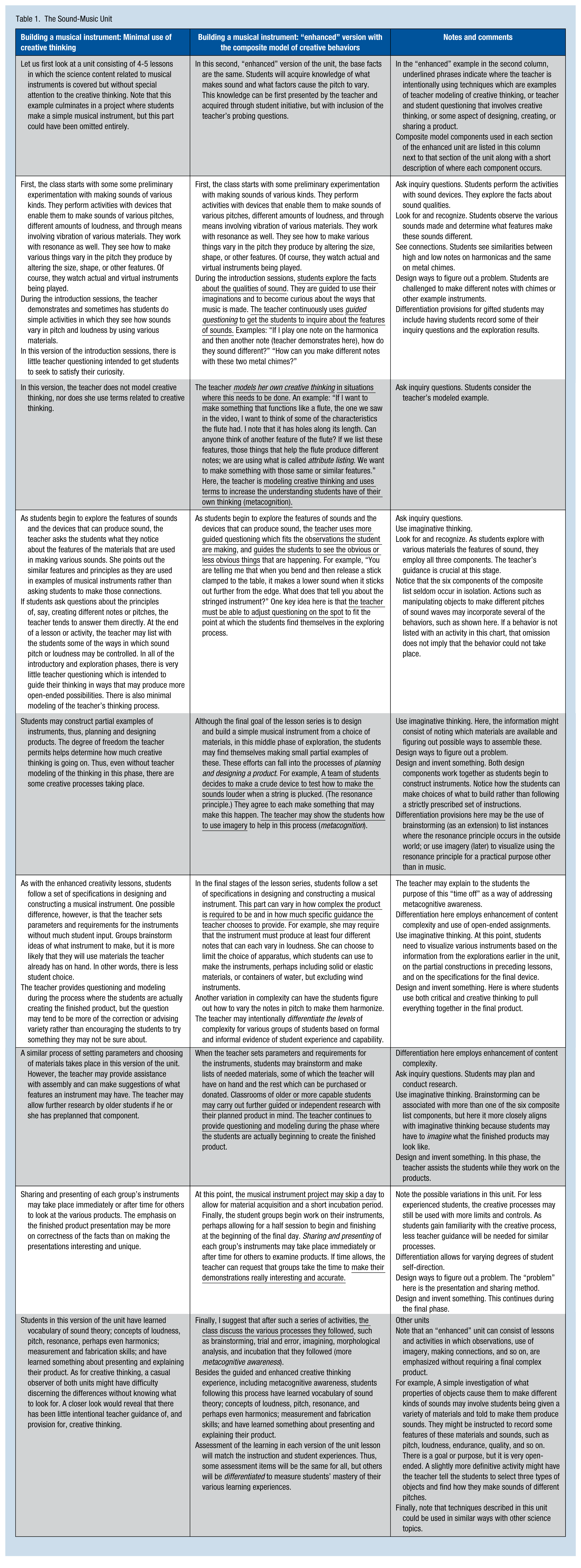
The standards for the sound-music unit include the following performance indicators. (Note that terms in italics are similar to those in the composite list.)
Develop a model of waves to describe patterns in terms of amplitude and wavelength, and those waves can cause objects to move (4-PS4-1).
Make observations to provide evidence that sound, light, heat, and electric currents can transfer energy from place to place (4-PS3-2).
Apply scientific ideas to design, test, and refine a device that converts energy from one form to another (4-PS3-4).
Also included in the NGSS for the unit are the following engineering and design goals:
Develop a model to describe phenomena (4-PS4-1),
Generate and compare multiple solutions with a problem based on how well they meet the criteria and constraints of the design solution (4-PS4-3),
Ask questions that can be investigated and predict reasonable outcomes based on patterns such as cause and effect relationships (4-PS3-3), and
Make observations to produce data to serve as the basis for evidence for an explanation of a phenomenon or test a design solution (4-PS3-2).
The first column in Table 1 describes a series of lessons in the unit that focus on exploration of sound waves and the properties of amplitude, pitch, and resonance. The lessons culminate in the construction of simple musical instruments by small groups of students. The middle column describes a series of the same lessons in which the teacher integrates creative thinking by teaching and coaching the students to use imaginative thinking, make connections, observe and inquire, and exhibit other behaviors in the composite list.
Underlined phrases in the enhanced lesson description indicate where the teacher is using modeling, interchanges, or product assignment. The third column lists and discusses any of the six components from the composite list where they would be expected to occur.
It is entirely likely that some of the creative thinking would occur without teacher guidance in the non-enhanced lessons described in the first column, but no references to these instances are made in the third column.
Application of Interchanges and Modeling in the Sound/Music Unit
From teacher–student to student–student interchanges
Contant et al. (2014) explain the difference between closed-ended and open-ended questions asked by the teacher. Asking more open-ended questions works directly with stimulating the mind to think of possibilities. In the sound/music unit in Table 1, the teacher uses guided questioning based on observing students and asks, “What can your observation of the stick tell you about how the string vibrates in an instrument?” As students become familiar with open-ended questions and the thinking required by their use, they may develop to the point of asking the questions of themselves or each other.
Teacher modeling
Piirto (2010) describes how to use imagery, a technique that could work well with hypothesizing or with other steps in designing a science study. In the music unit, students may use imagery when visualizing how to make a crude musical device to test an idea. The teacher may show the students how to envision mental images or draw simple sketches to help in this process.
The technique known as attribute listing, followed by morphological analysis, occurs in the example lessons in the discussion of the flute. Other creative thinking techniques of which teachers and students should have a working knowledge include brainstorming, incubation, and making analogies (Coleman & Cross, 2005). In some cases, the practice of temporarily withholding judgment (Piirto, 2010) can be included. These practices may take place in the case of the sound/music unit in optional extensions.
Planning for the Teaching of Creative Thinking
Beginning the Planning
Teachers may elect to work individually or as a team. The starting point is to consider science tasks, which the teacher already uses and try modifying them so that science practices from the composite list and the interchanges and modeling take place wherever appropriate. Table 2, “Bird Beaks,” illustrates this by showing how the planner/teacher can start with a non-enhanced lesson and by using a checklist of science processes note where enhancement for creative thinking (and inquiry science in general) may be implemented for an enhanced version. However, tasks and activities which have not been attempted, may prove to be better choices in some areas of science content. Teachers can examine the text and other outside sources for ideas. Some may wish to combine smaller short-term activities into a longer, more complex project.
Lesson on Bird Beaks
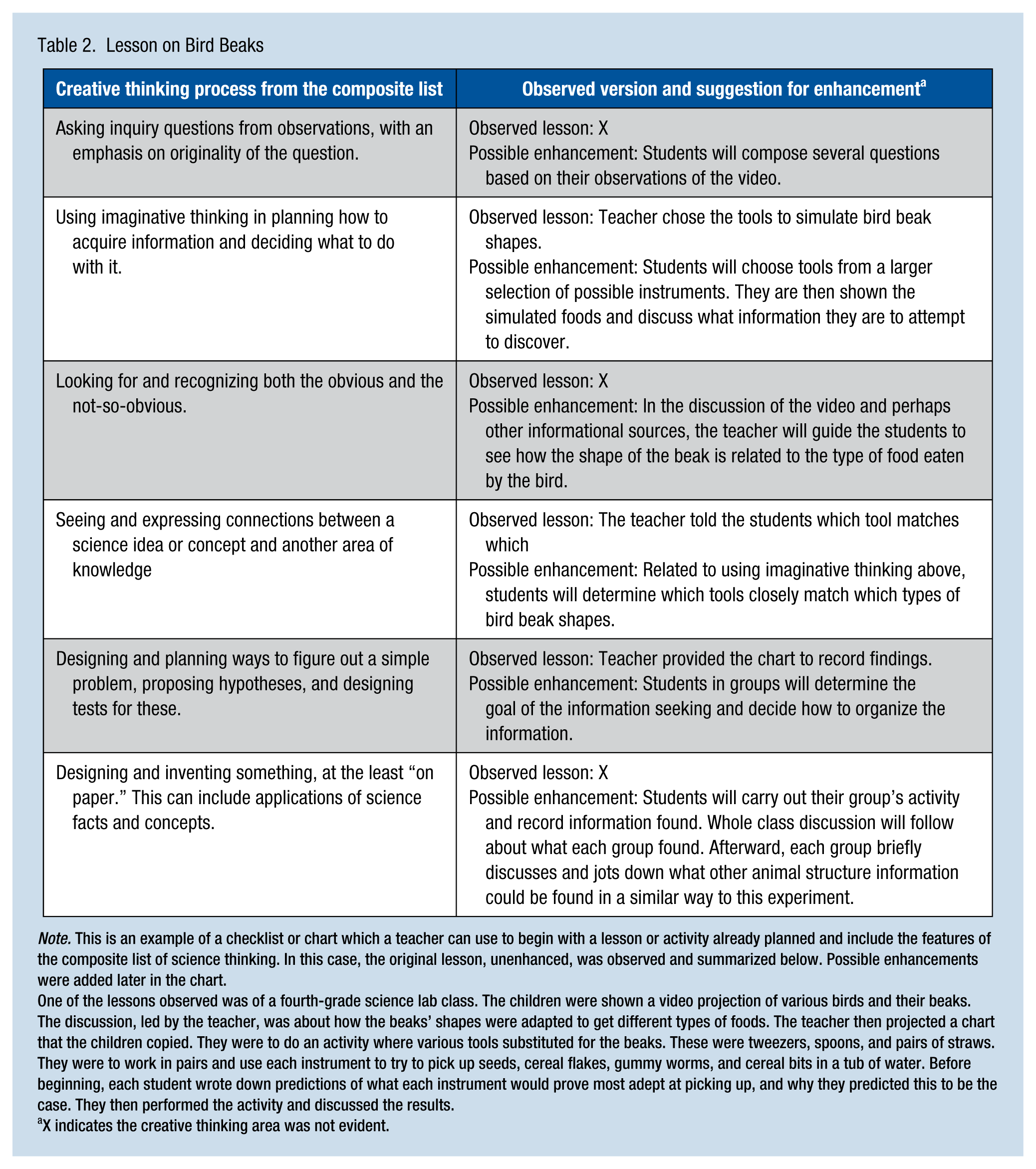
Note. This is an example of a checklist or chart which a teacher can use to begin with a lesson or activity already planned and include the features of the composite list of science thinking. In this case, the original lesson, unenhanced, was observed and summarized below. Possible enhancements were added later in the chart.
One of the lessons observed was of a fourth-grade science lab class. The children were shown a video projection of various birds and their beaks. The discussion, led by the teacher, was about how the beaks’ shapes were adapted to get different types of foods. The teacher then projected a chart that the children copied. They were to do an activity where various tools substituted for the beaks. These were tweezers, spoons, and pairs of straws. They were to work in pairs and use each instrument to try to pick up seeds, cereal flakes, gummy worms, and cereal bits in a tub of water. Before beginning, each student wrote down predictions of what each instrument would prove most adept at picking up, and why they predicted this to be the case. They then performed the activity and discussed the results.
X indicates the creative thinking area was not evident.
The process of teaching creative thinking in science is flexible in several ways. For example, a teacher can plan assignments that include teacher modeling and interchanges for a heterogeneous classroom or for one with a concentration of gifted students. Assignments can vary from the simple to the complex and can be developed for novices or with students more experienced with creative production. The activity can be designed for a short time span or for one spanning a week or two. In most cases, the assigned activity is adjustable during the implementation should things take an unexpected turn.
Various models for planning creative thinking activities in general may help in some cases. For example, in their step-by-step guide, Rubenstein and Wilson (2011) describe five activity design strategies: “specification, perspective, improvement, combination, and elaboration” (p. 60). Three backbone factors to consider in the choice of science activities are motivation and inspiration of the students, the variables possible in problem solving activities, and the opportunity for students to share and present what they have accomplished.
Motivation and Inspiration—The Spark That Starts Things
If students are to use creative thinking, they need the motivation to do so. Reliance on extrinsic motivation in creative behavior is less desirable than building intrinsic motivation (Coleman & Cross 2005). Fortunately, the appealing aspects of science can be an intrinsic motivation for students. Here, I would offer that the will to think creatively about a science problem is connected to the interest inherent in the topic. When Piirto (2010) says “. . . scientists are inspired by the opportunity to solve the mysteries of nature” (p. 155), science teachers might note that studying the creative processes of selected inventors may impress the students with the fact that real scientists think in creative ways.
In the enhanced music unit, the hands-on activities that make sounds and the challenge of making an instrument would be motivational to most students. The teacher might try to enhance this motivation by relating stories of inventors and innovators in the music field. She might challenge the groups to design instruments that produce unique sounds different from the others. As pointed out in the following section about problem solving, the motivational qualities of the problems are related to the degree to which they are relevant and meaningful.
Problem Solving—Giving Meaning and Direction
As stated earlier, creative thinking in science as made evident through the items in the composite list occurs with the use of inquiry. In general, all but the simplest of inquiry science activities are variations of problem solving. For students, working with problems can be divided into three stages:
Clarification of the problem (“How can we configure a ramp and adjust other features to allow a toy car to attain the optimum travel distance?”; “Are we intending to classify this set of rocks into groups, and for what purpose?”)
Planning of one or more solution processes (“In what order should we try different arrangements of the ramp to find the answer?”; “What features of this rock should we look for in order to classify it?”)
Interpreting and then communicating results by sharing/presenting (“Are there ways to make our results clear to others in a limited time span?”).
The problems posed for students should be meaningful ones (Kay, 1998). Whether possible problems offered to students are relevant and meaningful is a judgment the teacher can make through knowing the students. These problems can be motivational in that creative thinkers have a “desire” to perform in the area or interest (Piirto, 2010).
Some of the most meaningful problems are the “real-world” kind (Clark, 2010, p. 310). Often these are situations revolving around environmental or human needs familiar to the students.
An important aspect of problem solving is the degree of definition. Most teacher-presented problems, like the musical device, are well defined. The object or goal, the function of the final product, is clearly explained. But students also learn to prepare solutions to problems that are not well defined (Piirto, 2010) or which are undertaken by the students themselves with only hints at solutions (Coleman & Cross, 2005). When the students are asked to both define and solve a problem, the thinking is more independent, and decisions must be made after thinking of ideas for what to investigate and how to find the answers. This more open-ended student-led approach is especially appropriate for gifted students. Suggestions are given throughout Table 1 for such variations in the activity.
Many science lessons do not culminate in a physical, engineered project. In some cases, the product may be a design or description of something related to the science studied, such as a spaceship that would be able to go to Pluto or a list of circuit arrangements that cause light bulbs to glow. Often the product is a series of small decisions or conclusions made by students. When studying plants, for example, students may propose an experiment that will determine the effect of some factor on the plants’ growth. Lessons about a food chain may have as a product an opinion about the results of removing one of the food sources in the chain. The teacher of the music unit could have left out the construction of the instrument and substituted student notebooks with writing and pictures describing the sound phenomena. Although not as complex as a lengthy problem/product, such smaller short-term activities are more easily incorporated into classes with limited time for instruction.
Finally, in all problem solving, the students use creative speculation together with logical analysis. Throughout the process of thinking, the teacher uses modeling and questioning to guide the students to where they might be.
Sharing and Presenting—What Real Scientists Do
Creative thinking can be challenged by the request to present one’s solution to the others in a group or the entire class. As broadly defined, presenting/sharing can even include student discussion of an observation, where creative thinking occurs in the communication of the ideas among peers. When the sharing is part of solving a problem, the starting point for the creative thought is when the students become aware of the purpose of the sharing. This awareness helps to ensure that the sharing or presenting is clear to others, interesting to the audience, and effective. The sharing and presenting in the music unit occurs at the end when others examine the products.
The teacher can discuss with the class what information should be included in presentations of the results of a problem solution, but how to share that knowledge can vary in ways determined by the students. The teacher may brainstorm with less experienced students the ways to make the presentation clear, interesting, and effective. A challenge for the gifted students is to generate their own ideas about ways to effectively present the information.
Other Considerations
In addition to providing the backbones of motivation and meaning, direction, and sharing, a particular activity must satisfy a number of other factors.
Relevance to science content and creative thinking behaviors
Is the task relevant to the science content? Will students learn the important science information and gain experience in the science processes? Will students have opportunities to use all or most of the creative thinking components from the composite list in the assignment?
Match to student experience
Will the assignment match the experience and maturity of the students? How specific should the directions given to the students be? How much student choice should be allowed and encouraged?
As illustrated in comments in the music lesson in Table 1, the teacher can “work into” teaching creative thinking by choosing an assignment that is fairly short in duration and includes creative thinking behaviors that students can handle easily. At this early stage, the students should be made clearly aware of the objective of the assignment. As the class gains experience with creative thinking techniques and the accompanying responsibility, the students can be offered more choices and open-ended objectives.
Management of the activity
How will factors such as available time, space, materials, and grouping come into play?
Duration of the activity
Will scheduling force the activity to take place in one session or will there be multiple sessions possible in close time proximity?
Table 3 provides additional examples of assignments that relate to various other science standards at different grade levels. As with the examples in Table 1, these assignments vary from one-lesson to more long-term or complex projects and were not obtained from any published source but are based on informal ideas aligned to the general wording of the standards. Practitioners are urged, however, to seek ideas for assignments from any sources they desire, as long as they are willing to tweak the procedures to allow for observable creative thinking.
Samples of Science Assignments Linked to Next Generation Science Standards From Various Grade Levels and Topics
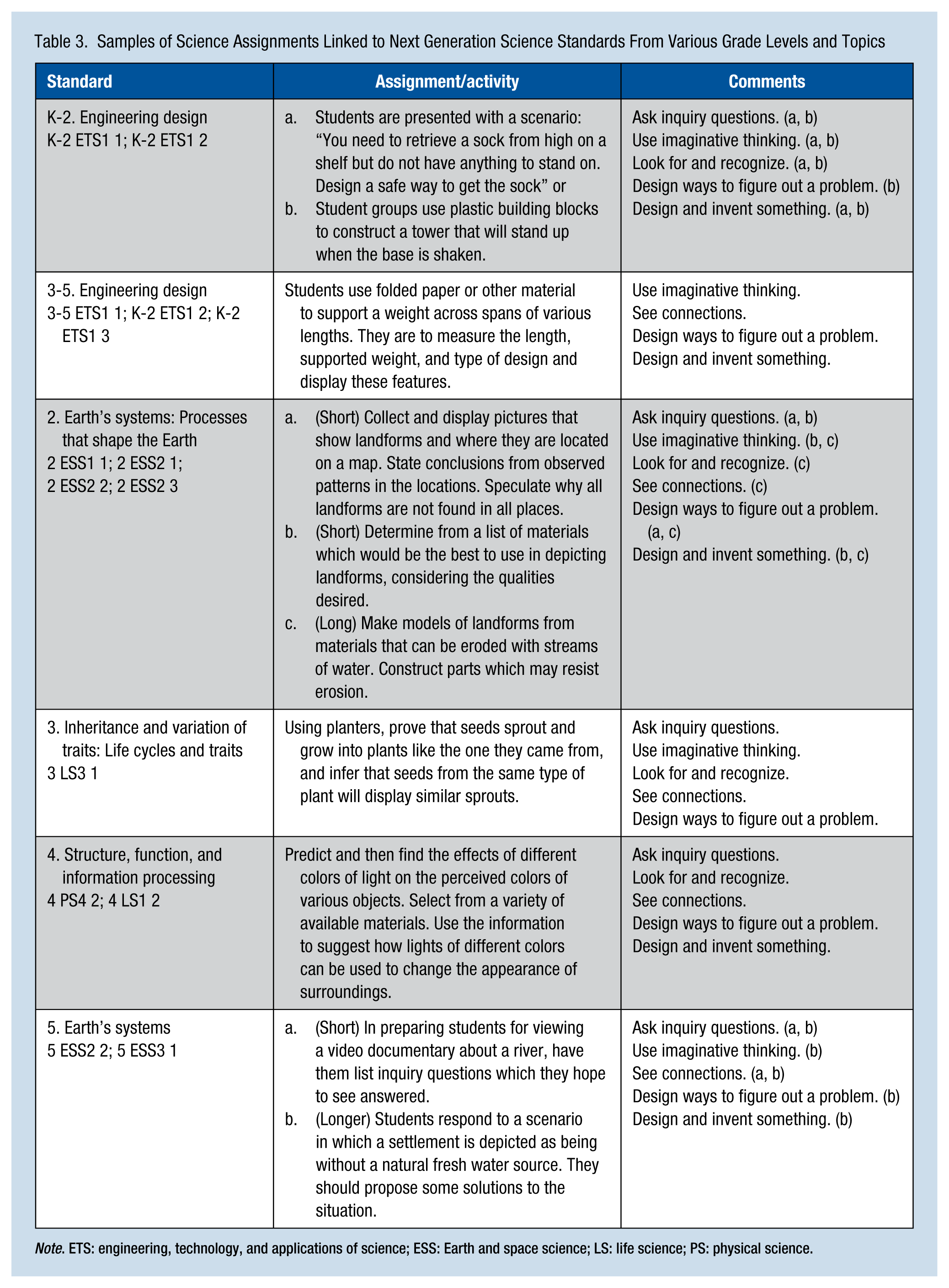
Note. ETS: engineering, technology, and applications of science; ESS: Earth and space science; LS: life science; PS: physical science.
The table includes the NGSS associated with the assignments and the creative thinking areas from the composite list. However, Table 3 does not include examples of teacher modeling or any of the interchanges.
Differentiation and Assessment
In planning differentiation, the teacher must first determine the criteria such as a student’s current knowledge of the science content and his or her language and communication level. Less visible qualities might be the student’s willingness to withhold judgment, consider out-of-norm solutions, and use other features of creative thinking. Differentiation methods can then consist of grouping arrangements, tiered assignments, choices offered, and degree of teacher direction. In heterogeneous classrooms, gifted and other highly capable students may work at a tiered level from the beginning of an assignment that offers more complex content. (Refer to comments in the examples unit in Table 1 for specifics.)
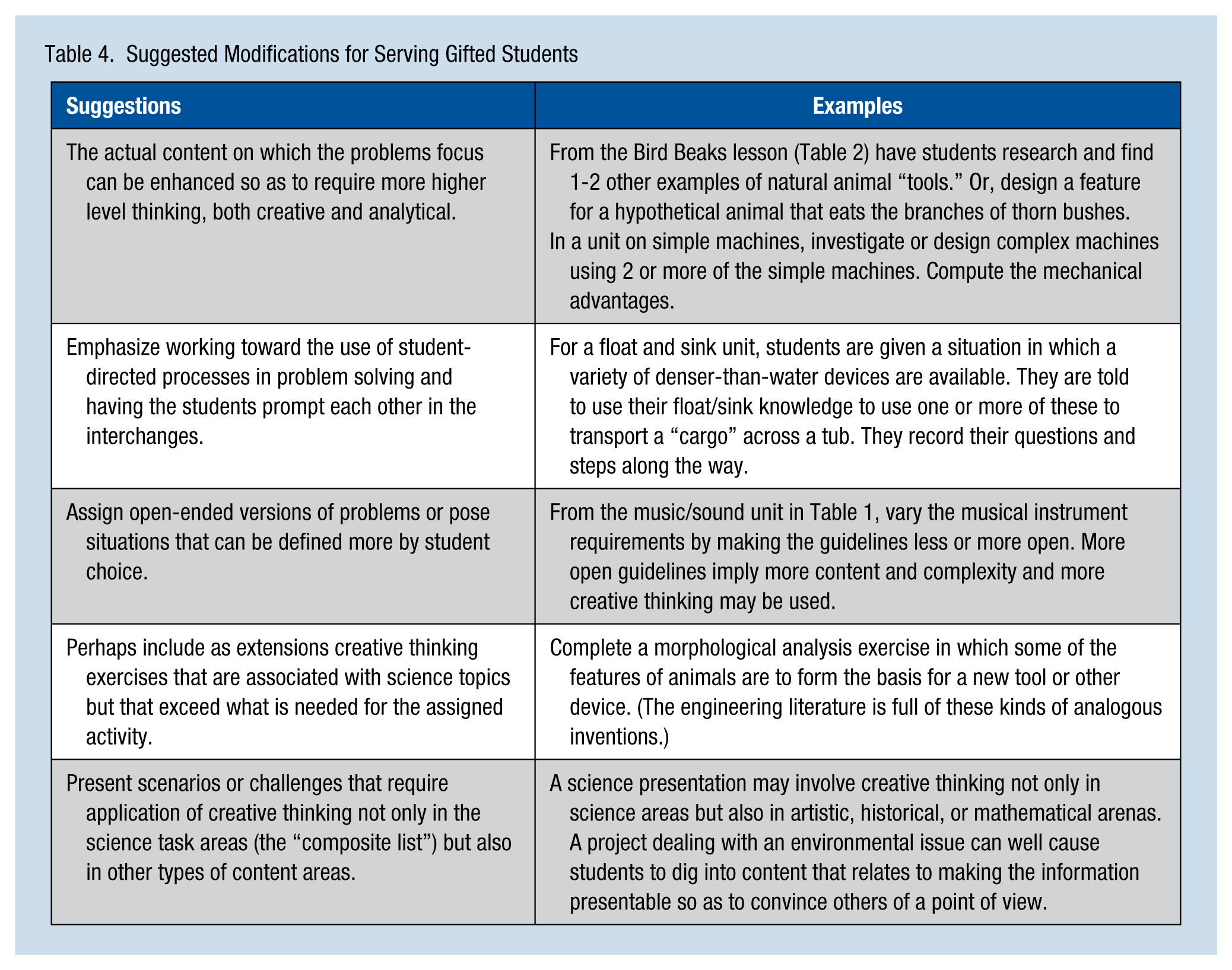
Table 4 summarizes special suggestions for serving the gifted students when planning for the teaching of creative thinking in science. Some of these are described throughout the rest of the article, including the example lesson comparison in Table 1.
Suggested Modifications for Serving Gifted Students
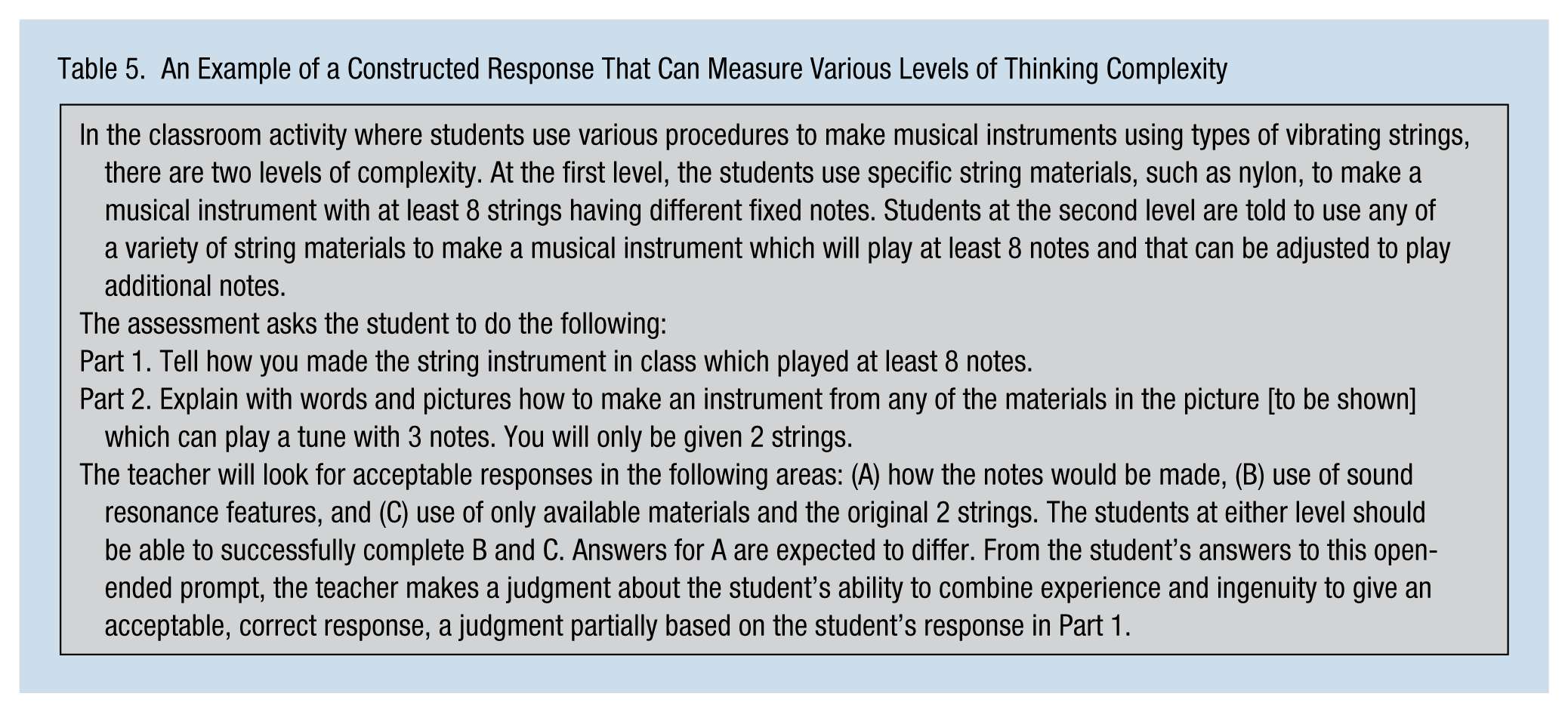
Some of the assessment of the skills and knowledge in a science unit, which is enhanced to include more creative thinking, can be similar to those in non-enhanced assessment, but the enhanced unit should also include an assessment of the creative processes used. For example, a test might use constructed-response questions requiring students to apply creative and critical thinking in situations similar to the unit tasks. As pointed out in Table 1 with the musical instrument construction (enhanced unit), such assessment features should be differentiated so as to allow for assessment of the level of complexity, depth, and content of the student’s work. See Table 5 for an example of this assessment differentiation.
An Example of a Constructed Response That Can Measure Various Levels of Thinking Complexity
Assessment in an enhanced science unit should also include continual assessment of the students’ thinking as determined by the teacher’s observation during the activities in the unit and the evaluation of the final products. This growth model approach can be used to increase creative thinking in subsequent units and activities. In some circumstances, creative thinking rubrics (Drapeau, 2014) may be completed by the teacher or by the students through self-assessments.
Conclusion
The general process of enhancing instruction with inclusion of creative thinking is not limited to science. This enhanced teaching can be used with any subject content, or, as in “real life,” a combination of content from many subjects. The differences will occur in adapting the processes of thinking and production to those practices that fit well with those other content areas.
As with science, planning for creative thinking in other subjects might begin with examining the processes used by professionals; identifying performance standards in the subjects, such as the Common Core; and specifying other practices used in research, discovery, application, and innovation. These “composite lists” would then be used to identify creative thinking already present in the learning process and to then enhance and develop the learning activities that can provide opportunity for the creative thinking process. As in science, these practices will likewise include motivation, problem solving, and sharing.
Teachers of all students can incorporate creative thinking into the curriculum by using the principles and guidelines described in this article. The teacher must be thoroughly knowledgeable of the content and the characteristics of their students. Employment of techniques of differentiated teaching and assessment is critical. By including creative thinking processes in all content areas, teachers can provide students with 21st-century life skills in creative thinking and production.
Footnotes
Conflict of Interest
The author(s) declared no potential conflicts of interest with respect to the research, authorship, and/or publication of this article.
Funding
The author(s) received no financial support for the research, authorship, and/or publication of this article.
Bio
Taylor Thompson, PhD, has been involved with education of the gifted since 1974. He has taught gifted students at the K-12 levels and has worked in an endorsement program preparing teachers of the gifted since 1996. He is currently professor of graduate education at Georgetown College (KY). His principal interest areas are delivery of services to gifted students through content areas and analysis of life goals of older gifted students.