




Abstract
This qualitative study explored the role teacher perceptions play in the underrepresentation of culturally and linguistically diverse (CLD) students in gifted programming. Purposeful sampling was used to select six interview participants with at least 5 years of teaching experience. Each participant took part in two semistructured interviews over a 3-month period. Interviews were transcribed and analyzed using Auerbach and Silverstein’s highly structured analytic method. The findings indicate that “the language barrier” and the overemphasis on standardized testing contribute to the underrepresentation of CLD learners in gifted programming. In addition, the researcher identified a need for increased collaboration among educators during the gifted referral and identification processes as well as professional development to raise awareness about the issue of underserved populations in gifted education.
“Teachers need professional development to raise awareness about the issue of underrepresentation of culturally and linguistically diverse students in gifted programming.”
I choose to teach critically because I believe young children are capable of amazing things, far more than is usually expected of them.
Introduction
Nestled neatly inside the home–school journals, each mother had written “Para un mejor futuro” in response to the question, “Why did you move to the U.S.?” Of course they came here for a better future. Certainly that would involve an equitable education for their children, one that would result in limitless opportunities and the pursuit of success. But were their children receiving the prized education they imagined? Did they realize that their children might be facing lower expectations in American schools because of their culturally and linguistically diverse (CLD) backgrounds? Did their children have gifts and talents, hidden from the eyes of teachers not used to noticing them among those diverse student populations? I set out to explore and gain a deeper understanding of this unintentional clash between diverse learners and their teachers.
Theoretical Framework
Education is generally reflective of society and is consequently viewed as a primary means for the eradication of structural injustices (Bronner, 2011; Freire, 1970/2012; Levinson, 2011). To promote positive social and educational change, critical educational scholars aim to address social injustices in the field of education, particularly how the marginalization of people is constructed through schooling (Popkewitz, 1999). Working within the critical theory tradition involves exploring subjective lifeworlds and therefore stresses the importance of dialogue between researchers and participants (Bronner, 2011; Habermas, 1981/1984, 1981/1987), but it is set apart by its commitment to social justice, its interrogation of seemingly innocuous institutional practices, and its focus on social change (Comstock, 1982; Prasad, 2005).
Researchers who embody critical theory in their work are concerned not only with how things are but how they might or should be and therefore view themselves as activists working to confront social injustices to create a better world for all (Bronner, 2011; Kincheloe, McLaren, & Steinberg, 2011). Critical researchers can help schools break the cycle of indifference and begin doing everything they can to change the status quo so that teachers become more able to recognize giftedness in diverse learners, thus helping these students gain equal access to gifted and talented programs.
Literature Review
Labeling or defining people, actions, and things is often challenging because of the ever-changing connotations, varying degrees of acceptance, complex interconnectedness among labels, and the fact that certain labels carry assumptions and beliefs with them (Castellano & Diaz, 2002). Furthermore, categories become problematic when they are used habitually and haphazardly, resulting in false assumptions of neutrality and suggesting absolute truths about people that impose limitations on them (Lee & Anderson, 2009). To enable collective understanding for the purposes of this article, CLD students (or learners) refers to students representative of diverse cultural and ethnic groups, specifically those with native language backgrounds other than English (of whom the majority learn English as a second language). In my research, I use the term culturally and linguistically diverse students to represent those students commonly referred to as English language learners (ELLs) or English learners (ELs; Lee & Anderson, 2009). I use CLD because of its inclusion of both the culture and language dimensions, which are interrelated (Castellano & Diaz, 2002). However, I use ELL when I cite the work of scholars who used that particular term in their work or when I discuss educators’ specific comments.
Research on the underrepresentation of CLD students in gifted programming has become more prevalent as the landscape of American schools continues to change rapidly with more diverse students attending today’s schools. Between 1980 and 2009, the number of students (ages: 5-17 years) speaking a language other than English at home more than doubled, rising from 4.7 to 11.2 million, which is 21% of the school-age population (National Center for Education Statistics, 2011). As of 2009, nearly half of the public school students in America come from racially, ethnically, or linguistically diverse backgrounds (Ford, Coleman, & Davis, 2014). Despite the fact that the number of diverse learners continues to skyrocket, the representation of these learners in gifted and advanced programming remains disproportionate (Ford et al., 2014).
Much of the research attributes the underrepresentation of CLD learners in gifted programming to deficit mind-sets that ultimately impact referrals (Baldwin, 2003; Cahnmann, 2006; Ford, 2013; Ford & Grantham, 2003; Ford, Grantham, & Whiting, 2008; Frasier, Garcia, & Passow, 1995; Harris, Plucker, Rapp, & Martinez, 2009; Milner & Ford, 2007; Olthouse, 2013). A deficit view of diverse students contributes heavily to this issue as many of today’s educators are ill-equipped for handling the changing demography of schools and operate from a deficit model that focuses on remediation rather than exploring and enhancing the positives (Baldwin, 2003; Ford & Grantham, 2003).
In addition to the “Limited English Proficient” label officially used by the U.S. Department of Education, oftentimes, schools categorize students and give them labels, such as “ELL,” “EL,” or “CLD learner,” and these labels often bring about associations of deficiency that overshadow the rich sociocultural histories of students’ identities and only highlight their abilities in relation to speaking or not speaking English (Lee & Anderson, 2009). Because practices and policies in educational settings are often grounded in labels that ascribe who learners are or should be based on socially constructed assumptions (Lee & Anderson, 2009), categories of students are often perceived as bound and mutually exclusive. The misperceptions based on these commonly accepted labels result in disproportionate numbers of diverse students being identified for gifted education because they are often not referred for gifted evaluation (Milner & Ford, 2007).
A lack of teacher referrals significantly contributes to the underrepresentation of CLD students in gifted and advanced programs (Ford et al., 2008). Referrals, nominations or screening activities designed to determine which students should be formally evaluated to determine gifted eligibility, are usually the first step in the identification process (Frasier et al., 1995). Relying heavily on teachers to initiate the referral process gives teachers substantial influence and power over the gifted identification of ELLs as students who are not referred will not have the chance to be selected for gifted programs (Bernal, 2009; Milner & Ford, 2007; Reyes, 2004).
Some scholars believe that many ELLs may not be referred for or qualify for gifted programs because they may have difficulty communicating their learning in a way that is valued by mainstream educators (Harris et al., 2009; Olthouse, 2013). For instance, code switching, which involves using more than one language or dialect in conversation, can be an indicator of giftedness (Abellan-Pagnani & Hébert, 2013). Similarly, interpreting or translating from one language to another requires profound cognitive aptitude and may be indicative of giftedness (Valdés, 2003). These abilities may be undervalued by mainstream educators, and traditional gifted assessments and educator checklists usually do not measure or include them.
Statement of the Problem
Potentially gifted students from CLD backgrounds have been deemed to be most at-risk due to a lack of sufficient and appropriate educational services, and these students, including those who are economically disadvantaged, have been a targeted population of highest priority due to the Jacob K. Javits Gifted and Talented Students Education Act of 1988 (Frasier et al., 1995). In the 25 years that have passed since the Jacob Javits Act recognized the need for supporting underserved populations, little improvement has been made in the area of access to gifted programming for CLD students as these students remain underrepresented in gifted education programs nationwide (Ford, 2012; Ford et al., 2008). In fact, Ford (2014) reported Black and Hispanic students were underrepresented in gifted education programs across the nation by 50% and 36%, respectively, according to the 2012 Department of Education’s Civil Rights Data Collection Agency. Numerically, these percentages translate into at least 1½ million underserved students (Ford, 2010).
In light of the significant barriers CLD learners’ face in accessing more challenging curricula, I developed an inquiry project that focused on recruitment and referral issues of CLD students with untapped gifts and talents. I support the proposition widely recognized in the literature by gifted scholars that giftedness exists in every level of society and in every cultural and ethnic group, even though traditional school measures and social/cultural norms may fail to validate it (Castellano & Diaz, 2002; Frasier et al., 1995; Grantham, 2014). My primary goal was to examine the role teacher beliefs and perceptions play in the gifted referral and evaluation process for CLD students and ultimately raise awareness on the topic of underrepresentation.
Research Methods
I used qualitative interviews as my method for gaining insight into my research questions. The following sections provide the details of my study and elaborate on my findings related to the role teacher perceptions play in the underrepresentation of CLD learners in gifted education programs.
The Research Questions
My research questions were at the epicenter of my research design because they informed all other components, directly affected all components, and in turn were impacted by the other components as well (Maxwell, 2013). The overarching question driving my research—How can I help improve access to gifted education, advanced programs, and/or more challenging curricula for CLD students?—has been addressed by other scholars in the field (Castellano & Diaz, 2002; Ford, 2013; Ford & Grantham, 2003; Ford et al., 2008; Frasier et al., 1995; Gonzales, 2002; Harris, Rapp, Martinez, & Plucker, 2007; Milner & Ford, 2007; Sisk, 2003). For this project, I wanted to investigate the following questions: How do elementary schoolteachers make decisions about students they refer for gifted and talented evaluation? How do these teachers’ beliefs and perceptions about CLD learners (ELLs) influence their decision to refer or not refer them for gifted and talented evaluation?
Exploring Teacher Perceptions Through Qualitative Interviews
I chose to conduct a qualitative interview study that included two rounds of interviews for each participant. Qualitative interviews allow researchers to learn from participants through “long, focused conversations” (deMarrais, 2004, p. 52). Although these interviews mimic everyday conversation, they are designed with a clear purpose and involve specific approaches, techniques, and questions that allow the qualitative interviewer to seek to understand the lived experiences of their subject as they describe them in everyday language (deMarrais, 2004; Kvale, 2007). Carefully crafted, the goal of a qualitative interview aims for the participant to speak much more than the researcher, allowing the researcher to create as complete a picture as possible from the words and experiences of the participant (deMarrais, 2004). Because an interview involves the interaction between two or more people, knowledge is negotiated and co-constructed through a social dynamic that shapes the knowledge generated during the interview (Fontana & Frey, 2005).
Prior to my interviews, I carefully considered the wording of each question and its placement within the interview protocol. The semistructured interviews specified key open-ended questions but left room for additional related topics to be explored (see the Appendix). By asking specific interview questions that related to my research questions, I was able to gain insight into teachers’ beliefs and perceptions and learn the rationale behind their decisions involving gifted referrals and CLD learners.
The Setting
The site of my study was a Title I elementary school in the Southeast. Employing approximately 150 staff members, this elementary school houses pre-K through fifth grade and has an enrollment of roughly 960 students from a range of socioeconomic and ethnic/cultural backgrounds (see Table 1). A relatively small number of Hispanic 1 students attend the school, comprising approximately 11.2% of the total student body but making up only 2.6% of the school’s gifted population. Although it may unintentionally go unnoticed, an underrepresentation of ethnic minority students clearly exists at this school—a not-so-surprising discovery considering the facts on the underrepresentation of CLD students in gifted programming.
Schoolwide and Gifted Program Demographics
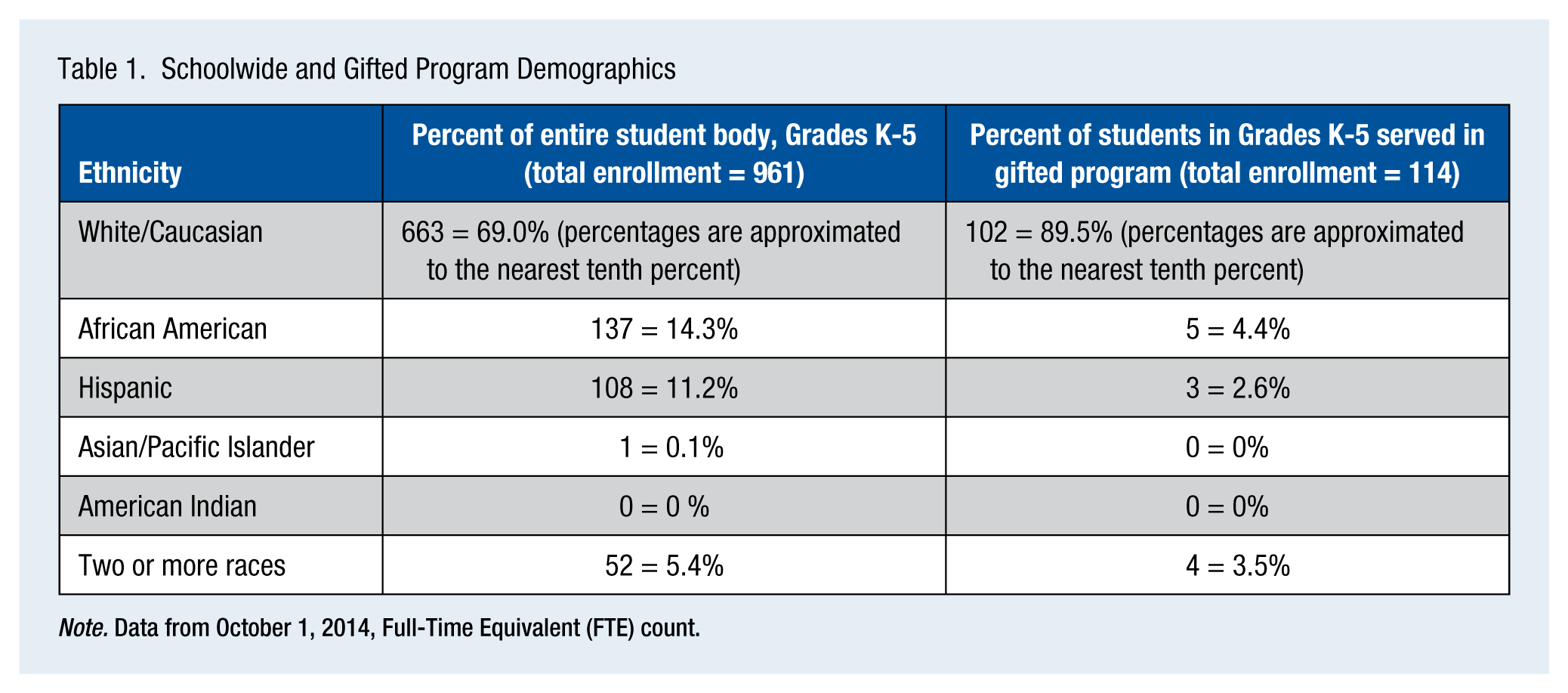
Note. Data from October 1, 2014, Full-Time Equivalent (FTE) count.
The Participants
I sought participants with at least 5 years of teaching experience, including experience working with CLD and/or gifted learners because I knew the teachers would need to draw from their own personal experiences during the interviews to discuss their perceptions of students and the gifted referral process. I felt that more experienced teachers would be able to draw on their own experiences to make claims regarding their beliefs and perceptions based on their classroom observations, interactions, thought processes, decisions, and the like. I also wanted to interview teachers who were native English speakers so that my participants would be representative of the majority of today’s educators.
I used purposeful sampling to select participants based on their ability to talk about the topic of study (deMarrais, 2004), and so that I could study “information-rich” cases that would result in new insights and understandings (Patton, 2002, p. 230). The principal of the school assisted me in my recruiting process. He was helpful in suggesting teachers who might be interested in the topic, who would be experienced enough to discuss the topic thoughtfully, and who would be candid about their thoughts. Relying on the knowledge of his staff and being mindful of the topic of my study, the principal forwarded my recruitment email to approximately 15 teachers on his staff who fit the participation requirements. Of those teachers who received an email, six contacted me via email to let me know that they were interested in the topic and willing to participate. Therefore, I ultimately acquired participation from two general education teachers, two gifted education teachers, and two ESOL (English for speakers of other language) teachers, all of whom were female. The assortment of grade levels and teaching positions represented allowed me to explore the topic from a variety of vantage points.
Data Collection
My qualitative interview study included two rounds of interviews for each of my six participants. The first interviews were conducted individually, while the second interviews were conducted in pairs, with pairs consisting of the two teachers whose teaching capacities were similar (i.e., two gifted teachers, two ESOL teachers, and two regular classroom teachers). I chose individual interviews for my first round of interviews to establish a rapport with my participants, to learn more about them as educators, and to discover their personal beliefs and perceptions about gifted and talented students as well as CLD students. I chose to conduct paired follow-up interviews because I believed that the teachers’ comparable teaching positions and similar teaching experiences would allow them to bounce ideas off of each another and trigger additional ideas for one another during the interview. Furthermore, I suspected that their ideas might be better displayed if they were able to talk through their thoughts with another teacher in a similar teaching role.
Data Analysis
I took notes during each interview, and I wrote memos of my significant questions and insights. One of the advantages of this reflective stance was that I was able to make informed decisions about my next moves as a researcher (Mills, 2014). For example, after conducting the first round of individual interviews, I noticed that there seemed to be more commonalities among the responses of the teachers in the same teaching position. For instance, the ESOL teachers had highly similar remarks on many of the questions, as did the two regular classroom teachers, and the gifted specialists. This noticing nudged me toward a decision to conduct my second round of interviews in pairs with teachers from like teaching positions so that they could bounce ideas off of one another, and we could discuss experiences based on similar teaching placements.
I immersed myself in my data by listening at least once to the audio recorded interviews I conducted to be sure I had not missed significant responses during the actual interview itself. This gave me a second chance to notate important thoughts and listen for recurring ideas. Furthermore, all interviews were transcribed and read through wholly to refamiliarize myself with the data. Reading through each transcript as a whole provided me with one more opportunity to think about the holistic story before I began a more disciplined analytic approach to discover links between my participants’ subjective experiences. As I read, I wrote notes and memos about tentative ideas and data relationships (Maxwell & Miller, 2008). For example, it was at this point that I noticed all of the teachers referring to issues related to “the language barrier,” so I knew that I would want to investigate this idea further during my formal analysis process.
To formally analyze my data, I used Auerbach and Silverstein’s (2003) specific analytic method involving a structured coding process. I chose this highly structured inductive approach to data analysis because I believed that it would allow me to remain close to the data and create descriptions of patterns found in the data. To begin this process, I centered my analysis on my research concerns for the project, which were founded upon the research questions and the theoretical framework driving the inquiry (Auerbach & Silverstein, 2003).
My individual and paired interviews resulted in approximately 150 single-spaced pages of interview transcripts. I analyzed transcripts in a set order, beginning with those transcripts from the ESOL teachers, then moving to the transcripts from the gifted specialists, and finally on to the regular classroom teachers. I felt that analyzing the transcripts in sets might help me more easily recognize significant and repeating ideas and establish patterns.
To make the data more manageable, I reduced the data by first determining the “relevant text” for each data set (Auerbach & Silverstein, 2003, p. 37). To do this, I synthesized my personal experiences, literature reviews, research questions, and participants’ responses to help me distinguish relevant text from irrelevant text (Auerbach & Silverstein, 2003). I used the highlighting function in Microsoft Word to highlight all chunks of ideas I believed were relevant to my research concerns. This method kept my transcripts fully intact, allowing me to decontextualize and recontextualize the relevant ideas shared, thus illuminating them from the rest of the text but allowing them to remain embedded within the original context.
Next, I approached each chunk of relevant text in the same methodological fashion, coding the raw text in small steps so that each built on the previous one, moving me from a concrete to a more abstract level of thinking (Auerbach & Silverstein, 2003). To do this, I looked for “repeating ideas” (p. 37), or similar words and phrases expressed in the data that provided insight into my research concerns, and I labeled them with a shorthand notation (i.e., I used “LangBarr” to represent the teachers’ ideas about “the language barrier” and “LangBarrInv” to represent comments relating to the invisibility of the language barrier). Labeling the significant and recurrent ideas made it easier to scroll through the transcripts and locate similar ideas.
Following that step, I grouped similar ideas together into a “theme,” or “an implicit topic that organizes a group of repeating ideas” (p. 38). Next, I grouped my themes into broad, abstract ideas including The Impact of the Language Barrier, The Over-Emphasis on Testing, and The Need for Collaboration and Professional Development. I elaborate on each of these ideas in the “Findings” section.
Design Strengths and Weaknesses
During my follow-up interviews, each teacher reported that she appreciated our interview sessions because they made her more aware of the issue and caused her to pay more attention to ELLs and their potential gifted traits. For me, this was a tremendous success. As Patton (2002) suggested, the interview process “affects the person being interviewed and leaves them knowing things about themselves that they didn’t know—or at least were not fully aware of—before the interview” (p. 405). I think my interviews did just that.
Being an insider had its advantages and disadvantages. On one hand, being informally acquainted with most of my participants helped me feel more at-ease during our discussions. In addition, my 10 years of classroom teaching experience gave me a major advantage in that my participants trusted my sincere understanding of their teaching situations and my genuine interest in the topic. This was obvious from their thoughtful responses to my interview questions. On the other hand, my experience as a teacher and my ability to relate to my participants made me feel guilty for infringing on their work time. During each interview, I felt pressed for time, as I knew each teacher had an agenda full of planning, teaching, grading, meeting, and other relevant duties.
Prior to my interviews, I examined the demographic data of the school, including the breakdown of the total student body as well as the breakdown of students served in the gifted program. This information was enlightening for me as it allowed me to go into the interviews with the knowledge that CLD learners are underrepresented at that specific school, a trend not uncommon for most schools across the nation. This knowledge shaped my interview protocol, prompting me to ask certain questions I might not have thought to address otherwise.
Because this is a qualitative research study, where data are produced through social interactions, the sample size is small (Freeman, deMarrais, Preissle, Roulston, & St. Pierre, 2007). In addition, neither researcher nor participant is neutral because they, along with their subsequent interactions, are influenced by various cultural, social, historical, and theoretical perspectives (Freeman et al., 2007). Although the findings may not be generalizable in the strictest sense of the word, the knowledge generated by this study might be applied to other similar educational communities.
Findings
My interview study afforded me the opportunity to learn more about why the gifts and talents of CLD learners are often overlooked and remain hidden from the eyes of teachers. The findings of my study are evident in the broad, abstract ideas I identified in my data, which include The Impact of the Language Barrier, The Over-Emphasis on Testing, and The Need for Collaboration and Professional Development. The following sections explain each concept as well as its related themes and significant repeating ideas.
The Impact of the Language Barrier
In its most literal form, “the language barrier” is the term given to the struggles that exist when people of two uncommon languages attempt to communicate. In the classroom setting, “the language barrier” figuratively represents the “wall” that prevents teachers from seeing students’ academic abilities that lie beyond their language competencies. The language barrier can potentially impact learning as it challenges students and teachers, often masking students’ abilities. Specifically, in American classrooms, teachers may find themselves fixated on CLD students’ language challenges, making it more difficult to notice gifts and talents that might be obscured by their language challenges.
According to my data, the language barrier is a very real phenomenon that often negatively impacts teachers’ attitudes and perceptions toward CLD learners. The language barrier makes it difficult for teachers to recognize gifted characteristics among students who are CLD. For example, one ESOL teacher I interviewed said, “I had a teacher tell me that, I would think, if it wasn’t for the language barrier, I would think he would be gifted” (TE1). That same teacher also reported, “I feel like he probably was gifted, and the teacher, I think the teacher saw that too, but then there was that barrier for her that she could not get past the language in order to see his giftedness” (TE1).
A regular classroom teacher I interviewed confirmed this notion in her statement about a student she recently taught. “Daniel would have been (gifted). In fact, in everything science. I think his language still got in his way some” (TR1). One of the gifted teachers reiterated this struggle, referring to a former student saying, “ . . . I’ll never forget . . . when I would talk to him in his native tongue, I was just amazed at his progress, but his regular teacher was adamant that he not be tested” (TG2). These statements make it clear that in the minds of teachers, students’ language challenges are more prominent than their potential gifts and talents.
However, a second ESOL teacher I interviewed noted that due to her years of experience working with ELLs, “I can look at a student and take their language out of the equation to see how they compare to a third grader,” but she asserted that she thinks “that’s very difficult for teachers who don’t know ELs so well” (TE2). This idea leads me to believe that perhaps experts in language acquisition are able to see a student’s language challenges as just one layer of that learner’s identity.
Labels and identity are tightly intertwined with how educators teach and how students learn, and oftentimes mainstream educators categorize CLD learners as different or “other,” resulting in connotations of cultural and linguistic deficiencies and academic restrictions rather than opportunities (Lee & Anderson, 2009, p. 182). This is apparent in my participants’ statements about the “language barrier.” The deficit mind-sets some educators possess cause them to unintentionally overlook diverse student populations for referrals. When teachers aren’t able to notice gifts and talents among CLD students, they often do not refer them for gifted evaluation, thus creating a significant barrier for these students who desperately need access to gifted programming and more challenging curricula. Therefore, while schools should be sites of boundless opportunities for students, they often become sites of struggle for students from diverse backgrounds (Lee & Anderson, 2009). My hope is that teachers’ increased awareness about the underrepresentation of CLD learners in gifted education programs will result in an increased desire to learn more to create more equitable procedures and outcomes for students from diverse backgrounds.
The Overemphasis on Testing
The overuse of test scores as measures of ability, achievement, and giftedness is a real challenge in today’s schools. From my conversations with teachers as well as my experience as a former elementary schoolteacher, I understand the reality that test scores have become the focus of student performance and achievement. Whether they are norm-referenced or criterion-referenced assessments, curriculum-based benchmarks, or informal teacher-created tests, the defining data driving almost every decision for students comes from testing.
One ESOL teacher put it frankly stating,
I think it’s the culture of just the way we do school now that we place such an emphasis on those scores, and we’re all preparing for the CRCT, the standardized tests, that yeah we’re just acclimated to look at these scores . . . that’s what drives it. (TE1)
She also commented, “we’ve got the high-stakes tests, and you know they (teachers) are going to be judged on their scores” (TE1). This pressure and accountability leads teachers to hone in on test scores as key indicators of student progress and performance. “I really think teachers would rather rely on standardized tests or . . . what other tests they give in their rooms,” to assess whether or not students are performing at or above grade level (TE1).
Even the gifted evaluation process is heavily based on testing as two out of the four criteria to be met for qualification include norm-referenced mental ability and achievement tests. According to my interview data, for teachers to feel justified in making a gifted referral on behalf of a student, the student must showcase above-average test scores. If a student has below-average testing data, he or she is significantly less likely to be referred for gifted evaluation, even if the classroom performance is noteworthy or if teachers notice potential gifted traits. The teachers know how much weight the standardized tests carry in the gifted evaluation process, and as one ESOL teacher commented, when it comes to giftedness and testing, “it is difficult to identify a language learner as gifted, given the qualifiers that I’ve seen, which are usually standardized tests” (TE2).
A classroom teacher I interviewed said, in reference to an ELL she had taught previously who showed some gifted characteristics, “I don’t know that he would have tested well. So, no, I didn’t refer him” (TR1). When discussing a student she currently teaches, the teacher said that
her gift in art would not even be a blip on my radar because that’s not one of the things they really test for . . . she might get the creativity side, but she wouldn’t get the test scores. (TR1)
Another classroom teacher emphasized similar concerns, saying, “I see so much potential, but yet, I know the CogAT (Cognitive Abilities Test) would hold her back” (TR2). Furthermore, one ESOL teacher found this issue equally distressing, saying,
If you look at their STAR reading scores, they’re all reading below grade level (referring to many of her ELL students). So then for me to go and say, “well I think this student might be gifted,” they’re going to look at that score . . . and they’re never going to think that. (TE1)
These remarks make it clear that the overreliance on test scores can be detrimental as the test scores may cause teachers to perceive students’ abilities to be lower than they actually are. This finding suggests a need for flexible and culturally sensitive approaches to assessment that involve the integration of multiple measures of performance/ability using such things as portfolios, observations, student interviews, journals, checklists, and the like.
The Need for Collaboration and Professional Development
In the process of learning more about and considering potential giftedness among students, including ELLs, teachers need to collaborate and have productive discussions about students so that they can see them as whole learners. This intentional collaboration among classroom teachers, ESOL teachers, and gifted specialists would promote a greater number of thoughtful conversations about students and would hopefully result in a higher rate of collaboration on gifted referral documents and evaluation checklists.
Both ESOL teachers I interviewed made reference to the fact that the classroom teachers are generally responsible for the gifted referral process and that they typically do not consult the ESOL teachers in regard to gifted referrals. One ESOL teacher reported,
I’ve been hesitant about referring or recommending. You know, they don’t come to me for that . . . that usually happens in their regular classroom . . . they come to me if they need a form sent home in Spanish. (TE1)
She also said that it would be “beneficial” to form a “committee of the student’s teachers to come together to meet and discuss” (TE1).
The other ESOL teacher also mentioned gifted referrals being a “path through the classroom teacher” and though she may have had conversations with teachers about potential gifted traits in students, “it always kind of went back through the classroom teacher” (TE2). That is why she thinks that collaboration is “so important” and that all teachers who serve the student should “have a conversation about, and perhaps maybe we need to sit down, you know, as third grade with the ESOL teacher, and just have a conversation about your ESOL kids in general” (TE2). She later reiterated the importance of having a collaborative “conversation where you get to the bottom of the learner” (TE2). One of the regular classroom teachers agreed that collaboration is an important piece to the gifted referral process, especially since her team is departmentalized. However, she indicated that while her team meets to discuss whether or not a student is “gifted” or an “overachiever,” she did not make reference to including the ESOL teachers in this discussion (TR1).
In addition, according to my interview data, teachers need professional development to raise awareness about the issue of underrepresentation of CLD students in gifted programming. Professional development can range from formal seminars or workshops where teachers spend an extensive amount of time developing their pedagogical skills to informal meetings or sessions where new ideas are presented and further explored. When asked during the paired follow-up interviews what they had thought about since our last interview, every single teacher mentioned their increased awareness about the topic and that they had tried to study their ELLs more deeply to look for potential gifts and talents. All the teachers admitted that they had not thought much about the issue before our interviews.
Throughout both rounds of interviews, most of the teachers suggested that some form of professional development regarding the topic of ELLs and giftedness would be appropriate and beneficial for their staff. Therefore, if teachers participated in informal professional development opportunities where they became more aware of the need for recognizing potential giftedness in ELLs, they might be more able to see past the language barrier and notice gifts and talents among these diverse learners, making them less likely to unintentionally overlook them for gifted evaluation. One of the gifted teachers specifically indicated that “it’s all about awareness” and that professional development would help teachers be more cognizant of their perceptions and think, “ . . . wow, this is what we do sometimes . . . when a student comes in, we automatically think, they’re enrolled in that (ESOL), so gifted is not even in the question” (TG1).
One of the ESOL teachers I interviewed felt like participating in a professional development seminar based on ELLs and giftedness would “give them more knowledge of how to reach all kids” (TE1). She also emphasized that “it would be beneficial to me as an ESOL teacher, if I had some professional learning with the gifted program, you know, in knowing how to refer” (TE1). The other ESOL teacher agreed that she would like to know more about “what is gifted and what they look like because I’m not in that setting” (TE2). In addition, she supports the notion that others outside of the field of ESOL would benefit from getting a “feel for what is language learning and what is learning” (TE2). Furthermore, one of the ESOL teachers noted that one of her highest priorities for professional development would be “defining giftedness and defining language learners and allowing those boundaries to cross” (TE2).
When the regular classroom teachers and I discussed professional development opportunities, one teacher remarked, “I’m sure it would help . . . well, because you’re more educated about it. I mean, if you’re more educated about something, you know more about it, and you tend to see things” (TR1). If seeing is believing, then all teachers would benefit from professional development that helps them “see” the gifts and talents that are hidden behind the language struggles of ELLs. Helping teachers reset their brains to see giftedness and ELLs as mutually inclusive instead of mutually exclusive is certainly a goal of mine for my future research.
Closing Thoughts
The most rewarding experience for me during my interviews was being able to witness my participants discovering new ideas. It was gratifying to know that together, we had created new insights by discussing a topic that is often not addressed, and perhaps we had reached new understandings about how we might allow categorical lines to blur and increase gifted referral opportunities and evaluation outcomes for CLD learners.
As a critical researcher, I am deeply concerned with the unequal opportunities that exist in schools for students from CLD backgrounds. Equally distressing is the lack of awareness among teachers about the issue of underrepresentation of CLD learners in gifted programming. Teachers often do not question the seemingly innocuous policies set in place when they appear to work soundly for most (Nieto, 2014). However, it is important to realize that seemingly equal policies, such as those purported to set an equal playing field for gifted referrals and identification, do not always result in equal outcomes for students. Nieto (2014) explained it perfectly stating, “we don’t always question that which is familiar to us, even when it’s negative or detrimental” (p. 31).
I have come to the conclusion that an ounce of awareness is worth a pound of cure. There is no situation or problem that cannot be improved, but we must first recognize the problem and acknowledge that it exists. Working with teachers has been most insightful. I heard firsthand about what teachers commonly refer to as “the language barrier” and how it impacts teacher perceptions of students. I listened as teachers grappled with their frustrations over the emphasis on standardized testing and its harmful effects on students, specifically those from CLD backgrounds. I heard their cries for more collaboration and professional development related to CLD learners and giftedness. I look forward to working with these teachers in the future to discover better ways of knowing students as whole learners and discovering strengths and interests among them.
Challenges with the English language should not be synonymous with limitations in the classroom. We must all learn to make the language barrier a little less visible and make students’ gifts and talents a little more visible. Professional development will help, but only if it forces us to challenge our deficit mind-sets and broaden our conception of giftedness. Students from diverse linguistic backgrounds have so much more to offer than their language challenges may reveal. But we have to be willing to observe, converse, study, and analyze until we allow those hidden treasures to reveal themselves. I can only hope that my interactions with teachers—past, present, and future—will work together to lead to “un mejor futuro” for CLD students.
Footnotes
Appendix
Conflict of Interest
The author(s) declared no potential conflicts of interest with respect to the research, authorship, and/or publication of this article.
Funding
The author(s) received no financial support for the research, authorship, and/or publication of this article.
Notes
Bio
Jennifer K. Allen has a BSEd in Early Childhood Education from the University of Georgia (UGA) and an MEd in Reading Instruction from the University of West Georgia. She holds a Reading Specialist Certificate as well as an in-field Endorsement for Gifted Education and English for Speakers of Other Languages endorsement. She taught elementary school students for 10 years, working in second-, fourth-, and fifth-grade classrooms and in the gifted resource setting. She earned a PhD in Language and Literacy Education from the University of Georgia and is now an Assistant Professor at the University of West Georgia in the Department of Literacy and Special Education.