




Abstract
Bullying is known to be prevalent across social settings for children, particularly, for those who have disability and intermittently gifted students. What remains relatively underresearched is the phenomenon of bullying in the lives of twice-exceptional children. This article presents findings about the bullying experiences of eight twice-exceptional children aged 9 to 16 years from a study that explored the lived experiences of these children. Their narratives describe the pervasiveness of bullying. The six themes which emerged from the data about bullying experiences were (a) bullying by peers, (b) bullying by teachers, (c) teachers’ and adults’ responses to bullying, (d) social isolation and bullying, (e) the emotional effects of being bullied, and (f) protective factors. The contribution to the field of twice-exceptionality along with the children’s experiences and consequences of being bullied are discussed. This article concludes with recommendations for practice and further research.
Keywords
Background
Educators and school personnel are increasingly attuned to the relationship between behavioral and academic outcomes (Rose & Monda-Amaya, 2011), recognizing that to be successful at school, students benefit from a safe and supportive environment. A specific concern is the connection between being bullied and negative effects on the educational outcomes for students (Cook, Williams, Guerra, Kim, & Sadek, 2010). The literature reveals the growing incidence of bullying in schools (Dowling & Carey, 2013). There is also evidence that bullying occurs as a result of being perceived as different (Coleman, Micko, & Cross, 2015) with some children, such as those with giftedness, possibly being more vulnerable (Coleman et al., 2015). Furthermore, recent research suggests that students who have a disability are overrepresented in bullying statistics (Chen, Hamm, Farmer, Lambert, & Mehtaji, 2015; Miller, 2012). Hence, it might be predicted that being both gifted and having a disability might position twice-exceptional students as particularly vulnerable to bullying.
In many jurisdictions across Australia, conceptualizations of bullying share similar phrasing such as “repeated verbal, physical, social or psychological behavior that is harmful and involves the misuse of power by an individual or group towards one or more persons” (Department of Education and Training, 2016, para. 1). This definition suggests a pattern of bullying behaviors from one or more individuals targeting the same person. Also, bullying “usually occurs repeatedly over time” (Hemphill, Heerde, & Gomo, 2014, p. 3), but some of the evidence suggests that a single act of bullying can also be detrimental (Peterson & Ray, 2006a).
In this article, bullying is understood as being changeable across contexts and time, where children can be victimized via different means; direct (overt) and indirect (covert) forms of aggression, and social exclusion (Rose, Simpson, & Moss, 2015) that are not necessarily repeated over time or by the same perpetrators. Bullying here is understood to include any incident that the victim defines as bullying behaviors; whether one-off, or repeated by one or more perpetrators, aimed (intentionally or unintentionally) to hurt or humiliate them physically and/or mentally.
Conceptions of Giftedness and Talent
Many definitions of gifted and talented exist that presents problems when identifying and providing for these children. Davis and Rimm (2004) suggest that defining what it means to be gifted and talented is tied to provisions and educational practice, meaning that programs should be available to develop the differing types of gifts/talents and support the social emotional needs of these students.
For the last 50 years, researchers have explored the phenomenon of twice-exceptional learners (Baldwin, Baum, Pereles, & Hughes, 2015)—students who are “identified as gifted/talented in one or more areas while also possessing a learning, emotional, physical, sensory, and/or developmental disability” (Assouline, Foley Nicpon, & Huber, 2006, p. 14). A National Commission on Twice Exceptional Students produced the following definition that states in part that Twice-exceptional learners are students who demonstrate the potential for high achievement or creative productivity in one or more domains . . . AND who manifest one or more disabilities as defined by federal or state eligibility criteria . . . These disabilities and high abilities combine to produce a unique population of students who may fail to demonstrate either high academic performance or specific disabilities . . . Educational services must identify and serve both the high achievement potential and the academic and social-emotional deficits of this population of students. (Reis, Baum, & Burke, 2014, pp. 222-223)
Literature Review
Twice Exceptional Students
There are currently no known empirical studies that examine bullying in the lives of twice-exceptional students, however, some research suggests that the interaction of giftedness and disability can cause misunderstanding and create social emotional difficulties for these learners, particularly, with peers and teachers (Foley Nicpon, Allmon, Sieck, & Stinson, 2011; Reis & Colbert, 2004; Wood & Estrada-Hernández, 2009). Research suggests that the educational lives of these students are frequently littered with negative experiences (Foley Nicpon et al., 2011; Reis & Colbert, 2004; Vespi & Yewchuk, 1992), often relating to ongoing negative interactions with teachers and peers, where problems often started in early primary (elementary) school and continued throughout high school (Reis & Colbert, 2004). Many twice-exceptional students have reported difficult emotional and reactive responses to these negative experiences that included anger, frustration, suicide ideation, depression, embarrassment, low self-concept, low self-esteem, and negative self-perceptions (Foley Nicpon et al., 2011; Reis & Colbert, 2004). Yet, Vespi and Yewchuk (1992) found that when these students are well supported, they have immense capacity for self-motivation, increased confidence, and achievement.
Some studies suggest that high ability may act as a protective factor against social emotional issues for gifted students, with traits such as intellectual curiosity, self-efficacy, problem-solving abilities, and supportive adults and peers acting to protect some students against negative life experiences (Neihart, Reis, Robinson, & Moon, 2002). Coleman (1992) suggested that gifted students with specific learning disabilities (SLD) had significant coping mechanism to be able to contend with stress and frustration that they encountered in school. Furthermore, Dole (2001) observed that twice-exceptional college students who had positive self-identities possessed self-advocacy and self-determination skills. Trail (2006) also found that protective factors in terms of support from parents and significant others were effective in empowering twice-exceptional children. However, these findings are set against contrary research with regard to twice-exceptional children’s variable school achievements and more acute social emotional issues for differing categories of twice-exceptionality (e.g, SLD; Foley Nicpon, Assouline, & Colangelo, 2013).
Research involving twice-exceptional students reveals that these young people are at risk of underachievement at school because their gifts are often not recognized (Foley Nicpon et al., 2011). Research further suggests that their unique characteristics and learning traits add to their already low self-esteem and low self-concept (Barber & Mueller, 2011; Cross, Coleman, & Terhaar-Yonkers, 2014). In addition, studies have recognized the impact of negative school experiences on twice-exceptional children that have led to increased stress, anxiety, and poor relationships (Nielsen, 2002; Reis & Colbert, 2004).
Standing out from peers due to exceptional ability may promote an increased sense of differentness with consequential impact on social relationships with peers and teachers (Coleman et al., 2015), and when a gifted person also identifies with having disability that sense of differentness is likely to increase. However, limited research directly examines the prevalence and effects of bullying on twice-exceptional students.
Bullying Experiences of School Students
There have been many reports of bullying being widespread in schools (Dowling & Carey, 2013; Mae, Stewin, & Mah, 2001). A recent Australian study suggested that 30% of 6 to 16 year olds had been bullied at some time, with 39% reporting that it continued for a year or more (Blumer, 2015).
A 2016, Australian Senate inquiry (Commonwealth of Australia, 2016) into the education of students with a disability noted that these students experience higher incidences of bullying than other students. Many researchers confirm that children with disability are vulnerable to bullying, particularly at school (Dowling & Carey, 2013; Hartley, Bauman, Nixon, & Davis, 2015), and social isolation is often seen as a defining factor in victimization and harassment (Dowling & Carey, 2013). Parents of children with disability have reported that their children are targeted by bullies because of their difference to their peers (Flynt & Collins Morton, 2007). Besnoy et al. (2015) found that, according to parental reports, teachers also bullied children who had disability. This is consistent with research by Hartley et al. (2015) that found that students with disability were more likely to be verbally bullied by teachers than those from the general population.
Some gifted children may also be more vulnerable to being bullied as a result of being perceived as different (Coleman et al., 2015), although this is not a consistent finding in the literature. Peterson and Ray (2006a, 2006b) found that some students in Grade 6 stated that being gifted was a reason for their being victims of bullying. Estell et al. (2009) suggested that bullying was dependent and varied according to labels given to students. For some gifted students, having limited friendships and limited shared interests with their age-peers increased the chance that they were bullied for standing out, isolation, and/or by showing high achievement (Parker Peters & Bain, 2011; Smith, Dempsey, Jackson, Olenchak, & Gaa, 2012).
The literature reveals some commonalities between the bullying experiences of some gifted students and some students with disability in that they both appear to be targeted because of perceptions of differentness. Students who have separate identification of disability and giftedness often stand out from their peers who do not identify with either giftedness or disability. This feeling of differentness appears to come from both internal individual feelings and external perceptions by others. According to Silverman (2003), twice-exceptional children “are often teased by their classmates, misunderstood by their teachers, disqualified from gifted programs due to their deficiencies, and unserved by special education because of their strengths” (p. 4). Limited research exists about bullying for twice-exceptional children, however, it is anticipated that the patterns of bullying would be similar to those of some gifted students and those who have disability.
The Study
This article reports on findings about eight twice-exceptional children’s bullying experiences uncovered as part of a larger qualitative study that set out to explore their lived experiences both in-school and out-of-school. The bullying experiences that emerged came from an overarching narrative of stigma (Ronksley-Pavia, Grootenboer & Pendergast, in press ) where the children perceived themselves and believed others perceived them through the lens of disability (i.e., not giftedness or twice-exceptionality), that centered on what they could not do rather than what they could do.
Method
A narrative inquiry methodology was employed as the interpretive framework for understanding the experiences of the participants in this study (Connelly & Clandinin, 2006). Narrative informed case studies allowed an exploration of the twice-exceptional children’s experiences through their own eyes. The narrative approach acknowledges that stories of lived experiences are built through dialogue and narrative (Clandinin, 2013; Connelly & Clandinin, 2006), and the language of the story is built up from dialogue with the participant who has constructed their narrative of self around their own understandings.
The sample size allowed us to gather in-depth, thick description of the cases (Curtis, Geslerb, Smitha, & Washburn, 2000). Thus, participation was limited to eight cases which were utilized to make “analytic generalisations about how the selected cases fit with general constructs rather than statistical generalizations” (Curtis et al., 2000, p. 1002). The rationale for selecting the sample size was based on key qualifiers for qualitative research including the scope of the study, and participants having high levels of knowledge and expertise (Guest, Bunce, & Johnson, 2006) in relation to being twice-exceptional.
Participants
The eight participants were selected using purposive sampling; via a call for expression of interest through advocacy groups for gifted children and children with a disability, pediatricians, medical specialists, and school newsletters. Participants were selected based on the purpose of the study and with the expectancy that each participant would offer distinctive and rich information about their lived experiences with twice-exceptionality.
All of the participants needed to have a disability diagnosis from a qualified medical specialist and have already undergone a psychometric assessment that identified giftedness, both independent of and prior to the study. Five males and three females, aged 9 to 16 years, who were identified as twice-exceptional (see participants’ profiles in Table 1), chose to participate in the study. The rationale for selecting this age range was that these children should have had sufficient educational experiences to draw and reflect upon as these experiences were seen as the “best source of information about issues pertinent to children is the children themselves” (Scott, 2008, p. 96). Each child chose their own pseudonym, and these are used throughout this article. All eight children assented to participate in the study and were able to opt out at any time without providing a reason; none of the participants chose to do so.
Participants’ Profiles
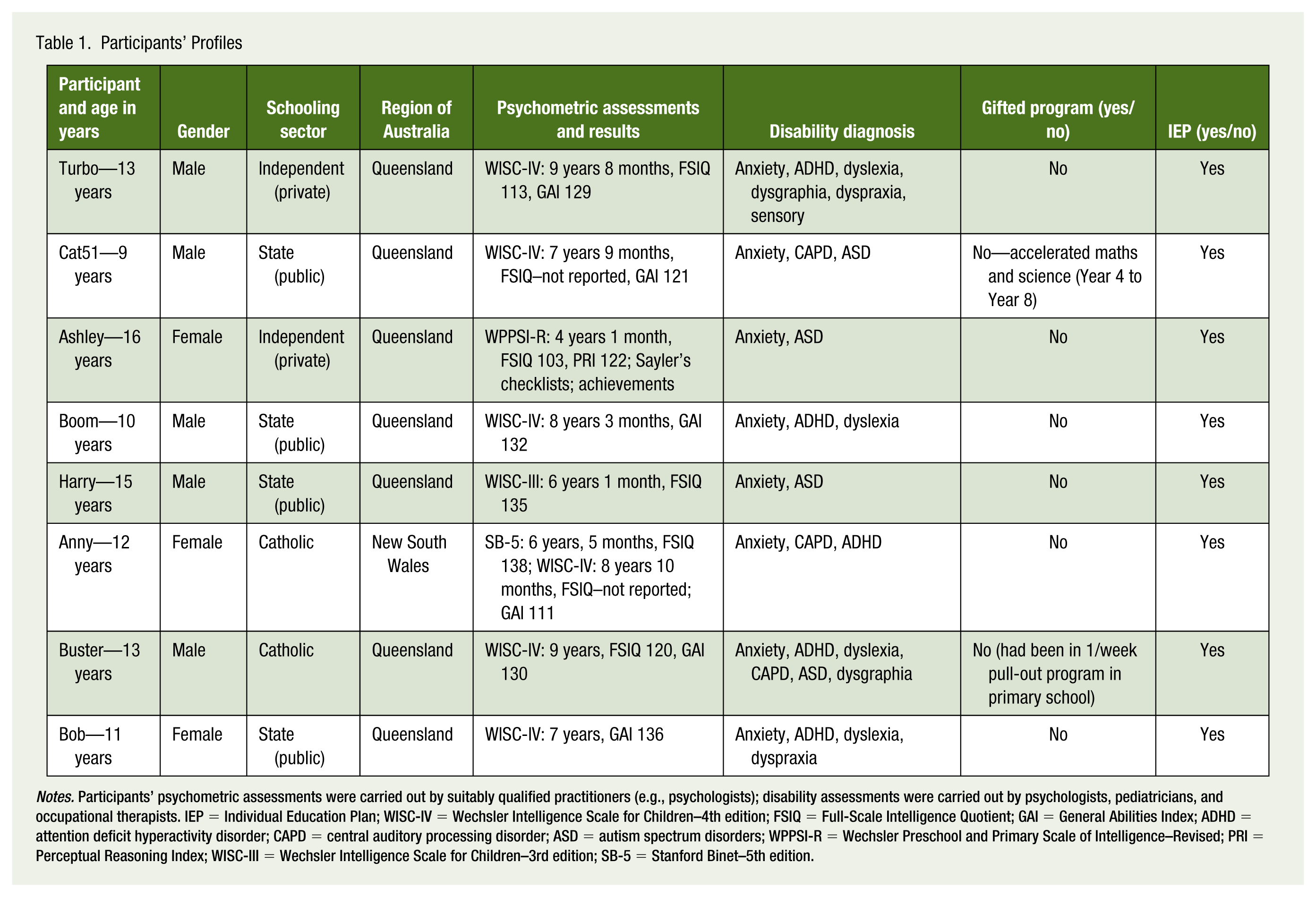
Notes. Participants’ psychometric assessments were carried out by suitably qualified practitioners (e.g., psychologists); disability assessments were carried out by psychologists, pediatricians, and occupational therapists. IEP = Individual Education Plan; WISC-IV = Wechsler Intelligence Scale for Children–4th edition; FSIQ = Full-Scale Intelligence Quotient; GAI = General Abilities Index; ADHD = attention deficit hyperactivity disorder; CAPD = central auditory processing disorder; ASD = autism spectrum disorders; WPPSI-R = Wechsler Preschool and Primary Scale of Intelligence–Revised; PRI = Perceptual Reasoning Index; WISC-III = Wechsler Intelligence Scale for Children–3rd edition; SB-5 = Stanford Binet–5th edition.
Giftedness was confirmed through reviewing prior psychometric testing, which parents had already undertaken independently and separate from this study, that was shared with the researchers. The inclusion criteria based on psychometric testing did not have a definite cut-off score but took into consideration the suggestions from researchers about using intelligence quotient (IQ) assessments in identifying twice-exceptional children. For instance, Majkut and Rogers (2005) suggest that using a traditional cut-off score of 130 IQ points will generally miss twice-exceptional children. Flexibility was needed in the selection process as outlined above, due to the assessments used to identify giftedness. It was necessary to use school-based assessments and reports and other school identification criteria, particularly in the case of Ashley (aged 16 years), whose Wechsler Preschool and Primary Scale of Intelligence–Third Edition (WPPSI-III) at age of 4 years (12 years earlier), did not confirm giftedness. In addition, a holistic identification process (Hyvärinen, 2008) was applied using multiple sources of information, such as school-based records, achievement, and our skills and knowledge in assessing giftedness in individual children.
Parents of the participants shared reports from medical professionals (e.g., psychologists and pediatricians) and allied health practitioners (e.g., occupational therapists) to confirm their children’s disability diagnoses. These reports were reviewed to confirm the diagnoses and to ascertain the nature of the children’s disabilities and needs associated with these. For this study, we used an expansive definition of the term disability from the Australian Disability Discrimination Act that expressly refers to a disability that affects on learning and furthermore that defines disability as [T]otal or partial loss of the person’s bodily or mental functions; or . . . a disorder or malfunction that results in the person learning differently from a person without the disorder or malfunction . . . To avoid doubt, a
The use of psychometric assessments and disability diagnosis reports aided in structural corroboration (Eisner, 1998) and crystallization (Richardson, 2000)—qualitative approaches to traditional methods of triangulation. Furthermore, students’ academic reports and school-based and out-of-school achievements were reviewed to add to the background information on each child and further support structural corroboration.
The interviews
Interviews as a method of inquiry are a powerful way “to gain insight into educational and other important social issues through understanding the experience of the individuals whose lives reflect those issues” (Seidman, 2006, p. 14). Seidman suggests that the use of qualitative interviews are for the purpose of understanding lived experiences of individuals and their meaning-making regarding those experiences, so the focus was on reconstructing the children’s lived experiences and interpreting those experiences.
Across the course of the study, a total of 28 interviews were conducted, each of which lasted approximately 30 to 60 min on separate occasions over a 6-month period. Unlike previous studies that used clinical or school-based settings for interviews, this study conducted all interviews in the participants’ homes and thus provided an opportunity for the children to be themselves in their own environments. The number of interviews conducted was based on reaching data saturation where no new information was recounted by the participants. In this study, the number of interviews to reach data saturation was between three and four for each participant. Table 2 provides details on the interviews conducted with each participant.
Interview Data
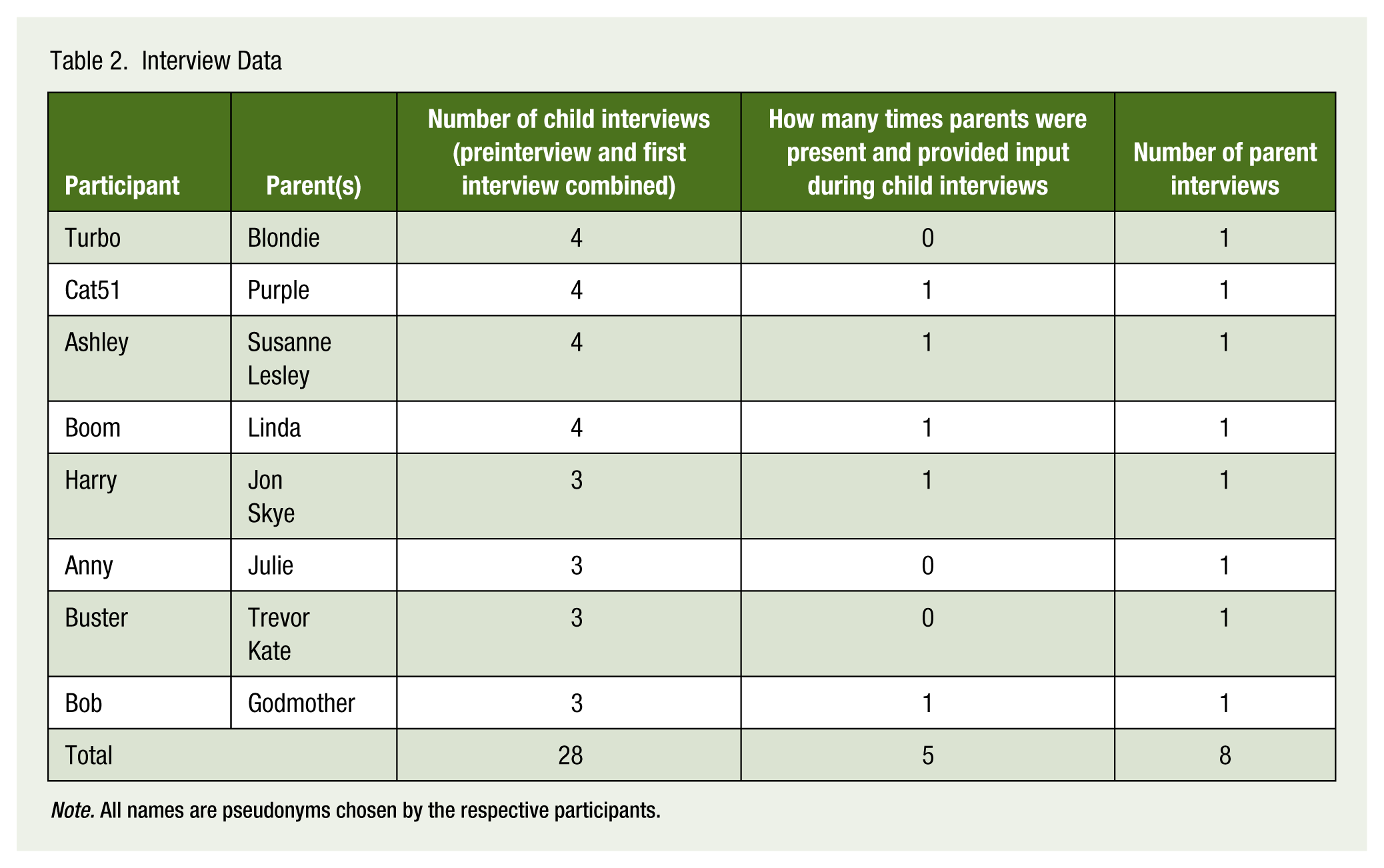
Note. All names are pseudonyms chosen by the respective participants.
The semistructured interview protocol used open-ended guiding questions to elicit extended responses from the participants along four stages of interviewing. Table 3 unpacks each of these stages and provides sample questions from the semistructured interview protocol.
Stages of the Semistructured Interview and Sample Questions From the Protocol
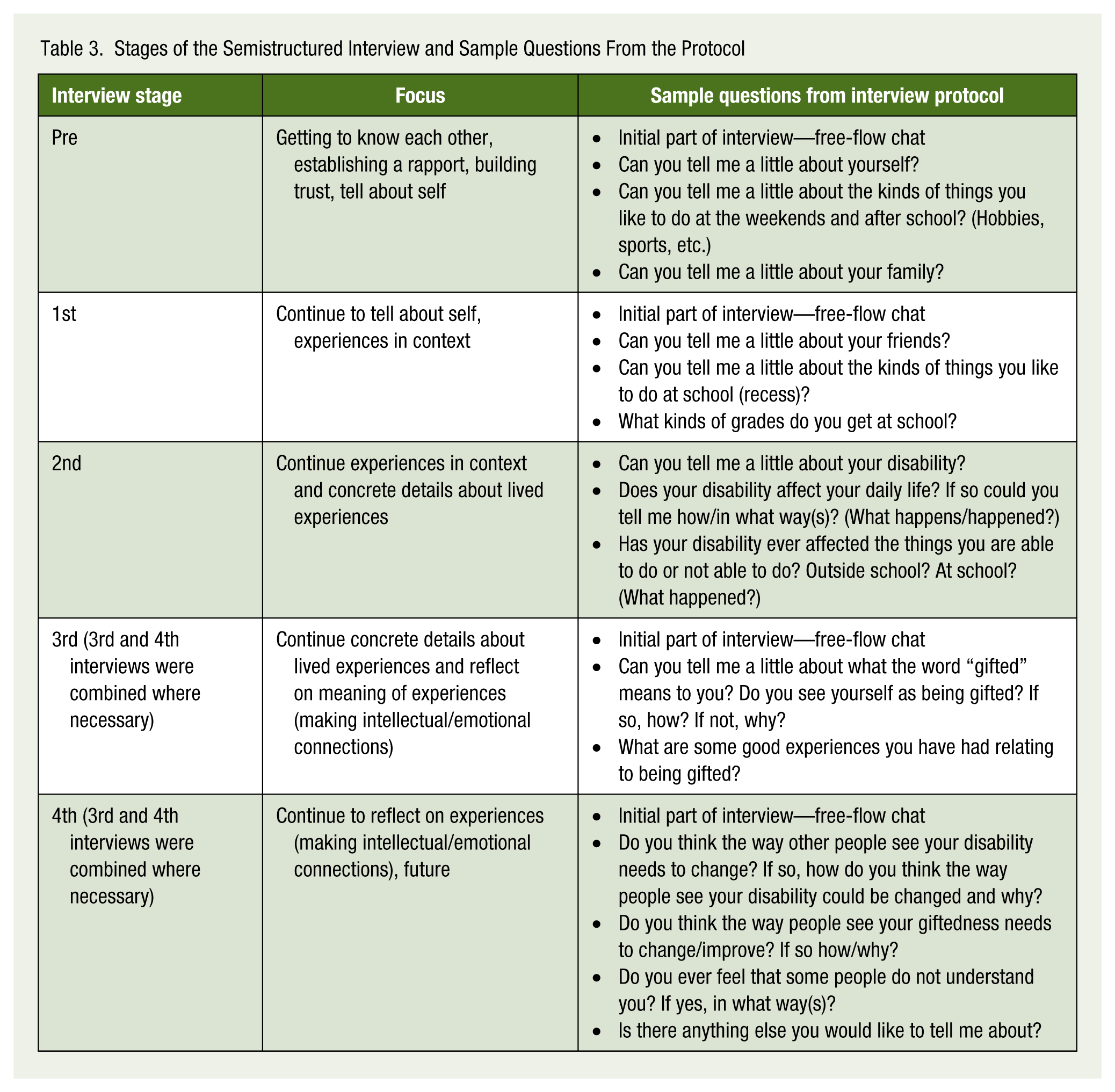
The semistructured part of the interviews were conducted in an informal manner and termed as a chat when referring to the interviews with the children (see Ronksley-Pavia & Grootenboer for further details on interviewing twice-exceptional children, 2017).
To complement the interview data, a memory box was used to allow the participant to include objects that were of significance to them for discussion during the interviews. Each interview began with a free-flow chat where the participants extracted artifacts from their memory boxes and shared objects of significance (Martin & Merrotsy, 2006). By showing these personal artifacts and through talking about these, stories and rich data were elicited to add to the authenticity of the case studies (Martin & Merrotsy, 2006). The memory box artifacts provided “triggers” (Clandinin, 2013, p. 46) for telling their stories where each participant guided discussion surrounding their chosen objects. Furthermore, these object often linked to specific memories and periods in the children’s lives that elicited good or not so good memories about particular events and experiences.
Multiple sources of information, such as school-based records, psychologists’ reports, allied health professionals’ reports, and field observations (in the participants’ own homes), are added to the complex data set for each participant’s case study. The use of multiple sources of data enabled deep exploration and interrogation of the phenomena (Cresswell, 2008) of bullying experiences for these twice-exceptional children. These multiple sources of data were further structurally corroborated using parental interviews. The resulting case study narratives in essence are an exploration and investigation of the bullying phenomena through the in-depth analysis of a narrow series of events, interactions, and circumstances and how these interconnect (Yin, 2009) in the lives of these twice-exceptional children.
Analysis
Strategies for establishing research confirmability were built into the research process that involved using NVivo software to manage the project. After each interview was completed, the field notes were entered into NVivo, and the audio recordings were sent for professional transcription. Coding involved both NVivo and hand coding, where the transcripts were read and reread to uncover overall themes from the raw data, and these were used as the basis for developing in-case primary narratives for each participant. These narratives were validated by each respective participant in the form of member checking where participants were invited to amend their narrative if necessary, none chose to do so. At each stage of the data collection and analysis, peer debriefing took place with other members of the research team to verify the research process, and here, discrepancies and problems were discussed and addressed by revisiting the data or analysis where necessary.
These data resulted in “a collection of storied texts” (Polkinghorne, 1988, p. 177), which were drawn together by using both “analysis of narrative” and “narrative analysis.” By using this analytical framework, we were able to examine the bullying experiences of the children through Bruner’s two modes of thought, paradigmatic mode, and narrative mode (Kim, 2016). Paradigmatic mode of analysis (analysis of narrative) referred to identifying and gathering specific themes, or threads of evidence, to create “general concepts and categories . . . to identify common themes or conceptual manifestations discovered in the data” (Kim, 2016, p. 196). These themes were organized under specific categories or subthemes related to bullying experiences drawn directly from the individual narratives.
Findings and Discussion
Within the thematic narratives of bullying, we found six subthemes that emerged from across the data about the children’s bullying experiences: (a) bullying by peers, (b) bullying by teachers, (c) teachers’ and adults’ responses to bullying, (d) social isolation and bullying, (e) emotional effects of being bullied, and (f) protective factors.
Bullying by Peers
All of the children described they had been bullied at some time during their schooling, and for some, it was more pervasive than others. Bullying by peers was described by the participants as another child or group of children negatively targeting them through verbal abuse; taunting, name calling, teasing, deriding them to their peers, or in front of their peers; and/or being physically abused: man-handled, punched, kicked; vandalism of personal property; and being excluded and ostracized.
These incidents were frequently repeated by the same instigators, or groups of instigators, or by various individuals/groups over the course of anywhere between a few weeks to several years. Buster described the types of bullying he had been subjected to: They would do things like name calling and not wanting to be my friend and telling me to go away and “F**k off,” and stuff like that as . . . I walked past. They would get up and move when I sat down at their table in classes, I don’t even say anything to them and they’d do that. So there was like a table of kids sitting down at lunch time, I’d walk over and sit down next to them and they’d just all get up and leave or move to another table or push me off the table or sometimes the kids would literally pick me up and drag me off the table to try and get me away, they’d grab my shorts and pull me backwards so I’d fall off the chair. (Individual interview, January 14, 2014)
As with Buster’s exploration of his experiences of being bullied, the participants discussed varying types of bullying and aggression from peers, many of which they felt targeted them because they were perceived as being different from their peers. Boom described some bullying incidents and attempted to determine for himself why the bullying had subsided: A few times in Year 2, I got beat up and once in Year 1, I got beat up. I was just walking around [at recess] and two people from Year 3 had come up and started punching me, kicking me. At a different time, one of the class bullies come up and kicked me, and no one had come to help . . . they beat me up again about three times more . . . bullies really just do it for fun, that’s why I thought they beat me up . . . [Another time] there was this guy [from school] at the skate park, so whenever I went to the skate park they’d be there and they’d be teasing me. They’d call me names—“dumb,” “stupid,” and “dumb arse.” (Individual interview, January 16, 2014)
Conversely, Harry was reluctant to talk about his experiences of being bullied. However, Harry’s father, Jon, explained a one-off incident of bullying that had been acutely distressing and left Harry emotionally traumatized: Everyone knows that Harry has this strange textual and pathological fear of fruit. Can’t stand the texture, he can’t stand the smell, won’t go near it, won’t eat it . . . He has a healthy scream, in Grade 7 at school, he opened his [desk] tray and someone’s put fruit in his tray. You know mean stuff! It doesn’t need to be done. He let out a scream like no one’s business and everyone in the classroom got a bit of a shock. So Harry gets in trouble for that. But the kids who do those mean things, they never found out who it was, they don’t get the same kind of [reprimand]. (Individual interview, May 10, 2014)
This incident was part of a larger picture of incidents that occurred over time but by different perpetrators that Jon found too distressing to talk about: “Even the really mean kids, those really mean events, I don’t want to talk about those . . . You know kids do really, really mean stuff to Harry and he’s just trying to fit in” (Individual interview, May 10, 2014). Harry’s experience illustrates that as Peterson and Ray (2006a) suggested from their research that the prevalence and impact of a single incident of bullying can be highly distressing for some children. This is an important component of the children’s experiences of bullying that was further exacerbated by repeated exposure to being bullied. This further highlights the importance of what can be termed “nonsustained [sic] bullying” (p. 264) which is frequently not included in definitions of bullying behaviors. It was clear from the participants’ descriptions that the incidents of bullying did not just have one or two ongoing perpetrators, but rather they often noted several perpetrators who were widespread across the school, their cohorts, and from one school year to the next. As exemplified in Cat51’s explanation of the type of bullying he experienced in primary school, They teased me at school, the way that a bully would . . . Just a normal bully, other people started teasing me. [They would] just say mean things, swear words and like push you, and like hurt you, those sort of things . . . they knew I was different . . . I thought it was terrible and mean, and sad . . . because I cried and that . . . The bullies, they try to get you as upset as possible, as quickly as possible. Even sometimes might be to fight you, and they’re like “Come on, why aren’t you fighting?” . . . I just walk away. They call me stuff . . . “Pussy,” those sort of, you know, normal things. (Individual interview, January 16, 2014)
In Cat51’s explanation, he believed that he was bullied as a direct result of being perceived by his peers as being different; this feeling of difference is not clarified as relating to disability or giftedness, but a rather distinct feeling of being different to his peers. Conversely, Anny explained how she was bullied because of her unusual ideas and imagination that came out in class and that she related to her giftedness: I was bullied every day [for] years . . . It’s a terrible experience because you can be bullied in so many ways . . . I wasn’t bullied because of my [disabilities] you can’t really tease someone about having anxieties. I did get bullied [because] I have really strange ideas . . . I actually had a humungous imagination . . . I was afraid of being myself . . . I was just not normal I would say, I mean no one’s normal, but I was just afraid of being myself because I just came [up] with strange ideas of the way I did my work . . . I was just different, the way I worked, plus I didn’t always talk to people; they sort of looked at me in strange ways that probably meant I wasn’t right . . . [but] that’s my personality because I’m gifted . . . I’m quite creative in my work . . . I’m a deep thinker. (Anny, April 15, 2014)
Cat51 exemplified how other students’ perceptions of his gifted ability led to him being bullied in class: Well last year Science, I hated it, obviously not an issue this year [because he had been accelerated to Year 8 (high school) science class from Year 4] . . . it’s the only reason I’m in touch with my own people . . . the other kids they didn’t like me, they used to pick on me because I knew all of the answers, I’d sometimes shout out . . . like [they’d] make fun of me, make noises behind me and call me the teacher’s pet sometimes . . . then I’d get in trouble [for being] very distracted by other people. (Individual interview, January 13, 2014)
Cat51 called the students in his new science class that he was accelerated into his “own people”; this statement suggests that he felt more at home and comfortable when he could be in a class with like-minded peers whom he felt understood him and whom he was “in touch with.”
Buster shared experiences that he related to being bullied because he was seen by peers as gifted and a “goody-two-shoes”: Since I was in the gifted and talented program, I think people expect since you’re in it that you’re a goody-two-shoes and since other people found out I was in it, I think I was treated differently by people calling me names . . . thinking that I’m a teacher’s pet and they’d think I’m good at everything and that I’m a snob and stuff like that. (Interview, May 31, 2014)
The peer bullying that the participant’s shared were particularly troubling because evidence suggested that when positive peer relationships were established, this helped the participants to be motivated and achieve at school. Ashley exemplified this when she stated that by . . . being around people that are quite intelligent it sort of drove me to want to be like them and do well and that improved my academics, just being around certain people [meant that they were] very good influences [on me and my work]. (Interview, April 8, 2014)
Bullying by Teachers
All of the participants described experiences of conflict with their teachers, with some reporting certain teachers who would appear to frequently negatively target them. Several reported experiencing bullying by educators and incidents which left them feeling vulnerable and unsupported in school environments. The following narrative from Buster highlights the distinct power imbalance between students and teachers moreover, it clearly shows an experience of bullying by a teachers that affected his overall schooling experience: It was in [Year 6] maths and he [the teacher] was walking up and down the rows of desks as we sat waiting for the end of class, I think he was telling us about what we were going to be doing in the next lesson or something, I wasn’t really listening . . . I wanted to see what subject I had next, so I was looking at the front of my diary, at my timetable, he [the teacher] came up behind me and grabbed my diary and closed it up hard, he hit me on the head with it! I don’t remember him saying anything he just carried on walking around the classroom and talking as if nothing had happened! It hurt, it wasn’t a soft cover, it was hard like a hardbound book. I told my mum and she rang my teacher, they didn’t really do anything, the next time I had maths he said to me “Don’t go round telling people I hit you when I didn’t” . . . that teacher used to keep a hammer on his desk and shake it at us if we didn’t do our work. (Individual interview, January 14, 2014)
In Buster’s anecdote, the teacher reacted negatively to Buster’s attempt to inform his mother about the incident, clearly dismissing it and adding to Buster’s feeling of being unsafe at school.
Episodes which the children saw as bullying by teachers included being yelled at, being singled out in front of their peers, being humiliated by incidents such as having their work ripped up in front of the class, being looked down on by teachers because of having disability diagnoses, and, punitive practices such as being kept in at recess. Although these types of incidents may happen to many children, it is the cumulative effects of these for individual twice-exceptional children which negatively affects upon them. Buster epitomized the type of bullying he experienced from one of his Year 4 teachers: When she [the teacher] looked at it [my handwriting], she would tear the pages out of my exercise book and tear them up and throw them in the bin in front of the whole class, and say, “Oh you should take more care in your work.” . . . and sometimes she would keep [me] in class to finish [my] work, that happened to me quite a few times, sometimes three or four days in a row I couldn’t go outside and play because she would just tell me to do my work. She would rip it up and sometimes she would even rip it up when I’ve tried it like the second or third time, I was a bit annoyed, and I was a little bit upset, because I thought, well the teacher’s not believing me that I tried my hardest . . . She just thought I was rushing or I was just purposely not taking care in my work. Sometimes it was really bad, like my arm was really sore since we’d done tons of writing, there was nothing I could do, she was the teacher . . . . (Individual interview, January 14, 2014)
This example from Buster characterized the types of punishments that teachers imposed on many of the children when they could not finish their work in the allocated time. All children need a break from sitting at a desk and from the cognitive load of learning, but this is particularly important for twice-exceptional students whose disabilities can add to their cognitive and emotional load. Cat51 explained the physical and mental stress of having to push himself and being pushed to write during class time often until he got “a headache . . . because of too many things going on at once” (individual interview, January 13, 2014) or “whole body cramps” (individual interview, January 8, 2014).
Ashley personalized how it felt to be perceived by teachers as less capable than her peers who did not have disability diagnoses and special education needs: With the special ed. program, I felt the teachers would often very much baby me and would very much look down on me, just speak to me like I was dumb. They would always sort of put me down and like point out the very obvious things. I can put two and two together thank you very much! You don’t need to treat me like this. It just makes me very angry to have people decide who I am . . . because I’m not that. You don’t get the right to choose that. (Individual interview, April 5, 2014)
Ashley felt that her giftedness was often overlooked by teachers as they predominantly focused on her disabilities. Some participants spoke of the lack of supportive relationships from educators who were teaching them on a daily basis. Examples supporting this came from anecdotes that the children shared regarding being segregated; punitive and humiliating punishments, being singled out by teachers, being blamed for incidents at school, being expected to work for longer/harder than they were physical and mentally able, and missing out on educational opportunities. Cat51 spoke of being pushed by his teacher to write when he was unable to cope which suggests a lack of understanding about his disability and the impact of this in classroom activities such as writing: The teacher pushed me way too far one day so . . . Yeah, I just couldn’t write anything . . . ‘cos then they push me too far and I just don’t like it . . . They just keep on pushing me and then eventually I just cannot do it at all . . . I just get tired of everything, then I just don’t want to do anything . . . Then because my hand got such a bad cramp . . . and then I feel like sick . . . after doing so much writing . . . I get sick sometimes . . . I don’t know why . . . my stomach, sometimes I get like a whole like body cramp . . . they just push me too far. They keep on getting me to write . . . I can’t write anymore, it just gets too far. (Individual interview, January 13, 2014)
Turbo told of teachers who he felt did not understand him and how he felt they would single him out to show his work in front of the class knowing that he had dyslexia (from his Individualized Education Program [IEP] and specialists’ reports): Only one teacher in my first school wasn’t very understanding, all of the teachers at my second school weren’t understanding . . . two at this school, yeah, two bad teachers at this school . . . I think they don’t understand because they single me out . . . like making me show what I’d done. Pull me up out of my seat and show the class my work—yeah not that good . . . show my writing and spelling . . . teachers didn’t understand me—[she was] like “Why’re you so stupid and lazy? There’s no excuse, if these guys can do it, you can do it!” I felt like a caged animal . . . they didn’t know a single thing about me . . . I feel angry and sad and not willing to listen to them . . . I hated that school then . . . ! I missed a lot of school. . . I don’t really want to talk about this. (Individual interview, December 12, 2013)
Turbo’s reluctance to discuss these incidents shows how it impacted him emotionally and how it angered him and made him feel sad at school. These negative experiences had been internalized for some of the participants, for example, their reluctance to recall and share certain negative experiences during the interviews and the silences which ensued. Turbo’s mother, Blondie, voiced concern about Turbo’s internalizing of negative experiences from school: Subconsciously I’m sure it goes deep . . . buries it deep down. I’m pretty sure he does . . . all these bad things that have happened over the years . . . He’ll certainly look back on the schooling as years of quite unhappy memories. I think he will, and that has entirely been dictated by the teachers. (Individual interview, January 21, 2014)
Internalizing negative experiences means directing feelings inward to oneself, rather than outwards to others; health problems resulting from this internalization can include anxiety, depression, loneliness, and psychosomatic conditions (Smith, 2014). Harry in particular was very reluctant to explain incidents of bullying skirting around the issue rather than addressing incidents of bullying more directly: I go to rather a big school . . . My dad’s a teacher there . . . often [that’s] good because when people bully me, I can tell someone about it . . . when people bully me I usually tell my dad or a teacher and the bullies [sometimes] get in trouble . . . Sometimes people have treated me badly because of my disabilities . . . yeah but I don’t exactly remember those exact times, and if I would I wouldn’t want to say. (Individual interview, May 16, 2014)
Our findings about the children’s perceptions of teachers bullying them support research which stresses that all children, but in particular children identified as twice-exceptional, need an educational environment that is safe and supportive, where levels of conflict between teachers and students, and students and students, are very low (Wang & Neihart, 2015). Research supports evidence that positive teacher and student relationships, particularly for twice-exceptional children, can increase their academic results (Hughes, Luo, Kwok, & Loyd, 2008; Wang & Neihart, 2015).
These findings are consistent with Besnoy et al. (2015) who found parents frequently reported bullying of their children (who had disability) by teachers, which they stated acted as a catalyst to their loss of confidence in educators and the education system. Furthermore, this finding is consistent with Hartley et al. (2015) who reported high verbal and relational bullying by teachers of students who received special education provisions. Furthermore, negative relationships between teachers and students have been shown to adversely influence children’s engagement patterns in academic tasks (Hughes et al., 2008; Wang & Neihart, 2015). This is particularly troubling for twice-exceptional children as they are capable of high achievement when well supported in the classroom (Vespi & Yewchuk, 1992).
Research indicates that children who have preexisting mental health issues can be at a greater risk for depression, suicide ideation, and suicide attempts. This is particularly so for those who have experienced peer bullying and victimization (Klomek, Sourander, & Gould, 2010). There is a tentative suggestion from our study that bullying experiences can affect future mental health and well-being of these participants. Indeed, when we approached the participants for follow-up statements, 12 months after the initial interviews, Ashley’s mother Susanna told us that Ashley had twice attempted suicide prior to finishing her final year of school: Ashley got worse with her work ethic and was back to her old days of no work and lack of concentration. She developed depression . . . She refused to go to school and dropped out . . . We started seeing a psychiatrist . . . two weeks later Ashley self-harmed, cutting numerous marks up her arm with a razor. She then attempted to strangle herself . . . twice . . . the psychiatrist at my request, got her admitted to the [child mental health hospital]. (Parent email, January 12, 2016)
We must stress that these suicide attempts may not be directly associated with Ashley’s experiences of being bullied, however, it does present a troubling picture for particular twice-exceptional students with existent mental health issues.
For many of the children, being looked down on by teachers and being perceived as the object of the teacher’s ire by such singling-out incidents in front of peers has implications for the way peers relate to children treated this way by their teachers. Children usually look to teachers as role models and how to connect with and respond to other people. By treating children with differences in an openly negative way, teachers are modeling inappropriate behaviors to the other students who may see it as acceptable to ostracize and bully particular children who they perceive the teacher does not like. This finding supports Hartley et al. (2015) who reported high verbal bullying by teachers of students receiving special education. Furthermore, our findings are also consistent with Reis, Neu, and McGuire (1997) who found harsh treatment from teachers in relation to twice-exceptional children. However, our findings indicate a wider pattern of negative interaction between some teachers and these twice-exceptional children, where furthermore, all of the children had difficulty reconciling and understanding despite their high reasoning abilities.
Our finding of bullying by teachers supports much of the literature on teachers’ impacts (positive and negative) on the education experiences of twice-exceptional children (Baldwin et al., 2015; Foley Nicpon & Assouline, 2015; Foley Nicpon et al., 2013; Reis et al., 1997).
Teachers’ and Adults’ Responses to Bullying
All of the children said that they had reported being bullied to adults, including teachers, but from the children’s perspectives, action taken by adults to curb the bullying appeared to have mixed results. The children expected to be listened to and their concerns taken seriously by adults, and to stop it. However, the participants’ reported that teachers ignored or dismissed their reports of bullying, or being met with dismissive responses as Buster explained: When someone would bully me they [the teachers] would just say “Oh shake hands!” That was their way of dealing with bullying. If it was something like name calling they’d go “Oh just man up!” . . . I just thought that it was a stupid technique of trying to fix a problem that never really got resolved. It might get resolved for half a day or a week at the most, and even with [telling] the Principal, they’d just tell the kids to stop doing it, then a week later they start doing it again. (Individual interview, January 14, 2014)
Findings here suggest that teachers often dismissed the children’s reports of being bullied as their supposed overreaction and hypersensitivity. This finding supports the literature on gifted children being bullied, where Peterson and Ray (2006a) found that bullying often occurs out of view of adults and is frequently normalized by them and, by doing so, invalidates children’s experiences.
Several of the children eventually decided not to report the bullying to teachers because of perceived inaction by them on previous occasions when bullying was reported. For example, Buster who detailed loss of faith in teachers to act to stop the ongoing incidents of bullying and peer victimization that he experienced: Since I was also bullied in Year 6 and 7, and the teachers didn’t really do much, I didn’t really trust teachers after that. I didn’t trust them to do anything about things like bullying or anything like that. I never really told them or spoke to them about it [being bullied] after that. (Individual interview, January 14, 2014)
The children talked about their experiences of indirect (Bosworth, Espelage, & Simon, 1999) or covert bullying, for example, where Anny related her experiences of bullying which she felt was not actually recognized by adults as such—“I mean I was bullied all the time because no one actually understood what the clever way of being bullied was.” Anny went on to explain how she was bullied because of her disabilities and the effect this had on her: Some people have treated me awfully because of my disabilities . . . I mean the thing wasn’t actually recognized as bullying [by the school], but it was. It was still making me sad and it still included basically not being nice over and over and like teasing in a not obvious way. It’s hard to explain the bullying . . . these days they tease you in a way that’s not obvious to other people . . . Last year, there were so many mean kids in my grade! There was no one at all that was nice. So I had no friends which was quite sad . . . the thing that they’d classify as actually bullying was in Year 3. I was being called names . . . You can’t tell people about the bullying because they don’t understand, so I did tell my mum at one point, my mum and dad, they just didn’t understand, so I couldn’t do anything else to help. I just was sad all the time, you know I just wanted to go to another school and just start afresh . . . It was extended bullying; it would start at the beginning of the day, basically as soon as everyone got to school. I think I was bullied because of my disabilities . . . also maybe because I didn’t have any friends to support me. Probably because I was the odd one out, I wasn’t really normal I suppose. I mean I wasn’t weird, but I was like, you know, had really strange ideas. (Individual interview, April 15, 2014)
These findings further reinforce research that suggested that adults rarely intervened in playground and classroom incidents of bullying (Brendtro, 2001; Craig, Pepler, & Atlas, 2000). By not responding to the children’s experiences of being bullied, the teachers unintentionally perpetuated and appeared to condone the bullying. This was further reinforced by participants’ reports of individual teachers’ negative attitudes and behavior directed at some of the children during class time. These findings agree with Farrington’s (1991) proposition that adults who fail to respond to bullying, appear to support and condone the cycle of bullying and aggression across generations and school cohorts.
Social Isolation and Bullying
For the participants, incidents of bullying seemed to occur during recess where the frequent aloneness of the children presented them as vulnerable targets for bullies. The children speculated that this may have been because they were frequently isolated and that other students viewed them as being targeted by bullies. Buster talked about making friends with new children who started at his school, but how these friendships would not last after the children saw him being teased and bullied by others, often as a result of being seen as different by others: I had a couple of friends at that time, but some of the kids who I thought were my friends, actually just ended up bullying me in the end. They stopped being friends with me because then they got bullied for being friends with me. I had friends from my previous school, so I wasn’t really friendless outside school, but I didn’t really have any friends inside school. So at lunchtime I might do some homework or I might just sit on my computer and play games in the library. (Individual interview, January 14, 2014)
As Buster epitomized in this extract, peers chose to distance themselves from him to protect their own identity from being stigmatized by association with a stigmatized individual. At school where his disability became visible through his engagement with classwork, he became ostracized as a result of others’ perceptions of him as different. Similarly, Boom experienced peers not wanting to be friends with him when he revealed his disabilities: The last time I told someone [about my disabilities] they went off telling their friends, they started teasing me . . . I thought it’d be ok if I told him, I just thought he’d keep it to himself and then he went off and told his friends. They came up to me and said, “Hey, you must be really dumb!” and “Hey look it’s the dumb boy!” and stuff like that . . . he didn’t want to be friends with me after that, when I’d told him about it [my dyslexia]. (Individual interview, January, 16 2014)
Consequently, their peers were perhaps fearful of similar experiences and being targeted by bullies for association, thus potential friends remained distant. Many of the participants were vulnerable to victimization and bullying by being alone, and Anny, Harry, and Buster had all mentioned that they had no school friends for a time. Harry personified this when he stated that “I don’t really have that many friends, I just sometimes talk to people over the Internet but that’s all, I don’t have friends really” (Individual interview, May 16, 2014). Buster explained that even in the gifted classes where it was considered he would be able to interact with like-minded peers, he was still isolated and bullied: I found that I did get actually bullied a little bit in the gifted classes, during class time . . . they would just exclude me from groups and group activities and they would keep all the equipment to themselves that was meant for everyone to use . . . I just got a bit annoyed, sometimes I’d just ignore it, go do my own thing. (Individual interview, May 31, 2014)
The children’s experiences were littered with recollections of lack of support from peers at school when incidents of bullying occurred. It would appear that being bullied is a further lonely and isolating experience for twice-exceptional children, particularly, for those already lacking in protective factors afforded by close allies and friends. This aligns with findings in the literature which posit that the quantity and quality of friendships directly affects a child’s vulnerability to bullying (Hodges & Perry, 1999). For example, Buster and Boom who both later stated that having friends with them seemed to curb the bullying: Boom felt that in early primary school he was a target for bullies, however, he believed that as his peers grew to understand and know him better that the bullying lessened. [In Year 4] I was fine then because I was like really good on computers and people would come up to me and ask for help with the computer, so I was okay then they had stopped beating me up because I had helped them on the computer and [they] thought I was pretty nice. (Individual interview, January 16, 2014)
Boom’s computer knowledge appeared to be valued by his peers as he was eventually accepted by them for his ability instead of being a target for bullies. It is important to note that this finding supports research conducted by Peterson and Ray (2006a), which highlighted that students’ not being known and understood by their peers were contributing factors in bullying of gifted individuals. Hence, where they become known, like with Boom, the bullying may lessen.
Emotional Effects of Being Bullied
The emotional effects of being bullied were significant for the children; Anny had reported that bullying made her “sad,” and Cat51 explained he was “sad” and he “cried.” Furthermore, Buster said he felt “upset” when the teacher ripped up his work but felt helpless because she was the teacher and could not do anything about it, despite the teacher having a copy of his IEP that detailed his disabilities and in-class adjustments needed to support him. Indeed, all of the children’s teachers and schools had contributed to the development of each child’s IEP at their respective school however, there seemed to be a distinct limitation to their implementation in classrooms. Both Buster and Ashley developed acute school phobias and for periods of time did not want to attend school, although it is unclear from the data whether there is a direct association between their bullying experiences and the development of school phobia.
Protective Factors
Although the findings from the study suggest that these eight students were bullied throughout much of their schooling, and for some outside school as well (e.g., Boom), it was not all negative. It would appear that through uncovering their bullying experiences, we also found that these participants had protective factors that acted to mediate some of the negative experiences, such as extensive support networks; external factors that the participants acknowledged as supportive. Some of these came from likely sources; like-minded friends, parents, some teachers, counselors/psychologists, and out-of-school social networks (e.g., youth group). Despite his previous negative experiences with teachers, Buster recognized and readily acknowledged the new-found support from teachers at his new high school: I’m actually getting support and there’s Teacher Aides in the classrooms apparently [at my old school they] said that they couldn’t help because I didn’t have funding . . . to them if I needed help with my disability I had to do everything up at Learning Support . . . It was either you need help with nothing or you need help with everything . . . I have a school counsellor too, she’s great! (Individual interview, January 14, 2014)
Ashley personified the important protective factor of having a support network when she discussed developing her friendship group of like-minded peers who shared her interests in art and social activism: I’ve had issues since I was young with my social behavior and stuff, and I was still bad in grade 7 and 8. I didn’t associate with a lot of other people . . . Year 9 was a very big year of change for me socially I stopped associating with people . . . that just upset me. I thought I became much more responsible that year and much more mature, and I was making more friends on my own with much more creative artsy friends who supported me. (Individual interview, March 22, 2014)
Outside school, Ashley took part in a Christian youth group and attended church every Sunday where she had formed strong social bonds. Some of Ashley’s diagnosed disabilities were anxiety and agoraphobia which she described as preventing her from undertaking activities that she enjoyed. However, she discussed how building her support network had contributed to her sense of self and acted as a protective factor somewhat countering and enabling her to cope with negative experiences where she found like-minded friends supported her: Essentially we’re just doing a lot of fundraising at the moment . . . I think it’s a very good opportunity for me to be forced to make new friends . . . putting myself into a new situation means I have to sort of make more . . . friends, it’s just puts me a little more out of my comfort zone, but I’m really enjoying it. (Individual interview, March 22, 2014)
Before attending church and having like-minded friends, Ashley had struggled with anxiety and agoraphobia that had prevented her from wanting to go out at all, even with her family to the point where her mother recalled that Ashley [W]ouldn’t go out with any friends or anything like that, she would only go out with church ladies who were in their fifties because she trusted them . She just wanted to be home . . . she goes to see a counsellor, and Ashley’s really improved . . . but she’s now coped quite well, having friends who understand and support her who she can trust has helped her. (Individual interview, April 10, 2014)
Indeed other participants reported that their out-of-school interests and activities presented them with opportunities to escape the many negative experiences they had in school.
An important aspect of developing friendships for the participants was having mutual interests with another person whom they could share their unique ideas and outlook on life. For some of the children, this was more with outside school activities and pursuits, which emphasized the significance of engaging in outside school interests and developing friends in different social environments to those presented by schools (e.g., Cat51 respite care and Ashley with her youth group). This links in with the importance of the children developing their own interests and enabling them to be children, rather than focusing on their positions as school students; working on remediation or school work. This finding is consistent with Nielsen and Higgins (2005) who stressed the imperatives of engaging in friendships with like-minded peers with shared interests, who are twice-exceptional rather than solely with peers with disability or giftedness; this is important in supporting twice-exceptional children’s self-understanding (Nielsen & Higgins, 2005).
The significance of stable and dependable friendships as protective factors for children against bullying are well recognized in the literature (e.g., Craig et al., 2000; Hartley et al., 2015; Mae et al., 2001; Peterson & Ray, 2006a; Rose et al., 2015). The emotional support provided by friends were elements absent in some of the children’s lived experiences (e.g., Harry who stated that he had no friends), however, in many instances, this was counteracted by having supportive families.
Through exploring these supports with the children, we were able to build a picture of their strong resilience to adverse situations suggesting that support networks helped to form protective factors in building resilience and coping strategies against the adversities they encountered through some of their experiences. Protective factors played a vital role in the children’s ability to bounce back; continue to attend school, take part in social events, engage in activities on a daily basis, and to be resilient in adverse situations. Some of these protective factors enhanced their abilities to manage stress and stressful events.
This finding is consistent with Trail (2006) who found that protective factors in terms of support from parents, and significant others were effective in empowering twice-exceptional children. Parents of the participants did this by establishing safe and supportive environments at home where their children’s strengths and interests were cultivated and nurtured with out-of-school interests, and where the children could be themselves. This finding supports the literature where both Coleman, Harradine, and Williams King (2005) and Trail (2006, 2011) suggest that where parents provide a nurturing environment for their twice-exceptional children, they are able to thrive and feel supported. Mixed with protective factors, the older participants (in mid-to-late high school) showed that in some areas, protective factors were significant in their capacity to keep going after difficult experiences.
Bullying was worse for some of the participants in the middle years of schooling (late primary, early high school), in particular, for those like Harry and Buster who both had autism spectrum disorder (ASD). This supports previous research (e.g., Rose et al., 2015) around children with disability at school being frequently bullied. Lovecky (2004) asserts that “it is middle school that many children with ASD report brutal teasing and bullying” (p. 249). However, despite reports of negative experiences and relationships for many twice-exceptional children made in the literature, there has been little exploration of their experiences, hence this present study presents important understandings about these experiences of being bullied that twice-exceptional children face.
Recommendations for Practice and Future Research
Both giftedness and disability on their own can serve as increased risk factors for bullying, suggesting that for twice-exceptional children (with combinations of both disability and giftedness), bullying rates may be high and occur more frequently. This was clear in the present study as all eight of the participants had been bullied during their schooling. Further research is needed to confirm and investigate this complex issue.
Our findings suggest that these twice-exceptional children’s differentness and isolation presented them as easy targets for bullies. Teachers and school leaders must be proactive throughout the school environment, at recess times and in the playground, and look to avert bullying behaviors in all students and themselves. This does not mean creating a negative environment of surveillance but rather an environment that limits opportunities for bullying behavior while creating gateways for cultivating supportive peer relationships. For example, school clubs which nurture the interests of twice-exceptional children while encouraging all interested students to join; buddy systems where students are paired, or grouped, for fun activities. Teachers and school leaders should be intentionally positive and attentive to firmly establish and maintain affirmative educational environments during recess and classroom activities, (even in the relative safety of gifted classes).
This study reveals that the bullying experiences of these twice-exceptional children stemmed from a lack of understanding by some teachers. Therefore, it is recommended that teacher education and professional learning must necessitate a clear and distinct focus on supporting these children. This education needs to focus on an understanding of twice-exceptionality, what it means for students and educators, and practical ways to cater for these unique children. This recommendation is supported by research which suggests that teachers have limited skills in identifying and nurturing giftedness (Kaya, 2015) and identifying and understanding twice-exceptional individuals within their classrooms (Wormald, 2009). Emphasis needs to be placed on reducing negative experiences; primarily bullying by peers and teachers.
Conclusion
In this article, we have outlined the findings about bullying in relation to eight twice-exceptional children’s experiences. We did not seek to objectively explore the participants’ lived experiences, but rather we sought to explore these through directly interviewing the twice-exceptional students involved to understand their perceptions of their bullying experiences. Thus, interpetivism provided a sound theoretical framework through which we undertook our aims of making these experiences visible and privileging the children’s voices.
We uncovered six subthemes about the children’s bullying experiences. While considered on their own, these findings on the pervasiveness of bullying for twice-exceptional children are concerning, however, when juxtaposed against previous research suggesting bullying of some gifted children, and of children with disabilities, the current study’s findings suggest that bullying of twice-exceptional children may be part of a wider entrenched culture of bullying across societies due to differentness of individuals and lack of acceptance from dominant groups. Where societies accept bullying behaviors as normal, reject them as nonexistent, and/or disregard reports of bullying especially from children, then bullying behaviors are more likely to go unchallenged and remain relatively unaddressed. It is vital to be aware of the possibility of pervasive bullying of children who are twice-exceptional. Therefore, it is crucial that those working with these children have an awareness of the effects of bullying on them and have the necessary skills, willingness, and institutional advocacy to sustain social and emotional support for these children throughout their education.
Unsurprisingly, the findings from this study align with broader social and cultural problems existing in Australian schools. Recent Australian research revealed that bullying “is a significant issue that more and more children need support with . . . [where] bullying behavior in the Australian community is very high” (Blumer, 2015, para. 14-15).
Limitations
This study is focused on the lived experience of eight students and, although their experience is valid, we cannot assume that it represents all twice-exceptional children. However, the main aim of this study was to explore the children’s lived experiences in relation to their experiences of bullying from a narrative perspective. The aims of narrative inquiry are to gain an in-depth understanding of phenomena that can be realized by using a small sample size. With this methodological limitation in mind, future research is recommended that is designed to explore a large sample quantitative analysis of the prevalence of bullying in the lives of twice-exceptional students. Likewise, investigating the experiences of support, both physical and emotional, for children who are twice-exceptional, in-school and out-of-school, would help to determine how we could better support this population when they do experience bullying.
Footnotes
Conflict of Interest
The author(s) declared no potential conflicts of interest with respect to the research, authorship, and/or publication of this article.
Funding
The author(s) received no financial support for the research, authorship, and/or publication of this article.

Bios
Michelle Ronksley-Pavia, PhD, has been a teacher across diverse education sectors for over 20 years and is currently an early career lecturer and GIER Adjunct Research Fellow at Griffith University, Australia. She lectures in undergraduate and postgraduate primary and secondary preservice teacher education courses. She has been awarded a Teaching Excellence commendation for her work. Her research interests include gifted and talented education, particularly those “at risk” of disengaging from education, which includes those from traditionally underserved populations of gifted learners. Michelle is an editorial board member of one of Autralia’s ledaing gifted eudctaion journals TalentEd and a founding member of SPELD Victoria’s Research Committee. Michelle is a leading expert in the field of twice-exceptionality in Australia.
Peter Grootenboer, EdD, was a schoolteacher and leader for 12 years before moving into the tertiary sector. He received a national Jim Campbell Award for teaching excellence. He is now a professor in education at Griffith University and the deputy director of the Griffith Institute for Educational Research. His recent books include the sole authored monograph “The practices of school middle leadership: Leading professional learning”; and coauthored books include Changing Practices, Changing Education, and Mathematics, Affect and Learning. His research interests include practice/praxis theory, mathematics education, educational leadership, and action research.
Donna Pendergast, PhD, is a professor and dean of the School of Education and Professional Studies at Griffith University. She researches middle year’s education, student engagement, teacher efficacy, school reform, and teacher education. She has over 160 peer reviewed publications and 19 books of relevance to contemporary teacher work. Donna received the Vice Chancellor’s Award for Excellence in Higher Degree Research Supervision in 2018 and the Australian Council for Educational Leadership Miller-Grassie Award for Outstanding Educational Leadership in 2018.