



Abstract
The author focuses on positive psychology as an important approach to supporting the psychological well-being of students with gifts and talents. Research has identified protective factors that can counteract risk factors for suicidal behavior. These protective factors may be found within the individual, the family, peers, the school, the community, and the sociopolitical arena. In a time when the world is full of threats and worries, it is important that educators help students with gifts and talents (SWGT) to thrive by building on the positive and bolstering the protective factors at every level.
Keywords
As we seek to help all people, including students with gifts and talents, be happy, healthy, and productive, it is important to explore how they are achieving well-being goals.”
For 4 decades of my career, I have focused my research and writing on the psychology of SWGT. In this work, I have pursued topics in the social and emotional or psychosocial domains, such as bullying, self-concept, ostracism, asynchronous development, multipotentiality, and personality. Since my early work with my colleague Larry Coleman, a mainstay of my research has been the topic of the stigma of giftedness (Coleman & Cross, 1988; T. Cross et al., 1991). For 30 years, I have also studied the suicidal behavior of SWGT (T.Cross & J. Cross, 2018, 2020). In this column, I have also written about code switching (T. Cross, 2023) and upward and downward comparisons in schools (T.Cross & J. Cross, 2022). A consistent aspect of most of these topics is that they only apply to a sample of SWGT, and in some cases, very few SWGT (e.g., suicidal behavior).
My goal in all this work has been to improve the lives of SWGT, ensuring they function well and are satisfied with their experiences in school, at home, and wherever they find themselves. Missing from this long list of efforts has been the direct focus on the psychological well-being of SWGT. To date, my collaborators and I have taken this positive perspective in some of our writing (J.Cross & T. Cross, 2017) and in numerous presentations, but for the most part, we have emphasized topics of some concern related to psychological well-being. In other words, we looked at it from the perspective of what was wrong or missing, and to what extent. Our efforts were in a positive direction, as we focused on what we could do to ameliorate the problem or concern, but they took a deficit or problem-oriented perspective. In this column, I am putting the horse before the cart by beginning with the positive, rather than identifying and attempting to measure all of the issues, experiences, circumstances and so forth that the horse may have in the cart being pulled.
We have referred to psychological well-being as a person being happy, healthy, and productive (J. Cross & T. Cross, 2017). The concept of subjective well-being is from the field of positive psychology, “the scientific study of what goes right in life” (Peterson, 2006, p. 4), which developed to counter the overwhelming focus on the negative in psychological research. Subjective well-being (SWB) is measured by the presence of pleasant emotions and the absence of unpleasant ones, along with one’s general satisfaction with life (Biswas-Diener et al., 2004). Research has found incrementally higher SWB is associated with greater resilience (Suldo & Huebner, 2004), academic achievement (Bücker et al., 2018), and positive social relationships (Diener et al., 2009). As we seek to help all people, including SWGT, be happy, healthy, and productive, it is important to explore how they are achieving those well-being goals.
Researchers have claimed that SWGT are no more likely than their typically developing peers to experience psychological problems (T. Cross et al., 2015; Neihart, 1999). At the same time, however, we know from experience and research they are not immune to psychological issues and concerns. As we attempt to support the development of SWGT—in life and in their talent domain—examining their SWB offers a different perspective, a new lens through which to view their condition.
In our research with low-income, high ability secondary students, we found that on average, they had relatively high SWB (J. Cross et al., 2023). There was no relationship between confidence in their academic abilities and their well-being, but there was a positive relationship with students’ confidence in their ability to self-regulate for learning. How well they thought they could meet homework deadlines, focus on their studying, or use different strategies for learning, for example, was directly related to their sense of well-being (β = .21, p < .01). There was an even stronger relationship with their identification with academics (β = .35, p < .001). From this study, we learned that the 11 non-binary students of our sample (4% of the total), however, had significantly lower SWB than their peers. This population may be particularly at risk. Non-binary students were overrepresented among gifted students who had attempted suicide according to school counselors in another of our studies (Cross et al., 2021b), which raises concerns that this population is not experiencing well-being as they should be. Looking at the dependent variable of SWB allows us a more holistic view of our participants.
For decades, the most common lens being used to consider suicide is to employ a medical model that attends to people who require treatment once their risk of suicide has been determined to be concerning. Over the past 25 years or so, efforts to create and offer some basic training on creating a more positive and protective school environment have been developing in the United States. Each of the two groups (those employing a medical model and those who operate from more of a community development framework) now have a vehicle for collaborating on suicide prevention, before attempts are made.
Examples of Protective Factors Among Students With Gifts and Talents.
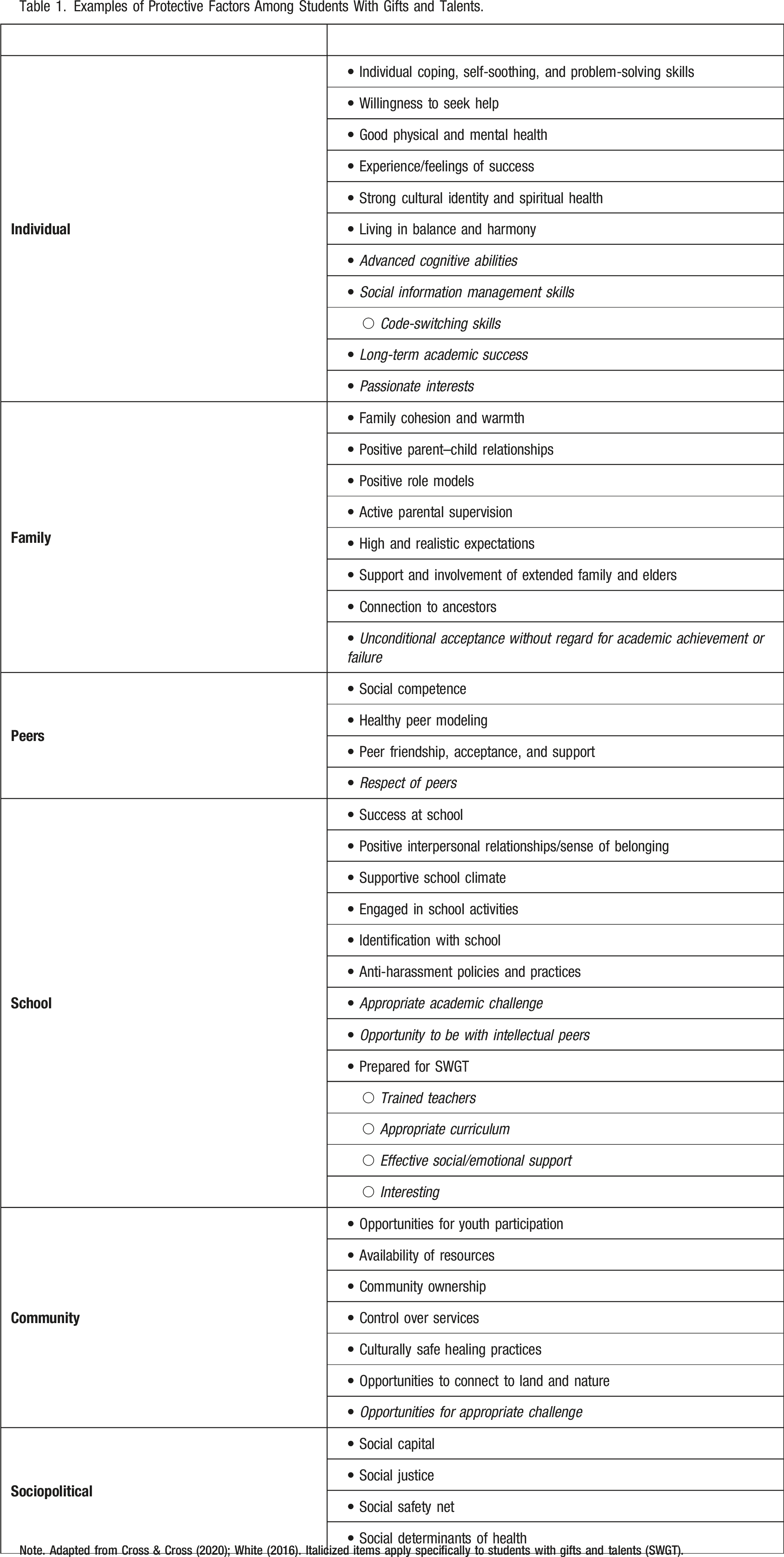
Note. Adapted from Cross & Cross (2020); White (2016). Italicized items apply specifically to students with gifts and talents (SWGT).
Applying positive psychology turns our focus away from the risks—which are not to be discounted—and toward a more optimistic approach to suicide prevention. When I speak with parents or counselors, I tend to focus on the importance of the protective factors and how building a caring community, for example, is the most appropriate action we can take to avoid negative outcomes. Table 1 contains clear indicators of protective factors that will be unique to SWGT relative to suicidal behavior. In many cases these can be drawn on to help bolster overall SWB among these students, with the end result being a reduced likelihood of suicidal behavior. For example, we can encourage help-seeking behaviors by making help readily available to all students and normalize advocating for one’s own mental health. Support for families can take many forms, from providing a safety net to offering educational programs. We can take steps to make all students feel welcome and connected with peers and adults at school (T. Cross & J. Cross, 2022).
All of these approaches will get us closer to our objective of supporting SWGT’s well-being—100% of them, not just a subset. This is important as all the students of today live in a time when the world is full of threats and worries (Cross et al., 2021b). We can help all students, including SWGT, thrive by building on the positive and bolstering both internal and external protective factors.
Footnotes
Declaration of Conflicting Interests
The author(s) declared no potential conflicts of interest with respect to the research, authorship, and/or publication of this article.
Funding
The author(s) received no financial support for the research, authorship, and/or publication of this article.
