



Abstract
Child maltreatment and family dysfunction (e.g., conflict) can have a long-term deleterious impact on youth well-being. Using a child welfare sample, this study examined whether dysfunction in the nuclear family of origin was associated with adjustment problems, including internalizing and externalizing behavior problems, beyond the effect of child maltreatment, and whether extended family (kinship) involvement protected against youth’s adjustment problems. Participants included 171 children and adolescents (mean age = 10.15; 50.3% female) who entered foster care due to child maltreatment. Results indicated that greater dysfunction in the nuclear family of origin and child maltreatment were independently associated with greater internalizing and externalizing behavior problems. Results also showed that kinship involvement was protective against externalizing behavior problems. Moreover, kinship involvement buffered the association between dysfunction in family of origin and internalizing behaviors only at low levels of family dysfunction. These results support policies that encourage the involvement of extended and noncustodial family members in the lives of maltreated youth following their entry into foster care.
Children who enter the child welfare system under the temporary custody of child welfare systems are usually victims of child maltreatment, including neglect or physical, emotional, or sexual abuse (Oswald, Heil, & Goldbeck, 2010). The extant literature indicates that children and adolescents in foster care experience psychological maladjustment and psychiatric problems in greater proportions than those in the general population (Burns et al., 2004; Garland et al., 2001; Orton, Riggs, & Libby, 2009; Pilowsky & Wu, 2006) as well as those in socioeconomically comparable samples (Pilowsky, 1995). In fact, youth placed in the foster care system are up to 8 times more likely to have behavioral or emotional adjustment problems compared to those in the general population (e.g., Burns et al., 2004). This includes externalizing behavior problems, such as aggression, delinquency, substance use, and antisocial behaviors (e.g., Burns et al., 2004; Orton et al., 2009; Pilowsky & Wu, 2006), and internalizing problems, such as depression, anxiety, and suicidal ideation (e.g., Guibord, Bell, Romano, & Rouillard, 2011). These statistics are not surprising, considering the adverse life experiences, such as child maltreatment and dysfunction in the family, that lead them to enter the child welfare system in the first place (Garland et al., 2000; Holtan, Ronning, Handegard, & Sourander, 2005).
Child maltreatment has been repeatedly linked to adverse mental health consequences (e.g., Garland et al., 2001; Jaffee, Caspi, Moffitt, Plo-Tomas, & Taylor, 2007), such as depression (e.g., Guibord et al., 2011; Orton et al., 2009; Cohen, Brown, & Smailes, 2001), substance use problems (e.g., Guibord et al., 2011), anxiety disorders (e.g., Cohen et al., 2001), aggression (e.g., Jaffee, Caspi, Moffitt, & Taylor, 2004), and future delinquency (e.g., Widom, 2000).
One factor that has been shown to influence the occurrence and effects of childhood maltreatment is family dysfunction which commonly co-occurs with childhood maltreatment (e.g., Dong, Anda, Dube, Giles, & Felitti, 2003; Dube et al., 2003; Felitti et al., 1998). Family dysfunction is typically defined by the quality of interpersonal relationships among family members in three domains: cohesion (i.e., the degree of help and support provided by family members to one another), expressiveness (i.e., the extent to which family members act openly and express feelings), and conflict (i.e., the amount of openly expressed anger, aggression, and conflict among family members). Research suggests poor family functioning not only makes children vulnerable to maltreatment (e.g., Belsky, 1993) but is also associated with subsequent maladjustment, regardless of the type or degree of child maltreatment (e.g., Higgins & McCabe, 1994, 2003). However, this relationship has not been examined thoroughly for youth in foster care.
Although child maltreatment and family dysfunction increase the risk for the development of adjustment problems, there are youth who are able to demonstrate resilience and achieve positive adaptation or developmental outcomes in the midst of significant adversity (Jaffee et al., 2007; Luthar, Cicchetti, & Becker, 2000; Zielinski & Bradshaw, 2006). Bronfenbrenner’s (1986) ecological model helps explain the heterogeneity in the effects of maltreatment because this framework considers the interaction of multiple factors across multiple contexts or layers of human ecology (e.g., Jaffee et al., 2007; Zielinski & Bradshaw, 2006). By recognizing that humans develop in a number of social contexts, an ecological framework is particularly valuable for understanding the risk and protective factors of youth in foster care, as they experience unique contextual shifts that youth who are not removed from their homes may not experience.
The literature has found family-level, school-level, and community-level factors that may contribute to the adjustment of youth in foster care. Regarding the family-level factors, the nature of the immediate family context, such as parenting behaviors and parental social support to children, may influence developmental outcomes of victims of maltreatment (see Zielinski & Bradshaw, 2006). For example, perceived levels of social support from family have been found to moderate the association between maltreatment and subsequent emotional and behavioral problems (e.g., Testa, Miller, Downs, & Panek, 1992; see Taussig, 2002). The research on family context, however, has focused primarily on the immediate or nuclear family context, which is a less accurate representation of the way family is often constructed among racial and ethnic minority communities.
The extended family (kinship) network is a culturally distinctive feature of family life among racial/ethnic minority communities (Harrison, Wilson, Pine, Chan, & Buriel, 1990; Hunter, Pearson, Ialongo, & Kellam, 1998). It is an important source of support for racial/ethnic minority families across all socioeconomic levels and a significant contributor to the healthy development of racial/ethnic minority youth (Hunter et al., 1998). The literature generally suggests that the availability of extended kin may benefit the functioning of youth in the general population (e.g., Pallock & Lamborn, 2006; Taylor, Seaton, & Dominguez, 2008). For example, kinship support has been found to buffer the negative effects of economic vulnerability (Taylor et al., 2008; Taylor, Casten, & Flickinger, 1993) and protect against the development of internalizing and externalizing behavior problems, such as anxiety, depression, substance use, and disruptive behaviors, among high-risk African American youth (e.g., McLoyd, Jayaratne, Ceballo, & Borquez, 1994; Taylor, 2010; Taylor et al., 1993). Kinship support has also been found to affect the association between familial stressors (e.g., hostility, conflict, and poor parenting) and behavioral problems among youth (e.g., McCabe, Clark, & Barnett, 1999; McLoyd et al., 1994; Taylor, 2010). Previous studies suggest that kinship support may be protective by helping caregivers create a more organized and structured home environment, improving parental involvement in schooling, providing advice to caregivers, and improving caregiver–child relationships as well as parental functioning (e.g., Taylor et al., 1993; Taylor, 2010). Although much is known about the effects of kinship involvement among youth in the general population, less is known about the nature of interactive or moderating effects of kinship involvement among foster youth. Luthar, Cicchetti, and Becker (2000) differentiated three moderating processes, including protective stabilizing (i.e., competence stays stable despite increasing risk), protective reactive (i.e., competence generally increases, but less so when the stress levels are high), and protective enhancing (i.e., competence increases in the context of stress). Given that racial/ethnic minority youth are overrepresented in the child welfare system, constituting 40–50% of the foster care population on average (e.g., Garland et al., 2000), it is important to examine the protective nature of kinship involvement within this unique context.
Although the positive influences of kinship support on youth adjustment are well established among racial/ethnic minority populations, current understanding of its impact on foster youth adjustment beyond kinship care (i.e., relative placements) is limited. The kinship care literature has generally found that children who live with relatives have fewer adjustment problems than those in traditional foster care (e.g., Holtan et al., 2005). However, the literature, with few exceptions (e.g., Poulin, 1992), has generally not examined the benefits of kinship involvement beyond kinship care among youth in foster care. Moreover, despite the disproportionately large involvement of racial and ethnic minority youth in foster care, the unique family ecologies of racial and ethnic minority youth remain relatively underexamined. The child welfare population is a unique group that has experienced child maltreatment severe enough to be removed from their homes and placed in substitute care. Thus, risk and protective factors related to family functioning found in the general population may not be generalized to the foster care population and are worthy of deeper analysis. It is important to note as well that while prior research has shown that kinship involvement and support are beneficial for racial and ethnic minority youth, comparisons of racial/ethnic and gender differences in the potential benefits of extended family networks remain relatively underexamined.
The purpose of this study is to expand the current literature on kinship involvement within the child welfare system by examining the protective effect of kinship involvement on psychological adjustment for youth in foster care. The present study first examines the contribution of functioning of the family of origin to foster youth’s psychological adjustment. Second, with particular attention paid to foster youth’s broader family context, this study examines how the involvement of extended family members (i.e., kinship involvement) may moderate the impact of dysfunction in the family of origin on adjustment upon youth’s entry into foster care. Unlike in previous studies, specific cross-generational categories of relatives (e.g., maternal aunt, paternal uncle, maternal great-aunt, and paternal grandmother) and various categories of involvement (e.g., phone calls, visitation, and child care) were identified. Additionally, this study explores the interaction between kinship involvement and race/ethnicity to assess whether the effect of kinship involvement on adjustment varies by race/ethnicity. Given that parenting practices may differ for boys and girls in some racial or ethnic groups (e.g., Barnett & Scaramella, 2013; Mandara, Murray, Telesford, Varner, & Richman, 2012), this study also explores any potential moderating effect of gender in the association between kinship involvement and adjustment problems. The present study hypothesizes that greater dysfunction in foster youth’s family of origin will be associated with more internalizing and externalizing problems and that greater kinship involvement will moderate these associations.
Method
Participants
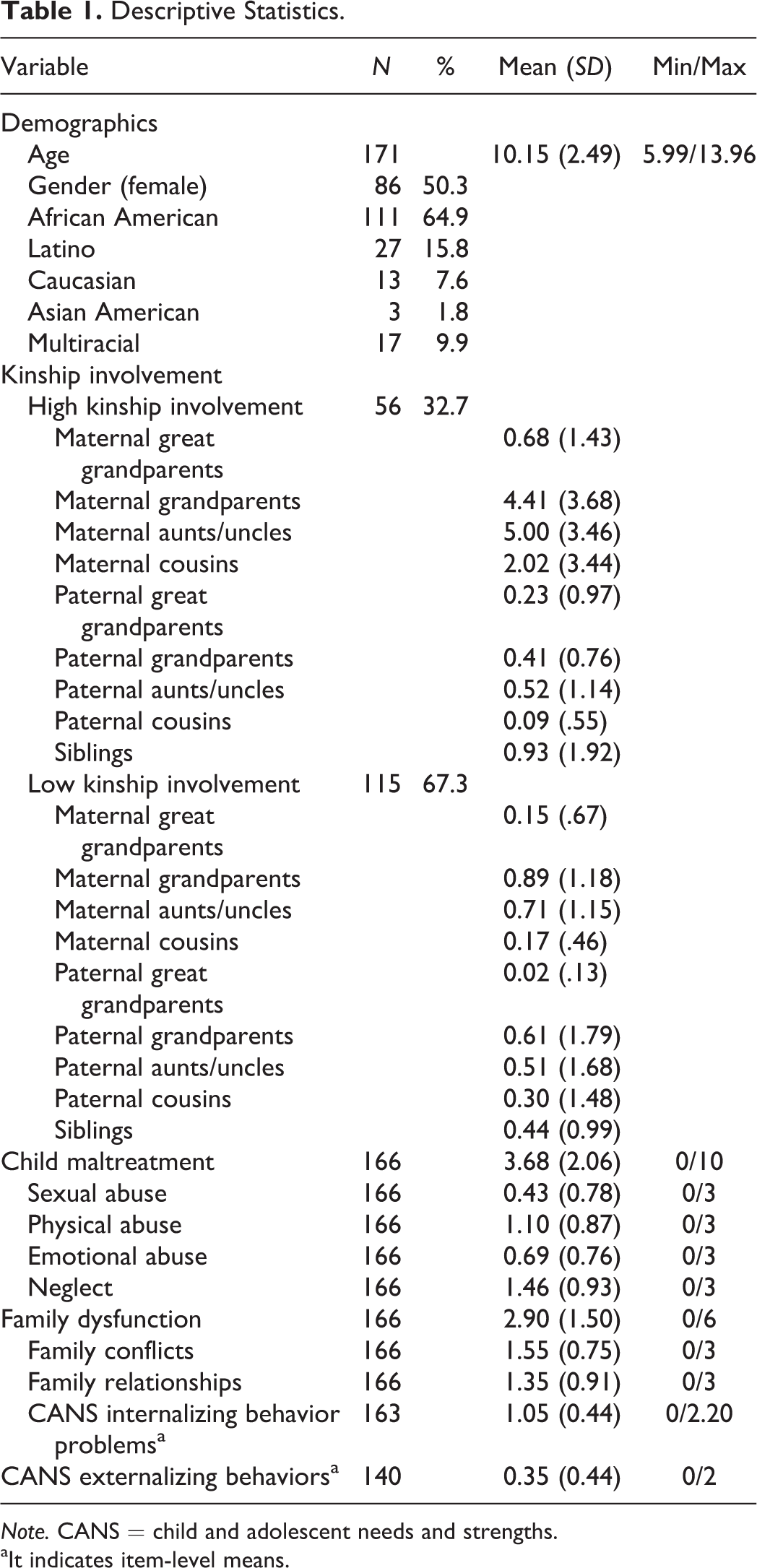
Children and adolescents between the ages of 6 and 13, who entered the care of the Illinois Department of Children and Family Services (DCFS) in Cook and Will Counties between October 1, 2011, and March 1, 2014, were eligible for the present study. In order to avoid violating the assumption of independence, one child was randomly selected from each family, resulting in a final sample size of 171. The mean age at entry into foster care was 10.15 years (standard deviation [SD] = 2.49), and females composed slightly more of the sample than males (50.3%; see Table 1). The sample represented a racially/ethnically diverse population: 64.9% African American, 15.8% Latino, 9.9% multiracial, 7.6% Caucasian, and 1.8% Asian American. Reasons for removal from the home and entry into DCFS included neglect (70.2%), physical abuse (32.7%), dependency (12.9%), and sexual abuse (7.0%). Dependency occurs when a child has no caregiver responsible for care or supervision, a caregiver is unable to provide care because of the child’s extraordinary needs (e.g., severe behavioral problems, illness, and disability), or the caregiver is unable to provide care due to his or her own issues (e.g., physical or mental illness, substance abuse, developmental disability, arrest).
Descriptive Statistics.
Note. CANS = child and adolescent needs and strengths.
aIt indicates item-level means.
Procedures
This study was part of a larger project designed to identify and promote the involvement of extended kin and fictive kin (e.g., godparent, neighbor, and coach) in the lives of youth once they enter the child welfare system. A list of eligible participants for the study was provided by the Illinois DCFS to the research team at Loyola University Chicago. The research team reviewed information on the Illinois DCFS Statewide Automated Child Welfare Information System (SACWIS) database to collect data on each youth’s demographics and family (see below). The primary section of the SACWIS record reviewed by the team was the psychosocial history developed as part of the Integrated Assessment (IA). As required by the state of Illinois, the IA is completed within 45 days of entry into DCFS care through temporary custody. An IA screener, a licensed mental health professional, conducts in-person interviews with each youth and his or her parent(s) and foster parent(s) to examine the medical, social, developmental, mental health, familial, and educational domains of functioning of both the child and the adults involved in rearing the child. After reviewing the IA for each participant, research assistants conducted phone interviews with child welfare workers to confirm and augment the information collected from the SACWIS database. The institutional review boards at both Illinois DCFS and Loyola University Chicago approved this study.
Materials
Demographic and familial information
A tool developed for this study, the Kin Identification and Level of Engagement Form, was used to obtain information regarding participants’ race/ethnicity, gender, age, family composition, and extended family members (e.g., maternal grandmother, maternal great-aunt, paternal aunt, and maternal cousin), and the type of kinship involvement provided by each of the identified individuals.
The completion of the Kin Identification and Level of Engagement Form occurred in two phases. In Phase I, the Loyola evaluator searched the Illinois DCFS SACWIS system to identify kin and record information regarding their involvement with the youth and their foster parents and biological parents. In Phase II, the research team contacted the youth’s child welfare worker to conduct an interview to review and (a) confirm the kin identified by the file review and identify any additional kin and (b) determine whether the worker was aware of any family involvement in the child’s life among the identified relatives. As part of this call, workers were asked to report on the various types of involvement and any barriers to involvement that may have been present (e.g., out of state and prior maltreatment indication).
Kinship involvement clusters
Based on the information gathered on the Kin Identification and Level of Engagement Form (i.e., youth’s kin and the involvement each individual provided), all of the youth’s relatives were categorized into the following relative types: maternal/paternal great grandparents, maternal/paternal grandparents/great-aunts/great uncles, maternal/paternal cousins and parents’ cousins, maternal/paternal aunts/uncles, and siblings (age 16 or older). The categories of kinship involvement included child care, visitation, phone calls, homework help, mentoring, transportation assistance, coaching, sending birthday cards or letters, invitations to family events, attendance at important events, and providing respite as well as support to biological parents and foster parents. Total kinship involvement scores for each relative type were calculated by giving one point for each type of involvement and computing a total score for each relative category. In order to understand how different types and amounts of kinship involvement influence foster youth’s adjustment, the present study identified clusters of kinship involvement (e.g., low or high involvement of extended family members) by performing a hierarchical agglomerative cluster analysis. Due to the limited prior research on this topic, Ward’s (1963) method, which is one of the most commonly used and powerful grouping mechanisms, was used as an exploratory technique to identify a number of clusters of children with similar patterns of kinship involvement (Fisher et al., 2000; Willett, 1988). This cluster method groups and regroups cases until the variance among them within each cluster reaches a minimum level. A review of studies using Ward’s method has shown that the most common way of determining a number of clusters is by looking for an inconsistently large jump in the agglomeration schedule (see Clatworthy, Buick, Hankins, Weinman, & Horne, 2005); this criterion was used in the present analysis. The two kinship involvement typologies identified are as follows: lower involvement across all relative types (“low kinship involvement” group; n = 115) and higher involvement of maternal relatives (“high kinship involvement” group; n = 56; see Table 1). Specifically, the low kinship involvement group had lower levels of involvement across both maternal and paternal relatives, while the high kinship involvement group had considerably higher degrees of involvement across maternal relatives (e.g., grandparents, aunts, uncles, and cousins) but not paternal relatives. The validity of this approach to measuring kinship involvement is suggested by unpublished findings that used the same data and found associations between kinship involvement clusters and kinship placement (Fuller, Bai, & Leon, 2016).
Child and adolescent needs and strengths (CANS)
Severities of family dysfunction, child maltreatment, and youth outcomes (i.e., internalizing and externalizing behavior problems) were evaluated using the CANS (Lyons, Small, Weiner, & Kisiel, 2008). The CANS was completed as part of the IA process. The CANS version used in this study was a 105-item structured instrument encompassing youth’s needs and strengths across seven domains, such as trauma experience, traumatic stress symptoms, youth strengths, youth behavioral/emotional needs, and youth risk behaviors. For each item on the CANS, severity ratings are reported on a 4-point Likert-type scale of 0–3, where a score of 0 indicates no evidence of any needs or the presence of significant strengths and a score of 3 indicates a need for immediate or intensive action. In order to complete the CANS as part of the IA, workers must first establish a reliability of 85% rating accuracy (State of Illinois DCFS).
Through a principal components analysis of items on the CANS, the following two scales were developed: Internalizing Behavior Problems (i.e., depression, anxiety, somatization, traumatic grief/separation, and adjustment to trauma; α = .71) and Externalizing Behavior Problems (i.e., oppositional behavior, conduct, attention deficit/impulse control, anger control, danger to others, sexual aggression, and delinquency; α = .84). In addition, 2 items were selected to represent family dysfunction (α = .76): family relationships and family conflict. Sum scores for these scales were computed and used in this study. All Cronbach’s α coefficients were above Nunnally’s (1978) criterion for acceptable internal consistency. A previous study has demonstrated the validity of these approaches by using the Kin Identification and Level of Engagement Form to measure father involvement, which was then examined as a predictor of consequential child outcomes using the CANS (Leon, Bai, & Fuller, 2016). Another study has also demonstrated a significant correlation between the CANS Externalizing Behavior Problems Scale, developed through principal components factor analyses, and the Child Behavior Checklist (CBCL) Externalizing Behavior Scale (r = .45, p < .001; Leon et al., 2016).
Statistical Analyses
Hypotheses were tested using hierarchical ordinary least squares regressions. The outcome variables were assessed using the Internalizing and Externalizing Behavior Problems scales from the CANS. All variables were centered prior to running regression analyses, and they were entered in three blocks. In order to examine the main effect of family dysfunction while controlling for other variables, family dysfunction and kinship involvement and control variables (i.e., child maltreatment, race/ethnicity, and gender) were entered simultaneously in the first block. In the second block, an interaction term between kinship involvement and family dysfunction was entered. In the third block, the interaction terms between kinship involvement and race/ethnicity as well as gender were entered stepwise due to the exploratory nature of the analyses. Due to the unbalanced racial/ethnic makeup of the sample (e.g., 64.9% African American, 15.8% Latino), the race/ethnicity variable was dummy coded (1 = African American; 0 = other racial/ethnic groups) for the interaction term. For any significant interactions, simple slope analyses were conducted in accordance with Holmbeck’s (1997) recommendations.
Results
Descriptive Statistics
Descriptive statistics were computed for the overall sample (n = 171; see Table 1). The descriptive statistics for the CANS Scales (i.e., Child Maltreatment, Family Dysfunction, and Internalizing and Externalizing Behavior Problems) and the individual items composing the scales are also presented in Table 1. The results suggest that the scales as well as the individual items varied in severity. For example, the average scores for the family dysfunction items (i.e., family conflict and relationships) neared the moderate range of impairment across youth (i.e., a 2 rating on the CANS). Regarding child maltreatment, physical abuse (M = 1.10, SD = .87) and neglect (M = 1.46, SD = .93) were, on average, the items rated highest. In terms of behavior problems, youth generally showed greater internalizing behaviors, where the item-level mean was 1.05 (SD = .44), than externalizing behaviors, where the item-level mean was 0.35 (SD = .44). Regarding internalizing behaviors, adjustment to trauma (M = 1.50, SD = .67) was the highest rated item, whereas anger control (M = .65, SD = .80) was the highest rated item for externalizing behaviors.
Main Effects
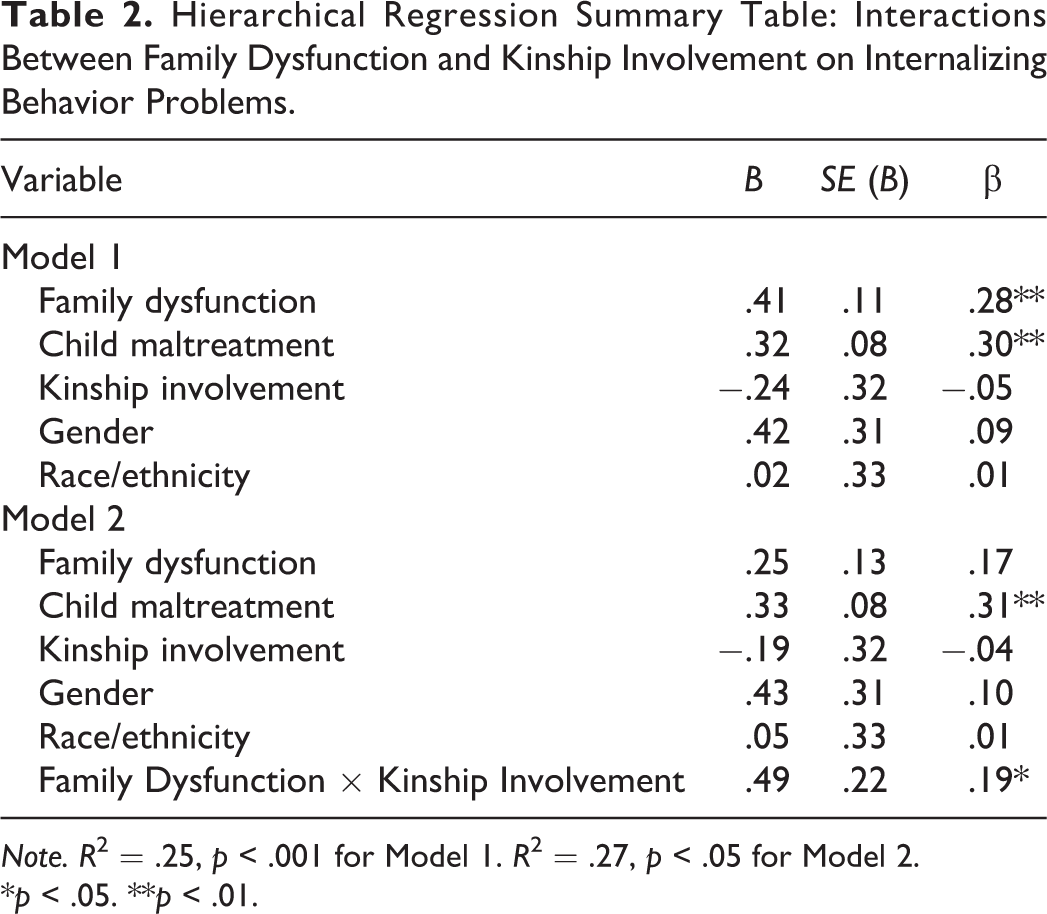
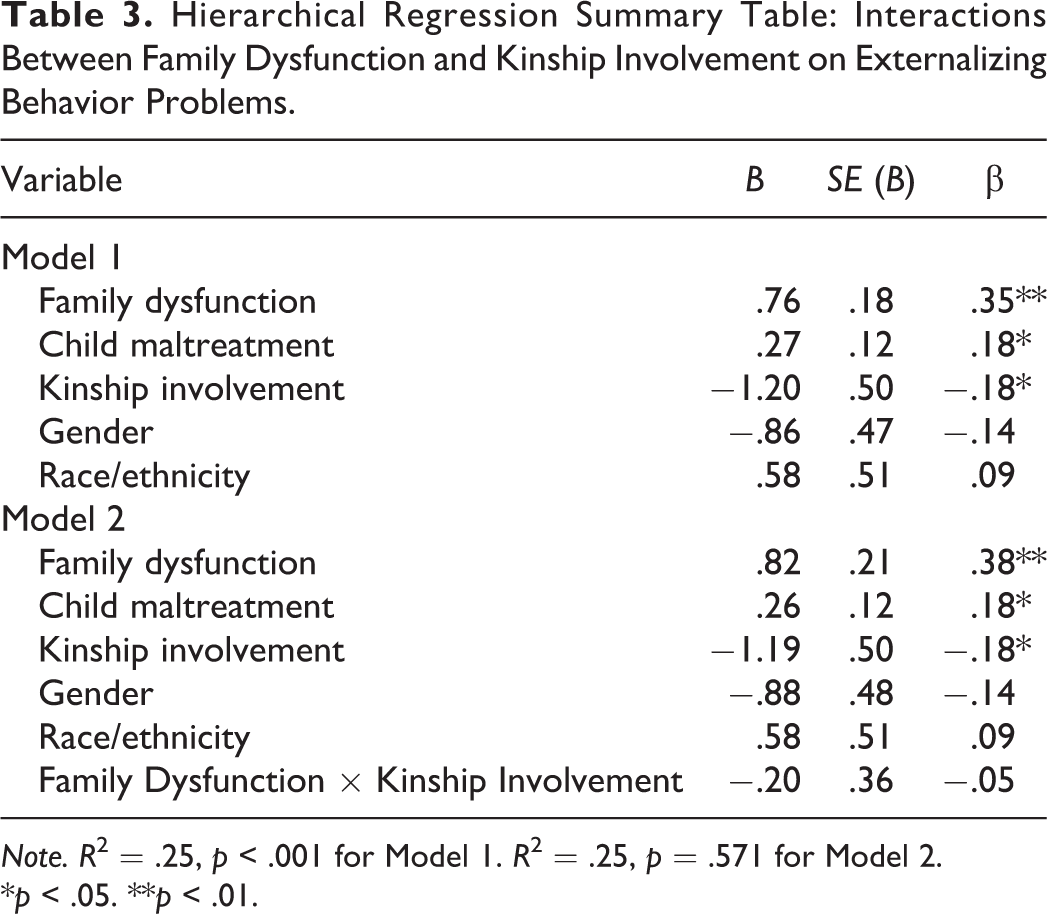
The present study examined whether family dysfunction was associated with internalizing and externalizing behavior problems after controlling for child maltreatment, kinship involvement, race/ethnicity, and gender (see Tables 2 and 3, respectively). Results indicated that greater dysfunction in each youth’s family of origin was associated with more externalizing behavior problems, β = .38, t(133) = 3.93, p < .001. The relation between dysfunction in the family of origin and internalizing behavior problems was marginally significant, β = .17, t(156) = 1.88, p = .06. More severe child maltreatment was also related to more internalizing and externalizing behavior problems, β = .31, t(156) = 4.15, p < .001 and β = .18, t(133) = 2.22, p < .05. Greater kinship involvement was associated with fewer externalizing behavior problems after controlling for family dysfunction, child maltreatment, race/ethnicity, and gender, β = −.18, t(156) = −2.37, p < .05. However, kinship involvement was not associated with fewer internalizing behavior problems, β = −.04, t(156) = −.60, p = .55.
Hierarchical Regression Summary Table: Interactions Between Family Dysfunction and Kinship Involvement on Internalizing Behavior Problems.
Note. R 2 = .25, p < .001 for Model 1. R 2 = .27, p < .05 for Model 2.
*p < .05. **p < .01.
Hierarchical Regression Summary Table: Interactions Between Family Dysfunction and Kinship Involvement on Externalizing Behavior Problems.
Note. R 2 = .25, p < .001 for Model 1. R 2 = .25, p = .571 for Model 2.
*p < .05. **p < .01.
The Moderating Effect of Kinship Involvement
Although kinship involvement did not have a main effect on foster youth’s internalizing behavior problems, there was a significant interaction between family dysfunction and kinship involvement, β = .19, t(156) = 2.22, p < .05 (see Table 2). A simple slope analysis revealed a significant positive relationship between family dysfunction and internalizing problems for children in both the low kinship, β = .27, t(156) = 2.06, p < .05, and high kinship, β = .74, t(156) = 4.15, p < .001, involvement groups. However, a t-test indicated that the slopes for the two groups were significantly different, t(167) = 2.37, p ≤ .05, and the relationship between family dysfunction and internalizing behaviors was stronger for the high kinship involvement group (see Figure 1).
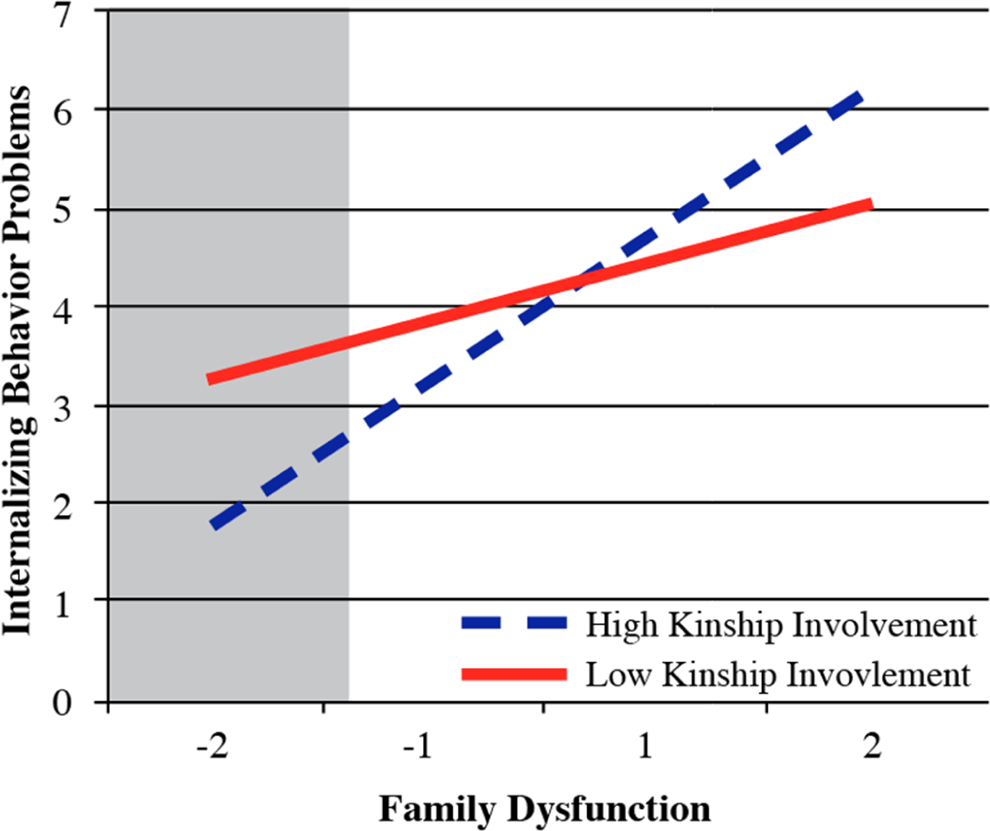
Reported internalizing behavior problems as a function of family dysfunction and kinship involvement. The shaded area represents a region of significance where the two subgroup regression lines (high vs. low kinship involvement) differ significantly (1.42 standard deviation below the mean of family dysfunction).
Lastly, in order to determine at what points the two subgroup regression lines (high vs. low kinship involvement) differ from each other, the Johnson–Neyman procedure for determining regions of significance was conducted using Fraley’s application, a supplement to Roisman et al.’s (2012) work. The regression of internalizing behavior problems on kinship involvement was significant for all values that fall more than 1.42 SDs below the mean of family dysfunction. In other words, the low kinship involvement group exhibited significantly more internalizing behavior problems than the high kinship involvement group at low levels of family dysfunction. Conversely, when youth were exposed to greater family dysfunction, the difference in the severity of their internalizing behavior problems was not significant between the high and low kinship involvement groups. The results of the regions of significance, as indicated by the shaded region, are represented in Figure 1.
In terms of externalizing behavior problems, a greater amount of kinship involvement was associated with fewer externalizing behavior problems. There were no significant interactions between kinship involvement and family dysfunction, β = −.05, t(133) = −.57, p = .57 (see Table 3). Additionally, there were no significant interactions between kinship involvement and youth’s race/ethnicity on internalizing and externalizing behavior problems, β = .05, t(156) = .39, p = .70 and β = −.03, t(133) = −.17, p = .86, respectively, as well as gender on internalizing and externalizing behavior problems, β = −.08, t(156) = −.37, p = .71 and β = .14, t(133) = .56, p = .58, respectively.
Discussion
Main Effects
The present study’s primary goal was to expand the understanding of the protective effects of kinship involvement on behavior problems among foster care youth who often experience child maltreatment and dysfunction in the family of origin. Consistent with the literature (e.g., Guibord et al., 2011; Jaffee et al., 2004) and the hypotheses, results showed that the severity of maltreatment was significantly associated with externalizing and internalizing behavior problems. In addition, the association between family dysfunction and behavior problems (particularly externalizing problems) was significant. Furthermore, this study adds to the existing literature in demonstrating that kinship involvement was negatively associated with externalizing behavior problems and with internalizing behavior problems when family dysfunction was low. Support for our finding that kinship involvement may offer protection against internalizing and externalizing behavior problems in a foster care sample can be found in research on higher risk youth outside of the child welfare system. For example, Taylor, Casten, and Flickinger (1993) found that greater kinship support was associated with fewer externalizing behavior problems among urban African American youth living in single-parent households. According to Taylor and colleagues, the positive effects of kinship support may be more pronounced among youth with greater needs. It is possible that foster youth in the present study and youth in single-parent households in Taylor et al.’s study are comparable in that both groups of youth are in great need of support, resources, help, and care as a result of difficulties within their nuclear families.
Interactions Between Kinship Involvement and Family Dysfunction
Although there was no main effect of kinship involvement on foster youth’s internalizing behavior problems, kinship involvement moderated the association between family dysfunction and internalizing behavior problems among youth in foster care. Specifically, both high and low kinship involvement had a protective effect when dysfunction in the family of origin was low, but not when the level of dysfunction in the family of origin was high. Since kinship involvement only partially buffered the adverse effects of family dysfunction on youth adjustment, kinship involvement in the present study is considered protective reactive (Luthar et al., 2000), meaning that it generally conferred advantage, but it was less protective when stress levels were higher. This finding is inconsistent with a previous study (McCabe et al., 1999), which found a protective stabilizing effect of kinship support on African American youth in that protectiveness was stable and present despite the increasing familial stress in a sample of urban African American youth, not in foster care. This suggests that protective factors may operate differently in the two populations or in response to different stressors.
The protective effect of kinship involvement may have been less pronounced at a higher level of family dysfunction because the level of dysfunction in the family of origin was too severe to be buffered by kinship involvement. The literature on the stress-buffering effect of support proposes that support is effective and can counterbalance or moderate the impact of stress on well-being when it sufficiently meets the emotional and practical needs of the distressed person (see, e.g., Cohen & McKay, 1984). It is possible that at a low stress level of family dysfunction, kinship involvement or support can alleviate its impact by providing a solution to the problem to the family or enhancing youth’s ability to cope with stressful situations (see, e.g., Cohen & McKay, 1984). However, at a high stress level of family dysfunction, the type of kinship involvement provided to foster youth did not match their needs and, thus, failed to promote self-efficacy or reduce stress reaction among foster youth. In fact, Hammack, Richards, Luo, Edlynn, and Roy’s (2004) study supports this idea that social support that appears to be protective at low levels of risk may fail to reduce the vulnerability to adverse outcomes in conditions of extreme risk. Their study of exposure to community violence found protective reactive effects for high victimization among urban African American youth but not for witnessing violence. Hammack and colleagues (2004) suggested that this pattern of findings may be due to social support failing to buffer youth in higher conditions of risk, such as directly experiencing high victimization, compared to lower levels of risk, such as merely witnessing violence; the effects of witnessing violence may be more easily mendable compared to the effects of being a victim of violence. In the present study, the emotional effects of experiencing high dysfunction in the family of origin may be too damaging and overwhelming, such that the effect of kinship involvement may not be significant and vulnerability to adjustment problems may be unavoidable. Thus, the finding that kinship involvement was not protective against developing internalizing behavior problems at a high level of dysfunction in the family of origin is not entirely surprising, given the traumatic nature of such life events as well as the experience of entering foster care.
Additionally, the present study found that foster youth’s race/ethnicity did not moderate the association between kinship involvement and adjustment problems. Although the literature describes the reliance on kinship support as an adaptive strategy commonly utilized among ethnic minority families (e.g., Harrison et al., 1990; Pallock & Lamborn, 2006), the predominance of racial and ethnic minority youth in the present sample may have prevented us from detecting an influence of race or ethnicity on the effect of kinship involvement. Also, the moderating effects of gender on the association of kinship involvement and adjustment problems were not significant. Given that gender differences in behavior problems typically occur later in development (see Eschenbeck, Kohlman, & Lohaus, 2007), the differential effects of kinship involvement may not be evident in childhood. It is important to note as well that while prior research has shown that kinship involvement and support are beneficial for racial and ethnic minorities, research has generally not compared the potential benefits of extended family networks between genders or different racial or ethnic groups.
Overall, the present study showed that the amount of kinship involvement experienced by foster youth and their caregivers was independently and uniquely associated with externalizing behavior problems regardless of the functioning of the family of origin. For internalizing behavior problems, however, kinship involvement was protective only when the intensity of family dysfunction was low. Although the literature generally suggests that kinship support has a positive influence on youth adjustment (e.g., Pallock & Lamborn, 2006), the current study suggests that due to the severity of adverse life events that foster youth experience, what is found to be protective in the general population may not hold the same protective effect among foster youth; the difference in the degree of stress may yield different types of protective effects. It is imperative that research closely examines what is considered protective among youth who are exposed to intense stressors.
Limitations and Future Directions
The present study has several strengths. Applying an ecological framework, the present study was novel in examining how youth’s broader family contexts may interact with their nuclear family contexts as well as how broader family contexts contribute to foster youth’s behavior problems. This was the first study to closely examine the protective effect of involvement of extended family members other than kin caregivers on youth’s adjustment within the child welfare system. Unlike previous research (e.g., McCabe et al., 1999), this study used an objective method of assessing the amount and type of kinship involvement to avoid youth’s tendency to inflate their perception of support they receive from their relatives. This study was able to identify specific types of relatives that foster youth have and their varying types of involvement. Additionally, the study focused on the characteristics of the family of origin—the context where child maltreatment occurred—instead of youth’s placements in foster care.
Despite its aforementioned strengths, the present study is not without limitations. First, because the study was cross sectional, the directions of the significant effects or causal relations are unknown. It is possible that kinship involvement leads to fewer externalizing behaviors, or it may be that foster youth with fewer behavior problems are more likely to elicit kinship involvement compared to those with higher levels of behavior problems. That is, children with fewer behavior problems may seem more manageable and less overwhelming for relatives to provide greater involvement in their lives, compared to those with high levels of behavior problems. Second, the current study did not assess foster youth’s perceived amount of kinship involvement. Youth’s reports of involvement of extended family members (e.g., visits with a particular relative) may differ from those of child welfare workers since workers may not know all the information. Third, future studies should assess kinship involvement using both objective and subjective methods to examine whether the objective amount of kinship involvement has the same effect as the perceived amount of kinship involvement and how potential discrepancies in objective and perceived kinship involvement may affect foster youth’s adjustment. Future research should also examine whether different types of involvement, such as visits, placement, or phone calls, have different effects on foster youth development. Future studies should also examine the impact of other social contexts, such as neighborhood and community, on foster youth’s adjustment (e.g., Garbarino, 1977). This is especially important for foster youth because they may move to different communities upon entering foster care or in the case of placement disruptions. Moreover, future studies should use a more evenly distributed sample, in terms of its racial and ethnic diversity, to examine whether the use of kinship support as a problem-solving and stress-coping system is a cultural pattern among families of youth in foster care. Expanding upon findings on kinship involvement, future studies should also examine how other sources of involvement (e.g., nonrelative adults, school, and friends) as well as the effect of kinship support (e.g., how much youth feel supported by relatives) may influence foster youth’s adjustment. In addition, the current study’s method of measuring family dysfunction does not indicate which specific aspect of family dysfunction has the most impact on youth adjustment. Lastly, the current study relied solely on child welfare or IA workers’ reports to assess foster youth’s symptoms. It would be helpful to also compare IA workers’ report of child’s symptoms (CANS) to that of the foster parent (e.g., using the CBCL). Nonetheless, this line of research will contribute to a better understanding of the effects of different factors at the level of the child, the family, and the child’s broader social network on the psychological adjustment of foster youth.
Conclusions
Overall, the present study indicates that nuclear family dysfunction may have an independent impact on adjustment among foster youth. Interventions should therefore focus not only on the effects of maltreatment but also on the effects of dysfunctional family relationships or high levels of conflict within the family of origin. Additionally, child welfare systems should encourage extended family, noncustodial kinship involvement for the potential it may have to protect youth from internalizing and externalizing behavior problems. To see lasting change, cultural shifts within child welfare systems may need to take place. In fact, as part of the Fostering Connections to Success and Increasing Adoptions Act of 2008, more efforts have been made to help connect foster youth to their family members (e.g., Children’s Bureau, 2013). Specifically, the U.S. Children’s Bureau awarded several intensive family finding grants to support states in their efforts to identify, engage, and connect youth in foster care with their family members. Acceptance, implementation, and evaluation of the family finding model are still in their infancy but show promise in finding and engaging noncustodial relatives (Vandivere & Malm, 2015). Initiatives of this kind at the policy level can help elevate kinship involvement beyond research into standard child welfare practice.
Footnotes
Declaration of Conflicting Interests
The author(s) declared no potential conflicts of interest with respect to the research, authorship, and/or publication of this article.
Funding
The author(s) received no financial support for the research, authorship, and/or publication of this article.