



Abstract
Children who experience maltreatment are more likely than nonmaltreated children to demonstrate deficits in early receptive language skills that negatively impact their later academic achievement, social competence, and behavioral adjustment. It remains unclear whether placement in foster care affects children’s early receptive language skills. In the current study, we examined whether children with Child Protective Services (CPS) involvement who were in foster care (n = 176) had more advanced receptive vocabulary than children with CPS involvement who resided with their birth parents (n = 144). Results demonstrated that children in foster care had higher receptive vocabulary scores at ages 36 and 48 months than children who stayed with their birth parents. Group differences were not significant after controlling for caregiver education level, marital status, and household income. These findings suggest that placement in foster care may be associated with meaningful improvements in children’s receptive vocabulary among children with experiences of CPS involvement, and birth parents might benefit from increased supports to promote parent–child interactions that facilitate language development.
Over 400,000 children are in foster care in the United States (Child Welfare Information Gateway, 2016). One of the goals of foster care is to provide a safe environment by removing children from harm due to neglect and abuse. Recently, an emphasis has been placed on the role of the child welfare system in promoting child well-being as well as safety (Administration for Children & Families, 2013). Receptive vocabulary, which is the ability to comprehend individual words, represents a key marker of early development. Early receptive vocabulary skills predict later academic achievement, particularly reading skills, and provide the foundation for learning more complex language skills (Barrett, 1989; Spira, Bracken, & Fischel, 2005). Children’s early language development is impacted by the caregiving environment (Perkins, Finegood, & Swain, 2013), with children who have been maltreated exhibiting deficits in receptive language skills (Eigsti & Cichetti, 2004; Lum, Powell, Timms, & Snow, 2015). However, it remains unclear whether placement in foster care has positive effects on cognitive and language development of children who have experienced maltreatment (Maclean, Sims, O’Donnell, & Gilbert, 2016). Thus, the goal of the current study was to examine differences in early receptive vocabulary between two groups of children: children with Child Protective Services (CPS) involvement who were placed in foster care and children with CPS involvement who stayed with their birth parents.
Maltreatment is theorized to affect language development negatively because language is learned in the context of social relationships (Tamis-LeMonda & Rodriguez, 2008). Maltreating parents are observed to be less responsive to their children’s verbalizations and use simpler language and ask fewer questions during conversations with their children than nonmaltreating parents (Christopoulos, Bonvillian, & Crittenden, 1988; Eigsti & Cicchetti, 2004). Similarly, children with histories of maltreatment demonstrate poorer language skills than nonmaltreated children (Stacks, Beeghly, Partridge, & Dexter, 2011; Veltman & Browne, 2001). Moreover, this association between maltreatment and negative language outcomes, including receptive language skills in particular, persists even after controlling for socioeconomic factors (Lum et al., 2015). Given that delays or deficits in early language skills are associated with later learning and socioemotional difficulties (Beitchman et al., 2001; Young et al., 2002), identifying factors that may mitigate the problematic consequences of maltreatment for children’s language development warrant attention.
In addition to maltreatment, another factor that has been theorized to affect language development is the provision of foster care (Lum et al., 2015; Reams, 1999). To date, it is unclear whether foster care has positive or negative effects on maltreated children’s cognitive and language outcomes. On one hand, it is possible that when children are placed into foster care, the disruption of the attachment to the biological parent may cause stress to children that could adversely impact their language development (e.g., Lawrence, Carlson, & Egeland, 2006). However, it is also possible that foster care represents an environment characterized by increased stability, enrichment, and responsive care, which would facilitate language development (e.g., Baumwell, Tamis-LeMonda, & Bornstein, 1997; Hirsh-Pasek et al., 2015).
In a recent review by Maclean, Sims, O’Donnell, and Gilbert (2016), only three studies were identified as examining effects of foster care on children’s language development. Berger, Bruch, Johnson, James, and Rubin (2009) examined language outcomes for children aged 4–17 using a brief intelligence test. Stahmer et al. (2009) and Stacks, Beeghly, Partridge, and Dexter (2011) examined language outcomes for children in early childhood using a standardized assessment of auditory and expressive communication. All three studies did not observe an effect of foster care on children’s language outcomes. However, none of the studies used a standardized assessment specifically designed for examining early receptive vocabulary. Moreover, given that all three of those studies were drawn from a single sample, examining receptive vocabulary outcomes potentially associated with foster care in another CPS-referred sample is an important next step.
The goal of the current study was to examine differences in early receptive vocabulary between two groups of children: children with CPS involvement who were placed in foster care and children with CPS involvement who stayed with their birth parents. Given that we anticipated that placement in foster care would provide the child with a more enriched caregiving environment in most instances, we expected that children who were placed in foster care would demonstrate higher receptive vocabulary scores than children with CPS involvement who stayed with their birth parents.
Method
Participants
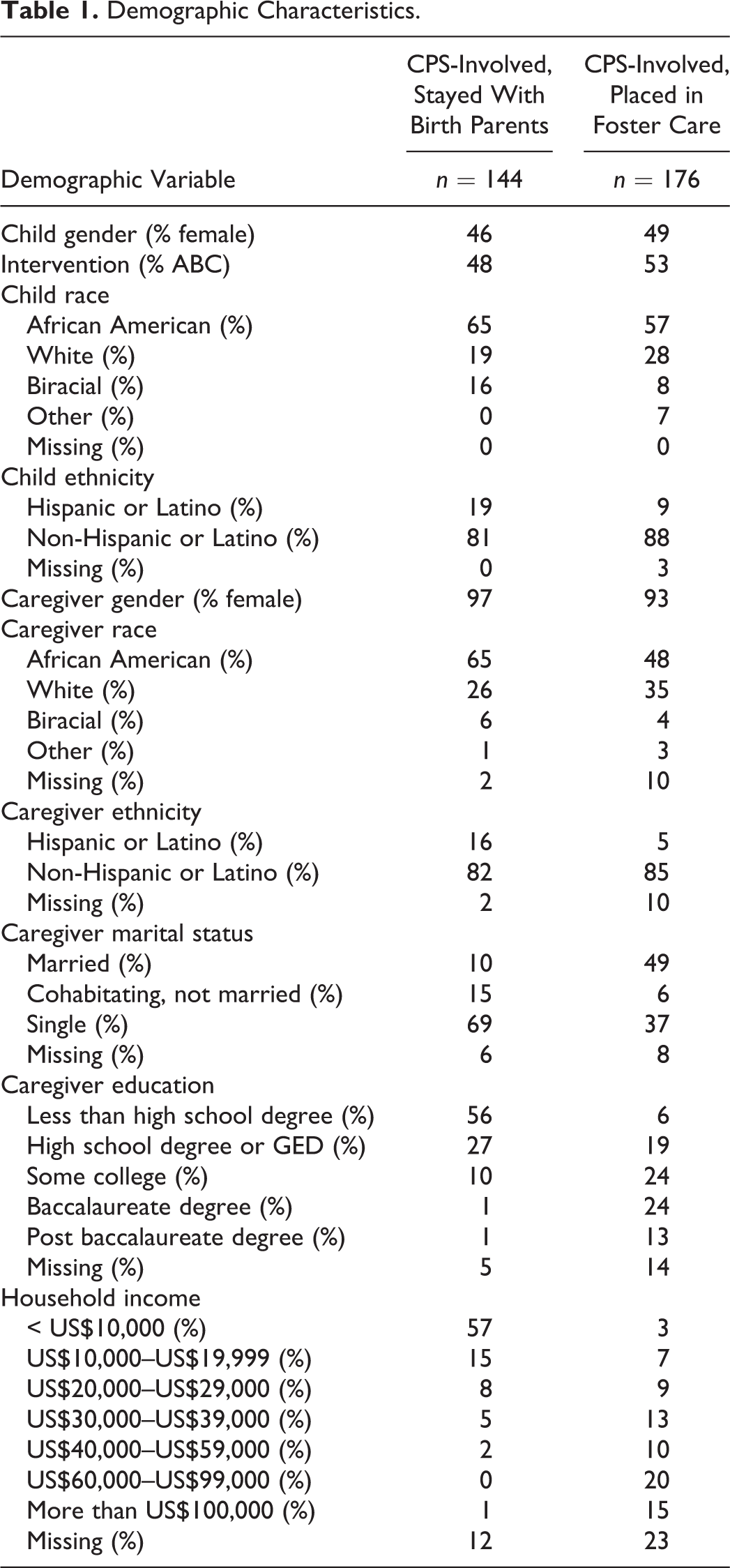
Data for this project were collected in the context of three longitudinal studies examining the efficacy of an attachment-based parenting intervention for families involved with CPS. Participants included 320 children whose birth parents were referred to CPS due to allegations of childhood abuse and/or neglect. After CPS involvement, 176 children were placed into foster care and 144 remained in the care of their birth parents. For children placed in foster care, foster parents were referred to participate in the parenting program by child welfare agencies in Pennsylvania, New Jersey, and Delaware. For the children who remained with their birth parents, the parents were referred to the parenting intervention as part of a foster care diversion program in Philadelphia. Table 1 presents demographic characteristics for children and caregivers.
Demographic Characteristics.
Procedures
When families were enrolled in the study, they were randomized to receive either the experimental intervention (Attachment and Biobehavioral Catch-up [ABC]; n = 162) or control intervention (Developmental Education for Families; n = 158). The interventions were both delivered in the home over the course of 10 weekly hour-long sessions. ABC was developed to promote caregiving quality by helping primary caregivers provide nurturance when children were distressed, respond in sensitive ways to child signals under positive and neutral affect conditions (i.e., “follow the lead”), and decrease frightening or harsh behaviors (Dozier & the Infant-Caregiver Lab, 2015). The control intervention emphasized ways to promote children’s cognitive and motor development. Children’s receptive vocabulary skills were assessed after the completion of the intervention when they were approximately 36 and 48 months of age.
Measures
Children’s receptive vocabulary was assessed using the Peabody Picture Vocabulary Test, third edition (PPVT-III; Dunn & Dunn, 1997). The PPVT is a standardized measure of receptive vocabulary and has demonstrated good reliability and validity (Campbell, Bell, & Keith, 2001; Dunn & Dunn, 1997). During the PPVT, the test administrator read a word, and children were asked to select one of four pictures that best illustrated the word’s meaning. Each child’s total number of correct responses was converted to an age-standardized score using the norms presented in the scoring manual. Standardized scores were used in the present analyses to control for differences in child age and to promote comparisons to age-based benchmarks (i.e., M = 100, SD = 15).
Results
Data Analytic Plan
We first conducted preliminary analyses exploring potential differences regarding demographic characteristics of the groups and examining potential associations between demographic variables and PPVT scores. Independent samples t tests then examined whether children placed in foster care had higher PPVT scores than children who stayed with their birth parents at 36 and 48 months of age. Based on the findings from Stacks et al. (2011), we expected foster parents to differ in systematic ways from birth parents referred to CPS in terms of demographic variables (e.g., educational attainment, income, and marital status). We therefore followed Miller and Chapman’s (2001) guidelines and initially did not control for parent demographic variables because controlling for such variables would have removed meaningful variance. Next, we conducted regression analyses examining whether group status (i.e., foster care vs. birth parents) predicted PPVT scores, even after controlling for those demographic variables.
Preliminary Analyses
There were no differences between children who were placed in foster care and children who stayed with their birth parents in terms of child sex or intervention status. Children with CPS involvement who were placed in foster care were more likely to be White or “Other” (e.g., multiracial) and less likely to be biracial than children with CPS involvement who stayed with their birth parents, p < .001. Children with CPS involvement who were placed in foster care were less likely to be Hispanic than children with CPS involvement who stayed with their birth parents, p = .01. Foster parents were less likely to be African American and more likely to be Caucasian than birth parents, p = .05. Foster parents were also less likely to be Hispanic than birth parents, p < .001. Foster parents were more likely to be married, less likely to be single, and less likely to be cohabitating with their romantic partner when not married than birth parents, p < .001. Foster parents reported higher levels of income than birth parents, p < .001, and higher levels of education than birth parents, p < .001.
Caregiver education was significantly correlated with PPVT standard scores at age 36 months (r = .29, p < .01, df = 190) and age 48 months (r = .42, p < .01, df = 177). Likewise, household income was significantly correlated with PPVT standard scores at age 36 months (r = .32, p < .01, df = 157) and age 48 months (r = .45, p < .01, df = 153). Parents’ marital status was also significantly related to PPVT standard scores. Specifically, children whose parents were married or in a relationship had significantly higher PPVT scores than children whose parents were single at age 36 months, t(207) = 3.19, p < .01, and age 48 months, t(193) = 3.14, p < .01. The other demographic variables (parent and child race and ethnicity and child sex) were not significantly associated with children’s PPVT scores at either 36 months or 48 months. For the children who were placed in foster care, duration of placement was unrelated to PPVT standard scores at both time points.
Results from a recent RCT with a sample of toddlers in foster care indicated that ABC had a positive effect on children’s receptive vocabulary scores as assessed by the PPVT between 36 and 60 months of age (Raby, Freedman, Yarger, Lind, & Dozier, 2018). In the present study’s sample, there was no significant effect of intervention group status on children’s PPVT scores at the 36- and 48-month assessment.
Focal Analyses
An independent samples t test of children’s PPVT scores revealed that children with CPS involvement who were placed in foster care had higher receptive vocabulary scores than children with CPS involvement who stayed with their birth parents at 36 months (M = 89.84, SD = 16.57, n = 103 and M = 81.53, SD = 14.36, n = 121, respectively; t(222) = 4.02, p < .001, d = 0.53; see Figure 1). Children who were placed in foster care had average receptive vocabulary scores at the 23rd percentile, whereas children who stayed with their birth parents had average receptive vocabulary scores at the 10th percentile. According to Cohen (1992), this difference represents a medium effect size.
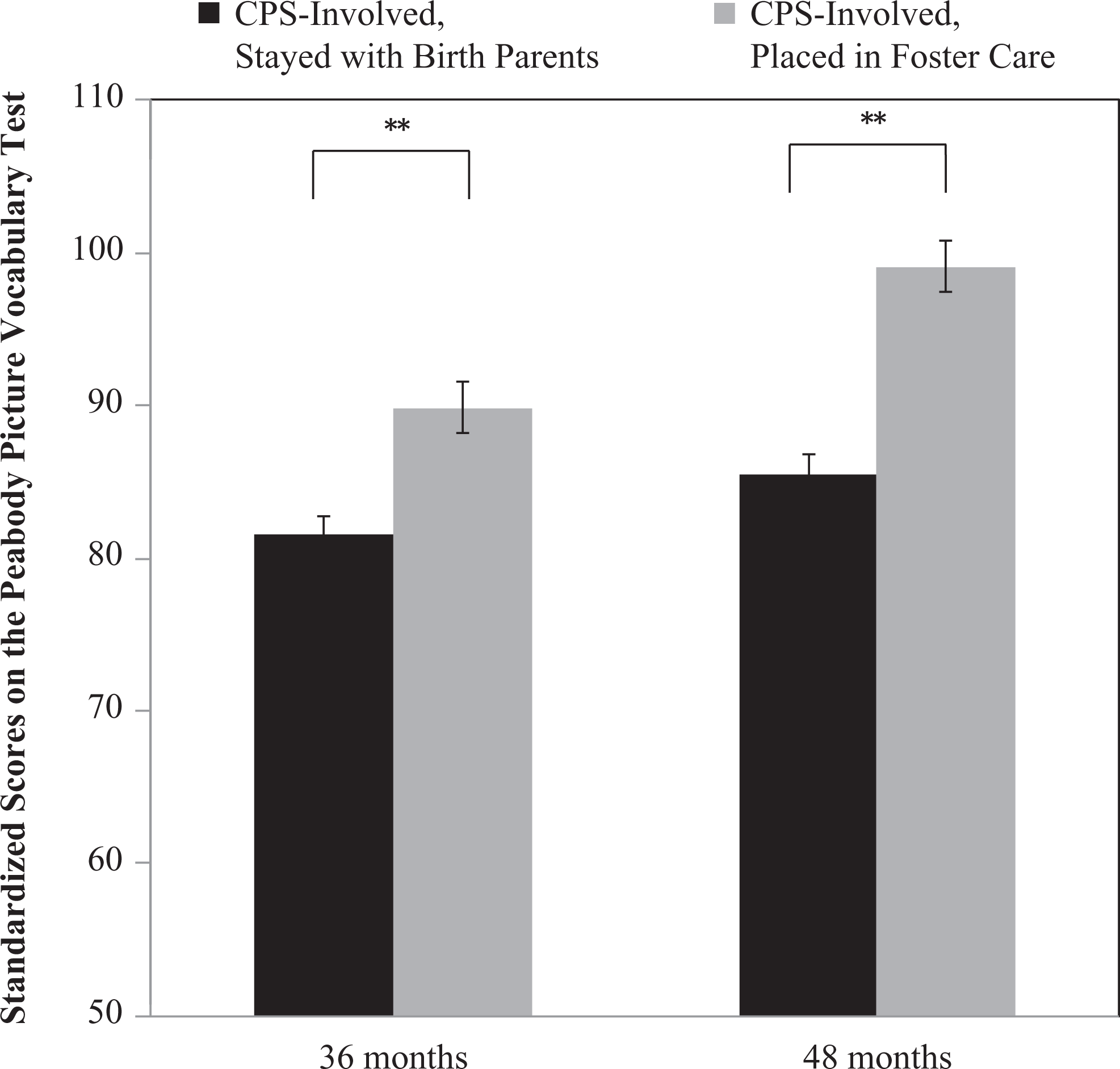
Differences in receptive vocabulary abilities among Child Protective Services (CPS)-involved children placed in foster care and CPS-involved children who stayed with birth parents. **p < .01. Error bars represent 1 ± SE.
Similarly, children with CPS involvement who were placed in foster care had higher receptive vocabulary scores than children with CPS involvement who stayed with their birth parents at 48 months (M = 99.08, SD = 16.79, n = 98 and M = 85.46, SD = 13.06, n = 115, respectively; t(211) = 6.65, p < .001, d = 1.02). At 48 months of age, children who were placed in foster care demonstrated average receptive vocabulary abilities close to the 50th percentile, whereas the average receptive vocabulary scores of children who stayed with their birth parents were close to the 16th percentile. According to Cohen (1992), this difference represents a large effect size.
Next, regression analyses examined whether placement status (i.e., foster care vs. birth parent) significantly predicted PPVT scores after accounting for caregiver education level, marital status, and household income. At age 36 months, the overall model predicted PPVT scores, R2 = .14, p < .01. However, placement status (β = −.03, p = .78), caregiver education level (β = .19, p = .07), marital status (β = −.07, p = .37), and household income (β = .19, p = .17) did not significantly predict PPVT scores. At age 48 months, the overall model again predicted PPVT scores, R2 = .23, p < .001, yet placement status (β = .15, p = .14), caregiver education level (β = .14, p = .18), marital status (β = .03, p = .73), and household income (β = .25, p = .07) did not significantly predict PPVT scores.
Discussion
The goal of the current study was to further our understanding of the potential effects of foster care on children’s early receptive vocabulary skills among children with histories of CPS involvement. We expected that placement in foster care would provide children with an enriched caregiving environment and that children with CPS involvement who were placed in foster care would demonstrate higher receptive vocabulary abilities than children with CPS involvement who stayed with their birth parents. As expected, children in foster care showed higher receptive vocabulary abilities at both 36 and 48 months of age than children who remained with their birth parents. Although the receptive vocabulary abilities of children who remained with their birth parents were on average below the 20th percentile at both ages, the average receptive vocabulary abilities of children in foster care were close to the 50th percentile by 48 months of age. Of note, these group differences were no longer significant after accounting for caregiver education level, marital status, and household income. This suggests that foster parents’ economic resources might help explain the beneficial effects of foster care on CPS-involved children’s early receptive vocabulary.
These findings build on three previous studies that examine the potential effects of foster care on cognitive and language outcomes (Berger, Bruch, Johnson, James, & Rubin, 2009; Stacks et al., 2011; Stahmer et al., 2009). Similar to our findings, all three studies did not report a significant association between foster care and effects on language outcomes when controlling for demographic variables. Berger et al. (2009) is the only study of the three to report analyses that did not control for demographic variables; however, even when demographic variables were not included in analyses, there was a nonsignificant association between foster care and effects on cognitive and language outcomes (Berger et al., 2009). Given that all three studies drew upon data from the National Survey of the Child and Adolescent Well-Being, the current study is distinct in that it drew from a different sample of children who all have histories of CPS involvement. The current study also used a standardized assessment of language designed to specifically examine receptive vocabulary.
This study is characterized by several limitations. Given that there were only two time points at which receptive vocabulary was assessed, we were unable to examine trajectories of receptive vocabulary after CPS involvement. Additionally, we were unable to control for language abilities prior to involvement with CPS and placement into foster care. Third, although the PPVT is a valid and reliable assessment of receptive vocabulary, the current study did not use a comprehensive language assessment that also assessed other aspects of receptive language development and children’s expressive language skills. Fourth, we also did not have access to CPS records and were thus unable to examine the effects of children’s exposure to specific types of maltreatment on receptive vocabulary. Future research would benefit from repeated assessments of receptive language skills across development in addition to assessments of expressive language skills. It would also be important to examine whether exposure or the duration of exposure to different types of maltreatment affects children’s receptive vocabulary. Furthermore, given that children in foster care demonstrated higher levels of receptive vocabulary than children who resided with their birth parents, it would be important to examine the specific and likely interrelated characteristics of foster care placements (e.g., communicative characteristics of the caregivers) that help promote children’s receptive language skills.
These limitations notwithstanding, the findings highlight that foster care may be associated with improvements in children’s receptive vocabulary abilities among children with experiences of CPS involvement. Additionally, findings suggest that vulnerable children and parents with CPS involvement may benefit from increased support, particularly financial and social resources, to promote parent–child interactions that facilitate language development.
Footnotes
Authors’ Note
The content is solely the responsibility of the authors and does not necessarily represent the official views of the National Institutes of Health.
Acknowledgments
The authors would like to thank the children and families who participated in the research. They also gratefully acknowledge the support of child protection agencies in Philadelphia.
Declaration of Conflicting Interests
The author(s) declared no potential conflicts of interest with respect to the research, authorship, and/or publication of this article.
Funding
The author(s) disclosed receipt of the following financial support for the research, authorship, and/or publication of this article: This research was supported by National Institute of Mental Health Grants R01 MH052135 and R01 MH074374 to the third author.
