



Abstract
Recent decades have seen an explosion of research into children’s eyewitness capabilities and resulted in legal reform to render the adversarial trial process more child friendly. Many, however, have been left with the feeling that the most intimidating legal process for child complainants—cross-examination—has not changed meaningfully despite its potential to distort children’s evidence. To test this possibility, we compared the cross-examination questioning of Australian child sexual abuse complainants in the 1950s to that used in contemporary cases. We found that the format of cross-examination questions has remained largely consistent over time, with leading questions still making up the bulk of the questions asked. The changes that we did observe, however, are concerning. Cross-examination questions posed to contemporary child complainants were less likely to be open-ended and more likely to be complex, relative to those asked in the 1950s. Crucially, contemporary complainants were asked 3 times as many cross-examination questions as they were 60 years ago. These changes are likely to have detrimental effects on child complainants and their evidence and could reduce the ability of jurors to reach just outcomes in these cases.
In the mid-20th century, the testimony of child sexual abuse complainants was viewed with considerable scepticism (Featherstone & Kaladelfos, 2016; Goodman, 1984). Children under 10 years were only allowed to give sworn evidence if they could show they understood the nature of an oath—for example, by showing they knew that lying would mean they went to hell. Judges were required to warn jurors about children’s inherent unreliability and about the dangers of convicting on uncorroborated evidence from a child (Hamilton & Addison, 1947). Cross-examination was essentially a free for all—few questions were off limits.
Since the 1950s, psychological science has provided a more sophisticated and nuanced understanding of children’s capabilities as witnesses (Goodman, 1984, 2006). The consensus among child memory researchers is that children can give highly reliable evidence as long as the adults who solicit their testimony do not—wittingly or unwittingly—contaminate their reports (see Bruck & Ceci, 1999 and Ceci, Hritz, & Royer, 2016, for reviews). That is, the types of questions children are asked and the circumstances under which they are interviewed are major influences on the accuracy of their recall. When children are interviewed coercively under intimidating conditions, their accuracy decreases (Bruck & Ceci, 1999).
Coupled with concerns over the negative influence of the trial process on children’s well-being, this body of research informed a series of sweeping criminal justice reforms in many countries around the world (see Bussey, 2009, for a review). The aim of these reforms has been two-fold: to reduce the distress associated with giving evidence and, in turn, to facilitate the accuracy of that evidence (e.g., Advisory Group on Video Recorded Evidence, 1989; Malloy, Mitchell, Block, Quas, & Goodman, 2007; Pipe & Henaghan, 1996).
The reforms focused on three key areas. First, the reforms eliminated several procedures based on unfounded assumptions about child witnesses’ unreliability—for example, the requirement for judicial warnings (e.g., Canada: Sas, Wolfe, & Gowdney, 1996). Second, procedures were implemented to maximize the completeness and accuracy of child sexual abuse complainants’ accounts before the case goes to trial. Specifically, those tasked with interviewing the child complainant during the investigation—police, psychologists, and social workers, for example—received specialist training in evidence-based interview practices to reduce the risk of contaminating this early account (e.g., New Zealand: Westera, Zajac, & Brown, 2016). Furthermore, to remove the potential negative effects of delay from children’s evidence, these interviews were video recorded; many jurisdictions allowed these interviews to be played in the courtroom in place of live direct examination (e.g., New Zealand: Hanna, Davies, Crothers, & Henderson, 2012; Pipe & Henaghan, 1996; UK: Westcott, Davies, & Spencer, 1999). Third, the criminal justice system puts in place specific strategies to facilitate the giving of live evidence. These measures included allowing the use of support people and permitting children to testify via special measures such as closed-circuit TV (CCTV) or from behind a screen (e.g., Canada: Bala, 1999; New Zealand: Hanna et al., 2012; Pipe & Henaghan, 1996; United States: Goodman, 2006; Australia: Shrimpton, Oates, & Hayes, 1996).
There is some evidence that the reforms described above reduced many of the barriers to child complainants’ successful participation in the adversarial system (Malloy et al., 2007). Pipe, Orbach, Lamb, Abbott, and Stewart (2013), for example, found that child sexual abuse cases were more likely to result in a guilty verdict when the interviewer of the child was trained in evidence-based practice than when they were not. Davies and Noon (1991) found that children who gave evidence via video-recorded interview were rated as less anxious and were asked questions in a more linguistically appropriate way than those who gave evidence live. An evaluation in Australia found that the use of special measures (e.g., the use of screens, CCTV, and prerecorded direct examination) was standard procedure, and criminal justice professionals perceived that these measures improved the way in which evidence was taken from child witnesses (Powell, Westera, Goodman-Delahunty, & Pichler, 2016). But whether these reforms have improved cross-examination—the process that the majority of child complainants view as the most intimidating aspect of the trial (Eastwood & Patton, 2002)—is highly contentious.
During cross-examination, defense lawyers question child complainants in an attempt to discredit them and their evidence. The kinds of questions that children are asked during cross-examination differ dramatically from those asked elsewhere in the investigative and trial processes (Davies, Henderson, & Seymour, 1997; Hanna, Davies, Henderson, Crothers, & Rotherham, 2010; Zajac & Cannan, 2009; Zajac, Gross, & Hayne, 2003). They also differ markedly from evidence-based guidelines established for questioning children (e.g., Home Office, 1992, 2002; Lamb, Hershkowitz, Orbach, & Esplin, 2008). In fact, cross-examination has even been described as a “how not to” guide to questioning children about their experiences (Henderson, 2002, p. 279).
Some differences between cross-examination and other questioning components should not surprise us. Because the goal of cross-examination is to test the child’s evidence, for example, it is understandable that defense lawyers are more likely than prosecution lawyers to ask children questions that directly or indirectly challenge their account of the alleged events (e.g., “why didn’t you tell him to stop?” Zajac & Cannan, 2009; Zajac et al., 2003).
But the format of cross-examination questions also differs in two other important ways. First, while questions that do not unduly constrain children’s responses have emerged as the gold standard for interviewing children (Home Office, 2002; Lamb, Orbach, Hershkowitz, Esplin, & Horowitz, 2007), lawyers have described these types of questions (e.g., “tell me what happened next?”) as “disastrous” during cross-examination (e.g., Eichelbaum, 1989, p. 204) because they allow a child to provide information that could be detrimental to the defense’s case. Instead, because the primary goal of cross-examination is to control what the witness says (Eichelbaum, 1989; Henderson, 2002; Salhany, 1999; Wellman, 1962; Westcott & Page, 2002), most of the cross-examination questions that are posed to children are closed or leading (Stone, 1988). That is, they restrict children to a yes or no response (e.g., “did you go outside after that?”) and often even make it clear which response is expected or desired (e.g., “you went outside after that, didn’t you?” Brennan & Brennan, 1988; Hanna et al., 2010; Zajac & Cannan, 2009; Zajac et al., 2003). It is well-documented that these types of suggestions decrease children’s accuracy (see Bruck & Ceci, 1999)—especially that of young children (e.g., Garven, Wood, Malpass, & Shaw, 1998).
Second, the types of questions that child complainants are asked during cross-examination are often beyond their developmental grasp. On a syntactic level, defense lawyers’ questions might be poorly constructed, multifaceted, ambiguous, or employ complex vocabulary and syntax (Brennan & Brennan, 1988; Davies & Seymour, 1998; Hanna et al., 2010; Zajac & Cannan, 2009; Zajac et al., 2003). On the broader level, questions often shift abruptly from topic to topic (Zajac et al., 2003) or solicit information (e.g., measurements, times, and dates) that children do not have the cognitive maturity to provide (Brennan & Brennan, 1988; Zajac & Cannan, 2009). When children are asked questions that they don’t comprehend, their accuracy suffers (e.g., Carter, Bottoms, & Levine, 1996). Clearly, younger children will find linguistically complex questions more difficult to handle than older children, and this difference is reflected in the findings of experimental studies that examine accuracy (e.g., Perry et al., 1995).
How might the unique combination of leading, complex, and credibility-challenging questions asked during cross-examination affect the veracity of children’s testimony? Unfortunately, the answer to this question is very concerning (see Zajac, O’Neill, & Hayne, 2012, for a review). When their memory reports are challenged using a laboratory analogue of cross-examination, children become inconsistent. Furthermore, the changes that they make to their earlier reports have little to do with the truth. Overall, cross-examination-style questions exert a detrimental effect on children’s accuracy (Zajac & Hayne, 2003). Although young children are more vulnerable to this effect than older children and adolescents (Jack & Zajac, 2014; Zajac & Hayne, 2006), the effect is strikingly robust. It occurs even when controlling for the potential effects of delay (Righarts, Jack, Zajac, & Hayne, 2015) and repeated interviewing (O’Neill & Zajac, 2013). In fact, even when children are lying about the event in question, the nature of their responses to cross-examination questions is not diagnostic of their accuracy (Zajac, Irvine, Ingram, & Jack, 2016). Taken together, these data provide abundant support for the notion that the cross-examination-style questions are unlikely to achieve best evidence.
Despite the problems researchers have identified, some in the legal community perceive that child cross-examinations have changed for the better, that is, that problematic questioning formats are no longer used with the frequency they once were: Defence counsel are far less aggressive with children because they know it will completely turn off the jury. So they are much more careful about their questions because they know the child has to understand them, and the judge will jump on them [the defence counsel] if they are using complex or multi-barrel questions. (Prosecutor, Powell et al., 2016) My experience of watching defence counsel cross-examine children is that generally they do it quite well, in a way that would not leave them feeling too attacked. (Defence Lawyer, Powell et al., 2016)
These perceptions raise an empirical question: Have several decades of research made a real difference to how lawyers cross-examine children? Due to the major shift in legal principles around the reliability of the child witness, current practices—although far from ideal—might well be an improvement on the past. Given the unique aims of cross-examination, however, it is equally possible that little has changed.
The Present Study
With these issues in mind, the primary goal of this study was to examine whether courtroom practices for child sexual abuse complainants have evolved in the last 60 years in line with our increased understanding of children’s strengths and weaknesses as witnesses. Specifically, we sought to understand whether and, if so, how the format of courtroom questions has changed over time. To answer this question, we compared a sample of Australian transcripts of sexual assault complainants’ evidence in contemporary trials to a sample from the 1950s.
We chose the 1950s as our historical comparison for three reasons. First, the decade both typifies the prelaw reform treatment of child complainants (Featherstone & Kaladelfos, 2016, pp. 75–101). Second, contrary to popular belief, trials involving sexual offenses against children were relatively common during the 1950s; in fact, they amounted to approximately two thirds of sexual assault cases prosecuted in the higher courts (Featherstone & Kaladelfos, 2016, p. 221). The resulting rich sample allowed us to control for potential confounding variables by matching cases for major characteristics. Finally, this decade predates the explosion of research into the best ways to elicit complete and accurate evidence from children.
Method
Court Transcripts
Historical transcripts
Historical transcripts were obtained from State Records New South Wales (NSW), using the archival records of the Court Reporting Branch, Criminal Transcripts. The transcripts were from cases heard from in the Court of Quarter Sessions, the Central Criminal Court, and the Supreme Court. The NSW court transcript series is a unique set of records among Australian archival holdings; no other jurisdiction has preserved a continuous series of verbatim criminal trial evidence. We examined all 120 volumes of criminal trial transcripts from 1950 to 1960 and identified 462 transcripts of criminal trials and sentencing hearings for child sex crimes and a further 19 transcripts of appeals on similar cases. The transcripts were a subset of the cases described in Featherstone and Kaladelfos (2016).
Contemporary transcripts
Contemporary transcripts were obtained as part of trial case files from the prosecuting agency in three jurisdictions in Australia (NSW, Victoria, and Western Australia). Transcripts of these cases are treated with sensitivity and difficult for researchers to obtain, but a unique opportunity allowed us to access these transcripts as part of another research project under notice or summons issued by the Australian Royal Commission into Institutional Responses to Child Sexual Abuse. The transcripts were a subset of those described in Powell, Westera, Goodman-Delahunty, and Pichler (2016) and were all from cases heard between 2011 and 2015. From this original sample of 80 transcripts from child complainants, 65 cases were selected based on our ability to match them with historical cases.
Case selection
To control for changes in the legal and social context of sexual assault cases during the six decades between the two transcript samples, we matched the historical to the contemporary cases to ensure that we compared transcripts that were similar in nature. Because we had access to more historical cases than contemporary cases, we sought to match every contemporary case involving a child complainant under 16 years to a historical case.
We matched transcripts based on the sex of the complainant and defendant, the number of complainants and defendants, and the age of the complainant at the time of the trial (within 12 months). A contemporary case was matched to the first historical case that fit these criteria. We matched 65 of a possible 80 contemporary cases to historical cases. All cases in the sample matched on each of the above criteria, and the remaining 15 cases were unable to be matched using the above criteria. We also identified a further two matching criteria: the relationship between the complainant and the defendant (intrafamilial or extrafamilial) and the nature of the sexual offense (penetrative or nonpenetrative). All cases matched one of these additional factors, with 44 (68%) matching on both factors.
Final sample
The final sample comprised 130 transcripts of complainant evidence (n = 65 historical; n = 65 contemporary). In each time period, 55 complainants were female and 10 were male. The age of the historical complainants ranged from 7 to 16 years at the time of the trial (M = 12.25 years, SD = 2.63); the age of the contemporary complainants ranged from 6 to 17 years (M = 12.45, SD = 3.03). In around a third of cases, the trial included co-complainants (n = 21 historical cases; n = 21 contemporary cases). Around half of the cases involved penetrative offenses (n = 34 historical cases; n = 30 contemporary cases).
All of the defendants were adult males. The relationship between complainant and defendant varied. In most cases, the complainant was acquainted with the defendant (n = 38 historical cases; n = 35 contemporary cases), who was often a family member (n = 14 historical cases; n = 27 contemporary cases). In the remaining cases, the defendant was a stranger or had only met the complainant on the day of the offense (n = 13 historical cases; n = 3 contemporary cases).
Coding Scheme
Our coding scheme was a variation of that used by Zajac, Gross, and Hayne (2003). Every question asked by defense lawyers (N = 30,539) was coded into one or more of six categories (see Table 1). First, each question was assigned to one of the three mutually exclusive question categories reflective of the question format: open, closed, or leading. Codes for complexity and repeated questions were then added if relevant.
Question Codes.

Intercoder reliability
To establish intercoder reliability, two experimenters independently coded 25% of the transcripts from each time period. For decisions regarding whether a question was coded as open, closed, or leading, the Cohen’s κ coefficient was .91. For the additional codes, the κ values were .84 for questions involving complex language, .87 for questions involving complex sense, and .62 for repeated questions. Disagreements were resolved by discussion before one experimenter coded the remaining transcripts. Further spot-checking took place throughout the coding process to ensure that the coding approach had not drifted.
Results
Recall that the historical and contemporary samples were matched for the age of the child complainant. We were therefore able to conduct a robust analysis of our measured variables as a function of both complainant age and time point.
For each of our dependent measures (i.e., the total number of questions asked and the proportion of each question type), we first conducted independent t tests to test the effect of time point and correlations to test the effect of child age. These analyses are shown in Table 2. We then conducted a series of hierarchical linear regression analyses to further explore the nature of these effects. 1 In each analysis, we included four predictor variables entered in three blocks. First, we simultaneously entered time period and complainant age—our two key predictors of interest. Next, we entered a quadratic age variable (to test for age effects that were nonlinear), followed by a variable representing the interaction between time period and age. The results of these analyses are described below.
Independent t-Tests and Correlations Exploring the Effects of Time Point and Age on Our Dependent Measures.
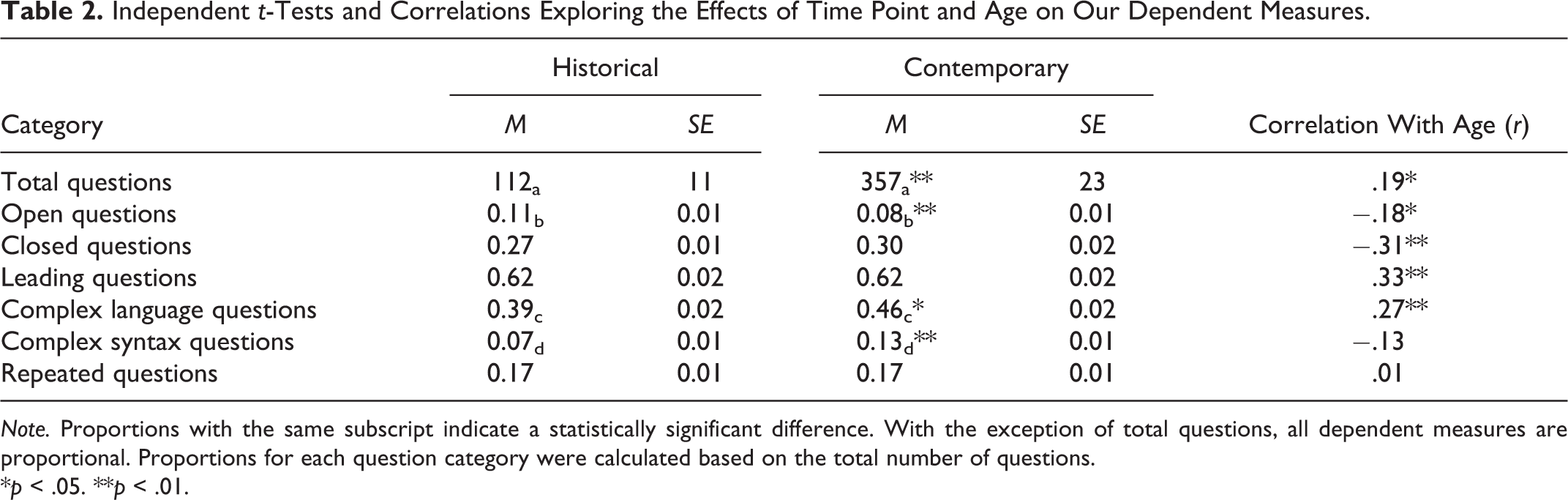
Note. Proportions with the same subscript indicate a statistically significant difference. With the exception of total questions, all dependent measures are proportional. Proportions for each question category were calculated based on the total number of questions.
*p < .05. **p < .01.
Total Number of Questions
The regression analysis yielded main effects of both time period (B = .55, SE = .05, β = .70, p < .01) and age (B = .02, SE = .01, β = .14, p = .03); the remaining variables did not improve the model, Step 1: R2 = .52, F(2, 127) = 67.64, p < .01; Step 2: R2 change < .01, F(1, 126) = 0.95, p = .33; Step 3: R2 change < .01, F(1, 125) < 0.01, p = .96. As shown in Figure 1, the total number of questions increased with child age.
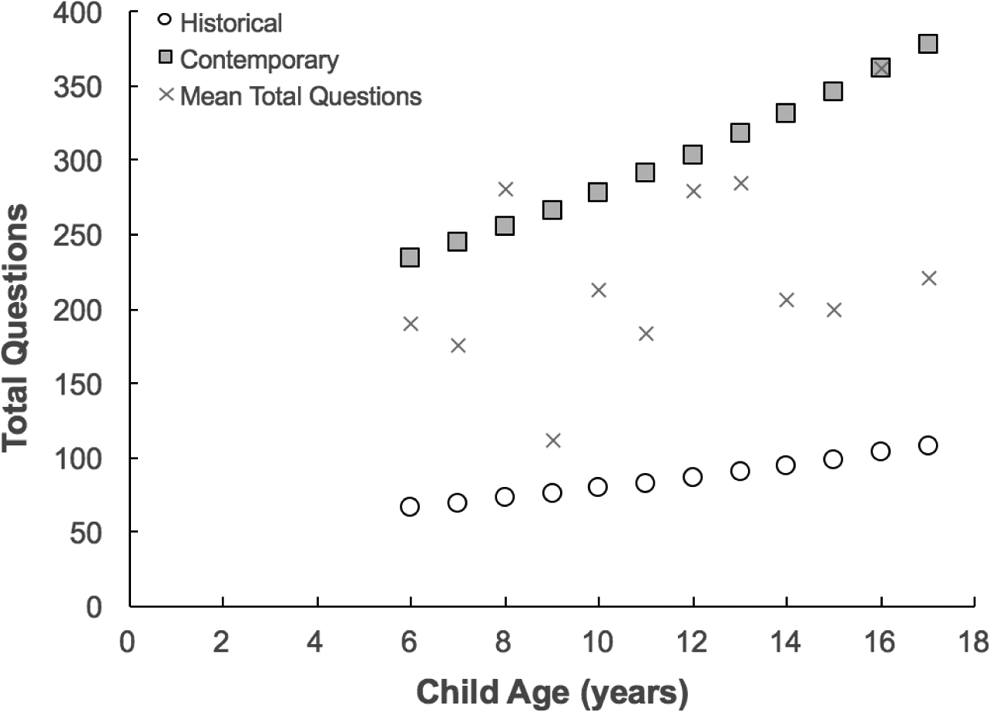
Standardized predicted values for total questions across age for each time period, with total questions mean shown as an indicator of model fit.
Regardless of age, there was a marked difference across time point; children in contemporary trials were asked over 3 times as many cross-examination questions as child complainants in historical trials. In fact, the youngest complainants in the contemporary cases were asked—on average—considerably more questions than the oldest complainants in the historical cases.
Proportion of Open Questions
The regression analysis yielded main effects of both time period (B = −.03, SE = .01, β = −.24, p < .01) and age (B < −.01, SE = .002, β = −.18, p = .04); the remaining variables did not improve the model, Step 1: R2 = .09, F(2, 127) = 6.22, p < .01; Step 2: R2 change < .01, F(1, 126) = 0.01, p = .94; Step 3: R2 change = .01, F(1, 125) = 1.34, p = .25. Figure 2 highlights that the proportion of open questions asked decreased with complainant age and that children were asked proportionally more open questions in historical cases, relative to contemporary cases.
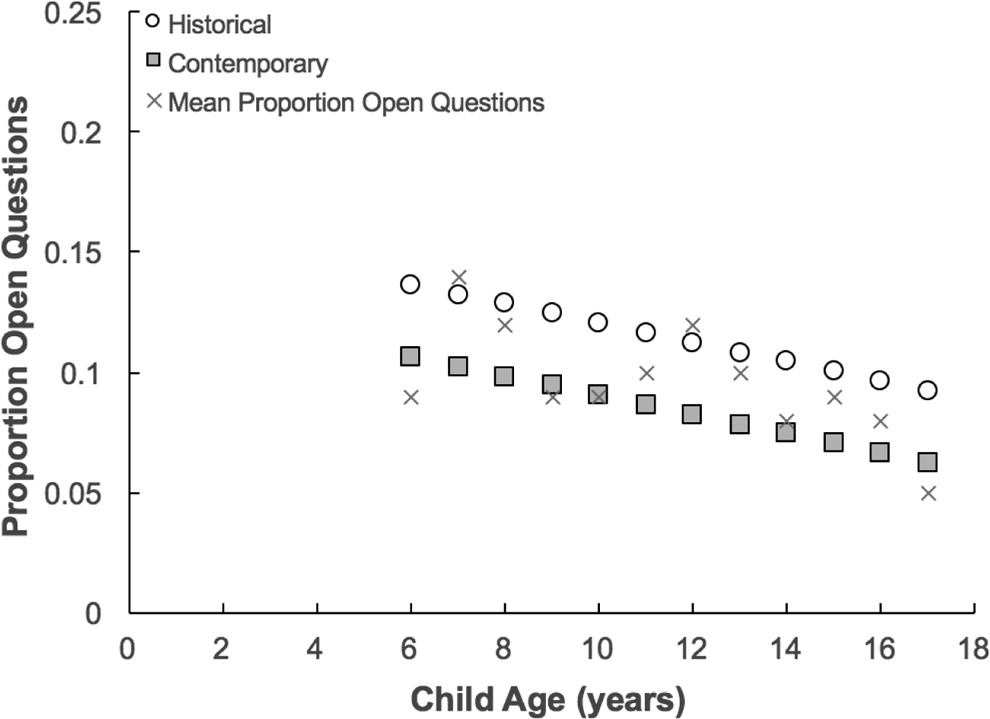
Standardized predicted values for proportion of open questions across age for each time period, with mean proportion of open questions shown as an indicator of model fit.
Proportion of Closed Questions
The regression analysis yielded main effects of age (B = −.14, SE = .004, β = −.31, p < .01) but not time period (B = .03, SE = .02, β = .11, p = .20); the remaining variables did not improve the model, Step 1: R2 = .11, F(2, 127) = 7.51, p < .01; Step 2: R2 change < .01, F(1, 126) = 0.02, p = .90; Step 3: R2 change < .01, F(1, 125) = 0.56, p = .46. The proportion of closed questions decreased with child age, but complainants were asked a similar proportion of closed questions across time point.
Proportion of Leading Questions
The regression analysis yielded main effects of age (B = .02, SE = .005, β = .33, p < .01) but not time period (B = .002, SE = .03, β = .006, p = .94); the remaining variables did not improve the model, Step 1: R2 = .11, F(2, 127) = 7.51, p < .01; Step 2: R2 change = .01, F(1, 126) = 0.01, p = .94; Step 3: R2 change = .01, F(1, 125) = 1.21, p = .27. The proportion of leading questions increased with child age, but complainants were asked a similar proportion of leading questions across time point.
Proportion of Complex Language Questions
The regression revealed main effects of both time period (B = .06, SE = .03, β = .20, p = .02) and age (B = .14, SE = .004, β = .26, p < .01), but the remaining variables did not significantly improve the model, Step 1: R2 = .11, F(2, 127) = 7.93, p < .01; Step 2: R2 change < .01, F(1, 126) = 0.52, p = .47; Step 3: R2 change = .01, F(1, 125) = 1.31, p = .26. As shown in Figure 3, the proportion of questions involving complex language increased with complainant age, and complainants were asked proportionally more complex language questions in contemporary cases than in historical cases.
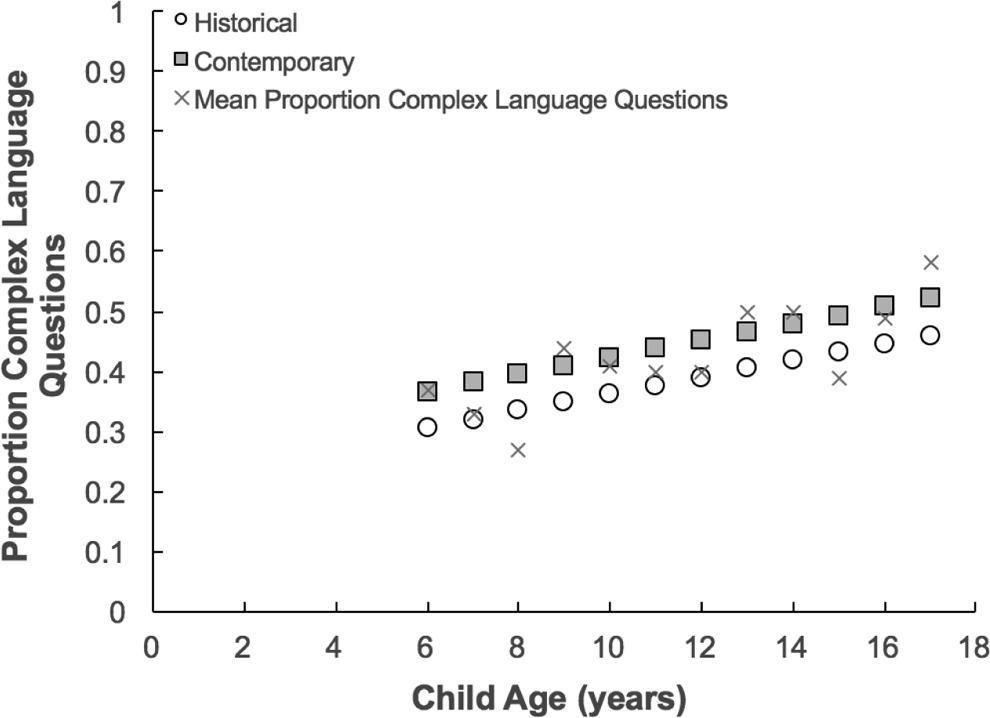
Standardized predicted values for proportion of complex language questions across age for each time period, with mean proportion of complex language questions shown as an indicator of model fit.
Proportion of Complex Sense Questions
The regression analysis yielded main effects of time period (B = .31, SE = .07, β = .35, p < .01) but not age (B = −.02, SE = .01, β = −.13, p = .12); the remaining variables did not improve the model, Step 1: R2 = .14, F(2, 127) = 9.91, p < .01; Step 2: R2 change = .01, F(1, 126) = 0.75, p = .39; Step 3: R2 change < .01, F(1, 125) = 0.09, p = .77. Defense lawyers in contemporary cases asked complainants a higher proportion of complex sense questions than defense lawyers in historical cases.
Proportion of Repeated Questions
The regression analysis did not yield a significant model, Step 1: R2 < .01, F(2, 127) = 0.03, p = .98; Step 2: R2 change < .01, F(1, 126) = 0.42, p = .52; Step 3: R2 change = .02, F(1, 125) = 3.05, p = .08. That is, the proportion of repeated questions was not significantly related to age or to time period.
Discussion
Juxtaposing transcripts from the 1950s to those from 21st century allowed us to compare the format of the cross-examination questions posed to Australian child sexual assault complainants in one of the most conservative eras to that of today, where social views of sexual abuse have been influenced by decades of research, activism, and advocacy on behalf of child witnesses.
Our findings do not support the notion that law reforms or advances in understandings about children’s memory have improved the types of questions that lawyers use to cross-examine child sexual abuse complainants. Instead, our data suggest that the format of the questions that lawyers ask children has undergone very little change over 60 years. Where changes were evident, questioning appears to be more problematic than it was in the past. Children today are asked far more questions overall, a smaller proportion of open questions (although this difference was small), and a larger proportion of complex questions.
Do cross-examining lawyers at least make allowances for the age of the child complainant? The answer to this question appears to be a tentative yes. Lawyers asked younger children a lower number of questions overall, a smaller proportion of leading questions, and a higher proportion of open questions than they asked older children. These effects were observed regardless of time period, suggesting that they cannot be attributed to reforms or research.
These apparent benefits for younger children, however, were purely relative in contemporary trials. That is, even the youngest children in the contemporary sample were asked more questions than the older children in the historical sample; consequently, those children were also asked a higher sheer number of the types of questions that might distort their accuracy.
To what can we attribute the current situation? One likely explanation is that lawyers simply do not have the skills to ask children age-appropriate questions. Indeed, lawyers perceive that they do not receive sufficient training in the questioning of children and that lawyers differ widely in the way in which they conduct their questioning (Powell et al., 2016). Even prosecutors and judges—both of whom are likely to be motivated to make questioning as straightforward as possible for child complainants—struggle to use age-appropriate questioning (Powell et al., 2016). Although reforms targeting courtroom questioning in the jurisdictions examined do provide some guidance on the types of questions and that are (and are not) appropriate, they do not impart lawyers with the skills to use these questions. The investigative interviewing literature clearly demonstrates that developing questioning skills is a complex task requiring an incremental approach to learning in which interviewers receive clear instruction on questioning methods and how to apply them (e.g., how to obtain key evidential information in a nonleading way), as well as comprehensive practice and expert feedback (Powell, 2008). Perhaps legal training programs simply do not have the elements required to effectively learn interviewing skills.
Although skills deficits are undoubtedly a real concern, they alone cannot explain the changes in questioning that we observed over time; we must therefore look further. One concerning possibility is that contemporary lawyers are deliberately making questioning more difficult for children. Specifically, because some efforts have been made to render child cross-examination less aggressive in its tone (e.g., the prohibition of questions intended solely to annoy, harass, or intimidate; section 41 Evidence Act 1995 [NSW]; Smith v. Illinois, 1968 [USA]), lawyers might be adopting a different approach to erode the witness’s evidence. That is, in the absence of a more direct avenue to placing pressure on children, lawyers might perceive a need to increase the volume and complexity of questions to achieve the same effect.
However, we must also look to the broader factors that could have influenced our findings. For instance, this more extensive approach to cross-examination seen in contemporary trials could reflect a change in the situational factors that influence legal practice. High caseloads, for example, could mean lawyers have less time to plan their case strategies, reverting instead to a more opportunistic “catch-all” approach to cross-examination. Perhaps defense lawyers perceive that the extra support afforded to child witnesses (e.g., support people, CCTV) tacitly gives them permission to “take the gloves off.” It is also possible that differences in the amount of evidence gathered by the police and/or presented by the prosecution have created additional lines of cross-examination. It would be illuminating to investigate whether cross-examinations have increased in length and complexity in other types of trials. Certainly, Westera, Zajac, and Brown (2016) found a similar—but smaller—effect when they compared the courtroom questioning of adult sexual assault complainants across a similar time period (see also Zydervelt, Zajac, Kaladelfos, & Westera, 2017); perhaps we are simply seeing just one aspect of wide-ranging trend to longer and more difficult questioning.
Changes in social context over time could also have influenced the types of cases that proceed to the courtroom. Although we matched our cases on their broad characteristics, there were other potential confounds that we could not control for. It could be that the types of cases that result in trial today are qualitatively different from those tried in the 1950s. More ambiguous or complex cases, for example, could mean that lawyers are required to argue more points.
How might our findings generalize to jurisdictions outside of those studied? Within Australia, all jurisdictions maintained similar provisions for child sexual offenses, with charges, age of consent, and rules of evidence differing only in the finer point of detail (e.g., the necessity for corroboration) rather than in fundamental ways. Likewise, given that the empirical data on the nature of cross-examination do not differ substantively across countries operating under an adversarial system (see Zajac et al., 2012, for a review), there is no reason to suspect that our data are anything other than representative of wider practices.
Could similar changes have occurred during the direct examination process? Unfortunately, we were unable to answer this question because the mode of direct examination in our cases was not consistent across time. In the contemporary period, the child’s direct evidence was usually elicited by police or social workers prior to the trial and played to the court. In contrast, in the historical period, prosecutors elicited direct evidence live in the courtroom. It is possible that direct examination questioning has undergone a similar pattern of change over time to cross-examination questioning; examination of court transcripts in countries that have not implemented this reform would be illuminating. We note, however, that our work on adult sexual assault complainants shows that the nature of direct examination questions has actually improved over the same period—that is, complainants are now asked more open questions and fewer leading and closed questions during direct examination than they were during the 1950s (Westera, Zydervelt, Kaladelfos, & Zajac, 2017).
Implications
Regardless of the reasons behind our findings, long, complex cross-examinations are likely to have detrimental effects on child complainants and their evidence. Children are likely to tire with extended periods of questioning, reducing their ability to provide a reliable and coherent account. Furthermore, questions that are likely to reduce the reliability of children’s responses are now more commonplace. Even when controlling for the sheer number of questions, lawyers today are more likely to use questions that are complex in both language and syntax and less likely to use open questions. A considerable body of evidence shows that cross-examination-style questions are detrimental to accuracy, even in relatively small numbers (see Zajac et al., 2012, for a review).
Drawn-out, complex cross-examinations are also likely to be detrimental to jurors’ decision-making. The elaboration likelihood model (Petty & Cacioppo, 1986a, 1986b) proposes that attitudinal change can be achieved via two routes. In central-route processing, people examine the arguments made, compare them to what they already know, and make a rational and objective decision as to whether those arguments are compelling. When the nature of the information means that people lack the ability or motivation to do this, however, they tend to engage in peripheral-route processing; that is, they abandon systematic processing of the information presented in favor of using more superficial cues to credibility (see also Chaiken, 1980). These superficial—or peripheral—cues in the courtroom context are likely to include lawyers’ confidence (Maslow, Yoselson, & London, 1971), whether they give the “appearance of winning” (Williams & Jones, 2005) and, crucially, the number of arguments that they make (Petty & Cacioppo, 1984). We note, however, that jurors’ perceptions will also be influenced by children’s responses to cross-examination questions—something we did not investigate in the present study. We also note that children’s responses can influence the types of questions that lawyers ask next (see Gilstrap & Ceci, 2005; Gilstrap & Papierno, 2004; Zajac & Cannan, 2009).
It is clear that the prolonged nature of cross-examination needs to be added to the reform agenda. More broadly, however, our findings highlight two areas that are important for policy makers to consider. First, as with other policy initiatives, we do not know what we cannot see. The lack of systematic and comprehensive evaluation of reforms—and monitoring of cross-examination more generally—has made it difficult for stakeholders to appreciate how the process has,or has not, changed. A lack of empirical monitoring also means that problems developing slowly over time can easily be overlooked. Second, cross-examination reforms to date could be described as superficial tweaks that do not address the underlying problems inherent in the process. That is, they largely speak of what not to do rather than how to do it. To effect meaningful change, policy makers may need to fundamentally rethink cross-examination, the culture that surrounds it, and assumptions about the level of training required to skillfully question children.
Footnotes
Acknowledgments
The authors gratefully acknowledge the contributions of James Green, Chelsea Leach, and Sarah Zydervelt. We pay tribute to our incredible colleague, Dr. Nina Westera, who passed away on May 25, 2017.
Declaration of Conflicting Interests
The author(s) declared no potential conflicts of interest with respect to the research, authorship, and/or publication of this article.
Funding
The author(s) disclosed receipt of the following financial support for the research, authorship, and/or publication of this article: This work was supported by funding from the Australian Research Council (DP150101798), the Royal Commission into Institutional Responses to Child Sexual Abuse, and the Griffith Criminology Institute Visiting Scholars Scheme. The views and findings expressed in this article are those of the authors and do not necessarily reflect those of the Royal Commission.