




Abstract
There is evidence that risk for delinquency is elevated among girls with foster care histories, and one correlate of delinquency is affiliating with peers who engage in delinquent behavior. Although intervention studies have shown positive effects of interventions that target delinquent peer affiliation on reductions in delinquency among adolescents with juvenile justice histories, the success of such interventions for younger girls in foster care, without prior involvement with juvenile justice, is unknown. We analyzed data from a randomized clinical trial of the middle school version of the Keep Safe intervention in a sample of girls in foster care (n = 100). The intervention was delivered to girls and foster parents during the transition to middle school. Path analysis suggested a significant intervention effect on reduction in affiliation with delinquent peers at 12 months (B = −.21). No significant mediation effects were identified. The middle school Keep Safe intervention shows promise as a preventative intervention for reducing affiliation with delinquent peers, which importantly is associated with adolescent delinquent behavior. Implications for researchers and professionals who tailor and deliver evidence-based programs for girls in foster care are discussed.
Juvenile delinquency has been associated with immediate and long-term behavioral problems for adolescents and society at large. For example, individuals involved in juvenile delinquency may experience academic failure, substance abuse, relationship problems, and adult crime (Barrett & Katsiyannis, 2016; Makarios et al., 2017). In addition, there are economic consequences associated with juvenile delinquency; when adolescents are held in facilities, the average cost is US$241.00 per day (Sickmund & Puzzanchera, 2014). It is estimated that the long-term costs of adolescent incarceration in the United States amount to 8–21 billion USD per year when considering factors such as recidivism, employment challenges, and health consequences associated with incarceration (Justice Policy Institute, 2014). One segment of the population at elevated risk for delinquency is girls in foster care; such youth have a higher risk of negative outcomes including delinquency, substance use, and health-risking sexual behaviors (Fowler et al., 2015; Kim et al., 2013). A recent meta-analysis found that youths involved in foster care had poorer peer relations relative to children reared with their biological parents (DeLuca et al., 2018). Further, girls in foster care, relative to boys, are at heightened risk for disrupted peer relationships (Leve et al., 2007), and peer relations are a known correlate of delinquency (Dishion & Tipsord, 2011). The purpose of this article is to examine the effect of a skill-building intervention delivered to girls in foster care and their caregivers by examining the mediating role that peer relationships might play on subsequent delinquency.
Girls With Maltreatment and Foster Care Histories: At Elevated Risk for Delinquency
There is evidence that risk for delinquency is elevated among girls with maltreatment and/or foster care histories. In a landmark prospective study of court cases of child abuse and neglect in children younger than age 12, Widom (1989) found that abused and neglected youths had higher rates of criminality and arrests for violent offenses between ages 16 and 32 than did individuals who were matched on demographic characteristics (age, sex, race, and socioeconomic background of the family) but did not have an official record of abuse or neglect. Overall, girls who were exposed to child abuse or interparental violence were more than 7 times as likely as girls selected from an age-matched community sample who had not been exposed to marital violence to commit a violent act that was referred to juvenile justice (Herrera & McCloskey, 2001). This statistic corroborates findings from a recent meta-analysis showing that risk of violent outcomes is greater in samples with higher percentages of girls exposed to child maltreatment (Fitton et al., 2018). Further, children in foster care, 70% of whom are placed into care due to maltreatment exposure, typically experience a multitude of parental transitions (U.S. Department of Health and Human Services Administration for Children, Youth, and Families, Children’s Bureau, 2017; Wulczyn et al., 2007), which are associated with an increased likelihood for disruptive behavior and inhibitory control difficulties (Lewis et al., 2007; Pears et al., 2010; Rubin et al., 2007; Villodas et al., 2016). In addition, such instability is associated with disruptions in the development of healthy relationships with parents, teachers, and peers (Kim et al., 2013). Therefore, it is important that interventions for youth with maltreatment and foster care histories focus on the development of supportive relationships.
The Role of Peer Relations
Developing meaningful relationships with peers is an important developmental task during adolescence. Peer relationships become more intense during adolescence and can become a source of support and attachment (Allen, 2008; Markiewicz et al., 2006). For many adolescents, peers are the most proximal extrafamilial source of support, and for youths in foster placements, peer relations are ostensibly more significant when disruptions in parental or familial relationship are experienced. Despite the importance of peer relations during adolescent development, empirical research has documented that adolescents residing in foster care report fewer age-related peers within their social networks, fewer overall social supports, and poorer peer relations relative to youths not in foster care (DeLuca et al., 2018; Negriff et al., 2015). Moreover, girls in foster care may be at elevated risk for developing negative peer relations because they have lower social skills relative to girls not in foster care (Leve et al., 2007), and while age-related peers can be an important source of social support, peers also have an increasing influence on risk-taking behaviors during adolescence relative to other developmental periods (Dishion & Tipsord, 2011; Gardner & Steinberg, 2005). Thus, there may be divergent pathways whereby peer relationships can either lead to, or help prevent, delinquency among youths in foster care: (1) affiliation with delinquent peers may increase risk for delinquency among girls in foster care and (2) supportive peer relationships may protect girls in foster care from engaging in delinquency. The evidence for each of these pathways is briefly reviewed here.
There is an abundance of research indicating that affiliating with deviant peers is a risk factor for delinquency (e.g., Dishion & Tipsord, 2011; Mrug et al., 2014; Wang & Dishion, 2012; Zhu et al., 2016). One reason for this association is that delinquent peers often demonstrate and reinforce antisocial behaviors (Dishion & Tipsord, 2011). For example, in a prospective study of kindergarteners, engaging in and peer reinforcement of deviant talk (i.e., deviancy training) was associated with conduct problems into the third and fourth grades (Snyder et al., 2008). In a second study, observed coercive joining (e.g., aggressive or coercive behaviors or struggles for power, which are negatively reinforced by peers) in adolescent friendships predicted greater violent outcomes in early adulthood (Van Ryzin & Dishion, 2013). As such, social engagement with delinquent peers can positively reinforce and maintain delinquent behavior.
Interventions for peer relations and delinquency specific to youths in foster care have been implemented and have shown positive results (Leve & Chamberlain, 2005; Van Ryzin & Leve, 2012). For example, one intervention for adolescents who were highly delinquent and in out-of-home placements, Treatment Foster Care Oregon, involved placing chronic delinquent youths with highly trained foster parents who monitored positive behavior and maintained close supervision of youths (Chamberlain, 2003). This intervention has been shown to be effective in reducing association with delinquent peers in female samples of adolescents (Leve & Chamberlain, 2005; Van Ryzin & Leve, 2012). Further, affiliation with delinquent peers was found to mediate intervention effects on subsequent delinquency in a sample of female adolescents in the juvenile justice system. Van Ryzin and Leve (2012) found a significant indirect effect whereby the intervention decreased delinquent peer affiliation at 12 months postbaseline, which then predicted a decrease in delinquency at 24 months postbaseline. These results suggest that reducing delinquent peer affiliations can have a preventive impact on delinquency, at least among females involved in the juvenile justice system. It is unknown, however, whether similar effects would be observed in younger samples prior to any involvement in the juvenile justice system and where foster placement is predicated on maltreatment. If so, this would suggest a potential preventive impact of such interventions for youths in foster care.
A second pathway to preventing delinquency among youths in foster care may evolve from youths’ positive relationships with their peers. In a longitudinal study on risk and protective factors for adolescents, youths with more positive peer relationships were shown to display fewer delinquent and violent acts across time (Pardini et al., 2012). Friendships with higher levels of warmth are associated with fewer conduct problems and more success in school. For example, in a study of adolescents between ages 11 and 16, those who had more positive peer attachments displayed more frequent prosocial behavior relative to adolescents with poor peer attachments (Markiewicz et al., 2006). Despite the emphasis on negative aspects of peer relationships in much of the extant literature, positive peer relationships might act to buffer delinquency for youths who are at-risk for problems. In a study of ninth and tenth graders, McElhaney et al. (2006) found that preoccupied or nondismissing adolescents who had close and trustworthy friendships reported lower levels of delinquency. These relationships provided positive attention and support, which may protect youths from engaging in delinquent behaviors. For adolescents who have experienced maltreatment from their caregivers, positive peer relationships may be an especially important buffer against engagement in delinquent behavior.
Skill-Based Preventive Interventions
Because children with maltreatment experiences who are placed into foster care have often not had the opportunity to develop effective skills, skill-focused interventions may be beneficial to prevent delinquent behavior (Chamberlain et al., 2006). Such interventions seek to increase positive peer relations and accurate beliefs about peer norms around deviant or risk-taking behaviors. In addition, they may enable youths to build self-competence, practice problem-solving skills, and focus on their future goals. Mentoring has also been shown as an effective intervention component for youths in foster care (Johnson et al., 2011), as mentors serve as an “advisor” who is able to role model prosocial behavior. Several skill-based preventive interventions aimed at preventing delinquency have been previously developed and tested. One widely tested intervention, Life Skills (Botvin et al., 2006), is a skill-focused intervention that emphasizes social skills, problem-solving skills, and resistance skills to prevent violence and delinquency. Research on Life Skills has shown that students in the intervention group showed reductions in delinquent behavior, physical violence, and verbal aggression (Botvin et al., 2006).
In addition, interventions that teach and encourage parenting strategies may be effective in preventing delinquent behavior. For example, Parent Management Training—Oregon Model teaches effective family management skills to parents (DeGarmo & Forgatch, 2005). DeGarmo and Forgatch (2005) reported reductions in delinquency that were mediated by reductions in deviant peer affiliation and increases in effective parenting skills, a finding that was sustained at 9 years postintervention (Forgatch et al., 2009). Guided by these studies and other studies on youths in foster care (Chamberlain, 2003), the present study also delivered parenting skills to foster parents, with a focus on increasing stability in the foster home, providing parents with effective behavioral management techniques and preventing maladjustment during the transition to middle school (Chamberlain et al., 2006; Kim & Leve, 2011). Because youths in foster care face risks across both parenting and peer systems, interventions that include a skills-based intervention component for parents or caregivers and youths, such as the intervention tested in the present study, may be most successful in preventing delinquency.
Current Study
Given the existing evidence suggesting that peers have an influential role on delinquent behavior, this study attempts to fill a gap in prior research by examining the effect of a skill-based preventive intervention on both positive and delinquent peer relationships. Girls enrolled in this study were entering middle school, a developmental period marked by significant transition, exposure to a wider peer group, and increasing susceptibility to peer influence. Moreover, research demonstrates that girls in foster care are particularly vulnerable to negative peer relations (DeLuca et al., 2018; Leve at al., 2007). Thus, the present study sought to demonstrate whether the intervention served to protect against negative future outcomes by targeting peer relations during the middle school transition. Specifically, we hypothesized that girls randomly assigned to the preventive intervention would have fewer delinquent peers and better peer relationship quality at 12 months postbaseline compared to girls who received foster care services-as-usual (SAU). Further, extending findings from studies of adolescent girls in juvenile justice (Mage = 15 years), we hypothesized that there would be an indirect effect on girls’ subsequent delinquency, such that intervention effects on affiliation with delinquent peers and peer positive relationship quality at 12 months would lead to lower levels of delinquency at 36 months. The hypotheses were tested in the context of a randomized controlled trial of 100 girls enrolled in an evaluation of the middle school version of the Keep Safe intervention.
Method
Participants
Adolescent girls (Mage = 11.54 years, SD = 0.48) with a history of maltreatment and involvement in the child welfare system in the state of Oregon were recruited into a longitudinal study. Girls were recruited into the study when they were in foster care and were transitioning to middle school (Chamberlain et al., 2006). To be recruited into the original study, the caseworker, foster family, and child had to consent/assent for participation. The following inclusion criteria were used: (1) female, (2) 10–12 years old, (3) in the final year of elementary school, (4) in foster care, and (5) living in the targeted county. Additional recruitment details are provided elsewhere (Kim & Leve, 2011). One hundred and forty-five girls met the inclusion criteria, and all were invited to participate in the study. Of the 145 eligible girls, 27 refused to participate (the girl, her foster parent, or her caseworker did not agree to the girl’s participation), and an additional 18 girls were excluded because their eligibility status changed by the time the family was contacted by study personnel for recruitment (e.g., moved out of the state, were pending reunification or adoption, or were in an ineligible grade level). The resulting sample included 100 girls and their caregivers. Figure 1 shows the CONSORT diagram.
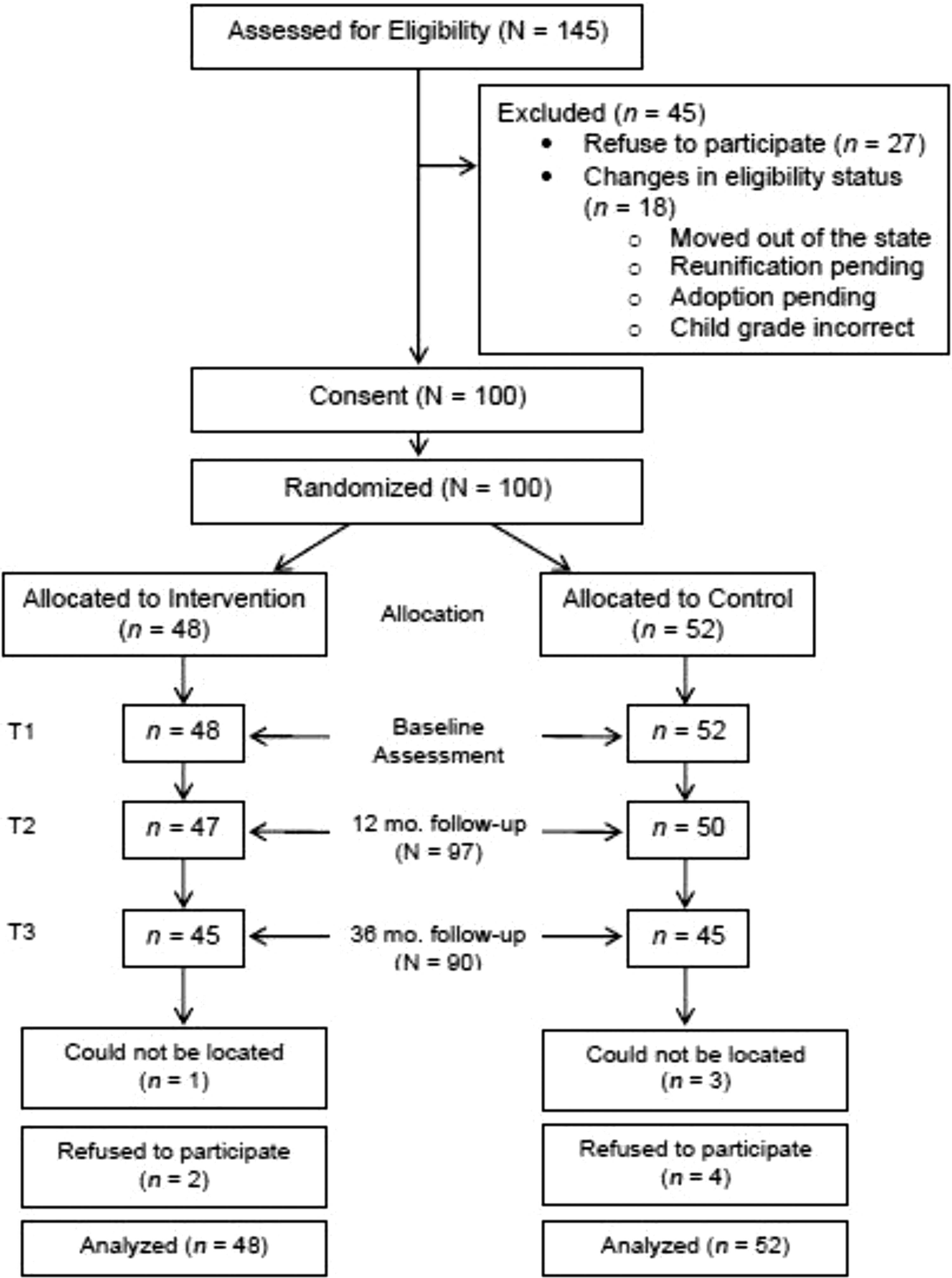
CONSORT flowchart.
On average, the girls were first placed in foster care at age 7.63 years (SD = 3.14) and had an average of 4.29 (SD = 3.32) prior placements based on official child welfare records. As noted above, inclusion and exclusion criteria did not specify maltreatment experiences; however, all youths in the study had at least one incident of maltreatment or neglect. Overall, 56% of girls in the sample had a documented history of physical abuse, 67% sexual abuse, and 96% neglect. Approximately, 41% of girls had a documented history of both physical and sexual abuse, and 41% reported all three types of maltreatment. The ethnicity breakdown of the sample was 63% European American/White, 9% African American/Black, 10% Latina, 4% Native American, and 14% multiracial. Thirty-two percent of the girls were in relative foster homes, and 68% were in nonrelative foster homes at baseline. Prior to the baseline assessment, the sample was randomly assigned either to foster care SAU or to a version of the Keep Safe intervention developed specifically for girls transitioning to middle school (Middle School Success), using a coin flip procedure. The intervention trial was registered with the National Institutes of Health Clinical Trials Registry [NIDA R21 DA027091; NIMH R01 MH054257].
Intervention Condition
The intervention began the summer prior to middle school entry, with the goal of preventing risk-taking behaviors such as delinquency, deviant peer affiliation, substance use, and related problems (Chamberlain et al., 2006). The intervention consisted of three components: (a) six sessions of group-based caregiver management training for the foster parents prior to middle school entry, (b) six sessions of group-based skill-building sessions for the girls prior to middle school entry, and (c) weekly group-based caregiver management training for the foster parents and weekly one-on-one skills training for the girl during the first year of middle school. The summer prior to middle school, the foster parent groups met twice a week for 3 weeks, with approximately seven participants in each group. The girl group sessions were held simultaneous to the parenting group sessions and were staffed with a high staff-to-girl ratio (1:2) for individualized attention, one-on-one modeling/practicing of new skills, and frequent reinforcement of positive behaviors. The follow-up intervention services, namely, ongoing training and support during the first year of middle school, were provided to the caregivers and girls once a week for 2 hr (foster parent meeting; one-on-one session for girls). The interventionists were supervised weekly. Videotaped sessions were reviewed, and feedback was provided to maintain the fidelity of the clinical model (Chamberlain et al., 2006).
Intervention for foster parents
The curriculum for the foster parent groups focused on developing a behavioral reinforcement system to encourage adaptive behaviors across home, school, and community settings. Weekly home practice assignments were provided to encourage foster parents to apply new skills. Interventionists also incorporated parent concerns into weekly sessions based on data collected from parent report measures of behavioral problems that occurred in each prior week. On average, foster parent participants completed 5.62 of the 6 summer sessions (SD = 0.99) and 20 weekly follow-up sessions (SD = 10.4).
Intervention for youths
The curriculum for the summer group sessions for girls was designed to prepare the girls for the middle school transition by increasing their social skills for establishing and maintaining positive relationships with peers, increasing their self-confidence, and decreasing their receptivity to initiation from deviant peers. The group structure typically included an introduction to the session topic, role-plays, and a game or activity during which girls practiced the new skill. Participation rates mirrored those of their caregivers. The individual skills coaching sessions during the first year of middle school continued to focus on establishing and maintaining positive peer relations, increasing knowledge of accurate norms for problem behaviors, and increasing self-competence in academic and social areas. Prior results from this study show that the intervention was effective in reducing risky sexual behavior and reducing substance use (Kim & Leve, 2011; Kim et al., 2013). Additional information regarding the intervention can be found elsewhere (Kim & Leve, 2011).
Control Condition (CC)
The girls and their caregivers who were randomly assigned to the SAU CC received the usual foster care services provided by the child welfare system, including services such as referrals to individual or family therapy, parenting classes for biological parents, and case monitoring. Sixty-two percent of girls in the CC received individual counseling, 20% received family counseling, 22% received group counseling, 30% received mentoring, 37% received psychiatric support, and 40% received other counseling or therapy services (e.g., school counseling, academic support) during the first year of middle school. Note that many girls received more than one service, and therefore, the percentages listed here exceed 100%. Child welfare caseworkers managed each case and were responsible for making all decisions on referrals to community resources, including individual and family therapy and parenting classes.
Procedures
In this study, the youth participants were assessed at baseline and at 12- and 36-month follow-ups. Retention rates were at or above 90% during the study period (see Figure 2). The assessment included separate structured interviews and questionnaires for each youth participant and her caregiver. Assessments lasted approximately 2 hr and were conducted by trained assessors who were unaware of the participant’s group assignment.
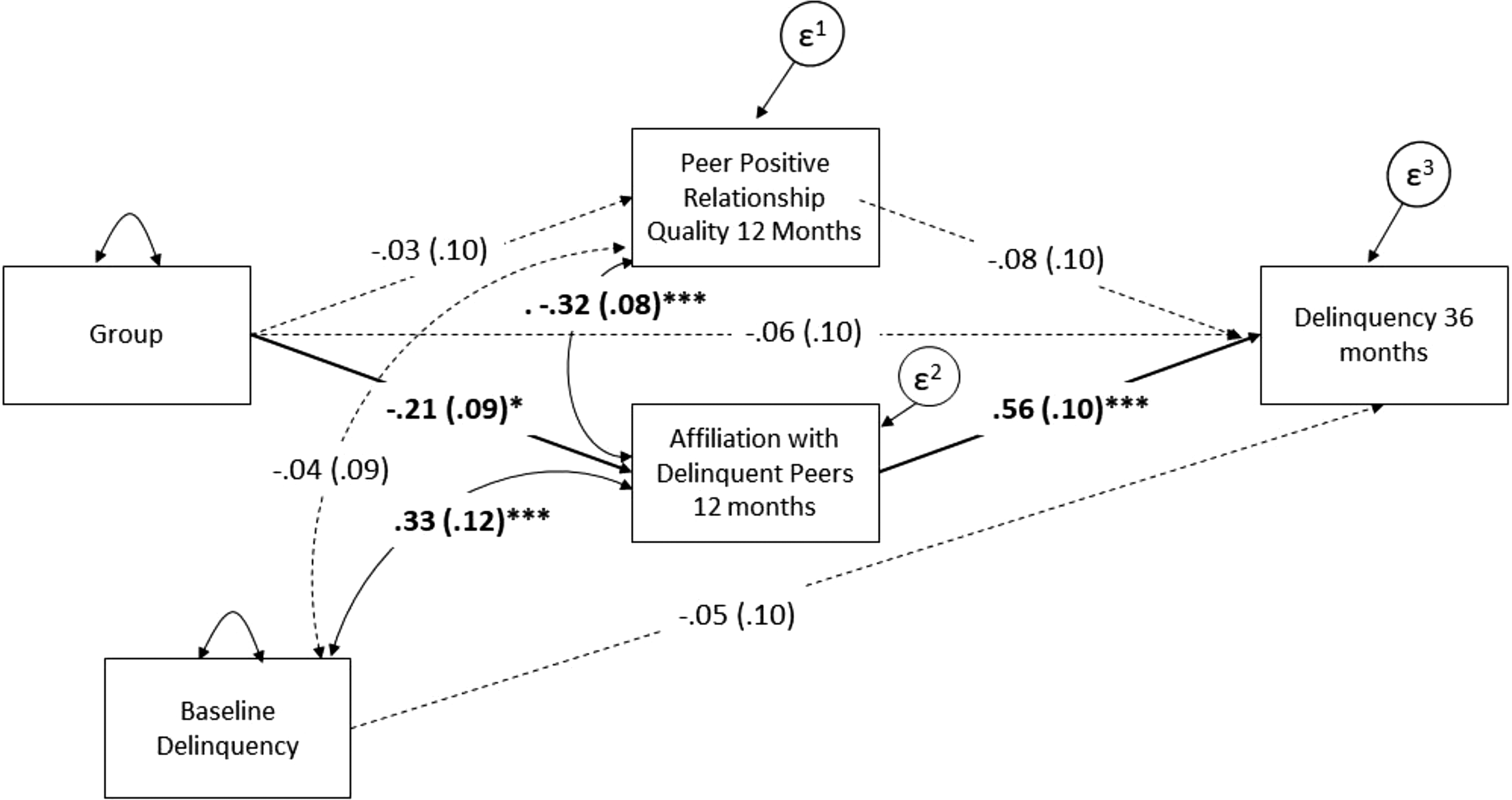
The longitudinal path model testing the hypothesized mediators of peer positive relationship quality and affiliation with delinquent peers. Note. Results show that the intervention had a direct effect on reducing affiliation with delinquent peers at 12 months. Affiliation with delinquent peers at 12 months was not a significant mediator (indirect effect = −.12, p = .05). Peer positive relationship quality at 12 months postintervention was not a significant mediator (indirect effect = .00, ns). Fit statistics indicated the model fit the data well, χ2(1) = 0.07, ns, comparative fit index = 1.00, non-normed or Tucker-Lewis index = 1.00, root mean square error of approximation = .000 (.000 | .170). The figure displays standardized path coefficients and standard errors, and all estimated parameters are shown, with the exception of the indirect effects. Dashed lines signify nonsignificant paths.
Measures
Delinquency
Self-reported delinquency was measured at baseline using a summed score of 23 items that measured noncompliant and delinquent behavior (e.g., swearing, disobeying adults, cheating, and skipping classes) and at 36 months using a mean score of 21 items from the Self-Report Delinquency Scale (SRD; Elliott et al., 1985; e.g., damaging or destroying property, and stealing). Youth participants were asked to rate how often they had committed various delinquent acts in the past year. The delinquency scale showed acceptable internal reliability at baseline and 36 months (Cronbach’s α = .84 and .62, respectively).
Affiliation with delinquent peers
Affiliation with delinquent peers was measured at 12 months with a modified version of the general delinquency scale from the SRD scale (Elliott et al., 1985). Youth participants reported on the extent to which they associated with friends who engaged in delinquent activities. Each youth participant indicated how many of her friends engaged in seven different antisocial activities (e.g., cheating on tests, stealing, and getting drunk) during the prior 12-month period on a scale from 1 (none of my friends) to 5 (all of my friends). Item scores were averaged to create a composite of delinquent peer affiliation. Reliability was acceptable (α = .84).
Peer positive relationship quality
Youth participants completed the Inventory of Parent and Peer Attachment (IPPA; Armsden & Greenberg, 1987) at the 12-month assessment to measure relationship quality. The IPPA is a 24-item questionnaire that assesses the youths’ attitude about the quality of parent and peer relationships. Sample items include, “I trust my friends,” “my female friends respect my feelings,” and “my female friends listen to what I have to say.” Youths responded to each item using a 5-point scale from 1 (never) to 5 (always) on the 12-item peer scale. Items were summed to create a summary score for peer positive relationship quality (α = .86).
Intervention condition
Intervention groups were dummy-coded in the main analyses, with the control condition group as the reference group (0 = control; 1 = intervention).
Analytic Plan
In general, requirements for mediation include a significant direct effect of the predictor (i.e., intervention condition) on a presumed mediator (i.e., affiliation with delinquent peers or peer positive relationship quality) and on the distal outcome (i.e., delinquency at 36 months), a significant direct effect of the mediator on the outcome, and a significant indirect effect of the predictor on the outcome by means of the mediator (Judd et al., 2001; MacKinnon & Dwyer, 1993). Thus, we first evaluated direct effects of the intervention condition on the outcome using a simple correlation. We then fit a path model in which the intervention condition predicted the two presumed mediators (i.e., affiliation with delinquent peers and peer positive relationship quality at 12 months), which in turn predicted the outcome (i.e., delinquency at 36 months). The path model enabled us to simultaneously evaluate the effects of the intervention condition on the mediators and the mediators on the outcome, and also enabled us to calculate the indirect effect of the intervention condition on the outcome by means of the mediators. In addition to these paths, we also included a path from baseline delinquency to delinquency at 36 months to ensure that we were predicting a change in delinquency following the intervention. We permitted both mediators to correlate with one another. Finally, we covaried baseline delinquency with both mediators given prior research that has shown evidence of positive associations between delinquency and affiliation with delinquent peers (Dishion & Tipsord, 2011) and negative associations between delinquency and peer relationship quality (Lansford et al., 2003; McElhaney et al., 2006).
We fit the model using structural equation modeling (SEM) with Mplus Version 7.1 (Muthén & Muthén, 1998–2014). We used maximum likelihood analysis with robust standard errors, which can provide unbiased estimates in the presence of missing data if the data are missing at random. Standard measures of fit are reported, including the χ2, comparative fit index (CFI), nonnormed or Tucker–Lewis index (TLI), and root mean square error of approximation (RMSEA). CFI values > .95, TLI values > .90, RMSEA values < .05, and a nonsignificant χ2 (or a ratio of χ2/df < 3.0) indicate good fit (Bentler, 1990; Hu & Bentler, 1999). All participants who underwent randomization were analyzed according to their original group assignment (intention-to-treat).
Results
Descriptive analyses were conducted to examine variable distributions. Means, standard deviations, and intercorrelations for all variables in the model are presented in Table 1. All variables fell within acceptable ranges of skewness and kurtosis of ±2 with the exception of the baseline delinquency variable. Mardia’s test for multivariate normality was also conducted, and data were multivariate nonnormal (skewness = 129.11, p < .001; kurtosis = 3.26, p < .001). Due to evidence of data nonnormality, maximum likelihood with robust standard errors was used as it has been shown to provide unbiased model estimates and standard errors in the presence of nonnormal data (Lai, 2018). The intervention condition was not significantly correlated with delinquency at 36 months, suggesting no direct effects of the intervention on delinquency at 36 months.
Means, Standard Deviations, and Intercorrelations.

†p = .055. *p < .05. **p < .01. ***p < .001.
We had some missing data in the outcome variable (i.e., 10% of the sample was missing delinquency data at 36 months; see Table 1), but the pattern of missingness was not correlated with baseline delinquency (r = .11, ns) or with either mediator (affiliation with delinquent peers: r = −.12, ns; peer positive relationship quality: r = .05, ns), suggesting that the missingness in the outcome did not introduce bias into the results.
The longitudinal path model evaluating links among the intervention condition, affiliation with delinquent peers, peer positive relationship quality, and delinquency fit the data well, χ2(1) = 0.07, ns, CFI = 1.00, TLI = 1.00, RMSEA = .000 (.000 | .170). In the path model, the mediators were permitted to correlate with baseline delinquency. Intervention condition predicted significant reductions in affiliation with delinquent peers at 12 months (B = −.21, p < .05) but had no effect on peer positive relationship quality; affiliation with delinquent peers, in turn, significantly predicted delinquency at 36 months, while controlling for baseline levels of delinquency (B = .56, p < .001). The indirect effect of the intervention condition on delinquency at 36 months via affiliation with delinquent peers was −.12 (p = .05), and although in the expected direction, it did not reach traditional thresholds of statistical significance. The indirect effect via peer positive relationship quality was .00 (ns).
Discussion
Results indicated that participation in the intervention was effective at reducing youths’ affiliation with delinquent peers at 12 months postintervention. Compared to youths in the control condition, youths in the Keep Safe intervention had lower levels of affiliation with delinquent peers at 12 months. Although tests of mediation did not reach traditional thresholds of statistical significance (p < .05), the indirect effect of affiliation with delinquent peers was in the expected direction, showing that delinquency at 36 months postintervention was lower (B = −.12, p = .05) as a result of reductions in affiliation with delinquent peers at 12 months.
Prior research has shown that when peers with a history of delinquency are grouped together, there are mutual influences that occur that may undermine an individual’s development or cause harm to others (Dishion & Tipsord, 2011). Dishion and Tipsord (2011) define this mechanism as peer contagion. Research on peer contagion has shown an increase in problem behavior when children at high risk for delinquency are aggregated in an intervention attempting to reduce such influence (Dishion & Tipsord, 2011). This study involved a small group intervention component for youths during the summer, followed by an individual intervention component for youths during the school year. Thus, the potential negative effects of peer contagion identified by Dishion and colleagues may have been reduced as a result of the individual intervention component that followed and was of longer duration. The one-on-one peer mentoring, which occurred throughout the first year of middle school, provided adult supervision by a young adult mentor who was trained to serve as a role model around issues of healthy relational and behavioral adjustment (Chamberlain et al., 2006). This may have additionally prevented negative peer contagion effects. Further, the youths in this study were not selected because of elevated delinquency, but rather, this was a preventive intervention study that began prior to middle school entry and was designed to prevent the onset of delinquency. The intervention also focused on supporting foster parents to use a behavioral reinforcement system with their foster daughter. This may have increased the amount of structure and monitoring provided by the adults in the intervention. Results showed a direct intervention effect on reductions in affiliation with delinquent peers at 1 year postintervention, and all of these study features may have led to its effectiveness and to the lack of negative peer contagion effects.
Despite the positive direct effects on lower levels of affiliation with peers who engage in delinquency, we did not find intervention effects on positive aspects of peer relationship quality. Assignment to the intervention condition yielded no direct effects on peer positive relationship quality at 12 months, and there were no indirect effects on delinquency at 36 months by means of peer positive relationship quality. This is in contrast to previous research (Criss et al., 2002; Klima & Repetti, 2008), which has shown that children with positive peer relationships have fewer externalizing behavior problems. Criss and colleagues (2002) distinguished two factors of peer relationships, peer acceptance, and friendship. Peer acceptance includes a sense of belonging and companionship, whereas friendship consists of intimacy, trust, and support (Criss et al., 2002). The authors found that peer acceptance was a more significant factor than friendship in predicting externalizing behavior problems. Other researchers have found similar relationships between peer acceptance, friendship, and behavior problems. For example, Klima and Repetti (2008) found that greater peer acceptance predicted fewer internalizing and externalizing behaviors 2 years later. Conversely, close friendships in adolescence did not predict internalizing or externalizing behaviors. The measure of peer relationship quality in the current study was not designed to distinguish between peer acceptance versus friendship, which is a limitation in interpreting our null findings. It is possible that positive long-term effects of interventions for this population of youths are influenced more by reductions in negative behaviors (reduced affiliations with delinquent peers) than by increases in positive relationship qualities. Additional research with precise measures of relationship quality is needed to further explore this possibility.
Study findings should be interpreted within the context of limitations including the relatively small sample size and the fact that the findings are the first of their kind with this population (girls in foster care, transitioning to middle school) and need to be replicated. The majority of the participants were non-Latina White, which does not fully represent the female foster care population in the United States. This study relies solely on self-report measures, which is a limitation. While two different measures of delinquency were used at baseline and 36 months post-intervention, this was done to capture developmentally salient delinquent behaviors at each wave. The sample-wide correlations between the two measures of delinquency were not significant, which may have been due to changes in delinquency for girls in the intervention or due to the wide variability of delinquent behaviors that manifest throughout the ages of girls in this study (11–14 years; Abderhalden & Evans, 2018). Police records were accessed to corroborate girls’ self-reports of delinquency, and arrest records at 36 months postintervention showed low base rates of documented arrests (n = 14); thus, we were not able to include this measure in our path model. There is some debate in the field regarding the limitations of both self-report and official records for delinquency (Gomes et al., 2018), with evidence that some subpopulations of adolescents report greater variability in delinquent behaviors with self-report relative to delinquent acts that are captured through arrest records (Kirk, 2006). As our mediation model did not reach conventional statistical significance thresholds, future studies might employ more highly powered designs and additional, robust measures of delinquency to further assess the potential effectiveness of the Keep Safe intervention in reducing adolescent girls’ delinquency. Furthermore, the measurement of peer relationship quality might not have been adequate to portray the domains of the relationships that are easily influenced during this developmental stage. Future research that investigates the specific contexts of peer relationship quality such as acceptance versus trust, social connectedness with peers, and peer acceptance would further the understanding of the role of positive peer contexts and relationships on the prevention of delinquency in studies of girls with foster care histories.
A final limitation of the current study is that we did not include an assessment of intervention effects on foster parenting behaviors in the present study. Given the emphasis on outcomes for foster youths and the particular influence of age-related peers during the middle-school years, less focus was placed on parenting measures; however, it is possible that foster parents also received beneficial effects from intervention participation. Next step studies might examine parenting measures, for example, the quality of the parent–youth relationship, parental monitoring, and parental involvement, in conjunction with peer relations, to determine whether additive or interactive effects of parent and peer relationships exist. Future studies may also explore whether such effects might mediate intervention effects on delinquency and other adolescent risk behaviors, thereby optimizing the design of interventions for youths in foster care. Additionally, youths in this study were placed into either relative or nonrelative foster care. Child welfare policies and empirical studies have increasingly emphasized the benefits of placing youths into relative foster placements when possible (Andersen & Fallesen, 2015; Cuddeback, 2004). As such, future studies might consider exploring the differences of these two types of placements on subsequent youth outcomes.
The current results extend prior work by suggesting that skill-based interventions such as Keep Safe can have positive effects for girls as they transition into middle school. Findings point to several implications for researchers and professionals who identify, tailor, and deliver evidence-based programs for girls placed into foster care. First, the direct intervention effect on reductions in affiliation with delinquent peers suggests the importance of supporting youths by providing accurate knowledge about norms related to refusing to engage in delinquent behaviors, and in parallel, building girls’ self-competence in peer relationships to carry out such behaviors. Keep Safe does this by increasing girls’ social skills and self-confidence and therefore decreasing their conformity to deviant peers. Next, the current study targeted these skills in two settings: a group setting with other girls in foster care and one-on-one with a supportive mentor. The group peer setting with other age-related peers permitted girls to practice and learn new skills that they may have lacked prior to participation in the intervention. The one-on-one skills and mentoring allowed girls to discuss their personal experiences in peer relationships, while the mentor, typically a recent female college graduate, was actively role-modeling prosocial behavior and providing guidance on healthy relational dynamics. Importantly, the individual mentoring continued throughout the first year of middle school during which time girls were being exposed to larger social networks. Overall, these results add to the literature on effective interventions for youths in foster care by providing evidence that Keep Safe is an effective intervention for decreasing adolescent affiliation with delinquent peers, which may in turn decrease the future occurrence of delinquency for an understudied and underserved population, girls in foster care.
Supplemental Material
Supplemental Material, Supplemental_File - Peer Relations and Delinquency Among Girls in Foster Care Following a Skill-Building Preventive Intervention
Supplemental Material, Supplemental_File for Peer Relations and Delinquency Among Girls in Foster Care Following a Skill-Building Preventive Intervention by Alana Hu, Mark J. Van Ryzin, Maria L. Schweer-Collins and Leslie D. Leve in Child Maltreatment
Footnotes
Authors’ Note
The content is solely the responsibility of the authors and does not necessarily represent the official views of the National Institutes of Health.
Acknowledgments
The authors gratefully acknowledge support from the National Institute on Drug Abuse and the National Institute of Mental Health. We thank Patricia Chamberlain for her leadership in the original study, Jennifer Volpi for editorial assistance, and the youth and families who participated in this project.
Declaration of Conflicting Interests
The author(s) declared no potential conflicts of interest with respect to the research, authorship, and/or publication of this article.
Funding
The author(s) disclosed receipt of the following financial support for the research, authorship, and/or publication of this article: The authors gratefully acknowledge support from the National Institute on Drug Abuse (R21 DA027091 and P50 DA048756) and the National Institute of Mental Health (R01 MH054257).

Supplemental Material
The Supplemental material for this article is available online.
References
Supplementary Material
Please find the following supplemental material available below.
For Open Access articles published under a Creative Commons License, all supplemental material carries the same license as the article it is associated with.
For non-Open Access articles published, all supplemental material carries a non-exclusive license, and permission requests for re-use of supplemental material or any part of supplemental material shall be sent directly to the copyright owner as specified in the copyright notice associated with the article.
