



Abstract
When a child is removed from their home and placed in foster care, society takes over the responsibility for that child’s well-being and development. Failure to provide a child with a nurturing upbringing may have negative consequences for the child as well as for society. Using Swedish longitudinal registry data for a national cohort sample of siblings, in which some were placed in foster care and others remained in their birth parents’ care, this study asks whether long-term foster care ensures improved life chances. Results from multilevel regression analyses of a wide range of educational, social, and health-related outcomes in mature adult age (16 outcome constructs) support a row of previous studies indicating that traditional long-term foster care does not seem to improve maltreated children’s life chances.
Foster care (foster family care/residential care) is a way of providing a family life for maltreated (abused/neglected) children who cannot live with their biological parents. In the Scandinavian countries, the intervention is not only aimed at child protection, it is also explicitly intended to improve children’s development and life chances (Bryderup et al., 2017; Hessle & Vinnerljung, 1999). A sizable proportion of the child population in Western countries will experience placement in public care at some point during their upbringing: 3–5% in Scandinavia and England and around 6% in the United States (Fallesen et al., 2014; Mc Grath-Lone et al., 2016; Vinnerljung et al., 2007; Wildeman & Emanuel, 2014). In this study, the focus is on children who remain in Swedish foster family care for a substantial part of their childhood before adolescence (at least 5 years before age 13). In doing so, we bring attention to a population of children which society, acting in loco parentis, has assumed far-reaching responsibilities for their well-being and development.
A large body of literature suggests that a history of foster care seems to be one of the strongest markers for compromised long-term health- and psychosocial development (e.g., Kessler et al., 2008; Lawrence et al., 2006). However, foster care populations are a strongly selected group where the sorting processes in themselves may influence the outcomes. This “confounding by indication” arises from the fact that children who are placed in foster care are inherently different from those who are not because they are placed for a reason (see Salas et al., 1999; Ubbesen, 2013). Conducting randomized controlled trials are unfeasible due to legal and ethical concerns. Therefore, the international research community has relied on observational studies, of which a large part comes from the Scandinavian countries (Kääriälä & Hiilamo, 2017). Long-term outcomes for foster care alumni tend to be poor in all life areas that have been examined in these and studies from other countries (e.g., Gypen et al., 2017). Observational studies of intended impacts of foster care are nevertheless prone to confounding by indication and can produce misleading estimates on intervention effects. If one fails to sufficiently control for confounding by indication, it may be expected that placement in foster care is associated with a higher risk of poor outcomes later in life. However, sibling studies have the potential of providing evidence that is more credible by reducing the residual confounding of unobserved variables related to familial environmental and, in part, hereditary factors (Lahey & D’Onofrio, 2010).
Using Swedish longitudinal registry data for a national cohort sample of siblings, the purpose of this study is to examine whether experience of long-term foster care has any beneficial long-term impacts on children’s life chances. A wide range of educational, social, and health-related outcomes in mature adult age (30–39 years) for children who spent at least 5 years before age 13 in foster care are compared to outcomes for maternal siblings in the same cohort who grew up in their birth mothers’ care. With this design, not only are problems related to confounding by indication reduced, but we also address a core question facing child welfare policy makers and professionals: Does placement in long-term foster care ensure better life chances?
Considering the invasive nature of foster care and the potential positive and/or negative effects over time—including impacts on the next generation (Mertz & Andersen, 2016; Wall-Wieler et al., 2018) —it is not surprising that the history of long-term outcome studies of foster care is as old as the discipline of social work (Theis, 1924). A large body of research from the United States have found indications of detrimental (e.g., Doyle, 2013; Lawrence et al., 2006; Lloyd & Barth, 2011; Warburton et al., 2014) or neutral long-term impact of foster care (Berger et al., 2009; Berzin, 2008, 2010; Stahmer et al., 2009). Other studies—mostly from the UK—have reported indications of beneficial long-term effects, often in comparisons of children who were reunited with their birth parents (Biehal, 2007; Biehal et al., 2015; Forrester et al., 2009; Taussig et al., 2001; Wade et al., 2010). Due to this variation in results, it is logical to turn to sibling-proband studies for clarification (as in many other fields of controversy, e.g., Colen & Ramey, 2014). However, studies comparing siblings with and without experience of long-term foster care are rare; we are only aware of four.
Using data from a Finnish local sample where most persons had grown up before or during World War II, Salo (1956) compared 901 adults who had been in long-term foster care with a sibling group consisting of 437 persons who remained with their birth parents. Among the adults who had been in foster care, almost half of the sample had been placed due to parental death. Salo used various forms of local information sources to assess mortality, health, alcohol abuse, criminality, and welfare dependency in the adult sample at age 20–40. The siblings who grew up in their birth families did worse on almost all outcome measures.
Dumaret and Stewart (1985) examined cognitive competence (IQ) and school performance at age 14–18 of 35 children who were adopted during infancy into families of high socioeconomic status, 21 maternal birth siblings who had grown up in foster care, and 20 maternal siblings who grew up in their mothers’ care. In adolescence, the adoptees had far better results on cognitive tests than the two other sibling groups and 80–90% had done well in the education system. In contrast, two of three siblings who had grown up with their mothers and all fostered siblings were considered “school failures.”
Vinnerljung (1996) used a local city cohort, containing all children born between 1958 and 1967 who had been in long-term foster family care, to create a sibling sample: 107 children with at least 5 years’ experience of foster care before age 13 were compared to 128 maternal siblings who had grown up in their birth mothers’ care. Maximum age difference between discordant siblings was set to 5 years. Data from 12 national registers were used to construct 41 outcome variables, spanning indications of social problems in adolescence (e.g., juvenile crime), educational attainment, family/housing situation in young adulthood, indications of health problems, and crime and economic difficulties in adulthood. In addition, three composite outcome variables were used. Age at end of follow-up was 24–34 years. All 41 outcomes were reported in sex-stratified bivariate analyses, and 18 were analyzed in fixed-effect (FE) regression models. Vinnerljung found no statistical differences in either bivariate or regression models and no trace of consistent tendencies favoring either fostered or “homegrown” siblings. Possible selection effects through indications of parental rejection of individual children in foster care (case files were scrutinized) had no impact on the results.
Wall-Wieler et al. (2019) used a sibling design to examine a more proximal outcome of foster care placements for young children: school readiness. Using a large cohort sample from Manitoba, Canada, fostered children placed in infancy and with 3–5 years in care did not have better outcomes than their birth siblings who had remained in parental care.
Salo’s (1956) findings are related to times of war and dire poverty in Finland and may therefore constitute a historical outlier. The French study (Dumaret & Stewart, 1985) is based on a small sample and is mostly focused on the benefits of adoption. Wall-Wieler and associates did not examine long-term outcomes and data in Vinnerljung’s (1996) local cohort study are 25 years old. Also his results reflect outcomes in a different societal context than today, a time when, for example, there were ample and well-paid employment opportunities in the Swedish industrial sector. Therefore, we have performed a new sibling study based on a national population sample that has the potential to shed light on more current outcomes of long-term foster care in a European welfare state.
Method
This study was based on record linkages between national registers with data on the entire national population, held by the Swedish National Board of Health and Welfare, Statistics Sweden, and the Crime Prevention Council. The overall quality of the registers is regarded as high (Cnattingius et al., 1990; Ludvigsson et al., 2011). The registers were linked by use of the individually unique 10-digit personal identity number (PIN) that follows all Swedish residents from birth (or date of immigration) until death. The PIN enables researchers to trace individuals over the life course in national databases, with low attrition. In research data sets, the PIN is replaced with an anonymized control number by the authorities responsible for the administration of the registers. The study was approved by the Stockholm regional ethics committee.
Study Population
The population was defined as (a) all persons born in Sweden between 1973 and 1982, according to the Medical Birth Register (held by National Board of Health and Welfare), (b) who were alive and residing in Sweden at their 15th birthday, according to the Total Population register (held by Statistics Sweden), and (c) who had been placed in foster care at least 5 years before their 13th birthday, according to the Child Welfare Register (held by the National Board of Health and Welfare). These delimitations yielded a sample of 4,116 persons.
From this population, we created our study group: all 533 persons who had been in foster care at least 5 years before their 13th birthday (median 13.5 years in care before age 18), who had a maternal sibling (a full or half sibling) within the cohort, and who had grown up in her or his mothers’ care (exceptions are temporary stays in foster care before age 13, ≤6 months totally [median 0 months in care before age 18]). These homegrown siblings (n = 616) were added to the study population (total n = 1,149 children of 474 mothers). Minimum–maximum age difference between foster children and their home siblings was 0–9 years (absolute values). Siblings were identified in the Multi-Generation register (held by Statistics Sweden). Long-term foster care of small children in Sweden almost always refers to foster family care, although in some cases preceded by a short stay in residential care before placement with foster parents (Vinnerljung, 1996).
The sibling configurations in our sample are atypical for cohort members who had been in long-term foster care 5 years before age 13 (n = 4,116). Of these, 60% (n = 2,514) had at least one maternal sibling. Henceforth, the 533 persons in our sample who (a) had grown up in foster care and (b) had a maternal sibling who grew up in her or his birth family constitute a rather small proportion (21.2%) of all long-term foster children with at least one maternal sibling and also of all cohort members with experience of long-term foster care before age 13 (12.9%).
We have no answers to the obvious question: Why were these siblings separated in early years, basically for their entire childhood? Vinnerljung (1996) scrutinized local case records trying to answer the same question but found that it was impossible in a majority of cases. Fostered siblings tended to be older than the homegrown group, and it seemed that either conditions improved for parents over time—enabling them to keep younger siblings at home—or that child welfare authorities simply had softened earlier interventionist attitudes to vulnerable families over time (the majority of siblings reared at home were younger). But the case files had no information that could shed light in why the fostered siblings were not reunited with their birth families. Indications of parental rejection of children were very rare.
The sample in this study was delimited from the national Child Welfare Register, where data are mainly restricted to date of entry and exit and form of care (foster family or residential care). The register does not contain any information on reason for placement or on characteristics of birth family and care environment. The only thing we know with certainty is that the foster children tended to be older than their brothers and sisters who grew up at home (Table 1).
Background and Outcome Variables by Foster Children and Home Siblings.
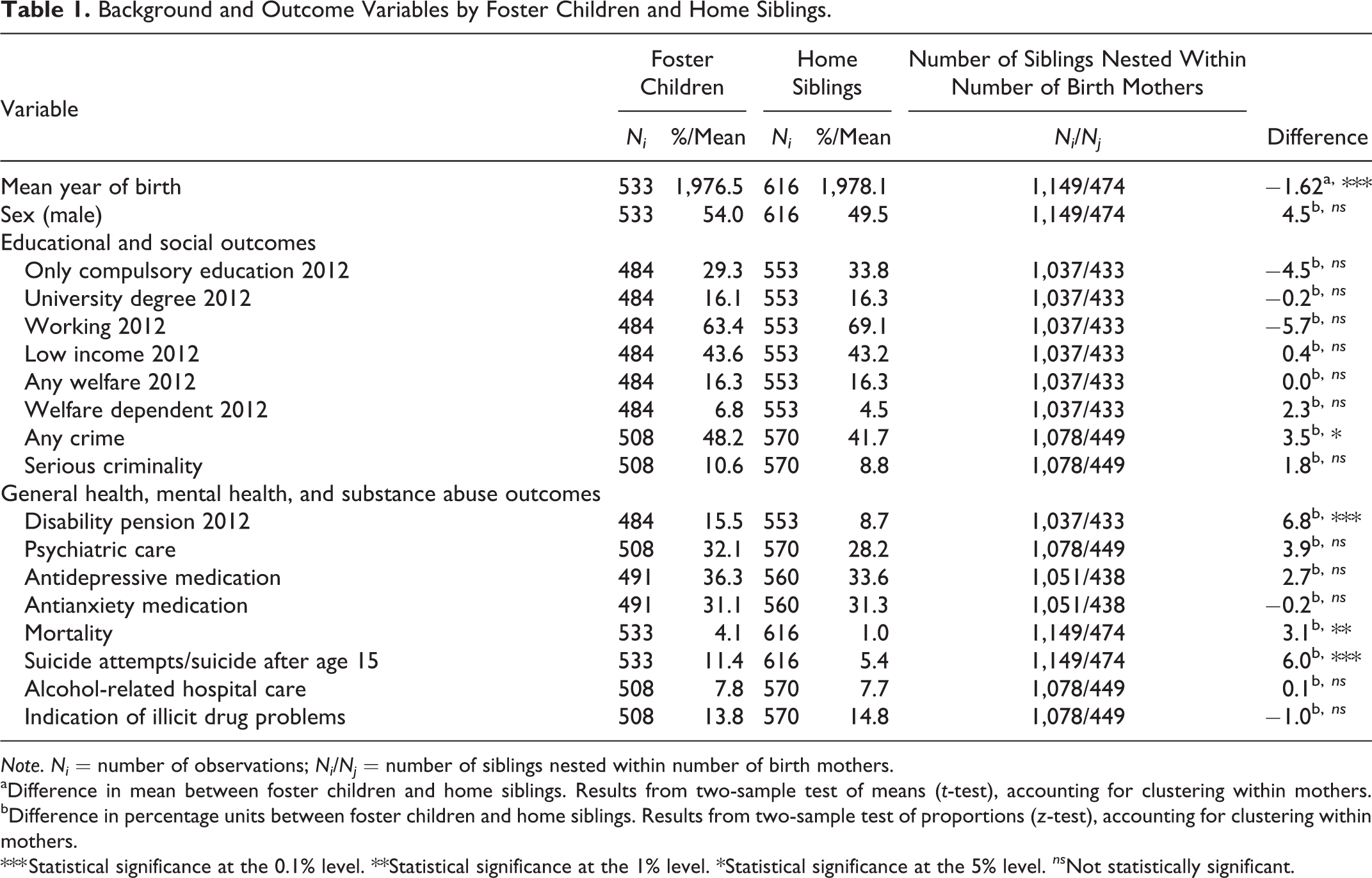
Note. Ni = number of observations; Ni /Nj = number of siblings nested within number of birth mothers.
aDifference in mean between foster children and home siblings. Results from two-sample test of means (t-test), accounting for clustering within mothers. bDifference in percentage units between foster children and home siblings. Results from two-sample test of proportions (z-test), accounting for clustering within mothers.
*** Statistical significance at the 0.1% level. **Statistical significance at the 1% level. *Statistical significance at the 5% level. ns Not statistically significant.
In contrast to the United States and the UK, it should be noted that the Swedish legislation does not include permanency planning. The only option for children who cannot be reunited with birth parents is to remain in long-term foster family care. Adoption requires consent of both birth parents and is simply not considered an intervention available to child welfare authorities (Barth, 1992; Hjern et al., 2019).
Outcomes
Last year of follow-up was 2012 when the population was 30–39 years old. We used national registers to create altogether 16 outcome variables. While the first eight are educational and social indicators, the remaining refer to general health, mental health, substance abuse, and mortality. Due to the age dependency of the indicators and the time-dependent availability of the information in the registers, the delimitation of the study population varies some between variables. The maximum number in our analyses was 1,149 (for suicidality and premature mortality from 15 years of age to 2012) and the lowest number 1,037 (all who were alive and residing in Sweden in 2012). Below we list the outcome measures.
Only compulsory education in 2012 (9 years)
Data retrieved from the Longitudinal Integration Database for Health Insurance and Labor Market Studies (LISA by acronym), held by Statistics Sweden (yes/no).
University/college degree in 2012
Data retrieved from LISA (yes/no).
Working in 2012
Any income from employment or self-employment in November 2012, according to LISA (yes/no). This variable is measured nationally by Statistics Sweden each year in November.
Low income in 2012
Annual income in the lowest national quintile income bracket (income from employment or self-employment), according to LISA (yes/no).
Any welfare in 2012
Any income from public means-tested welfare during 2012, according to LISA (yes/no). This variable and the next below are not mutually exclusive.
Welfare dependent in 2012
At least 50% of the disposable income in 2012 came from public means-tested welfare, according to LISA (yes/no).
Any crime
At least one conviction for a crime from the 18th birthday to 2012 (with exception of traffic violations), according to the Swedish Crime Register, held by the Crime Prevention Council (yes/no). All crime data are retrieved from this register. This variable and the next below are not mutually exclusive.
Severe criminality
At least one sentence to prison, probation, or forensic psychiatric care from age 18 to 2012 (yes/no). These sanctions indicate either repeated offending or a conviction for serious crime. The variable has been used in several previous studies and has shown good discriminatory traits (Berlin et al., 2011).
Disability pension in 2012
Income from disability pension during 2012, according to LISA (yes/no). Disability pension is awarded to individuals who are unfit to work due to health-related reasons. We do not have access to data on reason for disability pension, but know from other studies that most in this age-group are related to impaired mental health (Vinnerljung, Brännström, et al., 2015).
Psychiatric care
Any record in the National Patient Register (held by the National Board of Health and Welfare) of hospital care with a psychiatric diagnosis from age 18 to 2012 (yes/no). After 2002, these data include outpatient clinical care, before that only episodes of inpatient care were registered. Available data include diagnostic criteria for hospital care, which were used in tentative subanalyzes of suicide cases (see below).
Antidepressive medication
Retrieval of at least one prescription of antidepressants from July 2005–2012, according to the Pharmaceutical Register, held by National Board of Health and Welfare (yes/no). This register became operative with full coverage from July 2005 and contains records of all retrieved prescribed pharmaceuticals from pharmacies in Sweden but does not include prescribed medicines administered in hospitals. For this, and the next outcome variable (antianxiety medication), the study population was restricted to persons alive and residing in Sweden in 2005. Subsequently, the study population was 23–32 years of age at the start of the follow-up and 30–39 at the end.
Antianxiety medication
Retrieval of at least one prescription of anxiolytics from July 2005 to the end of 2012, according to the Pharmaceutical Register (yes/no).
Mortality
Deaths after age 15 to 2012, according to the Cause of Death Register, held by the National Board of Health and Welfare (yes/no).
Suicide attempts/suicide after age 15
All deaths after the 15th birthday to 2012 with the cause of death registered as suicide or “uncertain” in the Cause of Death Register (as recommended by Sainsbury, 1986) or at least one hospitalization after the 15th birthday to 2012 with a diagnosis of suicide attempt/self-inflicted injury, according to the National Patient Register (yes/no).
Alcohol-related hospital care
At least one instance of hospital care from age 18 to 2012 with an alcohol-related diagnosis (main or contributory diagnosis) according to the National Patient Register (yes/no).
Indication of illicit drug problems
At least one conviction for possession or distribution of illegal drugs in the National Crime Register, dating from age 18 to 2012, or at least one instance of hospital care from age 18 to 2012 with an illicit drug-related diagnosis (main or contributory diagnosis) according to the National Patient Register (yes/no).
Confounders
Data on sex and year of birth were collected from the Total Population Register. Year of birth was entered in the statistical analyses as a continuous variable.
Statistical Analyses
Siblings with experiences of long-term foster care before adolescence were compared to their maternal siblings who grew up in their mother’s care. Descriptive statistics of the sample and variables, including bivariate comparisons of the foster care group and the home sibling group with results from two-sample test of proportions (z-test)/means (t-test), are presented in Table 1.
Because of binary outcomes, we estimated logistic random-effects (RE) regression models (Hox et al., 2017). To account for unobserved characteristics shared by the siblings, we also estimated conditional logistic models, that is, FE models (Allison, 2009).
All analyses were performed using Stata 15/SE-version (StataCorp LP, College Station, TX). The bivariate comparisons were based on the prtest/ttest commands and account for the nested data structure (siblings clustered by birth mothers). The regression analyses were based on the xtlogit command using cluster-robust standard errors to account for the dependence on birth mothers (Cameron & Trivedi, 2010).
To assess whether our findings were robust to unobserved confounding, we calculated E-values for the observed exposure–outcome association estimates. Conditional on included control variables in the model, a large/small E-value suggests considerable/little unobserved confounding would be needed to fully explain away the effect estimate (VanderWeele & Ding, 2017). We also assessed to what extent our results were robust to birth spacing by systematically removing home siblings with the largest age difference (>5 years).
Results
Basic descriptives of the sample are shown in Table 1. The “home siblings” (children who grew up in the birth family) were on average 1.6 years younger (p < .001) than their fostered sisters or brothers. The foster care group tended to have more males; however, the difference was statistically nonsignificant. Four of the five (79.2%) in the foster care group had been in foster care for more than 10 years before age 18, the legal age of majority (not shown in tables).
In the 16 outcome variables, the foster care group had significantly poorer results in four. More had been convicted for a crime (“any crime”; 48.2% vs. 41.7%). Among the health-related outcome variables, we find some striking differences. Almost one in 6 former foster children (15.5%) were receiving a disability pension in 2012, meaning that they were more or less permanently excluded from the labor market, compared to one in 11 in the sibling group (8.7%). Although the frequencies are small, mortality figures for the fostered group were 4 times higher than for the homegrown siblings (4.1% vs. 1.0%). Suicide was the most common cause of death in both sibling groups, 12 in the foster care and 3 in the home group (p < .01; not shown in tables). Indications of suicidal behavior (completed and attempted suicide) were far more common among the former foster children (11.4%), in comparison to the siblings who grew up in their parents’ care (5.4%). One of six girls (17.3%) who grew up in foster care had been hospitalized for suicide attempt after age 15, compared to one in 15 among homegrown girls (6.6%, not shown in tables). When we scrutinized the data on diagnoses in the outcome variable “psychiatric care,” we found no differences for inpatient or outpatient care with depression- or bipolar-related diagnoses, both generally associated with highly elevated risks for suicide (Harris & Barraclough, 1997). None of the suicides in the sample was preceded by inpatient care for either depression or bipolar disorders.
To describe the exposure–outcome associations for educational and social outcomes, Table 2 reports odds ratios (ORs) from RE and FE logistic regression models adjusted for sex and year of birth. Due to no variation in outcomes within a number of pair of siblings, it should be noted that FE estimates generally are based on fewer observations than corresponding RE estimates. Yet, the two models concur in all but one variable (any crime). Significantly, fewer former foster children had income from work in November 2012. Also more—however, a small number in both sibling groups—were dependent on public welfare in 2012. The difference in the bivariate analysis for “any crime” became nonsignificant in the RE model. For the other five educational and social outcomes, results were nonsignificant in both models.
Educational and Social Outcomes for Foster Children Versus Home Siblings.
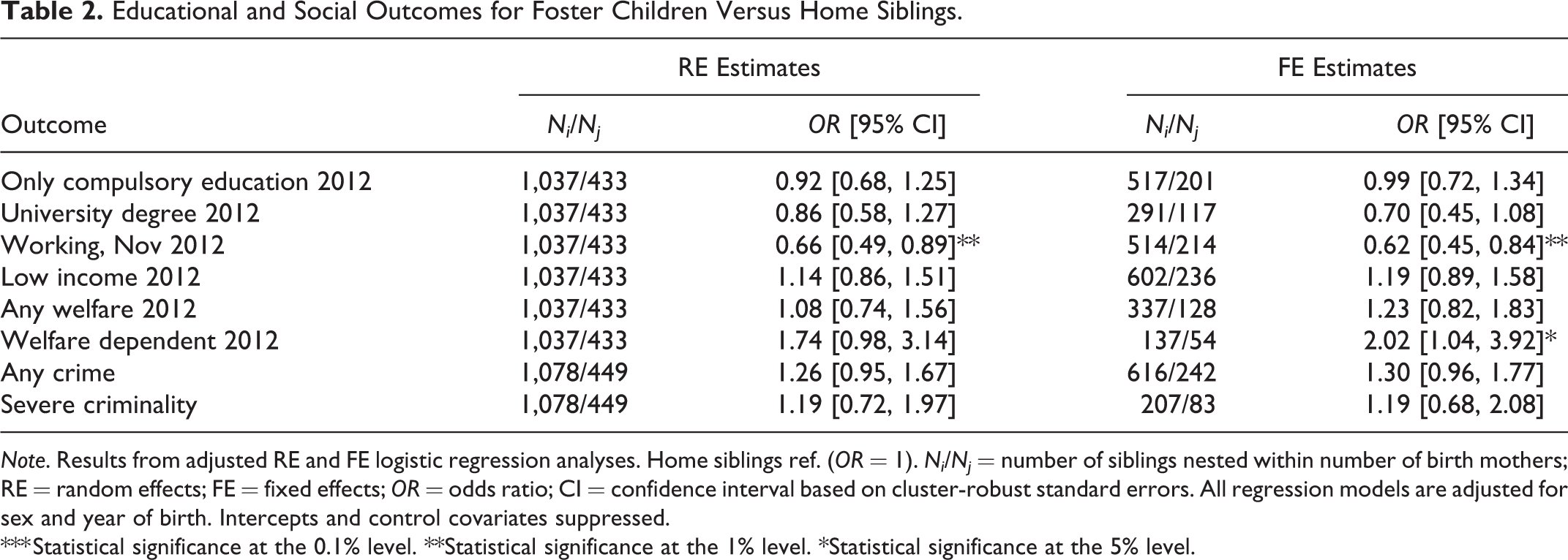
Note. Results from adjusted RE and FE logistic regression analyses. Home siblings ref. (OR = 1). Ni /Nj = number of siblings nested within number of birth mothers; RE = random effects; FE = fixed effects; OR = odds ratio; CI = confidence interval based on cluster-robust standard errors. All regression models are adjusted for sex and year of birth. Intercepts and control covariates suppressed.
*** Statistical significance at the 0.1% level. **Statistical significance at the 1% level. *Statistical significance at the 5% level.
Outcomes related to general health, mental health, and substance abuse are presented in Table 3. Adults who grew up in foster care were significantly more likely to receive disability pension in mature adult age (RE OR = 2.26, FE OR = 2.61). ORs for mortality were 3- to 4-fold for the former foster children compared to their home siblings, for suicidal behavior roughly 2-fold. For the other five health-related outcome variables, differences between the two study groups were small and statistically nonsignificant in both models.
General Health, Mental Health, and Substance Abuse Outcomes for Foster Children Versus Home Siblings.
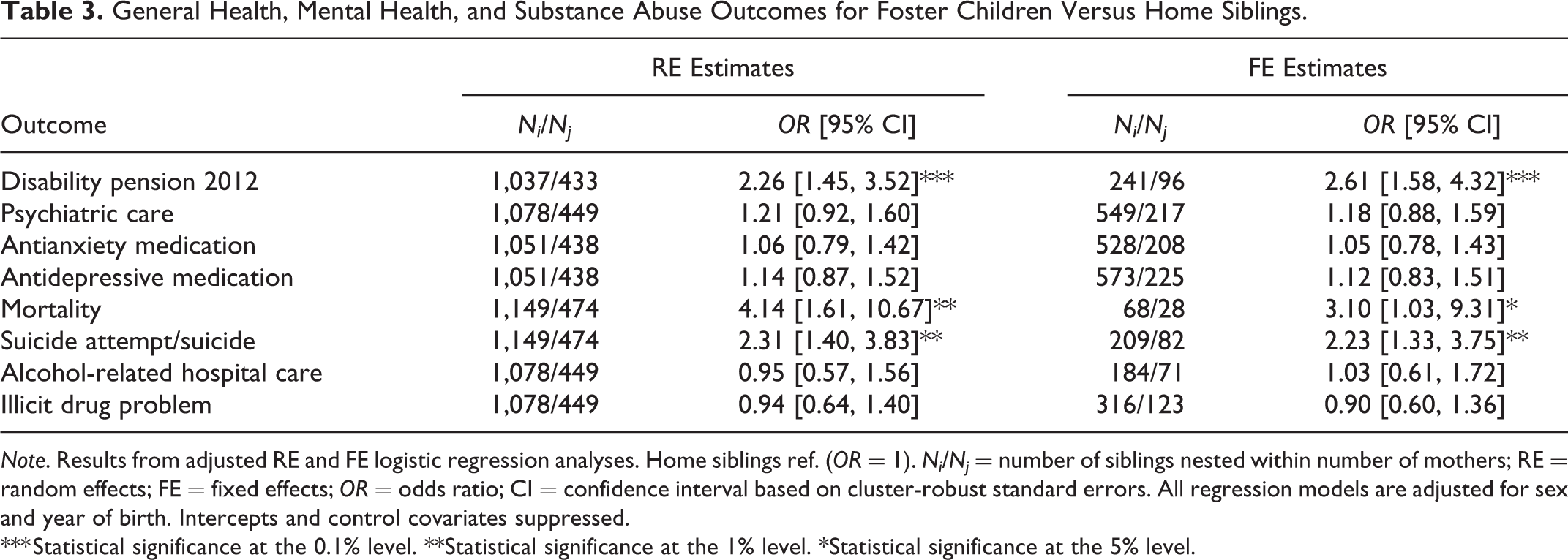
Note. Results from adjusted RE and FE logistic regression analyses. Home siblings ref. (OR = 1). Ni /Nj = number of siblings nested within number of mothers; RE = random effects; FE = fixed effects; OR = odds ratio; CI = confidence interval based on cluster-robust standard errors. All regression models are adjusted for sex and year of birth. Intercepts and control covariates suppressed.
*** Statistical significance at the 0.1% level. **Statistical significance at the 1% level. *Statistical significance at the 5% level.
Sensitivity Analyses
Table 4 reports the E-values for each exposure–outcome association. Ranging from 1.08 to 7.75, a crude summary would be that most OR estimates are fairly robust to unmeasured confounding (median E-value = 1.45). As expected, we can see that larger ORs are associated with larger E-values and are thus less sensitive than smaller ORs. Regarding “suicide attempt/suicide” with an observed RE OR of 2.31, for example, an unobserved confounder that was associated with both the outcome and the exposure by a risk ratio of 4.05-fold each, above and beyond the observed confounders, could fully explain away the association (i.e., drive it toward zero), but weaker confounding could not. The E-value for the corresponding FE estimate (OR = 2.23) was 3.89.
Sensitivity Analyses for RE and FE Logistic Regression OR Estimates.
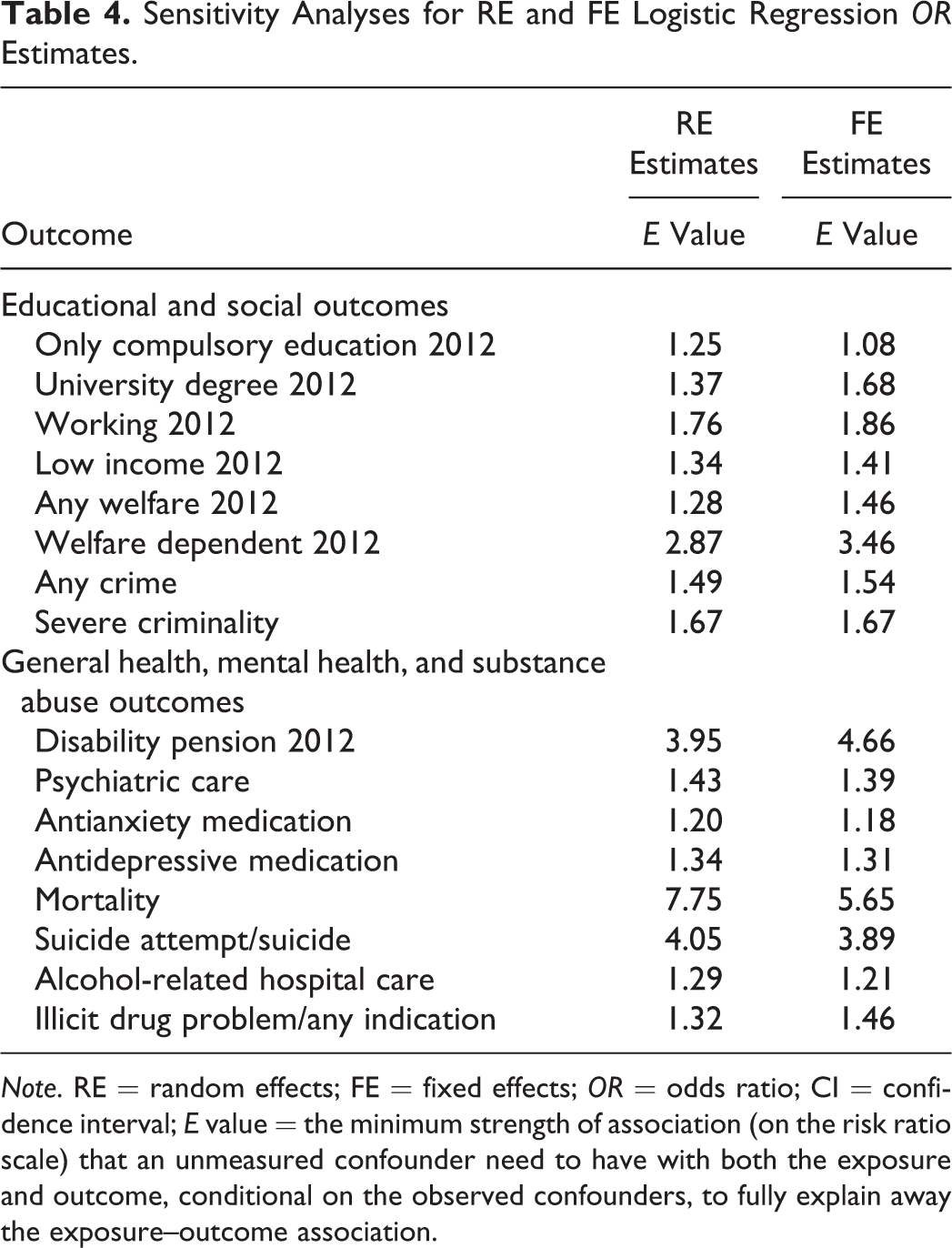
Note. RE = random effects; FE = fixed effects; OR = odds ratio; CI = confidence interval; E value = the minimum strength of association (on the risk ratio scale) that an unmeasured confounder need to have with both the exposure and outcome, conditional on the observed confounders, to fully explain away the exposure–outcome association.
To assess to what extent our results were sensitive to age differences between foster children and their home siblings, we excluded home siblings with the largest age difference (>5 years). This had negligible effects on point estimates reported above but resulted in a loss of power and hence wider confidence intervals (not shown in tables).
Discussion
Using national registers covering the entire Swedish population, we compared educational, social, and health-related outcomes in mature adult age (30–39 years) for 533 former foster children who had spent at least 5 years in foster care before their 13th birthday and 616 maternal birth siblings who had been reared in their birth families. The sample consisted of all sibling configurations in a national birth cohort (born 1973–1982) who met the selection criteria. These children were offspring of 474 mothers.
In multilevel RE and FE regression models, the fostered group had similar outcomes to the siblings reared in birth homes in 11 of the outcome variables that we constructed from national register data. The foster care group had significantly poorer outcomes (both regression models) in five outcomes measures: fewer were working, more were dependent on public welfare for economic self-support or received disability pension, and rates of suicidal behavior were higher as were all-cause mortality rates. Our initial hypothesis of no substantial differences between the two study groups was partly confirmed, but in about a third of the outcome constructs results were worse for the former foster children than we expected. Results from sensitivity analyses did not alter these findings.
Probably, the most alarming results concern the high rates of completed and attempted suicide in the foster care group, highly elevated in comparison to their birth siblings who remained in their parents’ care. Our findings echo several Swedish national cohort studies, spanning two decades (Hjern et al., 2004; Vinnerljung, 1996; Vinnerljung, Brännström, et al., 2015; Vinnerljung et al., 2006; Vinnerljung & Ribe, 2001).
Looking at other studies of long-term foster care with homegrown siblings as comparison group, Salo (1956) found that Finnish siblings in parental care did far worse that fostered children. Dumaret and Stewart (1985) noted that fostered siblings in France had poorer cognitive and school outcomes in adolescence than siblings who had remained in their birth homes. In Canada, Wall-Wieler et al. (2019) found no differences in school readiness after 3–5 years in care, and in Vinnerljung’s (1996) Swedish study, the two sibling groups showed no differences in young adult age, regardless of outcome construct (41 outcome variables). With the exception of Salo’s old study from Finland, the three others point in the same direction as what we have reported in this study, same or worse outcomes for the fostered group.
This overall trend is confirmed in a host of north American studies with quasi-experimental design and multivariable statistical analyses (e.g., Berger et al., 2009; Berzin, 2008; Doyle, 2013; Lawrence et al., 2006; Stahmer et al., 2009; Warburton et al., 2014). In all these studies—as in older follow-up works with reasonably credible comparison groups (review in Vinnerljung, 1996)—none has reported better long-term outcomes for fostered children. Henceforth, our longitudinal sibling study follows the main stream in international literature. In several national contexts, foster care seems to have scant compensatory influence on children’s long-term development. Results from this study even suggest the contrary for a few important outcomes. Our and other’s results collide with the long-standing prognostic logic behind Swedish state intervention in families. Since (at least) the 1950s, placement in foster care of young children has—on a policy level—been regarded as a path to better life chances for children in adverse family environments, for example, with parental substance abuse (Hessle & Vinnerljung, 1999; Vinnerljung, 1996). Court orders removing children from their parents are issued today if there is a “serious risk” that the child’s development is endangered (§2, Care of Young Persons Act).
How can we explain or understand these results? Due to lack of historic data, we are reduced to making informed speculations. Results could be related to preplacement factors in the fostered group. It is possible that maltreatment in the birth homes before placement in care compromised the children’s long-term development so much that a foster family could not remedy the damages. Likewise, it is possible that the homegrown siblings had a better early childhood environment in their birth homes. We have no data that can support or dispute these hypotheses.
Nevertheless, some possible explanations relate to the nature of foster care, as we know it today and in the past. Instability, that is unplanned changes of placements (breakdowns), is inherent to foster care (Oosterman et al., 2007). In a seminal study, Rubin et al. (2007) concluded that children in foster care experience placement breakdowns unrelated to their baseline problems and that this instability per se has a negative impact on their development (James et al., 2004; Newton et al., 2000). We do not have reliable data on changes of placement for the foster children in our sample since the register has only notes on changes from foster family to residential care, not moves between different foster families. However, we know from previous studies that every fourth previously stable placement in Swedish long-term foster family care ends with a breakdown in early adolescence, on average after 10 years in the same foster home (Vinnerljung et al., 2017). Probably, a significant proportion of our foster care sample has similar experiences (how many, we do not know).
John Triseliotis, the alderman of UK foster care and adoption research, has highlighted the existential insecurity felt by many children and youth in long-term foster care, many also lacking conviction that their foster home was “a family for life” (e.g., Triseliotis, 2002; Triseliotis & Hill, 1990). The trials of young people leaving foster care after age of majority are well known in research from several countries (Berzin, 2008; Höjer & Sjöblom, 2010; Stein, 2006). Their pathway to adulthood is accelerated in comparison with other peers and most are left without support from their foster families. In contrast to the other Nordic countries, UK, and the United States, Sweden does not have mandatory support for care leavers in the child welfare legislation, and there are no examples of systematic programs for supporting youths who age out of foster care (Vinnerljung, Forsman, et al., 2015). It is possible that some, even many, in our sample that left care at age 18, faced hardships that compromised earlier developmental progress (Berlin et al., 2011). Poor school and educational performance is strongly associated with poor long-term outcomes for foster children in basically all life areas (Berlin et al., 2011; Forsman et al., 2016; Vinnerljung et al., 2010). We know that the majority of children exiting long-term foster care have done poorly at school. Their chances of succeeding in school are compromised by frequent changes of residence and schools during their formative years (e.g., Pears et al., 2015). The result is that a large proportion enter adulthood with only compulsory school as educational merit, This, in practice, sets them up for exclusion from the Swedish labor market and for marginalization in several life areas (Vinnerljung et al., 2010). Even though our data do not allow us to examine these processes, we suspect that they are linked to the vulnerabilities of the foster care alumni in our sample.
Strengths and Limitations
The main strength of this study is the sibling design—one of few in this research field—and the use of high-quality outcome indicators from national registers, up to mature adult age, with little or no attrition. However, there are pitfalls in sibling designs as well (Gilman & Loucks, 2014). For reasons related to statistical power, our sample includes both full and half siblings, which lowers the validity of the sibling design (Lahey & D’Onofrio, 2010). Restricting the sample to full siblings would have been better but would have resulted in a drastically smaller sample. Yet, the lack of historical background data constitutes the main limitation in our study. Selection factors related to the children and within-family heterogeneity—undetected by us due to lack of relevant data—may explain some results. Representativity is also an issue since the sibling configurations in our sample are atypical for Swedish long-term foster care in the cohorts we examined (they constitute 13% of all children in the cohort with experience of long-term foster care before age 13). In addition, due to contextual factors, we do not know to what degree the results can be extrapolated to countries outside of Scandinavia.
Conclusions and Implications
Our results lend support to a row of previous studies suggesting that long-term foster care has no or weak compensatory powers related to children’s life chances as adults. However, this is valid for foster care, as we know it. Several studies have suggested that a stronger emphasis on fostered children’s school performance and educational career has a powerful potential to make a difference in the long run (Almquist et al., 2018; Forsman et al., 2016; Gypen et al., 2017). In addition, poor systematics in child welfare related to health care may be a partial explanation for the health-related outcomes in this study (Vinnerljung & Hjern, 2018). In a ground breaking U.S. study, Kessler et al. (2008) found that systematic attention to health-care needs during time in placement was strongly associated with better somatic and mental health in young adult age. In addition, there are effective intervention programs that enhance psychosocial development for children in foster care, but these are not used in Sweden (Bergström et al., 2019). In other words, there is ample space for improvements.
However, under present conditions that characterize Swedish foster care, it is worth considering Berger et al. (2009) conclusions after having performed a large sample quasi-experimental longitudinal study of long-term outcomes from U.S. foster care. Roughly, they recommended that decisions to remove children from their home should be based solely on concerns for children’s safety.
Finally, the alarmingly high rates of suicidal behavior in the foster care group in our and a host of other studies have proximal implications. Clinicians—irrespectively of setting—who meet adults with a history of long-term foster care should acknowledge that their patients belong to a high-risk group for suicide/suicide attempts and treat them as such.
Footnotes
Declaration of Conflicting Interests
The author(s) declared no potential conflicts of interest with respect to the research, authorship, and/or publication of this article.
Funding
The author(s) received no financial support for the research, authorship, and/or publication of this article.
