



Abstract
Child maltreatment recidivism is typically measured and studied at the individual level. Conditions that give rise to child abuse and neglect, however, typically affect multiple children in a given family. In the current study, we estimated maltreatment recidivism at the maternal level and examined its risk as a function of maternal sociodemographic characteristics that may change over time. Using linked administrative records, we identified a subset of first-time mothers in California whose first child was reported to the child protection system (CPS) between birth and age 5 and who then gave birth to another child (n = 14,715). Following the firstborn child's CPS reporting, nearly half of these mothers (43.3%) were re-reported concerning the non-firstborn children during the first 5 years of the child's life. Risk factors consistently documented across births were associated with a heightened risk of maternal CPS recidivism. Our study advances an understanding of the full extent of maltreatment recidivism by broadening the focus from individual children.
Introduction
Estimates from the United States indicate that among the roughly 650,000 children substantiated as victims of maltreatment in 2019, almost one third (29.7%) had a history of maltreatment (U.S. Department of Health & Human Services, 2021). Although recurrent involvement with the child protection system (CPS) is common (Kim & Drake, 2019) and has detrimental impacts on children (Jonson-Reid et al., 2010), inconsistent methods for quantifying repeated CPS reporting—follow-up timeframe and level of CPS involvement—have led to widely varying estimates of recidivism (Fluke et al., 2008; Jedwab et al., 2017; Kim & Drake, 2019; Putnam-Hornstein et al., 2015; White et al., 2015). In addition, the literature has examined recidivism at the level of individual children, even though maltreatment and conditions that lead to CPS involvement typically extend to more than one child in a household (Bae et al., 2009; Spano, 2018).
To better estimate and understand maltreatment recidivism, considering a family as the unit of analysis may be informative. A longitudinal, family-level analysis would also permit an examination of risk factors that may change over time. One way to conduct a family-level analysis is to document maternal trajectories of CPS interactions across children. Using linked administrative records from California, we identified a cohort of mothers whose first child was reported to CPS and who then gave birth to another child. We followed those mothers to document any CPS reports regarding the non-firstborn child. Then, we examined the extent to which changes in maternal sociodemographic characteristics measured at birth affected the likelihood of a CPS report.
Estimation of CPS Recidivism
Varying estimates of child maltreatment recidivism can be attributed, in part, to the lack of a singular definition of recidivism. Some studies have focused only on substantiated reports (Bae et al., 2009; DePanfilis & Zuravin, 1999; U.S. Department of Health & Human Services, 2020), whereas others have included both substantiated and unsubstantiated reports (Jedwab et al., 2017; Kim & Drake, 2019; Putnam-Hornstein et al., 2015; Sledjeski et al., 2008). There have been conflicting findings regarding the association between substantiation status and the risk of recidivism. Fuller and Nieto (2009) reported that children with an initially substantiated allegation of maltreatment had a significantly heightened risk of future investigations than children whose initial reports were not substantiated. In contrast, other studies have documented that the risk of recidivism was similar regardless of whether the initial report was substantiated (Drake et al., 2003; Kohl et al., 2009; Putnam-Hornstein et al., 2015). Studies have also found that children with substantiated and unsubstantiated maltreatment reports exhibit no significant differences in behavioral and developmental outcomes (Hussey et al., 2005) or adolescent health outcomes (Kugler et al., 2019). Undoubtedly, maltreatment substantiation is an important indicator of harm and risk because it reflects that a child has been confirmed as a victim of maltreatment (U.S. Department of Health & Human Services, 2021). That said, the existing literature suggests it would be a mistake to simply dismiss the significance of maltreatment allegations that may not be substantiated by CPS (Schneiderman et al., 2021).
Another factor that may affect estimation is the unit of analysis. Previous estimates have been generated based on a child’s CPS involvement (Jedwab et al., 2017; Kim & Drake, 2019; Putnam-Hornstein et al., 2015), overlooking other children, especially younger children, in the home who may also be affected by the conditions that led to their sibling’s maltreatment (Proctor et al., 2012; Spano, 2018). Evidence suggests that maltreatment incidence estimates increase when siblings are included in the analytic sample (Hamilton-Giachritsis & Browne, 2005; Spano, 2018). This indicates the potential underestimation of maltreatment recidivism and CPS interactions when restricting our focus to individual children. Yet only a few studies have estimated the incidence of recidivism at a household or family level. Bae and colleagues (2009) documented that 13% of families who had a substantiated CPS report in a given year had one or more subsequent substantiated reports of maltreatment during the following 4.4 to 5.4 years. Sledjeski and colleagues (2008) estimated that of the families that had an investigation in 2003, approximately one third (30.7%) were re-reported to CPS within 18 months. Both U.S. estimates, however, should be carefully interpreted because they did not identify the families’ true first CPS report. Using longitudinal population-based data in Australia, Kisely and colleagues (2021) found that three quarters (73.3%) of second siblings were reported following the first child’s report.
One primary challenge of conducting a family-level analysis lies in how administrative CPS records are structured. Although CPS data systems widely vary across states, they are generally limited to a subset of children associated with maltreatment reports (National Child Abuse and Neglect Database System, 2019). CPS records structured at the person level typically can be organized to identify multiple children living in a common household or born to the same mother. The problem, however, is that when only CPS records are available for analysis, researchers can only observe children who were reported, not those were not reported to CPS. This makes it impossible to accurately estimate the risk of family-level CPS recidivism. One way to overcome this limitation is to identify the entire universe of children born to an individual mother by linking CPS records to population-based vital birth records (Cuccaro-Alamin et al., 2021). This approach allows for estimating and examining the maternal-level risk of CPS recidivism.
Maternal Characteristics as Risk Factors
Studies have consistently documented risk factors associated with child maltreatment that stem from maternal characteristics associated with socioeconomic conditions. Maternal sociodemographic characteristics serve as proxies for family finance, structure, and context, and therefore, often influence multiple related children over time. Maternal education and financial status are associated with the risk of maltreatment for all children in a household (Berger, 2004; Connell et al., 2007; Fluke et al., 2008), and receipt of prenatal care and maternal age at birth are known to be critical circumstances tied to parenting (Baldwin et al., 2020; Carter et al., 2016). Similarly, although birthweight is a characteristic observed at the child level, it is also often an indirect measure of maternal health and health-related behaviors during pregnancy (Nkansah-Amankra et al., 2010). Maternal sociodemographic characteristics, including those associated with known risk factors for child maltreatment, can be universally measured through vital birth records, which provide information about children and parents at the time of birth.
Paternity establishment at birth has also emerged as a consistent marker of a child’s risk of maltreatment and CPS involvement (Baldwin et al., 2020; Buek et al., 2019), a phenomenon that may reflect the protective effects of paternal investments and the risk associated with a child’s exposure to unrelated male caretakers or relational instability (Austin et al., 2020; Berger et al., 2009; Zerr et al., 2019). Prior studies have documented that the presence of a biologically unrelated male in the home may increase the risk of child maltreatment (Berger et al., 2009; Zerr et al., 2019), while other evidence suggests that single motherhood is associated with an increased risk of CPS reporting (Baldwin et al., 2020).
Considering Changes in Risk Factors Over Time
Although some maternal sociodemographic characteristics associated with a heightened likelihood of CPS reporting are fixed markers that cannot change (e.g., maternal age at first birth), most risk factors featured in the empirical literature characterize context and dimensions that inevitably change over time (e.g., maternal age at each birth) or can be changed (e.g., maternal education, receipt of prenatal care, birth payment method, paternity establishment) (Kazdin, 1997). Because changes in risk factors could affect the likelihood of recidivism, understanding these dynamic associations is particularly relevant to identifying and serving children and families repeatedly reported to CPS. Yet little is known about how observable changes in maternal sociodemographic characteristics may contribute to CPS recidivism documented across children born at different points. Previous recidivism research has measured risk factors at the point of an initial CPS report and examined each factor’s association with CPS re-reporting during the follow-up period (Bae et al., 2009; Drake et al., 2006; Jedwab et al., 2017; Proctor et al., 2012). Although those analyses provided meaningful insights regarding risk factors related to recidivism, they did not explain how values of risk factors that change over time are associated with the likelihood of being reported and re-reported to CPS. In addition to understanding the cumulative impacts of risk factors for recidivism (Solomon et al., 2016), further exploration is needed to examine how risk factors that change over time are associated with CPS recidivism.
Current Study
In the current study, we estimated maternal CPS recidivism across related children by using a population-based linked dataset of birth and CPS records spanning 19 years. We then examined whether changes in maternal sociodemographic characteristics documented in birth records were associated with the risk of CPS recidivism. Our analysis was guided by two epidemiological research questions: Among mothers whose first child was reported to CPS and who then gave birth to another child, (a) what is the likelihood of maternal CPS recidivism concerning the non-firstborn child and (b) what is the likelihood of CPS recidivism associated with changes in maternal sociodemographic characteristics documented at birth? We hypothesized that mothers whose subsequent births were defined by steady or newly emergent risk factors would be more likely to be re-reported to CPS than those who had no sociodemographic risk factors documented at either birth.
Method
Data
In this study, we focused on a cohort of mothers in California whose first child was born in 1999 and reported to CPS within 5 years of birth and who then gave birth to another child between 1999 and 2013 following their first child’s first report (n = 14,715). Two statewide sources of data from California were used for this analysis: vital birth records from 1999 to 2013 and CPS records for all reports of alleged maltreatment received between 1999 and 2018. Birth records were accessed through the California Department of Public Health following review and approval by the state’s Vital Statistics Advisory Committee (California Department of Public Health, 2021). CPS records were extracted from the Child Welfare System/Case Management System through a data-sharing agreement with the California Department of Social Services. Data management, linkage, and security protocols were reviewed and approved by the state’s Committee for the Protection of Human Subjects and a university institutional review board.
To document maternal CPS recidivism across two children, birth records and CPS records were linked through a two-stage process using an open-source record linkage software program that employs probabilistic matching and machine learning techniques (ChoiceMaker, 2013; Putnam-Hornstein et al., 2020). First, we defined a cohort of first-time mothers who gave birth in 1999 and documented their later births by linking all annual birth files from 1999 through 2013 using a combination of maternal identifiers (e.g., first and last name, date of birth). Second, to document CPS reports for children born to the same mother at different times, information for each mother and all her children (as identified through birth records) was linked to longitudinally configured CPS records.
Measures
Outcome Variables
The outcome variable for this analysis was maternal CPS recidivism, defined as a maltreatment report to CPS regarding a non-firstborn child whose birth followed the firstborn child’s first CPS report. We included any maltreatment report to CPS during the first 5 years of the non-firstborn child’s life, independent of investigation or disposition. This is because any contact with the CPS signals some level of risk (Kugler et al., 2019; Putnam-Hornstein et al., 2015; Schneiderman et al., 2021). The outcome variable was binarily coded as 1 if a mother had a subsequent CPS report regarding the non-firstborn child and 0 if not. It is important to note that the non-firstborn child was not necessarily the second-born child. Rather, the non-firstborn child was defined as the youngest child born after the first CPS report involving the firstborn child.
Risk Factors
Maternal sociodemographic characteristics documented in birth records were used to examine risk factors associated with maternal CPS recidivism across children. The following risk factors were binarily coded (1 = yes, 0 = no): maternal age at birth less than 20 years; low educational attainment (no high school degree); late (after the first trimester) or absent prenatal care; birth paid for by public insurance; no paternal information documented at birth (no paternity established); and low child birthweight (<2500 g). Each risk factor was coded for the firstborn and non-firstborn child.
Sociodemographic Characteristics among First-Time Mothers by CPS Recidivism.
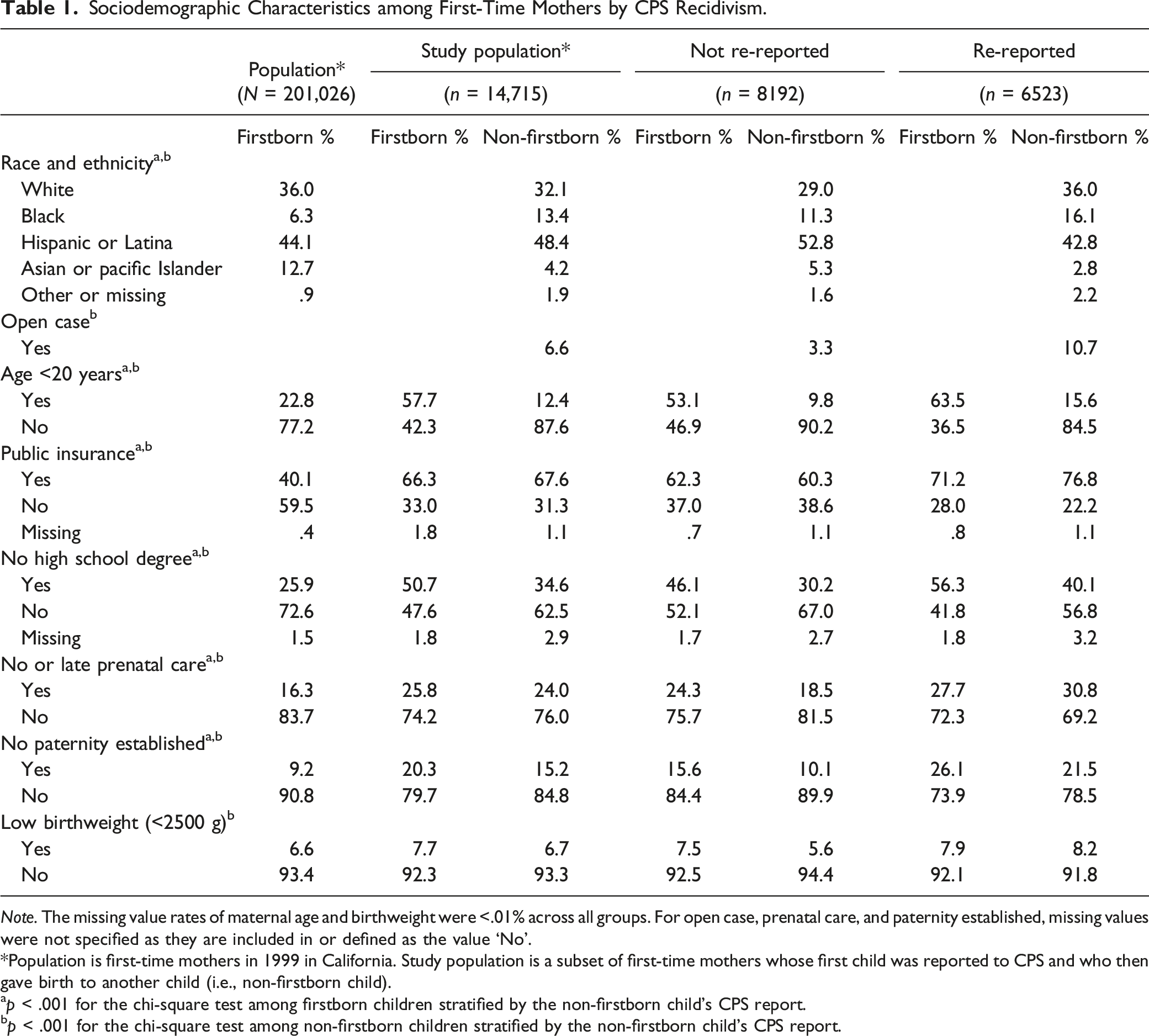
Note. The missing value rates of maternal age and birthweight were <.01% across all groups. For open case, prenatal care, and paternity established, missing values were not specified as they are included in or defined as the value ‘No'.
*Population is first-time mothers in 1999 in California. Study population is a subset of first-time mothers whose first child was reported to CPS and who then gave birth to another child (i.e., non-firstborn child).
ap < .001 for the chi-square test among firstborn children stratified by the non-firstborn child’s CPS report.
bp < .001 for the chi-square test among non-firstborn children stratified by the non-firstborn child’s CPS report.
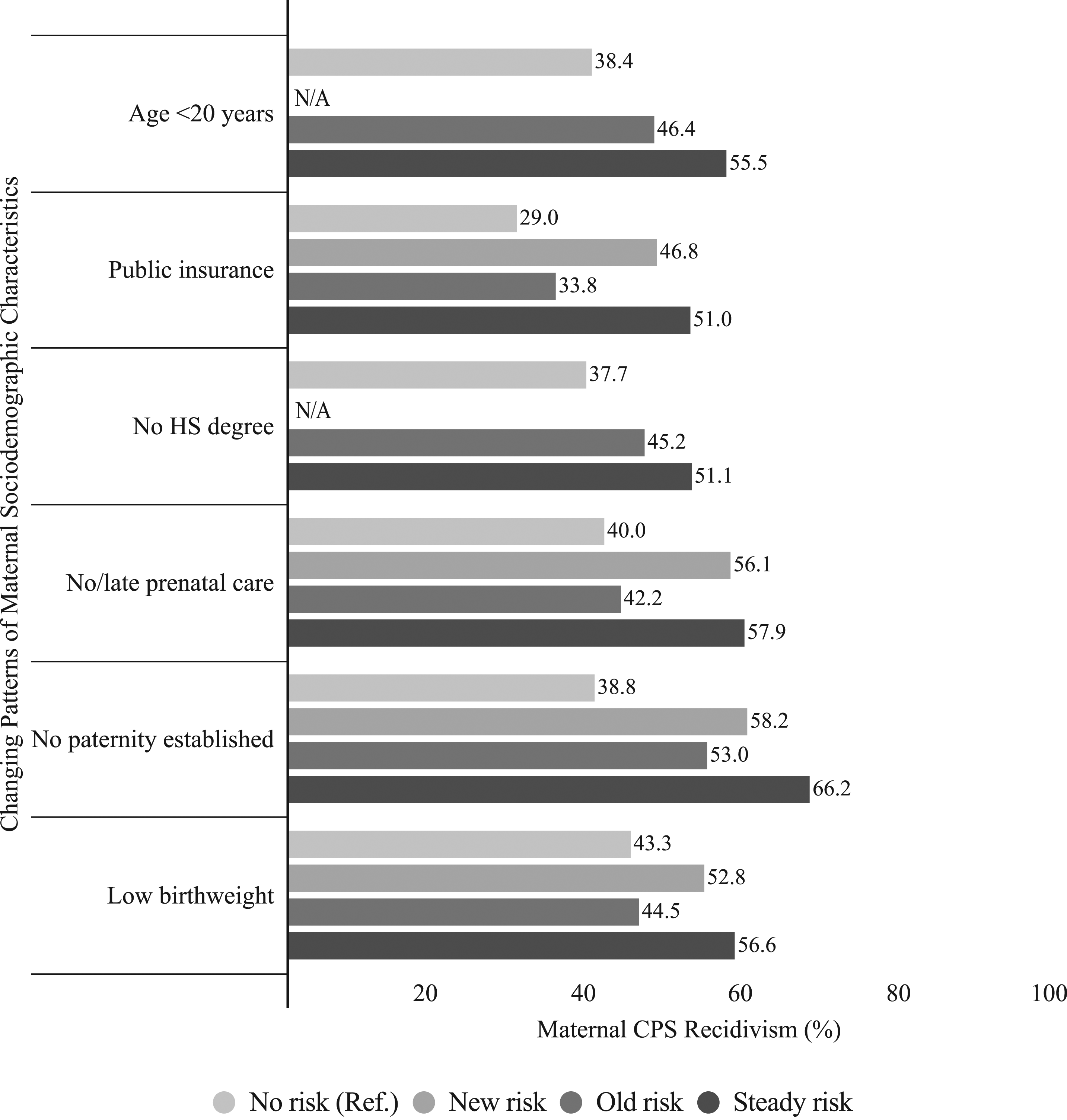
Changing Patterns of Risk Factors
We coded the changing patterns of maternal sociodemographic risk factors documented across firstborn and non-firstborn children’s births. Because each risk factor can be either present (coded as 1) or not (coded as 0) at each birth, we categorized four change patterns: (a) not documented at either birth (“no risk,” the reference value); (b) not documented at the first birth but newly emergent at the non-first birth (“new risk”); (c) present at the first birth but not at the non-first birth (“old risk”); and (d) consistently observed at both births (“steady risk”). For instance, if the payment method for both births was private insurance, this was coded as “no risk” because the risk indicator (paying by public insurance) was not present at either birth. If the first birth was covered by private insurance, but public insurance was documented for the non-first birth, this was coded as “new risk.” Similarly, if the first birth was covered by public insurance, but the non-first birth was covered by private insurance, it was coded as “old risk.” Last, if both births were covered by public insurance, it was coded as “steady risk.” Maternal education and age at birth were coded at three levels because the emergence of “new risk” was not possible for those variables (i.e., mothers could not become younger or lose years of education). Changing patterns of each risk factor were coded as a three- or four-level variable to reflect changes in maternal sociodemographic characteristics across the two births included in the analysis.
Covariates
Additional fields captured at birth were used to adjust for potential variations in CPS recidivism risk based on the mothers’ sociodemographic characteristics. A child’s sex was binarily coded (1 = female, 0 = male). Maternal race and ethnicity were coded based on a maternal race field and a maternal ethnicity field captured in the birth record, with Hispanic ethnicity overriding any identified race (White non-Hispanic [reference value], Black non-Hispanic, Asian or Pacific Islander non-Hispanic, Hispanic or Latina, and other or missing). Mothers whose race and ethnicity were other included those who reported their race and ethnicity as American Native or multiracial. Maternal involvement with an open CPS case at the time of the non-first birth was binarily coded (1 = yes, 0 = no) in an attempt to control for confounding effects that may have emerged because a mother had an already open case for services.
Statistical Analysis
Chi-square tests were conducted to assess differences in the categorical distribution of covariates and maternal sociodemographic characteristics captured at the birth of firstborn and non-firstborn children. Frequencies of maternal sociodemographic change patterns were computed, stratified by maternal CPS recidivism. We then estimated the odds of maternal CPS recidivism and changes in maternal sociodemographic characteristics as documented in birth records. Bivariate logistic regression models for each risk factor were run without and with adjusting for covariates—maternal race and ethnicity, child’s sex, and whether there was an open CPS case at the time of the non-firstborn child’s birth. All statistical analyses were conducted using Stata version 17.0.
Results
Among 512,077 mothers who gave birth in California in 1999, 39.3% (n = 201,026) were first-time mothers, of whom nearly half (44.1%) were Hispanic or Latina and almost a quarter (22.8%) were younger than 20 years old at the time of delivery. When those first-time mothers were followed, we documented that 1 in 10 (n = 21,189) were reported to CPS for alleged maltreatment concerning their firstborn child within 5 years. As shown in Table 1, approximately three quarters of these mothers (n = 14,715) had a subsequent birth (i.e., a non-firstborn child) following the initial report concerning their firstborn child. Almost half (44.3%) of those mothers had a later CPS report regarding the non-firstborn child; among those who were re-reported, 1 in 10 (10.7%) had an open CPS case for services at the time of the non-firstborn child’s birth. All maternal sociodemographic characteristics documented at both births were significantly different by maternal CPS recidivism (p < .05), except for the birthweight of the firstborn child (p = .387).
In Figure 1, we show the percentages of mothers who were re-reported to CPS by an open CPS case at the time of a non-firstborn child’s birth and maternal race and ethnicity. Two thirds of mothers (72.1%) with an open CPS case at the non-firstborn child’s birth were re-reported to CPS, and more than half of White (50.2%) and Black (54.0%) mothers were re-reported to CPS. In Figure 2, we present the percentages of mothers who were re-reported to CPS stratified by the changing patterns of maternal sociodemographic characteristics documented across the two births. Recidivism was highest among mothers with risk factors observed at both births (steady risk), followed by those who faced newly emergent risk factors (new risk). Percentages of maternal CPS recidivism in the study population (N = 14,715). Percentages of maternal CPS recidivism by changing patterns of maternal sociodemographic characteristics across two births.
Bivariate and Multivariate Logistic Regression Models.

Note. No risk (reference category): risk not found at both births; new risk: risk not found at first birth but newly appeared at non-first birth; old risk: risk found at first birth but not at non-first birth; and steady risk: risk found across both births. Bivariate analysis results of covariates: female (OR = .93*, 95% CI [.87, .99]); Black (OR = 1.16**, 95% CI [1.05, 1.30]); Hispanic (OR = .63***, 95% CI [.59, .68]); Asian or Pacific Islander (OR = .35***, 95% CI [.29, .42]); other race and ethnicity (OR = 1.61**, 95% CI [1.23, 2.10]); open case at non-first birth (OR = 3.32***, 95% CI [3.05, 4.07]). Covariates of adjusted bivariate models are provided in Appendix.
*p < .05. **p < .01. ***p < .001.
Discussion
In the current study, we used linked administrative records to identify the population of first-time mothers in 1999 in California (a) whose firstborn child was reported to CPS within 5 years of birth and (b) who gave a subsequent birth after that first report. Following those mothers, we documented CPS reporting and re-reporting and examined variations in the risk of maternal CPS recidivism based on the changing patterns of maternal sociodemographic characteristics across two births. Several significant findings emerged that have implications for our understanding of maltreatment recidivism, patterns of chronic CPS involvement, and the importance of secondary and tertiary prevention.
First, we found that among mothers who gave birth to another child following their firstborn child’s first CPS report, nearly half (44.3%) were re-reported to CPS concerning a non-firstborn child. Our estimate is higher than previous findings from U.S. family-level recidivism studies (Bae et al., 2009; Sledjeski et al., 2008) that documented substantiated re-reports at the family level during a relatively short follow-up period (4–5 years and 18 months, respectively). The differences between those previous estimates and ours likely emerge from several methodological decisions made in the current study, including documenting re-reporting across two children, identifying the true first CPS report of a family regarding a firstborn child, and including any report, regardless of substantiation or disposition. Using a longitudinal population-based Australian dataset, Kisely and colleagues (2021) documented that of 64 firstborn children reported for alleged maltreatment, three quarters of their second-born siblings were also reported. This study adopted similar methodological approaches as ours—following dyads of siblings documenting all maltreatment reports. A primary reason for its significantly higher estimate could be that the follow-up period was almost 2 decades, whereas we restricted our window to 5 years for each child.
Although it is difficult to make a direct comparison with child-level recidivism estimates, our findings align most closely with those of Dakil et al. (2011), Connell et al. (2007), and Thompson and Wiley (2009), who found that approximately 4 in 10 children were re-reported within 5–15 years. Our number is higher than other previous child-level estimates whose follow-up periods were relatively short—from 60 days (Fuller & Wells, 2003) to 45 months (Connell et al., 2007)—but lower than those focused on high-risk populations, such as children receiving financial assistance (Drake et al., 2006) and infants who were initially reported before their first birthday and remained at home (Putnam-Hornstein et al., 2015). Our analysis extends prior work by broadening the focus from individual children to maternal and family units through the linkage of population-based administrative data.
Second, our findings underscore the importance of understanding the varying needs of families that come to the attention of the system at an early stage of family development. Of the mothers whose first child was reported and who then gave birth to another child, the majority (55.7%) were not reported concerning the non-firstborn child during the first 5 years of that child’s life. One explanation is that the risk associated with mothers’ initial reports was more episodic than chronic—and that risk may have been resolved through services offered such that no reports were received for non-firstborn children. A second (and related) explanation is that there is significant noise to reports, with many mothers having an initial encounter with CPS that was unjustified, whereas many other mothers had significant needs that were not properly addressed. For mothers who were re-reported, risk factors associated with their initial CPS reports appeared to be more persistent. We found that mothers who presented the “steady risk” pattern for any risk factors were more likely to be re-reported. Yet of the mothers who were re-reported, only 1 in 10 had a case open for services at the time of the non-firstborn child’s birth. This leads to the question of whether we have failed to accurately assess and meet the complex needs of mothers who may have suffered from persistent risk factors such as mental health or substance use disorders. To reduce CPS recidivism, the varying needs of families should be carefully examined and adequately served from their initial contact with CPS.
Third, our findings suggest that maternal sociodemographic characteristics that may change over time can serve as a proxy for maternal and familial conditions relevant to CPS reporting risk. Aligned with previous literature documenting maternal sociodemographic characteristics as predictors of CPS reporting and re-reporting (Eastman et al., 2016; Putnam-Hornstein & Needell, 2011; Wu et al., 2004), we found that risk factors observed at birth were associated with a heightened risk of CPS reporting. Compared to risk factors present only at the first birth, those that newly emerged at the non-first birth, a more recent event, were more closely associated with increased odds of maternal CPS re-reporting. Additionally, mothers whose births were consistently characterized by the presence of risk factors demonstrated the highest odds of CPS re-reporting, aligning with previous literature that examined the cumulative impact of risk factors on child maltreatment (MacKenzie et al., 2011; Solomon et al., 2016).
For example, mothers whose births were both covered by public insurance were significantly more likely to be re-reported to CPS than mothers who were not on public insurance for both births. Eligibility for public health insurance (a means-tested program) may serve as a proxy for financial resource stability, and the association between maternal financial circumstances and the risk of being reported to CPS has been well established in previous literature (Berger, 2004; Putnam-Hornstein et al., 2021). Similarly, missing paternity was also associated with a significantly heightened risk of CPS reporting across change patterns. Compared to mothers who had paternity established at both births (no risk), those who did not have a partner at either or both births had a heightened risk of CPS recidivism. These findings are consistent with previous literature that found the presence of a non-biologically related male figure in the home may increase the risk of a CPS report (Berger et al., 2009; Zerr et al., 2019) and that documented risk associated with single motherhood (Baldwin et al., 2020).
Some risk factors observed only at the first birth (old risk) did not significantly increase the risk of maternal CPS recidivism, compared to not having the risk factor at either birth (no risk). From the adjusted bivariate analysis, we found that the risk of CPS recidivism among mothers with low birthweight as an old risk (i.e., present at the first birth but not at the non-first birth) was not significantly different than that of mothers who never had the risk. The current analysis only could compare odds of maternal CPS recidivism with changes in maternal sociodemographic characteristics as documented in birth records. Still, our findings indicate that not only are maternal sociodemographic characteristics measured at birth predictive of initial CPS reporting (Baldwin et al., 2020; Berger, 2004; Carter et al., 2016; Parrish et al., 2011) but also patterns of changes in those characteristics are associated with different risks of CPS recidivism.
Limitations
Despite the strengths of this prospective maternal-level analysis of CPS recidivism, limitations must be considered when interpreting findings. First, our estimates of maternal CPS recidivism are specific to maternal reporting and re-reporting dynamics during periods of early childhood parenting only. A focus on this period was intentional, but there is little doubt our recidivism estimates would increase were we to adjust the criteria for a firstborn child’s report or extend the follow-up period for non-firstborn children. Future research should examine maternal recidivism using more inclusive criteria and longer timelines. Second, our state-specific administrative data resulted in an inability to ascertain how many mothers were not captured in the CPS recidivism estimation because they moved out of California after the birth of a non-firstborn child. Likewise, it is unknown to what extent dynamics reported here may generalize to other states. Third, our analysis is limited to a core set of maternal sociodemographic characteristics documented in birth records that are admittedly crude measures of conditions that may contribute to recidivism risk. Although it is a strength that birth records are universally collected in every state, specific insights as to maternal service needs are inherently limited. Fourth, we use the term “CPS reporting” to describe maternal involvement with CPS in reference to children she delivered, regardless of whether she was named in the report as a perpetrator. Thus, the risk of maternal CPS recidivism and related risk factors should be carefully interpreted. Fifth, although county fixed effects were not considered in this study because county information did not meaningfully affect any findings reported or conclusions drawn, additional county analyses could be useful in future research. Finally, our analyses suffered the usual shortcomings of probabilistically linked administrative records, such as potential errors in underlying data sources and lower matching rates for minority groups (Harron et al., 2017).
Implications and Conclusions
In the current study, we documented that nearly half of the mothers in California whose first child was reported for maltreatment had subsequent reports for a later-born child. Most mothers who were re-reported concerning their non-firstborn child did not have an open case at the child’s birth. Mothers who were Black, White, and other races and ethnicities showed higher CPS recidivism rates relative to Hispanic or Latino and Asian or Pacific Islander mothers. Reductions in maternal risk factors between the timing of the first and subsequent births may be associated with mitigated odds of CPS recidivism. Focusing on a high-risk subset of mothers whose first child was reported during the first 5 years, our findings suggest that accurately understanding a family’s needs and how risk and needs may change over time is critical for preventing CPS recidivism. The current analysis calls attention to the importance of assessing repeated CPS involvement at the maternal level and the utility of birth record indicators as proxies of risk that may prove effectual targets of child maltreatment prevention initiatives.
Footnotes
Acknowledgments
The authors wish to acknowledge collaborating colleagues: Huy T. Nghiem, Joseph Magruder, and Stephanie Cuccaro-Alamin assisted with the preparation of data files and Eric Lindberg provided editorial assistance. Although the findings reported and conclusions drawn from these data are solely those of the authors and should not be considered to reflect those of any agency of the California government, this analysis would not be possible without the partnership of the California Department of Social Services and the county child welfare departments, reflecting their ongoing commitment to data-driven program and policy development.
Declaration of Conflicting Interests
The author(s) declared no potential conflicts of interest with respect to the research, authorship, and/or publication of this article.
Funding
The author(s) disclosed receipt of the following financial support for the research, authorship, and/or publication of this article: This analysis was funded by a grant from the Conrad N. Hilton Foundation to the Children’s Data Network at the University of Southern California. The Children’s Data Network is a university–agency data collaborative developed in collaboration with the UC Berkeley California Child Welfare Indicators Project and supported through essential funding support provided by First 5 LA and the Conrad N. Hilton Foundation.

Appendix
Covariates of Adjusted Bivariate Models.
Age <20 years
Public insurance
No HS degree
No or late prenatal care
No paternity established
Low birthweight
OR
95% CI
OR
95% CI
OR
95% CI
OR
95% CI
OR
95% CI
OR
95% CI
Non-firstborn child’s sex
Male (ref.)
Female
.92***
.86, .98
.93***
.86, .99
.93***
.87, .99
.92***
.86, .99
.93***
.86, .99
.92***
0.86, 0.99
Race and ethnicity
White (ref.)
Black
1.08***
.97, 1.21
1.03***
.92, 1.15
1.09***
.98, 1.22
1.14***
1.02, 1.28
.99***
.89, 1.12
1.10***
0.99, 1.23
Hispanic or Latina
.59***
.54, .64
.60***
.52, .61
.53***
.49, .57
.63***
.58, .68
.61***
.56, .66
.63***
0.58, 0.68
Asian or pacific Islander
.36***
.30, .44
.37***
.30, .45
.36***
.30, .44
.34***
.28, .41
.36***
.30, .44
.34***
0.28, 0.41
Other or missing
1.51***
1.13, 2.00
1.42***
1.06, 1.89
1.45***
1.09, 1.93
1.48***
1.11, 1.97
1.48***
1.11, 1.97
1.53***
1.15, 2.03
Open case
No (ref.)
Yes
3.21***
2.76, 3.74
3.05***
2.62, 3.56
3.10***
2.66, 3.61
3.18***
2.73, 3.70
2.98***
2.56, 3.48
3.28***
2.82, 3.81