




Abstract
This study is based on a survey of 364 undergraduate journalism students and looks at how news consumption patterns influence the journalistic role conceptions that students hold. This study finds that students rated the interpreter role as most important. Students who prioritized the interpreter role also tend to get their news from online sources and social media. The implications of these findings on college instruction are also discussed.
Introduction
The news media ecosystem is in a state of change. 1 The public’s changing news consumption patterns 2 are also changing how journalists do their work. 3 Situated at a crossroads, traditional journalists find themselves having to balance traditional journalistic standards that have guided the profession through decades and the novel demands of an evolving news construction model. This is an appropriate time, therefore, to revisit the normative roles that journalists play in society, especially now that transmission of information to mass audiences is no longer a monopoly of traditional news organizations. 4 In a changing news media environment, are the roles that journalists believe they serve in society also changing?
Journalists, however, do not enter a newsroom as an empty slate. They bring with them their own conceptions about the functions of journalism. They get socialized into newsroom practices and priorities but socialization also begins inside the classroom. 5 Therefore, it is worthwhile to explore the journalistic role conceptions of journalism students. Scholars have spent considerable time understanding the role conceptions of journalism students, mostly to examine the impact of college education. 6 But journalism students are news consumers too. Today’s college students consume a small diet of news, but many of them still get exposed to news, even through social media. 7 A survey found that 60 percent of people under the age of twenty-five get news from digital sources. 8 In some classes, journalism students are required to monitor the news for mandatory current events quizzes. Thus, it is important to also look at the influence of news consumption on the journalistic role conceptions of college students, something that many studies focusing on the effects of college instruction on role conceptions have overlooked.
This study will focus on the influence of students’ news consumption patterns on their normative beliefs about the roles that traditional journalists ought to serve. In the following sections, I will demonstrate how research on the role conceptions of journalism students will benefit from filling the gap on the potential influence of students’ exposure to news through traditional and social media channels.
Literature Review
Role Conceptions
The study of journalistic role conceptions assumes that journalists’ role conceptions influence their news outputs. 9 For example, a study involving thirty-six college students found that those who believe journalists should take on an active role tended to write the least objective stories that included analysis and interpretation. 10 The articles analyzed in the study are class-related outputs, however, and did not go through layers of editing, unlike news articles from traditional news media. Traditional journalistic products are rarely individual outputs. As journalists work within an occupational and social setting, 11 their outputs go through layers of editing and what ends up in the news is already an institutional product. Thus, in contrast to earlier assumptions in journalistic role conception research, recent studies found that journalists’ role conceptions are rarely reflected on the news articles they produce. 12
Initial work on journalistic roles had simply classified journalists as either detached observers or involved participants. 13 But subsequent studies of journalistic roles have offered a typology of multiple roles that journalists might embrace at the same time. 14 For example, a national survey of American journalists in the 1980s mapped out the disseminator, interpretative, and adversarial roles. 15 The disseminator role is a neutral and passive role. The interpretative role refers to analyzing the news for readers. The adversarial role refers to being critical of business and political officials. Subsequent surveys of American journalists added the populist mobilizer role, which is consistent with the public journalism movement. 16 This role refers to focusing on the views of ordinary people. Over the years, the interpretative role has emerged as the most popular among American journalists. 17 But how do journalists come to embrace particular roles?
Socialization into Roles
A role is “a composite of occupational tasks and purposes that is widely recognizable and has a stable and enduring form.” 18 For roles to be recognizable and enduring, they must be internalized by more than just one individual. Groups, in whatever form, are therefore breeding grounds of role identification. 19 For example, journalists shape their social identities through their membership and socialization in a news organization. Journalists negotiate between personal roles and what they believe the larger group expects from them.
This process of socialization of journalists is neatly explained by the framework of social identity theory (SIT). 20 Individuals create social identities through inevitable social interactions. 21 As individuals strive to maintain a positive social identity, they tend to align their interests and beliefs with that of their group. In-group members adhere to and prioritize what they perceive to be the rules—or in this study, the roles as well—that guide the group. In journalism, socialization goes through several stages: education and exposure to mass communication, initial communication with members of an organization, initial encounter with the group, and finally the stage of adjustment to the group’s norms and values. 22 This socialization process, as explained by SIT, accounts for how journalists get socialized into journalistic roles: To achieve a positive journalistic identity, journalists try to align their interest and beliefs, including the roles they believe in, with that of their respective organizations. Socialization can range from informal talks with veteran reporters and editors, seeing correction marks in their copies, to formal editorial news conferences. 23 For most journalists, however, socialization begins at the journalism school—the classroom being an important venue for socialization. This is why scholars have also explored the role conceptions that journalism students endorse. 24
Students’ Journalistic Role Conceptions
Many of the early studies about the role conceptions of journalism students found that most journalism students identify with an information-dissemination role. 25 A survey of 337 Norwegian students found that students rated informing about political issues and being a watchdog as the two most important journalistic roles. 26 This identification with the dissemination and watchdog roles also tend to be stable throughout their undergraduate studies. 27 A comparative survey of Spanish and British students also found that students rated getting information to the public quickly as the most important role. 28 Finally, a survey of 1,052 Chinese journalism students also found that Chinese students rated disseminating news quickly as the most important journalistic role. 29 Two of these studies also found significant effects of gender on students’ role conceptions. 30 In this study, I am focusing on journalism students in the United States.
In general, Weaver and Wilhoit 31 argued that journalism education in the United States had not homogenized journalistic conceptions, citing the variance in the journalistic roles that American journalists embrace. But what these findings also showed is that coming into journalism schools, students who are drawn into the profession must already have some perceptions of the roles that journalists play in society. A study found that news-editorial students saw public relations and advertising as less useful and less prestigious than their own course, which is consistent with the pro-journalism bias that many professional journalists have. 32 These attitudes among journalism students are already “firmly in place before they graduate college.” 33 A study also found marginal change in terms of journalistic roles among British college students, concluding that students’ journalism roles appear to have been “deeply internalized before arrival at university.” 34 If these role conceptions of students have been internalized before they came to the university, where did these role conceptions come from?
Studies on journalistic role conceptions among students surprisingly did not explore the effects of news consumption patterns, despite socialization literature that refers to mass communication habits as an important influence. 35 For journalism students, learning about the profession they seek to join might also come in the form of their exposure to the news media. Thus, guided by the SIT, which explains the socialization process, this study argues that news consumption functions as a socialization agent among journalism students and influences their journalistic role conceptions. This study seeks to answer the following questions:
Method
This study is based on an online survey of college students in an introductory journalism class at a large Midwestern journalism school. The class is required for freshman students in the journalism program. Two sections were invited to participate in the survey in exchange for course credit as approved by their professors and the university’s Institutional Review Board (IRB). As the survey was online and could be taken from any computer with Internet access, participation was confidential and offered no risk to the participants. Students also had the option to complete an alternative assignment for the equivalent course credit if they decided not to participate in the survey. No student took this option.
The first survey was conducted at the beginning of the Fall Semester (n = 134). The second survey was conducted at the beginning of the Spring Semester (n = 247). The responses were merged in a single data set because no significant differences were found between the two groups. Outliers and cases with missing values were removed prior to the analysis, leaving the study with a final sample of 364 participants. The average age is 19.76 years (SD = 3.19) and about 68 percent are females.
Variables
Role conceptions
This study adapted and consolidated fifteen statements from previous studies that measured journalistic role conceptions.
36
Two statements were included to reflect an advocacy role based on a previous study of environmental journalists.
37
Thus, participants rated on a 6-point Likert-type scale how much they agreed with each of the seventeen role items (see Table 1). A principal components analysis found four underlying roles, the results of which are presented in the results section to answer
Role Conception Items.
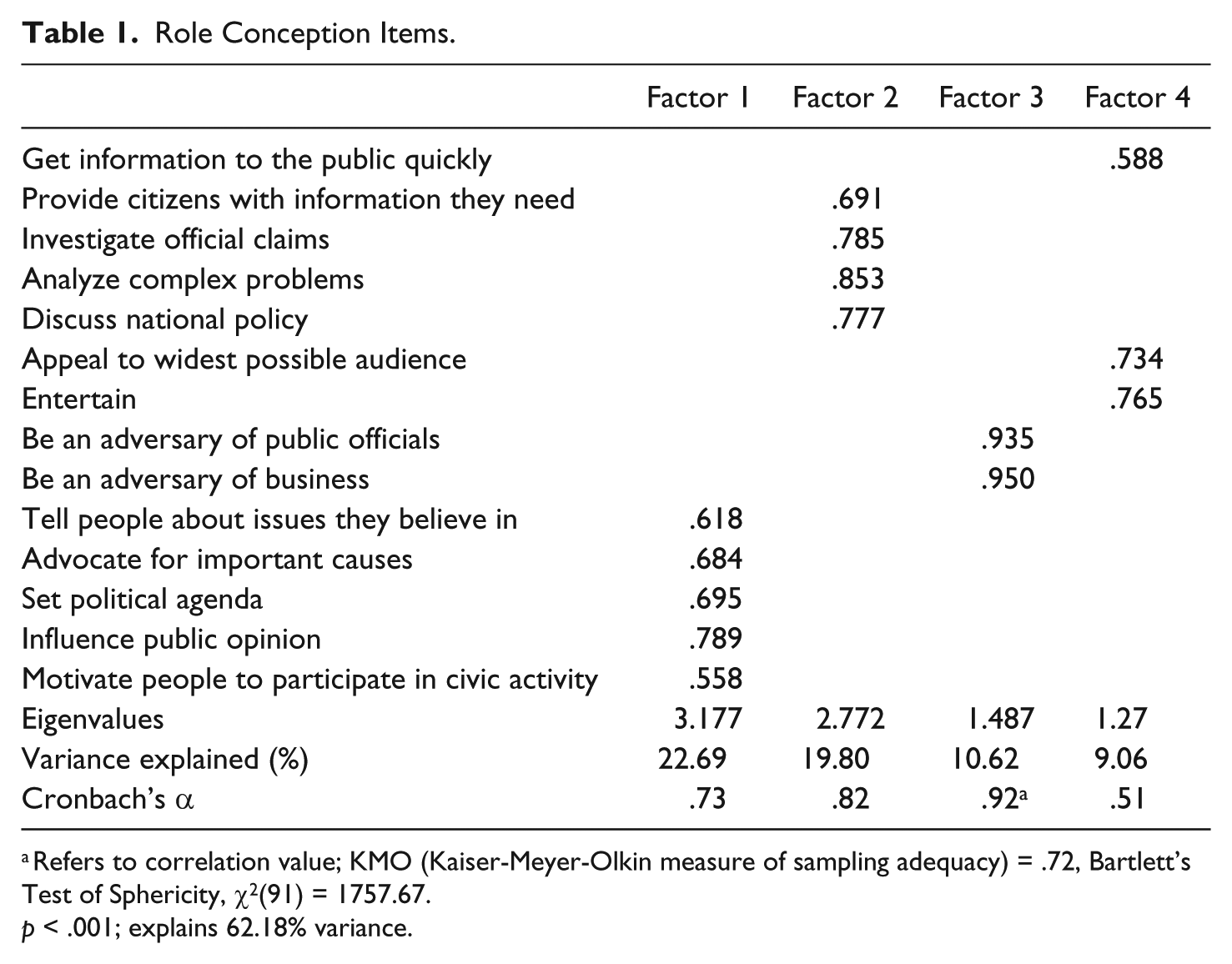
Refers to correlation value; KMO (Kaiser-Meyer-Olkin measure of sampling adequacy) = .72, Bartlett’s Test of Sphericity, χ2(91) = 1757.67.
p < .001; explains 62.18% variance.
Media use
To answer
News Consumption Patterns.

Note. The respondents answered the question: In a typical week, how many days do you (read national newspapers such as . . .)?
Results
Students’ Role Conceptions
Some of the previous studies that looked at journalism students’ role conceptions tested the items individually instead of clustering them into a previous typology of roles. 38 This might be because of some inherent contradictions subsequent studies found, particularly for the disseminator role, over the years. However, it will be worthwhile and interesting to see which items cluster among students, as this analysis might demonstrate how journalism students assess which roles go together, which might also be a reflection of the changing news media ecosystem.
This study ran factor analysis (principal components analysis) using oblique rotation (direct oblimin) to answer
The first factor was similar to the mobilizer role but included the advocacy items added in this study. The first factor includes the following: tell people about issues they believe in, advocate for important causes, set political agenda, influence public opinion, and motivate people to participate in civic activity. The first factor is reliable, with an improved Cronbach’s alpha = .73 after the fifth item was excluded.
The second factor was similar to the interpretative role (which will be referred to as interpreter role henceforth, to be consistent with how the mobilizer and adversarial roles are phrased) and included the following: investigate official claims, analyze complex problems, and discuss national policy. 39 However, the second factor also included a fourth item that traditionally was used to measure the information-dissemination role: provide citizens with the information they need. It is also reliable, Cronbach’s alpha = .82.
The third factor was similar to the adversarial role and included two items: be an adversary of public officials and be an adversary of business. This is consistent with previous studies that used these items to measure the adversarial role. 40 The two items are strongly correlated, r(359) = .92, p < .001.
The fourth factor included items similar to the disseminator role. 41 It included the following items: get information to the public quickly, entertain, and appeal to the widest possible audience. However, the three items did not form a reliable scale (Cronbach’s α = .51), similar to problems with the disseminator role experienced by recent studies on journalistic role conceptions. 42 This could be a reflection of the changing expectations that people have of the news media. In this study, these three statements are tested separately. Three statements that did not load on any factor—avoid stories with unverifiable facts, 43 convey a positive image of political and business leadership, 44 and provide alternative to other media 45 —were excluded in the analysis.
The journalism students in the sample rated the interpreter role as the most important (M = 5.21, SD = 0.76). The role also had the smallest standard deviation, which showed that students tend to agree on the level of its importance. The second most important role was quick information dissemination (M = 5.16, SD = 0.86), followed by appealing to the widest possible audience (M = 4.49, SD = 1.25), providing entertainment (M = 3.95, SD = 1.21), adversarial role (M = 3.47, SD = 1.27), and the mobilizer role (M = 3.26, SD = 1.03; see Table 3).
Journalism Students’ Role Conceptions.
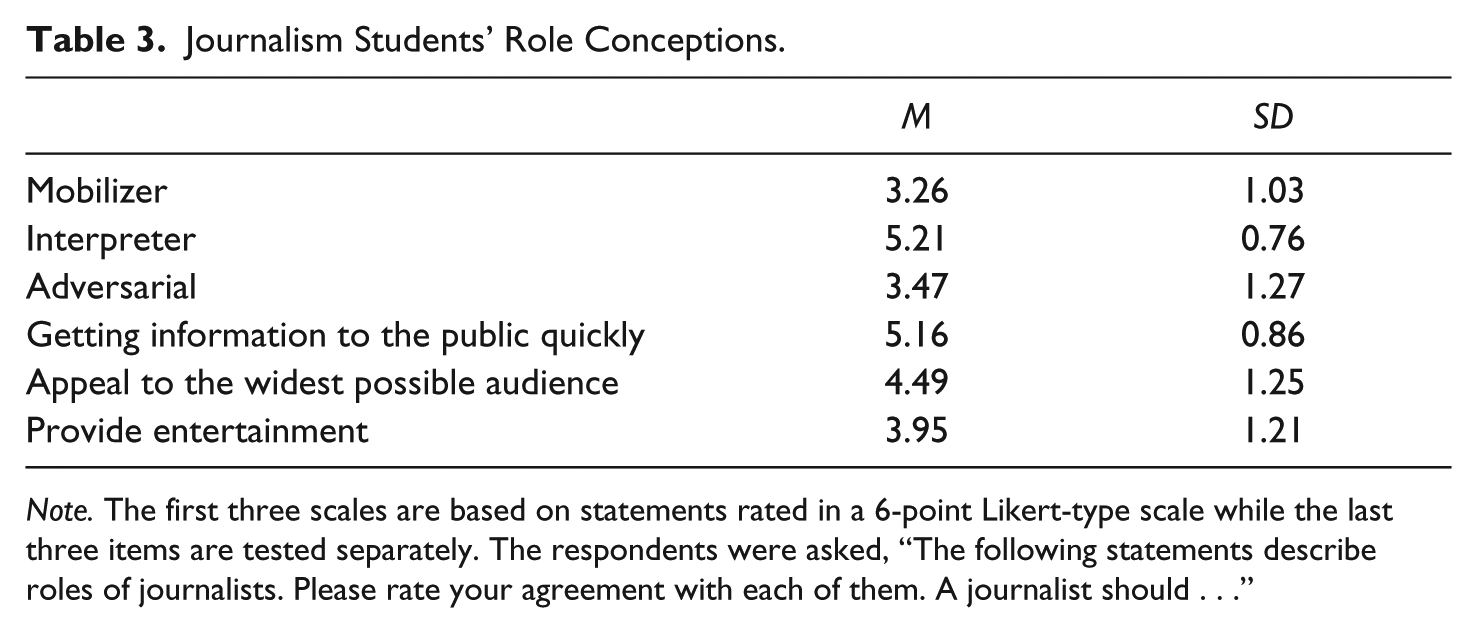
Note. The first three scales are based on statements rated in a 6-point Likert-type scale while the last three items are tested separately. The respondents were asked, “The following statements describe roles of journalists. Please rate your agreement with each of them. A journalist should . . .”
The Influence of News Consumption
Reading newspapers was not correlated with any role conception. Reading news magazines was also not associated with any of the role conceptions. Monitoring news on the radio was correlated with appealing to the widest possible audience, r(355) = .126, p < .05. Watching TV news is likewise correlated with appealing to the widest possible audience, r(355) = .223, p < .01. Online news use is correlated with the interpreter role, r(355) = .147, p < .01. Finally, the use of social media is correlated with both the interpreter role, r(355) = .106, p < .05, and with getting information to the public quickly, r(355) = .253, p < .01 (see Table 4).
Partial Correlations.
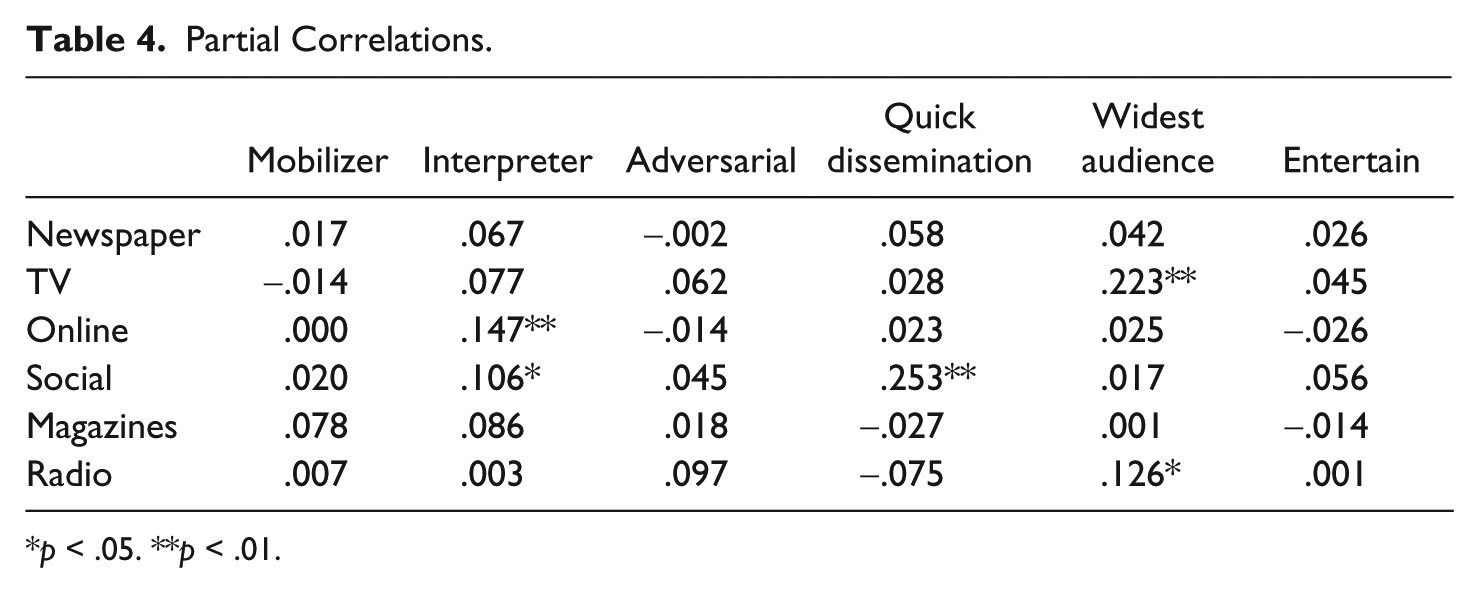
p < .05. **p < .01.
Discussion
News Consumption as a Form of Socialization
Studies that explored influences on the role conceptions of journalism students—resting on the assumption that understanding the role conceptions of future journalists is important not only in assessing the impact of college instruction but also in understanding how journalistic role conceptions come about—highlighted the role of college education, with varying results. However, socialization into journalism does not only happen in school. What students know about journalism can also come from their personal experiences of news consumption. This study controlled for the effect of college instruction by conducting a survey among journalism students at the start of an introductory class. For most of the respondents, the class was their first journalism course in the university. Conducting the survey at the beginning of the semester also ensured that their responses are not influenced by what they would have learned from the course had the survey been conducted later in the semester.
First, the study found that journalism students prioritized the interpreter role, consistent with the prioritization of American professional journalists. 47 Second, those who rated the interpreter role highly are students who tend to get their news from online sources and social media. These sources have become the standards for this demographic. Pew Research reported that 60 percent of young adults get their news from digital sources. 48 It seems that students getting their news from the standard sources for their generation also subscribe to the role conceptions considered standard by professional journalists. Now that more and more journalists have their outputs online, following online news is becoming an important socialization agent for future journalists who belong to an online-dependent demographic.
Social Media and Role Conceptions
The impact of using social media on role conceptions deserves more attention. It is the only news source associated with the role of quick information dissemination. The concept of breaking news was first snatched from newspapers by the live reporting capability of radio and television. Online news also proved to be faster in breaking stories. However, dissemination does not matter unless it is done in platforms where information consumers are available to attend to the disseminated information. Social media such as Facebook and Twitter have become ubiquitous especially among college students, thanks to wireless Internet and mobile phones. It is not surprising, therefore, that these social media platforms are more efficient in reaching young people the soonest, because this demographic is always connected to social media. This is why social media use is associated with believing in the journalistic role of getting information to the public quickly. It also highlights the changing news consumption patterns of the younger population and how this evolving pattern also changes expectations they have of how the news media ought to serve society and through which platform.
This deserves attention from journalism scholars concerned about the impact of the news consumption habits of this generation. To arrest the pattern of a shrinking news audience size that has begun to hurt the economy that sustains news operations, news organizations have started to adjust to the ever-changing news habits of today’s generation. Newsrooms use social media to disseminate and promote their work. However, by following where the young audience goes, the news media are also socializing these young news consumers within the confines of social media. Twitter, for example, is popular for its brevity and speed. How do long-form investigative stories fit into the 140-character limit on Twitter? In adjusting to the habits of young people, the news media are also nurturing them into non-traditional journalism practices. For undergraduate journalism students socialized into this kind of news delivery, this becomes the standard that affects their expectations of how the news media ought to work. In adjusting to the media habits of today’s generation, the news media are also reworking the standards that this audience will use to evaluate them now and maybe in the years to come.
Television and Radio
Television and radio use are both associated with believing in the role of appealing to the widest possible audience. The finding for television fits the idea that it is a generalist medium, as TV stations seek to offer a diversity of content to attract viewership. This evaluation of television is reflected in the finding that students who watch a lot of TV tend to identify with the role of appealing to the widest possible audience. However, the finding for radio presents a puzzle, considering the generally low radio usage among college students and the trend of radio stations becoming more and more specialized. Many radio stations targeting young people tend to market themselves as sources for sports news and analysis. How radio use becomes associated with the idea that journalists should appeal to the widest possible audience is something that future studies can also explore.
Limitations and Future Research
The interpretation of the results should be done within the context of the study’s limitations. First, it relied on a convenience sample of journalism students so that the findings should not be generalized to college students as a population. The sampling strategy, however, enabled the study to control for such variations as age, major, locality, among other things, to focus on the influence of news consumption patterns. Second, the links found between news consumption patterns and journalistic role conceptions are correlational in nature so that while the results demonstrate association between variables, they do not demonstrate causality. Third, the current study, being exploratory in nature, focused only on the relationship between news consumption patterns and the role conceptions of journalism students, finding that other similar studies have already explored the effects of college education, internship, and gender. 49 However, future studies should also explore the effects of other variables. For example, differences in media systems can account for differences in journalistic role conceptions even among college students. 50 Students interest in and orientation to particular forms of mass communication, such as sports reporting, advertising, or public relations, might also be a significant influence on role conceptions especially at the latter stage of college experience, when course majors and degrees have been decided upon. Finally, these role conceptions measured at the early stage of the students’ journalism education might still change. An interesting future study is to look at whether or not during college years the news consumption patterns of students also change, as this current study has found that news consumption patterns exert influence on the role conceptions of journalism students.
Conclusion
The findings point to the usefulness of understanding the changing news consumption patterns of journalism students as one of the agents of their socialization into the profession they are learning more about and are hoping to join. The reliance on online news and social media leads students to believe that journalists, first and foremost, have to serve the interpreter role. As these news consumption patterns are linked to particular beliefs in normative roles for journalists, educators should find ways of introducing students to other roles that students might otherwise ignore or take for granted. For instance, the mobilizer role of providing a voice to ordinary people is not associated with any news media use. It is also ranked the least important. From a normative theory perspective, non-prioritization of mobilizing the public that journalism ought to serve can be problematic. Looking at a more complete picture of what shapes the journalistic role conceptions of journalism students, beyond just the effect of school and demographics to include their news consumption as a socialization agent, can help us design better initiatives to mold more responsible journalists in and out of the classroom.
Footnotes
Declaration of Conflicting Interests
The author(s) declared no potential conflicts of interest with respect to the research, authorship, and/or publication of this article.
Funding
The author(s) received no financial support for the research, authorship, and/or publication of this article.