




Abstract
Media scholars have primarily assessed journalistic role perceptions through the survey method. We propose conceptual and operational definitions for four role enactments observable through content analysis: dissemination, interpretative, adversarial, and mobilization. We also examined how journalistic role enactments in stories related to organization type (nonprofit and for-profit) and reporter workload. Results show that nonprofit journalists were more likely to include interpretation in stories, whereas for-profit journalists were more likely to enact the dissemination and mobilization roles. In addition, as reporter story number increases, it significantly predicted enacting the dissemination role, while suppressing the interpretative role, and especially the adversarial role enactment.
Keywords
Scholars argue that journalists’ conceptions of the role of journalism affect behaviors such as their selection of news sources, frames, and topics (Donsbach, 2008; Weaver, Beam, Brownlee, Voakes, & Wilhoit, 2007; Weaver & Wilhoit, 1986; Zelizer, 2005). Journalistic roles, however, will only matter if they are enacted in the content of the news and opinion pieces those journalists produce.
Researchers identified the varying societal roles of journalists beginning in the 1960s (Cohen, 1963). Investigation into journalistic roles has mostly been accomplished through quantitative surveys (e.g., Cassidy, 2005; Fjaestad & Holmöv, 1976; Johnson & Kelly, 2003; Nah & Chung, 2011), followed by interviews (e.g., Agarwal & Barthel, 2015; Köcher, 1986) and the q-method (e.g., Abel et al., 1998; Giannoulis, Botezagias, & Skanavis, 2010), although the manifestation of those roles in news content has been investigated to a much lesser degree. This empirical gap has led roles scholars to stress the need for systematic content analyses verifying that journalistic role conceptions correlate with corresponding communication behaviors (Wilnat, Weaver, & Choi, 2013). Thus, behavioral measures are necessary to theoretically advance this line of literature because some scholars assume role conceptions “can have a strong influence on journalists’ professional behavior” (Donsbach, 2008, p. 265).
The present research, therefore, aims to advance the roles research stream by identifying particular role enactments that can be observed in news and opinion content. Specifically, we targeted four journalistic role enactments for conceptual and operational refinement. The role enactments focus on content that disseminates information, interprets developments, opposes societal power arrangements, and mobilizes the public. These are frequently referred to as the dissemination role, the interpretation role, the adversary role, and the mobilization role. We carried out a quantitative content analysis of U.S. online news articles to test the reliability and validity of the proposed manifest measures.
Finally, the identification of news organization factors that affect role enactments may enable both individual journalists and news organizations to close the gaps between what they want to do or believe they should do and what actually gets done in news content. The degree to which an organization supports reporters’ roles likely affects their ability to enact their roles in content, according to Shoemaker and Reese’s (2014) hierarchy of influences model. We explicitly explored how reporter story number and organization type (for-profit and nonprofit) influence the journalistic role enactments that are produced by reporters. Prior research showing that these independent variables affect other news content qualities suggests that they may also affect role enactments observable in content. In particular, we expect that the for-profit or nonprofit status of news organizations will affect the goals managers set for reporters, including the roles they are permitted, required, or forbidden to enact. And regardless of the for-profit or nonprofit status of the news organization, the story workload placed on reporters will hypothetically have an impact on the roles they are able to enact as well.
Journalistic Roles
Scholars recognized a major dichotomy in journalistic role conceptions when they identified that some journalists choose to personally interject themselves into a story and others do not. In 1963, Cohen argued that journalists are either neutral observers or participants in the news process. Janowitz (1975) also argued journalists could fall into two role categories: gatekeeper and advocate. The gatekeeper’s function was to process and relay information from sources, while the advocate’s function was to act as a vocal representative on behalf of the public. Johnstone, Slawski, and Bowman (1976) also identified two journalistic roles: neutral and participant. Neutral journalists perceived the role of journalists was to transmit facts, while participant journalists perceived the role was to contextualize information for the public. In their study, journalists were more likely to support the participant role. Several years later, researchers began to see that journalists could also take on an even more active role in solving problems facing society through the adversarial and mobilizing roles. Weaver (1986) followed upon the Johnstone, Slawski, and Bowman works, and created an additional dimension: the adversary role. In a continuation of the survey work on journalists, the populist mobilizer factor was added to this three-factor model, which emerged from the public journalism movement in the 1990s (Weaver et al., 2007; Weaver & Wilhoit, 1996).
Today, research on journalistic roles is one of the most popular streams in journalism scholarship (Blumler & Cushion, 2014). Survey research on U.S. journalists found that they predominantly envision that their role is to interpret and disseminate information, followed by mobilize the public and act as an adversary (Beam, Weaver, & Brownlee, 2009; Zhu, 1990). The dissemination and interpretative role conceptions are also the two most internationally studied roles (Wilnat et al., 2013). In general, journalistic role conceptions stress normative expectations for journalistic behavior, and the enactment of a particular role suggests that news organization and individual support for that role exist. Given their prominence in modern U.S. journalism research, we investigate four major journalistic role enactments (dissemination, interpretative, adversary, mobilization) in this present study.
Role Enactment Conceptualizations
Academics may assume that support for role conceptions leads to individual behaviors, but as Shoemaker and Reese (2014) noted, the behaviors of journalists are shaped and constrained by organizational contexts. Actual evidence that perceived roles are enacted, however, can only be found by conducting content analyses or directly observing organizational behaviors. Journalism scholars refer to these behavioral variables as either role enactment or role performance, neither of which has been explicitly conceptually defined in the literature (Mellado, 2014; Mellado & Dalen, 2014; Mellado & Lagos, 2014; Tandoc, Hellmueller, & Vos, 2013). We selected journalistic role enactments as the label. Role performance appears to concentrate on the perceived competence of individuals carrying out certain tasks and responsibilities within a role that serves an organization (Bahr, Chappell, & Leigh, 1983; Chugtai, 2008; Demerouti, 2006; Griffin, Neal, & Parker, 2007). We define journalistic role enactments as the result of behaviors that journalists engage in on behalf of organization and/or professional norms or standards that serve an external audience.
The goal of the present examination is to advance theory by measuring whether journalists enact four particular roles by observing their manifestation in content output. Our effort picks up where survey research leaves off. Often in such survey research, scholars apply the factor-analytic approach to identify dimensions of self-report measures, but researchers do not often conceptually define concepts representing specific subscales. Conceptualization prior to the operationalization in the explication process is helpful in establishing the validity of proposed measures (Simms, 2008). Overall, it appears that scholars interpret roles based on what journalists tell audiences about the purpose of their work, their sourcing practices, and the extent to which they interject themselves into a story. We therefore identified the themes of story purpose, sourcing practices, and journalistic opinion after reviewing theoretical roots of each dimension. We reengaged the explication process because existing content measures did not meet the manifest level of measurement reliability required for rigorous, replicable content analysis research. We summarize in Table 1 how we measured these dimensions in the present study. Following a historical review of role conceptions’ work, we reviewed and defined the dissemination, interpretative, adversarial, and mobilization dimensions of the journalistic role enactment construct.
Conceptualization and Operationalization of Journalistic Role Enactments.

Dissemination role enactment
Researchers claim this particular role reflects the goal of dispersing information to the public quickly while avoiding publishing stories containing unverified and unattributed source information (Fahy & Nisbet, 2011). Dissemination of information reflects a concentration on accuracy, facts, events, and spot news. Dissemination articles include the who, what, when, and where, and do not substantially address the how or why (Culbertson, 1981; Fink & Schudson, 2014; Salgado & Strömbäck, 2011). The role of the journalist is to present facts in objective manner. In the present study, dissemination role enactment is defined as “verifiable content that mainly includes facts presented in a impartial, straightforward style” based on an edited version of Patterson’s (2000) definition of descriptive reporting.
Interpretative role enactment
Interpretative journalism involves the journalist going beyond disseminating factual information by providing the public with stories that include detailed explanations, context, and meaning (Culbertson, 1981; Weaver et al., 2007). In other words, journalists emphasize the how and/or why of news developments. The interpretative role received the greatest support by U.S. journalists (Tandoc & Takahashi, 2014; Weaver et al., 2007). Fink and Schudson (2014) argued contextual reporting has grown based on the results of a study of three U.S. newspaper’s front pages between 1955 and 2003. In their research, they defined contextual reporting as an article that features sources and information that is explanatory and ongoing such as a trend story. We believe that journalists can present such content both objectively and subjectively because existing literature supports both approaches. In the present study, we use a slightly modified version of Salgado and Strömbäck’s (2011) proposed definition of interpretative journalism to conceptually define the interpretive role enactment as “content that includes reporting beyond descriptive, fact-focused, and source-driven journalism, which is characterized by journalistic explanations or contextualizations.”
Adversarial role enactment
Adversarial journalists initiate opposition and perceive it as their duty to be skeptical of public officials and special interests. Adversarial news content often features a reporter identifying a problem including the parties responsible for the problem (Eriksson & Östman, 2013). Historically, journalistic voice is an integral element in delineating role conceptions. In this enactment, conflict is the key, but there is also an emphasis on journalists’ resistance to people in positions of authority. Journalists who enact this role challenge the integrity or credibility of individuals or groups in an attempt to hold them accountable (Blumler & Gurevitch, 1995; Lachmann, 1986; Stocking & Holstein, 2009). As a result, we expect that such reporters will include their viewpoints in articles. In this role, the journalist critiques at least one person or a policy, which may have professional or personal consequences (Nygren & Stigbrand, 2014). Traditionally, journalistic coverage of societal conflict emphasizes the citing of major sources in such conflict. Adversarial reporting, however, goes one step beyond in which the reporter is explicitly one of the conflict protagonists. This conceptualization of adversarial role enactment may miss some instances in which the reporter acts through surrogate sources. However, the reporter’s own voice in a news or opinion piece is an unmistakable indicator of adversarial reporting, and the narrowness of this definition enhances its validity. Although the conflict frame (citing opposing sources) is common in American journalism, Weaver and colleagues found that the more aggressive, adversarial function received a small amount of endorsement by U.S. journalists, perhaps because most journalists do not support a more assertive, hostile approach to journalism (Henningham, 1998; Himelboim & Limor, 2011; Janowitz, 1975; Neuman, Just, & Crigler, 1992). In this study, adversarial role enactment is therefore conceptualized as content in which the author identifies a specific target such as government officials, union bosses, businesses, industries, and so on, as being responsible for the cause or continuation of a problem, and in which the author’s voice is clearly identifiable.
Mobilizing role enactment
A mobilizing reporter seeks to engage readers with their community (Weaver et al., 2007). Gans (1998) argued the availability of information does not lead to the empowerment of citizens. He contended that journalists should play a more active role to create change within their community. In 1976, Fjaestad and Holmöv also identified mobilization as an important role of journalism because the inclusion of such information enlightens users on how to act on issues. Journalists or sources seek to communicate how their readers can act on a community or policy issue. Overall, endorsement for the role is still low among American news reporters in comparison with the interpretative and dissemination roles (Weaver et al., 2007; Weaver & Wilhoit, 1996). In this study, the mobilization role enactment is similarly conceptualized as “content that allows people to act on attitudes they already possess” based on Lemert, Mitzman, Seither, Cook, and Hackett’s (1977) definition.
Journalistic Role Enactments as Behaviors
Many roles scholars interpret roles as expectations of occupational norms (Blumler & Cushion, 2014; Donsbach, 2008; Kahn, Wolfe, Quinn, & Snoek, 1964; Katz & Kahn, 1966). For example, if the organization or journalist stresses that the role of a journalist is to be objective and detached from the subject of interest, the majority of content from that journalist should reflect that perception, and similarly for the other roles studied. Indeed, some scholars have found that journalist role conceptions have notable explanatory power. Skovsgaard, Albaek, Bro, and de Vreese (2013) discovered that support for role conceptions predicted the likelihood journalists implemented the objectivity norm. In addition, Starck and Soloski (1977) found participant role conceptions predicted greater interpretation in articles when compared with neutral reporters.
Systematic quantitative content analyses can help to more precisely determine to what extent roles are enacted in news content. Content analysis is a research technique that deals with manifest content of communication. Manifest variables are developed to achieve acceptable levels of reliability among coders and future coders (Berelson, 1952; Riffe, Lacy, & Fico, 2014). The operational development of manifest-level measures of role enactments is a critical next step taken in the present research to assist in future replication efforts in this research stream.
Content Studies of Role Enactments
Content analyses examining role enactments are few, and thus, studies supply little guidance for future research (Himelboim & Limor, 2011; Mellado, 2014; Mellado & Dalen, 2014; Mellado & Lagos, 2014; Tandoc et al., 2013; Weaver & Wilhoit, 1996; Zhu, 1991). In particular, we found that replication of these studies is inappropriate or challenging because (a) most content analytic work does not include clear operational definitions for items; (b) many items are inappropriate because they are topic specific (e.g., codes of ethics, international trade); (c) no conceptual definitions of the overarching construct or the dimensions are provided for guidance; (d) latent survey items are used to measure manifest content variables; (e) some index items do not appear to be mutually exclusive within a dimension; (f) authors focus on dimensions not included in the present study; (g) many items are worded subjectively (e.g., “The story fairly expresses the position of each side” and “Accuracy of news coverage”); (h) only one set of authors provided intercoder reliability information for all variables (Mellado, 2011), which is a necessity in scientific content research; and, finally, (i) the validity of the index dimensions is questionable. Index development for role enactments in content differs from the scale development process. Researchers should justify how each manifest item is theoretically unique and how all index items within each dimension validly represent the breadth of the role enactment concept. In addition, factor analysis has been argued to be an inappropriate statistical technique for index development because manifest items are not expected to correlate to form each construct dimension (Diamantopoulos, 1999, 2011; Diamantopoulos & Winklhofer, 2001; Jarvis, Mackenzie, & Podsakoff, 2003). The goal of this study is to follow scientific theory building procedures to develop the dissemination, interpretative, adversarial, and mobilizing dimensions that meet rigorous conceptual and operational standards required for replication across content studies.
Organizational Characteristics
The most supported role by journalists illuminated in survey studies does not necessarily mean it will exist to a great degree in the content they produce. Organizational and media routine factors play a significant role in journalists’ autonomy to enact certain roles. Research has explicitly linked organization characteristics to role prescriptions by journalists. For example, Akhavan-Majid and Boudreau (1995) showed organizational size was a major predictor of activist role conceptions, and Mellado (2011) found medium, ownership, and geographic focus had a notable impact on most role conceptions. However, other scholars found that organizational (i.e. print vs. broadcast) factors did not explain variations in role conceptions (Zhu, Weaver, Lo, Chen, & Wu, 1997).
Shoemaker and Reese (2014) argued journalistic role conceptions have a significant influence on how stories are packaged for their perceived audiences, yet their hierarchal model of influences posits that organizational-level variables are more influential than journalists’ individual-level power. The present study examined how organization type and reporter story number (an organizational resource measure) predicted variations in journalistic role enactments. The assumption is that individuals’ perceptions ultimately have an impact on content. Yet journalists perceive that organizations do not always align with their view of the role of journalism (Tandoc & Takahashi, 2014). Similarly, consistent with Shoemaker and Reese’s model, reporters are constrained by time, expectations, and resources that diminish their autonomy and ability to enact particular roles (Ashforth & Mael, 1989; Beam et al., 2009; Hall, Schneider, & Nygren, 1970).
Organization type
Shoemaker and Reese (2014) argued that individuals are subordinated to an organization, its structure, and its goals, which ultimately affect content. Research supports that news professionals working in a newsroom often modify their behavior to meet the organizational need for profit, even when those values conflict with their own personal values (Breed, 1955; Epstein, 1973).
The present study examined how organization type (nonprofit or for-profit) related to variations in journalistic role enactments. Konieczna and Robinson (2014) stated the need for more research on nonprofit news organizations to articulate their specific contributions: “We call on future researchers to observe, through more comprehensive content/discourse analysis methods, what these organizations actually do” (p. 984).
Hypothetically, nonprofit journalists could be expected to produce journalism reflecting roles that are different in type and frequency in comparison with for-profit journalists. Nonprofit journalists say they are committed to filling particular voids such as engaging citizens, identifying community solutions, and empowering readers (Ferrucci, 2014; Konieczna & Robinson, 2014). Journalistic role enactments that represent greater role freedom for individual journalists include the interpretative, adversarial, and mobilization roles, and nonprofit organizations may enable the enactment of these roles. We examined the nonprofit mission statements of the sampled organizations because principles are broader guides than roles for behavior. Based on observations of the mission statements and existing research, the nonprofit organizations seemed committed to providing information that increases civic participation and covers local people and issues (see Konieczna, 2014; MinnPost, n.d.; New Haven Independent, n.d.; Seattle Crosscut, n.d.; Shaver, 2010; The Texas Tribune, n.d.; Voice of San Diego, n.d.).
Academic studies on nonprofit digital journalists support the assumption that they differ from for-profit journalists. In survey research, scholars are just recently investigating the perceived roles of non-traditional journalists (e.g., independent, alternative, nonprofit) with results showing support for the adversarial and interpretative roles, and mixed support for the mobilizer role. For example, Forde (1997) found the Australian independent and alternative press perceived that journalism had several roles in society, including giving context to news, motivating readers to take political action, and providing a forum for minority groups. Furthermore, Agarwal and Barthel (2015) compared perceived roles of journalists based on responses from 14 traditional (e.g., Washington Post, Boston Globe, Time, Harper’s) and contemporary nonprofit (ProPublica, The Center for Public Integrity, Center for Investigative) and for-profit (Gawker, Slate, Salon, Huffington Post) journalists. Contemporary journalists expressed support for the adversarial role and dismissed the disseminator and populist mobilizer roles, while the interviewed traditional journalists endorsed the disseminator and mobilizer functions. The research line examining content differences in public versus private broadcasting content provides additional evidence. Overall, these studies show that nonprofit television organizations create more interpretative, diverse, and slanted journalistic content than for-profit organizations (Groseclose & Milyo, 2005; Kerbel, Apee, & Ross, 2000; Zeldes, Fico, & Diddi, 2012). Thus, nonprofit journalists might more likely produce content reflecting the interpretation and adversarial roles, whereas for-profit journalists may more likely enact the dissemination role.
Reporter story number
Reporter story number can be a measure of organizational resources. Resources hypothetically influence the likelihood an organization will allow reporters to enact the interpretative role because such stories require time to critically analyze the implications of an issue. The higher the number of stories per reporter, the less likely he or she will be able to publish comprehensive news stories. Overall, it is plausible that reporters who must write more stories under daily deadline pressures will likely cover a topic differently than reporters who face fewer production pressures. One study showed that the simple number of stories a reporter wrote on a conflict topic predicted increased story imbalance (Fico & Balog, 2003). Authors have also claimed smaller publication editors are more likely to support activist values based on a statistical analysis of individual role items (Akhavan-Majid & Boudreau, 1995). Our underlying assumption is that reporters with more time will produce more comprehensive and critical coverage.
Research Questions
Roles practiced by reporters may reflect organizational mandates for roles and resources enabling roles. The assumptions made explicit above suggest that it is worthwhile to explore how reporter story production and organization type relate to the adoption of often-studied roles in journalism research. In particular, then, the following research questions were posited:
Method
Sample and Sampling Procedure
This study explored these research questions through a quantitative content analysis of news stories published online by five nonprofit news websites and five for-profit news websites. This study defines nonprofit news sites as websites that (a) have 501c status; (b) pay journalists a salary to cover the market; (c) have a geographic market larger than a neighborhood and includes a city, metro, or regional area; (d) have general community news and information and are not a niche site limited to a few subjects, such as politics, sports, or crime; and (e) post new information regularly. Sites matching those criteria were identified through listings on websites. 1
The initial list consisted of eight nonprofit sites in eight cities. However, three were subsequently dropped due to infrequent publication, a merger, and closure. The remaining professional nonprofit journalism sites consisted of the following five websites: Crosscut (Seattle, WA), MinnPost (Minneapolis, MN), Voice of San Diego (San Diego, CA), New Haven Independent (New Haven, CT), and Texas Tribune (Austin, TX).
To allow comparison between nonprofit and for-profit news websites, the online venue published by the for-profit newspaper with the largest circulation in the five respective geographic markets was chosen for analysis (Alliance for Audited Media, 2013). The selected newspaper websites were Times (Seattle, WA), Star Tribune (Minneapolis, MN), UT San Diego (San Diego, CA), Register (New Haven, CT), and American Statesman (Austin, TX).
As a second step, a randomly constructed week of May 2013 was created for all markets under investigation (Riffe, Lacy, & Fico, 2005; Riffe et al., 2014). A constructed week is a randomly selected Monday, Tuesday, Wednesday, and so on, within a time period. On those days, all website content was collected by accessing their Rich Site Summary (RSS) feeds using the program Shrook and storing the links to the published articles in a Microsoft Excel file. The stories were manually downloaded at a later date for coding. The study targeted how journalists covered local news. Therefore, we excluded international and national news stories from analysis. In addition, we excluded sports stories because sports journalists often work in a separate newsroom unit and abide by different reporting norms.
The story could be a text article, a video piece, graphic, or a combination of media focused on one story topic. For example, unique sources were coded in both the text and video stories if the content was presented as a topical package. Often, text stories are accompanied by a graphic or a video reflecting one overall story. The initial sample consisted of 2,275 stories, with the for-profit sites accounting for a majority of the content. To allow better comparison between sites, a random subsample was selected from the for-profit sites. The sample consisted of 712 stories, with 59% of the content coming from for-profit sites. However, the local RSS feeds included many duplicate and sports news stories. As a result, the remaining number was reduced to 491 news stories. And based on further inspection, we found that 64 news stories had a byline of staff. We excluded them from our analysis reducing the number to 427 because we were interested in the number of stories per individual reporter.
Journalistic Role Enactments
We designed observable measures by reviewing scientific literature, seeking expert feedback, and pretesting the variables. In quantitative content analysis research, scholars seek to operationalize any latent variable at a more manifest level (Riffe et al., 2014). The literature revealed several broad themes across role dimensions. As a result, we identified role enactments in content based on combinations of three indicators discussed above that can be observable in content: story purpose, the kinds of sources used, and the presence or absence of the journalist’s own voice. Story purpose in journalism can be broadly categorized into description (who, what, when, where) and explanation (the why and how news values). The latter category reflects the normatively appreciated role of interpretation, while dissemination reflects the first category. Sourcing practices characterize the importance of the topic and the philosophical stance of the journalist or organization. In the present study, a source was a person, organization, or document that provides attributed information cited in an article or unit. For example, incorporating quotes from a public speech represents low source effort, whereas accessing and analyzing databases requires more effort. Journalists following the disseminator philosophy believe that all sources should be identified so that readers can assess the credibility of the information, whereas adversarial journalists may more often use confidential or anonymous sources. Journalist opinion was defined and operationalized as a unit that included the manifest opinion of the reporter or the organization. The endorsement of journalistic opinion in news has historically helped researchers delineate roles. The most autonomy an organization can give a journalist is the freedom to inject opinion into news coverage and take sides on an issue. In this study, such freedom is most likely associated with the adversarial role. Table 1 shows how these factors are used together to place stories in each of the four role enactments.
Certainly, it should be noted that journalists, based on survey work, support multiple roles. For some of the roles, it is possible that journalists can enact multiple roles within a story, but some roles are incompatible within an individual news unit. An article must meet all three criteria before it can be coded as present for each role enactment. For example, a story would be coded as disseminator if it contained verifiable information, focused primarily on transmitting details of an event, and included all transparent sources. We designed the disseminator role based on its conceptualization and prior research on news dissemination. Logically, the disseminator role enactment can be combined with the mobilizing role, but not with the interpretative and adversarial roles. It is also possible that a news unit could be coded as interpretative, adversarial, and mobilizing because we treated each as a separate variable. However, we do not expect that many stories will be categorized under multiple role enactments (see Table 1).
Reporter Story Number
Story number reflects the human resources available at the organizational level within 1 sampled-month time period. The total number of news stories published by each individual reporter was counted to measure reporters’ workloads. The reporter’s name for each story was manually entered into the spreadsheet, and a separate variable was created calculating the total number of stories per reporter.
Intercoder Reliability
The measurement refinement process took approximately 6 months. Five coders pretested content was not included within the sample to assess the measures. We made adjustments to measures to improve clarity. Following the pretests and expert feedback, one doctoral student author and one faculty author coded 12% of a randomly sampled set of news stories for the purposes of intercoder reliability. We applied Riffe et al.’s (2014) procedure to compute the test sample size for intercoder reliability. In addition, they recommend running multiple statistics to test the reliability of measures due to the intellectual debates associated with the appropriateness of certain reliability statistics. Krippendorff’s alpha, Cohen’s kappa, and Scott’s pi were used for reliability analyses for the nominal-level variables. Reliability for the variables ranged from 0.78 to 1.0. 2
Results
We performed four logistic regressions to assess the impact of organization type and reporter story number on the dichotomous variables. As shown in Table 2, both independent variables made a unique statistically significant contribution to the model. Addressing
Organization Type and Reporter Story Number Explaining Journalistic Role Enactments.

Note. Four logistic regressions. Organization type (0 = nonprofit, 1 = for-profit). OR = odds ratio.
p < .05. **p < .01. ***p < .001. 4
Discussion
The content measures developed for this study offer an alternative way of assessing roles that is grounded in observable behaviors. The advancement of roles’ research rests on the assumption that scholars can examine communication behaviors. This content analysis targeted the dissemination, interpretation, adversarial, and mobilization role enactments for explication. Role enactment measures can also aid scholars in addressing present assumptions about alternative forms of journalism and their specific contributions to public intelligence and good.
Content analysis research can also help to gauge the extent to which there is conformity between role conceptions and role enactments. Obviously, the convergence of the two would mean that conceptions are supported. It is important to identify whether role ideals guide journalists’ behavior. Although interpretation is the most valued role in American journalism (Weaver et al., 2007; Weaver & Wilhoit, 1996), it appeared in a little more than a third (34.4%) of the stories (see Table 3). Dissemination was the most practiced role (59.3%), followed by the mobilization (7.3%) and adversarial (3.0%) role enactments. In other words, journalistic support for a role does not often equate to behavior. Shoemaker and Reese’s (2014) model posits organizational-level constraints shape the work of individual journalists. Such research may have the practical benefit of helping both journalists and news consumers to have more realistic expectations of news work.
Descriptive Data of Journalistic Role Enactments and Weaver et al.’s Role Conceptions.
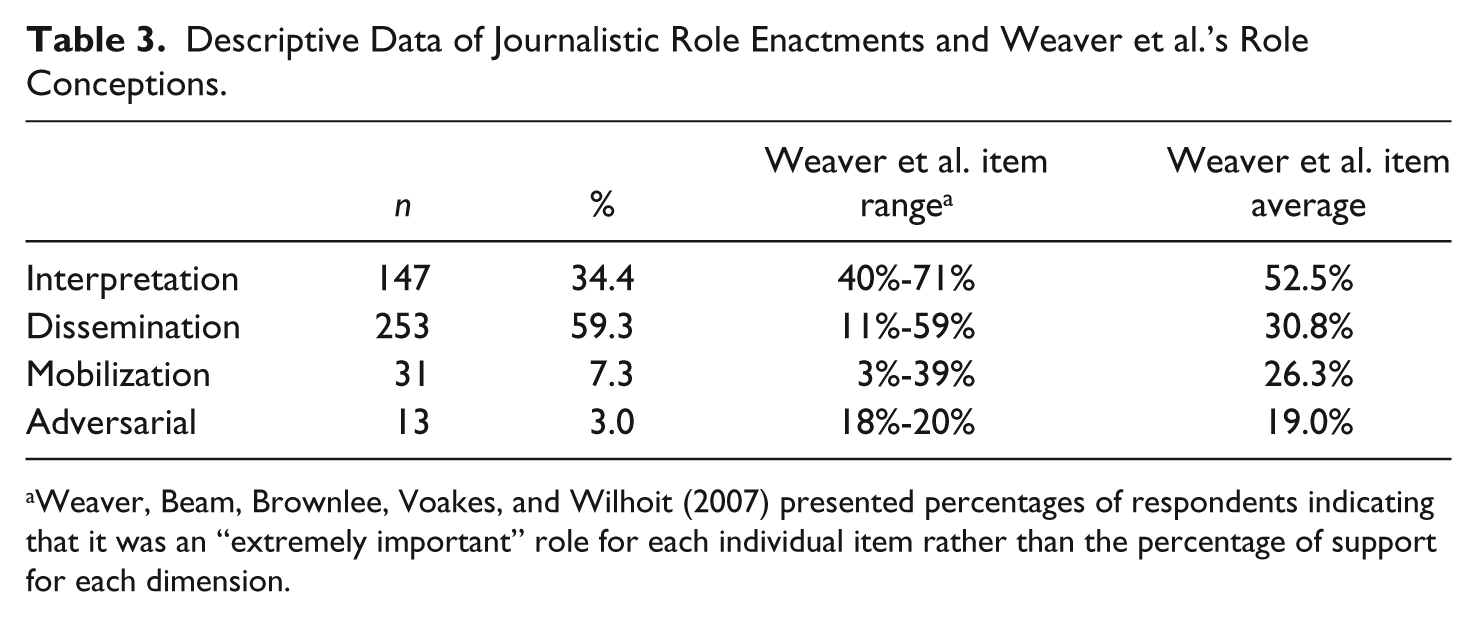
Weaver, Beam, Brownlee, Voakes, and Wilhoit (2007) presented percentages of respondents indicating that it was an “extremely important” role for each individual item rather than the percentage of support for each dimension.
Certainly, the results of the present research highlight the need to have more modest expectations for nonprofit journalists. Nonprofit journalists were thought to enact a greater diversity of roles in comparison with for-profit journalists because of their assumed autonomy, mission statements, and previous research. The category of nonprofit, however, only related to interpretative behaviors, and for-profit predicted the mobilization and dissemination role enactments. In addition, as the number of stories per reporter increased, the odds that the interpretative and adversarial roles were enacted decreased and the odds for the dissemination role enactment increased, regardless of the type of news organization.
The argument has been that nonprofit journalism provides a public service different from mainstream news media organizations. Based on these behavioral measures, nonprofit journalists may have taken on a narrower role of interpretative sense makers for their communities. Nonprofit news organizations may be positioning themselves as local experts and educators rather than organizations that empower people to act within their community. Altogether, these journalists were not more likely to champion causes or mobilize readers for community purposes. Possibly, the extent to which it can be different may be restricted when nonprofit news organizations employ traditional news journalists (Carpenter, Nah, & Chung, 2015; Konieczna, 2014; Nee, 2014). For-profit journalists were more likely to enact the mobilization and dissemination roles. From a normative perspective, the availability of mobilizing information was intended to show readers how they can participate in their community. However, coder observations suggest that the majority of this type of information was provided in entertainment rather than public affairs articles, which has been found in previous research (Lemert et al., 1977). In addition, objectivity has been a hallmark of journalism since the 20th century, and as expected, for-profit journalists were more likely to engage in a detached form of journalism by enacting the dissemination role.
Resources restrict reporters’ ability to cover stories. As reporter story number increased, the greater the likelihood that stories included the straight reporting of events. Moreover, increases in reporter story number decreased the odds that the organization produced stories reflecting the interpretative role. Interestingly, lighter reporter workloads may empower individual journalists to represent citizens and explain issues for them in stories. Role scholars Johnstone et al. (1976) argued that deadlines push journalists to cover and write stories in a straight, more restrictive manner, rather than interpretive, leaving many journalists to feel dissatisfaction with their job because of their lack of creative freedom. This study demonstrates how organizational resources can result in a different type of journalism. If story numbers per reporter increase, the public may more likely encounter a more formulaic approach to journalism based on these results. And when reporters have more time to focus on a story, they may more likely produce stories that challenge the status quo and explain how issues affect their readers.
Conclusion
Certainly, future research must further examine the validity of these study measures on similar and alternative types of content. The large numbers of role dimensions that exist in academic research reflect the range of accepted behaviors. Scholars could create additional role enactment measures using the three-part framework used in this study. To test assumptions about role conceptions, researchers could survey reporters to examine the degree to which they identify with a role and to what extent it is a predictor of their individual behavior. Finally, measures such as role identity salience, organizational commitment, or organizational identification variables have been found to be predictors of conceptions and behaviors (Ashforth & Mael, 1989). In particular, we encourage the examination of factors that narrow or widen the gap between the roles journalists believe they should play and the ones that they can enact.
The shifting of the methodological lens in roles research may assist in the theoretical advancement of one of the most studied lines of research in journalism. The slow increase of content studies of role enactments highlights new puzzles. For example, conceptual definitions are rarely provided, which makes theoretical and operational extensions difficult. This study presents operational definitions rooted in theoretical logic. However, our foundation is dependent upon assumptions (as is much research). For instance, the adversarial role enactment could consist of quoting two oppositional sources and may not include journalist’ opinion. The literature review guided our interpretations of role enactments.
We hope that scholars can further explore the usefulness and validity of such variables. This work highlighted both the potential and challenges of such endeavors. We believe that such explication efforts will serve practitioners and scholars in determining the extent to which journalists’ identity can be represented in their work.
Footnotes
Declaration of Conflicting Interests
The author(s) declared no potential conflicts of interest with respect to the research, authorship, and/or publication of this article.
Funding
The author(s) received no financial support for the research, authorship, and/or publication of this article.