




Abstract
This study examines students’ motives for communicating with their instructors when the instructor exhibits inappropriate or unprofessional online behavior. To understand the relationship between what we call instructors’ digital expectancy violations and students’ motives for communicating with instructors, students’ levels of task, social, and physical attraction are measured. Pearson correlations were used to assess relationships among the presence of digital expectancy violations, motives to communicate, and attraction. Results revealed that students’ motivation to communicate with instructors who commit digital expectancy violations differs based on preexisting social, physical, and task attraction to the instructor.
Keywords
Technology has changed the way we live, learn, work, play, and communicate. The use of electronic messages by students and faculty is encouraged or required by most universities (Waldeck, Kearney, & Plax, 2001). Journalism and mass communication programs teach students how to use digital channels for communication, but research has yet to explore whether instructors use digital channels appropriately to communicate with students, and whether their inappropriate behaviors in such contexts affect student performance (Sheer & Fung, 2007). Instructors should model appropriate online ethical and professional standards to future journalists and communication professionals, but many instructors have no formal training on how to use online channels in pedagogy. Some instructors who have spent a career delivering face-to-face communication courses are now encouraged to teach hybrid and online classes.
As the need for communication through digital channels for teaching communication increases, it is essential that instructors understand the implications of inappropriate digital communication and model effective techniques for communicating professionalism in computer-mediated environments. This study examines instructor misbehaviors, which are behaviors that interfere with classroom instruction and student learning (Kearney, Plax, Hays, & Ivey, 1991), in a digital context. Specifically, the effects of instructor misbehaviors in electronic messages on students’ motivation for communicating with instructors are examined. Expectancy violations theory (EVT) is used as a framework to understand how instructor misbehaviors in electronic messages divert attention away from the message, and instead focus attention on the instructor.
Theoretical Framework
EVT addresses the evaluation of behaviors when expectations are not met (Burgoon & Hale, 1988). EVT posits that in interpersonal interactions, individuals develop expectations about how another person should act. These expectations are formed based on social norms, and in some cases, relational history or prior knowledge of the other (Burgoon & Hale, 1988).
For the purposes of this study, we posit that students have expectations about the communicative behaviors of their instructors in electronic messages. Just as EVT suggests that expectations are formed in part by relational history, we suggest that students’ expectations for instructors’ behavior in electronic messages vary based on preexisting interpersonal attraction to these instructors. According to EVT, when students’ expectations are met, the instructors’ behaviors should operate outside of awareness. However, when the instructor violates expectations enough for the deviation to be recognized, the violation heightens the student’s arousal, which diverts attention away from the purpose of the interaction and focuses it toward the source of the arousal, in this case, the instructor. Burgoon and Hale (1988) acknowledge that arousals may be positively or negatively valenced, where a student could either be pleasantly surprised or repulsed by an instructor’s unexpected behavior, which causes him or her to evaluate that instructor more positively or negatively. We use EVT to explain how instructors’ inappropriate and unexpected behaviors in electronic messages do not tell students what to think, but rather tell them what to think about. When students are aroused by such violations of their expectations, their attention is directed away from the purposes of the message and focused toward the instructor. Students must then evaluate the instructor’s behavior, which in turn likely affects their motivation to communicate with such instructors.
Digital Expectancy Violations
Students engage in a variety of classroom behaviors that violate the expectations of their instructors, including talking out of turn, disrupting, and not paying attention (Kearney et al., 1991). However, instructors can also violate the expectations of their students by engaging in behaviors that interfere with classroom instruction and student learning. Scholars have referred to such inappropriate instructor behaviors as “misbehaviors” (Kearney et al., 1991). Specifically, three categories of instructor misbehaviors that occur in the classroom influence the way students think and act: indolence, incompetence, and offensiveness (Kearney et al., 1991). For the purposes of this study, we use the term digital expectancy violations to refer to instructor misbehaviors that occur digitally, via electronic messages.
Indolence
The indolent instructor is the “stereotypic, absent-minded college professor” (Kearney et al., 1991). They are likely forgetful when returning assignments, do not stay on schedule, and may be late to class. Indolent instructors offer easy classes, which fail to provide students with enough information, challenge, or learning opportunities (Kearney et al., 1991). Indolent expectancy violations refer to instructors’ electronic messages that are tardy, are disorganized, deviate from the purpose of the message, and do not provide enough information.
Incompetence
Incompetent instructors lack basic teaching skills, are hard on students, rush through information, and generate difficult exams. Because these instructors do not know their students’ names, and discourage student participation during class, students perceive them as having a lack of affect for students (Kearney et al., 1991). Incompetent expectancy violations refer to instructors’ electronic messages that are confusing or unclear, exhibit bad grammar or spelling, imply laziness or disinterest, and provide an overload of information.
Offensiveness
The offensive instructor is “mean, cruel, and ugly” (Kearney et al., 1991). Offensive misbehaviors are most troubling to students (Berkos, Allen, Kearney, & Plax, 2001), as they embarrass and demean students. Offensive instructors are condescending, may use profanity, insult students, and discuss inappropriate topics. Students perceive offensive instructors as rude and prejudiced. Offensive expectancy violations refer to instructors’ electronic messages that are generally negative, sarcastic, verbally abusive, and indicate favoritism.
Instructor misbehaviors interfere with learning and result in a variety of negative student perceptions of instructors. Students perceive instructors as less credible when they misbehave (Banfield, Richmond, & McCroskey, 2006; Teven, 2007). Students also perceive aggressive displays of instructor anger as inappropriate, and respond by assessing both the violation and the violator (McPherson, Kearney, & Plax, 2003). When students form negative perceptions of instructors, their motivation is endangered (Goodboy & Bolkan, 2009). In addition, students attribute misbehaviors to personal characteristics of the instructor, which adversely affects motivation (Kelsey, Kearney, Plax, Allen, & Ritter, 2004). This problem persists cross-culturally with similar behaviors reported in German, Chinese, and Japanese classrooms (Zhang, 2007). This study expands instructor misbehavior literature into the digital context to determine whether such behaviors transcend technological boundaries and elicit similar effects for students when experienced in electronic messages. This is particularly important as students increasingly rely on digital communication to communicate with instructors outside of class.
Digital Extra-Class Communication
Instructor–student communication is expected during class time, in formal classroom settings. Communication that occurs between these times is where the frequency of such interactions vary. ECC refers to extra-class communication, where students seek out instructors for one-on-one communication immediately prior to or following instruction (Bippus, Kearney, Plax, & Brooks, 2003), or outside of the classroom in office visits, chance meetings, or via technology (Bippus, Brooks, Plax, & Kearney, 2001). Digital ECC occurs via mediated channels such as email, social media, or text message. Students who engage in ECC experience a unique interpersonal relationship with their instructors, likely resulting from increased intimacy and feelings of shared control (Dobransky & Frymier, 2004). So, why do students not seek out these interactions with their instructors more often? During digital ECC is when instructors have the opportunity to enhance or damage relationships with students (Dobransky & Frymier, 2004). Perhaps instructors are violating students’ expectations of such digital interactions, thereby discouraging students to initiate further communication.
When instructors engage in prosocial communication, they are interested in establishing a relationship (Goodboy, Myers, & Bolkan, 2010). Students’ likelihood to engage in ECC may be a function of their perceptions of the valued outcome of the interaction (Bippus et al., 2003). Students are likely to seek out one-on-one communication with instructors if they expect the experience to be rewarding, and are unlikely to do so if they do not expect it to be a worthwhile experience. Students want instructors to help them feel positive, and are thus likely to seek support when experiencing stressful situations (Jones, 2008). This makes sense considering that socialization between instructors and students is positively correlated with increased trust and student motivation (Jaasma & Koper, 1999). If instructors engage in digital expectancy violations, their students’ motivation for communication is likely to be affected.
Digital Instructor–Student Communication
Today’s classrooms are populated with the millennial generation of students (Brumberger, 2011), also referred to as digital natives (Prensky, 2001). Individuals in this generation were born between 1982 and 2000 (Stephens, Houser, & Cowan, 2012). These students view technology positively and are confident in their abilities to use it (Howe & Strauss, 2000). Therefore, it is not surprising that students utilize digital platforms more frequently than instructors, and are comfortable communicating with instructors in this way (Parsloe, Benton, Davis, & Strang-Wolf, 2010). As a result, it is important for instructors to also communicate with students using this platform, and model a certain level of professionalism while doing so.
The increased use of electronic messages has begun to play a crucial role in terms of ECC. Electronic messages enable contact regardless of physical distance (Waldeck et al., 2001), so students can avoid meeting or calling instructors to discuss academic issues (Sheer & Fung, 2007). Instructors can use electronic messages to get to know their quiet students better (Duran, Kelly, & Keaten, 2005). Electronic messages have the power to enhance instructors’ credibility by communicating an understanding of contemporary student culture, and attempting to communicate with students outside of the classroom (Mazer, Murphy, & Simonds, 2007). In addition, electronic messages aid in the process of relational development, as the cyberspace relationship forms a new type of instructor–student relationship that has the potential to promote richer face-to-face interactions (Atay, 2009; Waldeck et al., 2001).
Some scholars have labeled electronic messages as informal (Parsloe et al., 2010), and others have acknowledged the potential loss of human contact (Stephens, Houser, & Cowan, 2009). However, nonverbal behaviors can be demonstrated through font, language choice, punctuation, or overall netiquette (Waldeck et al., 2001). Thus, faculty should be trained to utilize electronic messages to improve the instructor–student relationship, establish rapport, and form more intimate relationships with their students (Duran et al., 2005).
Communication Motives
Students communicate with instructors for various reasons, and their motivation to engage in such communication is largely dependent on their perceptions of their instructors’ use of assertive and responsive behaviors (Myers, Martin, & Mottet, 2002). The perceived competence of instructors affects students’ motives to communicate outside of the classroom, with students more likely to communicate when instructors exemplify qualities of character and caring (Myers, 2004).
Students who communicate with instructors for participatory reasons do so in the classroom. These students actively participate during class for the purpose of doing well. Students who communicate with instructors for functional purposes are interested in learning about course material, assignments, or other course-related information. When communicating with instructors for sycophantic reasons, students have a specific goal in mind, and may want to create a favorable impression by showing an interest in the class, or getting on the instructor’s good side (Martin, Myers, & Mottet, 1999). Students who communicate with instructors to explain why assignments are late, or to explain absences, are motivated by excusing purposes (Martin et al., 1999). Finally, students who communicate with instructors as a way to maintain an interpersonal relationship do so for relational purposes. These students desire their instructors’ opinions, suggestions, or recommendations, which implicitly confirm, support, or reinforce students’ feelings or ideas (Myers, Martin, & Knapp, 2005), while allowing them to get to know their instructors on a deeper level.
Interpersonal Attraction
Individuals initiate communication with those perceived as attractive and avoid communication with unattractive individuals (J. C. McCroskey, Richmond, & McCroskey, 2005). When students are attracted to instructors, they also experience increased perceptions of relational closeness (Claus, Booth-Butterfield, & Chory, 2012). Three dimensions of interpersonal attraction are task, social, and physical attraction (L. L. McCroskey, McCroskey, & Richmond, 2006).
Task attraction refers to the degree to which individuals desire working relationships with others. Here, the instructor is perceived as pleasant to work with, someone students could learn from, and who is motivated to help students achieve their goals. Students who communicate with their instructors for relational, functional, and excusing purposes are likely to be experiencing task attraction (Weiss & Houser, 2007). Social attraction refers to the degree individuals would like to spend time with others on a friendship level (J. C. McCroskey et al., 2005). Students are more likely to communicate with instructors when perceptions of social attraction are present, and communicate impression-managing messages to indicate a desire to form a friendship with instructors (Myers & Huebener, 2011). When students communicate with instructors for relational, excusing, and sycophantic purposes, they are likely experiencing social attraction (Weiss & Houser, 2007). Physical attraction refers to the degree individuals desire communication with others based on physical appearance. Although there is a cultural taboo against sexual relationships between instructors and students, physical attraction is arguably the most important dimension of communication (Myers & Huebener, 2011). Because it is the first dimension of perception encountered, if individuals do not find each other minimally attractive, there may be no communication at all. Students’ motivation for communicating with instructors for relational purposes is often predicted by physical attraction (Weiss & Houser, 2007).
Given prior research on the negative effects of instructor misbehaviors in the classroom on students’ motivation for communicating (Berkos et al., 2001; Goodboy & Bolkan, 2009; Kelsey et al., 2004; Zhang, 2007), we question whether the same response will be elicited when instructors engage in digital expectancy violations. Although research exists on students’ motives to communicate, and instructor misbehaviors, these constructs have not been fully explored in the context of computer-mediated communication. Hence, we posit the following research question:
Students communicate with instructors for intended purposes, which are typically linked to their level of interpersonal attraction to such instructors (Weiss & Houser, 2007). Thus, we question:
Method
Participants
Participants were 240 (95 males, 145 females) undergraduate students enrolled in communication classes at a small Northeastern and large Southwestern university. Students represented a variety of majors. Communication (n = 61), Business Administration (n = 50), Undecided (n = 15), Psychology (n = 14), and Education (n = 12) were among the most common. Approximately 31.3% of the sample were freshman (n = 75), 31.7% sophomores (n = 76), 18.8% juniors (n = 45), and 17.9% seniors (n = 43). One participant did not report year in school. Participants were generally 20 years old (range = 18-49) and White (n = 155, 64.6%). The sample was 20% Hispanic (n = 48), 8.3% African American (n = 20), 3.8% Asian (n = 9), and 3.5% other or unreported.
Experimental Procedures
Undergraduate students received a small amount of extra credit for their participation in the study during a class period. Participants signed an informed consent prior to receiving the survey. Based on the method developed by Plax, Kearney, McCroskey, and Richmond (1986), participants were asked to “think of an instructor you had in the class period immediately prior to the class you are currently in at this moment.” This method ensures maximum variability in the sample of instructors and subject fields that are represented in the data (Plax et al., 1986). After identifying an instructor, participants read an electronic message exhibiting one of the three digital expectancy violations. All three messages were written in response to a standardized scenario about a missed class. This scenario was chosen because electronic messages are favored by students who communicate with instructors about a missed class (Parsloe et al., 2010). For ethical purposes, in addition to the informed consent document, participants were reminded in the body of the survey that the email interaction was hypothetical, and that no such email from the identified instructor existed. Specifically, students were asked to imagine a situation where they were absent from a class and emailed the instructor asking for missed work. They were then exposed to a hypothetical email received in response to this request (see Appendix).
Pretest
Prior to administering the survey, a pretest was conducted to ensure that each message adequately represented the particular digital expectancy violation type. Because the characteristics of instructor misbehaviors developed by Kearney et al. (1991) were used to create the digital expectancy violation message types, it was necessary to ensure that the characteristics of those face-to-face behaviors translated into a computer-mediated context prior to administering the survey. Participants in the pretest were not included in the sample. Participants in the pretest (N = 30) rated each type by assessing the messages based on the characteristics of indolent, incompetent, and offensive instructor misbehaviors (Waldeck et al., 2001). Participants received a message exhibiting one of the three digital expectancy violation types, followed by a comprehensive list of characteristics used to create each message type. These characteristics were not labeled by digital expectancy violation type, and were arranged in no specific order so as not to be visually grouped together into their respective categories (i.e., indolent, incompetent, and offensive). Table 1 illustrates the specific characteristics associated with each message type. Participants were simply asked to read the message, and identify all of the characteristics that they believed were represented in the text of the message. These data were analyzed using a MANOVA to test for mean differences between the three digital expectancy violation types.
Digital Expectancy Violation Types.
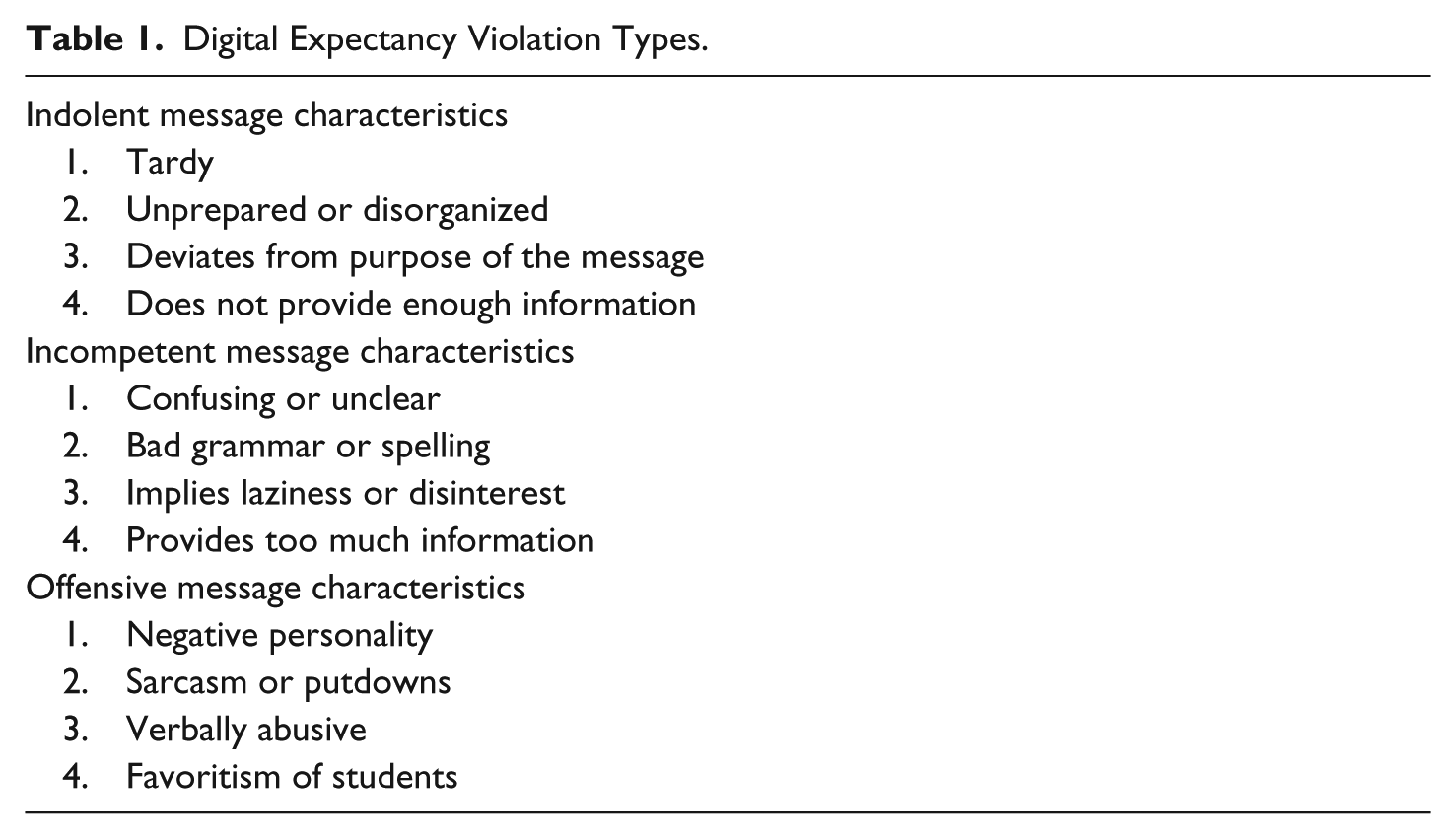
The pretest revealed that those in the indolent message group perceived it as significantly more indolent than incompetent or offensive (n = 10), F(2, 27) = 17.47, p < .0001. Similarly, participants in the offensive message group perceived it as significantly more offensive than indolent or incompetent (n = 10), F(2, 27) = 17.68, p < .0001. The incompetent message was perceived as significantly more incompetent than offensive (n = 10), F(2, 27) = 7.93, p < .002, but not indolent. After performing a factor analysis, the item “information overload” did not load on the typology and was edited to more clearly represent information overload in the message used in the survey.
Instrumentation
Scales in the survey included the Interpersonal Attraction Scale (IAS; L. L. McCroskey et al., 2006) and the Student Communication Motives Scale (SCMS; Martin et al., 1999). The IAS was administered first. The IAS (α = .95) is a 38-item measure that asks students to report their interpersonal attraction to instructors. Three subscales measure three dimensions of attraction: task, social, and physical. All items were measured on a 7-point Likert-type scale that indicated student agreement or disagreement with statements such as “I enjoy working on projects with this instructor” and “I could become closer friends with this instructor.” Cronbach’s alphas ranged from .82 to .92 (task: M = 82.03, SD = 11.36, α = .92; social: M = 59.47, SD = 12.46, α = .92; physical: M = 49.41, SD = 11.88, α = .93).
Participants were then exposed to one of three electronic messages exhibiting indolent, incompetent, or offensive digital expectancy violations. A manipulation check similar to the pretest was administered to ensure that participants in the sample perceived each message as an adequate representation of the particular digital expectancy violation. A MANOVA confirmed that participants in the sample viewed the indolent message as significantly more indolent than incompetent or offensive (n = 79), F(2, 231) = 23.31, p = .00. Similarly, the incompetent message was perceived as significantly more incompetent than indolent or offensive (n = 80), F(2, 231) = 27.62, p = .00. Finally, the offensive message was perceived as significantly more offensive than indolent or incompetent (n = 75), F(2, 231) = 191.53, p = .00.
Last, participants completed the SCMS (α = .86), which is a 24-item measure that asks students to report their motives for communicating with instructors. Five subscales measure various reasons students have for communicating with instructors: relational, functional, participatory, excuse making, and sycophantic. All items were measured on a 7-point Likert-type scale that indicated student agreement or disagreement with statements such as “I talk to my instructor to learn about him/her personally” and “I talk to my instructor to learn how I can improve in the class.” Cronbach’s alphas ranged from .82 to .92 (relational: M = 22.65, SD = 7.75, α = .92; functional: M = 36.35, SD = 4.68, α = .90; participatory: M = 21.20, SD = 4.96, α = .88; excuse making: M = 21.74, SD = 6.44, α = .84; sycophantic: M = 9.53, SD = 4.37, α = .82).
Results
To address the research questions, Pearson correlations were calculated (see Table 2). The research questions inquired the extent to which instructors’ digital expectancy violations affect students’ motivation for communicating with instructors, and what role preexisting interpersonal attraction plays. Results indicated that when students perceive indolent digital expectancy violations, they are still motivated to communicate for relational and functional motives when preexisting task and social attraction to instructors is present. Those who experience preexisting physical attraction to instructors are motivated to communicate for relational purposes when indolent digital expectancy violations are present.
Correlational Analyses.
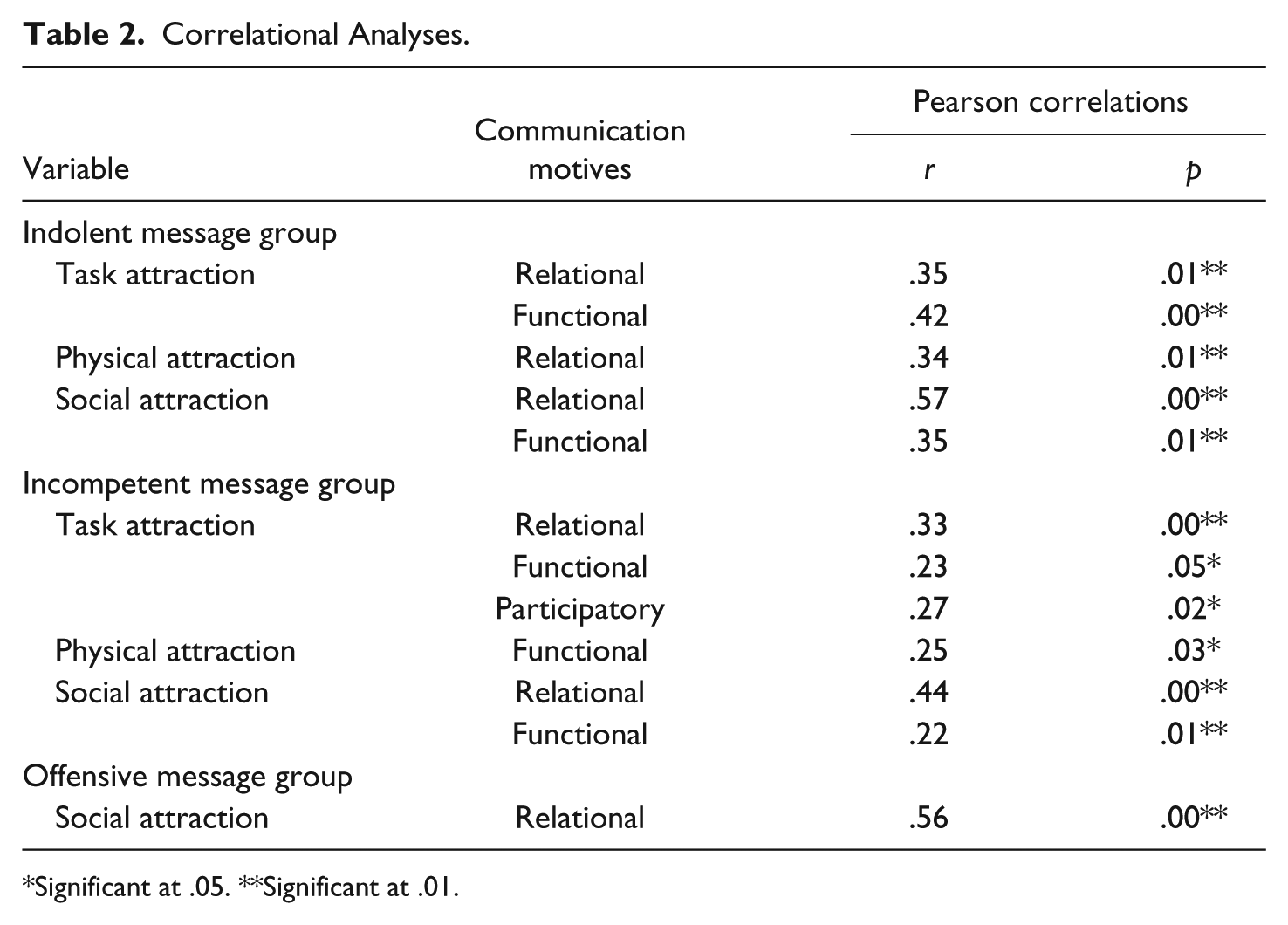
Significant at .05. **Significant at .01.
When students perceive incompetent digital expectancy violations, they are motivated to communicate for relational, functional, and participatory purposes when preexisting task attraction to instructors is present. For those with preexisting physical attraction to instructors, they are motivated to communicate for functional purposes. Students with preexisting social attraction to instructors are still motivated to communicate for relational and functional purposes when incompetent digital expectancy violations are present.
When students perceive offensive digital expectancy violations, they are only motivated to communicate with instructors for relational purposes when they experience preexisting social attraction to them.
Discussion
The purpose of this study was to determine how digital expectancy violations affect students’ motivation to communicate with instructors. Results indicated that students’ motives to communicate with instructors who engage in digital expectancy violations differ based on preexisting social, physical, and task attraction to those instructors. Specifically, students are tolerant of indolent digital expectancy violations when they desire a closer friendship or working relationship with their instructor. These students are still motivated to communicate with instructors to maintain an interpersonal relationship, and to communicate about the class.
Incompetent digital expectancy violations appear to signal a need for students to get involved in their education, as they are motivated to communicate with instructors as a way to show participation and do well in the course. When students perceive incompetence, they likely feel a need to get involved to ensure that they receive a fair grade, and may even attempt to negotiate rules and deadlines in the course (Cayanus, Martin, & Goodboy, 2009). Because incompetent instructors lack expert and referent power (Goodboy et al., 2010), students may recognize incompetent digital expectancy violations as an opportunity to exert expert power over them online to achieve a specific goal.
Students do not tolerate offensive digital expectancy violations. Although students are still motivated to communicate with instructors about the class when indolent or incompetent digital expectancy violations are present, they are no longer motivated to communicate about course-related information when offensive digital expectancy violations are present. However, students’ perceptions of such violations yielded an interesting finding with regard to social attraction. Students who perceived their instructors’ electronic messages as verbally abusive, sarcastic, or communicating a negative personality were motivated to communicate to maintain an interpersonal relationship, when preexisting social attraction was present. This is surprising considering that offensive instructor misbehaviors are the most troubling to students (Berkos et al., 2001). Perhaps it is the case that offensive digital expectancy violations uniquely affect students who already have an established relationship with their instructors before they are exposed to the violation. Students who do not share a close relationship with their instructor are intolerant of that instructor’s offensive digital expectancy violation and are no longer motivated to communicate when these violations are present. However, students who are closer to a particular instructor may have a hard time walking away from that relationship. Instead, these students may engage in relational maintenance behaviors to mend the relationship. Maintenance behaviors may include self-disclosure, assurances, or offering support and help to preserve friendships (Oswald & Clark, 2003). In the advisor–advisee relationship, advisees’ use of relationship maintenance behaviors sustains the relationship and appeases advisors (Mansson & Myers, 2012). Perhaps students perceive offensive digital expectancy violations as detrimental to the relationship and engage in such maintenance behaviors to repair the relationship.
Conclusion
In modern academia, electronic messages are exchanged regularly. This study is among the first to examine instructor misbehaviors in a digital context, and offers preliminary findings with regard to how students are affected by what we call digital expectancy violations. Instructors should be aware that such violations affect students differently, with more serious implications for their advisees and students to whom they may be closer. For students, it is important to recognize that digital expectancy violations may also negatively affect communication with future clients, colleagues, and management, although additional research in this area is needed. Digital communication is an integral part of the higher education process, and inevitable for hybrid and online courses. Instructors need to communicate effectively with students in a way that models appropriate techniques for communicating professionalism in computer-mediated environments.
Footnotes
Appendix
Declaration of Conflicting Interests
The author(s) declared no potential conflicts of interest with respect to the research, authorship, and/or publication of this article.
Funding
The author(s) received no financial support for the research, authorship, and/or publication of this article.