



Abstract
The current study examined the effects of aggressive communication styles on individuals’ pro-environmental behavioral intentions. Two underlying mechanisms—psychological reactance and expectancy violation—as well as the moderating role played by political ideology were investigated. An online experiment (N = 423) was conducted and the results showed that more aggressive style was more likely to trigger psychological reactance and violation of expectation, liberals responded more negatively to the aggressive message than conservatives, and expectancy violation was an important mediator. The findings provide explanations for how communication styles affect individuals’ information processing and offer implications regarding selecting communication styles wisely.
“It’s Global Warming, Stupid.”
The science coverage has been a topic of interest to scientists, science communicators, and journalists (Dunwoody, 2014). The reports of scientific issues and discoveries inform and influence individuals’ decision-making. In the current digital era, like many other genres of journalism, science journalism is not limited to traditional news media channels (Allan, 2011). Science blogs can also serve as competing channels for science news dissemination (Colson, 2011) and audience members tend to read science blogs for specific science information seeking (Jarreau & Porter, 2018). Meanwhile, science blogs tend to be less formal and the writers usually have a personal style while communicating science (Mahrt & Puschmann, 2014), and the style may vary depending on the communicator or topic.
When it comes to some specific scientific issues such as climate change, ongoing debates have become substantially more intense and the styles blog writers choose can be particularly forceful. During the climate change debate, it is common to come across messages that denounce those who refuse to accept the scientific facts on climate change and those who are opposed to pro-environmental policies and behaviors. Many journalists have referred to this debate as polarized, antagonistic, and uncivil (Howarth & Sharman, 2017). Although statistics are unavailable showing how often climate change communicators use an aggressive way to promote pro-environmental actions, a quick search on the internet yielded a great amount of anecdotal evidence of aggressive messages regarding climate change debates. For instance, a blog article titled, “climate change ignorance caused by humans!” used a very aggressive way to list anti-climate change misinformation (Kaulbars, 2008), and another article included the following: “with the evidence all but chocking them, climate change deniers must be deaf, blind and dumb” as its subtitle (Schwab, 2018).
Where the debate on climate change is heading will likely influence the actions or inactions the government decides to take because the preferences and opinions of the public play an important role in influencing government policy agenda (Bliuc et al., 2015). Therefore, finding effective ways to communicate with the public, especially nonscientists, with the hope of shaping the climate change debate has become a priority for climate change communicators.
However, a paucity of research has looked at the effects of aggressive communication styles on climate change–related outcomes of audiences, such as pro-environmental behaviors and support for climate change mitigation. Such research is needed because messages, if not well studied, can easily lead to unintended effects (Cho & Salmon, 2006) and any miscommunication with the potential to further deepen the climate divide will likely make its mitigation even more difficult to achieve.
The current study aims to examine the effects of aggressive communication styles in the climate change context, focusing particularly on how individuals react to science blogs and their subsequent behavioral intentions to adopt pro-environmental actions. In this study, we explore two plausible theory-driven explanations—violation of expectation and psychological reactance—for the effects of aggressive styles. The practical goal of this study is to explore the effects of this nonneutral communication style to help communicators, including science bloggers, determine how to maximize the desired impacts and prevent unintended consequences of their messages. In the following section, we review the literature on the promises and pitfalls of adopting aggressive communication styles in different contexts, which helps inform our study in the climate change context.
Aggressive Communication
In the current study, we focus on exploring the effects of verbal aggressive communication in science blogs. In previous literature, scholars have discussed concepts related to aggressive communication using different terms. The first defined term is verbal aggression, which is described as “the tendency to attack the self-concepts of individuals instead of, or in addition to, their positions on topics of communication” (Infante, 1987, p. 164). Meanwhile, there are some other related terms such as language intensity, which describes an emotional communication style and deviates from a neutral position in an argument (Bowers, 1963; M. A. Hamilton et al., 1990), and uncivility, which describes a negative discourse that uses “gratuitous asides” to suggest “a lack of respect and/or frustration with the opposition” in the argument (Mutz & Reeves, 2005, p. 5). The differences between verbal aggression and these terms are that verbal aggression also involves an ad hominem part that attacks a person’s character beyond just discussing the topic compared with intensity (Greenberg, 1976), whereas uncivility does not emphasize the use of powerful utterance to express the author’s view compared with verbal aggression. Therefore, based on these related concepts discussed above, we adopt the definition which regards aggressive communication from previous research as style of language that combines intense emotion with lack of respect and an attack on persons (Yuan et al., 2018).
Although much of the previous literature on aggressive communication was initiated in interpersonal contexts, many researchers have found that verbal aggression exists in mass communication settings such as television shows (Chory-Assad, 2004; Martin et al., 1997), especially in political contexts (Seiter & Gass, 2010). Moreover, recent studies showed that emotional languages like aggression is more likely to be used in computer-mediated communication environments than in interpersonal communication (Tu, 2002). To deliver attitude and emotion, online communicators are more likely to talk emotionally and use aggressive languages (Derks et al., 2008). As such, it provides the rationale for us to focus on the styles of climate change arguments as they occur on the internet.
The literature on aggressive communication has found mixed support for whether the use of aggressive communication is beneficial to the communicator. Aggressive communication has been discussed in classroom communication and the results showed that teachers’ aggressive communication style can decrease students’ motivation, and learning satisfaction (Martin et al., 2000; Myers, 2002; Myers & Rocca, 2000). Meanwhile, aggressive communication is commonly used in political communication, where it is often used to verbally attack competitors or misinterpret competitor’s statements (McNair, 2011). Researchers found that aggressive styles may produce the “boomerang effect,” which suggests that negative campaign messages about competitors can damage the trustworthiness of the attacker (Lau et al., 2007). However, such attacks are still used frequently by politicians, as they seem to hurt the target more.
In contrast, some positive effects of aggressive communication styles were also observed in different contexts. Aggressive political campaign messages were found to be more entertaining and more likely to attract audience’s attention (Mutz & Reeves, 2005). Attack ads in political campaign tend to be more memorable and stimulate more knowledge about the campaign (Lau et al., 2007). Researchers also found that negative and uncivil messages are more likely to encourage engagement of electorate (Brooks & Geer, 2007). Another positive effect of aggressive styles is that it may increase the power of the speech. When it comes to powerful language, signs of hesitations, hedges, or polite forms may jeopardize the power of a message (Blankenship & Holtgraves, 2005; Erickson et al., 1978). Therefore, the absence of these features may help communicators increase the power of speech (Blankenship & Holtgraves, 2005).
When it comes to climate change mitigation, the debate has often been seen as polarized (Bolsen & Shapiro, 2018; Hmielowski et al., 2014) and aggressive communication is frequently observed (König & Jucks, 2019), and the factors leading to this antagonistic situation include how the mainstream media cover the story to achieve greater viewership and the policy decision-making process which may leave others feeling disenfranchised (Howarth & Sharman, 2017). Meanwhile, researchers also pointed out that because climate change has been absorbed with partisan identity, this issue is very heavily laden with values, and it is “nearly impossible to build social consensus through conventional means” (Guber, 2017, p.2). The nature of this partisan also gives rise to hostile media perceptions (Hansen & Kim, 2011). This also provides the ground for aggressive messages from both sides. Although aggressive communication styles are commonly observed in climate change debates, little research has investigated how audience members react to the messages. One study has showed that uncivil messages about climate change mitigation reduced readers’ perception of communicators’ credibility (Thorson et al., 2010).
In the current study, we focus on messages promoting climate change mitigation and look at one particular outcome from audiences, which is an individual’s pro-environmental behavioral intentions. Enormous efforts have been devoted to persuading the public that climate change driven by human activities is real, and one of the outcomes communicators expect is to have more individuals adopt behaviors that help mitigate climate change (Bain et al., 2012). Previous research has investigated the effects of aggressive styles mostly on attitudinal variables (König & Jucks, 2019; Yuan et al., 2019), but not so much on behavioral intentions. Researchers have found that framing climate change differently may result in different levels of pro-environmental behavioral intentions, including voting for pro-environmental candidates, donating to environmental organization, and joining environmental groups (Bain et al., 2012). Based on the mixed findings regarding the effects of aggressive communication, we raise a research question here:
Expectancy Violation
The study also investigates the mechanisms that drive the potential effects of aggressive communication. Prior research has used expectancy violation theory (EVT; J. Burgoon & Hale, 1988) to explain aggressive communication styles in science communication contexts such as vaccination (Yuan et al., 2018) and genetically modified organisms (Yuan & Besley, 2017). EVT states that individuals have expectations—as a type of belief—of the behaviors of others, and that the violation of these expectations can change arousal and thus accelerate attitudinal and behavioral change (M. Burgoon & Miller, 1985). Expectation violations can either be positive or negative, and the corresponding shift in attitude or behavior can go in either direction as well. In this study, we focused on behavioral intention instead because it is the ultimate outcome predicted by EVT (J. Burgoon & Hale, 1988) and it is also weighted heavily by environmental communicators (Bain et al., 2012). In the context of the current study, we hope that assessing expectation violations can help explain why aggressive communication styles can cause any, if at all, potential effects on individuals’ pro-environmental behavioral intentions.
J. Burgoon and Hale (1988) described three factors that influence how expectation is developed: interactant characteristics, which include the personality traits of a communicator such as age, sex, or education; interpersonal characteristics, which describe the relationship between the communicator and the audience; and the environment, which refers to the context of social situation of the conversation. In terms of communication styles, M. Burgoon and Miller (1985) framed aggressive messages as one proposition that may negatively violate an individual’s expectation, which will further influence their reactions to the message. For example, with regard to swearing, Johnson (2012) found that the level of expectancy violation is related to the effectiveness of the perceived message and audiences’ perceptions of the speaker. Therefore, in the current study, we predict that expectancy violation may help explain the effects of aggressive communication styles.
Psychological Reactance
The second explanatory factor for the effects of aggressive styles we propose in the current study is psychological reactance, which is described as “the motivational state that is hypothesized to occur when a freedom is eliminated or threatened with elimination” (Brehm & Brehm, 1981, p. 37). The theory of psychological reactance suggests that a persuasive message that poses a threat to freedom may trigger reactance and lead to rejection of a message. Psychological reactance covers two aspects: affective responses such as anger, which is seen as the experience of hostile and aggressive feeling, and cognitive responses ranging from negative to positive thoughts. Reactance is an intermingling of both components (Dillard & Shen, 2005). The theory of psychological reactance has been widely applied in climate change messaging (Liang et al., 2018; Lu et al., 2017). In health communication contexts, Leventhal (1970) has pointed out that both cognitive and affective reactions to health messages have unique effects on message acceptance. Researchers have also adopted it in understanding assertive environmental messages and found that pushy requests received better responses when respondents perceived the issue to be important to them (Kronrod et al., 2012).
Psychological reactance theory explicitly presents the role of reactance as a mediator that explains the effects of threat to freedom on different outcomes such as attitude or behavior (Dillard & Shen, 2005). Although psychological reactance as a mediator for aggressive communication styles has not been examined in prior research, the characteristics of aggressive communication styles, as we have reviewed earlier, include forceful language and threats to the autonomy of the audience, which will likely induce psychological reactance. Moreover, the theory of psychological reactance considers emotional and cognitive reactance as the explanatory factors for attitudinal differences in different message conditions, which does not overlap with the factors proposed in EVT. In other words, psychological reactance may represent a separate factor from EVT that explains the effects of aggressive communication styles. Therefore, we propose the following hypotheses:
To explore the mechanisms of aggressive styles, the two factors proposed in the current study, expectancy violation and psychological reactance, are included as parallel mediators. 1 Next, we introduce the moderator in the model which may play an important role in influencing the processing of aggressive climate change blogs—political ideology.
Political Ideology
A prominent factor that commonly influences public opinion and behavior regarding climate change is political ideology. A number of recent studies showed that there is a large partisan and ideological divide with regard to climate change beliefs and support for climate change mitigation policies (Boudet et al., 2014; L. C. Hamilton et al., 2015; Schuldt et al., 2015). More specifically, Democrats and liberals are more likely to believe that climate change is primarily caused by human activities and has been generating negative effects on earth. Therefore, they are more likely to express support for government actions or policies that help address this issue. On the contrary, Republicans and conservatives are less likely to espouse these beliefs and support pro-environmental actions (Krosnick et al., 2000; McCright & Dunlap, 2011). These findings can be explained by motivated reasoning, which is described as the tendency of people to conform information they encounter to goals that lead to their desired conclusions (Kahan, 2015; Kunda, 1990). Previous research on climate change messaging has consistently shown that liberals and conservatives respond differently to climate change messages (e.g., Feldman & Hart, 2016; Lu & Schuldt, 2016). It is likely that because conservatives in general show a high level of reactance to climate change messages, climate change messages using aggressive styles will further push conservatives away. In contrast, liberals who exhibit consistent support for climate change mitigation may find aggressively communicating the existence of anthropogenic climate change warranted. To put it differently, we want to explore to what extent political ideology may moderate the effects of aggressive communication styles in the context of climate change mitigation. Because no prior research has examined the moderating role of political ideology in relation to aggressive communication, we propose the following research question alongside a tentative hypothesis based on how conservatives and liberals react to climate change mitigation messages:
Finally, we would also like to explore how the two proposed mediators, EVT and psychological reactance, may explain any potential moderating effects of political ideology:
Method
An experiment using a 2 (communication style: more vs. less aggressive) × 2 (target of address: deniers vs. we Americans) 2 between-subjects factorial design was conducted to test the effects of aggressive communication styles on individuals’ pro-environmental behavioral intentions.
The experiment was conducted with U.S. adults recruited from Amazon’s Mechanical Turk (mTurk). A total of 506 participants finished the survey. Eight-three participants who failed to answer at least one of the attention check questions (e.g., “please select strongly disagree for this statement,” “which of the following is a type of fruit”) correctly were removed from the data set. Of the remaining 423 participants, 43.3% were female, with a mean age of 37.47 (SD = 12.46). The majority of participants were White (76.8%), followed by African American (7.8%), Hispanic or Latino (7.3%), Asian (6.4%), and others (1.6%). About 45.9% of participants received a Bachelor’s degree, 27.7% received some college education, 13.2% received a master’s degree, and 8.3% of received high school education. Participants’ political ideology was leaning toward liberal (M = 3.72, SD = 1.80; 1 = very liberal and 7 = very conservative).
Stimuli and Procedure
A short blog article (about 300 words) discussing the acceptance of climate change based on several column articles (Nadler, 2017; Rall, 2016) was developed as the stimulus of this study. The article was then modified into more or less aggressive versions by adding or removing aggressive elements such as emotional phrases and attacks on specific targets. For example, the title of the more aggressive condition was, “It’s climate change, stupid! Stop the foolishness and act now!” while the title of the less aggressive condition was, “It’s climate change! Act now!” In the aggressive condition, we used phrases like “shameful results,” “It is the data, idiot!” Instead of saying, “The time to act is now. What is the solution to this issue with other community members who disagree with climate change?” in the aggressive condition, this sentence was rephrased as, “The time to act is now. What is the solution to our creeping stupidity?” (Online Appendix 1).
Participants were first told they would read a science blog from a mainstream website they usually visit and then randomly assigned to read one of the blog versions, after which they proceeded to complete a survey, including key measures, detailed in the next section. The correlation matrix for each measured item is shown in Table 1.
Correlation Matrix.
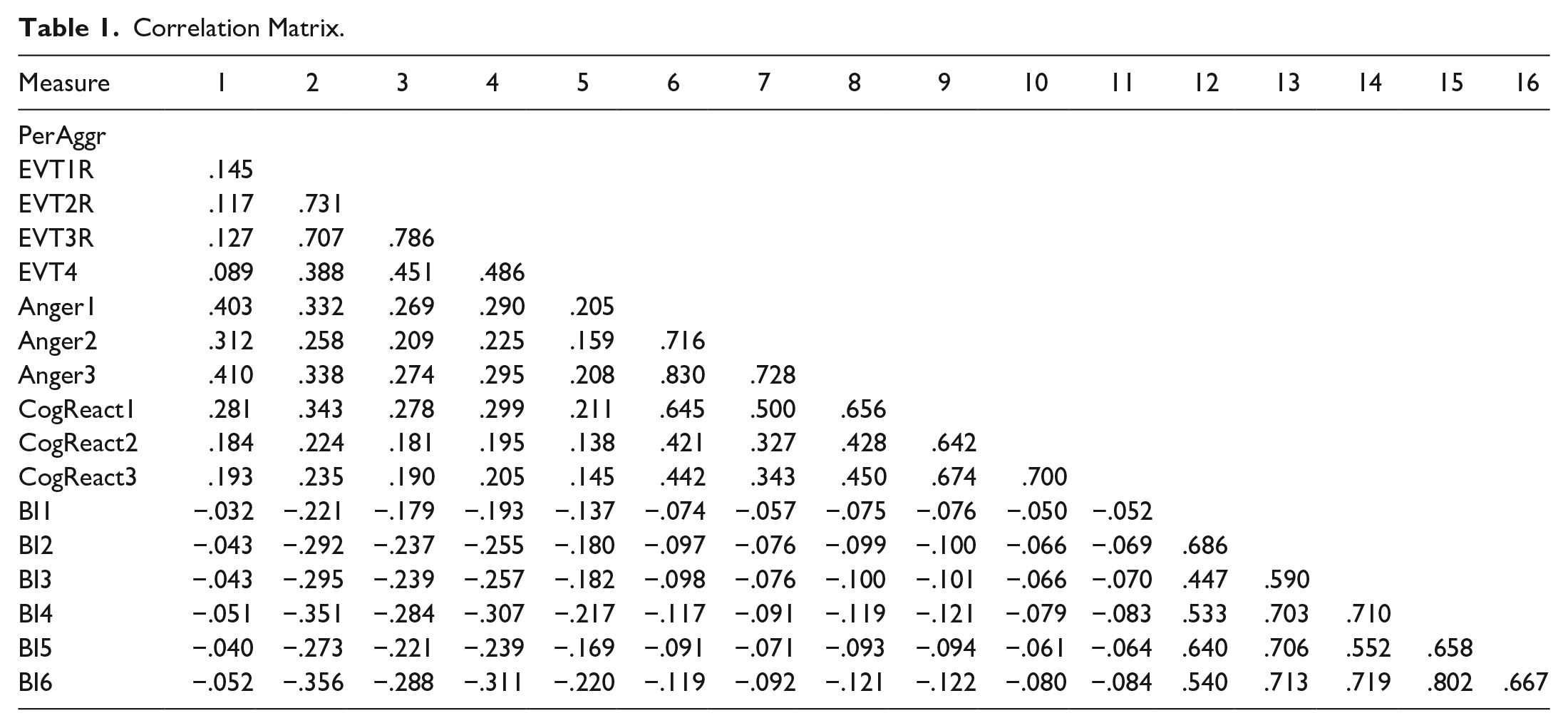
Key Measures
Perceived aggressiveness
We used a single item to assess perceived aggressiveness of the article adapted from Yuan et al. (2018): “Considering the style of the blog, how aggressive or nonaggressive would you say this blog article was?” Participants rated on a 7-point scale ranging from 1 = extremely nonaggressive to 7 = extremely aggressive (M = 4.86, SD = 1.57).
Expectancy violation
The items for expectancy violation were adopted from J. Burgoon and Walther (1990), including “The author’s writing was appropriate as a science blogger,” “The author wrote in a way I would expect most science bloggers to writer,” “The author used a normal writing style for a science blogger,” and “The author’s writing was unusual for a science blogger.” The first three items were coded reversely. Participants rated on a 7-point scale indicating how much they agreed or disagreed with each statement (1 = strongly disagree to 7 = strongly agree; α = .90; M = 4.29, SD = 1.59).
Anger at the writer
Participants indicated how much they felt irritated/angry/annoyed at/with the blog writer (Shen, 2011) on a 7-point scale (1 = none of this feeling to 7 = an extreme amount; α = .91; M = 2.93, SD = 1.84).
Cognitive reactance to the article
Participants indicated to what extent they agreed or disagreed with three statements adapted from Silvia (2006) (1 = strongly disagree to 7 = strongly agree; α = .87; M = 3.64, SD = 1.66): “I criticized the article while I was reading it,” “I thought of points that went against what was being said while I was reading the article,” and “I was skeptical of what was being said while reading the article.”
Psychological reactance
Following previous research (Dillard & Shen, 2005; Rains, 2013), psychological reactance was modeled as a latent factor with anger and cognitive reactance serving as indicators using structural equation modeling.
Pro-environmental behavioral intentions
Participants indicated how likely they were to perform the following behaviors (Bain et al., 2012) in the next 3 months (1 = extremely unlikely to 7 = extremely likely; α = .92; M = 4.05, SD = 1.66): “vote for candidates who support climate change mitigation,” “sign petitions supporting climate change mitigation,” “write to local newspapers in support of climate change mitigation,” “donate to pro-environmental organizations,” “read environmental publications,” and “join pro-environmental groups.”
Results
Manipulation Check
We conducted an analysis of variance (ANOVA) featuring communication style condition (0 = less aggressive, 1 = more aggressive), target of address condition (0 = everyone, 1 = deniers), and their two-way interaction as the independent variables, and perceived aggressiveness as the dependent variable. The results show that there was a main effect of the communication style condition on perceived aggressiveness, F(1, 419) = 141.71, p < .001,
Effects of Experimental Conditions
We conducted structural equation modeling to examine our research questions and hypotheses. We employed a maximum likelihood (ML) estimator in Mplus 8.3. The first research question and hypotheses
In terms of expectancy violation, we covaried the error terms of two indicators of expectancy violation for model fit improvement. The resulting model showed satisfying model fit: χ2(13) = 28.04, p = .009, RMSEA = .052 (90% CI = [0.025–0.079]), CFI = .987, SRMR = .030. We found that there was a main effect of the communication style condition on expectancy violation such that the more aggressive condition was more likely to violate expectancy as compared with the less aggressive condition, B = 1.48, SE = .15, p < .001; β = .49. There was no main effect of the target of address condition (B = 0.12, SE = .14, p = .362; β = .04) or two-way interaction (B = 0.12, SE = .27, p = .649; β = .02) on expectancy violation. Therefore,
As for psychological reactance, we modeled it as a latent factor with anger and cognitive reactance serving as indicators (Dillard & Shen, 2005; Rains, 2013). We added covariance between the error terms of two anger indicators and between the error terms of two cognitive reactance indicators for model fit improvement. The final model showed satisfying model fit: χ2(23) = 46.18, p = .003, RMSEA = .049 (90% CI = [0.028–0.069]), CFI = .988, SRMR = .029. We found that there was a main effect of communication style condition on psychological reactance such that the more aggressive condition was more likely to elicit psychological reactance as compared with the less aggressive condition (B = 1.19, SE = .18, p < .001; β = .35). There was no main effect of the target of address condition (B = 0.29, SE = .17, p = .096; β = .08) or two-way interaction (B = 0.32, SE = .35, p = .350; β = .05) on psychological reactance. Therefore,
Mediation, Moderation, and Moderated Mediation
Mediation, moderation, and moderated mediation analyses were performed using Mplus 8.3 with ML estimator for direct and indirect effects, 5,000 bootstrap samples, and 95% bias-corrected CIs. To address the second and fourth hypotheses that explore the mediating role played by expectancy violation (
We then constructed a parallel multiple mediator model using the same exogenous and outcome variables. We included expectancy violation and psychological reactance as the mediators simultaneously and covaried their error terms (B = 1.13, SE = .18, p < .001; β = .46). Results show that when both variables were included as parallel mediators, only expectancy violation (Bindirect = −0.49, SEindirect = .11, p < .001, 95% CI = [−0.73 to −0.30]), but not psychological reactance (Bindirect = 0.02, SEindirect = .06, p = .766, 95% CI = [−0.10 to 0.14]), served as the mediator between communication style condition and pro-environmental behavioral intentions (Figure 1).
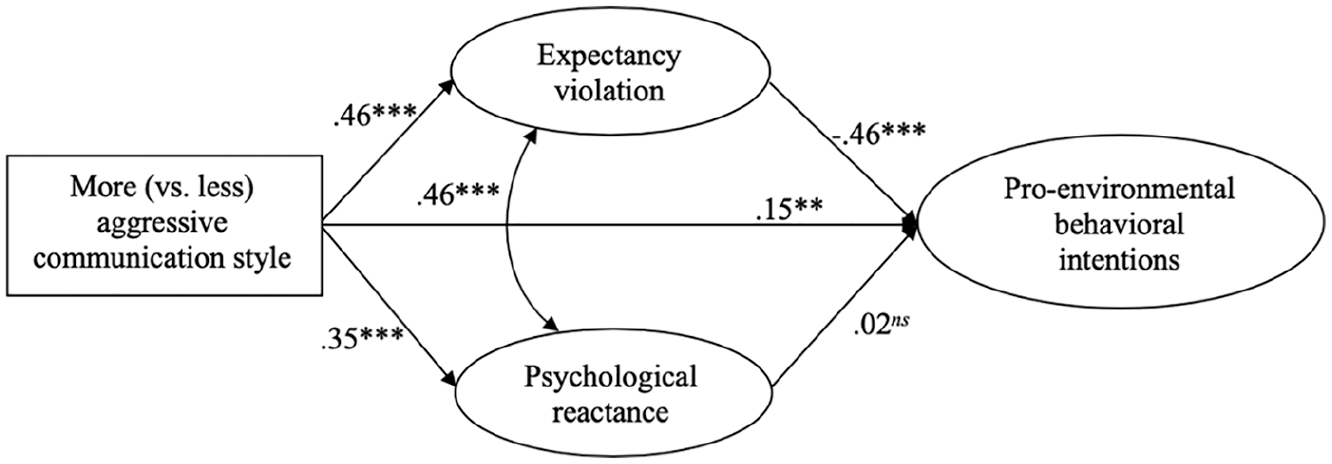
Parallel mediation model.
The second research question (
When expectancy violation was the outcome variable, there was a significant two-way interaction between the communication style condition, and political ideology (B = −0.24, SE = .08, p = .003; β = −.14). More specifically, the effects of more (vs. less) aggressive communication style on expectancy violation were found among individuals across political ideologies, but the effects were strongest for liberals (M − 1 SD; B = 1.96, SE = .21, p < .001), weaker for moderates (M; B = 1.52, SE = .15, p < .001), and weakest for conservatives (M + 1 SD; B = 1.09, SE = .20, p < .001).
When psychological reactance was the outcome variable, there was a significant two-way interaction between the communication style condition and political ideology (B = −0.21, SE = .09, p = .017; β = −.11). More specifically, the effects of more (vs. less) aggressive communication style on psychological reactance were found among individuals across political ideologies, but the effects were strongest for liberals (M − 1 SD; B = 1.50, SE = .24, p < .001), weaker for moderates (M; B = 1.12, SE = .18, p < .001), and weakest for conservatives (M + 1 SD; B = 0.74, SE = .25, p = .003). Therefore,
When pro-environmental behavioral intentions were the outcome variable, the two-way interaction between the communication style condition and political ideology was not significant (B = 0.06, SE = .07, p = .439; β = .04). Thus,
The third research question (
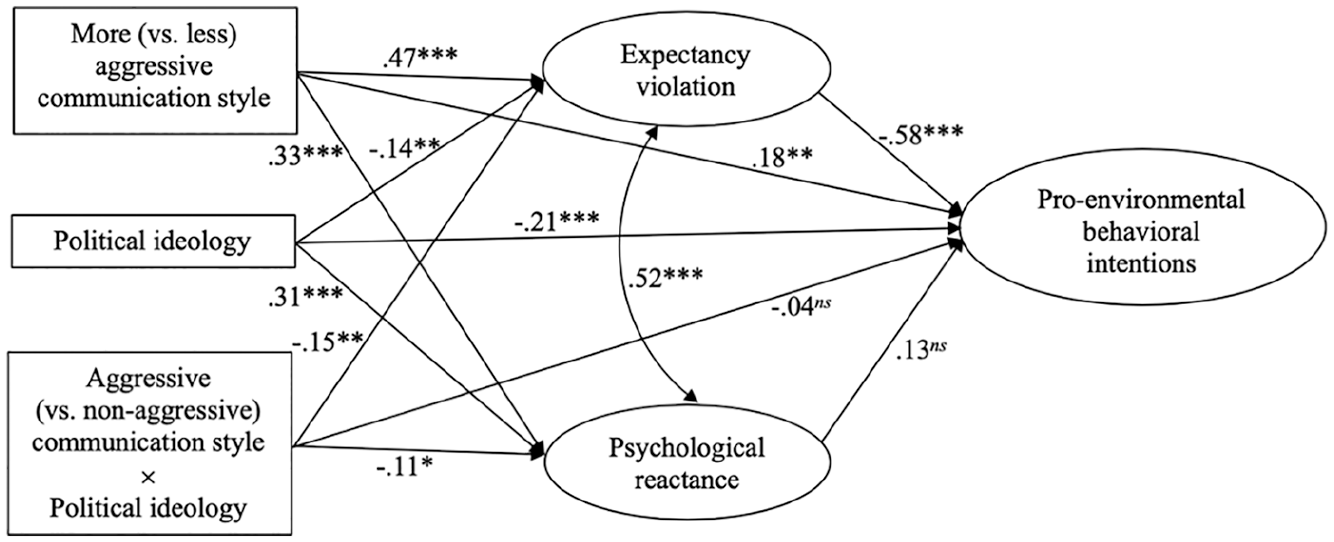
Moderated parallel mediation model.
Discussion
When science blogs have started to become a common channel for the public to receive science information and news, its less formal but more personal style of writing is also commonly observed by researchers (Mahrt & Puschmann, 2014). As public opinion toward many science issues, such as climate change, has become more and more polarized, it is increasingly common to encounter the use of nonneutral communication styles, including aggressive communication styles investigated in this study, in communicating controversial scientific issues. The question then becomes, “Is the use of aggressive styles in communicating climate change effective in promoting pro-environmental changes?” With little investigation on this topic so far, we set forth our study to address this question.
Overall, the findings showed that the more (vs. less) aggressive message influenced the way in which individuals reacted to the message. Aggressive messages indirectly influenced pro-environmental behavioral intentions through two pathways, that is, psychosocial reactance and the violation of expectation. Meanwhile, individuals’ political ideology moderated the effects of aggressive messages. It should be noted that our goal of this study is not to draw conclusions about whether aggressive communication is good or bad. Instead, we intend to illustrate the value of understanding how individuals process climate change messages in an aggressive style and provide practical implications for communicators regarding how to select communication styles more strategically.
As reviewed earlier, prior research has demonstrated both beneficial and harmful effects of using aggressive communication styles on various outcomes. Our current study focused on pro-environmental behavioral intentions but did not find any significant direct effects of using more (vs. less) aggressive messages. This might be because, unlike other attitudinal outcomes (such as customer satisfaction or communicator likability) frequently used in studies of aggressive communication styles, behavioral intentions are a more downstream outcome that would be more difficult to change by the mere use of an aggressive message, especially when the behaviors (e.g., writing to local newspapers) presented in the experiment required some amount of effort to perform. In contrast, we found that more (vs. less) aggressive messages directly influenced expectancy violation and psychological reactance in a direction that was consistent with our predictions, providing some evidence that the use of aggressive messages might not be advantageous in climate change communication.
The study of EVT dates back to almost three decades ago and has mostly been applied to the study of interpersonal communication/relationship (e.g., J. Burgoon & Hale, 1988). Its use in mediated communication, especially in explaining the effects of communication styles is still limited. A few studies have adopted EVT to explain how aggressive communication styles function (e.g., Yuan & Besley, 2017; Yuan et al., 2018). Consistent with their findings, the current study established expectancy violation as the underlying mechanism for the aggressive communication of a different science topic, illustrating the generalizability of expectancy violation as a mediator beyond a specific context.
What differs this study from the previous research is that it went further and identified another mediator, psychological reactance. Because the use of aggressive communication styles usually involves inflammatory language and potential attacks on some audiences, we expected that psychological reactance may be induced by the exposure to aggressive messages. Consistent with prior research (Dillard & Shen, 2005), psychological reactance was operationalized as a combination of the feeling of anger and cognitive reactance. The anger component of psychological reactance may be especially relevant to aggressive communication styles because authors using aggressive styles may be perceived as being angry. How perceived anger of the author relates to the anger contributing to psychological reactance is an open question that requires future research to address. By incorporating psychological reactance, this study expands the investigation into the psychological mechanisms explaining the way aggressive communication styles work and shifts the focus from a mere cognitive angle to a combination of cognitive and affective perspective. At the same time, by considering different communication styles to influence psychological reactance, this study makes a contribution to the reactance literature by providing a more nuanced look into the types of message styles that can lead to psychological reactance.
In addition, we investigated expectancy violation and psychological reactance as parallel mediators in our analyses because the current literature does not provide sufficient, if at all, guidance on the relationship between the two constructs. Some prior research has discussed or examined them but treated the two factors as separate entities (Campo & Cameron, 2006; Quick et al., 2012). We explored the relationship between expectancy violation and psychological reactance by conducting serial mediations (more details in the Supplemental Material), but they did not appear to improve the model. Future investigation is needed because any attempt to address this relationship will not only help clarify the particular sequential process through which aggressive communication styles function but also contribute to linking and enriching two bodies of literature that have been largely disconnected so far.
Moreover, another objective of this study was to investigate how audience members’ political ideology plays a role in influencing their processing of aggressive climate change messages. We put forward a tentative hypothesis based on the assumption that conservatives who generally show more reactance to climate change messages than liberals would find aggressive messages even more threatening, whereas liberals may perceive aggressive climate change messages to be more warranted. However, opposite to our prediction, the effects of aggressive communication styles on psychological reactance were found to be stronger among nonconservative audiences, which suggests that liberals and moderates were more sensitive to aggressive message styles, compared with a less aggressive style. Similarly, we also found that for individuals across political ideologies, the aggressive communication styles violated their expectations differently: the strongest for liberals, weaker for moderates, and the weakest for conservatives. It is likely that because conservatives are usually the target of persuasive messages promoting climate change existence (Feldman, 2017), which was the theme of the blog articles used in our study, conservatives may be more used to climate change messages that employ intensive language and explicit attacks than liberals, which explains why liberals found aggressive messages more surprising than conservatives did. As for psychological reactance, the reason why a more (vs. less) aggressive message produced a smaller effect on conservatives than liberals might be because conservatives reacted negatively to the content of climate change messages regardless of how the message was written. In contrast, it is likely that liberals reacted more negatively to aggressive climate change messages not because of its content but because of its threatening communication style. In a study that examined the effects of messages concerning genetically modified crops in the context of climate change, Lu et al. (2017) found that liberals showed more reactance to a message explicitly (vs. implicitly) using climate change as a persuasive cue. Lu et al.’s (2017) finding was consistent with ours in that while liberals generally support climate change mitigation, messages conveying a strong persuasive intent by adopting a more aggressive style or using explicit climate change cues may produce boomerang effects among this group.
Another possible explanation that may integrate the findings on EVT and psychological reactance was related to selective attention to the experimental messages (Luo & Zhao, 2019). It is likely that the reason conservatives showed less psychological reactance and violation of expectance was because they did not read the experimental message, the goal of which was to promote a topic conservatives generally oppose, as carefully as liberals (Luo & Zhao, 2019). Thus, because of their less attention to or engagement with the message, conservatives were less likely to react differently to the more (vs. less) aggressive messages than liberals. This explanation requires measures on attention to the message or the depth of processing the message, which were not included in this study. In short, although both EVT and psychological reactance can be used to explain why conservatives and liberals reacted differently to more (vs. less) aggressive climate change messages, the underlying psychological processes through expectancy violation and psychological reactance are rather different. Future research may seek to examine these nuanced differences, which can potentially provide informed sights into when EVT and theory of psychological reactance converge and diverge.
Practically speaking, although the conversation around climate change is often contentious, communicators, including science bloggers, should be wary of using too much aggression in their messages. However, sometimes it might seem necessary to use some aggressive language in climate change messages. For instance, Bernie Sanders tweeted, “Donald Trump believes climate change is a hoax. Donald Trump is an idiot” (Sanders, 2019). In these situations, the findings on EVT and psychological reactance suggest that communicators should find ways to make sure that their climate change messages do not unnecessarily violate the readers’ expectations or induce psychological reactance. In addition, the findings on the moderating role of political ideology suggest that even though aggressive language is usually being used against climate change opponents, such a communication style may in fact demotivate climate change proponents (e.g., liberals) more than climate change opponents (e.g., conservatives). Therefore, when communicating with different audiences, climate change communicators need to keep in mind the differential effects of aggressive styles on different groups and avoid unintended backfire from supporters.
While the study adds theoretical and empirical contributions to the literature on aggressive communication and climate change communication, it is not without limitations. First, the current study used a single message for testing, which might limit the generalizability of the current findings (O’Keefe, 2002; Slater et al., 2015). Future research should try to replicate this study’s findings with different sets of climate change messages. Furthermore, the results should be interpreted with caution because the effect sizes reported in the analyses are mostly small. In addition, we opted to use the format of a science blog for testing the messages because it is a common science communication channel. Future research may choose to test aggressive messages using other media channels and explore the appropriateness of different media channels adopting aggressive communication styles. Second, the measurement assessing expectancy violation only tested the strength of violation but not the valence of violation. Although it was unlikely, based on our results, that positive violation, for instance, the writer using more aggressive styles is being perceived as more appropriate than what audience members expect, would occur in the current context, it is worth studying in future studies whether the valence of expectancy violation (positive/negative violation) provides more nuanced explanations for the effects of different communication styles. Third, in this study, we selected an issue for which liberals showed much more support than conservatives and examined the moderating role played by political ideology. Future research should extend the investigation to issues that are favored by conservatives and examine whether the role played by political ideology changes. Other plausible explanations, including cognitive dissonance (Festinger, 1957), should also be tested in the future. The reason why liberals reacted to aggressive messages more negatively may be due to cognitive dissonance. The aggressive style of defending climate change may be inconsistent with what liberals knew or accepted. In addition, specific beliefs in climate change may also be an important moderating factor to explore in the future. Relatedly, it is worth noting that while climate change is primarily a science issue, its political polarization also makes it a salient political issue, which may make climate change a different case from many other science topics. Therefore, our findings may not be directly applicable to science issues that are not divided along the political spectrum. In addition, caution should also be executed when the findings are applied to other contexts like political communication. It is true that some work in the political communication contexts has shown similar effects of aggressive styles (Lau et al., 2007), but there are differences between science communication and political communication. For instance, political attack campaign messages are only valid till the election date and tend to have little influence after, but science or climate change communication does not necessarily have a deadline. This means that aggression in science communication may have longer impact on the readers.
In summary, science blogs, as an informal channel for science journalism, requires attention from communication scholars. Meanwhile, the lack of broad public support for climate change mitigation policies calls for more efforts from environmental communicators and policy makers to communicate this issue more strategically and effectively (Carmichael et al., 2017; Lu et al., 2017; Newman, 2017). Going beyond simply changing some people’s view of climate change, effective climate change communication has focused on exploring ways to encourage individuals to have more pro-environmental behaviors, including donating to pro-environmental organizations and reading environmental publications. By demonstrating the effects of aggressive communications styles on pro-environmental behavioral intentions in the context of climate change mitigation, the current study underscores the need to understand how this commonly used communication styles function and provides practical implications for communicators when adopting different communication styles.
Supplemental Material
DS_10.11771077699020904791 – Supplemental material for “It’s Global Warming, Stupid”: Aggressive Communication Styles and Political Ideology in Science Blog Debates About Climate Change
Supplemental material, DS_10.11771077699020904791 for “It’s Global Warming, Stupid”: Aggressive Communication Styles and Political Ideology in Science Blog Debates About Climate Change by Shupei Yuan and Hang Lu in Journalism & Mass Communication Quarterly
Footnotes
Declaration of Conflicting Interests
The author(s) declared no potential conflicts of interest with respect to the research, authorship, and/or publication of this article.
Funding
The author(s) declared receipt of the following financial support for the research, authorship, and/or publication of this article: this project is funded by Northern Illinois University faculty startup fund.

Supplemental material
Supplemental material for this article is available online.
Notes
Author Biographies
References
Supplementary Material
Please find the following supplemental material available below.
For Open Access articles published under a Creative Commons License, all supplemental material carries the same license as the article it is associated with.
For non-Open Access articles published, all supplemental material carries a non-exclusive license, and permission requests for re-use of supplemental material or any part of supplemental material shall be sent directly to the copyright owner as specified in the copyright notice associated with the article.
