



Abstract
Journalism programs working to stay current with industry practice often struggle to do so without forgoing traditional journalism skills and attributes. This longitudinal study involves content analysis of more than 1,800 jobs posted in either 2010 or 2015 by companies listed among the top 10 newspaper and broadcast journalism companies in the United States. The researchers found an increased demand for employee skills in social media and audience engagement, and a significant trend toward seeking candidates that exhibit web/multimedia skills, teamwork, and the ability to work under pressure and tight deadlines.
Journalism continues to find itself in an extended period of transformation, and journalism educators face a number of obstacles in trying to keep up. According to a Knight Foundation report, U.S. journalism education faces three major hurdles: lack of currency and innovation in the curriculum, lack of faculty expertise in new media, and accreditation standards that protect the status quo (Lynch, 2015). Complicating all of this is the fact that journalism itself has never been clearly defined. Ivor Shapiro (2014) put it well, “Scholarly definitions of the notion of ‘journalism’ have been rare and often unsatisfactory” (p. 555). Part of the challenge is likely that, although the core principles of relevance, accuracy, and timeliness have remained, when it comes to the presentation of news, journalism has been completely deconstructed. The required skill sets for those working in journalism are continually expanding as technology advances and news consumption preferences evolve. In addition, the range of journalism graduates’ career prospects is significantly more diverse than the range of paths encompassed by the usual meanings of “journalism” work. Ultimately, it is hard to know what to teach and how to teach it when those goals are a moving target.
However, achieving currency may get easier when educators have a firm understanding of today’s newsroom practices. In this longitudinal study, the authors compare results of content analysis involving more than 700 journalism job postings in 2010 with more than 1,100 journalism job openings posted in 2015 (Wenger, Owens, Charbonneau, & Trever, 2010). All the posts came from companies ranked among either the top 10 newspaper or top 10 broadcast journalism companies in the United States.
Literature Review
In his work on the societal functions of journalism, Donsbach (2014) concluded that practitioners are part of the “new knowledge profession.” He determined that there are five areas of competence that need to be taught in academic programs to appropriately educate potential journalists, including mastery of current journalistic skills.
Other researchers have found that those working in journalism today have recognized the need to adapt their practices to newer technological capabilities and are doing so with little resistance at this point (Ekdale, Singer, Tully, & Harmsen, 2015). To get a good sense of changes in current skills and practices, the authors believe that analyzing journalism employment listings offers unique and valuable insight. Employers of journalists obviously play a significant role in determining the nature of journalism, its practice, and, therefore, journalism education as a whole. Journalism employers do this primarily through the people they hire. If a candidate has the skills and attributes the news organization needs, he or she gets a job, and job placement is becoming an increasingly important metric for journalism schools. Therefore, the authors believe employment listings are of particular value to educators trying to determine how best to prepare students for work in today’s newsrooms and to anticipate emerging skill sets.
Ross (2017), too, suggested that this type of industry analysis has more value when the results are linked back to curriculum: While a growing body of academic research explores the evolution of production practices within formal news organizations, much less attention is paid to how journalism schools are addressing the demands of the profession in the twenty-first century. Strains on the traditional routines, practices and unwritten rules of news production challenge those involved in professional development to rethink the standards and skills they prioritize as they transmit knowledge to the next generation of news workers. (p. 86)
However, this “rethink” of journalism education is coming too slowly for some. A 2013 Poynter Institute study of journalism education found that just “39% of educators say journalism education keeps up with industry changes a little or not at all. News editors and staffers are even harsher, with 48% saying J-schools are not keeping up with changes in the field” (Finberg, 2013, para. 13). Part of the issue may be that some faculty still fear that a focus on teaching technological skills turns journalism programs into job training centers versus institutes of higher learning.
Others argue that journalism education should be about improving journalistic practice rather than simply mimicking it. They suggest journalism education is “one way in which society can intervene to influence the development of journalism” (Curran, 2005, p. xiv). In an analysis of multiple journalism education studies, Deuze (2006) found two distinct roles for journalism education: the “follower” mode, where the mission of the school or program centers on training as a reflection of the actual wants and needs of the profession; and the “innovator” mode, where journalism training is seen as a development laboratory, preparing students for a changing future rather than a static present. (p. 25)
Josephi (2009) wrote that journalism schools serve as both a preparation for and as corrective to the profession. However, he and others have noted that journalism education is dependent on the industry, indicating that success is routinely measured “by the number of internship opportunities it affords and the kind of jobs graduates are able to land” (Skinner, Gasher, & Compton, 2001, p. 341).
Auger, Tanes-Ehle, and Gee (2017) acknowledged that the goal of a journalism curriculum should be one in which students are prepared both conceptually and practically. They studied the experience of students working with new and traditional technologies to develop and produce news stories and found that the students’ technological and traditional skills were both stronger when practiced in tandem.
Journalism today does require a mix of old and new skills. Cleary and Cochie (2011) discovered a core skill set of writing, print design, and editing copy in their content analysis of newspaper job advertisements over a 27-year period. In an examination of more than 200 print and broadcast reporter job advertisements, Massey (2010) found in addition to traditional journalism requirements, nearly 40% of print and 30% of broadcast listings required web-posting skills, for example.
This study’s authors have also found core skills such as writing, working under tight deadlines, and enterprising remain among journalism employers’ most desired traits in previous analyses of help wanted ads (Owens & Wenger, 2012; Wenger et al., 2010). However, the demand for multiplatform skills continues to steadily rise, as job postings are increasingly listing skills involving online-content production, use of mobile apps, and social media experience among job requirements (Wenger, Owens, & Thompson, 2014).
Many of the changes required in a journalist’s skill set may be attributed to changes in audience behavior. For example, nearly two thirds of U.S. adults (62%) get some of their news from social media and almost one fifth (18%) do so regularly, according to a survey by Pew Research Center. In 2012, based on a slightly different question, 49% of U.S. adults reported seeing news on social media (Pew Research Center, 2016).
A scan of the academic literature on the topic of best practices for teaching about social media in journalism education unearths just a few publications. Studies conducted as late as 2011 found that students were sometimes reluctant to share publicly via social media, having previously used social tools with friends only. Instructors sometimes reacted by using closed groups, which limited the students’ ability to establish professional networks and to interact with the public (Cochrane, Sissons, Mulrennan, & Pamatatau, 2013). Other challenges to making social media instruction more fully integrated into journalism courses include the need for journalism educators to “up-skill” in both technical and theoretical competency with social media tools, etiquette, and techniques (Hirst & Treadwell, 2011).
However, Bor (2014) found that in response to the growing demand for digitally competent employees in the news media industry, journalism schools are cautiously integrating social media reporting into their curriculum. Findings from Bor’s study “suggest that curriculum should include emphasis on ethics, technical skills, and the potential for career development. In addition, differentiation between personal and professional social media use should be recognized” (p. 248).
More recently, schools like the University of Southern California’s Annenberg School of Communication and Journalism have created a class to produce stories directly for social media platforms. This type of course acknowledges the importance of social media as news distribution channel in its own right (NiemanLab, 2015). Research on the practice of monitoring audience to help make journalistic decisions also reveals why it is becoming more important for individual journalists, not just editors and other news managers, to be well aware of audience response to their work. Shoemaker and Voss (2009) proposed audiences are acting as secondary gatekeepers, telling journalists via web analytics what stories are popular and in turn shaping journalistic decisions. According to Örnebring (2010), this influence can lead to a change in values within newsrooms.
For more than a decade, research has shown a disconnect between the journalism skills learned in college and the needs of the workforce (Adams, 2008; Lepre & Bleske, 2005; Mattern, 2003; McDonough, Rodriguez, & Prior-Miller, 2009). Yet, it is not for lack of effort on the part of educators. As Huang et al. (2006) found that, at the start of the millennium, 60% of journalism schools in the United States were redesigning their curricula to include courses that prepared students for producing news in multiple platforms.
However, once a program becomes focused on staying current with skills instruction, the need for curriculum change is ongoing and growing. The rise of new technologies presents a challenge to many journalism programs struggling with the choice of whether to invest in new skills classes or to revamp existing courses (Carpenter, 2009). Moody (2010) concluded that many communication educators had not adequately modified their course curricula to include the new technology skills that reflected those used in the industry. Todd and Levine (2010) suggested collaboration between educators and industry professionals to develop more course assignments that would utilize current technology, thus better preparing students for the workforce.
This study is aimed at isolating the specific skills and attributes required of journalists seeking employment in today’s newsrooms. The authors are interested in both the enduring traditional abilities required and the emerging areas of expertise necessary to succeed in journalism careers. An understanding of current demands in the industry is vital for educators in examining and revising journalism curricula, if part of the program’s goal is to serve the needs of the profession.
Research Questions
The purpose of this study is to track changes over time in the skills and attributes sought by hiring managers for some of the largest journalism companies in the United States. The research questions seek to guide comparisons between 2010 and 2015 data collected and analyzed by the authors.
Method
A quantitative content analysis was performed on job postings from companies, which appeared on a list of either the top 10 broadcast or top 10 newspaper companies in the country, according to a Pew Research report (2015), which ranked companies by revenue. As some companies are among the top 10 on both lists, the analysis was narrowed to 15 media companies in all: Lee, New York Times, Media News Group, McClatchy, Advance, Berkshire-Hathaway, Gannett, News Corp, CBS, Tribune, Univision, Comcast, Hearst, Disney, and Sinclair. Although most, if not all, of these companies would be considered to produce multiplatform content, the authors began tracking newspaper and broadcast companies as defined by Pew and others in 2008. By defining the sample consistently over the years, the authors are able to make comparisons over time.
The authors collected job postings from the news divisions of the companies’ publicly accessible websites, for a 3-month period, January 15, 2015, to March 15, 2015. Only job postings for newsroom positions were taken for analysis. Jobs in departments such as sales, promotions, advertising, and engineering were not collected. On the first visit to the websites, all existing job postings listed as “current” that met the criteria were collected, not just the postings dated January 15, 2015. On the daily subsequent visits, only new postings were collected. In total, 1,108 job postings were collected.
The job postings were coded by one of the study’s authors for job title, job type (multiple platform, broadcast, print, or online), attributes, and skills required. About 110 randomly selected job postings, or approximately 10% of the sample, were coded by a second author. The results fell into the acceptable level of intercoder reliability (Cohen’s Kappa = ~.80; Dewey, 1983).
The coding sheet was based on previous studies done by the authors (Wenger, et al., 2010; Owens & Wenger, 2012; Wenger, Owens & Thompson, 2014). Those coding sheets were developed after analyzing hundreds of job postings and noting the most common skills and attributes requested.
Results
The study yielded 1,108 job postings. Analyzing the postings by job title, the 10 most sought-after positions were reporter (n = 330), producer (n = 134), web writer (n = 88), photographer (n = 72), internships/nonpaid positions (n = 71), web producer (n = 68), anchor (n = 66), editor (n = 61), executive producer (n = 43), and assignment editor (n = 40).
Coding for “job type” involved creating broad categories based on the job duties described in the postings. “Multiple platform” positions, defined as those that reference as many as 20 cross-platform skills and attributes in a single advertisement, was the largest job type in the study, with 48.4% (n = 537) postings falling into the category. More traditional broadcast and print positions (which did not specifically detail a large number of duties on multiple platforms) accounted for 39.7% (n = 440) and 8.6% (n = 95) of positions, respectively. Job postings that detailed duties limited to the web were categorized as online-only positions (3.2%, n = 36).
Top Jobs Within Category
The job titles that most often required multiple platform skills were reporters (37.6%), web writers (14.3%), web producers (7.8%), editors (6.7%), and producers (6.3%).
In the broadcast category, 20.7% of job listings were for producers, 20.2% for reporters, 11.9% for anchors, 10.5% for photographers, and 7.7% for executive producers.
In the print category, the most postings were for the job titles reporter (35.8%), copyeditor (17.9%), editor (12.6%), entry level/assistants (10.5%), and internships (8.4%).
Finally, the top positions in the online-only jobs category were web producer (44.4%), web writer (16.7%), reporter (13.9%), social media producer (8.3%), and internship (5.6%).
Top Skills and Attributes Required for Multiplatform Jobs
Positions coded as requiring prospective employees to work across multiple platforms made up the largest job category with more than 500 jobs coded. This significant sample size gives the researchers confidence in the relevance of the findings.
Within this job category, 10 skills and attributes were specified most often: web/multimedia skills (appeared in 79.5% of postings), previous experience (76.5%), strong writing skills (71.1%), social networking skills (70%), team player (65%), news judgment (63.1%), ability to work under tight deadlines/pressure (60.7%), mobile skills (59.8%), aggressive (54.6%), and shooting/photography skills (53.4%).
Top Skills and Attributes Required Overall
The 10 attributes specified most often for all the jobs analyzed included the following: previous experience (appeared in 72% of job postings), web/multimedia skills and strong writing skills (62%), ability to work under tight deadlines/pressure (56%), team player (52%), news judgment (49%), social media (47%), posting to the web (40%), video/photo skills (39%), and communication skills (38%). Table 1 further breaks down the results, detailing the top 20 skills and attributes for all 2015 postings.
Top 20 Skills and Attributes Requested in Job Postings in 2015.

Changes Over Time
The researchers’ ongoing program of content analysis involving job postings for the dominant legacy news media companies in the United States has created an opportunity to evaluate the changing nature of a journalist’s job and to consider journalism instruction in light of those changes. In addition to delving deeply into the current dataset, the researchers believe there is value in looking back to the 2010 results to see how traditional job postings have evolved.
In 2010, the authors coded 735 position descriptions; 31.2% (n = 229) were newspaper jobs and 68.8% (n = 506) were broadcast jobs. A chi-square test for independence was conducted to determine if the expected frequency of 36 different skills in help wanted ads differed significantly between 2010 and 2015. Table 2 contains the results of this analysis (df = 1, and N = 1,844 for all skills listed). The chi-square value listed is the continuity corrected value as all tests were 2 × 2 tables. Table 2 also includes the frequencies of how often a skill appeared in a job ad in either 2010 or 2015.
Chi-Square Test of Independence Results.

p ≤ .05. **p ≤ .01.
Of the 36 skills sought in both the 2010 and 2015 job ad samples, all but six demonstrated a relationship between how frequently the skill appeared in the sample and the year from which the sample came. Skills that showed no significant relationship between frequency and year were Field Production, CSS, HTML, Photoshop, Illustrator, and InDesign.
Changes for Traditional Platforms
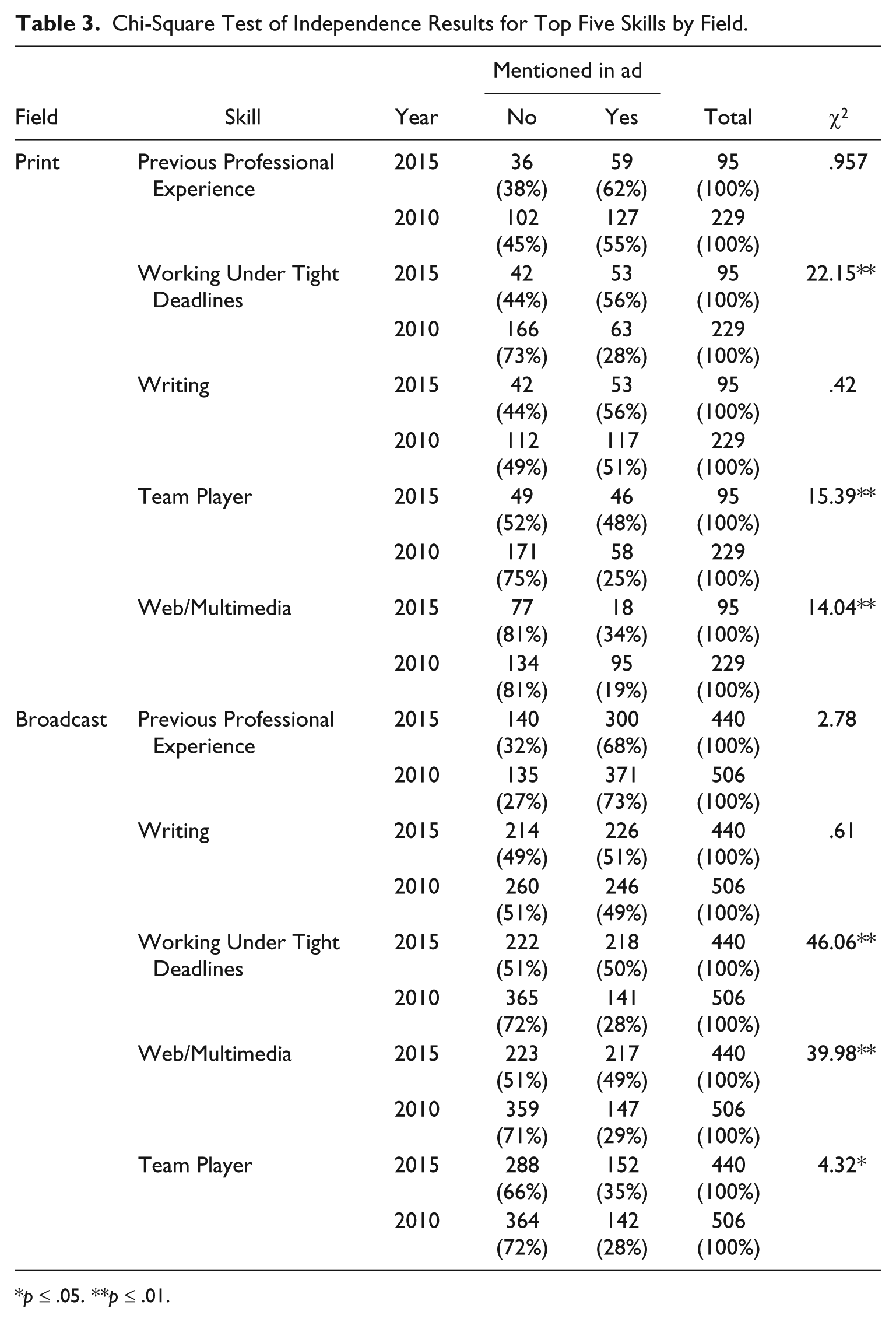
Analysis indicated that the five skills most frequently appearing in 2015 job ads were Previous Professional Experience (72%), Web/Multimedia (62%), Writing (62%), Working Under Tight Deadlines (56%), and Team Player (52%). To determine, if when separated by journalistic field—print or broadcast—if frequencies were significantly different by year, a series of chi-square tests of independence was conducted for print and broadcast separately using Year as the grouping variable (df = 1, and N = 1,844) for all skills listed. 1 The results are contained in Table 3, and once again the continuity corrected value was used due to the tables being 2 × 2. Table 3 also contains a breakdown of frequency for each skill by year and field.
Chi-Square Test of Independence Results for Top Five Skills by Field.
p ≤ .05. **p ≤ .01.
In both the print and broadcast fields, there was a significant departure from expected frequencies for job postings mentioning the skills Team Player, Working Under Tight Deadlines, and Web/Multimedia. Working Under Tight Deadlines and Team Player appeared less frequently in 2015 than the expected count, whereas Web/Multimedia appeared more frequently than the expected count. Previous Professional Experience and Writing remained two of the most common skills listed in job ads, the frequency with which the skill was mentioned had not substantially changed between 2010 and 2015.
Discussion and Conclusion
Evolving Job Duties
Overall, 2015 job postings were more detailed and lengthy as compared with posts for similar positions in 2010. There were still, of course, those postings that were very short and had fewer than five required skills and attributes (11%), but those were in the minority. In fact, 9% of positions referenced at least 20 attributes and skills as requirements. Employers clearly seem to be demanding more from prospective hires.
For job listings categorized as “multiple platform” positions, the researchers found that the posts invariably used the phrase “across all platforms,” when describing the work job candidates must do. For example, if a reporting job for a television station listed as many or more multimedia skills as it did traditional broadcast skills, it was coded as multiple platform. Here is an excerpt including a partial list of skills and attributes from one entry-level, multiple platform employment post: This reporter must be able to break news quickly as well as produce enterprise and watchdog stories by parsing public records and documents, using data and cultivating sources. You should be a self-starter comfortable working in multiple types of media: reporting and writing stories; shooting photos and videos with an iPhone; and immersed in the networks of social media to help spread the word about your great work. You should be nimble and able to tailor your approach to stories to satisfy audiences viewing your work in print or on a desktop browser, mobile device or tablet. But we also want you to cover the news, efficiently and concisely, and break important stories before anyone else.
This is an important finding for journalism educators to consider fully. The employment listing above is for an entry-level newspaper reporter job. How many of the reporting classes in a typical journalism program are incorporating the breadth of skills listed above into the coursework required? According to the findings of this study, this type of skill set and attribute list is what the industry demands of journalism graduates from the very start of their careers.
Social Focus for Jobs
The authors have been tracking social media mentions in job postings since 2010, when references appeared in 2% of postings. The need for social media skills grew over time for all journalism positions analyzed and was of particular importance for jobs coded as multiple platform. In 2012, 30% of all posts referenced social networking (Wenger & Owens, 2013) and that percentage increased to 47% in 2015. Focusing solely on multiple platform positions, 70% of job postings reference a need for those skills.
Pew Research found that after Reddit, Facebook was the social network with the largest percentage of users who get their news there. In terms of social networks used by journalists on the job, the authors did not code for Reddit, but did find Facebook to be the most important social network for journalists with 13% of all employment listings referencing it specifically. Twitter received mentions in 11% of posts and Instagram in 5.3%. Snapchat, Vine, and Pinterest were referenced in less than 1% of posts.
For educators, the big takeaway is that, although strong writing skills were referenced in 71.1% of multiplatform posts, social networking skills were mentioned in 70%. However, few journalism programs spend as much time on social media instruction as they do on more traditional forms of writing.
Schools that are trying to increase the emphasis on social media instruction are most often creating these courses as electives that serve just a small number of students. Although there are many required journalism courses that include a healthy dose of writing, this research suggests that social media is as important and essential to the job of a journalist as broad-based writing skills and should be fully integrated into journalism curricula at this point, as social media are de rigueur in employment listings, as exemplified by these excerpts describing an opening for a breaking news producer: From editing to taking reports from the field and doing rewrite to posting to social media and sending push alerts, this digital producer will exercise and develop skills in many areas. Posts, packages and creates digital-specific breaking-news content, including photo galleries, graphics, links, videos and interactives. Sends push/text and email alerts with urgency and accuracy. Writes platform-appropriate headlines and social-media posts that are engaging, enticing, tone-appropriate and maximizes SEO.
For this producer job, the requirements included a bachelor’s degree with an “internship or previous professional experience preferred.” This is not a position targeting a professional with years of experience; rather it is an entry-level job to which any recent journalism school graduate should feel qualified to apply. This is the skill set the industry demands from journalism degree holders.
Addressing Emerging Challenges
One of the advantages to the longitudinal nature of this research is to track the emergence of skills and attributes that are beginning to resonate within the profession. In 2010, mentions of mobile newsgathering skills were found in just 1.5% of position ads. By 2015, mobile skills were referenced in 35% of job postings—an increase of more than 2,000%.
In 2010, the authors found that knowledge of audience analytics was referenced in just 2% of the postings. In 2015, that percentage had increased to 16%. Focusing on multiple platform jobs specifically, analytics is referenced in 30% of the positions. Common phrases used to describe desirable traits for many of the jobs were “building, maintaining, and engaging the audience”; “using metrics to reevaluate tactics”; and “must build community engagement.” Here is an example from an entry-level job with a local newspaper: As a local reporter, you will leverage your strong reporting background, story-telling skills and news judgment to break news and deliver penetrating beat coverage and enterprise work. We are building a team of top talent in a truly collaborative, performance-based environment that values high-quality reporting and audience engagement across our leading print and digital platforms.
Findings such as these may frighten some journalism educators who quickly raise concerns about pandering and invoke the journalist’s responsibility to inform the public about issues that matter. However, the surest way to promote the misuse of audience analytics is to fail to develop an understanding of how these data can be used to improve quality journalism. Certainly, understanding what formats and subjects resonate with the audience can be helpful in determining how to frame important stories.
Rather than creating stand-alone courses that offer a deep dive into analytics, though that may be appropriate in some instances, educators can introduce students to key concepts by publicly publishing content produced in classes and then using Twitter Analytics, Facebook Insights, or Google Analytics—all free tools that require nothing more than those social media accounts or a website—to start collecting and interpreting data. This practical application of the tools allows instructors the opportunity to discuss how and when audience preferences should be considered as primary factors when making news judgments and offers educators a chance to prepare graduates for jobs like the one excerpted below: Digital producers manage the delivery of content across multiple platforms. They work on deadline and understand the need for posting and pushing content as quickly as possible. Engage with readers by posting links, questions or promotions of Star content to social media and interact with commenters in a professional manner. Use provided online analytics tools to track page views, comments and social media engagement—and uses that information to make content more or less prominent.
The job indicated 2 to 3 years of work experience is ideal, but indicated the employers would consider candidates with work on a college newspaper. Educators are encouraged to think about the doors that could open for students by incorporating instruction related to analytics and audience engagement into our classrooms.
Fundamental Changes
The Knight Foundation’s look at the future of journalism finds journalism curricula lacking in currency, and suggests that the ability to track and adapt to changes in media technology and audience preferences is as important to journalism education as teaching Associated Press style and the inverted pyramid used to be.
The evolution of job postings from 2010 to 2015 supports the notion that the traditional print or TV job is, in many ways, a thing of the past. The increased emphasis on working in teams, under tight deadlines and with a strong foundation of web/multimedia skills, is pervasive in the profession and raises questions about how much those skills and attributes permeate journalism instruction. As recently as 5 years ago, no more than a third of positions (33%) required web/multimedia skills—now it is nearly two thirds of all jobs (62%). Working under pressure and tight deadlines increased from 28% to 56%, and working as a team player jumped from 27% to 52% in those 5 years. Social media grew from references in 2% of job postings in 2010to 47% of all job postings, and the authors anticipate that percentage to increase in subsequent studies.
A challenge for journalism educators is that very few of the skills the authors have tracked over time have seen any sort of decrease in mentions, confirming that the work of preparing a job-ready graduate has never been more difficult. References to foundational skills of writing and reporting are not decreasing, which may give credence to the point of view that what journalism programs have done for years is not any less valuable than it was 5, 10, or more years ago. However, for those programs determined to develop the most job-ready candidate possible, it is important to note that the profession is demanding more from educators and students than ever before.
Footnotes
Declaration of Conflicting Interests
The author(s) declared no potential conflicts of interest with respect to the research, authorship, and/or publication of this article.
Funding
The author(s) received no financial support for the research, authorship, and/or publication of this article.