



Abstract
Education researchers have long been interested in helping students develop effective inquiry questions to guide research projects. In this study, students in a journalism senior capstone used writing-studies informed practices such as middle-stakes, iterative writing prompts to enhance metacognition and critical thinking. Using prompts to guide students to periodically revise their inquiry questions and working thesis statements, students showed improvement in their written products as measured through holistic writing assessment measures. Despite measurable improvement, students’ thesis statements were still lackluster, suggesting that programs should develop connected curricula that sequentially scaffold research methods, critical thinking, and writing skills across the major.
Keywords
Superior writing skills have long been a hallmark of students majoring in journalism, and a love of writing prevails as one of the main motivations for students to choose journalism as a major (Carpenter et al., 2016; Coleman et al., 2018; Hanusch et al., 2016). While good writing skills are a necessary component for producing quality journalism, they are not sufficient in isolation. Journalists’ ability to think critically about their professional practice is ever more important as the field evolves in reaction to disruptions within the industry and society. As journalists constantly adapt their professional skills and knowledge to new situations, they must critically reflect on prior experiences (Burns, 2004). Having the ability to be self-reflexive about one’s professional practice has benefits. Integrating thinking and doing “binds practices with the social and ethical effects produced” argued Burns (2004, p. 14). Furthermore, building metacognitive capacity allows journalists to make the transition from educated beginners to expert practitioners who are able to respond to a variety of situations (Burns, 2004; National Research Council, 2000, 2001; Niblock, 2007).
Despite the importance of developing deep thinking and metacognitive proficiency, explicit instruction in these skills is often neglected in formal learning (Ambrose et al., 2010). In particular, journalism instruction often focuses on creating professional work—news stories—rather than on using the writing process as a tool for improving critical or reflective thinking (Blom & Davenport, 2012). Unfortunately, this emphasis reinforces an artificial divide in writing instruction between the ultimate writing product and the process taken to get there (Masse & Popovich, 1998). This product–process dichotomy aptly parallels the theory–practice divide that has been a feature of long-standing debates about journalism education (Greenberg, 2007; Harcup, 2012). In developing a student-centered journalism program, Deuze (2001) urged the “abandonment of the theory versus practice discussion in favor of a general program toward teaching critical, self-reflection” (p. 15). Similarly, Tulloch and Mas i Manchon (2018) demonstrated a training model designed to bridge this theory–practice divide.
As a path toward improving—and evaluating—critical thinking skills among students (Ruminski & Hanks, 1995), researchers and practitioners alike are interested in evidence-based methods for teaching students how to develop effective inquiry questions to guide research projects. While scaffolding inquiry is an endeavor common across the academy, it is especially relevant for writing-intensive fields like journalism and composition. Despite this common interest, however, there is little communication between the two disciplines regarding teaching and learning practices that promote inquiry, deep thinking, and metacognition. In the spirit of bridging process–product, theory–practice, and disciplinary divides, this study tests a pedagogy informed by both journalism and composition studies: undergraduate journalism students are introduced to mass communication theory, and they use an iterative inquiry process to augment both writing and deep thinking skills.
Literature Review
Writing, Thinking, and Reflecting in Journalism Pedagogy
The continuous dynamic transformations of the news industry mean it “can never be said as to be an expert body of knowledge as such but rather an ongoing series of decisions,” as Niblock (2007, p. 31) wrote, adding: “It is these decisions that need careful illumination through reflexive research.” However, long-standing questions about the usefulness of scholarly research in journalism mean that many journalism programs underplay the importance of academic work in the field (Reese, 1999; Usher, 2017). The perceived relevance of scholarly research (or lack of it) provides both challenges and opportunities for journalism educators. But the reality is that journalism students in higher education rarely engage the research literature, with one notable exception: in capstone or senior seminar classes (Bowe et al., 2018; Rosenberry & Vicker, 2006). While the goal of these classes is often to encourage reflective practice, metacognition and self-efficacy, there is philosophical debate over whether these classes should be considered the closure of a student’s undergraduate education, a bridge to the professional world, or a stepping-stone toward a lifetime of self-directed learning (Bowe et al., 2018; Heinemann, 1997; Rosenberry & Vicker, 2006).
Developing the inquiry and critical thinking skills to build lifelong learners is considered a holy grail in higher education, yet the lack of a standard definition or solid evaluation metrics makes these outcomes elusive (Ruminski & Hanks, 1995). While some have previously argued that critical thinking is a natural result of higher education and that the process of creating works of journalism automatically builds lifelong learning skills (Blom & Davenport, 2012; Nimmer, 1991), others argue that teaching critical thinking requires a conscious decision, systematic planning, and intentional scaffolding (Ruminski & Hanks, 1995).
Although relationship between inquiry, critical thinking, and metacognition remains somewhat murky, the Revised Bloom’s Taxonomy helps illuminate this relationship (Center for Excellence in Learning and Teaching, Iowa State University, 2012). This revised model creates a multidimensional framework by overlaying the original hierarchy with knowledge domains: factual, “knowing about”; conceptual, “knowing that”; procedural, “knowing how”; and metacognitive, “knowing about knowing.” With Revised Bloom’s knowledge domains in mind, metacognition becomes a key aspect of critical thinking and is subject to all of the same cognitive moves as other domains of knowledge. For instance, beginning metacognitive skills might include knowing about: metacognition is “thinking about thinking” (Flavell, 1979; Livingston, 2003). More sophisticated learners will also know how: that is, they will develop strategies for “the process of reflecting on and directing one’s own thinking” (National Research Council, 2001, p. 78). The most sophisticated learners will be able to evaluate their own learning, and they will be able to synthesize or create new strategies when their usual ones fail. In other words, learners monitor and control their cognitive processes through practices like assessing an assigned task, planning an approach for completing the task that accounts for their own strengths and weaknesses, monitoring their acquisition of understanding, evaluating their progress toward task completion, and adjusting their strategy if needed (Ambrose et al., 2010; Livingston, 2003). Flavell (1979) described metacognition as an interplay between the learner’s beliefs about their own abilities; transferring skills derived from prior learning; goals that the learner hopes to achieve; and the actions or strategies the learner employs to reach this desired goal.
While metacognition is a part of all deep thinking, it takes on increasing importance at higher levels of education and in the professional world, as people are confronted with new tasks that require them to recognize what they already know, identify relevant gaps in their knowledge, develop a plan to fill those gaps on their own, and independently monitor their own progress (Ambrose et al., 2010). Research suggests that better metacognitive skills tend to lead to better educational outcomes and such skills can be taught (Livingston, 2003). For example, in a study of prompts used in an advanced communication writing class, reflective writing assignments helped students progress in developing metacognitive awareness of writing strategies, revision, topic selection, their own writing process, time management, and audience (Redwine et al., 2017). In short, they learn to write—and they write to learn.
Writing, Thinking, and Reflecting in Composition Pedagogy
Like journalism scholars, rhetoric and composition scholars have historically recognized the distinction between learning to write and writing to learn. 1 In learning to write, students must master the prescriptive conventions of a new academic discourse community so they can present scholarship in writing that meets the disciplinary and genre-based expectations of experts. In teaching writing across disciplines, instructors must equip students with skills and strategies to make rhetorical decisions aligned with those prescribed by full-fledged members of an academic discourse community. The more closely students approximate those conventions, the more likely they are to be considered “good writers” who produce “good writing.” Of course, the world of professional journalism stands as one particular kind of discourse community with specific and well-established conventions of good writing that frequently emphasizes deadline pressures that do not invite leisurely contemplation.
Although methods of formal writing instruction are rich and varied, standard practices in K-20 education nearly always include an emphasis learning to write using iterative process. The draft-feedback-revise cycle has become standard recursive practice in most college courses that feature research-based writing, but especially in Writing in the Disciplines (WID) contexts. Decades old to composition studies, iterative process has been around even longer in the design world and in problem-based learning. Flower and Hayes (1977) first brought problem-based learning to the attention of composition studies using think-aloud protocols to illuminate the decision-making processes of novice writers. By acknowledging writing as a problem-based activity with no fixed answer, Flower and Hayes introduced an evidence-based rationale for using an iterative process in helping students recursively approximate the formal conventions of prescriptive writing.
But mastering rhetorical conventions does not assure meaningful writing; writing is only as good as the thinking it presents. That is why compositionists also recommend employing strategies like low-stakes writing to prompt-inspired deep thinking. The use of low-stakes writing—writing to learn—is historically linked to inspiration: the development of critical thinking or deep engagement with new learning (Emig, 1977; Fulwiler & Young, 1982). Although transactional writing employs writing to communicate ideas to another (journalistic articles, for example), writing to learn (also known as low-stakes, informal, no-stakes, or quick writing) functions as a medium for thinking, as Forsman (1985) says in the title of her article: “Writing to Learn Means Learning to Think.” Low-stakes writing features prompts that encourage students to chew over new concepts and connect them to previous learning—without any risk of being evaluated for quality of either the thinking or the writing.
In composition, the most studied teaching recommendation pairs low-stakes writing (to scaffold students’ deep thinking) with iterative revising (to scaffold the effective presentation of this deep thinking). However, while most academics eschew binaries, composition educators have created one by virtually ignoring what happens in the liminal space between low- and high-stakes writing. Poorly defined in the literature, 2 middle-stakes writing is defined by the current researchers as writing that includes most of the informality of low stakes but some of the accountability of high-stakes writing. Middle-stakes writing must be turned in and it must be good enough for readers to understand the ideas, but on the contrary, it includes ample permission to take risks: it can be mediocre or just plain wrong. Middle-stakes writing may be evaluated formatively (mostly by students themselves) but it is not graded beyond meeting the basic technical instructions of the assignment. The current research tests the value of using iterative, middle-stakes writing in furthering students’ growth as inquirers. This research addresses two gaps in composition studies: the outcomes of using iterative process in enhancing critical inquiry and of using middle-stakes writing in enhancing both critical inquiry and formal writing skills. In short, this study examines the question: To what extent do middle-stakes, iterative, theory-based prompts improve the development of inquiry questions and the resulting thesis statements?
Methods
Study participants were students enrolled in a senior seminar course taught by one of the study co-authors at a master’s granting public university in the Pacific Northwest over two terms in the academic year 2017–2018. The university’s human subjects research review board determined the project was exempt from review. Over the course of the academic year, this professor taught five sections of the course, with 36 students consenting to participate in the project.
Over the course of each term, students participated in three research and writing workshops designed and taught by library-based research and writing studio professionals, working in conjunction with the journalism faculty member. One workshop served as a “getting started” introduction to the project; the second revolved around finding and using sources; the third related to revising and editing. During each workshop, students engaged in a variety of activities, after which they were asked to fill out an online form prompting them to post a version of their inquiry question and their best guess at an answer for that question. In this way, they were engaged in metacognitive activities while they workshopped their inquiry questions and thesis statements (which function as the answer to the research questions).
For the first workshop, students brought an idea of a question that they would like to examine for their research paper. After submitting the first version of the inquiry question, students were led through an analysis of the assignment. They were also led through a group exercise called “question the question,” in which students broke into small groups and critiqued each other’s questions, looking for vague language, embedded assumptions, and fuzzy thinking. After going through this exercise, they submitted a revised version of their inquiry question, and their best hunch of what the answer to the inquiry question might be—in other words, a guess at their thesis statement.
For the second workshop, students began by submitting their most current inquiry question and updated hunch of what the answer might be. After submitting this revised version of the inquiry question, students broke into small groups and explained how their questions evolved over time. Peers were encouraged to offer feedback. Then, the entire class was given some lecture material about how to use sources in their paper and some individual work time to find sources. After this period of peer critique and focused engagement with academic literature, the students again revised their thesis-hunch pairs.
The third library session occurred after students were through with data collection and were working on their thesis statements in earnest. They began the session by submitting their current version of an inquiry question and a draft of their actual thesis. To help them step back from the data and see the big picture, students were first led through a mind-mapping exercise to help them visualize their findings. They then participated in a “question the thesis” strategy very like the one used to focus the inquiry question in the first library session. Using both the mapping and thesis exercise to revise, they then submitted another iteration of their tentative question/thesis pair. The journalism faculty member collected the final version of both the inquiry question and thesis from the final papers submitted for grading.
Preworkshop/postworkshop iterations of inquiry questions and working thesis statements based on medium stakes writing prompts were collected via a Google form, supplying a corpus of 364 inquiry question/thesis iterations. Responses were holistically rated by composition study co-authors outside of the field of journalism. Each inquiry question/thesis was scored independently by two raters; scores were averaged. When raters disagreed by more than two points, a third rater also scored. Highly aberrant scores (rare) were tossed; otherwise all three ratings were averaged. Raters based their ratings on pre-established criteria of good inquiry questions and working thesis statements as instructed in both the class and the research-writing workshops. Pre-established quality criteria include focus, specificity, and quality of investigation, and raters used a 0 to 3 rating scale (see Appendix). All methods, including quality criteria, iterative sampling, and ratings protocols were established based on existing scholarship. For instance, both classroom and workshop curriculum supported quality criteria informed by developmental models of growth in cognition indicated in a Revised Bloom’s Taxonomy (Center for Excellence in Learning and Teaching, Iowa State University, 2012). Criterion-based writing assessment, iterative sampling, and holistic rating protocols are established student learning outcomes assessment methodologies in the field of composition (Charney, 1984; Elliott & Perelman, 2012; Huot, 2002; Huot & O’Neill, 2007).
Findings
Over all four submissions of inquiry question/working thesis statements, the average change in score was +1.9 points (+21%) (Table 1). To illustrate using the “focus” criterion, two points of growth might mean that a student may have gone from starting with a very broad question “How does the media portray women?” to a question more narrow (but not perfect) in scope “How did popular cooking magazines portray women in 2017?” A question that grew three points might also have specified a narrower scope for the type of evidence being investigated, for example, front covers or interviews. Researchers determined that two or more points of growth indicates meaningful learning.
Inquiry Question/Thesis Scores and Growth.
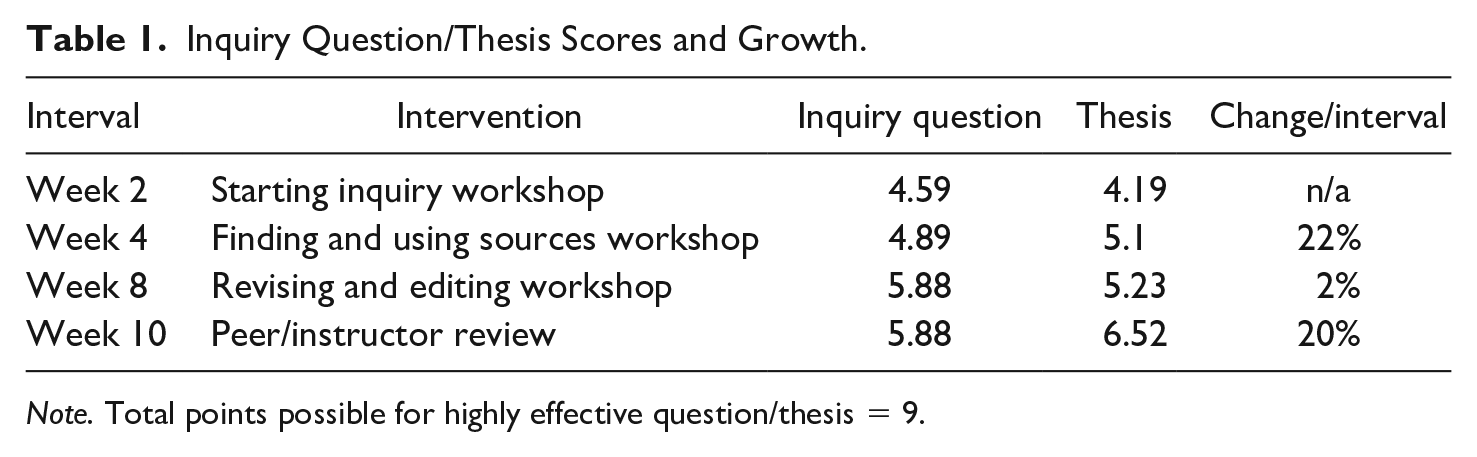
Note. Total points possible for highly effective question/thesis = 9.
This growth, however, was not linear. Although not all students “backslid” and the timing of the backslide varied, most students submitted at some point an appreciably worse iteration before writing a significantly better one. Owing to this fluctuation, we found it helpful to look for minimum and maximum scores achieved throughout any part of the process. For instance, adjusting the scores to a 100-point scale, the average maximum score achieved by one student at any time for a question or thesis was 78/100, while the average minimum score achieved by one student at any time for question or thesis was 39/100. Interestingly, thesis statements submitted in final drafts of papers were not necessarily students’ best work. On average, students’ final thesis statements rated only 72/100 points. Overall, question/thesis quality varied widely, both from student to student and also within one student’s learning process.
Discussion
A senior-level capstone class is an appropriate venue to focus on metacognition because the ability to self-monitor understanding and take appropriate action is the mark of an expert (National Research Council, 2000, 2001), and thus focusing on a student’s major area of expertise allows them to tap into their discipline-specific knowledge. The results showed that over the course of the term, students consistently moved away from their initial assumptions, which were often loaded with implicit biases, toward perspectives that were more examined and reasoned. These more reasoned perspectives contained more nuance, suggesting that the metacognitive thinking prompted by re-engaging with the inquiry questions repeatedly throughout the quarter was successful in supporting students’ growth in critical thinking (Figure 1).
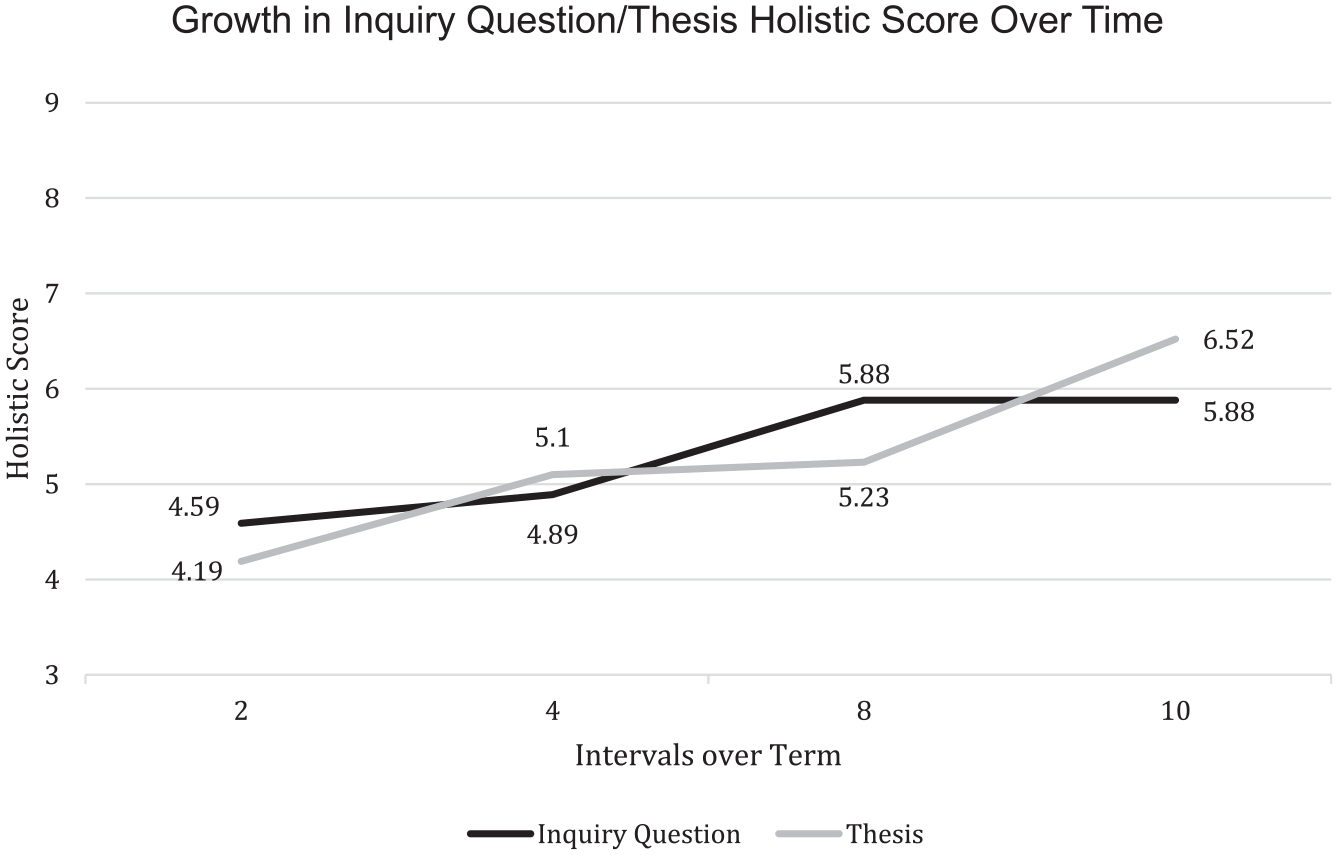
Growth in inquiry question/thesis score over time.
Although student scores grew 21% from start to finish, many students still did not reach a level of development that instructors may expect from senior-level capstone projects. In fact, the final thesis statements were generally of middling quality—a vexing outcome, given departmental, faculty, and student expectations for capstone course performance. The average final scores indicate that students began to consistently apply good thinking practices to guide their inquiries. But they generally did not achieve a high level of sophistication in thesis statements by the time they turned in their papers, leaving researchers to conclude one term is simply not enough to scaffold students in formulating a research question, developing methods, collecting and analyzing data, and forging new theory in ways that reflect a strong level of media literacy.
Rather than blaming students for being underprepared or not taking the assignment seriously, the current findings emphasize how essential it is for instructors and administrators to ensure that writing instruction is ongoing and supported in multiple ways throughout students’ undergraduate trajectories and to ensure that writing instruction goes well beyond surface-level academic or professional conventions into the much-talked-about but often poorly supported realms of metacognition and critical thinking. It is equally instructive for faculty to realize that even highly sophisticated assignments well supported with thoughtfully scaffolded instruction will yield student outcomes typical of entry-level journalists, not mid- or late-career ones. In short, this research demonstrates that administrators, faculty, students, and future employers should maintain reasonable expectations: neither writing nor critical thinking are perfectly acquired in 2 years let alone 10 weeks. These students are likely to be right where they need to be; more sophistication on these types of tasks is likely more suitable for graduate students who receive more in-depth instruction in conducting empirical research.
Alternatively, it could be argued that this genre of academic paper (IMRD—Intro, Method, Results, Discussion) does not best support students in displaying the critical thinking they are capable of. It is conceivable that students’ metacognitive efforts were torn between learning new critical habits of mind at the same time as they struggled to master a new genre, one that academics value but that students might perceive as irrelevant to their future careers. The cumulative cognitive challenge may have simply made it so students could not perform optimally in either task. Professors should be encouraged to experiment with assigning other presentation formats—podcasts, blogs, explanatory feature stories, videos, and so on. A more familiar mode of presentation allows students more creative space to explore new ideas and take intellectual risks without the fear of presenting these discoveries according to genre expectations that are both rigid and unfamiliar.
Pedagogical research is pointless if it does not inform actual course design. After collecting and analyzing the data, the lead author engaged journalism department colleagues in revising this capstone. Collectively, they standardized their syllabi and incorporated the workshop model. Some have opted to replace the final research paper with a more flexible research blog assignment. While it was helpful for them to collaborate on scaffolding the information within this one class, there remains more work to be done to infuse some of these ideas elsewhere in the curriculum to make this class less overstuffed. Increasingly, this capstone may need to minimize academic writing in favor of a more single-minded focus on supporting theory-informed inquiry habits of mind. Rather than leaving all of this sophisticated learning to a senior seminar, departments could ensure earlier instruction in research methods and theoretical ideas throughout the curriculum. Packing both in a single term results in the construction of a steep scaffold indeed.
While instructive, this research contains some limitations. Most notably, the exploratory results presented here represent the experiences of the students of one professor at one university. A more systematic examination across instructors and institutions would be helpful in illuminating these findings. Nevertheless, this journalism- and composition-informed co-inquiry suggests that the iterative, mid-stakes writing process holds promise for teaching writing and meta-awareness. Iteration, particularly in repetitions of the “question the question/thesis” strategy, seemed to expose and confront students’ stated or unstated assumptions. It is the undoing of those assumptions that leads to reasoned and balanced journalistic practice, not to mention quality research.
In addition to the iterative, mid-stakes teaching practices used here, there are additional ones that might build on this initial success and lead to even better outcomes for students. Since even senior journalism students are not immune from discussing “the media” in monolithic, un-nuanced terms, professors could take a more intentional approach to blowing up student assumptions or naïve understandings of the field. To offer one example, an examination of the international differences among journalists in how they think of the profession based on the Worlds of Journalism study 3 prompted students to question their own conceptions of the profession in a productive way.
Concluding Remarks
Two decades ago, Reese (1999) argued “criticism of journalism education is tied to the crisis of legitimacy within journalism itself, leading an ever more concentrated and corporate voice to assert itself” (p. 71). Much has changed since then, though this sense of crisis remains. To begin with, there has been a reorganization of the profession, with small players forced out and traditional economic models no longer viable (and no obvious replacement at hand). Compounding that, regimes globally are increasingly hostile to the press, while public trust in journalism is at all-time lows. This reality underscores why journalism students need to be equipped not only with the skills to fit into established professional roles, but the critical thinking competencies to, in Reese’s (1999) words, “challenge the simplistic professionalism that assumes its own validity and prevents turning on itself the kind of questioning that journalism excels in directing at others” (p. 90). Helping students develop robust and balanced inquiry questions to guide their journalist research is one important step in helping students turn a necessary critical eye on their own practice.
Footnotes
Appendix
Scoring Criteria.

| Scoring criteria with examples | ||||||
|---|---|---|---|---|---|---|
| Score | Focus |
Specificity |
Quality |
|||
| Criteria | Example inquiry | Criteria | Example inquiry | Criteria | Example thesis | |
| 0 | Extremely broad: Can’t be addressed in one term; no attempt to limit scope | How are athletes portrayed? | Ambiguous: Entire question/thesis is vague or confusing | How does media coverage affect athletes’ lives? | Neither complex or meaningful: question/thesis lacks nuance and “so what” significance | The media covers athletes differently |
| 1 | Broad: Can’t be addressed in one term; some attempt to limit scope | How are female and male athletes portrayed differently in the media? | Some ambiguity: Some aspects of question/thesis are not concrete | How are female and male athletes portrayed differently on ESPN? | Complex but lacks meaning: question/thesis nuanced but lacks “so what” significance | ESPN does twice as many feature stories on male vs. female professional athletes |
| 2 | Average: Could be addressed in one term with slight modification to scope | How does the way male and female athletes are portrayed in the media affect PR strategies? | Little ambiguity: One aspect of question/thesis is not concrete | How do ESPN post-game interviews with female athletes affect franchise PR strategies? | Meaningful but lacks complexity: question/thesis has “so what” significance, lacks nuance | Since ESPN does fewer post-game interviews with female vs. male professional basketball players, female franchises suffer |
| 3 | Focused: Scoped appropriately to be fully addressed in one term | How do TV features on male and female professional basketball athletes affect franchise PR strategies? | No ambiguity: All aspects of question/thesis concrete | How do ESPN post-game interviews with female professional basketball athletes affect franchise PR strategies? | Complex and meaningful: question/thesis is nuanced, has “so what” significance | Given scant coverage of female pro basketball players on ESPN, successful PR cultivates fan and sponsor support through social media strategies |
Acknowledgements
The authors acknowledge undergraduate research assistants Tian Qing Yen and Alyssa Kaufman, whose help was instrumental in completing this work.
Declaration of Conflicting Interests
The author(s) declared no potential conflicts of interest with respect to the research, authorship, and/or publication of this article.
Funding
The author(s) received no financial support for the research, authorship, and/or publication of this article.
