



Abstract
The purpose of this study was to understand better how a conversational human voice versus a corporate tone of voice in blogs affects key publics’ responses to an organization in the context of a crisis, using a 2 (tone of voice: human/organizational) × 2 (source: public relations executive/private citizen) × 2 (crisis response: defensive/accommodative) mixed experimental design. Results indicate that first-person voice and personal narratives increased perceptions of social presence and interactivity in online communication. These perceptions subsequently resulted in positive post-crisis outcomes, such as reputation and behavioral intentions.
The growing popularity of social media has stimulated public relations (PR) professionals to integrate social media elements into their communication planning and has led scholars to focus attention on the potential that these new communication tools imply for PR practice. 1 Given its potential for faster and more dialogic communication, the effective use of social media for managing a crisis has gained enthusiastic research interest. 2 However, research on social media in crisis communication is still in its inception and offers a host of unanswered questions, such as whether the tone of voice delivering crisis messages affects public responses and whether the credibility of those messages varies as a function of the source.
Based on social presence theory, 3 this study posited that using the first-person voice and personal narratives, as opposed to a corporate tone of voice, increases perceptions of social presence and interactivity in online crisis communication. These perceptions may subsequently result in positive outcomes of crisis communication, such as public acceptance of an organization’s response, favorable corporate reputation, and behavioral intentions toward an organization. Another aim of this study was to explore how the type of source (organization-affiliated blog vs. personal blog) and crisis response strategies (defensive vs. accommodative) interplay with the tone of voice (human vs. organizational) in crisis communication via social media.
The presumed effects of these factors were examined using blogs, which are part of the social media venue and often spark conversations on Twitter and Facebook. 4 While blogging and blog reading have appeared to decline due to the proliferation of other social networking tools, blogs remain an important online platform for information sharing. 5 Compared with personal and professional social networking sites, blogs are more likely to facilitate conversational discussions and stimulate more meaningful feedback from other users. 6 Indeed, social media users seem to perceive blogs as venues for obtaining in-depth information but prefer social networking sites such as Facebook for creating and managing relationships. 7
As social media sites grow in popularity, it is important to understand the potential of social media tools for PR practice. Research on online PR and crisis communication can gain from this study by expanding the application of crisis communication strategies beyond traditional media and examining source credibility effects within the new communication environment.
Literature Review
Use of Social Media for PR and Crisis Communication
As the popularity and potential of social media provide a variety of opportunities for organizations, an increasing number of companies and nonprofit organizations are using social media sites to inform others about their products and services, streamline internal communication, and foster relationships with important publics. 8 There is growing consensus among PR practitioners that blogs and other types of social media enable more instantaneous communication both inside and outside of organizations, thereby improving practice. 9
Recent research points to social media as being potentially effective and powerful tools for crisis management because of their ability to disseminate information quickly 10 and to present genuine concerns for related publics. 11 When a crisis occurs, individual members of the public want explanations in plain language to make sense of what happened when and to reduce uncertainty. 12 Thus, social media messages in a first-person narrative style are more likely than official responses via traditional media to help victims and other publics understand how a series of events occurred within the context of a crisis 13 and provide them with emotional support. 14
Of the wide range of social media tools, blogs are considered to be effective venues for providing or obtaining in-depth information and receiving meaningful feedback. 15 By virtue of the blog writing style, usually represented by authentic conversations, blogs are especially ideal for crisis situations in which detailed explanations in plain language are necessary to alleviate fright and anger among publics. 16 Thus, the present study sought to extend understanding of effective crisis communication by using blogs as social media channels.
Conversational Human Voice and Social Presence Theory
In social media spaces, where communication occurs through constant and interpersonal interactions, publics expect organizations to pursue authentic, transparent conversations in a human voice rather than to provide organizational messages as delivered in their press releases. 17 To exploit the full potential of strategic online communication, an organization needs to incorporate a human tone of voice in its social media site rather than a corporate tone of voice. Kelleher 18 describes a conversational human voice as “an engaging and natural style of organizational communication as perceived by an organization’s publics based on interactions between individuals in the organization and individuals in publics.”
The use of conversational human voice can increase publics’ positive responses to an organization, as it generates perceptions of transparency and openness in the organizational dialogue with its publics. 19 Previous studies on organizational blogs have shown that a human voice of an organization can play an important role in promoting satisfying relationships with key publics online. 20 Furthermore, even in times of crisis, a conversational human voice in organizational communication may increase positive attitudes toward an organization, as well as intentions to engage in word-of-mouth (WOM) communications, while reducing negative emotions about the organization. 21 Sweetser and Metzgar 22 found that the use of conversational human voice on an organizational blog, as well as responsiveness, plays an important role in reducing perceptions of a crisis and in maintaining relational trust.
The strategy of using conversational human voice and its potential impact pertain to ideas that underlie the social presence theory proposed by Short, Williams, and Christie. 23 The core assumption of social presence theory is that a critical aspect of communication channels pertains to the degree to which the counterparty is perceived as being real in a mediated communication environment. Within this framework, the concept of social presence is defined as “the degree to which a person is perceived as a ‘real person’ in mediated communication.” 24 This definition implies that perceptions of social presence increase as more interpersonal interactions are perceived in an online context.
The literature suggests that the addition of a personal dimension to online communication brings about increased feelings of human contact and creates the illusion of interpersonal communication. 25 For example, fostering an informal and friendly atmosphere through first-person narratives is likely to make blog visitors feel as though they are interacting with actual human beings. 26 As such, without face-to-face conversations, social presence is more likely to emerge in communication that conveys a feeling of personal human contact than in interactions devoid of a human voice. 27 Thus,
Perceived Interactivity
The concept of interactivity has been studied extensively and measured as one of the key characteristics of new media. 28 While interactivity is a driving force for using social media, 29 measuring interactivity is not an easy task because it occurs as a dynamic process rather than as a single state at a specific moment. 30 In this respect, interactivity may be better understood if it is measured by psychological factors representing what individuals perceive as being interactive rather than by interactive features of a medium. 31
Integrating the construct of social presence, Thorson and Rodgers 32 defined perceived interactivity as “the extent to which users perceive their experience as a simulation of interpersonal interaction and sense they are in the presence of a social other.” High interactivity was manipulated in their study by providing a candidate’s personal web journal written in first person along with a feedback forum, whereas the low interactivity condition contained the same text written in third person with no feedback button. They found that the use of human voice and the feedback mechanism positively influenced perceived interactivity and interpersonal involvement with the candidate. In the context of crisis communication, blog posts with a salient narrative structure appeared to increase perceived interactivity more than did those conveying general knowledge. 33
Previous studies on social presence suggest that personal narratives or personalization of content can instill a sense of personal contact and human warmth, and further result in increased perceptions of interacting with another person. 34 It is reasonable to assume that the use of a human voice versus an organizational voice is more likely to induce perceptions of interactivity in crisis communication via social media. Thus,
Source Credibility
Source credibility is conceptualized as the characteristics of the message sender that have an impact on the receiver’s processing of the message. 35 Because source credibility is assumed to influence people’s evaluations of a message, such as accuracy and truthfulness, 36 credibility judgments can be an important determinant for the effectiveness of organizational crisis responses in increasing positive outcomes. 37 Thus, it is important for an organization to choose the right spokesperson for representing the organization during a crisis.
Perceptions of source credibility can be affected by publics’ expectancies and prejudices, which frame their beliefs about whether a communicator tends to tell accurate and truthful information or to deliberately distort the reality of a situation. 38 Previous studies have shown that PR professionals are perceived as being less credible, more dishonest, and less trustworthy than other employees affiliated with a company and independent sources. 39 While the difference in credibility perceptions may result from different degrees of interpersonal similarity with the sources, 40 it is more likely that PR sources are deemed to have a reporting bias, which refers to a tendency to withhold certain facts caused by situational pressures or expectations from audiences. 41 In other words, publics do not associate PR with telling the truth because they think that PR practitioners want to present an organization in the most favorable light and meet audiences’ expectations to convince them to believe in the organization.
The reporting bias becomes more salient in the minds of publics in times of crisis because organizational responses to a negative event increase public scrutiny. 42 Thus,
Crisis Communication Outcomes
The strategic use of crisis communication can influence the degree to which publics perceive an organization to be responsible for a crisis. 43 Emphasizing the benefits of using narratives in crisis communication, Heath and Palenchar 44 note the following: “Narrative frames people’s understanding of the past, knows what is occurring in the present, and projects events into the future.” In this sense, blogs and other social media sites offer organizations ideal platforms through which they can tell their side of the story, articulate their plans for solving problems, and garner support from their key publics. 45
Account acceptance
The use of conversational human voice in crisis responses may promote the likelihood of accepting an organization’s account of a crisis. 46 However, not only do publics want to communicate with sociable and friendly bloggers, but they also tend to prefer obtaining information from bloggers who are perceived to be credible. 47 Based on the credibility literature, 48 publics are more likely to think that a crisis response is appropriate and genuine when it is provided by a communicator with greater credibility. In addition to potential effects from voice and source, the type of crisis response used by an organization may come into play in determining publics’ evaluations about the appropriateness of the response and their willingness to accept the organization’s explanations. 49 Therefore,
Reputation
Organizational reputation is important because it is the core factor that differentiates an organization from its competitors and induces continuing support for the organization. 50 While corporate reputation serves as a buffer against negative reactions from publics during a crisis, 51 it is also an important asset that an organization wants to protect from damage. 52
Research on social presence has suggested that greater perceptions of communicating with another person on a website lead to more positive attitudes toward the website and the sponsoring organization. 53 Within blogs, Kelleher 54 found that conversational human voice positively influences relational outcomes such as trust and satisfaction, which are often considered antecedents of favorable corporate reputation. 55 In terms of crisis management, conversational human voice seems to benefit an organization, as it reduces negative perceptions of an organization in crisis. 56 In delivering organizational messages, publics’ attitudes toward an organization may also be influenced by the communicator’s credibility. 57 Based on these rationales, the following hypotheses and research question were proposed:
Behavioral intentions
Maintaining a favorable reputation is expected to bring positive tangible and intangible outcomes, such as purchase of a company’s products and positive WOM, which enable organizations to overcome critical situations and achieve maximum effectiveness. 58 Given the link between corporate reputation and favorable behavioral intentions toward an organization, 59 it is highly plausible that there exists a spillover effect from perceived reputation onto intentions for organization-favoring behaviors (purchase, dialogic communication, and WOM). Therefore, the following hypotheses and research question were proposed:
In an effort to gain a more comprehensive understanding of crisis communication via blogs, this study examined the role of perceived interactivity as a mediator between the narrative style of crisis messages and the abovementioned outcomes. Perceived interactivity has been assumed to serve a mediating role in many studies concerning online communication. 60 For example, perceived interactivity appeared to mediate the effect of blog-mediated responses using a first-person voice in increasing publics’ acceptance of organizational accounts and favorable attitudes toward an organization. 61 Thus, the following research question was proposed:
Method
This study used a 2 (tone of voice: human/organizational) × 2 (source: PR executive/private citizen) × 2 (type of crisis response: defensive/accommodative) mixed experimental design. Tone of voice and type of source served as within-subjects factors, and type of crisis response was a between-subjects factor.
Participants
Participants for this study were 117 college students. A larger percentage of the participants were female (65.8%, n = 77) than male (34.2%, n = 40). Participants ranged in age from eighteen to twenty-nine with an average age of twenty (SD = 1.71).
Stimuli Development
In the current experimental design, the use of a single crisis story is not ideal because it would require participants to view four different versions (Voice × Source) of the same crisis story with only a few message features altered. For this reason, two crisis scenarios, ice cream and cookie dough recalls, were used to produce the different versions of stimuli within each treatment level, thereby creating message variance as well as treatment variance. 62
As stimulus materials, four mock-up blogs were created in pairs, with each pair devoted to an ice cream and a cookie dough recall. To avoid any potential bias from previous experience, fictitious company names were used. In an effort to make the fictitious product recalls appear realistic, the crisis scenarios were created based on actual product recall cases, such as Nestlé’s recall of its Toll House refrigerated cookie dough products in 2009 and a nationwide recall of food flavoring additives ordered by the U.S. Food and Drug Administration in 2010. The reason for both recalls in the stimuli was food poisoning, the exact cause of which was held as undetermined by mentioning that the companies were currently searching for the source of the food poisoning in cooperation with a public health department. All scenarios included information about the severity of the food poisoning (e.g., three hospitalizations and no death) and how to contact the company for questions about the recall. With the four blog templates, a total of twenty blog pages were created: four “about me” pages and sixteen different blog posts about the crises—four written by each blogger (two types of voice × two types of crisis response). These blog posts were similar in length. Other factors that could have affected the attractiveness of blogs, such as color tone, font, and content of images, were consistent across the stimuli.
Counterbalancing of Stimulus Orders
This study used a counterbalanced design to control for stimulus order effects. A cross-combination of the three manipulated factors with the two types of product recall produced four stimulus sets, each of which included four different blogs (see Table 1). The four stimuli in each set were arranged in twenty-four random sequences, and four sets of four stimuli each resulted in ninety-six possible orders of presentation.
Composition of Stimulus Sets (N = 117).
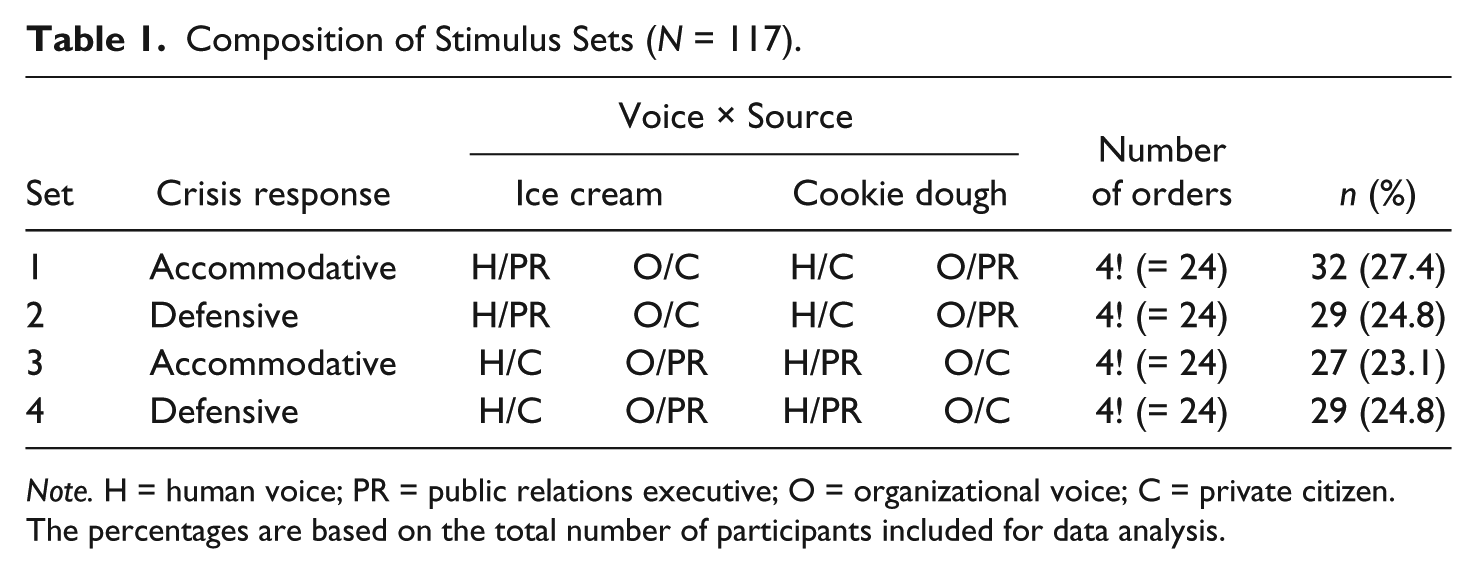
Note. H = human voice; PR = public relations executive; O = organizational voice; C = private citizen. The percentages are based on the total number of participants included for data analysis.
Independent Variables
Tone of voice
Based on Kelleher’s 63 conceptualization of the human voice, the tone of voice was manipulated by using different forms of narratives, as well as including or not including a blogger’s personal story. Blogs using a human voice were written in the first person and involved a blogger’s personal experiences and thoughts that were relevant to the crisis (e.g., a blogger’s constant craving for ice cream), whereas those using an organizational voice provided only straightforward information about the crisis in the third person.
Source
The type of source was manipulated as being either a PR practitioner or private citizen. PR practitioners introduced themselves as senior PR executives working for the company for ten or twelve years. Private citizens were operationalized as personal bloggers who are not associated with the company and who write food blogs as a hobby.
Crisis response
Based on the accommodative-defensive continuum developed by Coombs, 64 the type of crisis response strategy was manipulated into two levels (defensive vs. accommodative) to represent different degrees to which an organization has accepted responsibility for a crisis and has apologized to the public. In the defensive response condition, the company attempted to deny any possible mistake and minimize its presumed responsibility for the crisis (e.g., no fault found at its processing system). A blame-shifting strategy was also used, as the company was implicitly attributing the cause of the food poisoning to its contractor or customers (e.g., not following the instructions on the package). In the accommodative response condition, the company apologized for its mistake and tried to demonstrate its positive actions in taking steps to correct the situation (e.g., implementation of safety procedures).
Dependent Variables
Social presence
Participants were asked to rate how they felt about the blog based on the way the blogger wrote about the product recall. Four 7-point bipolar items suggested by Short, Williams, and Christie 65 were used: impersonal/personal, unsociable/sociable, insensitive/sensitive, and warm/cold (α = .83).
Perceived interactivity
Perceived interactivity was assessed using seven 7-point Likert-type scale items adapted from McMillan and Hwang. 66 Examples of the items are “Interacting with this blog was like having a conversation with a representative of the organization” and “I felt as if this blog talked back to me while I was reading the post” (α = .87).
Perceived blogger credibility
The following five 7-point semantic differential items from Kang 67 were used: (a) unknowledgeable/knowledgeable, (b) not influential/influential, (c) indifferent/passionate, (d) secretive/transparent, and (e) unreliable/reliable (α = .80).
Account acceptance
Acceptance of the company’s crisis response strategies was measured with a single-item measure, as in Jin’s 68 study: “How acceptable do you think the actions taken by the company are?” (1 = not acceptable at all, 7 = totally acceptable).
Organizational reputation
Perceived reputation was measured using eight 7-point Likert-type items from the Harris-Fombrun Reputation Quotient. 69 This reputation scale included items such as the following: “I have a good feeling about this company” and “I think this company would offer high-quality products and services” (α = .97).
Behavioral intentions
Purchase intention was measured using two 7-point items adapted from Coyle and Thorson 70 : “I would purchase products from this company” and “I would try products from this company” (α = .93). Six 7-point scale items from Bettencourt 71 were used to assess participants’ intentions to engage in dialogic communication with a company. Examples of the items are “I let this company know of ways that they can better serve my needs” and “I make constructive suggestions to this company on how to improve its service” (α = .95). Word-of-mouth intention was measured using four items on a 7-point scale adopted from Brown, Barry, Dacin, and Gunst. 72 Examples of the items are “I would encourage friends to use services from this organization” and “I would encourage family members or relatives to use services from this organization” (α = .98).
Manipulation Check
The voice manipulation (human vs. organizational) was assessed in terms of the narrative form and the inclusion of personal stories. The use of personal narratives was measured with the following Likert-type item ranging from 1 (strongly disagree) to 7 (strongly agree): “The blog posting about the product recall includes the blogger’s personal story or thoughts.” Nine items adapted from Kelleher and Miller 73 were also used to assess participants’ perceptions of conversational human voice on the blog page. The effectiveness of the crisis response manipulation was assessed using a semantic differential scale ranging from 1 (denial) to 7 (apology).
Data Collection Procedure
The experiment took place in a campus computer laboratory. Participants were randomly assigned to one of the four sets of experimental conditions. First, they were presented with one of the four blogs, the order of which was randomized. The screenshots of the stimulus blogs were taken and embedded as image files in the online questionnaire. Participants first read the “about me” page of the blog, which contained the source biography of a blogger who was either a senior PR executive or private citizen. This was followed by a blog post pertaining to the ice cream or cookie dough recall, written either in first person or third person. Then, participants responded to questions measuring the dependent variables. The process of reading blog posts and answering the questions was repeated for the remaining three stimuli. It took approximately twenty to thirty minutes to complete the entire study.
Results
Manipulation Check
Participants perceived blog posts written in a human voice (M = 6.44) as containing personal thoughts and opinions more than those written in an organizational voice (M = 2.39), t(116) = 23.47, p < .001. Participants were also more likely to perceive blogs written in first person (M = 5.34) as using conversational-style communication than those written in third person (M = 3.52), t(116) = 11.86, p < .001. Regarding the type of crisis response strategy, participants exposed to the accommodative responses (M = 6.03) as opposed to the defensive responses (M = 3.72) were more likely to perceive a company’s response as resembling an apology rather than denial, t(115) = 8.24, p < .001.
Tests of Hypotheses and Research Questions
The type of source and the type of crisis response, however, significantly affected account acceptance, F(1, 115) = 6.41, p < .05,
In addition to the main effects of source and response type, there was also an interaction effect between these two factors, F(1, 115) = 7.92, p < .01,
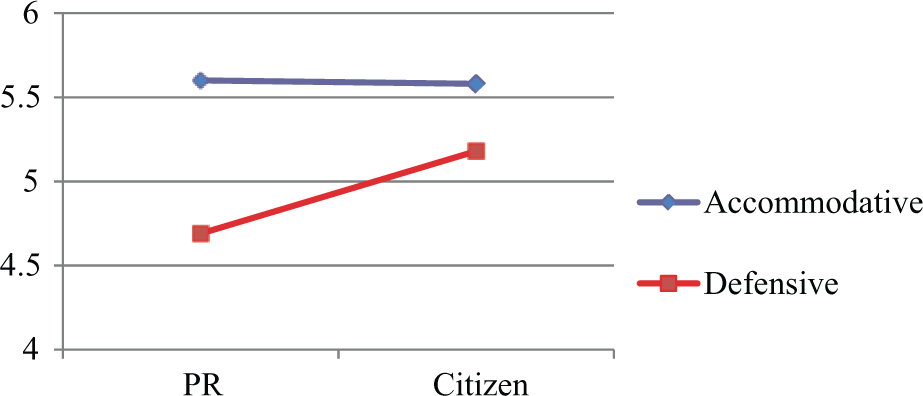
An interaction effect between source and response type on account acceptance.
There was no indication of a significant interaction effect between voice and source, F(1, 115) = 0.01, p = .92, or between voice and response type, F(1, 115) = 2.20, p = .14. The three-way interaction was also not significant, F(1, 115) = 2.10, p = .15. These results answered
Source type did not significantly affect behavioral intentions in favor of the organization, Wilks’s Λ = .95, F(3, 113) = 1.95, p = .13. Thus,

Path diagram of mediation analysis: Mediating role of interactivity.
Both path models for PR and citizen bloggers were evaluated to have good data-model fits based on Hu and Bentler’s 75 criteria. Perceived interactivity appeared to mediate the effect of voice on post-crisis communication outcomes. However, there were differences observed in the processes through which this mediation occurred. For the PR blogger, the use of human voice influenced organizational reputation through two routes: (a) voice → interactivity → reputation and (b) voice → interactivity → account acceptance → reputation. The tone of voice significantly affected perceived interactivity (β = .50). This interactivity variable, in turn, had a positive effect on organizational reputation (β = .16), as well as on account acceptance (β = .26), which subsequently influenced organizational reputation (β = .58). For the private citizen blogger, however, there was only one path through which the human voice affected organizational reputation. The human voice had a significant effect on perceived interactivity (β = .57), which resulted in increased reputation (β = .21).
Discussion
Social media raise the question of how PR practitioners can use the potential of these new communication platforms to achieve organizational objectives and mitigate crisis situations. The current study addressed this question, suggesting the use of conversational human voice as a key factor in crisis communication via blogs. Blogs are not representative of social media as a whole, but they are considered to be an ideal venue for communicating with publics in times of crisis. 76 As these online venues are where substantive conversations often occur, 77 blogs were chosen to create stimulus materials for this study. The overall results support the notion of social presence theory that greater perceived social presence, implying human contact, in the mediated communication context leads to greater persuasive impact of the message being conveyed. 78
Blogs with first-person narratives appeared to create a more personal and sociable atmosphere for blog visitors than did those devoid of personal stories and thoughts. More importantly, increased social presence, in turn, appeared to promote perceived interactivity in online communication with an organization. This result is consistent with Kelleher and Miller’s 79 finding that personal journal-type blogs are more capable of emulating and displaying interpersonal communication attributes than are organizational websites using more of a declarative tone. Accordingly, conversational human voice can serve as a viable and effective tactic for dialogic communication online by bringing some sense of human presence and warmth that underlies the facade of an organization to the communication context. 80
Another important insight involves source credibility. The more favorable judgments about the credibility of PR bloggers found in this study cast doubt on the common belief that PR sources are perceived as less credible and trustworthy than third-party, independent sources. 81 This result is promising for PR professionals, suggesting that they hold credibility in the new media environment and can serve as reliable spokespersons for an organization during a crisis. Heath and Palenchar 82 note that high uncertainty and anxiety caused by a crisis make publics more attentive to organizational messages and more willing to communicate with an organization during a crisis. Given this condition, an organization can benefit from strategically using a spokesperson perceived as being credible in reducing negative crisis perceptions and presenting its commitment to correct problems. However, participants’ willingness to accept an organization’s accounts appeared to be higher for the citizen blogger than for the PR executive. This is somewhat counterintuitive in that account acceptance did not parallel credibility judgments. More research is needed to examine how PR practitioners can take advantage of their credibility in increasing publics’ acceptance of organizational messages.
Although there was no significant direct effect from tone of voice on organizational reputation, the use of the human (as opposed to organizational) voice did promote stronger intentions to purchase a company’s products and engage in dialogic and WOM communications. Publics’ willingness to communicate with an organization may be particularly important in the aftermath of a crisis because feedback from key publics helps an organization measure the impact of a crisis and take appropriate steps for recovery and growth. 83 Given the growing popularity of social media, communicating in a human voice may encourage positive WOM behaviors and thereby gain viral attention. Positive WOM communication can serve as free advertising and reduce promotion and advertising costs for companies. 84 The development of online communication tools has made WOM easier and more influential due to their speed in reaching many people simultaneously.
Two-way interactive communication is vital for effectively managing crises and building trusting relationships with key publics before and after a crisis. 85 A key insight from this study is that perceptions of interactivity are significantly influenced by social presence, which results from the use of human voice. The path analyses also suggest that perceived interactivity serves as a bridge between conversational human voice and outcomes of crisis communication, such as reputation and supportive behavioral intentions. This pivotal role of perceived interactivity as a mediator underscores the need to study the process through which authentic and informal communication styles on social media affect perceptions, attitudes, and behaviors in relation to communicated messages.
Limitations and Future Research Directions
Although college students comprise a large part of social media users, this research was limited by using a student sample. These young adults are savvier than the older generation in terms of using new technologies and may have different perceptions about information available on social media. While use of fictitious companies and product names avoided potential bias from previous experience, it may have hindered the presumed effects on reputation from occurring because the artificiality demotivated participants to give precise evaluations of reputation attributes from their impressions of the blogs. Replication is needed with different groups of participants and various types of crisis situations and products. In addition, further research should consider manipulating different social media platforms.
Footnotes
Declaration of Conflicting Interests
The author(s) declared no potential conflicts of interest with respect to the research, authorship, and/or publication of this article.
Funding
The author(s) received no financial support for the research, authorship, and/or publication of this article.