



Abstract
This study aims to understand dynamic agenda-building and agenda-setting processes between real-world indicators, public expectations (PEs), and aggregated news on the general economy and unemployment for the four most popular general news outlets in Germany from 2002 to 2011: two public service, a commercial news show, and a tabloid newspaper. Vector autoregression models and Granger causality tests reveal that (1) news tone (NT) relates to real-world indicators; (2) PEs for the general economy and unemployment are partly set by the tone of news on the general economy, especially during recession times; and (3) PEs can forecast the future real-world economy.
Keywords
Introduction
Economic news not only reports on the economy but also affects its development. Public economic opinion such as consumer confidence is subject to media effects, 1 an early indicator of consumption 2 and of the economy. 3 The economy is a “permanently salient issue of the public discourse” 4 and of news coverage. Yet few studies simultaneously consider dynamic agenda-building and agenda-setting processes between economic news, public opinion, and the economy. 5
This study aims to understand the relations between economic news coverage on the general economy and employment, changes in public expectations (PEs) about the general national economic and unemployment developments, and the development of corresponding economic indicators (EIs). The research objectives are to assess (1) whether news is set by PEs and/or EIs, (2) to what degree PEs are set by the news, and (3) to what degree news and/or PEs forecast EIs.
This study addresses these objectives by applying vector autoregressive (VAR) models to monthly time series data on the news tone, consonance, and volume of four most popular news outlets in Germany, PEs, and EIs on the general state of the economy and unemployment for Germany from January 2002 to June 2011. As time lags in agenda setting are expected to appear within quarters, 6 analysis on monthly frequency is applied.
This aggregate analysis approach combining secondary data assumes collective news effects on the public. According to the concept of collective media effects, news effects are repeated by follow-up conversations with non-users, and therefore, media users and non-users develop similar economic expectations. 7
Literature Review
Impact of PEs and EIs on News Coverage
Economic news relies on real-world cues such as EIs or public opinion of the economy. Which of the two is more potent for news coverage has not fully been clarified. 8 Behr and Iyengar reveal that news coverage is more likely influenced by EIs than by public opinion. 9 Later, Wu et al. support this result. 10 However, in periods with an economic downturn, public opinion can forecast economic news better than the real-world economy. In Blood and Phillips’s study, 11 the effects of changes in public opinion on news on the general economy are reported across time. Here, during an upturn and a stable period, public opinion had an effect on news whereas leading EIs had no effect. Further, economic news is often characterized as negative. 12 Changes in news coverage are found to be asymmetric, favoring the coverage of negative economic developments. 13 Nadeau et al. 14 show that EIs (change in unemployment, change in inflation, the oil shock in 1979/1980) and elite judgments have an impact on the economic outlook in the news—and that the news interprets economic conditions. The dramatic event of the oil shock had an especially strong negative impact on news outlooks in their study. Also different affectedness of employment may cause different levels of news salience. 15 In the study by Starr, 16 consumer sentiment and the unemployment rate have a stronger forecasting ability for news than do other real-world indicators such as the Federal Funds rate, consumption, inflation, and stock prices. However, Soroka 17 proves that very little unemployment news variation can be explained by the unemployment rate. He argues that a certain amount of noise, the interests of the journalists and third parties, as well as the salience of other issues may produce this result. Similarly, Nadeau et al. 18 discuss the idea that the journalistic interpretation of real-world events may lead to weak relations between economic news and EIs. The news pattern in recession periods is an excessive increase in negative news caused by real-world developments. Journalists may act in a “regular mode,” with greater interpretative autonomy, during non-recession periods that declines during recession periods. Hence, I ask the following.
Impact of News Coverage and EIs on PEs
Although many researchers have revealed that news coverage influences people’s agendas and views about the economy, 19 and traditional news media affect the public agenda, 20 the public can also obtain economic information from their daily lives, experiencing real-world cues in their environment that supersede the influence of media coverage. 21 The obtrusive contingency hypothesis expects agenda-setting effects to decrease with personal experience of an issue. Media may set the agenda for abstract, unobtrusive topics. 22 Obtrusive topics are those that “people can have personal experience” 23 with and that relate to “events in their daily life.” 24 Previous research a priori defines unemployment as an obtrusive issue, whereas the national gross domestic product (GDP) can be defined as either obtrusive or unobtrusive. 25 For national economic topics, indicators in people’s lives such as the bustle on shopping streets or the construction activity in a city can influence economic sentiment. Still, only when the news reports about economic issues can these be grasped as a social problem and expectations for the economic development in a country be developed. For unemployment, Mutz 26 finds that personal experience affects the evaluation of the individual employment situation, whereas, at a national level, economic news affects the evaluation of unemployment as a social problem. Hagen 27 argues that unemployment contains personal, egocentric (fear of losing one’s job), and sociotropic (national problem) aspects, and finds that the news affects the perception of unemployment as an important national problem but is not likely to engender the fear that one will personally become unemployed. Yet both the general state of the economy and the increase in unemployment can affect personal life. Therefore, I understand the general state of the economy and national unemployment development as potentially obtrusive topics and expect the following according to the obtrusive contingency hypothesis:
National unemployment development is a lagging indicator of the economy, that is, follows changes in the general economic situation. 28 Hence, when the public develops national unemployment expectations as opposed to current unemployment evaluation, the general state of the economy may be considered as well. Therefore, I test the following:
According to the concept of collective media effects, media users and non-users develop similar economic expectations through follow-up conversations. 29 Yet a high degree of news consonance across outlets is crucial to the measurement of collective news effects. 30 Hence, I test the interaction effect:
Shehata and Strömbäck find no short-term agenda-setting effects for the perceived importance of unemployment as an “important political issue today” and suppose that chronic accessibility due to high news salience prevents an effect. 31 However, Soroka 32 expects that media influence on the public decreases as unemployment increases since more people then have their own experiences with unemployment, that is, obtrusiveness and the perception of an egocentric problem increase. 33 This is why personal experience creates similar economic expectations among media users and non-users. 34 Hence, I test the interaction effect:
During the financial crisis, economic news served as the dominant source for the public when it was almost impossible for people to accurately evaluate economic issues. 35 Wu and Coleman 36 and Hester and Gibson, 37 using the examples of presidential candidates and the economy, respectively, show that negative information has a more powerful public agenda-setting effect than does positive information. Wu et al. 38 reveal that, in a recession, news has a stronger effect than the real economic situation on PEs. More attention may be given to economic news during a recession to assess whether someone’s own employment situation may be affected. As the need for orientation increases, the public pays more attention to economic news, 39 and issue salience increases as a result. 40 Hence, I expect the following:
Impact of News Coverage and PEs on EIs
Grossarth-Maticek and Mayr 41 find that counts of the word “recession” in German newspapers can somewhat forecast the German GDP. This relation should be moderated by economic decision making, which is influenced by public opinion. Wu et al. 42 show that public sentiment from two to four months ago predicts economic performance. Therefore, both belief shocks 43 and self-fulfilling expectations 44 can move the economy. Expectation-driven business cycles explain changes in the economy through changes in economic expectations, which are caused by news shocks: “Empirically, news shocks about future productivity growth [. . .] induce an expansion in aggregate consumption, investment, employment, output and stock prices.” 45 Hence, false announcements of the macroeconomic development can affect economic growth. 46
Iyengar and Kinder 47 argue that, when making decisions, recipients rely on those topics that are most salient to them. After establishing attitudes and expectations, these should affect intention and behavior according to the theories of reasoned action and planned behavior. 48 For example, TV evening news sentiment can predict private consumption. 49 This comprises the micro-explanation of why consumer sentiment on the economy is considered an early indicator of the economy. 50 Therefore, I propose the following hypotheses:
Method
The German Case
This study analyzes economic news coverage by three television news shows and a newspaper with the largest audience in Germany, thereby representing Germany’s pluralistic media structure. According to Hallin and Mancini, 51 the German media system belongs to the Northern European or democratic corporatist model, with high newspaper circulation compared with that of other countries. Nevertheless, the reach of daily newspapers has been decreasing since the 1990s, dropping to 44% in 2010 from 54% in 2000, whereas TV reached 86% (85%) of the German population in 2010 (2000). 52 In Germany, the quantity of economic news coverage in newspapers and TV has increased during the last two decades, 53 as it has in Europe generally. 54 Therefore, I consider German TV and newspaper media outlets a good European example for researching economic news.
The periods of the first quarter 2003 to the third quarter 2004 and the second quarter 2008 to the first quarter 2009 comprise recessions in Germany. 55
News Outlet Selection
The news outlet with the largest audience in terms of reach (9.62 million and 9.14 million viewers in 2002 and 2011, respectively) is the major evening news show ARD Tagesschau, a public service broadcast, followed by the major evening news show ZDF heute (5.17 million and 3.97 million viewers in 2002 and 2010, respectively), the second public service broadcast. 56 During the observation period, the reach of a major commercial broadcaster’s evening news, RTL aktuell (3.89 million and 3.91 million viewers in 2002 and 2010, respectively 57 ), exceeded that of heute. The fourth most important news outlet in terms of circulation is the commercial daily tabloid, BILD, whose circulation is in decline (4.05 million and 2.94 million in 2002 and 2010, respectively 58 ).
The TV news shows provide general evening news. In the public service news shows, 70% of the content is dedicated to political and economic news. 59 About 40% of the commercial news show, RTL aktuell, consists of political and economic news, with the rest consisting of sports, human interest, or celebrity stories. BILD is not specialized in providing economic news and does not have a business news section but is a “prototypical representative of tabloid journalism.” 60 Yet its news is found to influence economic sentiment. 61 Shehata 62 finds that TV news and tabloid newspapers display greater agenda-setting effects than other print media news.
Therefore, the news outlet selection covers the news repertoire of many Germans and allows the disclosure of collective agenda-setting effects on the aggregate level.
Data
News coverage
The news content data for public service and commercial broadcasters and the tabloid for the observation period from January 2002 to June 2011 (n = 114 months) are kindly provided by the research company Media Tenor. The unit of analysis is each print article and TV report on economic topics 63 referring to Germany on TV news shows and in the first three pages of the selected newspaper, as it does not hold a separate business news section. Except for the weather forecast, TV news shows are coded in their entirety. This study selects all reports and articles dealing with the topics of national income, gross national product (GNP), GDP, the general economic situation, and economic growth for news on the general economic situation (N = 4,152). Employment news comprises all reports and articles on employment, unemployment, occupation, apprenticeships, labor force participation rate, the professional education system, and the professional qualification of the population (N = 4,806). Total observations on the general economy (employment) amount to 1,095 (1,148) for Tagesschau; 1,267 (1,100) for heute; 711 (996) for RTL aktuell; and 1,079 (1,562) for BILD.
Economic news coverage is measured using three variables: the average tone of all economic news reports per month, news tone (NT); the degree of news tone consonance as the inverse standard deviation of news tone, news tone consonance (NC; higher values reflect a more homogeneous NT); and the sum of all reports per month, news volume (NV) on the general economy and employment. NT and NC measure journalistic interpretation, and NV measures journalistic selection. The data are aggregated as means (NT, NC) and sums (NV) per month for the four news outlets considered. To take the mean of NT assumes that the news outlets report similarly. Although news outlets differ from each other in levels of NT—especially the tabloid newspaper BILD uses more positive NT after 2007 compared with TV news—NT and NC of the news outlets share common trends over time. 64 Therefore, and because of the goal to reveal collective news effects, I consider taking the mean of NT and NC over the four selected news outlets to be useful.
NT is coded as positive (1), neutral (0), or negative (−1). Only predominantly judgmental statements or descriptions of actors or situations by journalists, concerned parties, adversaries, or independent actors, such as politicians, business people, or scientists, lead to positive or negative NT coding. NT is coded as positive when explicitly positive terms are mentioned, such as good, excellent, or promising, or the topic is embedded in an implicitly positive context, such as decreasing unemployment figures or company profits. If no predominant positive or negative tendencies are identifiable, the article or report is coded as neutral. The means of NT and NC are −.18 and .56 (−.28 and .48) for the news on the general economy (employment) over the observed 114 months, revealing a slightly negative tone level with rather strong deviations.
The coding of economic news is carried out on original print copy and broadcasts by professionally trained, full-time coders at Media Tenor. Every coder must pass a validity test with a minimum score of 87% before analyzing media content. Intercoder reliability is continuously tested at the level of the article or report (i.e., main topic), reference objects (e.g., companies), and the statement. At every level, intercoder reliability is maintained at a minimum of 87%. 65 Media Tenor data are often used in academic research. 66
EIs
I use the industrial production index and the unemployment rate from the German Federal Statistical Office. The industrial production index is available monthly, whereas the GDP is available only quarterly. Yet industrial production is closely related to the GDP in Germany. Therefore, the industrial production index can be considered as indicating the general state of the economy and has been previously used in monthly analyses. 67 On average, 8.9% of the German population had personal experience of unemployment within the observation period with a maximum of 11.5% in 2005. After the severe 2008/2009 recession, the unemployment rate tops 8% in mid-2009. Both real-world indicators are seasonally adjusted. The industrial production index is also working-day adjusted.
PEs
PEs concerning the general state of the economy and unemployment expectations are obtained from the monthly Consumer Survey of the European Commission. This survey has been conducted in the European Union Member States and candidate countries by partner institutes on behalf of the European Commission according to a commonly agreed methodology since 1961. 68 The consumer survey is comparable with the University of Michigan Consumer Sentiment Survey for the United States. For this survey, two thousand respondents among the German population older than fourteen years are polled through in-home, computer-assisted face-to-face interviews during the first two weeks of every month. Sampling is stratified by gender, age, occupation, household size, federal region, and community size. The sampling error has a confidence level of 95%, and the error for a 10% share is ±1.3%. 69 The question used to determine public opinion on the expected development of the general state of the economy is, “How do you expect the general economic situation in this country to develop over the next twelve months?” 70 The question used to determine public opinion on unemployment expectations is, “How do you expect the number of people unemployed in this country to change over the next twelve months?” 71 The answers are given on a 5-point ordinal scale (and a don’t know category [N]): “the economic situation will . . .” “get a lot better” (PP), “get a little better” (P), “stay the same” (E), “get a little worse” (M), or “get a lot worse” (MM); “employment will . . .” “increase sharply” (PP), “increase slightly” (P), “remain the same” (E), “fall slightly” (M), or “fall sharply” (MM). On the basis of the distribution of the answer options for each question, the European Commission calculates balances (B) ranging from −100 to +100 on the basis of weighted averages as B = (PP + ½P) − (½M + MM), where PP + P + E + M + MM + N = 100 (N is the percentage of respondents without any opinion). The balances are seasonally adjusted. Hence, the PE indicators are a measure of the average and the frequency of expectations.
Figures 1 and 2 plot EI, PE, NT, NC, and NV, for the general economy and for employment, respectively, against time. For equivalent display and analysis, all data standardized by z-transforming are therefore mean-centered to zero.
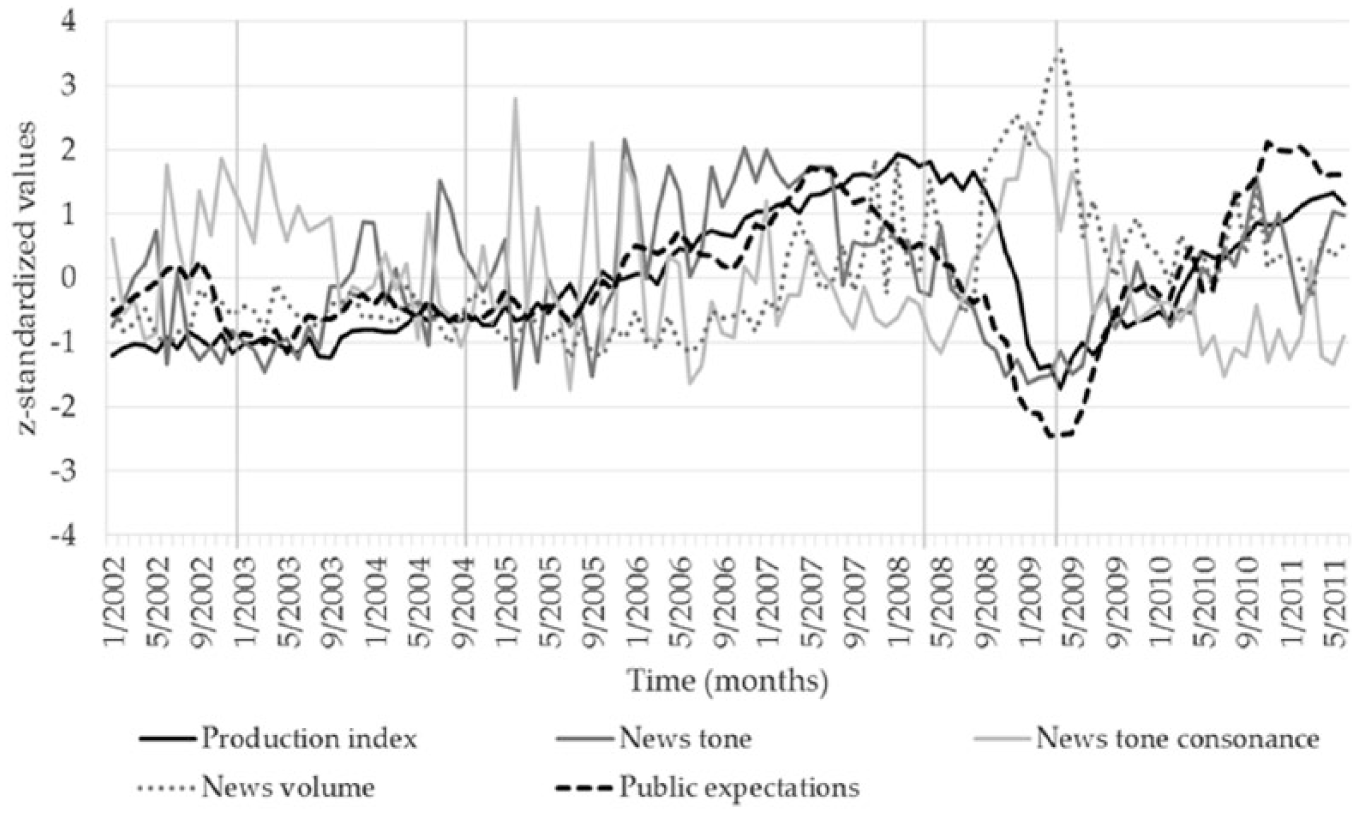
Production index, news on the general state of the economy, and PEs for the general state of the economy.
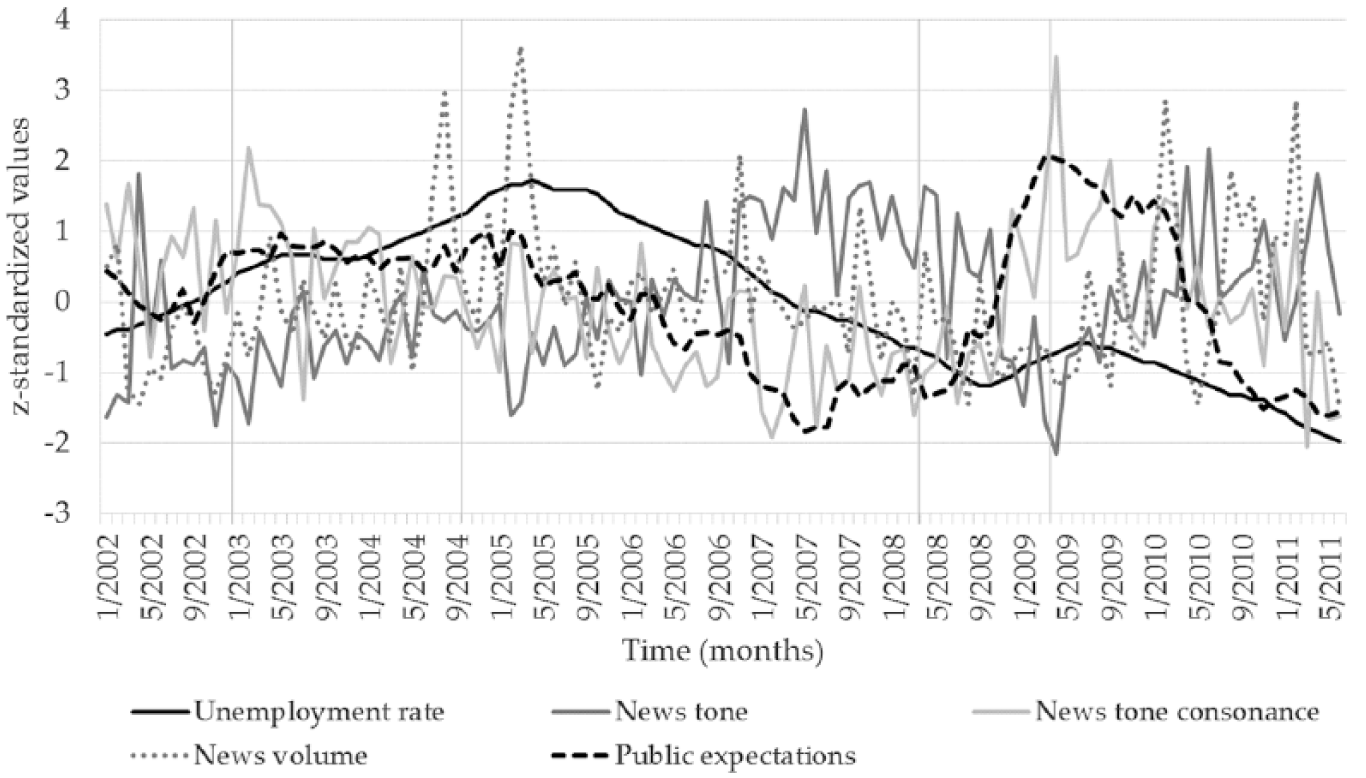
Unemployment rate, news on employment, and PEs for unemployment.
Measurement
The temporal relation between EIs, news coverage, and PEs is estimated using VAR modeling 72 and Granger causality. 73 The VAR approach is to write a symmetrical system of equations that allows dynamic and interdependent analyses between the variables of interest. 74 A VAR model including the past (lags) of the dependent and independent variables of the forms


is applied to the data, where α is the constant, β1 and λ2 are the autoregressive coefficients of the dependent variable, λ1 and β2 are the coefficients of the independent variable, and ε is the error term. With VAR models, a variable is described as a result of its own past and that of other variables. Granger causality is based on VAR models and tests whether a variable can be better predicted by using the past of another variable instead of just its own. This concept therefore explores lead–lag relations or forecasting qualities. After each VAR model is estimated, Granger causality tests determine whether Xt−n helps forecasting Yt (Equation 1a). In addition, the signs (±) of the VAR coefficients reveal whether the relations are positive or negative. This VAR procedure follows recent research on the relations between the “reality,” media content, and public opinion. 75
In time series modeling, it is crucial that the data fulfill the condition of (weak) stationarity to avoid spurious correlations appearing with a low Durbin–Watson d statistic revealing autocorrelated residuals, a high R2, and high significance of the coefficients. 76 The commonly used augmented Dickey–Fuller (ADF) test is performed to detect the unit roots, and the Kwiatkowski–Phillips–Schmidt–Shin (KPSS) test is used to assess trends and level stationarity for each time series. The variables, public opinion and EIs, contain trends and drifts, especially around 2009 during the financial crisis (see Figures 1 and 2) and are non-stationary. NT, NC, and NC are stationary according to ADF and KPSS. 77 To eliminate the trend from the non-stationary series and achieve mean stationarity, the common method used is differencing. 78 Differentiated time series of order 1 (Yt − Yt−1, Δ) for PE and EI are tested as stationary according to ADF and KPSS. Therefore, the analysis is executed based on changes (Δ) in the current month (t) compared with the previous month (t − 1) for PE and EI and based on levels in the current month (t) for NT, NC, and NV. This approach is similar to that of Soroka’s media content time series. 79 For the interaction terms, products of non-standardized data are calculated and afterward z-transformed. For NT × NC (PE × NC), a higher consonance should reinforce and a lower consonance should weaken NT (PE) values. Therefore, NC is computed as (1 + M(SD NT)) − SD NT so that the new mean of NC is 1. For PE × NT (EI × NT), negative PE (EI) and negative NT invert PE (EI) into positive interaction values, whereas positive NT weakens negative PE (EI).
The appropriate lag order of the model is selected by using Akaike’s information criterion and Wald lag exclusion statistics. All VAR models satisfy the Eigenvalue stability condition. For testing separate effects of the recession periods 2003/2004 and 2008/2009, the variables are set to zero (mean) during the remaining periods. This procedure allows the analysis of the complete observation period without break while absorbing (non-)recession effects. As the autocorrelation or a non-white noise process of the residuals
Findings
Impact of EIs and PEs on News Coverage
Impact of EI and PE on News Coverage.

Note. Δ: first differences, otherwise levels. Cells contain the lags and signs of significant VAR coefficients with Granger causality F values in parentheses. For Granger causality, the null hypothesis that the coefficients on all the lags of an endogenous variable are jointly zero is tested. EI for general economy is the production index; EI number for employment is the unemployment rate. The PE question for the general economy is, “How do you expect the general economic situation in this country to develop over the next twelve months?” The PE question for employment is, “How do you expect the number of people unemployed in this country to change over the next twelve months?” n.s. = not significant; NT = news tone; NV = news volume; NC = news tone consonance; EI = economic indicator; PE = public expectation; RMSE = root mean square error.
Significant on the 10% level. *Significant on the 5% level. **Significant on the 1% level. ***Significant on the 0.1% level.
Impact of News Coverage and EIs on PEs
Table 2 shows results for PEs being the dependent variable. Variables and interaction terms are added to the models step by step. As indicated by Granger causality and the level of significance of the coefficients, the production index (EI) can better forecast PE for the general economy (
Impact of EI and News Coverage on the PE for the General Economy and National Unemployment.
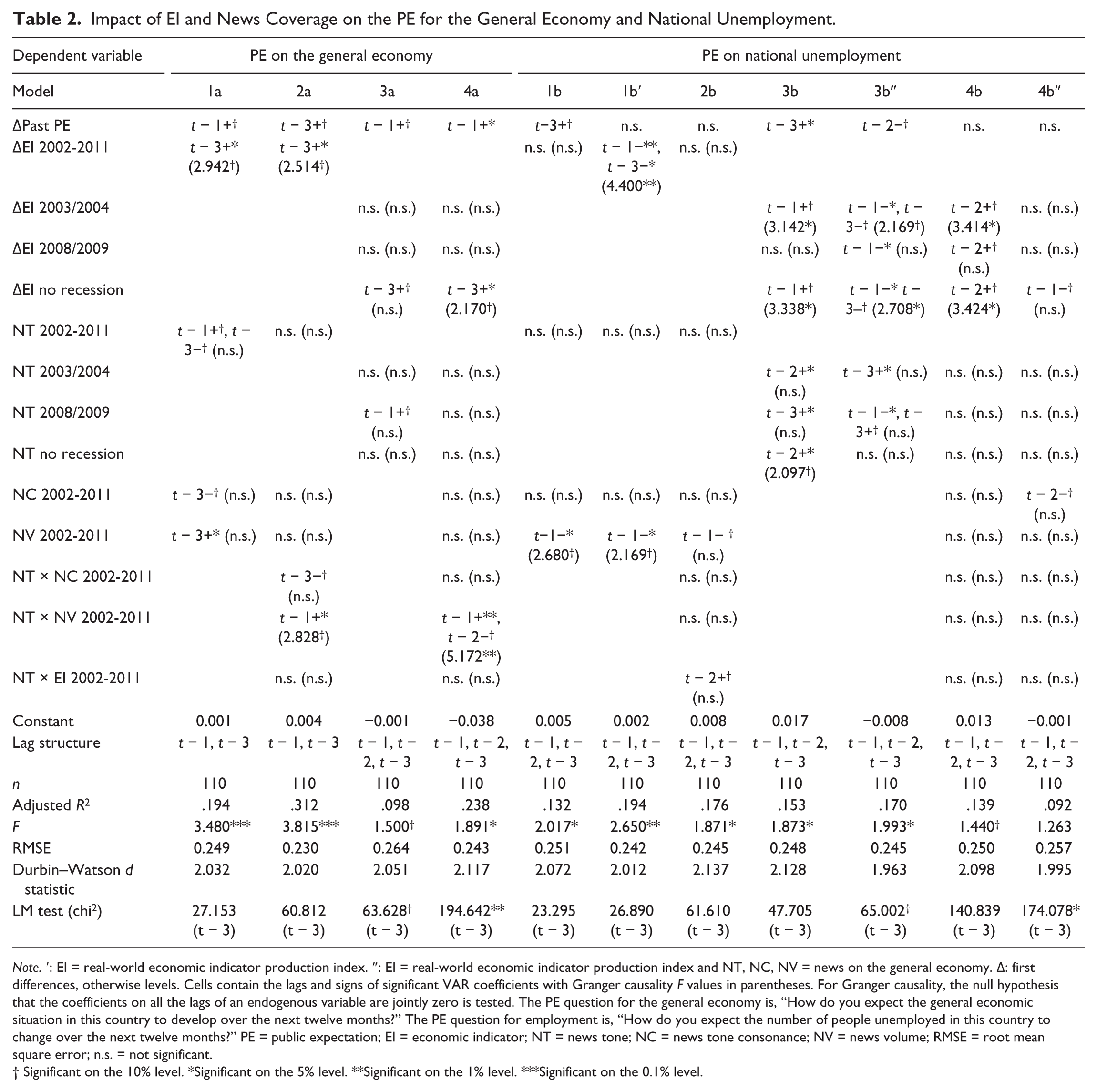
Note. ′: EI = real-world economic indicator production index. ″: EI = real-world economic indicator production index and NT, NC, NV = news on the general economy. Δ: first differences, otherwise levels. Cells contain the lags and signs of significant VAR coefficients with Granger causality F values in parentheses. For Granger causality, the null hypothesis that the coefficients on all the lags of an endogenous variable are jointly zero is tested. The PE question for the general economy is, “How do you expect the general economic situation in this country to develop over the next twelve months?” The PE question for employment is, “How do you expect the number of people unemployed in this country to change over the next twelve months?” PE = public expectation; EI = economic indicator; NT = news tone; NC = news tone consonance; NV = news volume; RMSE = root mean square error; n.s. = not significant.
Significant on the 10% level. *Significant on the 5% level. **Significant on the 1% level. ***Significant on the 0.1% level.
The interaction effect between NT and NC shows a negative sign of the coefficient for PE for the general economy (2a). Hence, the less consonant it is, the more NT tends to affect PE for the general economy. This interaction effect is not significant for unemployment expectations (2b). Therefore,
There is also no support for
Model 3a relates to
The role of NV is tested directly in Models 1a und 1b for the general economy and unemployment, revealing that more news leads to more optimistic PE for the economy in three months (t − 3+*) and the expectation of a decrease in unemployment numbers in the next month (t − 1−*). The interaction effect of NT and NV reveals that the NT effect on the PE for the general economy tends to increase with higher volume (2a and 4a, row NT × NV, t − 1+*, t − 1+**, respectively).
Concerning the quality of the estimations, residuals of Models 3a, 3b’’, 4a and 4b’’ contain further information according to the LM test. For PE for the general economy, Model 2a is the most efficient estimation with an explained variance of 31% (adjusted R2). However, it is not sufficient to explain national unemployment expectations with unemployment numbers or the production index and unemployment news or news on the general economy as adjusted R2 allows for more explaining variables.
Impact of News Coverage and PEs on EIs
The results in Table 3, Model 1a, reveal that PE on the general economy positively forecasts the production index. More optimistic PE of the previous month Granger causes an increase in the production index (t − 1+** (3.842*)). Therefore,
Impact of News Coverage and PE for EI.

Note. Cells contain the lags and signs of significant VAR coefficients with Granger causality F values in parentheses. For Granger causality, the null hypothesis that the coefficients on all the lags of an endogenous variable are jointly zero is tested. EI for general economy is the production index; EI number for employment is the unemployment rate. The PE question for general economy is, “How do you expect the general economic situation in this country to develop over the next twelve months?” The PE question for employment is, “How do you expect the number of people unemployed in this country to change over the next twelve months?” EI = economic indicator; PE = public expectation; NT = news tone; NC = news tone consonance; NV = news volume; RMSE = root mean square error; n.s. = not significant.
Significant on the 10% level. *Significant on the 5% level. **Significant on the 1% level. ***Significant on the 0.1% level.
News coverage has no direct unconditional effect on the production index in Model 1. Adding interaction terms between PE and news coverage improves the model quality for the production index (2a). Interaction terms reveal that the forecasting ability of PE for the production index tends to decrease with less consonant NT (t − 3−) and less NV (t − 2−). Hence, news coverage is not positively related to the production index. Therefore,
Discussion
This study compares economic news coverage of major German news outlets with economic indicators and public economic expectations. First, the interpretation of economic news is mainly set by changes in EIs and rarely by PEs confirming previous research. 80 A more negative economic development tends to lead to a more negative and more consonant NT. By the same token, the more positive the economic development, the less consonant the NT. The fewer unemployed people there are, the more positive is employment news—but the less consonant it is, as well; that is, news interpretation is more consistent in downturns and less consistent in upturns—which may be caused by asymmetric responses by journalists. 81 EIs are not explicitly stronger drivers of news during recessions, but PEs are. NV concerning the general economy was clearly forecast by PEs for the economy during the 2008/2009 recession. Hence, general economic NV did not respond in a “fire alarm” fashion to warn the public, 82 but public opinion did herald increased NV. The increase of news on the general economy leads to a decrease in the unemployment NV. In line with Soroka, 83 I argue that a certain amount of noise and the salience of the issue of the general economy produce this result. Also, the development of news coverage is much more volatile than the development of real-world EIs and PEs, indicating that journalistic selection and interpretations are versatile and do not represent solely the economic development on an aggregate level.
Second, public economic expectations are more influenced by EIs than by news coverage supporting the obtrusive contingency hypothesis. Yet the effects of NT increase with greater NV instead of NC. In the 2008/2009 recession, NT concerning the general economy positively forecast PEs for the general economy and, more clearly, unemployment expectations. This is in line with findings revealing stronger agenda-setting effects during recessions 84 or for negative news. 85 The public concludes that unemployment increases as a result of a declining general economic situation. An increase in employment NV also forecasts more pessimistic unemployment expectations. This relates to the results of Golan and Wanta, 86 who show that news volume is a stronger predictor of public opinion than tone.
PEs for the general economy are explained by the corresponding EI and news coverage. During stable economic times and the less severe 2003/2004 recession, decreasing unemployment numbers and an improving general state of the economy forecast a decrease in national unemployment expectations. A previous study that fails to reveal short-term agenda-setting effects for unemployment in Sweden explains that the lack of agenda setting is due to constant high news coverage over the years. 87 This situation—in which the public may be oversaturated with news on unemployment—may prevent news from having an effect on the public’s unemployment expectations even in the present study. If unemployment is regarded as a more obtrusive topic than the general economy, a lack of agenda-setting effects can be explained according to the obtrusive contingency hypothesis. However, this study suggests another explanation. Unemployment expectations are developed based on preceding EIs and news such as on the general economy. The production index as current indicator of the economy precedes changes in national unemployment 88 and therefore better forecasts unemployment expectations. Future agenda-setting research may therefore take related (news) topics to the topic of interest into account.
Yet a major weakness when analyzing aggregate data is the inability to link public expectations with media usage on a micro-level of the individual. Although collective media effects can be expected since the selected news outlets are the most popular in Germany and news media are found to be the most important information sources for audiences on the general state of the economy, 89 not all economic actors receive economic news with the same frequency, nor do they receive the same economic news.
Third, as expected, PEs for the general economy forecast the real-world economic development whereas news does not have an unconditional direct effect. This result supports the finding of Wu et al., 90 revealing that PEs forecast economic performance. Two explanations are possible for this forecasting ability. Either, the public makes correct assumptions about developments in the economy or the public influences the economy via economic decision making. The latter would support the concept of expectation-driven business cycles explaining changes in the economy through changes in economic expectations. However, the influence of public expectations on a change in the production index is very short term—only one month in the present study. Unemployment expectations are not found to have the capacity to forecast employment numbers. Because the employment situation is experienced by the population directly and is a result of the state of the economy, as it is a lagging indicator. 91 The employment situation cannot be changed by media coverage or attitudinal or behavioral changes in the audience but is, instead, a result of the state of the economy. Further research could include actual decision making of the public, such as consumption decisions, to clarify whether the public correctly anticipates or influences economic development.
In conclusion, first, economic news is a result of the interpretation of noisy real-world developments. Journalistic interpretation on economic issues is related to but goes beyond aggregate EIs. More narrow news topic selection or more specialized news outlets might reveal closer relations between news coverage and EIs. Second, people are more likely to use information gathered from their daily lives to develop economic sentiment than information gathered from the general news. High news volume instead of consonance is a condition for stronger news tone effects. Hence, second-level agenda-setting effects also depend on news quantity. Third, public unemployment expectations depend on news on the general economy. Therefore, the public correctly anticipates the unemployment development in the future by using a preceding EI of unemployment—the general state of the economy.
Footnotes
Acknowledgements
The author thanks Media Tenor for providing news coverage data and the anonymous reviewers for their most useful remarks.
Declaration of Conflicting Interests
The author(s) declared no potential conflicts of interest with respect to the research, authorship, and/or publication of this article.
Funding
The author(s) disclosed receipt of the following financial support for the research, authorship, and/or publication of this article: This study was funded by the Swiss National Science Foundation (Grant 100018_143395).