




Abstract
This study examines the extent to which professional journalism adopts and uses citizen journalism, such as user-generated content (UGC) and user-submitted stories (USS), at the individual, organizational, and community levels. In doing so, the study adopts a web-based survey of top U.S. news editors (n = 142) coupled with U.S. Census Data. The study reveals that experience as online journalists and online staff size play roles in the adoption and use of UGC. The study also finds that community structural pluralism is related to the adoption and use of news stories written together by professional and citizen journalists.
Keywords
A growing body of scholarship has paid close attention to citizen journalism in diverse and comparative contexts in conjunction with professional journalism. 1 Generally, citizen journalism scholarship falls under two categories. First, scholars have focused on changing journalistic role conceptions between citizen journalists and professional journalists 2 and more diverse news content and sources of citizen news sites compared to those of professional news sites. 3 Second, scholars have also shed light on user-generated content (UGC) or citizen journalism and its impact on democratic outcomes, such as civic participation. 4
What seems to be missing, however, is how professional journalists adopt and use citizen journalism and its practices. Although some scholars have examined news editors’ philosophical and practical approaches of adopting citizen journalism, 5 little attention has been given to why professional journalists attempt to incorporate UGC, such as comments made on news stories, photos and videos, as well as citizen-submitted news stories. Therefore, an investigation into the conditions in which professional journalists rely on citizen-created content is warranted.
This study aims to examine the adoption and use of citizen journalism by professional journalists at multiple levels—individual, organizational, and community levels. 6 Given the increasing number of citizen-based community news sites, 7 more attention should be devoted to the understanding of who adopts and uses citizen-produced news content and how and why such decisions are made considering professional journalists’ experiences and organizational contexts. Equally important, citizen journalism scholarship should advance the knowledge of community features driving the varying degrees of adoption and use of citizen journalism as news organizations are embedded in serving their communities. Taken together, this study attempts to reveal what promotes the adoption and use of citizen journalism with a consideration of constraints and opportunities operating at multiple levels—journalists’ professional experience, organizational contexts, and community characteristics.
Literature Review and Hypotheses
Citizen Journalism: Conceptual Definition
In this study, citizen journalism, also known as participatory journalism, refers to “contribution to discussion in the public sphere, whether in the form of simple information, synthesis, reporting, or opinion. The contributions can range from very local to global, entering into the ‘conversation of democracy’ in media critic James Carey’s phrase.” 8 Citizen journalists by definition “can be individuals making a single contribution (a fact, correction, photo, etc.), bloggers, or professionals editing citizen content for ‘professional-amateur’ (pro-am) sites which integrate the works of professional staff and citizen contributors.” 9 In sum, this study defines citizen journalism and citizen journalists broadly, embracing a wide array of activities, content, and practices that can contribute to the public sphere. 10
In terms of the types of citizen journalism, such practices have emerged in different media forms and outlets. First, as a substantial number of studies have indicated, 11 citizen journalists contribute to mainstream and commercial news sites as well as citizen news sites and blogs. Second, citizen journalism includes two types of contributions to the conversation of democracy: not only UGC, such as comments made to news stories, and photos and videos by citizen journalists, but also user-submitted stories (USS) by citizen journalists. Given this typology, the current study focuses on citizen contributions to commercial news sites as it attempts to examine how professional news sites adopt and use citizen journalism at multiple levels.
Citizen Journalism Scholarship on the Adoption and Use of Citizen Journalism
The rapid growth of online news publications demonstrates their interactive appeal and signals a transformation in the transmission model of information delivery. Although initially slow in its adoption, 12 news publications gradually warmed to the idea of online news, providing audiences with more engaging news experiences and increasingly sophisticated content. 13 Users are now offered a diverse range of features enabling them to actively choose information, tailor a news site with personalized preferences, post comments on news articles, and even share stories or pictures with other users. These features are considered to have contributed to participatory communication 14 shifting more agency to the audience.
In recent memory, a number of journalism movements have attempted to integrate participatory practices and audience engagement. For example, both public journalism (also known as civic journalism) and citizen journalism have roots in promoting conversation and dialogue, 15 which is a departure from traditional reporting practices that exclude news audiences from contributing to the public sphere. However, while public journalism encourages audience participation (e.g., journalists tapping into the pulse of the audience through polls, focus groups), the news organization still retains a high degree of control, “setting the agenda, choosing the participants and moderating the conversation.” 16 With participatory journalism, there is no central news organization controlling the information flow. Nip also suggests there exist various models of connection between mainstream journalism and the public. She locates public journalism as being closer to traditional journalism despite its efforts to engage the audience because of its adherence to gatekeeping practices and ultimately framing issues presented to the community. 17
As such, Nip suggests the American public can become re-engaged in public life with the help of interactive electronic tools that extend opportunities for ordinary citizens to take greater control over the production and distribution of news. 18 Furthermore, news audiences may choose to act as sources of information and participate in the journalistic activity of reporting. During crisis situations, for example, citizens have participated in producing material that was used effectively to inform the public and also generate a greater sense of community. 19
As news audiences are increasingly being offered options to experience news in more active ways, opportunities for citizen participation have also been the focus of various investigations worldwide. For example, studies have examined mainstream media’s responses to citizen media and UGC in European countries, 20 U.S.-based community newspaper editors’ perceptions about integrating UGC, 21 citizen participation opportunities available through online newspapers in both Europe and the United States, 22 and interactions between both professional and citizen journalists and their perceptions of citizen journalistic professionalism at a successful citizen journalism operation in South Korea. 23
Although the various types of participatory tools and their integration into online news publications have received global attention, 24 there is still a dearth of scholarship regarding why newspapers ultimately decide to adopt opportunities for citizen journalistic practices (e.g., UGC, USS). In particular, little research has focused on examining the interconnections between the individual, organizational, and community levels. Modeling the adoption and use of citizen journalistic practices by U.S. daily newspapers at multiple levels may help map out and better explain the complex nature of factors contributing to that decision-making process.
A Hierarchy of Influences Model
The present multilevel exploration of editors’ decisions to adopt and use citizen journalism is guided by Shoemaker and Reese’s hierarchy of influences model. 25 This model suggests editorial decisions are affected by intrinsic and extrinsic forces operating at multiple levels, including the personal characteristics of journalists, routinized practices, organization structure and resources, institutional relationships with social actors, and the larger sociopolitical environment, with each level presenting a different set of constraints and opportunities for news decision making. This model channels the current theoretical attention to individual-, organizational-, and community-level factors.
Individual-Level Factors
An editor’s professional experience would likely affect decision making about new technologies in news production and dissemination. Editors involved in editorial decision making for a longer period of time tend to internalize professional values, norms, and obligations. 26 They also tend to be attentive to industry trends and demands as well as other media outlets. In today’s news landscape, UGC is clearly one noticeable phenomenon. In fact, to complement professionally produced news items, newspaper editors are increasingly aware of, and integrate, forms of user engagement. 27 These rationales lead to the following hypothesis:
In addition to editorial experience, an individual’s experience as an online journalist 28 may also be expected to affect decision making about the adoption and use of citizen journalism. For example, Singer found online editors affiliated with major U.S. newspapers are increasingly accommodating the participatory nature of the online environment and are warming up to user involvement. 29 In examining how editors and managing editors of British news websites adopt UGC initiatives, Thurman found that online editors understood the merits of blogs and the benefits associated with incorporation of UGC as such material may potentially increase circulation and provide a source of stories. 30 Furthermore, according to a survey of journalists in the U.S., 31 online journalists tend to be more oriented toward the interpretive function than the disseminator, populist mobilizer, and adversary functions, with, for example, a focus on discussing national and international issues. This emphasis implies that online journalists specifically highlight presenting a diversity of opinions. Nah and Chung also found community news editors’ online job experience to be a positive predictor of the interpretive role (and marginally significant with the adversary role) with those with more extensive online experience more likely to find the interpretive role as a prominent function of the news media. 32 Based on these rationales, the following hypothesis is proposed:
Organizational-Level Factors
Informed by the hierarchy of influences model, the present study also examines several organizational factors, including ownership, size of online staff, length of website presence, and circulation size. First, ownership structure is a factor that may affect allocation of organizational resources. Newspapers owned by large, distant corporate entities tend to have more resources and take economic risks that stem from early adoption of innovative applications that may later turn out to be unsuccessful, while editors at small, locally owned newspapers tend to be more concerned with sustaining organizational operation. 33 Also, integration of innovations into news production and distribution may make financial sense. Editors at large, corporate newspapers tend to play dual roles as a news editor and business manager, concerned with both journalistic and business responsibilities, such as editing, hiring, circulation, and promotion. 34
Another important line of research suggests citizen journalism is a cost-effective method to generate profit for publicly owned newspapers facing declines in newsroom budgets. For example, studies by Blankenburg and Ozanich 35 and Lacy and Blanchard 36 have shown that public ownership is associated with declines in newsroom budgets and staffs. Such findings are indeed supported by current trends of using citizen contributions for UGC in breaking news in place of professional staff. 37
Prior research has shown that ownership structure is related to news organizations’ adoption and use of web components. For example, ownership size was found to be associated with broadcast TV stations’ website interactivity, with larger stations more likely than single-owned stations to use interactive tools and applications, such as feedback form, chat room, and multimedia content distribution. 38 Furthermore, Lowrey found that ownership type, measured by private, regional, and national ownership, was found to be associated with website adoption and the number of interactive features on online editions of newspapers. 39
Generally, at present, there appears to be limited research examining associations between ownership structure and adoption and use of citizen journalism. Based on the above discussion, however, large, publicly owned corporate newspapers are expected to be more likely to adopt citizen journalism and its practices to embrace more different opinions and voices from ordinary citizens because they tend to be more willing to take risks by being innovative. Equally plausible is that citizen journalism can help editors at publicly owned newspapers meet financial goals, as user-generated and submitted content is a cost-efficient way to fill news holes with little financial investment and simultaneously attract reader interest by bringing readers into the news production process. 40 Therefore, this rationale leads to the following hypothesis:
Size of the online journalism staff is posited as another organizational factor affecting the decision to incorporate citizen journalism into news production. News organizations need journalists who have specific training, knowledge, and skills to handle specialized news tasks while maintaining high quality reporting, 41 which should be also true for online journalism, as uploading and managing content online requires technical skills. Indeed, a recent study by Larsson showed that the number of website staff is related to the use of medium interactive features, such as streamed video and graphics, and medium-human interactive features, such as customized content, RSS feeds, and e-mail alerts, on Swedish newspaper websites. 42 Therefore, the following hypothesis is proposed:
Length of website presence may also influence the adoption and use of citizen journalism. As the diffusion of innovation theory indicates, 43 news media organizations as earlier website adopters are more likely to adopt an innovation earlier than other organizations. Likewise, from the resource mobilization theory perspective, 44 pre-existing resources and web capabilities enable news organizations to pursue additional web resources, such as UGC and USS. 45 As newspapers produce and upload news items, they have more content on their websites, prompting them to improve site structure and user experience, such as user friendly and accessible search functions, clear menu navigation, clear anchor text, user customization, and multimedia content. 46 It is, thus, plausible that newspapers that have maintained online editions for a longer period of time are more likely to incorporate UGC and USS into news production. Thus, the following hypothesis is posited:
Finally, newspaper size is one major indicator of organizational complexity. Larger, more complex news organizations possess greater human and financial resources than smaller, less complex ones, which enable them to develop greater role specialization and cover a greater variety of issues and events. 47 Also, news organizations rich in resources are more innovative and willing than their counterparts to adopt new technologies to improve news production and dissemination. 48 Lowrey found that organizational size of newspapers, measured by circulation size, was positively related to the number of interactive features available on newspaper websites. 49
It is equally plausible, however, that smaller-size newspapers may benefit from integrating news items provided by citizen journalists. Citizen journalism could allow these newspapers to overcome resource constraints and improve the efficiency of the news production process. Given the conflicting possibilities, the following research question is proposed:
Community-Level Factors: Community Structural Pluralism
The present study also considers a community-level factor. Specifically, existing literature indicates that community structural pluralism can affect editors’ decisions to adopt information technologies in news gathering and distribution. Community structural pluralism refers to “the degree of differentiation in the social system along institutional and specialized interest group lines, in a way that determines the potential sources of organized social power.” 50 It captures two components: differentiation in the social system focuses on the extent to which actors of a social system are interdependent based on specialized functions and a system develops different interests among social actors stemming from common roles and group experiences. 51 The potential sources of organized social power indicate the extent to which power structure is diversified and disperse, and decision making involves competing interests. 52
A rich body of research indicates that newspapers in different structural settings differentially cover social conflict to maintain the stability of the communities they serve. 53 Newspapers in less structurally pluralistic communities tend to perform a distribution control function, selectively reporting conflict among local groups in the interest of basic community functioning. 54 Newspapers in more structurally pluralistic communities perform an additional process of control by reporting differences and disagreements within local power structure and between local elites and alternative groups and, by doing so, dissipate tension among competing groups before it becomes uncontrollable. 55
From a structural perspective, the adoption of citizen journalism can be viewed as a feedback control mechanism by which newspaper organizations respond to and incorporate the needs and interests of the communities they serve. Journalists tend to depend on institutional sources, and news has centered on the activity of those in power and their competing interests, often to the exclusion of other ideas and viewpoints in a social system. 56 Citizen journalism, by channeling its attention to voices of ordinary citizens, can present issues and subjects from an alternative perspective, and newspapers may also serve as a platform for such content where a greater diversity of ideas and perspectives are expressed and function to maintain the stability of a social system.
At the same time, however, smaller, less structurally pluralistic community settings would allow editors to develop close locality-based social ties, as it is relatively easy in such communities to know and directly interact with local residents and groups, both personally and professionally. 57 Such intimate local contexts may enable editors to actively seek interesting news and events from local residents, or local residents may feel comfortable sharing their thoughts and stories with editors. In contrast, larger, more structural pluralistic communities characterized by more complex role specialization and orientation to secondary occupations rather than primary ties may constrain editors to form locality-based networks, with the likelihood of embracing citizen journalism perhaps limited in such communities.
Although a few studies have examined the role of structural pluralism in editors’ decisions to adopt information technologies, such as online editions and newspaper site interactivity, 58 how community structural variations may affect the extent to which newspapers incorporate citizen journalism into news production and distribution has not been fully explored. Based on the conflicting possibilities presented above, the following research question is proposed:
Method
Sampling
Data for this study were derived from a representative sample of top editors at U.S. newspapers. Top editors were defined as “having titles of executive editor, editor, managing editor, editor in chief, and vice president for news.” 59 Based on 1,457 daily U.S. newspapers available in the Editor & Publisher’s Data Book, 60 formerly Editor & Publisher International Yearbook, the population was divided into sampling strata based on circulation figures: less than 25,000 (n = 1,101); 25,000 to 49,999 (n = 159); 50,000 to 99,999 (n = 82); and more than 100,000 (n = 78). Listings in the Data Book that did not include circulation figures (n = 37) were excluded from analysis.
A random sample of 75% of papers with circulations less than 25,000 (n = 826) was taken, along with a random sample of 75% of papers with circulations more than 25,000 (n = 240), with a total of 1,065 papers. For each sampled paper, the site URL listed in the Data Book was used to locate the e-mail address of the top editor. When the top editor’s e-mail address was not available, the general newspaper e-mail address was obtained. As a consequence, a total of 1,019 unique e-mail addresses was gathered.
Web-Based Survey
The Tailored Design Internet survey method 61 was used to conduct a web-based survey on Qualtrics, fielded from May to July 2013. Participants were invited via e-mail to participate in the survey. They were first contacted through a prenotice e-mail regarding the survey. Three days following this message, an invitation e-mail was sent to the sampled 1,019 e-mail addresses with a survey link. Of these addresses, six were inactive. Two editors were added to the sample as they were referred to by someone who worked at the newspaper. Therefore, a total of 1,015 valid e-mail addresses was included in the sample. A thank you/reminder e-mail was sent a week later, and additional e-mail messages were sent two and four weeks after the thank you/reminder message. Due to low response rates, the survey was extended for a second round. 62
Of the 1,015 sampled editors, 226 editors started filling out the survey questionnaire. However, a total of 142 editors completed the survey yielding a 13.9% response rate. Out of 84 editors who did not complete the survey, 45 editors did not go beyond the introduction screen and 39 editors did not complete the survey. Therefore, 142 fully completed responses were used for data analysis. In terms of the survey response rate, although it is lower than expected, it is acceptable given the declining level of response rates of Internet and e-mail surveys. 63
Measures
User-generated content (UGC)
The extent to which newspapers incorporate UGC was measured by asking respondents, in a dichotomous fashion (1 = yes, 0 = no), whether their news sites currently featured (1) user comments after news articles (M = 0.90, SD = 0.30), (2) photos submitted by users (M = 0.81, SD = 0.39), and (3) videos submitted by users (M = 0.46, SD = 0.50). Due to the low internal consistency (α = .54), these items were analyzed individually.
User-submitted stories (USS)
The extent to which newspapers incorporate citizen-generated news stories was measured by two items. Respondents were first provided with the definition of citizen journalism in the survey, “ordinary citizens who do not have any professional journalistic training but write news stories on a part-time or voluntary basis,” and then asked, in a dichotomous fashion (1 = yes, 0 = no), whether their news sites currently adopted (1) stories submitted by citizen journalists (M = 0.35, SD = 0.48) and (2) stories written together by professional and citizen journalists (M = 0.28, SD = 0.45). These two items were also analyzed individually. 64
Professional experience as editors
Professional experience as an editor was measured by a single item asking respondents how many years they had been working as an editor (M = 19.13, SD = 10.82).
Professional experience as online journalists
Professional experience as an online journalist was measured by asking respondents if they considered themselves an online journalist and how many years they had been working in that capacity (M = 4.11, SD = 5.43).
Ownership
Ownership structure was measured by asking respondents to indicate the ownership of their newspapers, privately owned (individual or family), local or regional public ownership, national public ownership, or others. Responses were coded so that publicly owned newspapers were coded 1 and privately owned newspapers and others were coded as 0 (M = 0.37, SD = 0.48).
Newspaper size
Circulation figures were used to measure newspaper organizational size. The data were obtained from the Editor & Publisher’s Data Book (M = 24,216.21, SD = 36,256.82). A total of 76.8% of the final sample was below 25,000 circulation (M = 10,186.31, SD = 5,991.12), while the mean of newspapers with greater than 25,000 circulation was 70,557.39 (SD = 52,782.87). The circulation distribution of the final sample, therefore, was roughly equal to the initial sample. To address the skewed distribution of the variable, a natural log transformation was taken (M = 9.50, SD = 1.02).
Online staff size
Online staff size was measured by asking respondents how many online journalists their newspapers employed (M = 9.78, SD = 23.48). A natural log transformation was applied to normalize the skewed nature of the variable (M = 1.20, SD = 1.35).
Years of web age (length of website presence)
Website age was measured by asking respondents how long their news organizations had maintained their news sites (M = 14.75, SD = 4.92).
Community structural pluralism
Structural pluralism was measured at the county level using five indicators: county population; percentage of the population not engaged in agriculture, forestry, fishing and hunting, and mining; percentage of the population with a bachelor’s degree or higher; percentage of the non-Caucasian population; and per capita income. These items were derived from previous literature of the concept. 65 With sufficient variations captured across communities, 66 these indicators were first standardized and then combined into an additive index (M = 0.00, SD = 3.41, range = −6.08-11.25, α = .71).
Analytical Techniques
Given the dichotomous nature of the five outcome variables (UGC and USS), the present study used logistic regression as using ordinary least squares (OLS) would result in inefficient, inconsistent, and biased parameter estimates. 67 And the logistic regressions estimated the five models and assessed the effects of the independent variables while controlling for each other’s influence. 68 Collinearity statistics indicate there are no signs of multicollinearity among the independent variables. 69
Results
Before testing the hypotheses, correlations among the variables were explored. As displayed in Table 1, a majority of the predictors were related to two indicators of UGC, user-submitted photos and videos, at the zero-order level, with the relationships in the hypothesized direction. In contrast, none of the predictors was related to user comments. Also, none of the predictors except years of experience as an online journalist was correlated with stories written by citizen journalists. Years of experience as an online journalist and structural pluralism were positively associated with stories written together by professional and citizen journalists. The predictors were only moderately correlated with each other, providing support for convergent and discriminant validity among the predictors.
Zero-Order Correlations among Variables.

Note. CJ, citizen journalist.
p < .10. *p < .05. **p < .01.
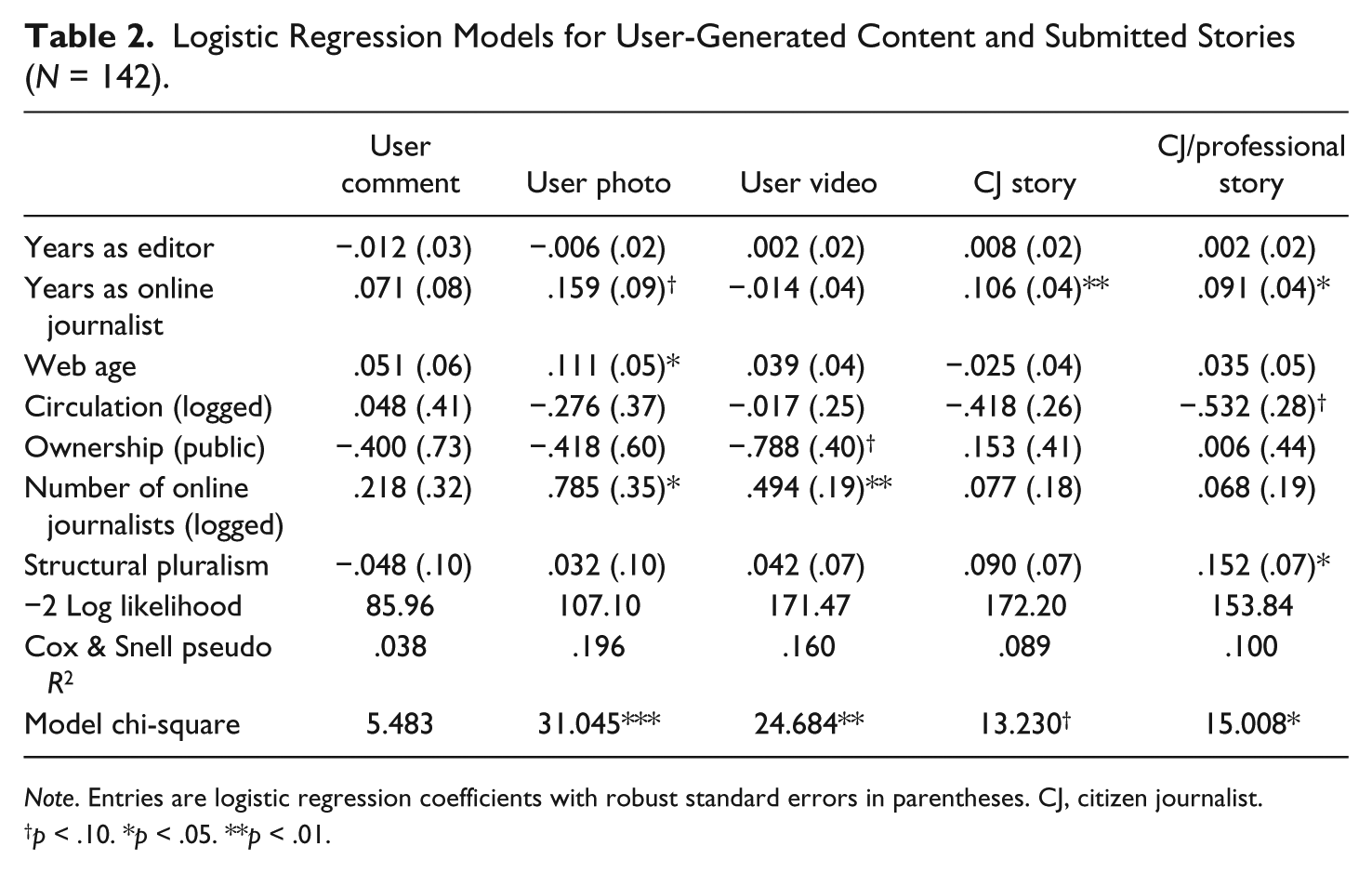
Table 2 shows logistic regression models whereby the UGC and USS indicators were regressed on the individual-, organizational-, and community-level predictors. The first set of hypotheses stated that professional experience as an editor and online journalist would be positively associated with the adoption and use of citizen journalism. As shown in Table 2, years of experience as an editor were not related to any of the dependent variables. However, years of experience as an online journalist had positive effects on stories written by citizen journalists and stories written together by professional and citizen journalists (coefficient = .106, p < .01 and .091, p < .05, respectively), with those with longer years of experience as an editor and online journalist more likely to adopt and use citizen journalist news stories. In addition, although statistically marginal (p = .072), the effect of years of experience as an online journalist on user photos was in the hypothesized direction. Thus, H1a was not supported, and H1b received partial support.
Logistic Regression Models for User-Generated Content and Submitted Stories (N = 142).
Note. Entries are logistic regression coefficients with robust standard errors in parentheses. CJ, citizen journalist.
p < .10. *p < .05. **p < .01.
The second set of hypotheses concerns organizational factors, predicting that public ownership, size of online journalists, and length of website presence would be positively associated with the adoption and use of citizen journalism. First, the number of online journalists had an independent positive effect on two of the UGC indicators—user photos and user videos (coefficients = .785, p < .05 and .494, p < .01), with newspapers that employed more online journalists integrating more user photos and videos. Length of website presence was positively related to user photos (coefficient = .111, p < .05), with newspapers with longer online presence using more user-submitted photos. Furthermore, the effect of public ownership on user videos marginally reached statistical significance (p = .052).
Turning to USS, public ownership, size of online journalists, and length of website presence did not predict the adoption and use of citizen journalist stories. Taken together, H2a was not supported. H2b received limited support for its effects on user photos and videos, while support for H2c was limited to user photos.
Next, RQ1 examined how circulation size would influence the adoption and use of citizen journalism. Organizational size measured by circulation figures was not related to UGC and USS, with the exception of its marginal negative relationship with stories written together by professionals and citizen journalists (coefficient = −.532, p = .054).
RQ2 examined the extent to which community structural pluralism would be associated with the adoption and use of citizen journalism. The measure of structural pluralism was not significantly related to UGC. However, the structural pluralism measure had a positive and significant effect on stories written together by professionals and citizen journalists while all other variables in the model were simultaneously taken into account (coefficient = .152, p < .05), indicating that newspapers in larger, more structurally pluralistic communities were more likely to integrate these types of stories into news production and distribution.
Discussion
Overall, several variables operating at different levels were found to contribute to predicting the adoption and use of citizen journalism. As for UGC, web age and the size of online staff were positively associated with the integration of user photos, with newspapers that maintained a longer online presence and had larger online staff more likely to use user-uploaded photos in news production. Experience as online journalist approached statistical significance in predicting the use of user photos. Newspapers with a longer online presence were more likely to adopt and use user-created videos. Also, with the marginal significance level (p = .052) in mind, publicly owned newspapers were less likely than privately owned counterparts to integrate user-generated videos. As documented by Singer and Thurman, 70 U.S. newspaper editors appear to recognize the benefits of integrating UGC by online news audiences, perhaps in the hope to provide a more dynamic and engaging news consumption experience for their own readers in addition to the potential to increase circulation and story generation.
Several variables at multiple levels contributed to predicting the adoption and use of USS. First, experience as online journalists was positively related to both stories submitted by citizen journalists and stories written together by professional and citizen journalists, indicating that editors with more professional experience as online journalists tend to better understand the importance of ordinary citizens as citizen journalists who contribute to news production and the conversation of democracy. Therefore, professional journalists as online journalists appear to be more favorable toward adopting and using citizen-created news stories. 71
Second, newspaper size, measured as circulation, was marginally associated with the adoption and use of news stories written together by professional and citizen journalists. While the marginal significance level (p = .054) does not permit rejecting the null hypothesis with sufficient confidence, this result suggests newspapers with smaller circulations tend to adopt more collaborative news stories that mobilize ordinary citizens and community members in news production. It appears then that this type of USS is considered more appropriate activities for smaller newspaper organizations in the U.S., where the news production process is constrained by limited human and financial resources, and interaction between the newsroom and citizen contributors are more readily achievable. 72
Third, community structural pluralism was related to the adoption and use of stories written by professional and citizen journalists. That is, editors of newspapers in heterogeneous communities were more likely to incorporate such collaborative stories than those of newspapers in homogeneous communities. The result appears consistent with the structural pluralism model by which newspapers in larger, more pluralistic communities function to represent different ideas and perspectives to maintain the stability of the communities in which they operate. It seems that this function is further enhanced by involving ordinary citizens and community members in news production. 73 Given a vast number of user-supplied stories are PR/press release type ones, another plausible explanation might be derived from the community power structure where a larger number of community groups and organizations have more resources and power to achieve the legitimacy from newspapers. That is, newspapers in a more diverse power structure are more likely to work with powerful community organizations by publishing their press releases or helping them edit and publish stories about their organizations.
These results carry important theoretical implications. It appears that variables at the organizational level (i.e., web age and online staff size) play a role in influencing whether U.S. newspapers decide to use UGC, that is, user photos and videos. Newspapers that have maintained a longer online presence and have had a larger online staff can mobilize news audiences to use interactive features and generate content on their news sites. 74 Notably, as the resource dependence theory implies, 75 organizational resources, especially those with a longer online history and, thus, with more extensive online experience, are factors that affect newspapers’ adoption and use of UGC on news sites.
In terms of USS, each variable at the multiple levels (i.e., journalistic experience as online journalists and community structural pluralism) brings important insights and implications to the citizen journalism scholarship. First, this study confirms that online journalists tend to be favorable toward the adoption and use of USS as they advocate diverse perspectives and opinions in their news production. 76 Second, community structural pluralism, as predicted, explains the adoption and use of stories written together by professional and citizen journalists and confirms its explanatory power. 77 That is, newspapers in more diverse and heterogeneous communities rely on news stories from citizen journalists and strive to make use of a range of voices through free labor.
In sum, although organizational features, such as web age and online staff size, influenced the adoption and use of UGC, individual- and community-level factors, such as experience as online journalist and community structural pluralism, led newspapers to adopt and use USS. That is, variables at each level played distinct roles in predicting the two types of citizen journalism, UGC and USS.
These findings should be interpreted with a consideration of several key limitations. First, the response rate may limit what can be said about the observed significant predictors at the population level. The reasons for the low response rate may be due to the busy work schedules of newspaper editors. Second, the limited sample size restricted the ability of the study to include other theoretically salient predictors and detect stable parameter estimates. Third, the measures of citizen journalism relied exclusively on self-reports of newspaper editors, and thus, the extent to which citizen journalism makes unique contributions to the quality of news production remains to be seen. In relation, the measurement of online journalists with a single self-reporting item could be problematic given the variances across news editors as well as the overlapped roles between online and print versions.
These limitations convey suggestions for future scholarship. First, future studies should strive to increase the response rate to better represent the population or online newspapers in this study although the extant literature indicates a low response rate does not necessarily lead to biased, unrepresentative results. 78 Second, future studies may analyze patterns of content integrated into newspaper websites while considering other internal and external factors 79 that can influence adoption and use of citizen journalism (e.g., decreasing labor forces and payment in newsrooms). Notably, moving forward, scholars should analyze types of news stories (e.g., straight news, PR/press releases, comments/opinions/advocacy) submitted by citizen reporters as well as stories written together by professional and citizen journalists and assess how they can influence news production and news audiences. Last, future studies should consider the presence of citizen journalism sites and citizen blogs in local communities as they may influence professional and commercial news sites to increase the adoption and use of citizen journalism and its content.
These limitations notwithstanding, this study reveals the driving forces of adopting and using citizen journalism by professional journalists at multiple levels: news editors’ professional experience as online journalists; organizational contexts, such as web age, online staff size, and ownership; and community structural pluralism. These bring valuable insights concerning who, how, and why a news organization/editor adopts and uses citizen journalism through a more comprehensive perspective. Future citizen journalism scholarship should continue to advance theoretical perspectives to examine these issues through rigorous methodological approaches and measurements.
Footnotes
Declaration of Conflicting Interests
The author(s) declared no potential conflicts of interest with respect to the research, authorship, and/or publication of this article.
Funding
The author(s) received no financial support for the research, authorship, and/or publication of this article.