



Abstract
With the increase in citizen-generated news, the need to understand how individual predispositions interact with news sources to influence perceptions of news credibility becomes increasingly important. Using a web-based experiment, this study examines the influences individual predispositions toward the media and politics have on perceived credibility of mainstream and citizen journalism. Analyzing data drawn from a representative sample of the U.S. adult population, results indicate that media skepticism and political cynicism interact, such that cynics and skeptics perceive citizen journalism as more credible, while non-cynics and non-skeptics think mainstream journalism is more credible.
With the advent of technologies such as blogs (e.g., Wordpress and Tumblr), microblogging services (e.g., Twitter and Vine), and sites devoted to user-generated video content (e.g., YouTube and Vimeo), the ability for media users to actively participate in the creation, dissemination, and evaluation of current events programming is now available on a near-global scale. Many scholars have optimistically claimed that these developments give ordinary citizens more power in processes of information gathering and dissemination. 1 Early speculation into the influence of citizen journalism on society imbued the practice with an almost messianic ability to save both journalism and democracy by drawing on the public to generate and police the flow of information as trust in the mainstream media declined. 2 It is easy to understand these optimistic outlooks for the prospects of citizen journalism and democracy given the roots of the citizen-driven news movements that arose “in response to a perceived crisis in the role of the press in constituting a public sphere in which citizens could understand and engage productively with the issues of the day.” 3 Born out of a credibility crisis in the mainstream news media system, citizen journalism itself claimed to solve what it saw as the problems of the news. Some scholars buy into these claims, arguing that citizen journalism provides a route for the reengagement of increasingly distrustful segments of the public. 4 Critics, on the contrary, contend that citizen journalists fail to live up to journalistic standards and provide, at best, questionable information. 5 Others promote a more nuanced approach to the new media landscape, noting the fluid boundaries between amateur and professional, as well as the nebulous nature of the term “citizen journalist.” 6
Regardless of the debate surrounding the relationship between citizen and professional journalists within the United States media landscape, the concerns regarding public perception of these new voices remain strong. 7 More information does not necessarily increase the quality of information. The overwhelming cacophony of voices on the Internet, for instance, can leave the individual at a loss to distinguish the trustworthy from the dross. 8 Even if citizen journalism does provide quality news, the public may be reticent to believe that it does so, 9 limiting the potentially beneficial influences of citizen journalism on society.
Therefore, the question of information quality and perceived credibility of citizen journalism has become critical for mass communication scholars. Before claims regarding the democratic potential of, or accuracy of the information provided by, citizen journalism can be properly affirmed or rejected, social scientists must first address the question of the perceived credibility of citizen journalism through systematic research. Indeed, people will not be influenced by information if they discard or ignore it. Therefore, if they do not find citizen journalism credible, they will exhibit few effects from having been exposed to it. Examinations of the perceived credibility of citizen journalism have, to this point, relied primarily on cross-sectional survey research. 10 This study fills a gap in the literature with an experimental design developed to highlight factors that influence perceptions of credibility of mainstream media and citizen journalism.
Citizen Journalism
There are at least two general approaches to defining citizen journalism, encompassing several related concepts. Broadly, the term refers to amateur news reporting. The concept of citizen journalism subsumes the concept of participatory journalism, which typically refers to activities of citizens in collaboration with a mainstream media outlet (e.g., CNN’s “iReport”). 11 Citizen journalism can also include civic or public journalism 12 (i.e., journalism focused on civic affairs), as well as hyper-local journalism 13 (i.e., journalism focused on particular geographic communities) if the information is collected and presented by amateur reporters. Thus, these forms of reporting overlap the concept of citizen journalism, but do not define it. The narrow definition of citizen journalism focuses on the reporting of newsworthy events, usually disasters or crises (events that the mainstream media cannot predict), typically using new media technologies, and often before the mainstream media arrive on the scene. 14 The broader definition of citizen journalism includes a range of information gathering and reporting activities, such as blogging (or microblogging) and image sharing, as well as reporting breaking news. 15 We adopt the broader perspective, defining citizen journalism as a range of amateur information reporting and sharing activities. As such, this experiment compares the effects of a professional news report and a current affairs video blog about the same story.
Research shows that citizen journalists include more non-public official sources and more “popular” voices than the mainstream media, 16 leading some to argue that citizen journalism offers greater diversity in news content than mainstream news. 17 On the contrary, this trend could explain why some believe citizen journalism does not follow professional journalistic norms and routines. 18 Research has also shown that blog users find blogs to be more credible than non-blog users 19 and that trust in citizen journalism enhances its effects on political participation. 20 Although the findings may seem intuitive, they confirm a strong relationship between the use of non-mainstream media and the perceived credibility of non-mainstream media. Therefore, one plausible way to expand upon this line of research is to uncover the individual-level predispositions toward the media and politics that make certain individuals more inclined to use and believe in non-mainstream news. This study examines experimentally whether pre-existing attitudes toward journalism and politics influence perceptions of the credibility of citizen journalism.
Media Credibility
Although credibility in communication has been widely seen as partially dependent on the source of the message, people seem to assess information from the news media more critically than from other sources. 21 Research shows that evaluations of the credibility of news media depend on factors such as perceived norms of fairness, accuracy, and bias, 22 which in turn depend at least in part on the structure of news stories. 23 Similarly, the style of the host or journalist on television news shows can influence the perceived credibility of information, 24 as well as the branding of major news outlets. 25 Taken together, this literature suggests that people perform a complicated mental calculus when assessing the credibility of news. They consider not only the message and the source of the information, but also the way in which the information is presented.
Thus, perceived credibility can be broadly defined as the assessment of believability and trustworthiness of a message based on a multitude of factors involved in communication, such as message source, message content, and the medium through which the message is presented. 26 Previous research indicates that perceived credibility plays an important role in audiences’ behaviors and attitudes across domains. 27 For example, higher levels of credibility attributed to the source of a message can elicit desired changes in health-related behaviors, 28 attitudes toward social issues, 29 and brand preferences. 30 Of course, source credibility is not the only credibility element that impacts the effects of a message, particularly in mediated communication environments where the content of information and media outlets may also shape audience reactions. 31 Regarding the credibility of the message itself, Fico, Richardson, and Edwards reported that news stories that favor one side of an issue over the other tend to be rated as biased, which in turn had a negative impact on the credibility attributed to the news outlet publishing said stories. 32 Likewise, stories deemed poorly written and uninteresting are also perceived as less credible, resulting in a decreased likelihood of eliciting desired belief changes. 33 Finally, perceptions of media channels should also be noted in the discussion of credibility. Although media skepticism—the flip side of credibility—leads people to shun mainstream news outlets in favor of non-mainstream ones, 34 evaluations of competence, timeliness, and dynamism of news outlets influence perceptions of their credibility. 35
With the proliferation of information sources, especially on the web, people may find it difficult to establish useful heuristics for assessing the quality of information they encounter from non-mainstream news sources. Therefore, the problem of the perceived credibility of citizen journalism is important to consider when assessing its viability as an alternative news source. This question becomes even more pressing as the credibility of professional news outlets deteriorates, 36 and information disseminated by citizen reporters plays an increasingly important role, as seen in the coverage of the Arab Spring and Occupy Wall Street movements. 37
Therefore, in an era when people are increasingly bombarded by a mélange of professional and citizen news, it is worthwhile to investigate whether the specific source of news influences perceptions of credibility. Broadly, individuals tend to think of mainstream news outlets (e.g., national, local and cable television news, as well as daily newspapers) as more credible than non-mainstream news channels (e.g., political radio talk and political blogs). 38 While these studies do not consider individual-level predispositions toward the media and politics, they do suggest that people, in the aggregate, think certain types of media are more credible than others. We expect to find, therefore, that
Media Skepticism
Given the above research on the effects of citizen journalism, this study aims to examine whether and how media skepticism plays a role in evaluation of citizen journalists and citizen journalism programs. Media skepticism can be defined as “a subjective feeling of alienation and mistrust” toward the news media. 39 How an individual sees professional journalistic standards was found to be the basis of such limitation of trust. 40 In other words, people imagine journalists’ motivations and consider them when making assessments about whether reporting is accurate and fair. 41 Given this tendency to consider more factors when assessing the credibility of a report, we expect to find that skeptics will rate both news reports and journalists as less credible than non-skeptics:
Moreover, there might be an implicit understanding among the general public that citizen journalists tend to be less professional and competent than mainstream journalists. 42 On the contrary, media skeptics are predisposed to be mistrustful of mainstream journalistic standards and motivations in the first place. 43 Therefore, it is reasonable to expect that media skepticism may have different effects across types of journalism in such a way that media skeptics may regard citizen journalism as a credible alternative news source, whereas non-skeptics are likely to perceive mainstream media as more credible than the amateur journalism. In other words, media skepticism may interact with news sources in shaping judgments of credibility. Therefore, we expect that
Political Cynicism
In addition to media skepticism, we are also interested in the effects of political cynicism. Political cynicism results from an erosion of trust in the government and politicians, 44 and has increased over time in the U.S. Whereas in 1964, 76% of Americans believed that the U.S. government does what is right at least most of the time, only 25% believed the same in 1980. 45 The downward spiral of political trust spawns political cynicism 46 and alienates citizens from the political processes. 47 Factors that affect political disaffection include governmental performance, 48 congressional approval, 49 and congressional scandals, 50 among others.
The media also play an important role in shaping perceptions about politics. 51 Some have asserted that the media’s negative depiction of the government explains the rise of cynical attitudes about politics. 52 Furthermore, journalists are preoccupied with “horse race” stories in election campaign coverage, which focus on strategy and competition in elections 53 and may contribute to political cynicism. 54 By extension, political cynicism likely breeds negative perceptions of politics and the media’s coverage of politics. Therefore, we expect to find that cynics will think all news media are less credible than non-cynics:
However, if political cynicism is driven mainly by the mainstream media, 55 it follows that cynics may come to prefer alternative journalism sources, expecting new sorts of political reporting. Non-cynics, on the contrary, will still perceive the same credibility problem in amateur reporting as compared to the mainstream media. We expect, therefore, that
Method
This article presents results from an experiment embedded in a web-based survey administered to a representative sample of adults in the United States. The data were collected over a one-week period during April 2012. Responses were obtained online through a private company, Amazon.com’s Mechanical Turk, which offers subjects compensation in the form of small payments or gift cards and discounts for various consumer products. Mechanical Turk maintains an active cache of potential survey respondents who self-select into the database and employs quota sampling techniques using geographic and demographic parameters to create a representative sample of the U.S. adult population. Previous research has shown that Mechanical Turk samples deviate slightly from the national population, largely due to the self-selection of subjects into the sample pool. However, while self-selection of subjects may cause the sample to be systematically biased in some ways, social science research has shown that Mechanical Turk samples tend to provide estimates similar to national probability samples. 56 Furthermore, Mechanical Turk samples, while they are more biased for narrow populations, are less biased for broader populations—such as the U.S. adult population. 57 Given that this research attempts to generalize to a relatively broad population of adults in the United States, the Mechanical Turk sample therefore provides a reasonable representation of this population, and certainly provides a more representative sample than a student sample taken from a major American university. The data contained 184 completed responses (56% female, M age = 32.36 years). Subjects were randomly assigned to one of two conditions: the mainstream news report (n = 94) and the citizen news report (n = 90).
Experimental Design and Stimulus
After providing informed consent, participants completed a pre-test questionnaire and were then directed to a prompt telling them they were about to read an e-mail “currently circulating in Colorado” sent by the fictitious political action committee (PAC) Citizens for a Better Colorado. The e-mail attacked Sean Townsend, a fictitious Democratic candidate for State Congress, for his inappropriate behavior and expressed support for his opponent, Alan Baker. The e-mail also contained a link to a video of a news story covering the scandal, which the subjects were instructed to click. Upon clicking the link for the video, participants were randomly assigned to view one of the two versions of a fictitious news story about a sex scandal involving Sean Townsend and a twenty-three-year-old female intern. Following the video, subjects were directed to a series of post-exposure questions before being debriefed and thanked for their participation.
The news story first introduced the scandal, saying U.S. congressional candidate Sean Townsend was facing allegations of sending inappropriate text messages to a twenty-three-year-old female intern. The story highlights that Townsend is in a “dead heat” with Republican Alan Baker in the race for Colorado’s fourth district congressional seat. The idea behind the inclusion of this “horse race” information is twofold. First, the information conveys the importance of the scandal, as it could influence the close race. Second, the information may prime subject’s political cynicism, a key element of our examination. Thus, the “horse race” information helps heighten any effects we may observe.
The text messages in question are said to have been obtained from a source close to the intern, who posted them on Twitter. Three texts were then displayed, all of which were developed based on existing political scandal messages and designed to be sexually suggestive without being excessively graphic. The news host then notes that the Townsend campaign has not commented on the issue. The segment ends by again highlighting the close race between Townsend and Baker.
To produce the news story, a professional actor was hired to fill the role of news host. The script was designed to mirror a typical television news format and length (one minute forty-seven seconds). A television studio with a green screen was used to tape the mock program, allowing the creation of stimuli that resembles local news programming. A professional director and experienced video editor assisted in the development and production of the scripts and stimulus materials, maintaining consistent quality and realism across the different takes and conditions.
Extreme care was taken in balancing internal and external validity while operationalizing the citizen journalism and professional journalism conditions. In both conditions, the same actor was used to fill the role of reporter, and the information within the story was maintained as consistently as possible, maximizing the internal validity of the manipulations. To distinguish between citizen and professional journalism, three facets of the production were manipulated: delivery style, production quality, and setting. Delivery style was manipulated through a combination of a more conversational tone, the citizen journalist adopted a different “voice” than the professional journalist, and through an alteration of the actor’s wardrobe, the citizen journalist wore a sweater and T-shirt whereas the professional journalist wore a suit coat, collared shirt, and tie. Both the production quality and setting were manipulated post-production, with the citizen journalist program containing lower quality video and graphical elements than the professional program. The conditions were framed differently as well. The professional report used a tighter shot whereas the citizen report captured almost the entire “room.” Finally, the green screen was used to place the citizen journalist in a household setting, designed to look like a den or basement room, while the professional journalist was placed in a broadcast setting, sitting at a desk, and with graphics that conveyed network identification (the Columbia Broadcasting System eye logo with fictional station call letters; both the e-mail and video stimulus materials are available at www.blindreview.net/62722012c/).
Measures
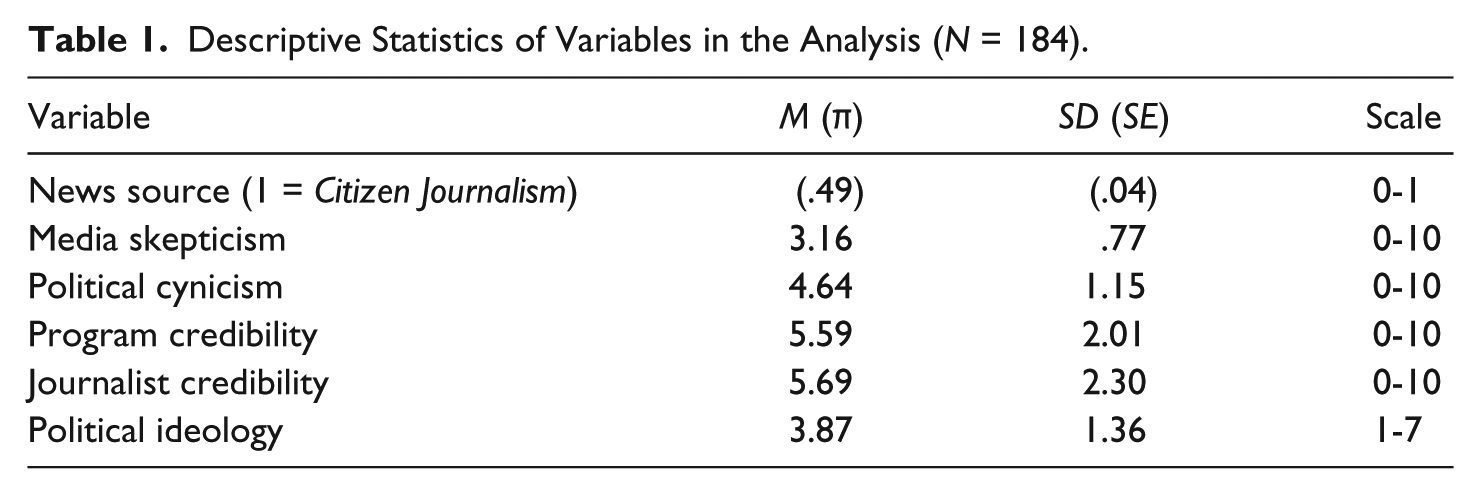
Pre-test measures were created for subjects’ pre-existing levels of media skepticism and political cynicism. Post-test measures included multiple indicators of perceived media credibility, which give the study additional leverage over the research problem. Accordingly, measures were created for perceived credibility of both the news program and the journalist. All questionnaire items used eleven-point scales unless otherwise noted. See Table 1 for a summary of descriptive statistics for each item.
Descriptive Statistics of Variables in the Analysis (N = 184).
Media skepticism
A measure of the subjects’ pre-existing levels of media trust was constructed from the mean of five pre-experiment measures of whether the media provide accurate and trustworthy information, whether the media deal fairly with all sides, and whether the information provided needs to be confirmed (α = .73, M = 3.16, SD = 0.77). We then used the median of the resulting scale as a dividing point along which to split the subjects into two groups: skeptics, those individuals scoring below 3.2 on the computed scale (n = 96), and non-skeptics, comprised of those scoring 3.3 or higher on the scale (n = 88).
Political cynicism
Two survey items were used to establish the subjects’ pre-existing levels of political cynicism. Respondents rated their agreement with the following statements: “Elected officials put their own interests ahead of the public’s interest” and “It seems like politicians only care about special interests.” These two items were averaged (r = .41, M = 4.64, SD = 1.15). A median split of this scale was again used to divide the subjects into two groups: those with low levels of political cynicism, those scoring below 4 on the above scale (n = 79), and those with high levels of political cynicism, defined as scoring 4.5 or higher on the scale (n = 105).
Program credibility
To measure how perceptions of the news program changed depending on experimental condition, respondents were asked to rate their level of agreement with a series of program evaluations drawn from Meyer 58 and Ognianova, 59 including its fairness, accuracy, bias, trustworthiness, balance, and partisan nature. These six questionnaire items were averaged to create an index (α = .84, M = 5.59, SD = 2.01).
Journalist credibility
To test how perceptions of the journalist changed depending on experimental condition, respondents were asked to rate their level of agreement with a series of statements about the moderator, including his credibility, fairness, reasonableness, open-mindedness, professionalism, and truth-seeking intentions. 60 These six items were averaged to create an index (α = .90, M = 5.69, SD = 2.30).
Political ideology
The models testing the influence of political cynicism also control for the subject’s political ideology to avoid a potential confound. It could be that political cynicism runs in a particular ideological direction dependent upon the party of the fictitious candidate in the news report (Democrat). Subjects were asked two questions in which they rated their own political ideology on economic issues and social issues, respectively. The questions used seven-point scales (1 = liberal, 4 = neutral, 7 = conservative), and the responses were averaged to create the final variable (r = .68, M = 3.87, SD = 1.36).
Results
Manipulation Checks
To confirm that our experimental manipulations performed as intended, respondents were asked to identify the source of the video. Most respondents (87%) answered the question correctly (CBS, for those in the professional condition, and Amateur Blogger, for those in the citizen journalism condition), and the citizen journalism group did not provide significantly more correct answers than the professional journalism group (3% difference; z = .37, ns). We therefore concluded that our manipulations performed well and continued with the analysis.
News Source
Two-way analyses of variance (ANOVAs) were used to address each of the hypotheses outlined above.
Two-way Analyses of Variance for Perceived Credibility of News Program and Journalist by News Source, Conditional on Media Skepticism and Political Cynicism.
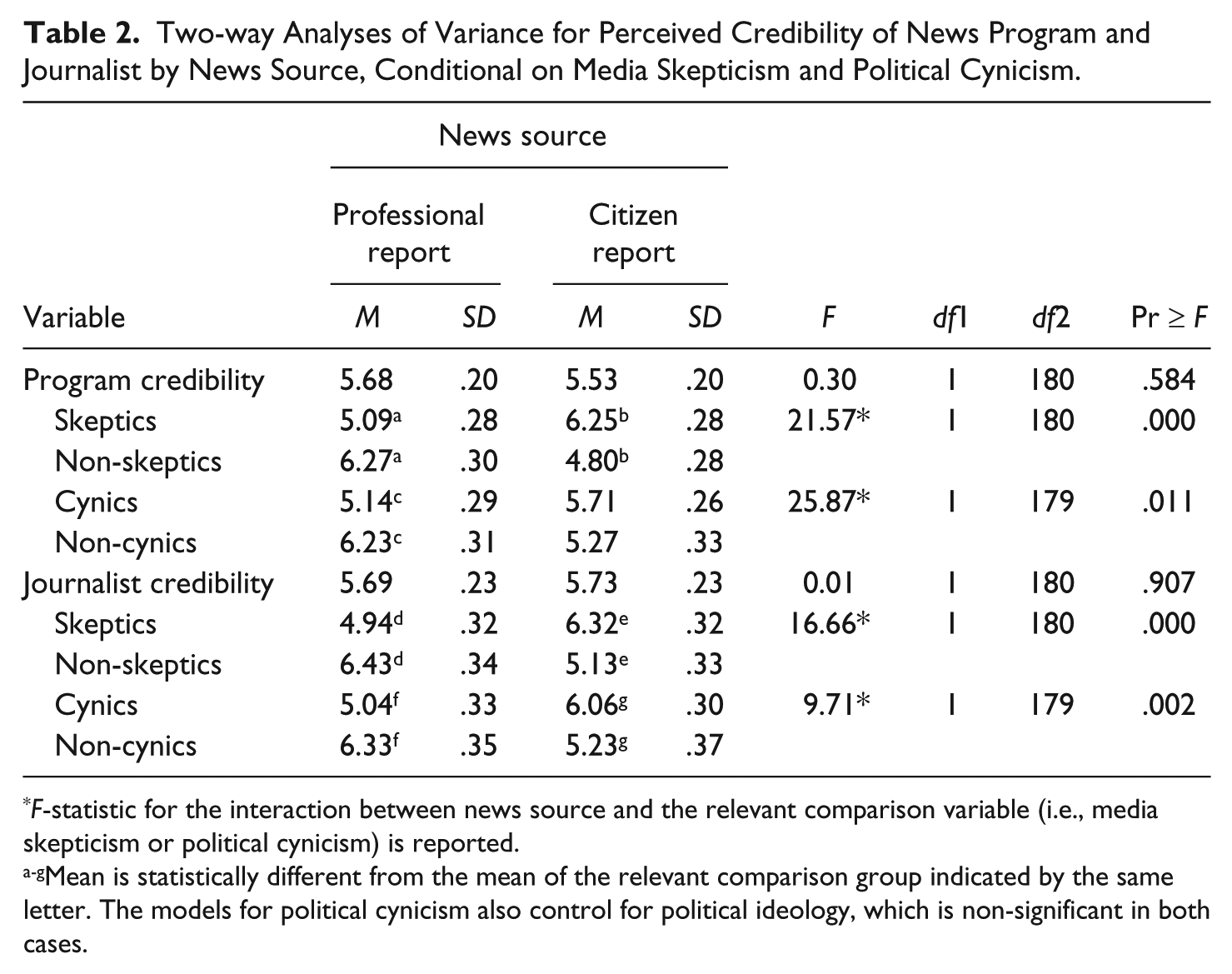
F-statistic for the interaction between news source and the relevant comparison variable (i.e., media skepticism or political cynicism) is reported.
Mean is statistically different from the mean of the relevant comparison group indicated by the same letter. The models for political cynicism also control for political ideology, which is non-significant in both cases.
Media Skepticism
On the contrary, we do find evidence that the effects of news source on perceived credibility are conditional upon an individual’s predispositions toward the media and politics. Although there are no main effects of media skepticism on either program credibility, F(1, 180) = 0.23, ns, or journalist credibility, F(1, 180) = 0.22, ns, leading us to reject

The interactive effect of news source and media skepticism on subjects’ assessments of news program credibility.
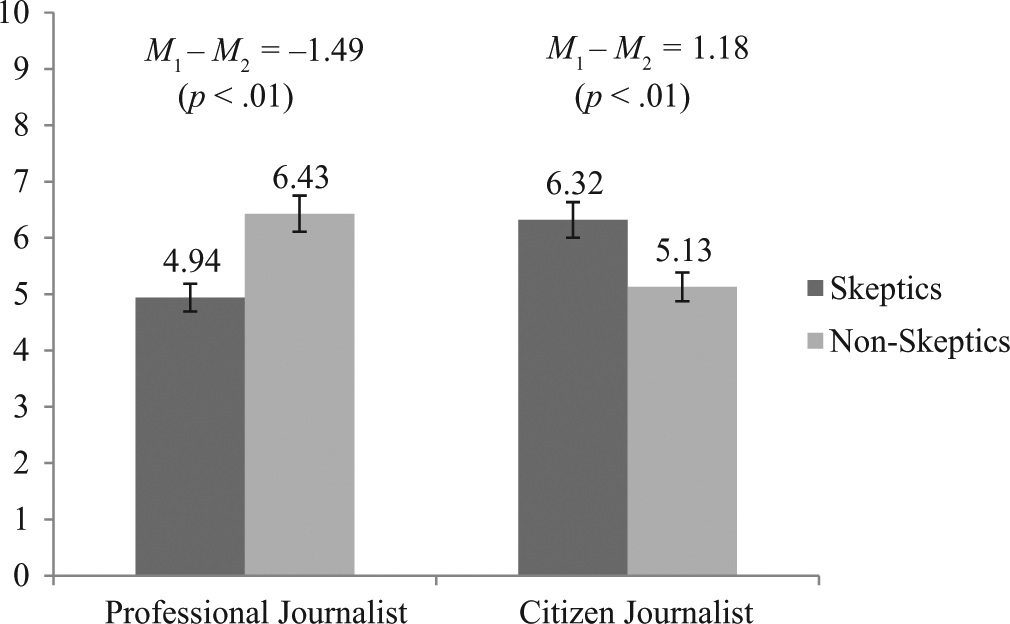
The interactive effect of news source and media skepticism on subjects’ assessments of the journalist’s credibility.
Political Cynicism
As with media skepticism, we find evidence of transverse interactive effects of political cynicism and news source on perceived credibility. Once again, we find no main effect of political cynicism on subjects’ evaluations of either the journalist or program credibility, F(1, 179) = 1.14, ns, F(1, 179) = 0.44, ns, respectively, leading us to reject

The interactive effect of news source and political cynicism on subjects’ assessments of news program credibility.

The interactive effect of news source and political cynicism on subjects’ assessments of the journalist’s credibility.
Discussion
Taken together, our results demonstrate that the effects of different news sources on the perceived credibility of information are conditional upon pre-existing attitudes toward the news media and politics. While, on the aggregate, people do not differentiate between the credibility of mainstream and citizen journalism, these assessments are dependent upon an individual’s levels of media skepticism and political cynicism. In our sample, cynics and skeptics found citizen journalism more credible than mainstream journalism, while non-cynics and non-skeptics expressed the opposite.
The conditionality of the effects we observe is certainly the most important aspect of our findings. Although we expected such conditionality, we also expected to observe a main effect of the news source. However, without considering their attitudes toward the media and political predispositions, subjects in our sample do not distinguish between the two sources of news. This finding implies that in an era of proliferating sources of news and information, especially on the Internet, people may distinguish less and less between mainstream and alternative sources of news and information, at least on the aggregate level. This conclusion must be qualified, of course, by the consideration that our citizen journalist manipulation remained relatively close to traditional news presentation formats to maintain the internal validity of the experiment. Perhaps if the citizen journalist condition had been even more informal in style and tone, a main effect of the news source would have manifested. Still, holding the specific information presented in the news story constant, subjects do not necessarily distinguish between the professional and citizen report. From one perspective, these findings would appear to conflict with previous research showing differences between types of news media and between mainstream and alternative news media. 61 On the contrary, those studies focused on differences between media themselves (e.g., newspapers vs. television and online news), 62 whereas our study compared a professional and amateur report viewed on the same medium. Furthermore, any discrepancies that appear to exist with previous research disappear once we consider individual-level predispositions toward the media and politics. It turns out that people do distinguish between media types. However, these distinctions are conditional upon pre-existing levels of media skepticism and political cynicism.
Our results fit nicely with a body of literature suggesting that media skeptics are less likely to trust the mainstream news media because they are suspicious of common journalistic practices. 63 Our findings extend this body of literature by demonstrating the conditionality of media skepticism’s influence. It is not simply that media skeptics are more critical of all media; rather, they are more critical of mainstream news than they are of alternative news outlets. This conclusion implies that media skeptics may find refuge in citizen journalism, seeking out alternative sources of information in reply to their critical stance toward the mainstream news media. Certainly, this conclusion will perhaps help to abate fears about the declining trust in the mainstream news media. 64 Once again, however, this conclusion must be qualified. If the quality of information presented in citizen journalism is, in reality, not comparable to the quality of information in professional journalism, media skeptics may receive inaccurate, incomplete, misleading, or slanted information from their preferred news sources. This possibility, of course, hardly seems positive for the prospects of an informed citizenry.
Our findings also show the conditional influence of political cynicism. Knowing that political scandals prime political cynicism, 65 it is not surprising to see its effects on perceived credibility. What is new and important about our findings is, once again, the conditionality of the effects. Many studies have explored the link between mainstream news media coverage of politics and the development of political cynicism. 66 However, fewer studies have compared mainstream news to alternative news sources. The addition this study makes to the literature is the suggestion that political cynics, like media skeptics, are more critical of the mainstream news media than they are of citizen journalism. This could be because they view citizen journalists as political outsiders, not constrained by the same need to maintain contacts in political circles. Again, these results generally point toward an optimistic conclusion for an informed citizenry, assuming citizen journalism provides its audience with quality information.
Previous research has focused on how news media lead to the development of dispositions such as media skepticism 67 and political cynicism. 68 Our study addresses the reflexive nature of this relationship, exploring how political cynicism and media skepticism influence perceptions of the media. Our evidence therefore implies the possibility of a reciprocal relationship between individual predispositions and media exposure. 69 However, our evidence also shows that political cynics and media skeptics find solace from the mainstream media in citizen journalism. This idea provides a more hopeful outlook than the “spiral of cynicism” argument supposes. 70 Indeed, cynics may become more trusting over time if they pay attention to news sources they believe. On the contrary, if citizen journalism provides the same type of information as mainstream journalism, its audience may grow even more cynical over time.
The findings of this study are tempered by several important limitations. First, while every effort was made to maintain the ecological validity of the stimulus materials, the news story and candidate were, in fact, not real. This problem could be particularly acute among subjects who reside in Colorado, as they may have realized the stimulus was not real. Furthermore, the stimulus may not be representative of all forms of citizen journalism on the web. In fact, the stimulus for both conditions used the same information, and thus represents a relatively more formal style of citizen reporting. Next, the results of the study may not be generalizable beyond the context of political scandal. Different informational contexts could produce different reactions among cynics and skeptics. Furthermore, while we have previously argued that the Mechanical Turk sample is representative of the U.S. adult population, some consideration must be given to the possibility that the results of this study are specific to the sample under examination, even while this possibility seems relatively unlikely. Additional concerns remain regarding the Mechanical Turk sample, specifically the use of paid subjects. However, the practice of compensating study respondents is common in the communications field, particularly in experimental research. Given the representative nature of the sample obtained and the existing research supporting this approach, 71 the researchers are confident that any effects stemming from the sample recruitment techniques are minimal. Another important consideration is that subjects potentially engaged with the video materials under different conditions, which could create an experimental confound. However, within real-world settings, citizens regularly engage with the news media through a variety of formats, and the lack of control over the viewing environment provides a more naturalistic context for exposure. In addition, given the randomization procedure, any effect caused by differing viewing environments should be distributed evenly between the two conditions. The final limiting consideration is that the stimulus was designed and the experiment was administered with the U.S. context in mind, and therefore these results may not generalize to non-U.S. contexts.
Despite these limitations, this experiment has provided strong evidence that cynics and skeptics believe citizen journalism is more credible than mainstream journalism, and that non-cynics and non-skeptics believe the opposite. Some scholars have claimed that the proliferation of citizen journalism could help disaffected and distrustful citizens re-engage with the news media and with politics. 72 Our study supports this optimistic outlook, showing that cynics and skeptics view citizen journalists as more credible than the mainstream media. In all, the idea that citizens who distrust the mainstream news media have placed their trust in alternative sources of news and information leads to renewed hopefulness about having an informed and engaged electorate in the United States, contingent on the quality of information citizen journalism provides, and underscores the importance of alternative news outlets in American society.
Footnotes
Declaration of Conflicting Interests
The author(s) declared no potential conflicts of interest with respect to the research, authorship, and/or publication of this article.
Funding
The author(s) received no financial support for the research, authorship, and/or publication of this article.