




Abstract
This study examined the effects of news use motivations and differing native advertising contexts (hard vs. soft news) on the ability to perceive commercialized content, evaluations of native advertising, and ensuing digital news perceptions. Based upon the framework of the persuasion knowledge model, an online experiment was conducted among a sample of U.S. adults (N = 684). Engaging with news for informational motivations conditioned perceptions of advertising as did the contextual effects of hard versus soft news. Furthermore, hard-news approaches to native advertising were perceived more unfavorably by audiences and tarnished the subsequent reporting of actual journalists.
The practice of native advertising (NA) has become ubiquitous among mainstream news organizations in the United States (Gerth, 2017; Levi, 2015) and is spreading worldwide (Ferrer Conill, 2016). In response to the vexing problems of annoying consumers with disruptive advertisements that “clutter” an editorial medium (Ha, 1996) as well as plunging publisher advertising revenue, NA seeks to blend in with, or appear “native” to, the online platform on which it appears. In digital news environments, these messages mimic the format and tone of a traditional piece of journalism, often down to the identical font (Einstein, 2016; Ferrer Conill, 2016) distorting the genre boundaries of what constitutes news (Edgerly & Vraga, 2019). Although publishers have always offered advertisers a way to reach and communicate with audiences, the blurring of editorial and commercial content inherent in NA threatens to tarnish the reputational credibility and autonomy of news organizations (Carlson, 2015; Kovach & Rosenstiel, 2001). Even with traditional forms of disruptive ad content, publisher credibility suffers when ads co-opt news content (Zha & Wu, 2014). Furthermore, most damaging to a website’s credibility is when the distinction between ads and content is blurred (Fogg et al., 2002). Accordingly, this study aims to contribute to calls for understanding how the blurring of news genres affects media effects (Edgerly & Vraga, 2019).
Recent research on “customized” NA (Einstein, 2016) in digital news environments reveals that individuals most likely to recognize this content as commercial in nature are those motivated to engage with news media for surveillance or information-seeking purposes (Amazeen & Wojdynski, 2019). This seems to contradict research indicating that the more involved an individual is with media content, the less likely they are to attend to the surrounding advertisements (Norris & Colman, 1992), although ads that are thematically congruent are better remembered (Moorman, Neijens, & Smit, 2002). These studies, however, were premised on advertising content that was separate from the programming/editorial content surrounding it rather than integrated into the content. This prompts the question of whether the context of the sponsored news story that comprises NA may also affect how audiences process and react to covert persuasive attempts. In other words, do audiences perceive and react to NA differently depending upon not only their motivations for engaging with the news content but also whether the content involves a hard versus soft news topic? Indeed, Wojdynski and Evans (2019) contend that one reason traditional models of how people understand persuasion are insufficient at explaining the processing of contemporary covert advertising formats is because they do not account for contextual factors such as the type of surrounding context in which these messages appear. This study seeks to fill this gap.
It is well established that media context—such as the editorial environment—can influence the effects of traditional advertising (De Pelsmacker, Geuens, & Anckaert, 2002; Moorman et al., 2002). To date, however, academic studies gauging the consequences of recognizing NA in digital news environments have typically been limited to soft-news topics oriented toward consumers with a commercial brand sponsoring the content. Examples include Ben & Jerry’s ice cream as it relates to sustainability practices (Amazeen & Muddiman, 2018); Bank of America’s mobile banking application (Amazeen & Wojdynski, 2018, 2019); advances in automotive batteries by a fictitious company, LEOMotive (Wojdynski & Evans, 2016); a tablet-based drawing application by Dell (Wojdynski & Evans, 2016); Apple iPads (Tutaj & van Reijmersdal, 2012); smartwatches by Samsung (Krouwer, Poels, & Paulussen, 2017); and travel destinations by Super 8 Motels (Wu et al., 2016). A notable exception was a study by Iversen and Knudsen (2019) in which an article involved a hard-news topic about a political party leader surging in public opinion polls, sponsored by that political party. Nevertheless, none of these studies have varied the sponsored news topic to explore differential contextual effects. Thus, this study revisits how contextual effects may influence perceptions of integrated, covert persuasive attempts in digital news.
Given the changing media environment, this study aims to understand the conditions under which audiences are able to identify news and how they respond to the blurring lines between journalism and advertising. To do so, it empirically examines news use motivations and the contextual effects of differing topics of customized NA in a digital news environment on the ability to perceive commercialized content and on evaluations of ensuing news perceptions. In so doing, the study extends the theoretical framework of Friestad and Wright’s (1994) Persuasion Knowledge Model (PKM) to a covert advertising context, enhancing our understanding of the knowledge structures in this model and how they interact. It also builds upon previous research identifying news use motivations as an individual characteristic influencing recognition of and responses to NA (Amazeen & Wojdynski, 2019) by demonstrating how these outcomes are conditioned by the contextual effects of news topic. In addition, this research extends work by Iversen and Knudsen (2019), who found that recognition of NA results in less trust of subsequent political news. This study reveals how the contextual effects of NA topic also conditionally influence perceptions of real journalism. To these ends, an online experiment was conducted among a sample of U.S. adults (N = 684). The results address important concerns of policymakers and consumers who seek to reduce deception and unfair business practices in the online marketplace. Moreover, publishers may also benefit from a better understanding of when and how various people are likely to respond to differing NA topics in digital news. Most broadly, the findings contribute to research on how the public perceives the “news-ness” of journalism or what constitutes news (Edgerly & Vraga, 2019).
Hard News versus Soft News
Among the conventions of journalism is the distinction between hard versus soft news stories (Zelizer, 2004). Although these classifications often overlap, hard news typically involves the factual presentation of immediately newsworthy national or international events such as coverage of top political leaders or significant political or social issues that could disrupt public daily life including attacks, disasters, or epidemics (Baum, 2006; Lehman-Wilzig & Seletzky, 2010; Tuchman, 1973). In this way, hard news involves socially consequential issues presented in a style devoid of a journalists’ opinion (Otto, Glogger, & Boukes, 2017; Reinemann, Stanyer, Scherr, & Legnante, 2011). In contrast, soft news focuses on human interest or personal feature stories characterized in style by emotionally evocative or sensational presentations of dramatic subject matter (Baum, 2006; Otto et al., 2017; Reinemann et al., 2011; Tuchman, 1973). Topically, hard news includes international affairs, politics, business, the economy, and finance (Newman, Fletcher, Levy, & Nielsen, 2016; Reinemann et al., 2011). Soft news covers celebrities and entertainment, arts, culture, lifestyle, royal families, scandals, and sports (Newman et al., 2016; Reinemann et al., 2011). To the extent that political issues are addressed by soft news, they tend to be the most current and dramatic from a human interest or celebrity-involvement perspective (Baum, 2003).
Although contemporary news outlets often offer a mixture of hard and soft news, the characteristics and motivations of people who prefer one type over the other differ. Demographically, audiences for soft news tend to be younger (Newman et al., 2016), less educated (Baum, 2006), female (Newman et al., 2016; Prior, 2003), and non-White, with lower incomes than those who consume content from traditionally hard-news outlets (Prior, 2003). Furthermore, from a uses and gratifications perspective, individuals have different motivations for consuming media content (Ha & McCann, 2008; Katz, Haas, & Gurevitch, 1973; Rodgers & Thorson, 2000; Rubin, 1984; Ruggiero, 2000). Consistent with ritualistic consumption motivations (Rubin, 1984), people engage with soft news primarily to be entertained (Baum, 2006; Prior, 2003). They are also less interested in politics (Baum, 2006) or more cynical about it (Boukes & Boomgaarden, 2015). In contrast, those who consume hard news are more politically knowledgeable (Curran, Iyengar, Lund, & Salovaara-Moring, 2009) and enjoy detailed news coverage (Prior, 2003)—consistent with instrumental consumption that is selective and goal directed (Rubin, 1984). Given the detail orientation of hard-news consumers and entertainment orientation of soft-news consumers, the following hypotheses are proposed regarding the relationship between news consumption motivations and news type interest:
Persuasion Knowledge and Information Processing
A framework for conceptualizing how consumers recognize and react to persuasive messages is the PKM (Friestad & Wright, 1994). According to this model, as goal-seeking individuals, people draw upon three cognitive knowledge structures regarding (a) the agent or source of a message, (b) the topic of a message, and (c) their accumulated understanding of what persuasion entails. However, consistent with information-processing models (e.g., Chaiken, 1980; Petty & Cacioppo, 1986), drawing upon these mental resources is dependent, in part, upon situational goals and ability to process information. That is, whether an individual is engaging with digital news for informational or entertainment needs will influence how they respond to online advertising (Ha & McCann, 2008; Rodgers & Thorson, 2000). Moreover, an appropriate response also requires the activation of persuasion knowledge, that is, the recognition that a message involves a persuasive attempt (Tutaj & van Reijmersdal, 2012; Wojdynski & Evans, 2019). Because NA in digital news contexts is disguised as editorial content, persuasion knowledge may not be activated as consumers are often deceived about the purpose of the message and receive the content as if it were editorial rather than commercial in nature (Amazeen & Muddiman, 2018; Amazeen & Wojdynski, 2018; Wojdynski & Evans, 2016).
For example, when offered content from the New York Times (NYT), most people would identify the Times (the agent) as a news organization with varying degrees of credibility based upon their past experiences. In this situation, persuasion knowledge is unlikely to be triggered unless the individual is confronted with and attentive to a cue—such as a NA disclosure—to suggest that there is another source of the message and what they are seeing is something other than journalism. Although the U.S. Federal Trade Commission (FTC; 2015) requires clear and conspicuous disclosures for NA content, even with disclosures the vast majority of readers do not notice or do not understand what they mean and, consequently, do not recognize NA in digital news contexts (Amazeen & Muddiman, 2018; Amazeen & Wojdynski, 2018, 2019; Wojdynski, 2016; Wojdynski & Evans, 2016).
Topic knowledge is also used by individuals to interpret a message and involves beliefs about products, services, social causes, or candidates (Friestad & Wright, 1994). Given the opportunity to engage with a product such as news, consumers should draw upon their topic knowledge schemata to gauge what constitutes news, which articles are of interest based upon subject matter, and whether articles are in a preferred hard- or soft-news orientation. As domain-specific product expertise is a component of topic knowledge, those with greater expertise should be better at distinguishing product quality than novices (Campbell & Kirmani, 2008). It follows, then, that those with a greater understanding of what news is should be better able to discriminate journalistic content from imposter content and use this knowledge in deciding whether to engage with or avoid a message (Wojdynski & Evans, 2019). Indeed, individuals with greater procedural news knowledge—an understanding of news gathering practices—are better able to identify and resist online disinformation efforts such as fabricated news and covert advertising attempts (Amazeen & Bucy, 2019).
The motives of an individual that drive engagement with digital news may also influence topic knowledge and ability to draw upon persuasion knowledge in distinguishing commercial content from journalism (Wojdynski & Evans, 2019). To be sure, recognition of NA is more likely among those who prefer to use news for informational purposes (Amazeen & Wojdynski, 2019). This may be because people who are motivated to engage with news for informational purposes tend to pay more attention to the content claims and learn more (Eveland, Shah, & Kwak, 2003; Feldman, 2013). In contrast, people who engage with media for diversionary or entertainment purposes tend to focus on the accuracy of social portrayals (Blumler, 1979; Rubin, 1981) and invest less mental effort in message processing (Feldman, 2013). Thus, information seekers may be functioning in a more goal-directed and serious task-orientation mode that is associated with greater cognitive effort than those in a less serious mode (Ha & McCann, 2008; Rodgers & Thorson, 2000). Motivations to consume media have, indeed, been linked to cognitive involvement with a message (Petty & Cacioppo, 1986). For instance, an instrumental motivation, such as information-seeking behavior, generates higher levels of involvement and cognitive processing than do ritualistic motivations such as entertainment-seeking behavior (Smith & Buchholz, 1991; Sun, 2008). Accordingly, those motivated to engage with content for entertainment may be less likely than information seekers to notice if it is authentic journalism or an ad that mimics journalism.
Ability to process information is also affected by the surrounding media environment such as perceptions of advertising clutter and intrusiveness as well as editorial context. Perceived ad clutter refers to the excessiveness of advertising in media, whereas intrusiveness refers to the degree to which the presence of advertising interrupts the flow of editorial content (Elliott & Speck, 1998; Ha, 1996; Ha & McCann, 2008). Given that NA is designed to blend in with the editorial environment and be less intrusive than pop-up ads or traditional display advertising, more cognitive resources are likely necessary for preliminary processing efforts such as message feature discrimination. Thus, individuals who engage with digital news sites on a low-involvement basis—such as entertainment seekers—may be less likely to perceive the advertising because they will be less likely to allocate the attentional resources needed to accurately encode and process the content masquerading as journalism (Smith & Buchholz, 1991). This is consistent with research showing that the context of the editorial environment influences cognitive involvement and recall of advertising (Norris & Colman, 1992).
There is some evidence to suggest that the contextual effects of a sponsored news article topic may also interact with persuasion knowledge. Because people who consume soft news tend to seek entertainment rather than information (Baum, 2006), they may have a lower level of involvement and use less cognitive effort, consequently relying on peripheral cues to process the information. This may lead to a lower likelihood of recognition of NA when the sponsored content mimics soft news. Moreover, because motives influence the cognitive processes of attention, encoding, and central elaboration (Rodgers & Thorson, 2000), soft-news consumers would also be less likely to spend time engaging with a hard-news-oriented native advertisement because it would be of little interest to them. Conversely, because it is expected that informational news use motivations have a positive correspondence to hard news, perceiving NA may be more likely in this context. These users would be more likely to both attend to hard-news appearing content and more motivated to cognitively process it as well as less likely to attend to and process soft news. Given the preceding arguments, the following is expected regarding how motivations and news topic context will affect perceptions of content:
Consequences of Persuasion Knowledge
It is well established that recognition of advertising generally results in negative consumer reactions (Friestad & Wright, 1994; Tutaj & van Reijmersdal, 2012). Particularly with covert practices, individuals who are able to decipher the content as commercial in nature tend to have less favorable attitudes toward the advertised brand (Boerman, van Reijmersdal, & Neijens, 2012; Wojdynski & Evans, 2016) as well as the message content (Amazeen & Wojdynski, 2018; Boerman, Willemsen, & Van Der Aa, 2017; Wu et al., 2016). This is consistent with the “change of meaning” hypothesis when individuals refine their attitudes based upon new information (Friestad & Wright, 1994, p. 13). That is, if an individual realizes that the content they are observing is commercial rather than journalistic in nature, they will update their attitudes, accordingly. Moreover, when NA content is recognized, digital news users who engage for informational purposes tend to have less favorable evaluations of the content than those who engage for other purposes (Amazeen & Wojdynski, 2019).
Given that soft news generally focuses on human-interest, personally relevant stories, participants may find it less offensive to discover the content they are reading is a (however subtle) self-interested sales pitch. Indeed, research indicates that people who had lower involvement with media content—such as soft-news consumers—responded more favorably to ads that were contextually congruent (De Pelsmacker et al., 2002). In contrast, hard-news stories often focus on public-interest issues. Thus, violating the norms of hard-news conventions may have greater negative consequences than violating the norms of soft-news conventions, particularly given the greater perceived credibility of the former among TV viewers (Miller & Kurpius, 2010) and the “scrupulous” reputation hard news inherited from the bygone newspaper industry (Bagdikian, 2004, p. 246). This is consistent with the blurred boundary notion associated with the softening of news for commercial objectives (Carlson, 2015; Otto et al., 2017). Furthermore, as hard-news consumers are motivated to engage and actively process news content, they may perceive a greater level of intrusiveness toward the advertising which has disrupted their news consumption process (Ha & McCann, 2008). Thus, to the extent that the erosion of journalistic boundaries between editorial and commercial interests is more problematic in what appears to be a hard news story than a soft news story, the following expectation is offered:
Reactions to advertising can also have more widespread, spillover effects. In the case of NA within a journalistic context, recognition has led to less favorable evaluations of the industry of advertising, overall (Amazeen & Wojdynski, 2018). As suggested by the defensive consumer model, when an individual feels like they have been misled, a more general distrust of advertising may be fostered (Darke, Ashworth, & Ritchie, 2008). Furthermore, recognition of NA has also affected perceptions of journalism, albeit equivocally. Although one study found recognition of NA to result in more favorable evaluations of journalism, as an industry (Amazeen & Wojdynski, 2018), another study found that recognition results in less trust of subsequent political news (Iversen & Knudsen, 2019). Amazeen and Wojdynski (2018) speculate that the more favorable attitudes toward journalism were driven by those who recognized the NA content as having a greater appreciation for genuine journalism. They also found that upon recognition of NA, negative attitudes were most prevalent among individuals motivated to use news for informational purposes (Amazeen & Wojdynski, 2019). This suggests that the contextual effects of news topic may also affect reactions to NA more broadly. It is possible that, upon NA recognition, those observing what they thought was hard news may react more negatively to ensuing genuine political news than those exposed to what was thought to be soft news. Thus, expectations are that:
Method
Following institutional review board (IRB) approval, this study was carried out via an online experiment administered between December 7 and December 14, 2018, using the academic TurkPrime interface among 718 adult Amazon Mechanical Turk (MTurk) workers residing in the United States, who were paid US$2 for their participation. Although MTurk workers are not demographically representative of the U.S. population, past research indicates that the incidence of recognizing NA in the general population is quite low at approximately 10% (Amazeen & Wojdynski, 2018). However, those who are most likely to identify NA are younger in age with more education, characteristics consistent with the pool of MTurk workers (Sheehan, 2018). Moreover, a growing body of academic studies suggests that MTurk offers a reliable source of participants particularly when the aim of the research is to examine theory-driven motivations and cognitive processes such as attention and attitudes—as with the present research—rather than infer general population estimates. That is, MTurk samples perform similarly on cognitive tasks as do populations from other types of samples in academic studies (Berinsky, Huber, & Lenz, 2012; Litman, Robinson, & Abberbock, 2017; Sheehan, 2018). Particularly for advertising experiments where lack of attention to manipulated advertising stimuli may have detrimental effects on tests of theory, MTurk samples are beneficial in terms of participant attentiveness and involvement when compared with standard student or professional panel samples (Kees, Berry, Burton, & Sheehan, 2017). Furthermore, the use of the TurkPrime interface facilitates and improves the quality of online data collection for social science purposes (Litman et al., 2017). Accordingly, drawing participants from the MTurk population is appropriate for this study.
From the 718 participants, data cleaning yielded N = 684 useable surveys. Consistent with academic literature regarding online data quality (Menictas, Wang, & Fine, 2011; Wood, Harms, Lowman, & DeSimone, 2017; Zhang & Conrad, 2014), 1% of the participants were omitted for spending less than 4 min on the survey (median survey length was 11 min, M = 12.78, SD = 7.12). This is well within the guidelines of excluding “speeders” as suggested by Greszki, Meyer, and Schoen (2015): those who respond 50% faster than the median response time. In addition, 3.8% of the participants were excluded due to exhibiting behaviors of server farm workers—low-quality responses from foreign workers with little English proficiency (TurkPrime, 2018). In sum, removing less than 5% of the participants for data quality issues is at the low end of other published estimates of data quality exclusions (Wood et al., 2017). Detailed breakdowns of sample characteristics are listed in Table 1, and the average age of the participants was 36, 51% were male, 77% identified as White, and 43% were single/never married.
Sample Demographic Breakdowns.

Note. Due to a fieldwork error, the educational status of participants was not measured. See endnote for details.
The study involved a 2 (NA context: soft vs. hard news) × 3 (stimulus disclosure: news, NA, or unidentified) × 2 (primary stimulus evaluation questions: yes vs. no) full factorial design (see Table 2). Participants were randomly assigned to one of the 12 conditions. For the first manipulation, half of the sample was exposed to the primary stimulus (described below) that was in the form of a soft-news native advertisement and the other half to a hard-news native advertisement. The second manipulation involved how the stimulus was described to participants after reading it. One-third of the participants were each told that what they just read was either “an excerpt of a news article published in The New York Times,” “ . . . sponsored content (a form of advertising) paid for by [sponsor] that appeared in The New York Times,” or “ . . . published in The New York Times.” The stimulus content was identical regardless of whether it was revealed to be news, NA, or undisclosed. The final manipulation involved whether participants were asked any evaluative questions pertaining to the NA stimulus. To reduce the potential for demand effects, only half the sample was asked these questions, whereas the other half of the participants was directed to a secondary stimulus without evaluating the first stimulus.
Study Design.

Note. NA = native advertising.
Stimuli
Because the aim of this study is to examine whether the contextual effects of a NA “news” article influences perceptions of commercialism and journalism and to maximize external validity, the primary stimuli were based upon the existing native advertisements rather than ones that were artificially designed for the experiment. Furthermore, hard and soft news are not dichotomous designations, but, rather distinguished by multiple dimensions including topic, focus, and style (Otto et al., 2017; Reinemann et al., 2011). Thus, the decision was made to use exemplars of NA as designed by the NYT’ T Brand Studio.
The primary stimuli (see Supplemental Appendix A) were selected based upon a pretest of six native ads that measured reader perceptions of hard news versus soft news orientation as well as understanding of and interest in the content. The pretest was administered November 27 to December 12, 2017 using the online Qualtrics system among students studying communication at a large, private university in the New England region of the United States. The 155 participants who completed the survey were compensated with course credit. Median survey length was 20 min. Based upon the pretest, the stimulus selected for the hard news conditions was “A Complex Flow of Energy,” sponsored by Chevron (Aston, n.d.), and the stimulus for the soft news conditions was “Grit & Grace,” sponsored by Cole Haan (T Brand Studio, n.d.). A paired-samples t-test of the pretest results, t(61) = 14.20; p < .001, indicated that the Chevron native ad (M = 4.96, SD = 1.38) was significantly more likely to be perceived as hard news than the Cole Haan ad (M = 1.92, SD = 1.11) where 1 = soft news and 7 = hard news. Although it would have been preferable to have the same product across the two contexts, news topics that are decidedly “hard” in orientation (such as energy consumption) do not readily lend themselves to a soft news format and vice versa. Limitations of this design are addressed more fully at the end of the study. To maintain consistency between the news context conditions, all visuals (charts, graphs, photos, and videos) were omitted from the stimuli. Participants were only presented with text-based excerpts that were both approximately 400 words in length.
The secondary stimulus was a political news article in the form of a fact-check attributed to the NYT (see Supplemental Appendix B). Following Amazeen, Thorson, Muddiman, and Graves (2018), the scenario was modified from an actual PolitiFact item from the 2008 U.S. presidential campaign that debunked a charge by then Senator Barack Obama against Senator John McCain (Farley, 2008). In the current scenario, participants were shown a statement attributed to a fictitious Congressman, Daniel Stacks: “During the 2018 Florida Congressional election, Stacks said this about his opponent, John Hunter: ‘One hundred percent of John Hunter’s ads have been negative.’” The political affiliations of both candidates were not disclosed. The fact-check article provides context surrounding the claim and assesses it as “mostly false.”
Procedure
Respondents were invited to participate in a study about media consumption. Following informed consent, all participants were asked about their media use habits and interests as well as perceptions of various news organizations and knowledge of news media practices. Participants were then asked to “read an excerpt of a longer text” that they “would be asked questions about afterwards.” After exposure to the stimulus, the type of content they saw was identified followed by manipulation check questions. Half the participants were also asked about their perceptions of the message content. All participants were then asked to read and evaluate the political news article. The study concluded with demographic measures, a debriefing, and thanking participants for their time.
Measures
News use motivations
Informed by Palmgreen and Rayburn (1982) and Choi (2016), two composite measures of news use motivations were created using 7-point Likert-type scales (1 = strongly disagree and 7 = strongly agree). The surveillance/information-seeking dimension was measured using three items describing why the participant seeks out news that are consistent with goal-directed cognitive processes: “to find out firsthand information about important issues,” “to keep up with the latest issues and events,” and “to learn something” (Cronbach’s α = .80, M = 5.84, SD = 1.06). Entertainment motivation was measured using four items with statements for seeking out the news consistent with more playful, less cognitively-taxing processes, including “to pass the time when I don’t feel like doing anything else,” “to entertain myself,” “to relax,” and “to relieve boredom” (α = .83, M = 3.74, SD = 1.42).
Interest in hard versus soft news
To develop composite measures of interest in hard news and soft news, participants were asked to indicate how interested they were in six types of news topics using a 6-point Likert-type scale (1 = not at all interested and 6 = very interested). An even number of scale points was purposely used to avoid a neutral option. Based upon Newman et al. (2016) and Reinemann et al. (2011), the political news, international affairs, and business or economic news items were averaged to form a measure of hard news interest (α = .71, M = 4.11, SD = 1.14). Interests in entertainment or celebrity news and lifestyle were averaged to form a measure of soft news interest (α = .70, M = 4.94, SD = 1.80).
Perceived commerciality
Perceptions that the primary stimulus was advertising was operationalized using an adaptation of Edgerly and Vraga’s (2019) “news-ness” construct which measures how likely people are to perceive content as news. Based upon a 7-point Likert-type scale (1 = strongly disagree and 7 = strongly agree), participants indicated how strongly they agreed that the article excerpt they read was news (M = 4.40, SD = 1.95), entertainment (M = 3.96, SD = 2.11), and advertising (M = 2.59, SD = 1.59). The advertising measure represents perceptions that the article excerpt was commercial in nature, that is, advertising.
Attitudes toward content
Following Wojdynski and Evans (2016), participants were provided 7-point semantic differential scales to indicate their thoughts about the NA content on five items: unappealing/appealing, good/bad, unpleasant/pleasant, favorable/unfavorable, and unlikable/likable. After reverse-coding to match the direction of word polarity (with lower scores indicating less favorable attitudes), the five items were averaged to form a composite measure of attitudes toward the advertising content (Cronbach’s α = .94, M = 5.30, SD = 1.18).
Credibility of content
Using 7-point Likert-type scales (1 = strongly disagree and 7 = strongly agree), participants were asked to evaluate the political article on five attributes: honesty, trustworthiness, conviction, bias, and credibility (Wojdynski & Evans, 2016). After reverse-coding for consistent word polarity (with lower scores indicating less credibility), the five items were averaged to form a composite measure of perceived credibility of the political article (α = .90, M = 4.99, SD = 1.28).
Control variables
To isolate the unique effects of the variables under theoretical consideration, several variables found as correlates were employed as statistical controls. Previously shown to influence NA recognition (Amazeen & Wojdynski, 2018; Howe & Teufel, 2014), age was measured using an open-ended question (M = 35.60, SD = 10.08). Knowledge about news practices/operations (procedural news knowledge) has been demonstrated to play a role in helping people identify and resist online covert advertising attempts (Amazeen & Bucy, 2019) and was based upon summing correct responses to three multiple choice questions about press releases, social media, and public media (see Supplemental Appendix C for question wording) that each had one correct answer. All three questions were correctly answered by 41% of the participants, one in three answered two correctly, 19% answered only one correctly, and 7% answered none of the questions correctly (M = 2.08, SD = 0.93). This measure is consistent with cross-national studies of news knowledge which use similar items and also reinforce the value of news-knowledge holding, showing that people with greater understanding of how the news media operate (e.g., sources of news and how it is funded) are more likely to rely upon a greater range of credibility cues when deciding which types of news to consume (Newman, Fletcher, Kalogeropoulos, Levy, & Nielsen, 2018). Finally, because it was disclosed as the publisher of the stimuli, perceived credibility of the NYT is also a control variable, measured using a 7-point Likert-type scale where 1 = less credible and 7 = more credible (M = 5.16, SD =1.70).
Manipulation Checks
To confirm pretest results indicating a perceived difference in news topic context between the two NA stimuli, participants were asked to evaluate the primary stimulus using a 1 to 7 scale where 1 represented soft news and 7 hard news. Specifically, participants were instructed as follows: Would you describe the information presented in the article as closer to hard news or soft news? “Hard” news is typically used to refer to topics that are timely, important and consequential, such as politics, international affairs, and business news. Conversely, “soft” news topics include entertainment, celebrity, and lifestyle news.
Using SPSS version 24, a statistically significant t-test, t(587.24)= −40.56, p < .001, indicates that participants exposed to the Chevron stimulus perceived it as having a harder news orientation (M = 5.35, SD = 1.48) compared with the Cole Haan stimulus which was closer to soft news (M = 1.48, SD = 0.96). Thus, the context manipulation was successful.
The perceived commerciality of the primary stimulus was a second manipulation check. An analysis of covariance (ANCOVA) was employed with the stimulus disclosure conditions (news, NA, and undisclosed) as the independent variable and the perceived commerciality as the dependent variable. Age, NYT credibility, and procedural news knowledge were covariates. A significant result, F(6, 677) = 14.13, p < .001, indicates differences between the three stimulus disclosure conditions. Planned contrasts show that participants in the conditions where the stimulus was revealed to be NA were significantly more likely to perceive the content as advertising (M = 3.19, SE = 0.10, p < .001) than those who were told the stimulus was a news article (M = 2.34, SE = 0.10) or compared with those for whom the content type was not disclosed (M = 2.26, SE = 0.10). Thus, the content disclosure manipulation was successful. Furthermore, because there were no significant differences between the news and unidentified conditions (p > .10), they were collapsed into a binary measure of NA disclosure (0 = no, 1 = yes) in many of the analyses.
Results
The first two hypotheses sought to establish the relationship between news use motivations and audience interest in hard versus soft news. As expected by
To test the expectation that the type of motivation to engage with news moderates the effects of NA disclosure on perceived commerciality of content (
OLS Regression of NA Disclosure and News Use Motivations on Perceived Commerciality.
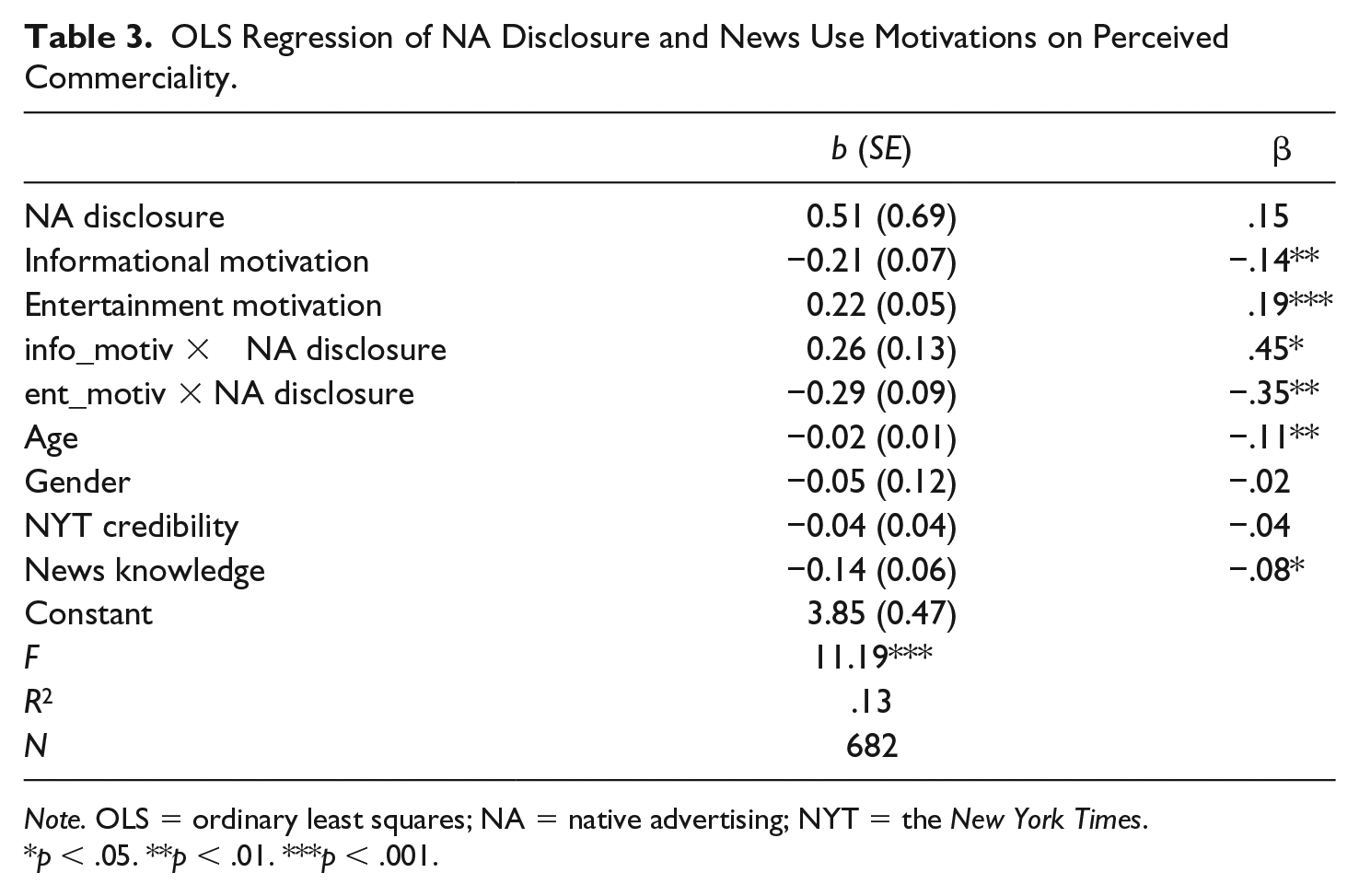
Note. OLS = ordinary least squares; NA = native advertising; NYT = the New York Times.
p < .05. **p < .01. ***p < .001.
To investigate the extent to which context moderates the effects of perceived commerciality on attitudes toward the content among those exposed to disclosed advertising content (
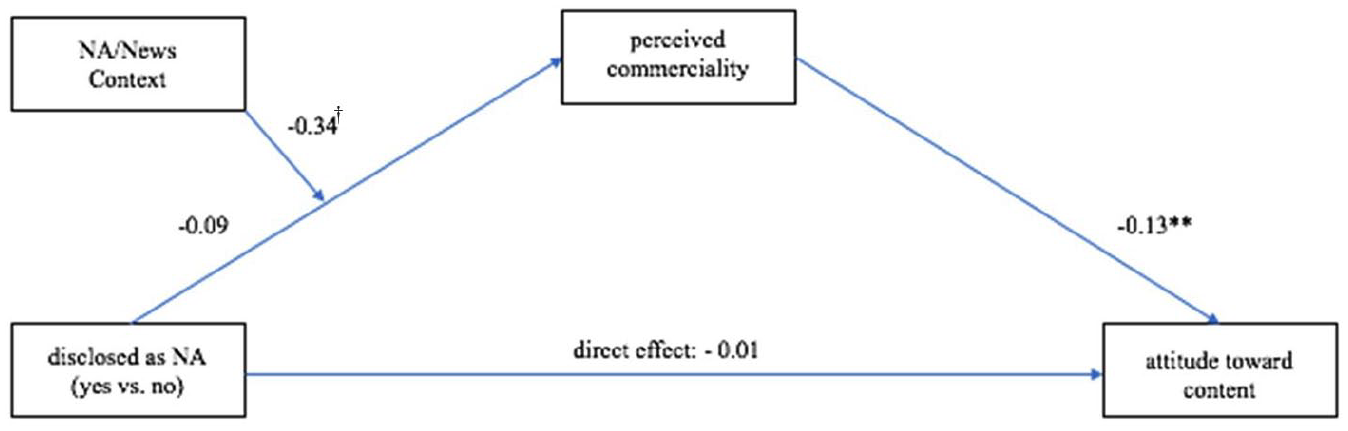
Moderated mediation analysis of effect of disclosed NA and context on attitude toward the content via perceived commerciality (n = 345).
The objective of
Discussion
The results of this study extend our theoretical understanding of how people respond to NA in a digital news environment and the factors that condition their responses. As Wojdynski and Evans (2019) argue, traditional models of how people process and respond to persuasion are premised upon a clear distinction of advertising from editorial and entertainment content. Because contemporary media content blurs these distinctions, social scientists must revisit how media consumers recognize, process, and respond to covert persuasion. Furthermore, even within domain-specific genres, such as news, audiences may not distinguish content in the way that practitioners or academic researchers expect (Edgerly & Vraga, 2019). As this study demonstrates, motivations for engaging with news and the context of the news stories condition how people recognize and respond to NA.
Expectations of the relationship between news use motivations and interest in types of news were partially supported. Although people who were motivated to engage with news for entertainment purposes did not have differential preferences between soft and hard news topics, those motivated to use news for informational purposes did prefer hard-news stories. This is consistent with Rubin (1984), who suggested that information-seeking motivations may only be relevant in the context of particular types of media content. Although both soft- and hard-news stories may fulfill diversionary or entertainment-seeking motivations, soft-news stories may not provide the type of detailed content sought by engaged information seekers. Thus, the contextual effects of news topic are an important factor to consider when examining the conditions under which news use motivations affect perceptions of NA.
As expected, perceptions that content was commercial in nature differed based upon news use motivations. Consistent with previous research (Amazeen & Wojdynski, 2019), informational motivations facilitated recognition of NA, whereas entertainment motivations did not. Furthermore, although it was expected that the disclosure of NA would interact with both an informational news use motivation and contextual effects of the NA (hard versus soft-news topic) on perceived commerciality, the evidence did not support this prediction. The hard-news-oriented Chevron ad was significantly more likely to be perceived as advertising than was the soft-news-oriented Cole Haan ad, regardless of informational news use motivation levels. This lack of three-way interaction may suggest a ceiling effect of informational motivation levels among the present sample. As detailed in the “Measures” section of the report, participants had higher levels of information-seeking motivations with less variance and lower levels of entertainment motivations with greater variance. Thus, there may not have been enough discrimination in the levels of informational motivations to detect the expected effect. The possibility of a Type II error (a false negative) is a weakness of the study and is further addressed in the “Limitations and Conclusion” section.
Nonetheless, these results are consistent with theories of selective attention wherein prior interests and preferences influence the media content consumers are more likely to attend to, encode, and elaborate upon (Blumler, 1979; Rodgers & Thorson, 2000). Although this study did not measure cognitive engagement, it is likely that participants with greater informational motivations were more likely to perceive the hard-news topic as advertising because they were more interested in the seeming news article and thus more involved in processing the message. In contrast, because participants were generally less interested in the soft-news story, they were likely less cognitively involved and consequently less likely to perceive it as advertising.
Thus, two theoretical implications are indicated by these findings. First, as theorized by Wojdynski and Evans (2019), an individual’s motivation determines the type of message processing likely to occur which interacts with persuasion knowledge in affecting scrutiny of message factors. This is a crucial antecedent to advertising recognition in covert persuasion situations. Second, the study also demonstrates that the type of context in which these advertising messages are integrated affects the ability to activate topic and persuasion knowledge structures which is consequential in how individuals respond to mediated messages. Accordingly, an important avenue for future research is to empirically account for the cognitive processes of involvement that are speculated here. Eye tracking measurements of attention and thought listing to gauge the quantity and quality of cognitive elaboration may confirm the difficulties consumers have in cognitively processing ad messages within certain news contexts.
From a normative journalistic perspective, this finding suggests an area of concern. In hard-news contexts, the commerciality of the content was more difficult to disguise—but only among consumers most motivated to engage with this type of news. In soft-news contexts, consumers were generally less likely to perceive NA as commercial in nature. This could indicate that consumers already perceive soft news as having some degree of commerciality. The findings from
Because participants were more likely to perceive the hard-news-oriented stimulus as advertising, they evaluated it less favorably than did participants exposed to a soft-news-oriented native ad. Although much of the academic research examining the effects of NA has focused on examples characterized as soft-news (Amazeen & Muddiman, 2018; Amazeen & Wojdynski, 2018, 2019; Krouwer et al., 2017; Tutaj & van Reijmersdal, 2012; Wojdynski & Evans, 2016; Wu et al., 2016), little attention has been given to hard-news native ads (see Iversen & Knudsen, 2019 for an exception). Yet, disparaging media coverage reveals cases where hard news native ads masquerade as legitimate news. For example, in 2014 Reuters won a Pulitzer Prize for its reporting on the trafficking of migrants into the seafood industry by members of the Thai navy. In November 2018, Reuters ran another article on its website about seafood slavery in Thailand—this time sponsored by Thailand’s Ministry of Foreign Affairs—profiling efforts to protect the rights of seafood workers (Carroll, 2019). Sometimes these types of sponsored relationships are not readily disclosed, such as when the British Broadcasting Corporation (BBC) accepted funding from ExxonMobil to enable coverage of environmental reporting in the United States (Cusick & Boros, 2018). Thus, it is precisely these types of hard-news-oriented native ads that are less well received by audiences—but only if they realize it is a native advertisement, something that only one in 10 people in the United States are generally able to do with typical disclosures (Amazeen & Wojdynski, 2018). This underscores for consumers the importance of mindful engagement with media content: even that seemingly factual story about global energy consumption published by the most venerated of news organizations could be an ad. Indeed, explainers on responsible media consumption are proliferating (McGrew, Ortega, Breakstone, & Wineburg, 2017; Victor, 2019; Vraga & Tully, 2019).
Rather than placing all the responsibility on the public to learn how to navigate through the confusing stew of online content or speculate about new policies necessary for the protection of consumers, publishers must be held to account for practices that defy existing norms and regulations. Not only do they disregard their own industry standards of shunning hybrid content that blurs the distinction between news and advertising (Society of Professional Journalists, 2014; Van der Goot, Zandbergen, & Van Reijmersdal, 2019) but they also violate the Newspaper Publicity Act of 1912 requiring publishers to label ad content disguised as news (Powell, 2013) so that the average consumer can distinguish the two (FTC, 2015). For publishers in the hard-news business, the present study reveals why these violations should be particularly alarming: it is detrimental to their legitimate news reporting. When exposed to hard-news native ads (and told as much), participants ultimately found ensuing political reporting to be significantly less credible than those exposed to soft-news oriented NA. Although this practice may provide publishers with much-needed incremental revenue in the short term, the long-term costs of jeopardizing the actual hard-news reporting of real journalists warrant the reevaluation of a business model that seems to imperil the future of journalism.
Limitations and Conclusion
Like any research effort, certain limitations of this study need acknowledgment. As previously noted, since the incidence of recognizing NA among the general U.S. population is very low (Amazeen & Wojdynski, 2018), MTurk workers were selected as the population from which to recruit the sample of participants. Although a fieldwork error omitted the measurement of the educational status of study participants, 1 MTurk workers are known to be younger and better educated than the general public (Sheehan, 2018). Consequently, they are likely better able to identify covert advertising which would reduce the likelihood of null findings due to misperceiving the type of stimulus presented in the study. To be sure, the aim of this study was to examine how people respond to NA rather than whether they could recognize it. At the same time, because MTurk workers are better educated, they may also be less likely to have an interest in soft-news topics and/or more likely to engage with news for informational purposes, which may have lessened the likelihood of finding a more robust range of effects related to news use motivations. Thus, future research should seek to replicate these findings within a more diverse sample of participants.
Potentially related to the characteristics of this sample of participants, the coefficients for Cronbach’s alpha on interest in hard and soft news measures were at the low end of the acceptable range. This could indicate lower reliability (or consistency) of assessing preferences in terms of this dichotomy. Interests across these categories likely overlap and may vary based upon situational motivations as indicated by Rubin (1984) and the results of this study. Furthermore, what constitutes hard versus soft news is a complex construct, going beyond mere topic as noted by other scholars (Lehman-Wilzig & Seletzky, 2010; Reinemann et al., 2011) and merits further attention in future research efforts.
It is also important to acknowledge that the selected stimuli were chosen because they offered the greatest disparity in the context of pretested hard/soft news topics. Future studies should implement a greater variety of hard versus soft news stories. Furthermore, customized native ads for the same product could be developed using both a hard and a soft news orientation to more directly compare results. Moreover, although these results focus on responses of U.S. adults, NA is increasing worldwide (Ferrer Conill, 2016). Because news preferences vary around the world (Newman et al., 2018), attempts should be made to replicate these effects based upon audiences in other countries, as well.
These findings should also be interpreted with certain methodological considerations in mind. Specifically, the data were collected within an online experimental context with forced (albeit voluntary) exposure to the treatment stimuli. Had participants encountered these articles on their own, they may have engaged with them differently, or not at all. Moreover, the results reflect the immediate influence of perceiving the NA on attitudes toward the message as well as credibility of ensuing political reporting. Although the negativity of these perceptions is certainly a cause for concern, particularly among publishers, the duration of these effects has been called into question (Beckert, Koch, Viererbl, Denner, & Peter, in press) and merits further scrutiny.
It is reassuring that when hard news is revealed as advertising, the people who are more likely exposed to it are also more likely to perceive it as such. At the same time, policymakers should be concerned that soft-news-oriented native ads are less likely to be perceived as advertising even when disclosed as such. Although “audiences increasingly see shades of gray when making sense of media” (Edgerly & Vraga, 2019, p. 821), these results make clear that mixing news and advertising is unfavorably received particularly by hard-news consumers. Revealing to readers that the seemingly hard-news-oriented stories were really sponsored ads jeopardized the credibility of that news organization’s wider reporting. Thus, the implications are that publishers who must engage in NA should limit the practice to soft-news-oriented stories that are clearly and conspicuously labeled such that even casual readers can tell from where the content originates. Hard-news approaches to NA are more likely to be received unfavorably by audiences, tarnish the reporting of actual journalists, and hasten the squandering of reader trust which will ultimately—paraphrasing media critic Bob Garfield—destroy the industry rather than save it (Powell, 2013).
Supplemental Material
DS_10.1177_1077699019886589 – Supplemental material for News in an Era of Content Confusion: Effects of News Use Motivations and Context on Native Advertising and Digital News Perceptions
Supplemental material, DS_10.1177_1077699019886589 for News in an Era of Content Confusion: Effects of News Use Motivations and Context on Native Advertising and Digital News Perceptions by Michelle A. Amazeen in Journalism & Mass Communication Quarterly
Footnotes
Acknowledgements
I thank Zicheng (Claire) Cheng, Eric Getzoff, and Daniel Novak for their research assistance as well as James E. Katz and the anonymous reviewers for their helpful comments on this study.
Declaration of Conflicting Interests
The author(s) declared no potential conflicts of interest with respect to the research, authorship, and/or publication of this article.
Funding
The author(s) received no financial support for the research, authorship, and/or publication of this article.

Supplemental Material
Supplemental material for this article is available online.
Notes
Author Biography
References
Supplementary Material
Please find the following supplemental material available below.
For Open Access articles published under a Creative Commons License, all supplemental material carries the same license as the article it is associated with.
For non-Open Access articles published, all supplemental material carries a non-exclusive license, and permission requests for re-use of supplemental material or any part of supplemental material shall be sent directly to the copyright owner as specified in the copyright notice associated with the article.
