



Abstract
This research highlights mechanisms underlying transparency’s influence on news engagement, as contingent upon perceptions of the news media’s importance (PNMI). Employing an experimental design with randomized exposure to a transparency feature and contrasting source (regional vs. national newspaper) attributions, the study provides evidence of transparency fostering increased message credibility and (indirectly) news engagement. Transparency’s indirect relationship with engagement intentions was shown to be strongest when average/high in PNMI. Notably, transparency’s effect did not vary by source attribution and was demonstrated with only one of the two stories featured in the study—further highlighting limitations of transparency as a solution for declining news trust and engagement.
Keywords
Amid widespread frustration with the news media industry and within a polarized political media landscape, it is not clear how to best build public trust in/engagement with news content and promote its import. In both professional and scholarly discussions focused on how news media actors might reduce the public’s uncertainty about journalism practices and establish/maintain credibility—thereby fostering trust-based media use—the catchphrase “transparency is the new objectivity” commonly surfaces (Weinberger, 2009). That is, deliberations often turn to how journalists might reduce uncertainty and strengthen credibility by “showing the work” through transparency-based practices and indicators. Notably, research indicates that transparency-related features within and alongside news content can be effective for fostering perceptions of credibility (Chen et al., 2019; Curry & Stroud, 2019), but the effects appear modest and are inconsistent (Karlsson et al., 2014; Masullo et al., 2021; Tandoc & Thomas, 2017), suggesting that transparency’s efficacy is not universal or straightforward (Craft & Heim, 2009; Haapanen, 2020; Karlsson, 2020).
This research effort aims to shed further light on the theoretical mechanisms underlying journalistic transparency’s potential influence and value. It features an online experiment (N = 508) for examining questions of how and when journalistic transparency can engender trust and engagement with news outlets. More specifically, it is designed to further test the proposition that transparency can serve as a key for fostering news message credibility. Simultaneously, it explores how transparency and message credibility together may promote trust-based behavior—in the form of intentions to engage with a media source. Furthermore, the project is designed to examine the role of news media importance perceptions relative to shaping the boundary conditions of transparency’s indirect effect on news engagement. Finally, this project examines the question of whether a news source’s locality (i.e., national vs. local source attribution) may factor into transparency’s effectiveness. An online experiment randomly assigned participants to view a text-based, regional news story about either (a) recycling availability or (b) infrastructure funding. The experiment exposed half of the sample to an “explainer box” (also described herein as a “transparency box”) feature, while also randomly attributing the given story to either a national or regional newspaper. Ultimately, the study provides evidence that transparency efforts can influence perceptions of message credibility. Furthermore, it demonstrated that increases in credibility were associated with stronger engagement intentions with the news publisher attributed to the content. Moreover, credibility’s positive relationship with engagement was shown to be most pronounced when participants were predisposed to attribute high importance to the idealized roles of the news media. Importantly, however, transparency’s effect on message credibility was demonstrated with only one of the two news stories featured in the study—evincing limitations of transparency’s influence.
Literature Review
News Credibility and Trust
News media outlets increasingly must grapple with the challenges of garnering audience attention and engagement. This is likely due to a host of factors, including structural issues such as increased competition with nonpolitical entertainment media options (Prior, 2005) and—especially in a United States context—a general erosion of credibility and trust, stretching over the course of decades (Brenan, 2020). Although the closely related terms of “trust” and “credibility” are often used interchangeably—consequently rendering an oft murky understanding of the differences between the concepts—for the purposes of this study, it is helpful to draw several basic distinctions, thereby enhancing their explanatory value.
Credibility is here taken to be understood as subjective audience assessments of believability—as in perceiving some message or entity to possess qualities of truth, accuracy, and facticity; of not being manipulatively selective in the sharing of full information (Hovland & Weiss, 1951; Metzger et al., 2003). Metzger et al. (2003) highlight three basic types of information-related credibility: source, message, and media credibility. Source credibility has to do with the “believability of the message source” (Wilson & Sherrell, 1993, p. 102), involving audience evaluations of a given communicator’s ability/expertise to know the truth and motivation/intention to tell the truth. Source credibility can reside at an individual level (e.g., a particular journalist), an organizational level (e.g., a specific news outlet), or even an institutional level (e.g., the news media industry). In contrast, message credibility relates to “an individual’s judgment of the veracity of the content of communication” (Appelman & Sundar, 2016, p. 63). Finally, media credibility focuses on believability relative to different media formats—namely in terms of mediums such as newspaper, radio, television, and the internet (e.g., Roper, 1985).
Social scientists (e.g., Hovland & Weiss, 1951; McCroskey & Teven, 1999) have long been attuned to the merits of an individual’s credibility, especially relative to persuasion-related goals. But there is also a long history of research on credibility within the domain of journalism, with particular attention devoted to how one might best measure (news) media credibility. Starting in 1959—on behalf of the Television Information Office—the Roper organization regularly surveyed American about the believability of news stories from radio, television, magazines, and newspapers (Roper, 1985). This so-called “Roper question” approach served as the basis of much early research on media credibility, though measures of news media credibility have grown more sophisticated in subsequent decades, with researchers conceptualizing various dimensions of credibility and incorporating multiple indicators into operationalizations of the concept (Gaziano & McGrath, 1986; Meyer, 1988; West, 1994).
The common conflation of news credibility and media trust seems in large part due to trust’s dependency on credibility. In one sense, credibility can be understood as an important basis for trust. 1 Within a media context, credibility encompasses “the clues that people use to evaluate their trust in media” (Strömbäck et al., 2020, p. 3). This linkage becomes apparent when recognizing the relational nature of trust, pertaining to an action-oriented dynamic between a trustor and a trustee (Tsfati & Cappella, 2003). That is, as with any relationship, trust involves uncertainty—particularly on the part of the trustor. To this point, Mayer et al. (1995) describe trust as “the willingness of a party to be vulnerable to the actions of another party” (p. 712)—evincing how trust pertains to yet-to-be-fulfilled expectations that carry risk.
As an action-oriented process, there are behavioral implications to trust, such that one needs to “extend” and “place” trust. Even as the stakes may not always be high, trust entails risk and vulnerability in the sense that an act of entrusting a task to a trustee (e.g., the task of reporting/investigating claims of reality beyond one’s immediate personal experience) not only offers potential benefits, but also the potential for loss (Coleman, 1990). For instance, one’s reputation could be diminished by being wrongly informed or one could “lose” resources such as money, time, and energy if a trustee does not fulfill a given news information-based expectation. In this regard, Kohring and Matthes’ (2007) conception of “trust in news media” is illuminating, as it highlights the risk and uncertainty involved when people entrust news media entities with specific tasks and judgment calls, wherein “journalists selectively choose some information over other information” (p. 239). Entrusting news outlets/personnel with tasks such as selecting news topics, facts, descriptions, and formulating opinions (Kohring & Matthes, 2007) can have meaningful implications. Given the future-oriented nature of trust and a related willingness to extend trust in some way, media engagement activity should be a relevant factor to consider vis-à-vis media trust—a behavioral link that will be further considered below.
Journalism credibility research has, historically, placed the bulk of its focus on perceptions of media (i.e., media format) credibility and source credibility (e.g., Gaziano & McGrath, 1986; Roper, 1985; Tsfati & Cappella, 2003). However, within the context of journalism, message credibility is arguably just as important a form of credibility. Especially in a social media context, wherein it is easy to largely ignore information about the author/publisher of a given new story, the story headline/content tends to be the primary focus of most people’s engagement with online news information (Dias et al., 2020). This is not to suggest that other dimensions of news credibility are unworthy of attention. For instance, preconceptions about a news source likely contribute to how one perceives the accuracy and potential bias of news content from that source (Baum & Gussin, 2007). But in light of how source cues often have limited salience with many news consumers (Dias et al., 2020), message credibility warrants concerted attention—as it receives in this study.
Journalistic Transparency and News Media Literacy
In view of the key role of credibility for fostering trust and potential engagement, an important issue to consider is what factors contribute to animating strong news message credibility. Although not universally embraced by journalists (Koliska & Chadha, 2018) or without skepticism (Allen, 2008; Haapanen, 2020), transparency is commonly touted as part of a solution to help strengthen the credibility issues underlying the often tenuous news media–audience relationship (Kovach & Rosenstiel, 2014; Weinberger, 2009). In basic terms, journalistic transparency typically entails some form of openness on the part of news outlets, both in terms of simply making information about how news is produced publicly available (if sought out) and—more proactively—directly highlighting and foregrounding such information in news content venues (Craft & Heim, 2009).
Following the lead of Karlsson (2010), transparency can more specifically be understood in at least two fundamental respects: disclosure and participation. Largely pertaining to specific news stories, disclosure transparency refers to media practices centered on being open about the news production process, such as explaining why a story was selected or showing how it was reported on. Disclosure transparency involves “communicating standards to but not necessarily with the audience” (Karlsson, 2010, p. 537). Meanwhile, participatory transparency refers to “getting the audience involved in the news production process” (Karlsson, 2010, p. 538)—anything from allowing comments on stories to social media interaction to hosting audience polls. More recently, Karlsson (2020) proposed “ambient transparency” as an additional distinct dimension for conceptualizing transparency, describing it as “techniques or tools that are used/added by news producers in the vicinity of (news) content” (p. 14), but not necessarily directly asserted in the news content itself. This peripheral information could include, for example, hyperlinks, ancillary information about the personal opinions of a given journalist, or the labeling of a story as sponsored content.
Research indicates that, when directly asked, audiences generally attribute value to transparency about how the journalistic process works. In one focus group-based study, the authors noted that participants mentioned limited transparency as a barrier to trust, expressing desire to know more about how journalists gather information, how they make those choices, and which story points were based on direct data versus inferred (Schmidt et al., 2019). Koliska’s (2015) experimental research on transparency also demonstrated audience valuation of transparency in journalism, with the vast majority of the sample (90%) indicating that it is very or extremely important that news articles are transparent about their sources, methods, mistakes, and biases. Similarly, van der Wurff and Schönbach’s (2014) survey-based research revealed general affirmation of the importance of explaining the news process/sourcing and openly admitting mistakes.
Yet, even with such evidence in view, it is still not clear that transparency is at the forefront citizens’ minds when evaluating their expectations of news media. Most notably, Karlsson and Clerwall’s (2018) multimethod investigation of public views of transparency in Sweden was not able to find a strong public clamoring for transparency. When focus group participants were asked what they considered to be good/ideal/credible journalism, transparency was not brought up. As Karlsson and Clerwall (2018) observed, “transparency was not on the [audience] agenda” (p. 1926). Notably, to the extent that transparency is valued by consumers, it is evident that different forms of transparency have contrasting appeals to different audiences, along the line audience traits and attitudes such as gender, education, media trust, and perceptions of journalistic performance (Karlsson, 2020).
Although the appeal of transparency to the public is not altogether clear, many scholars and journalism industry observers such as Plaisance (2007) nonetheless assert that “transparency is more than academic; it is an essential element of credibility” (p. 193). This rationale is driven by a line of thinking in which the openness at the core of transparency practices should allow audiences to more clearly identify the sources, values, and assumptions that animate a given news story. Rather than leveraging credentials and reputation as a basis for credibility (e.g., believability that hinges on a claim of objectivity/neutrality), transparency-motivated credibility relies more upon practices that foreground “a web of evidence, ideas, and argument” (Weinberger, 2009, p. 10) that audiences can ostensibly evaluate for themselves, thereby reducing uncertainty about a news topic/story and bolstering the content’s believability.
The logic of transparency bears strong relevance to principles of news media literacy (NML) and the value of cultivating knowledge structures about journalism. NML scholarship represents a subset of media literacy scholarship. Potter (2004) advocates a view of media literacy as “the set of perspectives from which we expose ourselves to the media and interpret the meaning of the messages we encounter” (p. 58). These perspectives are informed by knowledge structures about media content, media industries, media effects, and oneself. Given that individuals are not born media literate, the argument for the value of media literacy is that the more aware and mindful one becomes of these knowledge structures, the more skilled one can be to use media to meet their goals, avoid the potential negative effects of media, and better control one’s own meaning-making processes (Livingstone, 2004; Potter, 2004). Marking an application of media literacy principles to a news media context, NML scholarship is undergirded by the hope that citizens may similarly benefit from an understanding of the normative goals, standards, and processes that commonly guide the production of journalistic content—resulting in a knowledge base and skill set that supports democratic citizenship and an ability to responsibly deconstruct/interpret news messages (Ashley et al., 2013; Vraga & Tully, 2015).
Although empirical research efforts on the effectiveness and prevalence of journalistic transparency and NML initiatives are not abundant, these research domains are increasingly drawing scholarly attention. One swath of these research areas analyzes the presence of transparency in actual news content. For instance, Karlsson (2010) looked at transparency practices on the websites of elite newspapers from three different countries. In the realm of social media, content analyses have shown that journalists sometimes use Twitter to reveal the processes behind how the news is produced (Hedman, 2016) and that journalists at elite newspapers were the least likely to provide information on social media about how they do their jobs (Lasorsa et al., 2012).
Extant research also employs experimental approaches for probing the effects of journalistic transparency and NML tools, rendering mixed results. For instance, Karlsson et al. (2014) investigated the influence that transparency wielded on source and message credibility, revealing a broad absence of any transparency effect on credibility assessments. However, the study did highlight modest effects related to the use of hyperlinks and contextual information. Meanwhile, Tandoc and Thomas (2017) found that transparency in the form of disclosing personal information about a news story’s author resulted in lower evaluations of message credibility, compared with exposure to stimuli without the transparency feature.
In terms of NML, a burgeoning body of research offers evidence that applications of media literacy principles can affect various perceptions of news media. For example, Vraga et al. (2009) found that exposing study participants to an NML presentation resulted in the subjects being significantly less likely to perceive a select news story as biased—indication that NML training may help reduce perceptions of bias in news media. Elsewhere, research on the use of video news releases (VNRs; i.e., prepackaged broadcast news story content designed to mimic conventional news content, provided to news outlets for free by outside organizations) also suggest that efforts to make audiences more knowledgeable about covert marketing in the news production process can negatively contribute to shaping credibility assessments. Nelson and Park (2015) examined the effects of disclosing the source of the VNR content in broadcast news programming after instructing study participants to view a VNR-based news story. They found that the message credibility of the news story eroded after study participants were informed that the story they had viewed was actually produced by a public relations company. Other research efforts have rendered similar findings (e.g., Wood et al., 2008), though, notably, Tewksbury et al. (2011) did not find evidence that merely labeling news stories as containing VNR content affects news message credibility assessments.
In light of some success in foregrounding contextual information about a news story, one intriguing approach for enacting disclosure transparency is to “billboard” story-related questions and answers alongside the story text itself—addressing queries such as the following: What is new here? What facts don’t we know yet? (Rosenstiel & Elizabeth, 2018). For example, in collaboration with Trustingnews.org and two newsroom partners, the Center for Media Engagement investigated the effectiveness of using an “Explain your process” box alongside news stories (Chen et al., 2019). This explainer box featured details of how the newspapers approached the stories in focus—including why and how the respective stories were covered. The study results showed that exposure to an explainer box significantly elicited more positive evaluations related to different facets of media trust (Chen et al., 2019). Similarly, using this same type of transparency tool in an online experiment, Curry and Stroud (2019) found that increased transparency bolstered source credibility assessments of a fictitious news source and strengthened intentions to engage with news from that fictitious source.
On the whole then, evidence to date suggests that different transparency tools may have a modest influence on news credibility, though transparency’s effects on elements of news media credibility are not always consistent and direct. In light of evidence that the disclosure of contextual information about a news story can provide a basis for enhanced credibility (e.g., Curry & Stroud, 2019), an appropriate first step of this study is to empirically confirm this relationship.
Locality
Usher (2019) posits that the “where” of journalism’s knowledge production process is a neglected facet of journalism studies, advocating for stronger focus on “place-based” inquiry and its role in influencing facets of news trust and engagement (p. 85). Indeed, the “place” factor may be illuminating for understanding the contingencies of transparency’s relationship with news credibility. Even as it does not appear that local media outlets are altogether immune to the forces that undermine the legitimacy of and trust in national media, it is apparent that American audiences tend to express more confidence in their local news sources than national news sources (e.g., Dyakon & Grau, 2018; Sands, 2019). Perhaps this can be attributed to how local media are not as deeply entrenched in the polarizing issues that animate national politics (Lakshmanan, 2018). It may also be attributable to greater legitimacy and authority conferred to news production efforts by virtue of a localized “sense of place” (Hess, 2013), both in geographical and relational terms. Individuals construct meaning and forge identities as based on a sense of place—not unlike how many may feel a sense of connection and loyalty to a local sports franchise. In a media context, local news entities similarly bear a capacity to uniquely foster a sense of community and connection (Mathews, 2020).
A sense of connection to a news source may depend, in part, on the cognitive distance perceived between oneself and the agent that they entrust to acquire/distribute knowledge. Such distance may be reduced by way of a more proximate sense of place relative to a knowledge production process. If a news consumer perceives that a given news source is generally anchored in a localized sphere, and is thus more familiar with and better positioned to reliably know the intricacies of local issues (as opposed to “parachuting in” to cover a given story), that consumer’s confidence in the veracity of the news content and the production process behind it may be stronger. Usher (2019) discusses such considerations in terms of “place trust” (p. 105). Because news media trust inherently involves a dependency on “journalists’ capacity to distribute someone else’s superior place-based knowledge” (p. 106), it stands to reason that a news source entity will be perceived as more believable (i.e., credible) in the coverage of local issues when its institutional history and identity are associated with a local domain.
To be sure, there is a diversity of thought on what constitutes “community” or “local” journalism, especially in communities outside large metropolitan regions (see Hanusch, 2015; Hess, 2013). While acknowledging such conceptual nuance, for the sake of space and efficiency, this present study directs focus to the broad idea of locality as a means to highlight a basic contrast between (a) news sources that have a national profile and scope of coverage and (b) news outlets tethered to a narrower geographical scope and sense of place—at a more regional/local level.
News coverage with a more proximate sense of locality may be especially conducive to being perceived as open/transparent because it’s coming from a seemingly more familiar, community-anchored entity. That is, the “place trust” derived from a narrower cognitive distance associated with a more localized identity may bolster transparency’s ability to reduce uncertainty about journalism practices and content. However, research to date has not directly investigated dynamics of news source locality vis-à-vis transparency. Notably, a study that did feature both local and national newspaper source attribution provided no indication that an explainer box is more or less effective in terms of what this study refers to as “locality” (Chen et al., 2019). Without a strong basis for a directional hypothesis, exploration of locality’s role in conditioning transparency’s influence on credibility will be examined as a research question.
News Engagement
In addition to considering how and when transparency can influence message credibility assessments, it is also worthwhile to explore the consequences of transparency fostering news credibility—namely, in terms of subsequent engagement with and use of news media content from a given news source. In certain respects, exploration of these consequences pertains to media trust. Recall that this article earlier posited that increased message credibility can affect a willingness to be vulnerable (i.e., trust) between a trustor and trustee. Understanding news engagement as, in part, a behavioral outcome of a trust relationship, we next consider how engagement intentions can be interpreted as indication of news media trust.
Often driven by strong interest in public affairs and politics, news engagement can involve actively seeking out and consuming news from a news outlet, as well as sharing news stories/commentary—whether on social media or via other forms of personal interaction. In the contemporary media landscape, it is common for citizens to engage with news on social networking sites (SNSs) such as Facebook or Twitter (Schaeffer, 2019). But while some people actively use SNSs for news media consumption, others might be exposed to SNS news simply because a friend or acquaintance “liked” or shared a news piece—highlighting the prevalence of incidental exposure to news media content (Tewksbury et al., 2001). For instance, a 2016 poll from Pew Research found that 62% of Facebook users got news from the social media site as a product of “doing other things online,” not because they went to Facebook seeking out news content (Gottfried & Shearer, 2016).
Even as there is often limited rational deliberation behind seeking out media and news—and it can be assumed that political interest, habit, and incidental factors contribute to shaping engagement patterns with a given news source—it stands to reason that credibility is nonetheless a fundamental factor for helping to explain trust and future-oriented engagement with a news entity. Although people sometimes do use/engage with news they do not fully trust (Tsfati & Cappella, 2003), on the whole citizens are more likely to expend time, energy, and resources relative to news content they find credible. If a person does not find a news media outlet’s work to be credible, that person would seem less than likely to extend trust in terms of actively seeking out, viewing, or sharing news from that outlet.
Indeed, research indicates that the perceived credibility of a news story and/or source is associated with future engagement intentions, such as returning to the news source or sharing its work (Peifer & Myrick, 2019). Notably, Williams (2012) demonstrated that trust in news deliverers, trust in media corporations, and trust in news information were associated with audience attention to news. Furthermore, with a particular focus on source credibility’s relationship with news engagement intentions, Curry and Stroud (2019) showed that credibility assessments of a news publisher (as experimentally induced by transparency-related manipulations) mediated the effect of transparency on news engagement intentions. In sum, even as the relationship between media trust and media engagement/use may be modest (Strömbäck et al., 2020; Tsfati & Cappella, 2003), there is broad support for the expectation that news credibility generally wields a positive influence on various forms of news engagement—serving as indication that increased credibility promotes trust-related behavior.
Perceptions of News Media Importance
Finally, in addition to considering how assessments of credibility contribute to the likelihood of future engagement, it is critical to also consider the role of value judgments. As highlighted by Expectancy-Value theory (e.g., Fishbein & Ajzen, 1975), motivations for a given behavior are meaningfully informed by (a) one’s expectations/beliefs about a desired outcome and (b) the level of value that one attributes to that outcome. In theory then, news engagement intentions should at least partially be propelled by the value that one attributes to news work products more broadly. With this rationale in view, another factor that may help elucidate when transparency can indirectly impact audience engagement (via message credibility) is the concept of Perceived News Media Importance (PNMI). Described as “the weight of desirability that one imputes to the press relative to fulfilling normative expectations” (Peifer, 2018a, p. 57), PNMI focuses on the extent to which aspirational roles of journalism are valued on a personal level. Aligned with Schudson’s (2008) explication of what journalism can do for democracy, the concept focuses on six particular functions of journalism: (a) informing people, (b) facilitating a diverse public forum for the exchange of ideas, (c) providing analysis, (d) mobilizing civic participation, (e) cultivating social empathy, and (f) investigating issues of corruption and dysfunction among power holders. By encompassing a spectrum of idealized news functions, PNMI offers a broad lens for understanding the extent to which the various facets of news work are meaningful to individuals.
Given that one’s behavior is influenced by what one values (Boninger et al., 1995), the effectiveness of employing transparency strategies and the credibility that it may foster should be amplified by the extent to which one perceives that idealized goals of journalism are desirable. If a citizen does not value the core aspirations of journalism (e.g., serving a watchdog function or providing analysis), transparency efforts may be largely ignored/discounted and have a limited capacity to influence behavioral intentions related to news use. More specifically, it is reasonable to anticipate that message credibility’s capacity to motivate engagement behavior would be dependent (in part) on the extent to which a person values the normative goals of journalism. A transparency effort could lead to a wide range of news readers/viewers to think that a news story is more credible. But if a news consumer does not value or is uncertain about the fundamental goals of the journalist/news organization behind a story, it seems unlikely that message credibility would meaningfully lead to stronger engagement. To examine this expectation, this study examines PNMI’s interaction with message credibility assessments, such that message credibility’s relationship with future news engagement is anticipated to be strongest when one is high in PNMI.
Finally, based on the full set of hypotheses outlined above, we propose a process model (see Figure 1) that examines the indirect influence of disclosure-based transparency on news engagement, as a function of perceiving the normative roles of journalism to be important. The final hypothesis of this study represents an omnibus test (Hayes, 2015) of this moderated-mediation model of relationships.
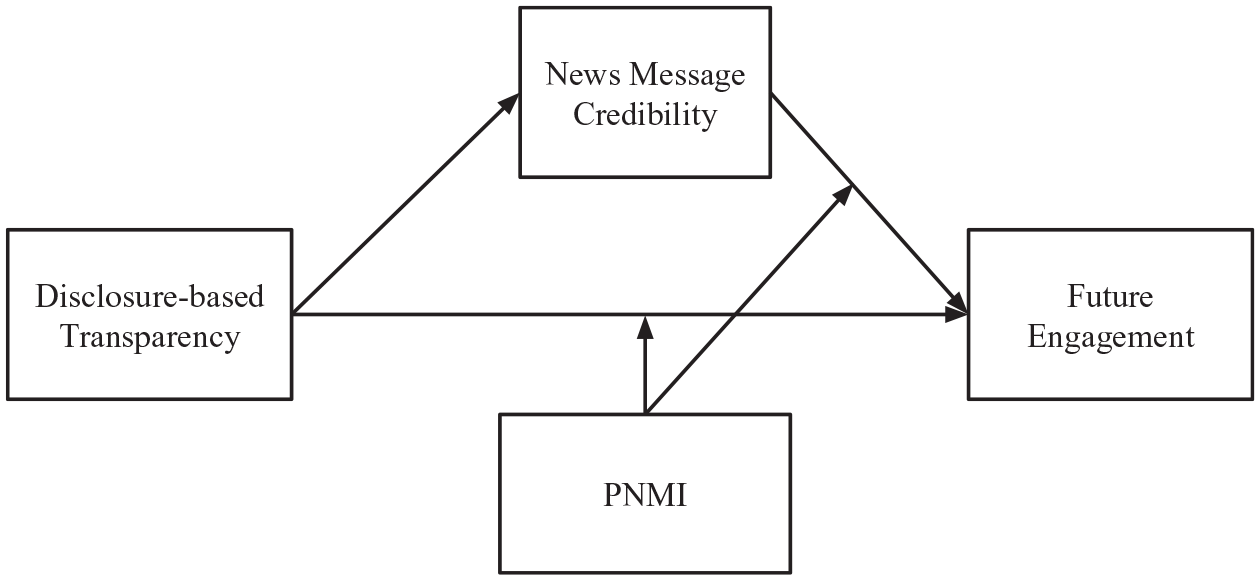
Conceptual overview of moderated-mediation model (see
Method
Participants
The study questionnaire was administered to participants recruited from the Qualtrics survey firm in August and September 2019. A convenience sample of adults residing in the 34-county service area of the Indianapolis Star—a major metropolitan newspaper in central Indiana—was analyzed for this study (N = 508). 2 Within the sample, 55.3% self-identified as females. A majority of the sample identified as White (88.4%); the other respondents identified as African American/Black (7.7%), Asian (2.2%), Native American or Pacific Islander (0.6%), and “other” (1.2%). Furthermore, 27 participants (5.3%) identified as being Hispanic, Latino(a), or Spanish origin. Participants ranged in age from 18 to 86 years (M = 47.28 years, SD = 16.99 years). A majority of the sample reported having at least some college experience (78.4%), and 39.6% reported having a 4-year college degree or more. In terms of political orientation, 39.6% said they were or leaned Democrat, 41.6% said they were or leaned Republican, and 18.7% said they were independent (close to neither party).
Experimental Procedures and Stimuli
This study features a 2 × 2 × 2 between-subjects experimental design. The key factors of this design are Transparency, Locality, and Topic. Transparency was operationalized by exposure to an “Explaining our reporting” box of contextual information beneath the story, versus no exposure to the explainer box. Locality pertained to story attribution to a local news outlet (i.e., The Indianapolis Star) versus attribution to a national news outlet (i.e., USA Today). Finally, in an effort to better gauge the generalizability of the process of influence under investigation, the experimental design included random assignment to a story topic. One of the text-based news stories was about financing and completing a major highway infrastructure project in Indiana and the other was about low levels of recycling in the state. Each version of the explainer box (relative to each story) used in the experiment featured three key elements: “Why are we covering this story,” “How did we report this story,” and “Our approach to covering ___________” (see Section 5 of the Online Supplemental Material for more details on the stimuli used). Before responding to the key posttest questions upon reading a randomly assigned news story, respondents were asked to identify the main topic of the story they had just read. Those who were not able to identify the topic of the story were screened out and not retained in the study analyses.
Both stories were based on content actually reported in news media (Alesia & Lange, 2017; Bowman & Hopkins, 2019; O’Dowd, 2019), though the stories were condensed and edited for clarity and to make the news content less time-specific and similar in length. Notably, these edits did not alter any factual details in the stories. Participants were randomly assigned to read one of the two stories featured in the study (n = 243 viewed the highway infrastructure story; n = 265 were exposed to the recycling story). Subjects were also randomly assigned to a condition either attributing the story to USA Today (a national newspaper) or the Indianapolis Star newspaper.
Again, the study analyses focused only on residents of the 34-county region that encompasses the market of the Indianapolis Star. 3 This scope of analysis renders the local/regional newspaper featured in the study as one that the participants would plausibly consider “local” on some level. In view of evidence that forms of disclosure transparency such as hyperlinks, journalist biographies, and corrections may not be not overly effective for bolstering credibility (Karlsson et al., 2014; Koliska, 2015), this study’s design features an approach that tests transparency effects via explaining contextual information about a news story. Indeed, while Karlsson et al. (2014) found little evidence of various transparency practices enhancing credibility, they did demonstrate modest significant effects relative to providing contextual information. Given that this type of transparency seems relatively desirable (Karlsson & Clerwall, 2018), and in tandem with more recent evidence that disclosing information about a news story can bolster forms of credibility (e.g., Curry & Stroud, 2019), an explainer box approach for testing transparency’s efficacy was adopted for this study.
The stimuli selection criteria for this experiment included that the story topic be plausibly relevant to the locality of the participants, that the story was not too time sensitive, and that the story could plausibly appear in both a regional/local and national newspaper. Indeed, these story topics were originally covered by both national and regional news outlets. While the story content itself was factual and based on existing news coverage, the study authors created the explainer box exclusively for use in this study. Both the edited stories and the explainer boxes crafted for the study were reviewed by veteran journalists for face validity prior to fielding the experiment. Finally, several manipulation checks were conducted via (a) the data featured in this article (N = 508) and (b) data collected in February 2020 in a separate, post hoc study (N = 142) using Amazon’s Mechanical Turk platform. In short, the post hoc manipulation checks served to confirm that the transparency tool featured in this study was indeed perceived as performing functions of disclosure-based transparency. Section 1 of the Online Supplemental Material details these manipulation check analyses.
Measures
Message credibility
Although there are various approaches to measuring credibility assessments (cf. Appelman & Sundar, 2016), this study opted to employ a fairly established, standard, and efficient approach to operationalizing the concept—aiming to be consistent with much extant research (e.g., Nelson & Park, 2015; Tewksbury et al., 2011; Thorson et al., 2010). That is, participants were asked to “rate how well you feel the following terms describe the news story” on a 7-point scale (1 = not at all, 7 = very well). Five descriptors tapped message credibility assessments: “accurate,” “fair,” “unbiased,” “tells the whole story,” and “can be trusted” (Cronbach’s α = .92).
News engagement intentions
Engagement intentions with the attributed news source were measured with two items, drawing on questions employed in previous research (see Peifer & Myrick, 2019). Respondents were asked how likely (1 = not at all likely, 7 = extremely likely) they would be to “visit the website of _______ on your own time” and “pay attention to social media content circulated by ________.” Either the USA Today or the Indianapolis Star was inserted into the question, as per the source attribution of the story the study participant read. The items comprising this posttest engagement measures were strongly correlated (r = .69, p < .001).
PNMI
PNMI was measured with a 13-item scale (Peifer, 2018a) prior to exposure to the news story. Using a 7-point Likert-type scale (1 = strongly disagree, 7 = strongly agree), the battery of survey items gauged agreement with statements such as “It is important to me that the news media expose the shortcomings of government officials and institutions” (see Section 2 of Online Supplemental Material for the full battery of questions). This pretest measure was reliable (Cronbach’s α = .88).
Analytical Procedures
Multiple t tests and a two-way analysis of variance (ANOVA) were used to address
Findings
As noted above, the study hypotheses and
To address
Influence of Message Credibility and Exposure to Transparency Box on Future News Engagement Intentions.
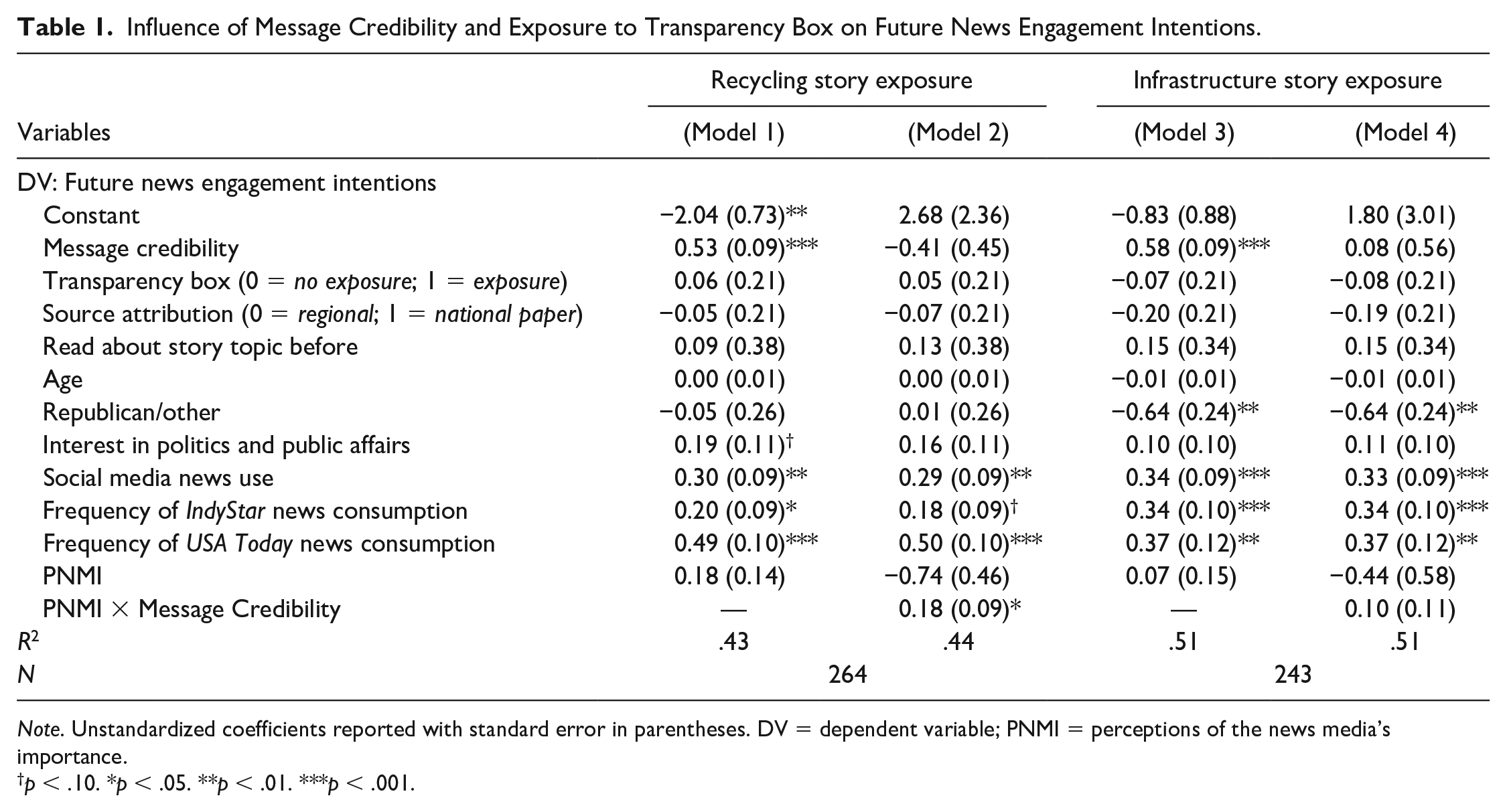
Note. Unstandardized coefficients reported with standard error in parentheses. DV = dependent variable; PNMI = perceptions of the news media’s importance.
p < .10. *p < .05. **p < .01. ***p < .001.
The next hypothesis (
The final study hypothesis (
Estimate of Indirect Effect on News Source Engagement Intentions, via Credibility, at Values of PNMI (for Recycling Story).
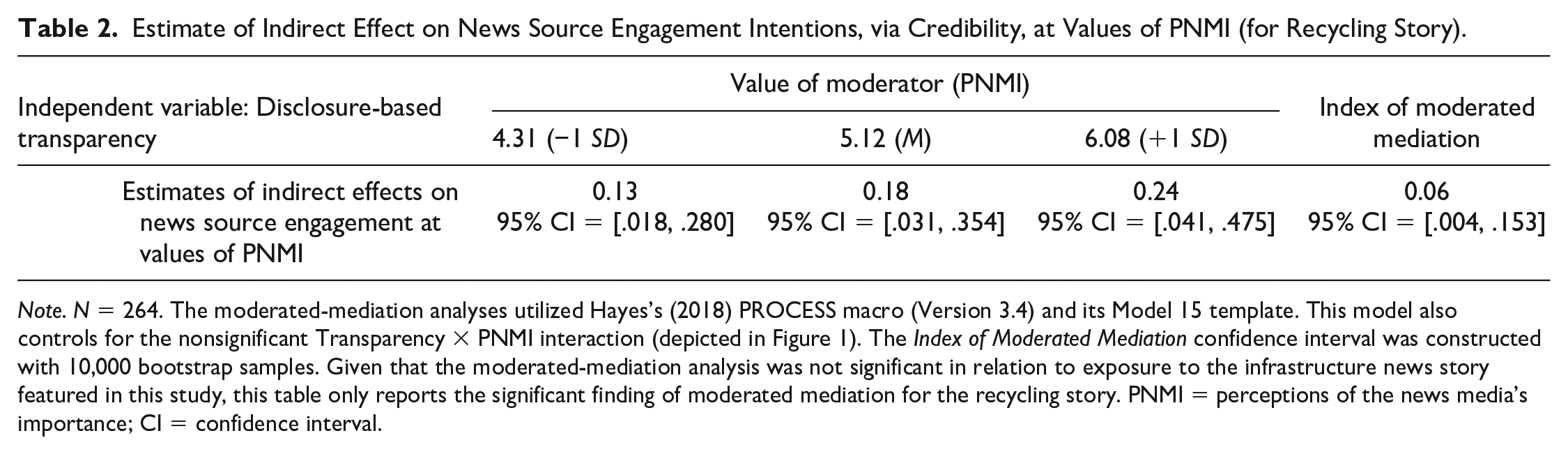
Note. N = 264. The moderated-mediation analyses utilized Hayes’s (2018) PROCESS macro (Version 3.4) and its Model 15 template. This model also controls for the nonsignificant Transparency × PNMI interaction (depicted in Figure 1). The Index of Moderated Mediation confidence interval was constructed with 10,000 bootstrap samples. Given that the moderated-mediation analysis was not significant in relation to exposure to the infrastructure news story featured in this study, this table only reports the significant finding of moderated mediation for the recycling story. PNMI = perceptions of the news media’s importance; CI = confidence interval.
Discussion
Openness on the part of journalists is commonly lauded as a key for fostering news media credibility, trust, and engagement. It bears the potential to support the ongoing development of citizens’ knowledge structures about news media—thereby strengthening NML. Using stimuli with strong ecological validity, this online experiment contributes to a more nuanced understanding of transparency’s influence by first confirming that disclosure of contextual information about a news story can foster greater message credibility. An increase in credibility, in turn, was shown to be associated with a stronger likelihood of future engagement with the respective news source. Importantly, message credibility’s relationship with news engagement appears dependent upon being average/high in PNMI. Finally, in a broad assessment of a moderated-mediation process of influence modeled in this study, the data confirm how behavioral intentions related to news engagement can be understood as a product of both transparency and credibility, given that transparency only exhibited a relationship with engagement indirectly—by way of increased message credibility.
At a basic level, this study underscores the central role of message credibility for promoting news engagement. The implementation of a transparency tool alone does not appear to directly prompt willingness for future engagement. Thus, if a transparency effort is not fostering a perception of credibility, it is unlikely that the transparency is promoting meaningful engagement either. Furthermore, this study’s exploration also sheds light on how the relative locality of a news source may not meaningfully influence transparency’s effectiveness. That is, varying the source attribution between a regional and a national news source did not seem to make any difference in transparency’s influence on credibility—for either story topic. Bearing in mind the limited attention devoted to questions about transparency and place trust, the inability to demonstrate a locality effect warrants some additional consideration. Why did the more localized news source attribution seem to not make any difference in this instance? One plausible explanation is that the cognitive/affective distance for the population in focus (i.e., the 34-county service area of the Indianapolis Star) was not narrow enough to demonstrate the influence of locality. Even though the Indy Star is not a national newspaper in its scope of coverage and geographical affiliation, as a regional metropolitan paper it may not be distinct enough from national news outlets in minds of the study participants. Perhaps if the news outlet attribution and content had been more localized (e.g., at a county or city/town-level), the influence of locality would have been more discernable.
The absence of a locality effect herein may also pertain to matters of “media credibility” (i.e., credibility pertaining to the qualities of different mediums such as television, newspapers, or radio). It may be that the influence of place-related credibility is in some case more robust with a medium such as television, given that credibility in the realm of television news can be more strongly based on familiarity with and the likability of on-camera personalities (Newhagen & Nass, 1989). Discussion of these possibilities underscores the importance of deepening an understanding of place-related trust, highlighting the need for careful investigation of the contingencies of when and how a “sense of place” wields influence in reducing uncertainty about journalistic practices.
Another critical insight afforded by this research is that even when transparency is successful in promoting credibility, the effect does not appear to accomplish much (in terms of news engagement intentions) if citizens do not perceive some fundamental value in news work. It seems the more one is, essentially, “uncertain” about the fundamental value of journalism, the less effective transparency efforts can be in reducing uncertainty about journalistic content/actors. In light of extant evidence that PNMI is strongly associated with news media credibility (Peifer, 2018b), it suggests that transparency may not be too successful among those most inclined to have little faith in the news media and generally skeptical of journalism’s value. This echoes the findings of Karlsson (2020), who demonstrated a positive correlation between media trust and valuing disclosure transparency. Karlsson’s study also highlighted how positive evaluations of actual journalistic performance correlate with valuing transparency. Such research and this study’s evidence of PNMI’s moderating influence beg the question of whether transparency’s general effectiveness is principally confined to those already inclined to trust and value the news media. When a transparency effect is evident, are we largely witnessing a case of “preaching to the converted”—in that transparency seems to have limited effectiveness among the audiences that journalism advocates seem most determined to reach with transparency initiatives? (see Karlsson, 2020, for a similar discussion)
Perceptions of importance aside, this research effort is also sobering in that it further suggests that transparency’s influence, in terms of engendering credibility, can be hit and miss. The transparency tool implemented was demonstrably successful only with one of the two story topics featured (i.e., the recycling story). This discrepancy highlights a need for future research: scholars should further probe what news content is most conducive to journalistic transparency efforts. Researchers should also further grapple with questions of when, how much, and what kind of transparency is helpful (Karlsson, 2020; Smolkin, 2006). It is possible that too much transparency can do a disservice, perhaps overwhelming readers with information or making some readers even more suspicious—misconstruing a journalist’s/news organization’s openness. Furthermore, it will be important to build a stronger understanding of how much readers even notice a transparency tool such as the explainer box featured in this study (Murray & Stroud, 2020). How effective is a transparency effort when readers are not noting it in the first place? Yet, even as transparency may not be universally effective, it is important to emphasize that this study offers no clear evidence that transparency somehow undermines credibility or engagement (see also Karlsson et al., 2014).
Limitations
In considering the insights generated by this project, there are various limitations to recognize. First—as alluded to in the paragraph preceding this section—it remains unclear what particular message properties differentiated the recycling story from infrastructure story, in terms of the contrasting process of effects exhibited by exposure to the two different stories. The study design was not intended to directly test the effects of message factors beyond the manipulations of attribution and the transparency feature. Instead, the use of more than one news story in study project represents an effort to avoid pitfalls of single-message design (Wells & Windschitl, 1999). As noted in the manipulation check analyses detailed in the supplemental material, one potentially meaningful difference between the stories was that the infrastructure story was deemed slightly more “controversial” than the recycling story. Perhaps this had to do with mention of former Republican Indiana Governor and (later) Vice President Mike Pence in the infrastructure story, introducing a politically polarizing element. Even as the contrast between the story exposure group means—in terms of being perceived as controversial—was fairly modest, it would be worthwhile to further explore how assessments of a news topic being “controversial” might be a critical factor in rendering a transparency feature more or less potent.
A second key limitation to note is the rudimentary nature of the news engagement intentions measure in this study. In focusing only on the likelihood of visiting the news source website and paying attention to social media content circulated by the news source, this operationalization of engagement is limited in scope. It might have, for instance, included other forms of news engagement intentions such as social media sharing intentions—one key way that people engage with news media content in today’s media environment. It would be worthwhile for scholars to strengthen the conceptualization and measurement of news engagement intentions, given that audience engagement is a central aim of news outlets. Finally, while this study’s modeling is based on causal assumptions and features an experimental manipulation of transparency’s effect, it is important to acknowledge that the relationship between credibility and engagement is not experimentally manipulated. That is, the mediator is measured rather than manipulated (Chan et al., 2020). Future work might further probe the casual influence of credibility in this regard, as well as examine alternative explanations of mediation.
Conclusion
The study’s examination of a moderated-mediation process of influence partly confirms the value of disclosure-based transparency and highlights the boundary conditions of transparency’s effectiveness as demarcated by PNMI. Importantly, it underscores how transparency in and of itself is likely not sufficient for prompting greater credibility, trust, and increased news engagement. It is also important for journalism advocates to showcase and convince citizens of the fundamental value of journalism (i.e., PNMI). To be sure, the question of how to bolster perceptions of importance is a challenging one to address; there do not seem to be obvious answers. Even as this research offers further validation of the PNMI concept’s utility for illuminating dynamics of media trust and use, it also highlights the critical need for continued investigation of PNMI and its antecedents. Moreover, while this study demonstrates that transparency’s effectiveness in an experimental context is not always consistent, it is nonetheless an ethical and arguably useful professional value to promote (McBride & Rosenstiel, 2013). Even as transparency need not be cast as a panacea for the challenges of news media credibility and engagement—whether at a local or national level—transparency strategies may nonetheless have the potential to assist many citizens, over time, in becoming more literate and fluent with journalism practices and in news consumption.
Supplemental Material
sj-pdf-1-jmq-10.1177_10776990211012953 – Supplemental material for The Value of Explaining the Process: How Journalistic Transparency and Perceptions of News Media Importance Can (Sometimes) Foster Message Credibility and Engagement Intentions
Supplemental material, sj-pdf-1-jmq-10.1177_10776990211012953 for The Value of Explaining the Process: How Journalistic Transparency and Perceptions of News Media Importance Can (Sometimes) Foster Message Credibility and Engagement Intentions by Jason T. Peifer and Jared Meisinger in Journalism & Mass Communication Quarterly
Footnotes
Acknowledgements
The authors thank Gerry Lanosga, as well as Indiana University’s Strategic Communication Research Lab, for insightful feedback on this project.
Declaration of Conflicting Interests
The author(s) declared no potential conflicts of interest with respect to the research, authorship, and/or publication of this article.
Funding
The author(s) disclosed receipt of the following financial support for the research, authorship, and/or publication of this article: This study was supported by the Association for Education in Journalism and Mass Communication’s (AEJMC) Emerging Scholars Program (2019). The project was also partially supported by Indiana University’s Arts and Humanities Council and the New Frontiers in the Arts & Humanities Program.

Supplemental Material
Supplemental material for this article is available online.
Notes
Author Biographies
References
Supplementary Material
Please find the following supplemental material available below.
For Open Access articles published under a Creative Commons License, all supplemental material carries the same license as the article it is associated with.
For non-Open Access articles published, all supplemental material carries a non-exclusive license, and permission requests for re-use of supplemental material or any part of supplemental material shall be sent directly to the copyright owner as specified in the copyright notice associated with the article.
