




Abstract
This content analysis expands protest paradigm research, examining the relationship between Facebook user engagement and newspaper protest coverage. Stories not posted to social media housed more negative frames that delegitimized protesters. For select protests, Facebook users engaged more with articles with legitimizing content, suggesting users, like journalists, follow a paradigm that legitimizes some protests and marginalizes others. We discuss these implications and consider how engagement plays a role in a protest’s ability to gain visibility and public support. Findings show the media and the public marginalize movements within a framework that rebuilds a hierarchy of social struggle on social media.
In 2017, demonstrations in support of women’s empowerment led to one of the largest single-day demonstrations ever recorded (Chenoweth & Pressman, 2017). The Women’s March occurred alongside protests of incoming-President Donald Trump. About 1 week later, journalists were on the protest beat again, covering nationwide protests of executive order 13769, informally known as the “Travel Ban” or “Muslim Ban.” Protests continued throughout the year, including protests against confederate monuments, the proposed wall along the US-Mexico border, construction of the Dakota Access Pipeline, and policing practices. The year also included counter protests and demonstrations in support of White supremacy, southern heritage, and national anthem etiquette. In all of these cases, as has been seen from the Arab Spring to Black Lives Matter (Freelon et al., 2016; Gerbaudo, 2012), social media played an important role in mobilizing protests. TIME magazine ended the year by awarding advocates they named the “silence breakers” as the publication’s “person of the year,” a capstone highlighting the momentous impact of protests in 2017.
Although the documented relationship between mainstream media and protesters is often contentious, resulting in negative protest coverage that tends to follow the protest paradigm (Chan & Lee, 1984; McLeod & Hertog, 1999), the intrusion of digital technologies and online social networks into the media ecology have altered the routines, tactics, and strategies of journalists and social movements (Deuze, 2017; Tufekci, 2017). Within this new media landscape, scholars have begun to identify shifts in patterns of media coverage of protests (Harlow & Johnson, 2011; Kilgo et al., 2018b; Kyriakidou & Olivas-Osuna, 2017), but more research is needed into what role social media users play in the spread of protest narratives, as social media offer new opportunities for news distribution (Oeldorf-Hirsch & Sundar, 2015). Facebook, in particular, as the world’s most-used social platform, merits study for its role in mobilizing protests and for the way political news—including protest news—is shared more on Facebook than other platforms (Valenzuela et al., 2017).
The symbiotic relationship between the press and audiences, especially within social media networks, is a relatively unexplored factor in protest coverage (Harlow et al., 2017). Research shows social media afford visibility and scalability to news and information (Fox & McEwan, 2019), but users’ sharing selections can simultaneously amplify and limit exposure to different media narratives (Thorson et al., 2021). Social media metrics can drive what topics news editors decide need covering (Tandoc & Vos, 2016), what kind of placement stories will receive (Lee et al., 2014), and even whether a story will be taken down entirely (Bright & Nicholls, 2014). Social media users thus contribute to the gatekeeping and gatewatching functions of media distribution by amplifying certain narratives over others through their sharing and engagement choices. While previous protest paradigm research examines news media’s role in the marginalization or legitimization of a protest, our research considers how Facebook users’ engagement acts in a decentralized gatekeeping capacity (Meraz & Papacharissi, 2013), potentially disrupting the “hierarchy of social struggle” (Kilgo & Harlow, 2019) to amplify protest coverage differently than mainstream media. Given that news coverage can influence whether the public will support protesters or their causes (McLeod & Hertog, 1999; Shoemaker, 1984), and considering a worldwide increase in protest activity (GDELT, 2016), it becomes all the more urgent to explicate the role social media users play in the circulation of protest news.
Using a content analysis of 2017 protest-related stories from a sample of national, metropolitan, and local newspapers, we correlated news articles with their Facebook engagement data. We contribute to nascent research on news and social media engagement (Bright, 2016; Trilling et al., 2017) by examining which protests and which protest news narratives are engaged with most. In addition, our study accounts for articles with no Facebook engagement, allowing us to overcome limitations in prior work (e.g., García-Perdomo et al., 2018; Valenzuela et al., 2017) by considering whether protest-related stories that are posted to Facebook have different characteristics than those that are not. By scrutinizing the relationship between paradigmatic protest coverage and social media user engagement, this study interrogates the continued applicability of the protest paradigm to better understand the place of protest news in this new social media landscape. Ultimately, we posit that Facebook users’ amplification of certain protest narratives is a factor potentially contributing to the legitimization of some protest movements and the marginalization of others, thus making social media sharing, and not just the news coverage itself, a valuable variable at play in how the protest paradigm should be understood.
Protest Paradigm
Communication and social movement scholars have long studied the unequal and complex relationship between the media and protesters. News media tend to negatively portray protests that challenge institutional norms and the presumed status quo, a pattern known as the “protest paradigm” (Chan & Lee, 1984). Paradigmatic coverage is characterized by episodic narratives that rely on official sources over protesters’ voices, emphasize tactics that marginalize and demonize protesters, and support the status quo (McLeod & Hertog, 1999)—a result of the asymmetrical power relationship between social movements and media institutions (Gamson & Wolfsfeld, 1993). Movements need media attention to gain credibility and public support (Gamson & Wolfsfeld, 1993), even though mainstream media organizations routinely fall short of fulfilling those needs (Klandermans, 1993).
News framing is presented as a key aspect of the protest paradigm (Snow et al., 2007). Paradigmatic coverage relies on narratives, or frames, that emphasize violence, conflict with police, the deviance of protesters, and spectacle over protesters’ demands, thus marginalizing the cause and demonizing protesters (Gitlin, 1980). Protests that are seen as disruptive or violent are more likely to be covered (Wouters, 2013), and violence is highlighted even if the protest in general is peaceful (Gitlin, 1980; McLeod & Hertog, 1999). Other delegitimizing techniques include the exclusion of protesters’ voices or their juxtaposition against the “official” account from authorities (Hertog & McLeod, 1995). Di Cicco (2010) identified a “public nuisance paradigm” of protest reporting, noting that the mainstream media regularly dismiss protests for being inconvenient and negatively impacting bystanders. Such delegitimizing coverage was shown to have increased over time, potentially hindering a movement’s success (Di Cicco, 2010). Together, these studies highlight a pattern of negative coverage that ultimately works to deny movements the standing they need to be accepted by the public (McLeod & Hertog, 1999; Shoemaker, 1984).
Recently, scholars have begun pushing the limits of the protest paradigm, treating the formulaic coverage as a variable (Cottle, 2008). Mediating factors that might diminish adherence to the paradigm include the level of formality of a country’s political system (Shahin et al., 2016); the ideology of the media outlet and protesters (Luther & Miller, 2005); and whether the coverage appears in traditional media, online-only publications, or social media ( Harlow et al., 2017; Harlow & Johnson, 2011).
Research is only starting to examine how protest narratives might shift from traditional media to social media, allowing this present study to contribute to a growing body of scholarship. The few studies that have been done suggest social media are somewhat disrupting the paradigm, indicating social media users are perhaps not as critical of protesters as journalists are. For example, Harlow and Johnson (2011) found New York Times coverage of the Arab Spring was more delegitimizing than coverage in blogs or on Twitter. Likewise, other studies have shown the debate frame and less delegitimizing portrayals prompt more engagement on social media than the paradigm would predict (Harlow et al., 2017; Kilgo et al., 2018b). These studies, though, were specific to particular movements, while this current research examines sharing patterns across movements. Furthermore, this study accounts not just for users’ sharing decisions but also news companies’ and users’ initial decisions to post the protest stories to social media to begin with, helping us to better understand how the paradigm operates on social media at the level of journalists and users.
Protest type and its influence on paradigmatic coverage is another mediating factor worth exploring. Boyle et al. (2004) found the more a protest’s goals or tactics go against the status quo, the more likely media coverage is to be negative and marginalizing. For example, Black civil rights, immigrants’ rights, and indigenous rights movements historically have been and continue to be marginalized in the mainstream media (Baylor, 1996; LaPoe & LaPoe, 2018; Mourão et al., 2021). In contrast, while feminist movements at first are marginalized and ridiculed, eventually the media present them as non-threatening to the status quo (Robinson, 1978), in part because they are viewed as frivolous or unthreatening (Ashley & Olson, 1998). In addition, while environmental protests do not typically receive much coverage, the coverage they do attract tends to be favorable, not necessarily following paradigmatic patterns (Anderson, 1991; Wright & Reid, 2011). In their study of protest coverage in local and metropolitan newspapers, Kilgo and Harlow (2019) conceptualized a “hierarchy of social struggle,” in which stories about protests related to racial issues (discrimination of Indigenous people and anti-Black racism) followed a more delegitimizing pattern than stories about protests related to immigrants’ rights, gender, and health and the environment, which were presented as more legitimate. Our present study builds on this hierarchy to show how journalists and social media users, via sharing and engagement, are contributing to the positioning of certain protest topics as more valid than others.
Because the ability of social media users to share news is a fairly recent phenomenon, most paradigm research has yet to establish any predictive models for how social media users might influence the spread of paradigmatic narratives. Still, research shows social media are “important purveyors of information that can engender the psychological antecedents of participation, which may in turn motivate individuals toward actual participation” (Chan, 2017, p. 675). Knowing, then, that what news is shared on social media can potentially mobilize protesters (Chan, 2017), this study takes up the important task of considering how journalists’ and social media users’ sharing and engagement choices can amplify protest news coverage, which ultimately can give a movement the media attention it needs to be successful (Gamson & Wolfsfeld, 1993).
Engaging With News on Social Media
Social sharing has become such a part of the fabric of news that media outlets rely on referrals from social media as part of their overall measures of traffic and success (Mitchell & Jurkowitz, 2014). Recognizing the importance of engagement with news on social media, scholars have examined why and how users interact with news (Tenenboim & Cohen, 2015), as selective sharing decisions based on worldview (Shin & Thorson, 2017) can impact selective exposure and thus political knowledge (Thorson et al., 2021). Some research focuses on users’ psychological and personal characteristics that could influence engagement (Ho & Dempsey, 2010; Lee et al., 2016). Other studies consider how features of platforms, such as the algorithms that prioritize information, factor into what is shared (Gillespie, 2013; Lewis & Westlund, 2016).
Another line of relevant research examines the relationship between content characteristics and engagement (García-Perdomo et al., 2018; Trilling et al., 2017). For example, emotional content (Dobele et al., 2007) and positive or pleasant stories (Berger & Milkman, 2012) are shared more than stories that do not arouse emotions, or that are negative or sad (Kilgo et al., 2018a). Framing also influences sharing patterns. Bigman et al.’s (2019) experiment with college students showed framing of stories about race and inequality resulted in racial differences in whether social media users chose to share the stories, thereby limiting exposure of some stories to some audiences and amplifying others to other audiences.
News values of human interest, conflict/controversy, unusualness, impact/prominence, and usefulness also have been shown to positively predict social media engagement (García-Perdomo et al., 2018). Bright (2016) showed that stories about politics, accidents, disasters, and crime were shared less than news about social welfare, science, and technology. As Bright (2016, p. 358) concluded, “social media amplifies the reach and importance of certain types of news while ignoring and marginalizing other types.” Social media also are changing what we consider to be newsworthy, replacing traditional news values with digital-centric ones like “interactivity, participation, collaboration, and the distribution and dispersal of expertise and intelligence” (Lankshear & Knobel, 2011, p. 76). In addition, what users choose to share and engage with has important political consequences, as it can predict political knowledge and civic engagement (Gil de Zúñiga et al., 2012; Valenzuela et al., 2016). We thus position sharing in the context of protest coverage, as audiences have more power within the networked information and gatekeeping processes (Meraz & Papacharissi, 2013) through increasingly distinct social media channels and networks.
While user engagement is not a perfect proxy for public opinion about a protest, how users engage with protest coverage on social media is important practically and theoretically for illuminating which protest topics and media protest narratives are perhaps seen as more interesting or important from users’ perspectives. For example, news values of conflict (García-Perdomo et al., 2018)—in the protest paradigm’s riot and confrontation frames—and stories with emotional appeals (Dobele et al., 2007)—found in the spectacle frame—are more often shared on social media, making it worth examining how user engagement with the different frames plays out on social media. Practically, social media engagement is related to which news articles audiences are more likely to see and read (Anspach, 2017; Mummolo, 2016), which in turn shapes political knowledge and participation and likelihood to participate in protests (Gil de Zúñiga et al., 2012; Valenzuela et al., 2016).
Gatekeeping and Gatewatching
Theoretically, we complicate the traditional concept of the protest paradigm, adding social media users’ gatekeeping abilities as an important factor that can usurp some of the mainstream media’s power by determining which protest stories to share, thereby influencing which protests receive the social media attention movements need. Gatekeeping traditionally refers to the way journalists, using newsworthiness criteria, decide which news stories deserve coverage. The onset of the internet and social media, however, have created multiple new gates through which information can flow, so that a closed gate no longer inhibits the dissemination of news (Vos, 2015). Bruns (2018) referred to gatewatching, wherein citizens share published news content, amplifying it and even changing it by adding contextualization, critique, or interpretation. Rather than being “journalist-centered,” such news becomes “user-centered” (Boczkowski, 2004).
Users share and engage with information they find interesting, or that they think their networks would find interesting, and sharing decisions often are influenced by what other users in their network are engaging with (Bruns, 2018; Schmidt, 2014). Social media users’ sharing and engagement practices can amplify content that otherwise might not make it through traditional journalistic gates (Chadwick, 2011). Importantly, though, the socialization of news means audiences see what is popular (not necessarily important), potentially limiting their exposure to a plurality of sources (Hermida et al., 2012). It is worth considering then, how users’ sharing and engagement practices with protest coverage might serve to amplify some protest stories over others, similar to the way news media legitimize some causes and delegitimize others (Kilgo & Harlow, 2019).
Furthermore, it must be noted that gatekeeping and gatewatching are intertwined on social media, where journalists and audiences share and engage with news content. News outlets act as the primary gatekeepers deciding which news stories will be published on the company’s social media. Social media users can then share and interact with those stories, serving as gatewatchers. At the same time, though, ordinary users also can share news content directly from a news outlet’s webpage, even if that outlet did not originally share the story on social media. Journalists likewise can share their stories on their own Facebook accounts, bypassing their gatekeeping employers who might have opted not to share their story on the outlet’s official social media pages.
Considering the preceding literature, we pose the following research questions to understand what story characteristics predict whether a story will be posted on Facebook to begin with, and how much engagement it will generate, thus helping us better position the role of social media sharing within the protest paradigm and the hierarchy of social struggle:
Methods
Research questions were answered by correlating quantitative content analysis data with public Facebook engagement data. News articles and their coordinating Facebook engagement data were retrieved using NewsWhip’s Insights software that archives all universal record locators (URLs) of stories from more than 50,000 media organizations worldwide (NewsWhip, 2016). The analytics software associates story URLs with social media engagement data scraped from the public application program interface (API) from Facebook. These analytics are collected from public posts and do not associate engagement with individual users. Specifically, the engagement numbers included in this study are summed from public posts, accounting for the number of times any user interacts with a public post, while excluding the number of interactions that accumulate on privately shared posts or posts shared through messenger apps.
We collected and analyzed full articles from the national newspaper The New York Times as well as four major metropolitan/regional newspapers (Dallas Morning News, Austin American Statesman, Houston Chronicle, San Antonio Express-News) and 12 local newspapers (Abilene Reporter News, Amarillo Globe-News, Corpus Christie’s The Daily Caller, El Paso Times, Galveston’s The Daily News, Laredo Morning Times, Longview News-Journal, Lubbock Avalanche-Journal, McAllen’s The Monitor, Midland Reporter-Telegram, San Angelo Standard Times, San Antonio Express-News, and Victoria Advocate). While Texas represents only one state in the United States, it hosts several of the country’s largest media markets. In addition, Texas has a massive geographic landscape (larger than many countries around the world) and a diverse population. Most importantly, by including coverage from this market, our method allows us to compare our findings with previous scholarship which has tended to focus primarily on major markets geared toward national audiences. Using these metropolitan and local newspapers follows the same approach taken by Kilgo and Harlow (2019). Research shows news is framed differently depending on whether journalists work at outlets in larger or smaller, or heterogeneous or homogeneous, communities (Griffin & Dunwoody, 1997). Coverage also differs depending on whether an outlet’s audience is more local or national in scope (Hester & Gibson, 2007). Knowing, then, that different geographic contexts influence how the news is reported (Tong, 2013), we included national, metropolitan, and local newspapers, giving us a more robust sample that allows our study to more fully describe how Facebook users engage with protest coverage across the news landscape.
Using NewsWhip’s Boolean search function, beginning in February 2018, we collected all 2017 URLs published online from the selected newspapers that included “protest,” “protests,” “Women’s march,” or “Black Lives Matter” in the title, URL, metadata, or summary paragraph. This helped reduce the sample size to a manageable number for coders. Then, each URL was used to retrieve the article’s content. Letters to the editor, irrelevant articles, and dead links were removed, leaving a total of 1,177 newspaper articles coded in the sample. Because the goal was to examine dissemination of news articles via Facebook, we opted to code the full article, rather than the text of social media posts, to ensure more accurate and complete recognition and identification of the protest paradigm’s constitutive elements.
While it is important to note that different social media platforms have distinct affordances and uses (Dahlgren, 2014), it also is true that these platforms share users and user practices and the same news content is regularly posted to social media platforms like Facebook, as they “exist as part of a broader, thoroughly interconnected social news media network” (Bruns, 2018, p. 9). Furthermore, social media play important roles in mobilizing protest (Freelon et al., 2016; Gerbaudo, 2012; Harlow, 2012). Facebook has more users worldwide than any other social media platform, and more U.S. adults regularly turn to Facebook for news than any other platform (Shearer & Mitchell, 2020). Furthermore, Valenzuela and colleagues’ (2017) assessment of news coverage showed that political news—which includes protest coverage—was more likely to be shared on Facebook than Twitter. With this in mind, this study focuses on protest coverage shared on Facebook.
We note it is beyond the scope of this study to definitively determine whether the initial Facebook posts were made by the news organizations or by social media users. Still, one study estimated that up to 58% of engagement could be attributed to posts initially published on Facebook by the newspaper (Welbers & Opgenhaffen, 2018), indicating that users acting as gatewatchers account for a large share of news circulating on Facebook. Furthermore, in some cases, newspapers post the story to Facebook after it already has gained traction among social media users (Welbers & Opgenhaffen, 2018). Our study accounts for cumulative engagement regardless of who shared the article, but with the assumption that journalists likely were the ones to initially post the stories to Facebook.
Coder Training
This project employed four coders: two researchers of this study, an outside coder who is a professional journalist, and one doctoral graduate student. Several coder training sessions were conducted to improve and refine the coding scheme. Changes to the codebook primarily accounted for variations in how certain frames might appear depending on the type of protest. After four training sessions, coders participated in intercoder reliability (ICR) testing on a subsample of articles (n = 150) taken from the final sample. Using Krippendorff’s alpha as a reliability metric, variable descriptions and reliability measure are reported with each variable description. The type and position of the protest were open coded, but were discussed extensively during training.
Open-Coded Variables
All newspaper articles were open coded for the topic of the protest. Based on similarities in protest issues, we collapsed topics into the following categories: anti-racism (e.g., Black Lives Matter protests, protests of discriminatory policing, protests of confederate statues, Indigenous rights protests related to the Dakota Access Pipeline), President Donald Trump (e.g., inauguration protests, presidential cabinet choices, general Trump protests), gender (e.g., Women’s March, LGBTQ rights, sexual or reproductive rights, bathroom legislation), immigration (e.g., sanctuary cities, DACA protests, border wall, Muslim travel ban), National Football League 1 (e.g., protests and commentary on sports figures kneeling during the national anthem), anti-government (mostly protests in other countries, excluded anti-Trump protests), and finally “other,” representing topics not directly connected with the aforementioned protest efforts and that appeared infrequently. These included protests unique to local issues (such as a protest of a bookstore’s inventory or a restaurant’s dining policies), or related to health care, education, and labor/economy, among others. While it is a limitation to have such a large “other” category, the infrequency of the myriad protest topics comprising “other” made such a category necessary and expedient.
Frames
Adapted from the codebooks of other digital protest coverage research (e.g., Harlow & Johnson, 2011), coders identified the presence or absence of the following frames: riot, confrontation, spectacle, and debate. For the riot frame, coders looked for descriptions of protesters as destructive or threats to society, including looting, rioting, and property damage (α = .84). Confrontation frame describes protesters in conflict with the status quo and typically appears when journalists highlight clashes between protesters and police (α = .91). The spectacle frame depicts protests as dramatic and highlights sensational aspects, like protesters’ appearance or emotional state (α = .88). Finally, the debate frame highlights protesters’ demands and agendas within a social critique (α = .83). Frames are not mutually exclusive.
Peace and Violence Devices
Coders looked for specific mentions of protesters as peaceful (α = .77, 96% agreement), and for mentions of protesters as violent (α = 1).
Social Media Engagement Variables
Raw social media data capturing the number of comments, likes, and shares (including posting and re-sharing) on Facebook for each article in the sample came from NewsWhip. Data were analyzed as two different data points. The first was a dichotomous variable that allowed us to identify differences between articles that were and were not posted to Facebook to begin with. The second was a continuous measure accounting for the amount of engagement associated with those articles that were posted on Facebook (zero-engagement articles were removed, so that only articles posted to Facebook were included in the engagement analysis). Facebook engagement numbers included the sum of all interactions (comments, likes, and shares) on public posts that included the article’s link. Due to irregular distribution, data were transformed using the formula (Log 10 +1) to normalize the distribution for parametric statistical analysis.
Results
Of the 1,177 articles, 34% (n = 400) were published in The New York Times, 25.4% (n = 299) were from local papers, and 40.6% (n = 478) from metropolitan newspapers (see Table 1). In terms of protest topic of all stories (whether they were shared to Facebook or not), coverage of anti-racism (21.6%, n = 254), NFL (16.5%, n = 194), and immigration (15.2%, n = 179) protests appeared the most, followed by anti-Trump (9.6%, n = 113) and gender (8.9%, n = 105). Coverage marked as “other” was a combination of protest topics with 5% or fewer articles (18.9%, n=223). When it came to content characteristics, the spectacle frame dominated coverage (72.1%, n = 801). The debate frame appeared in about one-third of coverage (28.5%, n = 317), while the confrontation (25.7%, n = 286) and riot (18.4%, n = 204) frames appeared the least. Mentions of protests as violent (16.1%, n = 179) appeared in about twice as many stories as mentions of peacefulness (8.8%, n = 98).
Frequencies of Content Features by Outlet Scope.

A total of 938 stories (79.7%) were shared to Facebook at least once, meaning 239 articles never were posted to Facebook. Nearly all (98.8%, n = 395) of The New York Times stories were posted to Facebook at least once, and 72.6% (n = 217) of the local stories and 68.2% (n = 326) of the metropolitan stories were posted to Facebook. Articles on Facebook received an average of 5,717.94 public engagements (SD = 25,030). Table 2 provides additional frequencies about the protest topics and frames of articles that were posted or not to Facebook.
Frequencies of Content Features of Articles Posted or Not on Facebook.
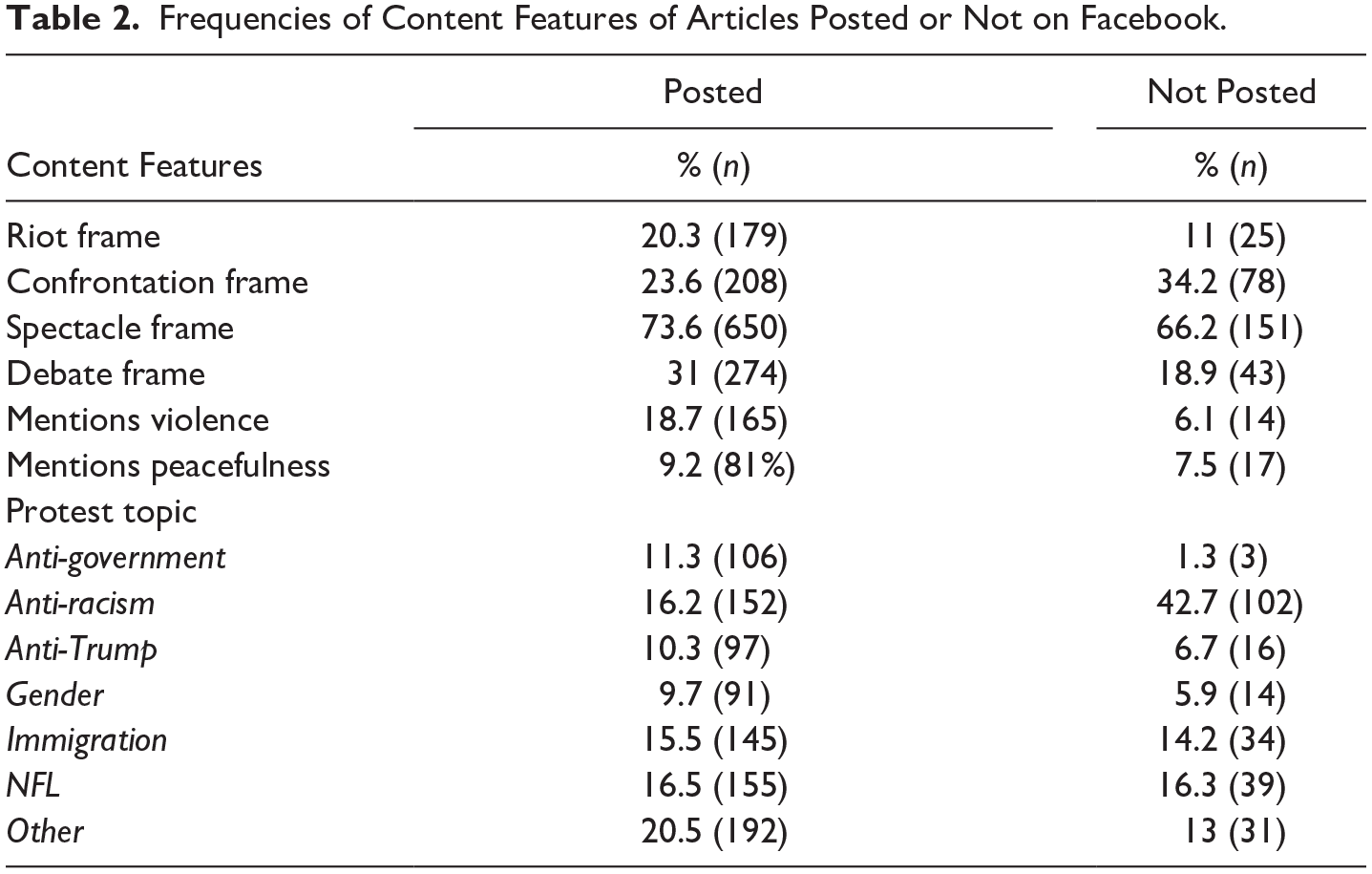
For
Binary Logistic Regression of Predictors of Posting to Facebook by Newspaper Geographic Scope. a

Note. B = unstandardized beta coefficient, Exp(β) = Exponential of beta coefficient, odds ratio.
p < .05; ** p < .01; *** p < .001.
The national model was not significant and is not included in this table
First, we examined the chances of all stories, across newspaper geographic scopes, of being posted to Facebook to begin with. The model was significant, χ2(15) = 312.492, p < .001, and explained 38.5% (Nagelkerke R2) of variance, correctly classifying 83.7% of cases. Protest articles in metropolitan, exp(B) = .018, p < .001, and local, exp(B) = .018, p < .001, newspapers had decreased odds compared with stories in the national newspaper of being posted to Facebook. Articles about domestic protests had increased odds of being posted, exp(B) = 3.851, p < .01. All protest topics had significantly greater odds of being posted to Facebook than stories about anti-racism protests. Presence of the riot, exp(B) = 3.308, p < .001, and debate, exp(B) = 2.593, p < .001, frames increased the odds of a protest story being posted to Facebook to begin with, while stories with the confrontation frame, exp(B) = .426, p < .001, had decreased odds of being initially posted.
Next, we examined whether articles published in a national newspaper were posted to Facebook or not. The model was not statistically significant, χ2(13) 10.912, p = .618.
Considering whether articles from metropolitan papers were posted or not to Facebook, the model was statistically significant, χ2(13) = 116.458, p < .001, and explained 30.3% (Nagelkerke R2) of the variance in posting, correctly classifying 76.3% of cases. Articles about all protest topics had significantly greater odds of being posted to Facebook compared with stories about anti-racism protests. The riot, exp(B) = 6.080, p < .001, and debate, exp(B) = 2.896, p < .001, frames had increased odds of being posted to Facebook, while the confrontation frame, exp(B) = .253, p < .001, signaled significantly decreased odds of a story being posted to Facebook.
Examining the chances of local articles being posted to Facebook showed the model was statistically significant, χ2(13) = 34.714, p < .001, and explained 19% (Nagelkerke R2) of variance, correctly classifying 73.1% of cases. Articles about protests related to gender, exp(B) = 5.832, p < .05, immigration, exp(B) = 3.387, p < .01, and “other” topics had better odds than stories abot anti-racism protests of being posted to Facebook. Frames made no significant differences.
The next research question explored user engagement with news stories posted to social media at least once (
Crosstabulations of the Presence of Content Features for Protest Articles Shared on Facebook.
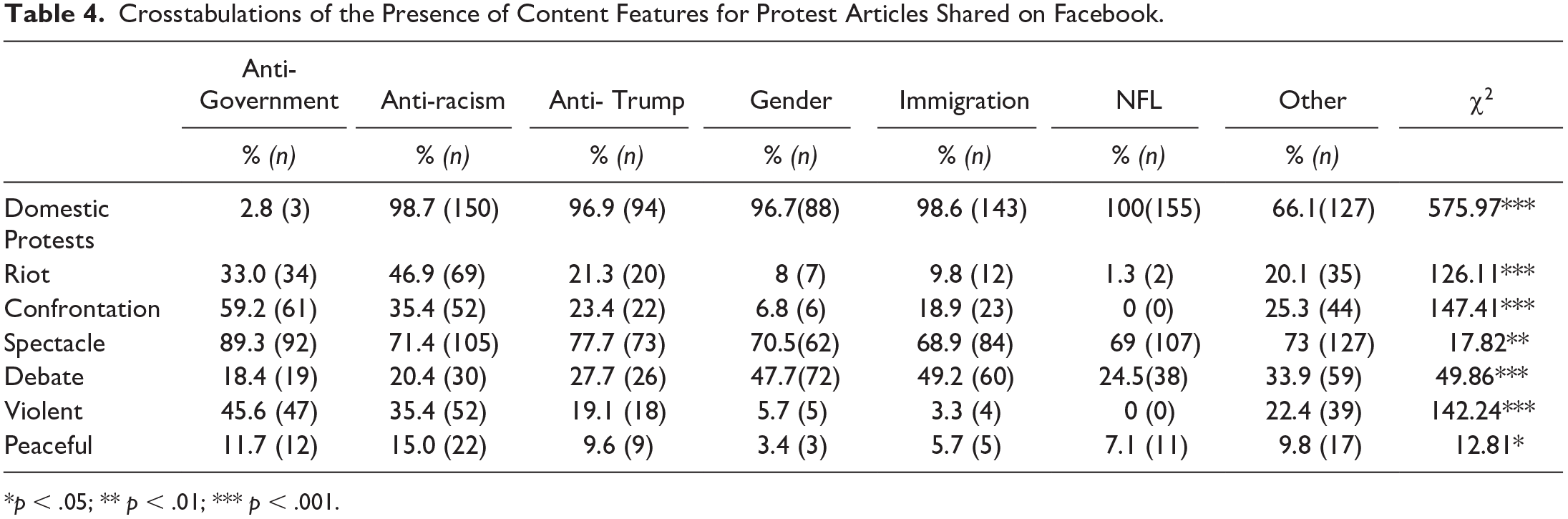
p < .05; ** p < .01; *** p < .001.
Finally, a series of hierarchical linear regressions were run to examine how protest topic (with anti-racism as the reference), frames, and devices influenced engagement on Facebook, overall, and depending on whether the article was published in a local, metropolitan, or national newspaper (the final models are reported in Table 5). For protest articles from all newspapers, the full model was significant, f(15, 867) = 46.812, p < .001, and explained 44.7% of variance. Protest stories in metropolitan, β = −.667, p < .001, and local, β = −.554, p < .001, newspapers predicted decreased engagement, and stories about domestic protests received significantly more engagement, β = .162, p < .001, than stories about international protests. Overall, protest topic did not significantly predict engagement when anti-racism protests were used as the reference. Articles with the spectacle, β = .061, p < .05, and debate, β = .127, p < .001, frames positively predicted increased Facebook engagement, as did mentions of violence, β = .071, p < .05.
Hierarchical OLS regression of predictors of Facebook engagement with protest articles.
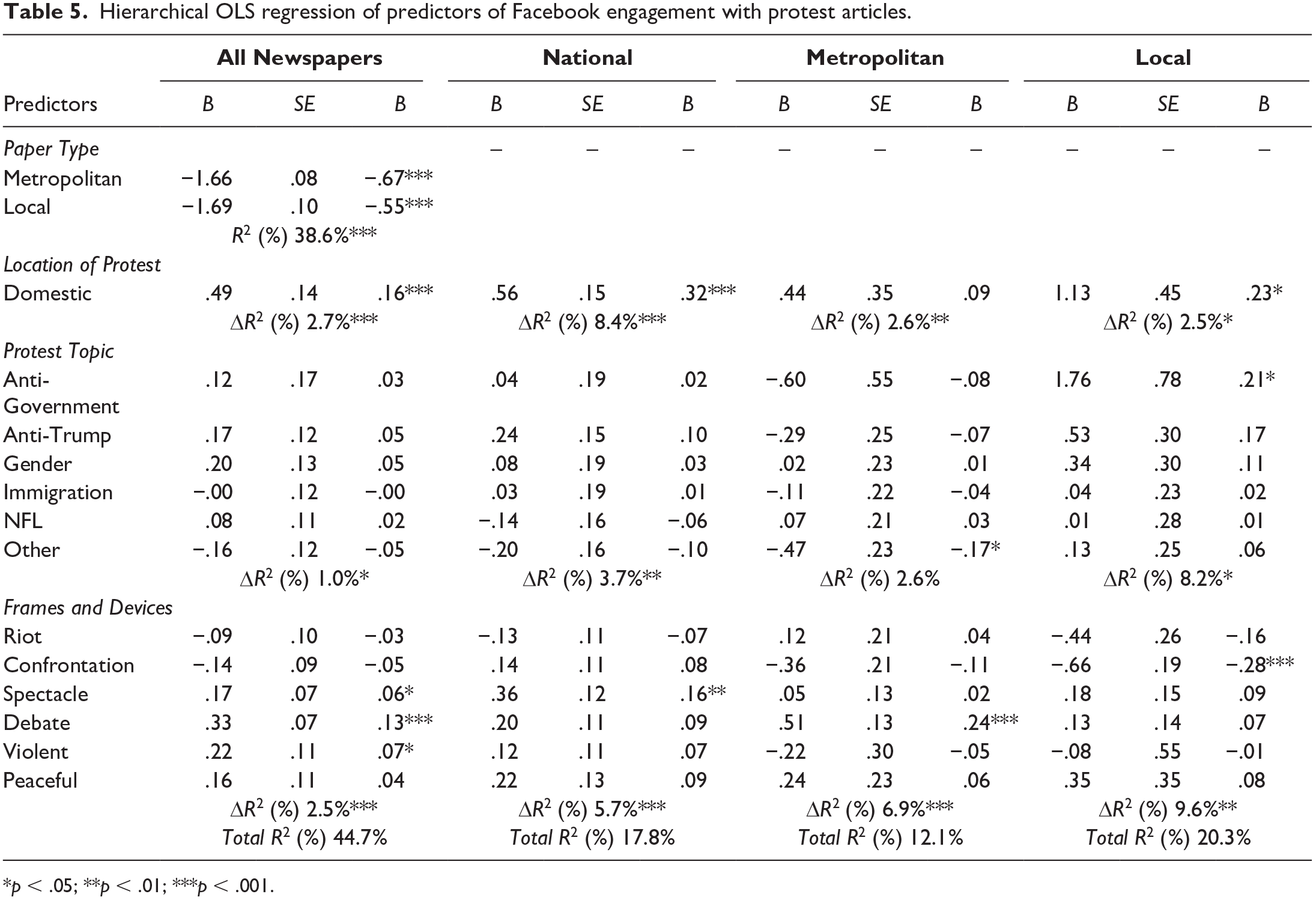
p < .05; **p < .01; ***p < .001.
When considering only national newspapers, the full model was significant, f(13, 374) = 6.212, p < .001, and explained 17.8% of variance. Protest stories about domestic protests received more engagement (β = .322, p < .001) than stories about international protests. For stories in the national newspaper, protest topic did not significantly matter for engagement. In terms of framing, stories with the spectacle (β = 1.57, p < .01) frame positively predicted Facebook engagement.
For protest stories published in metropolitan newspapers, the full model predicting Facebook engagement also was significant, f(13, 311) = 3.282, p < .001, and explained 12.1% of variance. For protest topic, the “other” category (β = −1.66, p < .05) predicted less engagement than did anti-racism protest stories. As far as frames, the debate frame (β = .235, p < .001) significantly predicted engagement among stories from metropolitan newspapers.
For local newspapers, the full model predicting Facebook engagement again was significant, f(13, 156) = 3.056, p < .001, and explained 20.3% of variance. Stories about domestic protests predicted more engagement, β = .23, p < .05, than stories about international protests. Stories about anti-government protests, β = .210, p < .05, also predicted more engagement compared with anti-racism protest articles. Presence of the confrontation frame, β = −.284, p < .001, predicted less engagement.
Discussion
This content analysis of all 2017 protest-related news stories published by The New York Times, four metropolitan newspapers, and 12 local newspapers showed how Facebook engagement changed depending on the geographic scope of the newspaper, topic of the protest, and the extent to which the article followed patterns of the protest paradigm (Chan & Lee, 1984). This study advances our understanding of the protest paradigm within a social media context and repositions within the networked news ecology Gamson and Wolfsfeld’s (1993) observation about the importance of mass media attention for a movement’s success. We argue that in this digital era, the circulation of and engagement with protest news on social media amplifies stories about certain protest movements in ways distinct from traditional media attention, which rarely meets movements’ needs (Klandermans, 1993). We build on Kilgo and Harlow’s (2019) hierarchy of social struggle to show that just as journalists’ coverage decisions legitimize some protest movements more than others, so, too, do journalists’ and social media users’ Facebook behaviors work in cohort to bring more attention to certain movements.
Movements need media attention regardless of whether that attention is positive or negative (Gamson & Wolfsfeld, 1993), and this study argues that social media sharing and engagement with protest coverage matters. We explore the function Facebook users serve as redistributors of news through social media engagement. As this study found, social media users amplify certain protest news narratives and engage less frequently with others, and as such, social media audiences become powerful gatewatchers that mediate the traditional relationship between news media and audiences as predicted by the protest paradigm. Social media attention, rather than traditional media attention alone, thus gives insight into how users and journalists together contribute to the circulation of protest paradigm narratives that can legitimize or delegitimize a movement. But all news does not make it to social media platforms, and our study is the first to address this phenomenon. First, we looked at distinguishing characteristics between those news stories posted or not to Facebook, before looking at how user engagement with stories shared to Facebook varied depending on whether the news was published in national, metropolitan, or local newspapers.
Building on previous research that indicates protest grievances and topics are important factors in how journalists portray protests (Kilgo & Harlow, 2019), this study found protest topic also plays a role in a story’s dissemination via social media. Of the protest-related stories that were not posted publicly to Facebook, nearly half were about anti-racism protests. In fact, overall, stories about anti-racism protests had decreased odds of ever being posted to Facebook to begin with. This finding is significant in that it empirically shows the influence of sharing practices on news distribution processes: with most people now getting their news from social media (Shearer & Mitchell, 2020), the decreased visibility of anti-racism protest news on social media means Black Lives Matter and other such movements are potentially denied the (social) media attention that scholars (e.g., Gamson & Wolfsfeld, 1993; Ryan et al., 1998) have identified as crucial for a movement’s success. While a weakness of this study is that we cannot definitively know how often or why the stories were shared by journalists or by non-journalists, a strength is that we know which stories were, or were not, shared at least once to Facebook, and we can assume that most of the original shared articles likely were posted by the originating media outlet or journalist (Welbers & Opgenhaffen, 2018), indicating that journalists—especially those at metropolitan and local newspapers—are de-prioritizing news about some protest topics more than others on Facebook. Our results show that anti-racism protest news is mostly suppressed for metropolitan and local newspapers’ Facebook audiences, giving users less of a chance to see or engage with that coverage. Considering the abundance of Black Lives Matter and indigenous land rights protests during the time of this study, the lack of increased odds of anti-racism stories diffused on Facebook points to a problematic avoidance of pressing issues related to race and racism in the United States, particularly in discursive networks like social media. Such avoidance could benefit news organizations with conservative audiences in Texas that are less favorable to protests like Black Lives Matter (Weber, 2020). Other consequences also result from such avoidance. Just because anti-racism protest news from these mainstream news outlets is suppressed on Facebook does not necessarily mean that other anti-racism protest coverage isn’t circulating on social media, which could portend other problems in this age of misinformation.
Differences across the geographic level of newspapers in terms of how protest topic or article framing influenced posting to Facebook suggests a need to consider to what extent resources and differing norms might play a role in what protest news is valued. While the influence of opaque, proprietary algorithms of private social media companies cannot be discounted in sharing patterns, the significance of the underlying power structures of these findings demands attention, as who is doing the initial posting implies a measure of control over the voices that are (or not) amplified within social networks. Ultimately, by choosing not to use Facebook to distribute news about anti-racism protests, news organizations and audiences limit the circulation of information about protests, thereby restricting public exposure to some movements and elevating exposure to others.
Articles’ frames and devices also were related to whether protest stories would be initially posted to Facebook, as well as to levels of engagement engendered among Facebook users. Our study showed that overall, the spectacle and debate frames positively predicted Facebook engagement. The spectacle frame predicted engagement for stories in national newspapers, while the debate frame was a predictor for stories in metropolitan newspapers. The finding about the spectacle frame likely is related to the nature of social media: studies show sensational and emotionally triggering content—content that is characteristic of the spectacle frame—is a staple of articles shared on social media (Dobele et al., 2007; Kilgo et al., 2018a). While increased engagement with spectacle-framed protest stories gives the movement attention, the frame’s de-emphasis of protesters’ grievances and goals in favor of a fixation on drama and sensationalism can ultimately serve to delegitimize the cause, potentially counteracting any strides toward public support the increased attention might have made. In contrast, the debate frame also predicted increased engagement overall, perhaps indicating a desire among users for content that explains the substance of a movement. These findings are somewhat contradictory: users engage more with protest content that is trivializing and shallow, and they engage more with content that goes in-depth into protesters’ claims and aims. These findings build on similar results in previous protest and social media research (e.g., Harlow et al., 2020) and highlight the need to move beyond a dichotomous understanding of protest stories as legitimizing or delegitimizing. Such findings also could be a result of the lack of mutual exclusion during coding of frames: the same story could emphasize elements of the spectacle and debate frames.
Regional differences help provide further nuance in which we can understand gatewatching patterns. Among metropolitan newspapers, the presence of the riot frame increased the likelihood of an article being posted to Facebook, indicating a penchant for coverage emphasizing protesters’ disruption and violence. It is likely the immediate impact of such protest tactics in large metropolitan cities promotes journalists’ and social media users’ willingness to post this news. Interestingly, though, across newspapers we found a lack of significance when it came to user engagement with the riot frame. Despite the abundance of protest stories with the riot frame, users did not engage with them any more or less than content with other frames.
In contrast to the riot frame, the presence of the confrontation frame in metropolitan newspapers’ stories decreased the likelihood of a protest article being posted on social media, and among stories in local newspapers, the confrontation frame negatively predicted engagement. These findings are surprising: the confrontation frame inherently is connected with conflict as a news value, and prior studies have shown that conflict and controversy are shared more often on social media than other news values (García-Perdomo et al., 2018). Perhaps, though, this finding can be explained by the fact that most of the stories with the confrontation frame were about international protests, and research has demonstrated that U.S. news consumers are mostly uninterested in foreign news (Chang & Lee, 1992), and social media users engage more with domestic protest coverage than coverage from other nations (Kilgo et al., 2018b).
Our results show that articles with the debate frame are more likely to appear on social media, and metropolitan newspapers’ audiences are more likely to engage with stories that have the debate frame. Despite the paradigm’s assertion that the debate frame infrequently appears in mainstream coverage, on social media, stories with this frame appear more often, highlighting the gatewatching role of social media users who amplify this frame more than the paradigm might predict. These findings give weight to Callison and Young’s (2019) observation that social media can offer a “corrective” for mainstream media narratives: posting more stories to Facebook with fewer delegitimizing and more legitimizing characteristics could potentially give protest movements the favorable attention they need to capture public support. Still, there is no denying the continued relevance of the paradigm and the ongoing attraction to social media users of stories with the riot frame—whether they are amplifying a story they agree with or disagree with, though, is beyond the scope of this study and is fodder for future research.
Protest coverage in metropolitan and local newspapers had decreased odds of ever being posted to social media, and received significantly less engagement on Facebook compared to The New York Times. It is true that these smaller news organizations have smaller social media followings. However, this could also be a result of strategy and preference: local and metropolitan newspapers’ social media audiences may not respond to protest news, or rely more on national news outlets for national protests, like many of those found in this study’s sample. Considering that most collective action occurs at a local level, these findings potentially have negative practical implications for protest organizers who rely on traditional and social media to promote their events and mobilize supporters. Future studies should examine why protest news prompts less engagement among metropolitan and local newspaper audiences. Also noteworthy is the finding that national and local newspapers’ domestic protest stories had an increased likelihood of being posted to begin with on Facebook, adding to previous research that shows U.S. news generally is more focused on domestic than international events (Jones et al., 2011). The lack of significance among metropolitan newspapers raises questions worth further study about why these hometown outlets are just as likely to post—or not post—international protest news as domestic stories. Likewise, when it came to engagement, stories about domestic protests, as opposed to international ones, predicted more engagement on Facebook. These geographic-related findings about protest news have important implications for the potential mobilization of transnational movements, as this study would suggest that such movements are unlikely to find their way into the social media presence of local news media.
Considering news from three geographic levels (national, metropolitan, local) allows this study to more robustly describe how social media users interact with protest coverage. There’s no doubt that proximity played a role in these differential findings. For example, readers of the local content perhaps engaged less with confrontation frames, which emphasize clashes between police and protesters, because protests with heavy police presence are less common in smaller cities. While variability among the different geographic levels of newspapers does not explain all journalistic production and sharing patterns of protest news, it does provide evidence that geographic differences should be accounted for in scholarship that often generalizes conclusions about journalism when it uses studies that privilege legacy or national papers.
Together, these results show that different newspapers’ social media audiences react differently to an article’s framing, elevating the importance of considering the role of audiences—and not just journalists—in the protest paradigm. Overall, audiences appear to engage more with legitimizing than delegitimizing coverage. With news outlets changing their agendas based in part on which stories prompt more social media engagement (Tandoc & Vos, 2016), our study raises the possibility of journalists successfully moving away from the riot and confrontation frames, and toward more use of the debate frame, in response to social media users’ engagement patterns. Such a shift in coverage would align with researchers who have cautioned against the trauma journalists can provoke when their coverage of violence fails to focus on society’s needs, and who have advocated for ethical approaches that take into account the greater public interest, which sometimes butts up against traditional journalistic practices (Simpson & Coté, 2006).
Overall, the findings from this study indicate that how a protest news story is framed is key to social media engagement. Although journalists post content they believe is more likely to perform well on social media (Harcup & O’Neill, 2017), we found that in most instances, one protest topic does not necessarily perform better or worse than another when it comes to public engagement. While the hierarchy of social struggle (Kilgo & Harlow, 2019) suggests that among mainstream media outlets protest topic is more important than framing, we found that on Facebook, perhaps due in part to algorithm effects, that hierarchy is somewhat tempered by users’ gatewatching power and sharing behaviors. Anti-racism protest stories indeed were covered more often with the riot frame and contained more mentions of violence than stories about other protest topics, as the hierarchy predicts. These stories also were initially posted—most likely by journalists—less to Facebook than any other protest topic, suggesting that social media are not fully shifting the hierarchical position of anti-racism coverage. Importantly, though, the lack of significance in engagement across most protest topics indicates that Facebook users are not necessarily disengaging with the protests at the bottom of the hierarchy, nor are they engaging more with protests at the top of the hierarchy. Further research should examine whether a gap exists between what protest stories journalists think will drive user engagement, and what content users actually do engage with.
Notably, users’ engagement patterns diverged from our findings of what content was posted to Facebook in the first place, indicating that on social media, the protest paradigm operates differently at two levels: that of journalists deciding what content should be posted, and users deciding what stories should be amplified. Future research should examine what might account for these similarities and differences, especially considering that audiences have adopted journalists’ concepts of newsworthiness (Eilders, 2006). These findings give weight to the continued relevance of the protest paradigm in the networked media ecology, as the protests seen as less threatening to the status quo receive less critical media coverage and are posted more often to Facebook, while anti-racism protests still trigger paradigmatic coverage. Importantly, we suggest the maintenance of the paradigm on social media comes in terms of what journalists write and post, and less so in terms of how Facebook users engage with content.
The role of social media users as gatewatchers plays a critical role in the (in)visibility of coverage, and users can minimize the social media distribution of legitimizing coverage that journalists produce about some protests, like this study shows might be the case for immigration protests. The absence of shares and other engagements could cause that legitimizing coverage to lose some of its power to attract public attention and, potentially, support. This underscores the critical role social media users now play in diffusing protest news by amplifying some protest stories more than others. This study furthers our understanding of Kilgo and Harlow’s (2019) hierarchy of social struggle, which indicated that newspaper articles tended to portray anti-Black racism and Indigenous rights protests with negative, delegitimizing narratives more than stories about the Women’s March and anti-Trump protesters. Our study indicates this hierarchy is to an extent rebuilt on social media, with negative coverage gaining less of a foothold on social media, but with anti-racism protest stories mostly unable to garner the (social) media attention necessary to gain legitimacy in the eyes of the public.
It is worth highlighting that engagement does not equate to endorsement, and these findings cannot tell us the motivations behind users’ engagement behaviors. Importantly, engagement also does not mean the stories portrayed protesters and their causes accurately or fairly. These findings complicate our understanding of how the protest paradigm works on social media, pointing to a hierarchy not only when it comes to which protests receive more or less legitimizing coverage but also in terms of whether these stories are posted on Facebook to begin with, and how users choose to engage with coverage that is more or less legitimizing. Future research should consider the motivations behind social media users’ engagement with protest news.
This study is limited in that it cannot account for the algorithmic functions and private sharing interactions that might have influenced sharing practices. The omission of visuals in our research, which studies have shown amplify engagement, could also explain why some of these sharing patterns differ. It also is impossible to know for certain from this data who posted the content, and how much of the coverage was shared and engaged with by journalists as opposed to ordinary social media users. Furthermore, research shows that news values and emotional appeals (e.g., Dobele et al., 2007; García-Perdomo et al., 2018) contribute to social media engagement patterns, and it is likely that these had some influence on how users interacted with protest news, which should be examined more closely in future studies. In addition, this study examined differences in coverage between articles shared on just one social platform. Future research might examine how engagement with protest stories changes according to different platforms. Finally, this study is limited by its sample of newspapers from the New York Times, a national outlet, and from one state, Texas. While we recognize that it is likely that the specific Texas context contributed somewhat to social media users’ interest, or lack therein, of different types of protest news, we looked at all public Facebook engagement, which is not limited to users in Texas. Furthermore, most of the protest news analyzed involved widespread movements of interest nationwide (e.g., Black Lives Matter, the Women’s March, NFL kneeling), reaching beyond Texas’ borders. Additional research might examine coverage from different regions of the United States and of the world, especially given that many protests have global reach.
Conclusion
Overall, our study advances the protest paradigm by suggesting that social media users can potentially contribute to the amplification of coverage of certain movements, depending on whether they choose to share legitimizing or delegitimizing protest stories, or even engage with stories following the paradigm at all. Our findings suggest that social media behaviors are tied not just to the framing of protest stories, but also to the geographic scope of newspapers. Whether the news is from a national, metropolitan, or local newspaper, users only sometimes push back against delegitimizing coverage. Furthermore, users continue to post delegitimizing coverage of, or ignore altogether, certain protests, such as those related to anti-racism. Thus, our findings provide social media evidence of a hierarchy of social struggle (Kilgo & Harlow, 2019), where not just journalists, but also Facebook users, amplify non-racism-related protest news more than anti-racism protest news. Such a hierarchy has important consequences, as low social media shares constrain exposure (Bigman et al., 2019), thereby potentially limiting protesters’ credibility with and support from audiences.
Our study suggests that if newsrooms continue to value social media engagement as a metric for newsworthiness, we might predict more favorable coverage for some protests in the future, and thus more public support for protesters and their causes. Social media users’ amplification—or lack thereof—of protest news coverage thus can contribute to potential shifts in public opinion about social movements. Still, we contend that although social media users are disrupting the protest paradigm in some cases, the hierarchy of social struggle shows that the media (whether social, digital, or national, metropolitan, or local) and the public are more likely to marginalize movements related to race and ethnicity. Journalists’ and users’ decisions not to post anti-racism protest stories on social media limit public exposure to these movements, with potentially negative consequences for political knowledge and protest participation (Gil de Zúñiga et al., 2012; Valenzuela et al., 2016).
Our study thus contributes to the digital evolution of the protest paradigm, indicating social media users, in their gatewatching capacity, follow a different pattern than journalists, so that the paradigm operates at multiple levels. However, users’ paradigm, like journalists’, has a similar outcome that marginalizes race and ethnicity-related protests and legitimizes others, illustrating the way technology-enabled power exchanges among social movements, social media users, and mainstream media have in many ways unraveled the protest paradigm, only to re-bind patterns that delegitimize protesters when overt challenges to social hierarchies are at issue. Further research is thus required into the (de)mobilizing potential of shareworthiness and selective sharing as important new variables that must be factored into our understanding of protest coverage in a social media context and its influence on public perception of protests.
Footnotes
Declaration of Conflicting Interests
The author(s) declared no potential conflicts of interest with respect to the research, authorship, and/or publication of this article.
Funding
The author(s) disclosed receipt of the following financial support for the research, authorship, and/or publication of this article: This research was funded by the Association for Education in Journalism and Mass Communication’s Emerging Scholars grant.
