



Abstract
Fostering mental health presents an exigency for societies across the globe. Advocates and activists employ societal rhetoric through public relations, yet we lack nuanced understandings of the relationship between different approaches. This study presents U.S. mental health social change communicators’ reflections (38). Through the lens of fully functioning society theory, I illustrate a rhetorical continuum of social change to show how the persuasive forces of advocacy, activism, community organizing, and lobbying coexist across sociocultural and institutional realms. I also explain how the study’s implications can apply beyond U.S. mental health and to a variety of mass communication endeavors.
Introduction
Mental health, as the balance of emotional, social, and psychological states that offers fortitude to manage adversities (Magomedova & Fatima, 2025), acknowledges both diagnosable conditions (i.e. mental illnesses or disorders) and overall mental wellbeing (VanderWeele et al., 2026). In 2025, over 1 billion people experienced mental health disorders, earning the label of a global “crisis” (World Health Organization, 2025, para. 4). Relatedly, a 2024 report showed almost 60 million Americans navigating a mental illness, the highest U.S. rates of death by suicide recorded at the time, and a lack of accessible treatments (Reinert et al., 2024). Stigma remains a prominent barrier to treatment (Magomedova & Fatima, 2025), and people diagnosed with mental illnesses may face discrimination in housing, employment, and other areas of life (Brohan et al., 2010; Walthall, 2020). As a collective public health issue, supporting citizens’ mental health is a discursive and material exigency – the way that the issue is conceptualized by society and decision makers influences tangible resources for people, such as access to care, medicines, and social support.
Through public relations (PR) and mass communication, advocates and activists employ rhetoric to advance arguments about mental health in societal discourse arenas (Aghazadeh, 2022). For instance, the National Alliance on Mental Illness, Mental Health America, American Foundation for Suicide Prevention, and MindFreedom International are just a few of the organizations that influence culture, media, law, and policy through education campaigns, protests, lobby days, community meetings, and other persuasive activities. Many organizations strive to protect mental health for all people, though some focus on populations (e.g. children, racial or ethnic communities) or specific mental illnesses (e.g. depression, anxiety, schizophrenia, bipolar disorder, obsessive compulsive disorder). While advocates and activists (collectively social change communicators) generally aim to help people protect or regain mental wellbeing, they often hold conflicting views about how to best achieve that vision and utilize diverse rhetorical approaches to offer perspectives. Furthermore, organizations often intersect with global social movements that promote diverse visions of mental wellbeing (Beresford & Rose, 2023; Saha, 2021).
PR and mass communication scholarship have invested in understanding advocacy and activism as persuasive tools for improving lives, reducing stigma, and establishing social equity through communication and social movements (Aghazadeh, 2022; Edrington, 2022; McKeever et al., 2023). PR works within mass communication contexts to establish discourses as frames of meaning for social issues and make positions identifiable within the public sphere (Len-Ríos, 2023). Theoretically, fully functioning society theory (FFST) demonstrates how PR can serve public interests by supporting rhetorical contests in the marketplace of ideas through advocacy and activism (Heath, 2006; Heath & Waymer, 2009). Yet scholarship across research areas often lacks nuanced articulations of diverse social change approaches, as much of the literature either intentionally or unintentionally conflates advocacy and activism (Choi, 2025; McKeever et al., 2023). While important studies have begun to disentangle advocacy and activism (e.g. Choi, 2025; McKeever et al., 2023; Zoller, 2005), we lack a framework for their interconnections, particularly across community-based and public policy contexts.
This study presents U.S. mental health social change communicators’ reflections (38) about advocacy and activism and their influences on discourse to parse out rhetorical functions, interconnections, and nuances, through the lens of FFST. This article advances PR and FFST by demonstrating that advocacy and activism are not mutually exclusive efforts but rather coexist as communicators navigate them. Through a rhetorical continuum, this study shows the conjoining, yet distinct, persuasive forces of advocacy, activism, community organizing, and lobbying as enacting influence across institutional and sociocultural realms. These specific approaches fall under a broader, overarching orientation of advocacy for social change that helps further disentangle advocacy and activism. These findings unveil how social change approaches intertwine with media coverage, public attention, dissensus, and societal influence, demonstrating their application to and value for journalism and mass communication. While the study is specific to mental health advocacy in the United States, I outline how its takeaways apply to various stigmatized and controversial social issues across the globe.
Rhetoric, Mass Communication, and Social Change
Mass communication facilitates the collective processing of rhetorical contest, wherein social change and movement ideals are made visible to society in new and traditional media forms (Adi, 2019; Edrington, 2022). Advocates and activists discursively contribute to social movements through symbolic and material actions (Foust & Alvarado, 2018), such as news coverage/releases, events/conferences, protests, or marches (Adi, 2019; Edwards, 2018). These communicators work through and alongside PR, journalism, and other crucial public communication vehicles to help citizens make sense of social issues. The study of PR rhetoric considers the systems, strategies, and tactics that uplift and/or thwart collective voices in public, often mass, discourse arenas (Heath, 2006).
Public Relations, FFST, and Issues
Rhetorical interpretations of PR provide a crucial bedrock of social change and public interest perspectives by unveiling how collectives use persuasion to influence sociopolitical realms, offer positions, and discursively frame issues (Heath, 2006). While early theorizing around PR tended to focus on management perspectives and an organizational unit of analysis, such as helping organizations segment publics (Grunig & Repper, 1992), rhetorical efforts emphasized the discipline’s role in society (Heath et al., 2021). Furthermore, traditional PR theories tended to privilege corporate perspectives, though rhetorical and critical scholarship have theorized about non-profit and social movement actors in promoting and advancing societal discourse (Heath & Waymer, 2009; Wolf, 2018). In addition to evaluating campaign and message-level materials, rhetoric can illuminate PR’s function within the mass mediated marketplace of ideas (Ihlen, 2016). For this study, I work from a definition of PR that incorporates its rhetorical nature and has mass communication significance – PR is a communicative and relational process by which collectives create, embed, and share arguments and discursive meaning in societal deliberative arenas (Edwards, 2016; Heath, 2006).
FFST builds from these rhetorical groundings to posit that productive societal processes rely on discourses and systems that balance specific interests with collective benefit (Heath, 2006). PR work has wide-reaching societal implications (Anderson & Guo, 2021; Logan, 2018) and makes complex issues digestible for public consumption (Edwards, 2018; Len-Ríos, 2023). It unearths how societies manage uncertainty through multivocality within the discourse ecosystem, acknowledging journalism, marketing, government communication, and other crucial processes (Heath, 2006; D.K. Williams et al., 2022). For example, PR spokespeople, from corporations, government, or advocacy organizations, shape news coverage to manage acceptability of or resistance to issues such as child immigrant detention (Len-Ríos, 2023). Thus, PR is not intrinsically good or bad for society or its deliberations, but serves as a tool to garner awareness, influence interpretations, and publicize debate.
FFST’s various propositions incorporate ethical responsibility, cultural context, and strategic approach to ground discourse’s interaction with collective values and shared decision-making (Heath, 2006, 2018; Logan, 2018). Heath (2006) presented reflective management, corporate responsibility, power resource management, community as conflicting and conjoining, communitas and corporatas, collective voice (i.e. organizational communication), responsible advocacy, and narrative for enlightened choice as FFST premises. Given the social change and issues-based focus of this study, collective voice is an appropriate focus. This proposition argues: Society is a complex of collectivities engaged in variously constructive dialogue and power resource distribution through meeting socially constructed and shared norm-based expectations whereby individuals seek to make enlightened choices in the face of risk, uncertainty, and reward/cost ambiguity. (Heath, 2006, p. 107)
Such a theoretical argument positions advocacy and activism as crucial for new ideas to spur societal advancement and enact democratic processes (Heath, 2018).
Conceptualizing Advocacy: Rhetorical Approaches and Strategies
Building on the extant literature, this study conceptualizes advocacy and activism as strategic approaches that utilize diverse means (e.g. campaigns, protests, boycotts) to achieve goals. Advocacy has been defined as a rhetorical activity that involves an outspoken embrace of something, such as an idea, cause, or collective, (Edgett, 2002) often with the intention of engendering support. Ideas are meant to “wrangle” (Heath et al., 2021, p. 369) and advocacy is crucial for living collectively (Heath, 2006). Activism is often defined as engagement in social change action (Choi, 2025; McKeever et al., 2023) with hallmark strategies of protest, boycotts, marches, sit-ins, and other modes of disruption (Adi, 2019).
Building from similar definitions and assumptions, scholars in PR and mass communication have attempted to draw a meaningful line between activism and advocacy approaches by describing the level of intensity of efforts (i.e. extreme to moderate), realm of change (i.e. within or external of systems), and degree of accommodation (i.e. compromising or inflexible). Derville (2007), citing Simons (1970) and others, argued that “moderate” to “militant” tactics could define advocacy organization and activist organization, respectively (p. 8). For instance, some climate activists have proposed the destruction of property as legitimate social change endeavors (Gayle, 2023), whereas advocates may look to change laws or educate policymakers. However, Derville (2005, 2007) also argued that any group seeking systems change could be considered activist but with similar ranges in intensity. From this perspective, “radical” activist groups often clearly oppose an idea, issue, or organization and work to engender social change while “moderate” activist groups often adhere to rationality, conventions, and norms (Derville, 2005). Regarding realm of change, advocacy has been conceptualized as working within existing systems while activism is distinguished by agitating outside of systems for longer-term sociocultural shifts (Choi, 2025; Zoller, 2005). Systems include various establishments, such as corporations, healthcare delivery entities, educational institutions, and government. Relatedly, accommodation, as the ability to reconcile conflict or difference in position, also relates to discussions about advocacy and activism. In times of controversy or injustice, compromise may not be possible for activists due to the threats against essential values and decided opposition may be the most reasonable response (McKeever et al., 2023; Stokes & Rubin, 2010; Wolf, 2018). Advocacy, in turn, may offer opportunities to compromise for pragmatic systems change.
Power struggles underpin each of these distinctions. For instance, activism’s aggressive approach is often most advantageous to groups without many avenues of wielding formal power within systems (Martin, 2007). Advocating within systems necessitates power through access and expertise to create and frame arguments as palatable and “rational” (Aghazadeh, 2022). While activism can include a variety of types of organizations, with different relationships to power (Wolf, 2018), activists often call out failures of corporations, governments, and other influential entities in serving the public interest (Heath & Waymer, 2009; Smith & Ferguson, 2018) and many not be welcomed within such systems.
Despite these helpful beginnings of unpacking advocacy and activism, questions about the rhetorical relationships between them, and how their characteristics shape issues and movements within society, persist. For instance, social change communicators also engage in citizen organizing that can range from confrontational to consensus-oriented (Ohmer & Brooks, 2013). Community members may come together in times of need to accomplish tasks such as organizing food drives or exerting pressure on local politicians (Morris et al., 2025). Furthermore, lobbying complicates these discussions (Choi & Boling, 2026; Ihlen & Raknes, 2020) in that it is unclear how political influence interconnects with social change advocacy and activism. These are not only academic questions but also point to the diverse ways that discourses circulate in different spaces of society, and the ways they engineer sociopolitical outcomes.
Discourses in a Fully Functioning Society: Mental Health as a Social Issue
FFST assumes that rhetorical arguments create persistent frames of meaning to influence and sustain discourses through advocacy and activism (Heath, 2018; Heath & Waymer, 2009). Thus, discourses are systems of meaning that helps societies make sense of rhetorical exigencies (Heath, 2018; Heath et al., 2021). However, FFST has also expanded to acknowledge that discourse is not neutral – powerful groups and coalitions may produce hegemonic frames of meaning that become fodder for resistance (Aghazadeh, 2022). Furthermore, discursive patterns help map social change efforts manifested in, by, and through communication, communities, and mass media (Foust & Alvarado, 2018).
Relatedly, mental health is a stigmatized social issue, which influences how discourses are created and whose perspectives are legitimized (Dimitrov et al., 2022; Madden, 2019). For instance, people diagnosed with mental illnesses may find it difficult to establish their ideas and arguments because of the ways many Western cultures value science and disregard people with such conditions as “unstable” or “crazy” (Aghazadeh, 2022). These realities can also make mental health taboo in public and private spaces (Dimitrov et al., 2022). Three collaborating and competing mental health advocacy discourses intersect within these realities: (a) treatment discourse, (b) consumer/survivor discourse, and (c) recovery discourse.
The treatment discourse often underpins advocacy for access to resources, mental health care, and clinical or community support for people with undiagnosed mental health challenges or diagnosed illnesses (Saha, 2021). The psychiatric innovations of the 1950s encouraged hopefulness that scientific biological markers could uncover medications, treat mental illness symptoms, and ultimately reduce stigma (Deacon, 2013). Many U.S. and global organizations promote this discourse to advance policies, obtain funding, and access resources for medical care from governments and health systems (Beresford & Rose, 2023; Saraceno & Caldas de Almeida, 2022). As a recent example of such advocacy, the International Obsessive Compulsive Disorder Foundation publicly expressed concern over U.S. Health Secretary Robert F. Kennedy Jr.’s allegations about overuse of antidepressants (Bendix, 2025), which could thwart the acceptability of and access to crucial treatments.
Critiques of the medical model spurred a global consumer/survivor discourse and movement through which groups advocate for lived experience and cultural acceptance, rather than psychiatry or diagnoses, to reduce stigma and discrimination (Adame, 2014; Stein et al., 2015). Consumer/survivor discourse parallels the civil rights movement (Stein et al., 2015) and establishes that people experience diverse responses to emotional distress rather than illness (Adame, 2014). Collectives that engage this frame often call for peer-led alternatives in mental health care and urge societies to move away from legally forced medication, treatment, or confinement (Adame, 2014; Aghazadeh, 2022). This perspective may be viewed as radical in U.S. society because of its demands for transformation, problematizing of mental illness as an individual medical issue, and use of activist means. For example, collectives host Mad Pride events and protests to draw attention to this discourse and its underlying philosophy (Center for Mad Culture, n.d.).
Alongside these two discourses, the 1990s brought a recovery discourse which argues that health providers can help people live productive, full lives with a mental illness diagnosis (Stein et al., 2015). Recovery involves building resilience for people to live with, rather than eliminate, symptoms (C. C. Williams et al., 2015). This discourse receives criticism because it retains the stigmatizing elements of recovering from something “abnormal” and/or operates within biomedical systems (Crowe, 2022; C. C. Williams et al., 2015). However, others argue that its underlying philosophy has a social justice angle that may somewhat reconcile biomedical and consumer definitions of mental health and illness (Adame, 2014).
These discourses intersect in their aims of support and care but differ in how they conceptualize mental illness and wellbeing, the sources of stigma, and the means to support people. For instance, a treatment perspective may prioritize access to medication and diagnoses as an issue of equity, whereas consumers/survivors may critique the social conditions, such as racism and lack of affordability, that cause mental distress. While each discourse offers valuable interpretations of mental health as a social issue, treatment discourse tends to remain prominent throughout the world due to its relationship with science and medicine (Crowe, 2022).
These competing discourses build from FFST’s assumptions about converging and contrasting advocacy interests (Heath, 2018). Through advocacy and activism, these overlapping and clashing discourses influence societal attempts to support people and address mental health as a collective issue (Heath et al., 2021). In addition to varied interpretations of mental health advocacy, we are left with few understandings about how social change communicators (as rhetors) conceptualize, chose, and enact advocacy and activism within such contexts. Given the arguments presented in the literature review, a question guides this research opportunity: How do mental health social change communicators make sense of advocacy and activism as rhetorical discourse approaches that influence society?
Method
This study investigated social change communicators’ views about rhetorical approaches to understand how they perceive their efforts as influencing societal discourse. Consequently, I conducted semi-structured qualitative interviews with U.S. mental health advocates and activists (38) from a variety of states throughout the nation. Such an approach is most appropriate for this study because I did not seek to evaluate participants’ materials or arguments for persuasive effect but rather unearth communicators’ firsthand accounts of, and experiences with, social change approaches. This study also builds from the perspective that rhetoric exists in the world around us, rather than only in texts or representations, to establish participants as rhetorical actors in discourse and utilize qualitative means to unearth these insights (McKinnon et al., 2016).
Institutional Review Board approved the study, and I then contacted U.S. mental health advocates and activists with PR, communication, and/or leadership roles to recruit participants. I searched for mental health advocacy organizations online, including those that I was already familiar with (e.g. National Alliance on Mental Illness, Mental Health America) and those that I came across when conducting more general searches for mental health advocacy organizations in different states and locations. Thus, I used primarily purposive sampling, and some participants were recruited via snowball sampling (Tracy, 2013). There was some overlap in affiliation – participants did not represent 38 separate organizations. For instance, some national organizations have multiple chapters/affiliates in most states and multiple participants were associated with their local units. There are various networks, coalitions, and partnerships that make drawing clear boundaries between organizations difficult, though about 32 organizations were represented. Most interviews were conducted via video call or phone (3 were in-person) and tended to last about 30 min to 1 hr. Interviews were conducted from November 2019 to February 2020. This effort was part of a larger study about how mental health advocacy and activism affect U.S. discourses and culture surrounding mental health and illness. Appendix A includes an abbreviated interview guide that shows the interview questions most pertinent to this specific study and most clearly informed by FFST’s assumptions.
Participants
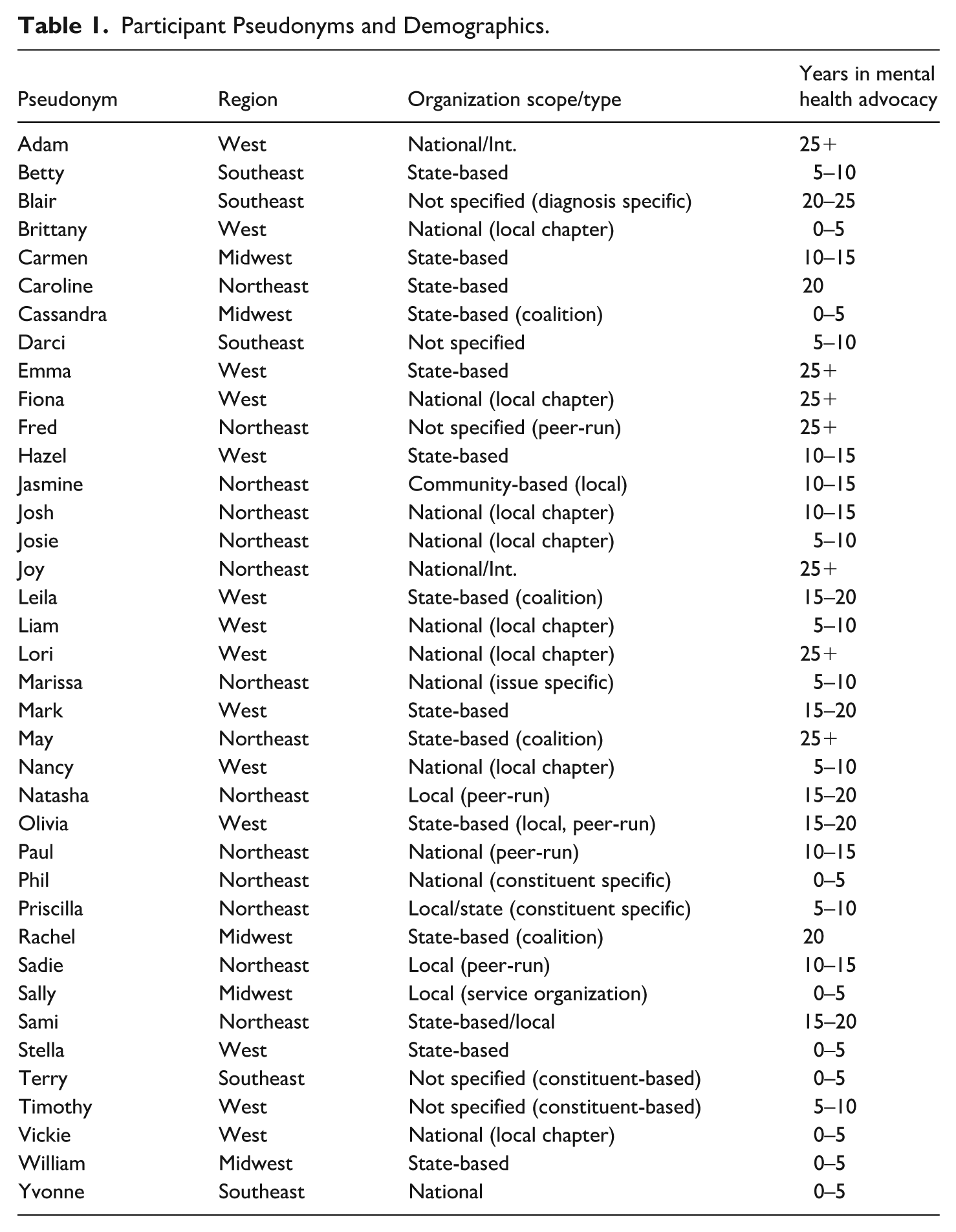
At the time of our interview, most social change communicators were between 46 and 65 years old (22) and many had or were pursuing advanced degrees (26). Within this sample, advocates identified in the following ways: men (10); women (28); White (33), Black or African American (4) and Asian or Asian American (1). I assigned participants pseudonyms to protect their identities. Participants often had diverse backgrounds that complemented their social change communication efforts (e.g. policy, law, social work) and sometimes upheld distinct discourses about mental health (treatment, survivors/consumers, or recovery). For instance, participants from large national or state-based advocacy organizations often aligned with a treatment discourse, while peer-run organizations and coalitions often shared consumer/survivor interpretations. However, participant reflections did not always fit neatly into any one discourse. To protect confidentiality, I do not share specific organization names alongside participant reflections or information. Some examples of organizations include National Alliance on Mental Illness, Mental Health America, MindFreedom International, trade associations, and state-based advocacy organizations. Please see Table 1 for pseudonyms, region, years of experience range, and organization type for all 38 participants. Information is offered in larger categories or ranges to avoid identification.
Participant Pseudonyms and Demographics.
Analysis
I used an interpretive qualitative lens to complement rhetorical theory as it assumes that participants and researchers create meaning together and values participant insight (Hesse-Biber, 2017). An interpretive lens posits that social, political, and cultural realities influence our individual lived experiences (Tracy, 2013). I used speech-to-text AI (non-generative) to create rough drafts of transcripts. I edited each transcript while listening to the recording again and engaged in an exploratory coding and note-taking process. One interviewee chose not to be recorded, so I took detailed notes instead. I coded in an inductive, iterative fashion to understand participant responses and apply them to the research purposes (Tracy, 2013), which necessitated revisiting transcripts and audio multiple times to derive relationships between labels. I focused on answering the research question, allowed the data to guide me, and aspired to uphold participant voices. I wrote memos to reflect on each interview as well as coding/analysis. I also engaged with reflexivity exercises offered by Hesse-Biber (2017, p. 45) to consider how my perspectives and priorities may influence my interpretation of the data. For instance, I thought about how my experiences with mental illness representations and mental health campaigns influenced my beliefs and attitudes about mental health advocacy. Furthermore, the process of writing, whether through memos, thought exercises, or various drafts of this manuscript, constituted an integral step of research, rather than simply a mechanism for the research output (Mitchell & Clark, 2021).
Findings and Discussion
A broad grounding for these participants’ social change work involves their efforts as persuading, changing, shifting, or starting conversations around mental health and illness. For instance, participants often noted the negative portrayals of mental illness in society and perpetuated by media, such as mental illness as moral failing, harmful language (e.g. crazy), and associating mental illnesses with violence, which required education and social change to address. They often emphasized how they produce communication initiatives that offer arguments, facts, education, and alternative views for society through materials such as research, meetings with legislators, white papers, media coverage or influence, social media, storytelling, and action events. In asking social change communicators about their perspectives on advocacy and activism, an inherent duality of interlocking and distinct approaches arose.
Synonymous or Hierarchical Distinctions? The Advocacy Umbrella
Some participants described advocacy and activism as interlocking pieces of a whole and, thus, may see these rhetorical approaches as synonymous. For instance, Terry shared, “I probably, like most people, use them interchangeably,” though if he had to distinguish, he conceptualized activism as “maybe activism is advocacy in action, like boots on the ground, doing the work, if you will.” Josh worked for a local chapter of a large national advocacy organization. He explained that he saw them as synonymous and clarified activism’s official definition as “vigorous campaigning” to note “that’s exactly what we do. We call it advocacy but you know, you could also call it activism.” He noted that activism sometimes carries a negative connotation which aligned with other participants, such as Hazel and Nancy, who explained activism as associated with aggressiveness. Darci believed advocacy and activism were “one and the same” but, most importantly, should intend to seek better circumstances for people.
Caroline acknowledged that the relationship between the two approaches is context dependent when she clarified, “I don’t think it [activism] has to be [different from advocacy]. I you know, I think that that varies according to kind of organizational mission and personal values.” Natasha explained them as both working toward similar visions, if adhering to the inherent social justice aims: I see advocacy and activism as really tied into that unrepresented or underrepresented voice and the power differentials and pushing back on those who have power and some people who are out there calling themselves advocates are very much on the power side.
Emma also described that advocacy is sometimes co-opted by industry and corporate interest, which can muddy the otherwise people-first and community-focused nature of advocacy and activism. While participants sometimes continued their statements with reflections on their potential distinctions, their experiences with advocacy and activism outlined overlapping persuasive activities for change that are difficult to distinguish, or ideally synonymous, when used for genuine, emancipatory purposes.
Advocacy was also described as a broader approach, or umbrella, in which activism falls under. As Paul explained from his experience leading a peer-focused organization, “I guess you could argue that activism is a form of advocacy. But I would say not all advocacy is activism.” Similarly, May thought out loud, “I think they’re related. I think activism – that’s actually interesting. I’m just thinking, is advocacy, a form of activism or vice versa? I think activism may be a form of advocacy more than vice versa.” Josie and Leila offered interpretations that aligned with advocacy as an umbrella term, too. Leila acknowledged the subjective nature of describing these approaches, “Well I think that they, they are not, you know, mutually exclusive. I think that within advocacy you have calls to action. And, so I think that that, to me is, it’s [activism] more action oriented.” Adam specified activism as “visible, concrete expressions of advocacy.”
Advocacy and activism’s synonymous uses, and the rhetorical choices they represent, imply that there may be a benefit in not “splitting hairs” between them. However, their interchangeability may also symbolize an underlying labeling strategy to avoid a radical connotation (of activism) or a co-opted by power connotation (for advocacy) in different contexts or for different audiences. Advocacy as a broader orientation that includes activism as a specific form further illuminates reasons for conflation between the two, as umbrella terms may be used to signify an overarching phenomenon in place of more narrow ones. In its macro meaning, advocacy is often positioned as an overarching attempt to garner public support and aligns with FFST’s versions of submitting arguments, facts, and values to a metaphorical arena where discourses compete (Heath et al., 2021). Despite these interpretations about interchangeability or perhaps advocacy as an umbrella term, interviews also illuminated some important distinctions that extend strategic nuances.
Advocacy Outcomes or Activist Spirit? Formality, Passion, and Flexibility
Another interpretation that complicated the relationship between the approaches included advocacy as centered on systems procedures and outcomes whereas activism includes an underlying spirit of civic engagement. For instance, activism presents arguments about social change visions while advocacy served as the “nuts and bolts” of systems change, as Yvonne recounted from her position at a national advocacy organization. Hazel described advocacy as putting a solution forward and going through a process of “give and take.” Nancy suggested that advocacy could be used at individual or organizational levels for gradual systems change while activism represented political movements. Liam expanded on these sentiments to assert that his advocacy work benefited from activists drawing attention to social injustices, but that his work provided closure through solutions. He explained: I think advocacy is focused, theoretically at least, more on a solution. Here’s the problem. Here’s the fix. I think activism stops short of that. I think activism is – here’s the problem. Isn’t this awful? Something should be done. What is that something?
After commenting on the sometimes-synonymous nature of advocacy and activism and differences across organizational mission, Caroline had a related reflection. She labeled her organization’s work as more advocacy-based or “analytical” than activism in that it conducts and shares research: So for example, we might develop a white paper and testify before the legislature about what would be best practice but we know that that’s really only going to make a difference if we’re partnering with other organizations that have a network of grassroots activists who can call their legislators and say “this is really important.”
Timothy and Mark also noted that advocacy requires specific solutions or outcomes, while activism emphasizes civic engagement or attention to issues.
Liam concluded that he could avoid participating in activist initiatives to “preserve” his advocacy role and relationships. May avoided civil disobedience efforts, which often align with activism, because of her background in law. Olivia explained how the social change demeanor of activism reflects an individual’s orientation to injustice: I think advocacy can happen in many different places. But I think by the time you hit activism, it is like inherent in who you are. So, I don’t just speak about, up about mental health and substance misuse injustices, I speak up about the social injustices that lead to people experiencing more mental trauma, mental health and substance misuse.
Jasmine, who worked for a local, community-based organization, said: I think of advocacy as more formal at times and at times professionalized set of activities, although it doesn’t have to be whereas activism I think, can take forms that, you know, in terms of public protest and certain kinds of performance-like activities as well as certain kinds of confrontations that can happen on a grassroots level that isn’t always easy to pull off if you’re representing an organization.
Joy mentioned that “permission” is needed for many advocacy actions, such as assisting people in obtaining benefits or resources, implying a degree of officiality expected within structured, formal contexts. She continued, “but activism really is about issues, positions and laws that are unjust. And you are doing activism to make people aware and to eventually change it.”
Passion and emotion also drove distinctions between the two rhetorical approaches, emphasizing connotations of aggressiveness that often accompany activism and expectations of subtly related to advocacy. Brittany described advocacy as a “whisper” (suggesting conscientiousness, subtleness) and activism as a “yell” (suggesting disturbance) to describe how she balances the two. She stated, “so your approach as a PR person has to be flexible. There’s sometimes you yell and there’s sometimes you whisper.” She mentioned that the mental health stigma of a particular context and her identity as someone who has experienced a diagnosis informed her approach to oscillating between whispering (advocacy) and yelling (activism). Olivia also mentioned the tension she navigates, having come from a recovery background into a treatment-based context, “I’m less so now joining protests and marches mostly because my colleague and I agreed that like every day, in a certain way, I’m protesting and I’m having to do it very subtly. Very nuanced, ‘have you considered this?’”
These reflections relate to extant research about advocacy and activism as within and external of systems approaches, respectively (Choi, 2025; Zoller, 2005). Advocacy requires professionalization, formality, and rules to propose and facilitate institutional change. Passion and emotion are required for activism that disrupts unjust systems (Martin, 2007), such as when consumer/survivor efforts disrupt treatment, or even recovery, interpretations. These findings also explain scholarship that describes activism as more militant or combative to accentuate the moderate nature of other collectives and highlight compromise as palatable for institutions (Derville, 2005; Stokes & Rubin, 2010). For instance, Liam and Caroline explained how grassroots activism may be necessary to apply external pressure when working within prevailing treatment discourses and systems. Social change communicators not only make intentional decisions about which rhetorical approach to utilize based on a risk assessment of confrontation versus compromise, but they also consider how both work together within the broader orientation of advocacy to shape discourses in different realms (institutional and sociocultural). In that sense, these participants conveyed the two rhetorical approaches as sometimes synergistic and make decisions to blend or avoid one or the other depending on their circumstances and audiences.
Taken alongside reflections about interchangeability and advocacy as an umbrella term, the findings thus far point to two distinct understandings: (a) a macro-level, overarching advocacy that describes putting forth a position in a social change context (Heath et al., 2021); and (b) a narrower, more specific, solution-based advocacy that seeks changes within systems and is more clearly distinguishable from activism (Zoller, 2005). Activism, rather, is a version of civic engagement and visible dissent for sociocultural changemaking (Adi, 2019). In addition to the overlapping and distinct versions of advocacy and activism as rhetorical approaches, participants also noted lobbying and community organizing as central to these discussions.
Expanding Approaches: Lobbying and Community Organizing
Discussions about advocacy, activism, and their differences also brought about the rhetorical efforts of lobbying and community organizing. Lobbying was explained as a highly formal and regulated persuasive approach, and community organizing as a citizen-driven mobilization strategy related to both systems advocacy and activism.
Lobbying as “Direct” Advocacy
Lobbying, as a formal, etiquette-laden, professional, advocacy activity, often emerged when participants attempted to refine their definitions of advocacy or outline restrictions on their persuasive choices. These reflections about lobbying suggested a significant relationship between lobbying and advocacy, which in turn has consequences for activism. Some participants explained that the terms “advocacy” and “lobbying” have specific meanings in regulatory contexts that outline how and what kinds of resources a non-profit can expend for direct lobbying. Cassandra worked at a state-based coalition and noted that her organization had to report to regulatory bodies and had limited hours to allocate to “direct” lobbying of legislators. She explained that, due to these restrictions, “a lot of what we do is the grassroots lobbying, where we’re mobilizing other people. We’ll send out an action alert and we’ll say, ‘hey, you need to call your, your elected officials and tell them about this.’” Similarly, William mentioned that many of the organizations in their 501c4 association could not “lobby” but could “educate.” Rachel’s descriptions of advocacy and lobbying also aligned with these interpretations. She added that people can contact or meet with their legislators as private, concerned citizens and not be engaging in this heavily regulated form of direct lobbying.
Lobbying also appeared to be regulated culturally. Betty, a registered lobbyist, said that she followed unspoken rules in her work, “I think I’m probably more than a lot of advocates – Not pushy. [laughs]. Be polite. You know, I ask politely.” Betty also conveyed that she sometimes hesitates to share her registered lobbyist role because the term can have pejorative undertones even though she works in a non-profit context. Rachel noted that advocacy and lobbying are sometimes conflated by people who have not been engaged politically or civically, which could scare them away from participating. She continued, “everything’s so polarized right now in a political environment, that everybody doesn’t want to hear the word lobbyist.” Lobbying also emerged as a distinct from advocacy in its relationship to firsthand accounts of mental health challenges. Leila shared that, “I mean if you don’t have that lived experience, then I feel like you’re more of a lobbyist than an advocate.” However, Fiona also described “citizen lobbying” as a process where community members and non-professionals attempt to directly influence legislators, which is also regulated by cultural, often unspoken, rules: I think you have to meet the legislators where they’re at in terms of their expectations and citizen lobbyists. If you come in wearing tattered jeans and an icky T-shirt, they’re just, they’re not going to listen to you because, to them, that makes you invalid. You weren’t respectful enough, you know, the ones with the big egos.
In this sense, lobbying served as a specific rhetorical approach that necessitates immediate access to policy systems but sometimes culturally clashed with more organic, grassroots, and activist expectations of social change.
In PR and mass communication literature, lobbying represents a behind-the-scenes form of advocacy (Ihlen & Raknes, 2020; Willems, 2024), which implies access to decision-making spaces that are intentionally exclusive and often interpersonally established (Choi & Boling, 2026). Furthermore, some studies about lobbying focus on for-profit advocacy (e.g. Ihlen et al., 2018) as lobbying brings about connotations of partisan or business interests, and non-profits may be limited in their engagement with such work. However, participants show how social change organizations utilize other forms of lobbying (indirect, education, grassroots/citizen) to seek access to political institutions without engaging in formal lobbying. These reflections show lobbying’s integral relationship with the broader versions of advocacy as an effort for social change, as politics and legislation both affect and are affected by sociocultural realities and work alongside or in coordination with grassroots initiatives. Lobbying also connects to FFST reflections about power in considering how specific advocacy efforts require expertise to persuade decision-making systems (Heath, 2018).
Interestingly, some literature considers activism, rather than lobbying, as a “direct” form of advocacy (Solnit, 2004; D. K. Williams et al., 2022). As noted in earlier findings, activism is direct in its visibility and disruptiveness. People may march in the street, engage in civil disobedience or otherwise offer tangible, public examples of their persuasion. However, it is not direct in its effects or access to institutions. Activism takes time and faith as it seeks changes to values and culture to then influence systems and policies (Solnit, 2004). Thus, lobbying as a form of “direct” advocacy is related to its immediate access to political institutions and legislation, while activism is “direct” in its sociocultural visibility. Community organizing also helps outline the full scope of rhetorical approaches, in both defining participatory advocacy and in understanding citizen-centered persuasion.
Community Organizing as Social Change
Community focus and engagement were recurring descriptors of participants’ understandings of advocacy. As Stella stated, “advocacy feels as though you’re supporting maybe community. Community change and handing that power back to the communities, that the things you’re advocating for are really affecting.” Community participation, outreach, and connection were also central in making sure social change communicators were taking in the perspectives of people who would be affected by the potential outcomes of advocacy, particularly solutions-based systems advocacy. This community grounding also emerged as a participatory advocacy process, as Jasmine described, “good advocacy empowers other people to demand what they want, and to engage civically, in that and in whatever other way.”
Additionally, activism had strong connections to the specific approach of community organizing noting the citizen driven, grassroots, and civil rights strategies to social change. For instance, Cassandra used the word “mobilizing” and implied a mass nature to activism in organizing marches where advocacy could include one person working on behalf of a cause. Stella similarly described activism as, “engaged in the grassroots work of organizing or advocating for some issue.” Fred explained a central motivation for this rhetorical approach: Community organizing, I think, you know, you can’t – if you don’t have sort of enough masses, enough mass movement you’re kind of a lone voice in the wilderness. You need to have people willing to raise their voice in support of the cause.
He also recounted how he learned about community organizing from historic organizers, such as Saul Alinsky, and that bringing people together, securing media attention, and hosting rallies are central activities. Joy also shared her experiences learning about consciousness raising and consumer/survivor alternatives in the 1960s and 1970s from activists and organizers such as Judi Chamberlin, further tying mental health advocacy and activism to mass mobilizing and the civil rights era.
Advocacy can include a community informed orientation (Aghazadeh, 2024) that aligns with ethical, egalitarian approaches to change. Such efforts seek to imbue advocacy with community interests. Activism is also closely related to community organizing in its efforts of mobilization and bringing about a grassroots mass collective to inspire community-based and political change (Ohmer & Brooks, 2013; Staples, 2012). Community organizing can include more focus on using citizen agency to address systems change, rather than strictly sociocultural, and is not necessarily based in conflict or dissent (Ohmer & Brooks, 2013). Thus, community organizing may exist in the space between advocacy as a systems-based formal approach and activism as grassroots movement.
Taken together, participant reflections point to several key takeaways that build on extant literature. First, advocacy and activism overlap in tremendous ways and communicators sometimes move between them. Second, there exists a broader orientation to advocacy that houses activism and systems advocacy as narrower expressions. In the narrower conceptualizations of advocacy and activism, their distinctions align with much of the existing literature related to intensity of activities, realm of change, and compromise (e.g. Choi, 2025; Derville, 2007; Martin, 2007; McKeever et al., 2023). However, the elements of institutionalization (formality, subtleness, professionalization) for advocacy contrast with the more worldview or lifestyle-based elements (passion, broad civic engagement, resistance) of activism. Third, lobbying involves a heavily formal, regulated advocacy that is direct in its political influence and institutional access, though it can be utilized as grassroots efforts from citizen lobbyists. Lastly, community brings about a participatory form of advocacy of systems change, yet community organizing often works alongside activism in sociocultural influence and mass mobilization. With these takeaways in mind, I explain how these insights fit together on a continuum of social change advocacy that can apply beyond mental health.
Implications, Limitations, and Conclusion
This study addresses how advocacy and activism have been muddied in consequential ways and extends the work that attempts to understand their nuances (e.g. Choi, 2025; McKeever et al., 2023). It also sketches a system of deliberative persuasion relevant to social change and social movement endeavors within the complex web of vocality of FFST (Heath, 2018; Heath et al., 2021). These distinctions matter to mass communication because they show where societal decision-making and social change influence are rooted and what persuasive strategies may be available, appropriate, and/or effective given those considerations. This study’s findings also illuminate insights for journalism and mass communication as social change entangles with media, public deliberation, and dissensus. Specifically, these findings point to a continuum of rhetorical advocacy approaches (advocacy, activism, lobbying, community organizing) that fall under an overarching social change umbrella and that span institutional to sociocultural influences. First, I define each approach; then, I place them on a continuum to illustrate their relationships to, and their rhetorical influence on, discourses.
Framework of Social Change Advocacy: A Rhetorical Continuum of Approaches
The broad description of advocacy as an umbrella term, which I will call big “A” Advocacy as modeled after uppercase-lowercase frameworks for macro and micro relationships (e.g. Jian et al., 2008), describes a rhetorical discourse orientation toward social change. In the context of mental health, advocacy can signify the overarching efforts to improve conditions for people with mental illness and/or protect mental health for all citizens. Within this broad orientation, communicators may choose from a variety of approaches to achieve specific goals across institutional or sociocultural discourse spaces – activism, little “a” advocacy, lobbying and community organizing. Little “a” advocacy actions include the specific education and persuasion-based efforts within systems, which differ from activism’s focus on dismantling interlocking social injustices by using external, and often oppositional, tactics (Martin, 2007; McKeever et al., 2023). Additionally, lobbying and community organizing represent advocacy approaches that involve distinct but related persuasive realities. For instance, lobbying is highly regulated for social change organizations (both institutionally and culturally), and community organizing requires mass mobilization toward shared problems. These Advocacy/advocacy meanings are significant because they explain how advocacy and activism can be synonyms, hierarchical, and distinct all at once. Big “A” Advocacy also demonstrates how lobbying and community organizing seamlessly arise in conversations as each approach is not mutually exclusive but rather coexists. Table 2 provides specific definitions, key components, and examples of each Advocacy approach.
Big “A” Advocacy Rhetorical Approaches with Definitions and Examples.
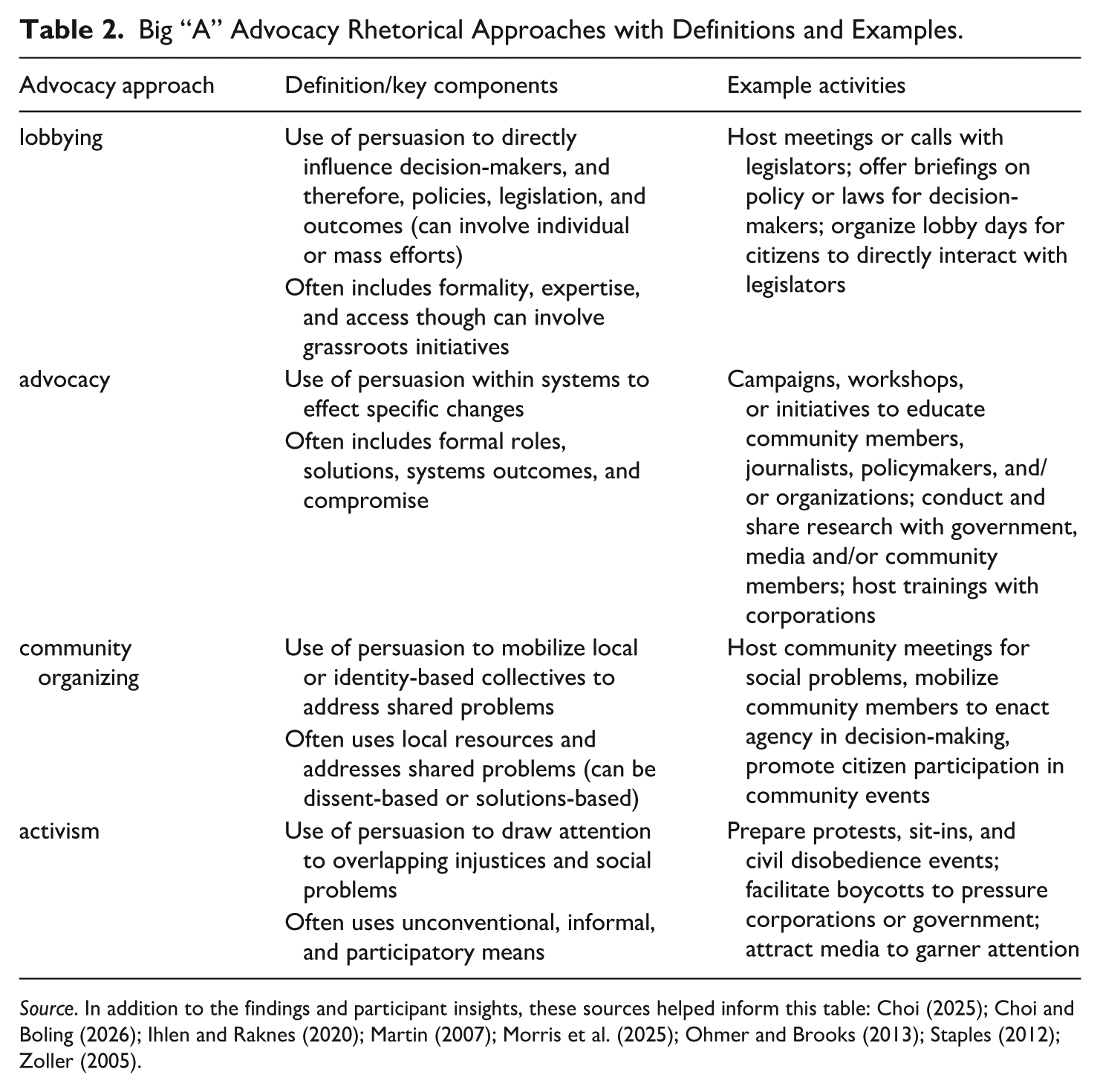
Source. In addition to the findings and participant insights, these sources helped inform this table: Choi (2025); Choi and Boling (2026); Ihlen and Raknes (2020); Martin (2007); Morris et al. (2025); Ohmer and Brooks (2013); Staples (2012); Zoller (2005).
A continuum demonstrates how phenomena are inherently connected; distinct yet not mutually exclusive. In this case, the continuum represents the span of institutional to sociocultural influence that different rhetorical approaches can enact when offering ideas and shaping discourses through rhetoric. Different types of Advocacy are governed by different rhetorical rules and social expectations because they operate within different societal spaces. More formal expectations for lobbying and systems advocacy suggest closeness to traditional structures, such as government, health systems, or corporations. As the most institutionally direct, formal, and regulated version of Advocacy, lobbying generally includes relationships with legislators and other decision-makers to influence policy and systems outcomes (Choi & Boling, 2026; Ihlen & Raknes, 2020) and often requires deep embeddedness in and knowledge of conventions, though everyday citizens can submit their arguments in these spaces, too. Not necessarily addressing specific legislation, little “a” advocacy often still involves formal roles, politeness, resources, and knowledge of rules to achieve change (Zoller, 2005). For instance, advocacy may include a corporate or government educational briefing, or a community education campaign. Community organizing represents actions within local contexts to serve the immediate needs of citizens (Morris et al., 2025; Ohmer & Brooks, 2013) often existing between informal, oppositional activist approaches and formal little “a” advocacy means to succeed. Activism is the least direct avenue to decision-makers and institutions, but most direct in sociocultural influence, attempting to change institutions and systems externally, often through culture, political pressure, and public opinion (Martin, 2007; Zoller, 2005). Figure 1 presents a visual representation of the relationship between these social change approaches and continuum of institutional to sociocultural realms.
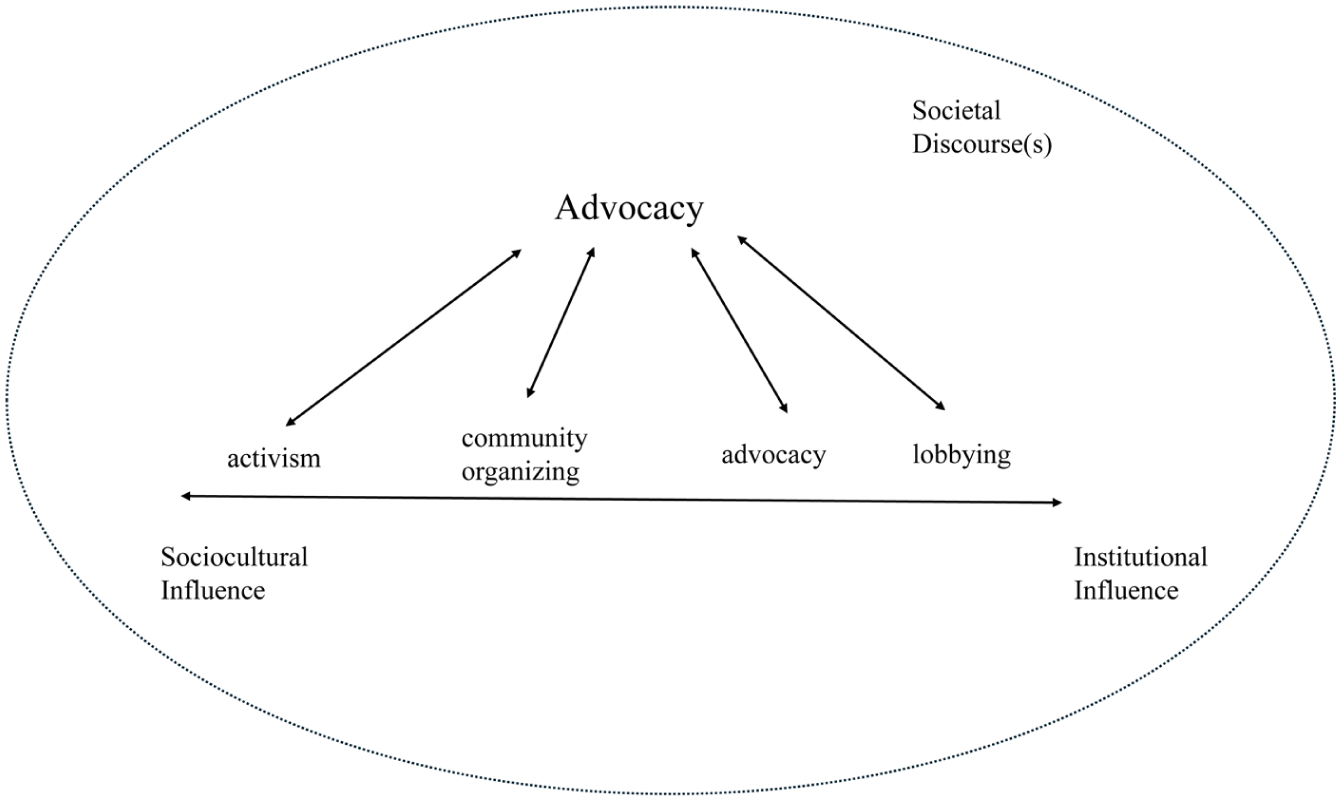
Continuum of social change rhetorical advocacy approaches.
Continuum Relevance Across Advocacy Contexts
This study specifically addresses mental health as a socially contested and often stigmatized issue in the United States. It is specific to a social change and public interest context and would likely not transfer well to for-profit scenarios. However, this framework overlaps with international contexts related to mental health. Mental health social change is a global endeavor, and global organizations are taking on related approaches to those offered in this study. For instance, Saha (2021) outlined a blend of institutional and sociocultural advocacy priorities for India that overlap with this research. Many global organizations also navigate similar tensions of mental health for all and specific services for those with mental illnesses as well as balancing treatment, recovery, and consumer/survivor framings and solutions (Beresford, & Rose, 2023; Crowe, 2022; Saha, 2021; Saraceno & Caldas de Almeida, 2022). Thus, this study’s clarification of rhetorical approaches may apply to other countries with similar political and discursive processes (e.g. Western Europe or Australia) or may apply to other countries when adapted to varied cultural and institutional structures.
Furthermore, the rhetorical advocacy continuum illuminates other issues throughout PR and mass communication, particularly those that are complex, stigmatized, and controversial (Madden, 2019). For example, pregnancy loss awareness advocates and activists have navigated overlapping institutional (i.e. governmental, laws, organizational policy) and sociocultural change (i.e. addressing taboo) alongside tensions between medical expertise and lived experience (Aghazadeh, 2024). Other issues that involve stigma and controversy, such as AIDS, education, or gun violence, also show diverse influences that span governmental and citizen-led advocacy to influence media, culture, and decision-making (Choi, 2025; Madden & Beykont, 2025; McKeever, 2021). As the U.S. and other societies continue to face polarization around a host of social issues, many different disciplines and professions in mass communication also benefit from clearer conceptualizations of these approaches. For instance, how media outlets and journalists conceptualize, label, and frame these approaches matter tremendously in their societal and discursive effects (McCluskey & Kim, 2012; Willems, 2024; D. K. Williams et al., 2022).
Limitations, Future Research, and Conclusion
One major limitation of this study includes the lack of diverse participants according to race, gender identity, and education. I was the only researcher for this project, which means findings and implications are bounded by my biases and experiences. This study privileges U.S. views as I am, and participants were, embedded in this context. Furthermore, this project assumes a social justice orientation of activism and advocacy, which may not represent causes such as pro-life/anti-abortion, anti-vaccine, or other movements (della Porta, 2023). Interviews were also conducted before COVID-19 shutdowns. While this could be a limitation in some ways, it may also serve as a strength in providing a more stable, enduring perspective less influenced by one particular crisis.
Future research should consider how different identity factors (such as race, gender, sexual orientation) and lived experiences influence philosophies and discourses within social issues advocacy. Studies that detail emotion could illuminate more about resilience in the contexts of social change and build from important theoretical work at the intersection of issues and adversity (Anderson & Guo, 2021; Madden, 2019; Madden & Beykont, 2025). Future studies can also help refine and test the relationships between the advocacy approaches offered in the continuum by building from and connecting to existing scales, categories (McKeever et al., 2023), and related policy contexts (Choi & Boling, 2026).
While important research has begun to disentangle advocacy and activism (Choi, 2025; McKeever et al., 2023), they have remained conflated as they exist in a discursive societal milieu. Mental health, like many controversial social issues, inspires a variety of voices in competition for societal understanding and decision-making. Through interviews with 38 mental health social change communicators, I offered firsthand accounts of the persuasive realities of advocacy and activism, which also uncovered lobbying and community organizing as distinct yet overlapping persuasive approaches to change. These communicators serve as rhetors who make decisions about when, how, and why to apply persuasive approaches and are intimately aware of their political and sociocultural consequences. In interpreting their responses, this study situated their lived experiences within extant PR and mass communication literature.
The major contribution of this study is the rhetorical continuum that seeks to disentangle advocacy and activism, while offering nuance about social change persuasion. It also presents discourses as rhetorical artifacts that influence symbolic and policy outcomes for society (Foust & Alvarado, 2018). This continuum serves as a framework for social change advocacy contexts and can help structure investigations in PR and mass communication research while also illuminating the everyday work of advocates and activists. In mass mediated society, where traditional and social media outlets are constantly exposing people to arguments about collective issues, interrogating their persuasive tenets are key to unpacking deliberative consequence.
Footnotes
Appendix A
Acknowledgements
I would like to thank this study’s participants for offering their expertise to build knowledge and for their daily work to make the world a better place.
Author Note
As noted in the manuscript, non-generative speech-to-text AI was used to create rough drafts of transcripts that were reviewed by the author for accuracy.

Funding
The author received no financial support for the research, authorship, and/or publication of this article.
Declaration of Conflicting Interests
The author declared no potential conflicts of interest with respect to the research, authorship, and/or publication of this article.