



Abstract
This article describes the analytical process of transforming a single interview into a dramatic vignette. Building on the tradition of ethnodramatic writing in the social sciences, as presented by qualitative scholars like Denzin, Mienczacowski, Saldaña, and others, the piece examines the method behind this artistically influenced mode of data presentation. It also discusses some of the affordances of ethnodrama as a way to represent research participants, particularly English learners, with nuance and subtlety. The analytical exercise culminates in a dramatic vignette titled “On the Map,” a readers’ theater-style scene between the author and an adult English learner studying in a community college.
Introduction
Ethnodrama is one of the names given to the method of transforming data into performance. This fusion of qualitative research and drama can take many forms, from classic monologues, dialogues, and plays, to more contemporary forms of theater like participatory performances, improvised performance art, and readers’ theater.
Denzin (1997) traces the genealogy of the rise of performance and social science, noting that in the late 1950s sociologist Goffman urged social scientists to acknowledge, examine, and represent the “dramaturgical” or staged/performative nature of identity enactment. In the decades since, various social scientists have begun to gather and organize their data (in the form of oral histories and participant observation) with the explicit purpose of performance in mind.
A growing group of qualitative researchers, Denzin, Saldaña, Donmoyer, and Mienczacowski among them, celebrate this narrative (or performative) turn in the analysis and writing of qualitative research and discuss the many possibilities of the genre. For example, Donmoyer and Donmoyer (2005), argue that when researchers must write about participants as characters in drama, they often can capture more clearly the subtle nuances, the “roundness” (p. 404) of their performed identities/personae. Similarly, Goldstein (2008) states that writing a script can help ethnographers be deeply reflexive about their portrayal of participants, because while writing, they must ask questions like, “Who gets the best lines?” “Who gets the final word?” “Who gets to speak and who doesn’t?” . . . . “How does my character’s silence speak on stage in a way it cannot in a traditional ethnographic text?” (p. 4)
These researchers also find innovative ways to make ethnodramatic theater more dialogic. Mienczacowski (1995) uses forum theater techniques inspired by Augusto Boal (1979) that encourage the audience and research participants to continually edit and modify the text and engaging in postperformance discussions. Donmoyer and Donmoyer (2005) use readers’ theater to present their data at conferences and to invite the audience members to perform and stage the scripts to facilitate greater participation and engagement with the data. In short, although they use divergent techniques and hail from distinct disciplines, ethnodramatic researchers converge upon the idea that ethnodrama, when done well, can facilitate engagement, more nuanced representation, reflexivity, and even action from the researcher, participant, and audience.
Goldstein (2001, 2008) has put ethnodrama on the map of research regarding multilingual and second- language-learner issues. (She has also looked at antiracist education and LGBTQ [lesbian, gay, bisexual, transgender, and queer] issues in schools). A critical ethnographer, Goldstein conducted ethnographic studies in a diverse Canadian high school and presented her written findings as a play, addressing the tensions between second-language-learner immigrant students and their Canadian-born peers (Goldstein, 2001). Goldstein cites 13 reasons why she has chosen the genre of ethnography to represent issues and tensions surrounding linguistic and ethnic diversity in schools. Among these reasons, she maintains that drama gives her a vehicle to represent (ethnically, linguistically, and in terms of viewpoints) students engaging in discussions they otherwise wouldn’t have. She also argues that ethnodrama engages teachers in a way that other forms of academic writing doesn’t, a distinction she calls, “speaking to them, not at them” (2001, p. 296). Thus, while other authors provide compelling and thought-provoking perspectives on the benefits and challenges of staging ethnographies, Goldstein’s work in particular provides a useful guide for how ethnographic work may be used to represent linguistically and culturally diverse voices of students in school settings.
Like Goldstein, I am interested in both what it means to live in a new land and learn English in schools and how we, as educators and academics, can find ways to make research more inclusive, dialogic, and action oriented. For several reasons, the community college is a compelling site to study the experiences of language learners. Moreover, while numerous scholars have discussed and theorized about the complex process of language acquisition and more broadly about adaptation to a new culture and society in grades K-12, little research has focused on second-language learners in community colleges (Harklau, 2000). According to Grubb and Associates (1999) community colleges host high proportions of low-income, minority, and language-learner students and represent “second chance schools” (p. 3) for many. And yet, to quote the title of Grubb’s book, community colleges are largely “honored but invisible.” Because I have worked in a tutoring center of a local community college with a fascinating, diverse (in terms of age, ethnicity, language, educational background) group of students, this topic is also personally relevant.
To bring together my interests in English language learners, community colleges and artistic forms of data dissemination, in this article, I use a dramaturgical coding system to analyze a single interview with an adult English language learner at a local community college. This purpose of this analytical process is to create a scene, specifically, a readers’ theater vignette, which Donmoyer and Donmoyer (2005) describe as a theatrical piece with minimal dramaturgical staging that can be presented in various spaces, from classrooms to academic conferences. Although this article mainly addresses the analytical process of transforming data into drama, I have also included the script at the end of this article.
Sampling and Initial Analysis
The broad aim of this small study was to examine how adult language learners in community colleges narrate their experiences of learning English over time, both in their countries of origin and in the United States. Because learning and becoming part of a new community can be thought of as a social and cultural phenomenon (e.g., Lave & Wenger, 1991; Rogoff, 1994) participants were also asked about their personal perceptions of learning English and adapting to living in the United States (Cannon, Blair, & Hagerman, 2011).
Because my two fellow research colleagues and I were seeking a preliminary sense of the terrain of conducting research with community college students, we aimed to keep the study small and, thus, conducted several interviews with three individuals. To recruit participants, we approached teachers of academic reading and writing classes that are heavily attended by second-language learners. We found three participants who were willing to narrate their experiences of learning English over time. The participants came from different areas of the world—Morocco, Laos, and Togo. Each participant had a distinct educational background and reason for studying at the community college.
Although we conducted a second round of interviews, we analyzed and presented the research data after the first round of interviews. In order to complete this process, we followed relatively familiar procedures in recording, transcribing, and analyzing our data. For example, we used in vivo coding (Saldaña, 2009) to generate codes and to identify recurring categories and themes within the individual interview data (Patton, 2002). To honor the distinctness of the participants’ stories, we decided to analyze our data separately, coming together to discuss codes and themes we saw in the individual interviews. As we discussed our cases further, we found compelling, overlapping themes, as well as themes unique to each participant’s case. Because of the uniqueness of each interviewee’s story, we ultimately decided to present the analysis of each student’s interview separately when we presented the data for a literacy conference.
While the process of analyzing and discussing the interviews with my fellow researchers was and continues to be thought provoking, since conducting the interviews and presenting on the initial data, I have felt that the process was somehow incomplete and puzzled about finding a new way to represent the data and to honor the interview participants’ individual voices. After all, the participants’ stories were poignant, laden with subtext, emotion, struggle, ambivalence, and optimism, and in short, worthy of our full attention. Moreover, as an educator, I have thought about how to share research and learning about English learners so that their stories can help teachers understand what adult English learners at the community college level know and bring to the classroom. In turn, I hope that this research can help teachers to reflect upon the needs of their students and to find better ways to design curriculum that is both culturally sensitive and responsive and academically rigorous.
Several theoretical perspectives prompted me to use narrative or drama as a tool of data analysis and presentation, from Bakhtin’s (1981) idea that narrative can serve as a crucial tool to represent the dynamic reality of the “multilanguaged consciousness” (p. 11) of diverse individuals, to theater scholar and social justice activist Boal’s (1979) proposal that theater has the responsibility not only to engage but also educate and serve as a vehicle for meaningful social change and liberation. While this article focuses mainly on the analytical process behind creating ethnodramatic writing, I am inspired by the idea that ethnodramatic writing and performance has the potential to be a joint, democratic endeavor, pursued concurrently by researcher and participant. Examples of such work can be found in Mienczacowki’s (1995) work with clients in rehabilitation settings.
Combining my interest in the link between qualitative research, narrative, and theater for social justice, I set out to find a method to analyze my data and create a dramatic scene. Theater scholar and qualitative researcher Saldaña (2005) informed the analytical process described below. He suggests that interviews can be staged, and in fact, single interviews and case studies are “cousins” of monologues and dialogues (p. 20). Encouraged this seemingly natural relationship between this single interview and a dramatic piece, I began the process of analysis, focusing on two, 1-hour long interviews with Edem, a 35-year-old male student from Togo. The analysis of the data is described in the following section.
Representation of Data: From Codes to Categories to Themes
First-Round Coding: Dramaturgical Coding
To code the data, I reread the transcript of the interview and used Saldaña’s (2009) dramaturgical coding, in which lines are coded, using a combination of in vivo and gerund codes. In addition, each coded line is assigned a secondary code in order to reveal the perspectives, motives, and conflicts of the participant. Saldaña borrows this coding system from Bogdan and Biklen’s strategy codes. This system employs six codes: Objective (OBJ), Conflict (CON), Tactics (TAC), Attitudes (ATT), Subtext (SUB), and Emotions (EMO). To illustrate one example, the following line from Edem’s interview would be coded as follows.
And I can say that some advisor helped me. And most of the clerical person help me. And they. It was very interesting. It’s not like my country. You have to give something like a money [bribe]. Codes: ATT: Americans as helpful EMO: grateful
As I read and coded line by line, I felt that the coding scheme seemed simultaneously inductive and deductive, a combination that Denzin (1978, cited in Patton, 2002) might call abductive. That is, I could name the codes as I felt appropriate, but I also had to deductively decide how these codes fit into predetermined secondary codes (e.g., emotion, subtext, etc.). Two key issues arose: (a) Some lines did not conform to a single code, and (b) the processing of coding for emotions and subtext—which often required my remembering Edem’s vocal expression or tones, or to recall the meaning laden silences between question and answers—proved to be difficult. To address the first issue of overlapping code, I often coded one sentence with several codes, as in the case below.
I am going to school because I think I need the basics. Help you to do something. Codes: SUB: needing the basics OBJ: getting a job
This line comes from a part of the interview when Edem describes how attending the community college will help him find a stable job; therefore, Edem’s larger objective is “getting a job.” However, because the “basics” comes up several times during the interview in reference to receiving an education, I coded the line as a subtext (SUB) of “needing the basics” because it is clear throughout the interview that Edem feels like an eternal novice, both linguistically and socially. Because Edem has moved and/or been relocated to several African countries, he has been in the position multiple times where his educational credentials effectively don’t count and he has to restart his education. Each new start begins with the need to relearn the “basics.”
To address the issue of the difficulty of coding for the more elusive elements of emotions or subtext, I took on the task of remembering meaningful silences or changes of the voice that signaled a change in emotion or a less obvious subtext. I reread the transcript where I had thankfully transcribed with enough detail to record silences or pauses that struck me as meaningful. In one particular instance, I asked Edem about his social life. His answer seems to belie the sense of discomfort he feels in his current situation in the United States. That is, as a sociable, formerly outgoing person, he expresses (verbally and nonverbally) feeling constrained and limited by his foreigner status and language skills. I coded the following silence as the emotion (EMO) discomfort.
So who do you spend time with here?
Silence [EMO: discomfort].
Um, who am I spend time with? [pause] like?
Your free time? Your time during the day?
I can say my family, especially my brother. And after that, no one else.
My struggle to code for embodied signs of emotions and subtext relied heavily on my memory of the interview. In this case, I remember clearly, Edem’s uncomfortable smile as I asked him whom he spends time with. The search for emotion in this instance underscores an idea forwarded by Carspecken (1996, cited in Kincheloe & McLaren, 2005) that “critical ethnographers [should] record body language carefully because the meaning of the action is not in the language, it is rather in the action and the author’s bodily states” (p. 328). In the following section, I will describe how further rounds of coding facilitated my transforming of interview into scene.
Second-Round Coding: Categories
After I coded the interview using the dramaturgical codes recommended by Saldaña, I compiled a dictionary of codes and then looked for commonalities among these codes to generate categories, based on patterns and shared characteristics (Saldaña, 2009).
The following example illustrates how the original Subtext (SUB) code “needing the basics,” which in the line refers to constantly being at a starting point educationally, was subsumed under a larger categorical code of “coming up short” (see Table 1).
Exploring Categories: Subtext
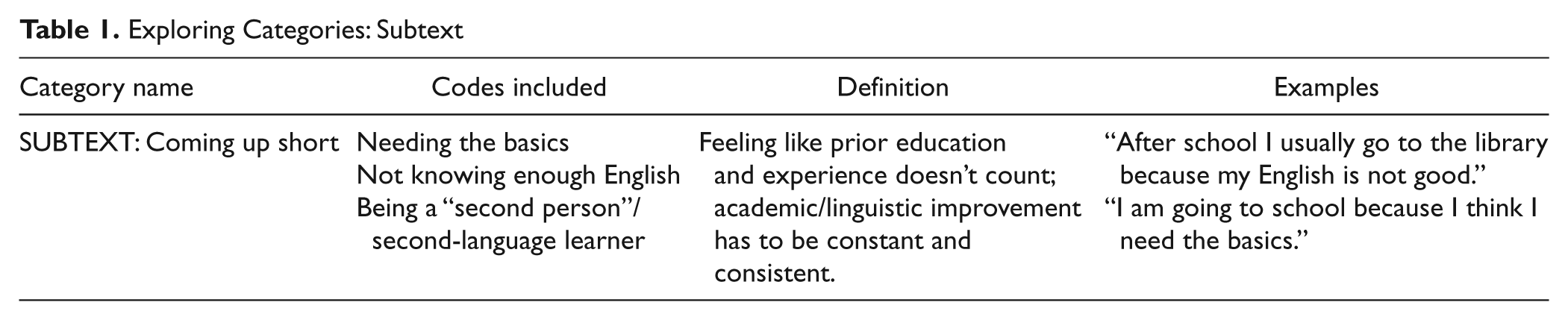
The process of coding and categorizing allowed me to see Edem’s character with greater depth and fullness. Most illuminating in this process was coding for emotions. In addition to looking for and recalling the more embodied evidence of emotions (silences and pregnant pauses, for example), I found that small words often provided great insight. For example, Edem frequently used the word “interesting” to describe positive life phases or events. While this phase of coding was very interesting—to borrow from Edem’s use of the word to denote positive and engaging—it was puzzling how to organize these various and disparate codes into spoken lines that wove into a larger, cohesive vignette, and how might I appear or play a part in this piece. Several more stages of analysis were necessary to connect some (but not all) of these disparate dots.
Third-Round Coding: Identifying Themes and Conflicts
In addition to identifying codes and categories, I recognized larger patterns or themes in my repeated readings of the interview. Patton (2002) and Saldaña (2009) suggest that thematic analysis is an organic process, largely driven by the competency of what Patton calls “pattern recognition” (2002, p. 452). I identified a few themes in the interview, including interruptions and waiting, learning the basics, and speaking American and fitting in.
Interestingly, I noticed that these recurrent themes were not neutral motifs, rather that they were active sites of conflict because in each case something stood in the way of Edem’s fulfilling goals. These hybrid conflict/themes were important to me as I began to think of the organizing features of a dramatic vignette about Edem. Using these themes/conflicts as my guide, I began to think about the best way to represent how conflict stood in the way of Edem fulfilling his stated objectives and how this conflict could facilitate the dramatic action in the scene.
To accomplish this task, I looked at the data to see how Edem referenced and represented conflicts, how he described his reactions to these struggles, and lastly, if and how he discussed the resolution of these conflicts. I organized the codes to focus on conflicts. I looked first for Objective (OBJ) codes to identify Edem’s goals. I then looked for Tactics (TAC) for how Edem was realizing these objectives. Finally, I read to see whether any Conflicts (CON) blocked the fulfillment of these objectives and what the consequences of these conflicts were. For example, did Edem react Emotionally (EMO)? Or employ a new set of Tactics (TAC) to negotiate with or resolve the conflict? Below I offer two illustrations of how I made sense of two theme/conflicts: speaking American and fitting in and interruptions and waiting.
Conflict 1: Speaking American and fitting in. A major theme for Edem was mastering English and sounding authentic. This objective was reflected in lines like these:
To improve my English And I have a focus so that after one year I can be able to read to express myself. I want, I hope that I can have, can imitate the American accent.
Edem employed tactics (coded as TAC) to fulfill these objectives, including extending himself to strangers on the bus or taking elective courses to meet people at the community college, as expressed in the following quote.
Sometime when I am on the bus, I don’t know something. I just to ask, even if I don’t know the person. And that help me to improve my English.
Despite his earnest attempts to fit into the social fabric of the community and college Edem felt that his efforts weren’t, in his words, “working.” Edem underscored how he feels like an outsider in his community, saying, “One thing is the way people are looking at you. It’s like, ‘this guy, he’s a foreigner.’”
This conflict spurs an emotional response from Edem, a sense of loss about his formally outgoing identity and frustration about what he perceives to be his limited English skills.
I used to be outgoing, but that’s put me in a difficult situation because I cannot talk to people like I want . . . I cannot express myself correctly. I don’t know if you get me.
In the face of this conflict, Edem attempts to make sense of the situation by theorizing that part of the problem or conflict may lie within the American people themselves, whom he refers as “trained to be polite,” but ultimately closed and guarded.
American people . . . it’s like they are trained to be polite . . . if they don’t know you. They are not going to talk.
These lines seem to create a narrative arc about Edem’s unresolved goal about fitting into American culture by mastering the vernacular and being able to make friendships with locals. Viewed differently, the figure below (Figure 1) represents the narrative arc of Edem’s attempts to learn English and fit in. As you can see that the arc is incomplete, representing that the conflict is still unresolved.
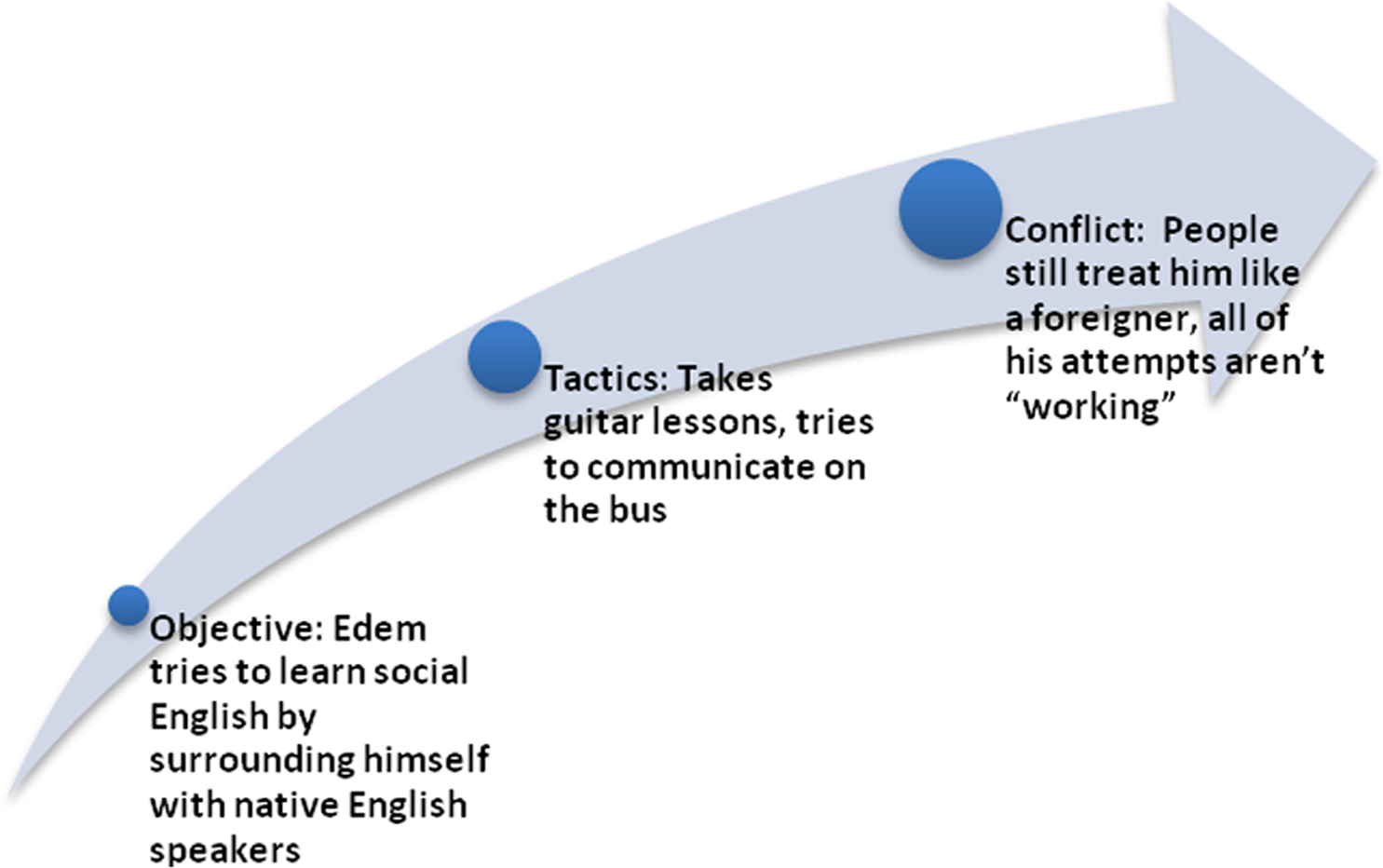
Narrative arc
Conflict 2: waiting and interruptions. A second theme/conflict of waiting and interruptions became very clear in my rereading of the data. Instead of a neat arc, this conflict was best represented, less linearly, as a series of stops and starts. The graphic below helped me to illustrate how Edem’s vocational and educational life has been interrupted several times by changing political regimes, forced relocation across countries, and different educational systems (Francophone and Anglophone African and U.S.).
In the following figure (Figure 2), each squiggly line in the timeline represents a critical interruption. To list only two of these key interruptions, Edem began primary school in Togo, spent some time in Benin, and then returned to Togo because of instability in the Togolese government.
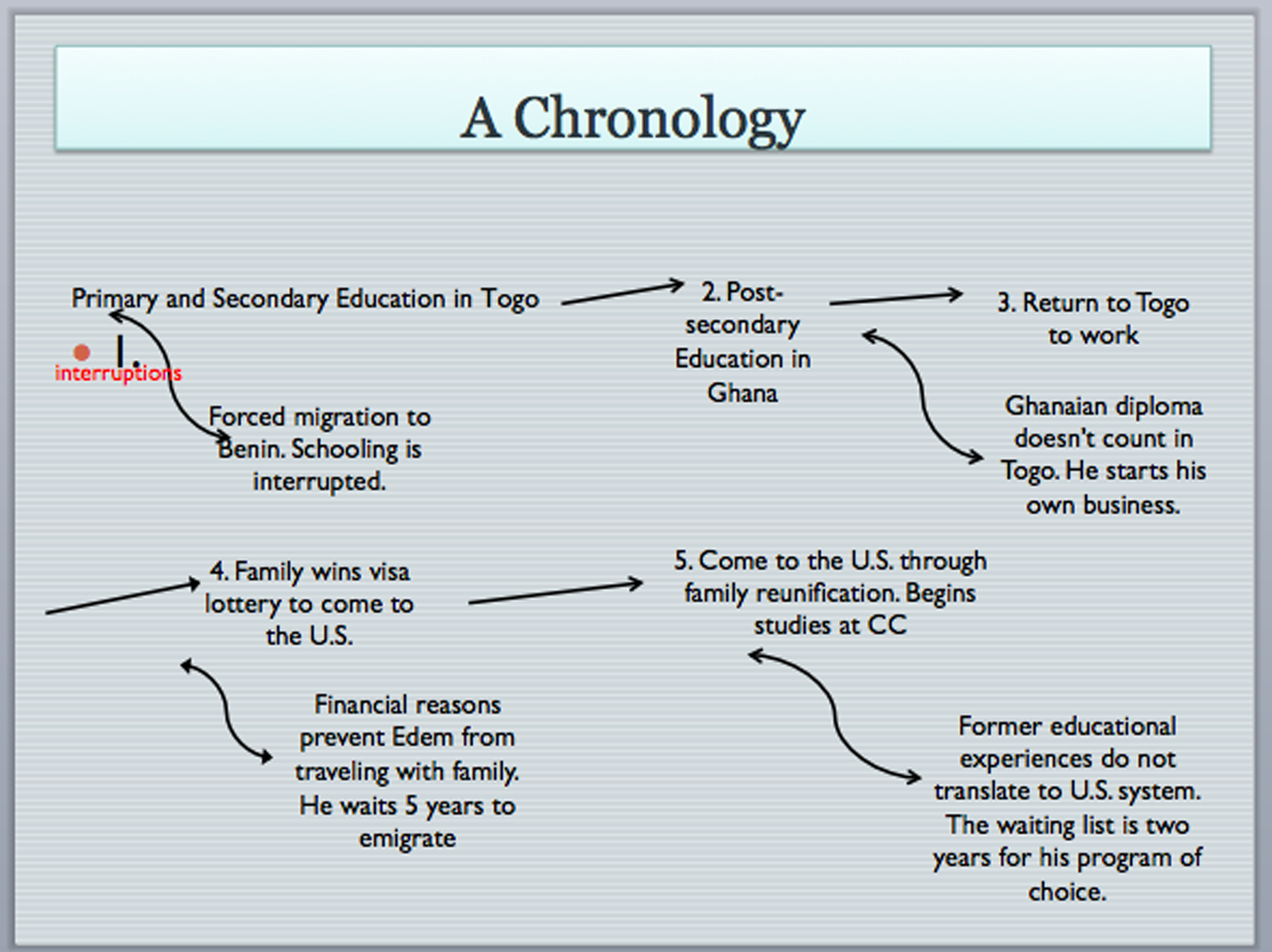
A chronology of interruptions
To give another example of an unanticipated obstacle and interruption, Edem pursued and completed several years of postsecondary education in Ghana and returned to Togo. However, upon returning to Togo, a Francophone country, Edem’s educational credentials from Ghana’s Anglophone educational system didn’t count and made him ineligible for employment in his trained area of expertise. In his interview, he recalls the difficulty trying to find a job in his home country.
I try to send some resume to some . . . company, but it didn’t take me, and there are some reasons. . . . It’s like there is a big difference between the English system and Francophone system, so they [employers] can’t consider that kind of study or diploma.
Years later, after reuniting with his family here in United States (also after substantial delay), Edem learned from an academic advisor at the community college that his all his previous postsecondary schooling amounts to approximately three transferable credits. In addition, he is on a long waiting list at the college to get into the academic program of his choice.
These interruptions have repeatedly put Edem in a position of starting over and also finding alternative paths—like opening his own business—to accomplish his goals. Despite these barriers, a sense of tempered optimism based on past experiences and hopefulness pervades his language.
For the positive mind I need to have. I can say in five years that some of the things will be done . . . Or maybe in five years it [fulfilling his educational and vocational goals] will be done. I don’t know because sometimes you say you want this, you plan this, but it cannot work. It will take time to be done.
As I considered the role that these themes and conflicts might play in the vignette, I began to puzzle how, in addition to representing Edem’s barriers to success, I could demonstrate (as the above quote does) how he, in the face of it all, showed a remarkable sense of optimism and resilience. For this reason, I decided to, like many ethnodramatists like Mienczacowski (1995) to, as much as possible, use verbatim quotes in order to preserve Edem’s voice. After identifying codes, categories, and these hybrid, theme/conflicts, I looked again to Saldaña’s recommendations for dramaturgical analysis to give me guidance on organizing the scene.
Analysis: Characterization and the Superobjective
Saldaña (2009) recommends that after identifying external conflicts (like the theme/conflicts described above) as well as the “more internal perspectives of the participant actor during this situation” (p. 104) as revealed in the emotions and subtexts, it is useful to write a narrative (first person or third person omniscient) from the perspective of the participant to attempt to better understand his or her deeper thoughts, motives, and desires.
Saldaña posits that this exercise can help the author understand the superobjective of the participant, a dramaturgical term meaning the goal or ultimate motive of what the individual wants or wants others to do. Because I was aiming to create a dialogue, I also coded my part of the interview and compiled a similar narrative with the effort of identifying my own superobjective. The exercise proved to be useful in defining my axiology about teaching and research; more relevant to this exercise, I wrote a memo to describe my superobjective, which I summed up with the phrase “to understand and help.”
I want to know about Edem’s language and learning practices—reading, writing and so on, but to be honest it doesn’t interest me as much as the non-school aspects of his life. What are his languages called? What are the African countries like where he has lived? How has his background as a kind of forced nomad/cosmopolitan citizen influenced his educational trajectory? How can I use this knowledge to better my practice, and not just as an anecdote about the diversity of community college second learners? What can we learn from this story? Who can a story like this help? Does it need to help? I want to be a good teacher, an ally. I want to know these languages, connect with the students. I admire them. I am humbled by their hard work, saddened by difficult pasts that in a fair world should and could have been avoided.
Here is an example from my arguably less developed first-person narrative I wrote from Edem’s perspective:
I want to improve my English. This is a really basic thing right now. I need a good job. I need to support my family, parents, and sister. I am the oldest. I have so much I want to accomplish. I can do it. I just need to work hard. I need to do my homework, go to the library, keep the same kind of vocabulary book I kept when I was in Ghana. I also want to fit in. It’s so difficult. Americans; they smile; they are helpful; they are polite, but it seems like they aren’t sincere. It’s more like they are trained that way. They won’t really talk to you. They won’t really be your friends, but that could change. I think if I speak good, clean English, that will help. I need to work harder. I want to learn English. I want a serious diploma, not like the one from Ghana. That diploma didn’t count in Togo. It didn’t work. Things are not working here for me yet either. But it will. I have so many dreams and ideas for businesses and lives.
For Edem, I chose two words “to belong and thrive.” Because our interview was largely about English learning, it was tempting to identify learning or learning English as the superobjective. After more reflection and rereading, however, I concluded that mastery of English was, as other skills had been before (like learning about computers in Ghana), a vehicle to having a vocation, playing a productive role in family and society, and “thriving” in this (or any) country.
After completing these stages of coding and analysis I wrote the vignette, a dialogue, which chronicles a fictional interaction between Edem and me in the busy drop-in tutoring center where I worked. I chose this setting because it would be the most likely place we would meet. In the scene, Edem’s objective is to get help with an academic paper in English (a situation familiar to me as a tutor). Although I used direct quotes from the actual interview, I often altered the English slightly to ensure clarity and readability. In the following section, I will describe and reflect on the process of presenting the findings of this analysis as drama.
Summary and Outcomes
As I had planned, the dramaturgical coding and analysis resulted in a dialogue using a collage of verbatim quotes between the respondent Edem and me. In writing the scene, however, I found it difficult to follow the comparatively neat and linear process of the initial rounds of coding and analysis. In fact, more than being a means to present my findings, the process of writing the scene was highly recursive and actually facilitated yet another level of analysis. Specifically, I actively questioned some of the overarching goals I had identified in earlier rounds of coding and struggled with how to use Edem’s quotes in ways that were both artistic and true to the meaning I felt was conveyed in the original context.
For example, although I had named two separate superobjectives (Edem: learn and thrive, and Anneliese: understand and help) before writing the scene, I found that in writing and reflecting, Edem’s and my objectives were more similar than I previously thought. That is, we have the overarching goal to communicate and connect with each other. More specifically, Edem wants to learn and be understood across social and academic modes of English—writing, listening, and speaking. For my part, I (my character) want to be clear and compassionate in order to understand and help an individual whose background and life before coming to the United States I can’t imagine. The main conflict to forging a meaningful connection is time—represented by the constant situational interruptions that cause the characters to frequently give individual asides to the audience, instead of engaging with each other. These interruptions play two key roles in the scene: (a) They symbolize the interruptions that have acted as barriers to Edem’s educational success across different countries’ educational systems, and (b) they reflect the time crunch felt by teachers and students as they try to work efficiently and effectively and, at the same, undertake the less efficient (but I would argue more personally worthwhile) task of getting to know students and honoring the unique background they bring to each learning experience.
The process of writing as a level of analysis allowed me to be steeped in the data in a way the previous rounds of coding and categorizing hadn’t. In fact, I nearly memorized the interview in the process! While I became very familiar with Edem’s actual words, the task of piecing quotes together to make a coherent conversation also required a high level of reflexivity. As Goldstein (2008) writes, each line and silence gives meaning and has the potential to unfairly privilege the perceptions of one speaker over another. In this case, I struggled particularly with how Edem’s and my lines represent Togo and, more broadly, Africa. Anthropologist Ferguson (2006) writes that often Africa represents more of a concept than a geographic region, one that, unfortunately, we hear about mostly in “troubling and urgent tones” (p. 2). Although I am often troubled by what I hear about Africa in the news, I am in awe and admiring of the students I work with from African countries. Yet, as in this scene, I walk a thin line between essentializing and understanding, between pity and compassion. Therefore, a next step to this project may be to analyze the dialogue with a postcolonial lens to explore the themes, such as our joint representation of Africa as lacking or backward, or Edem’s perceptions and prioritization of European languages (specifically American-accented English) over his “local languages.”
While this analytical exercise and resulting scene represent a nascent, perhaps inchoate effort at ethnodrama, I am enlivened, if not a little daunted, by the possibilities of performative critical ethnography. When Denzin (2005) extols the performance medium for its abilities to “contribute to radical social change, to economic justice, to a utopian cultural politics” (p. 933), I now realize simultaneously what a tall order this is and how potent this endeavor, if done “right,” could be.
While the task of being reflexive and critical has been difficult and continued even after I wrote the closing line of the scene, this analytical exercise demonstrated for me how Edem’s story had greater significance than just one story of a community college student trying to learn English. That is, we can also read Edem’s story as being about transnational flows of people, the fractured postcolonial political landscape of Togo, the prioritization of English over what Edem refers to in the interview as his “local” languages. Edem’s story, therefore, has something to tell us, I hope, about what it means to be a world citizen, a globetrotter, a multilingual cosmopolitan, even if not entirely by choice. As educators and researchers, I think that understanding the realities of multilingual, immigrant language learners takes on greater importance as the world seemingly shrinks in size but does not diminish in inequalities.
On the Map
Setting
The scene takes place in a drop-in tutoring center of a community college. The space is located in a bustling and busy library. There are approximately six tables, each filled with students of different ages, races, nationalities, and abilities.
Characters
Anneliese, a Reading/Writing/ESL instructor; Edem, a new student and recently arrived immigrant from Togo; one speaking student; and three to six silent students working at different tables
[Anneliese is seated at a table working with one student at a table. Edem enters the learning center area and looks around the tables for someone to help him with his paper.]
[Noticing Edem approaching the tables and looking around], Hi, are you going to need some help today?
Actually, I am looking for some help on my paper.
Ok, what class?
It’s for academic writing.
[Familiarly and relieved], Oh good, that’s something I can do. I can’t help much with sciences or math, but I can help with English. Would you mind having a seat here [points to the table where she is seated with another student] and we can work on your paper. I am gonna’ need to bounce around today. We are super busy, as you can see.
Yeah, thanks. It’s ok.
I’ll just let you get settled in and get your stuff out, ‘kay? [turns around to work with another student, freezes]
[To the audience, taking a seat and retrieving books from back pack], I really appreciate this about this country. That’s why I say America has a good education system. Most of the people help me here, most of the clerical persons, some advisors. This is not like my country. In Togo, you have to give something to get help, like money, like a bribe.
[Addressing Edem], Hi there, I’m Anneliese [points to name tag].
I am Edem.
Great to meet you. So, Edem, what exactly are you working on today?
I am wondering if you can help me with my paper. I am comparing Togo to the United States.
Oh, compare and contrast. Why Togo? Is Togo where you’re from? [Someone at another table gestures for Anneliese’s help.] [Distractedly], Oh no! Hold that thought Edem. I’ll be right back.
[Anneliese leaves table and sits at another table with people, freezes.]
[Addressing the audience], Togo is where I am from. My country. My childhood country. I grew up there, playing games and stuff. It was interesting. Those times. But Benin, I lived there too. You know, because of the political situation in my country. Ghana. I lived there. And Ghana? It’s like my steady country. I learned computer science there. You know, because of the political and financial situations in Africa, we are sometimes just going from place to place. I am here, but there are still brave people, intelligent people, people better than me, living in Togo. My country. They don’t have the chance I have to [pause].
[Anneliese returns to Edem’s table and sits down.]
Ok, let’s get to it. What’s this paper about again? Sorry! It’s just so busy. Oh yeah [looking and reading the paper title aloud]. “Togo and the United States.” So Togo is your home country? Does that mean you speak French?
Yeah, I speak French, some English, and also, um, local languages. Actually, I lived in Ghana for studies too. Oh yeah, Benin too.
Wow, Benin! Did you study there too?
[More seriously], Uh, no, when we lived there, [pause] it was because of the political situation in my country at that time.
[Pauses, seemingly not knowing what to say], Ok, well, let’s start on your paper. Would you like to read it aloud or would like me to read and edit and talk to you as I make comments?
Could you read it to yourself?
[Enthusiastically], Sounds like a deal! [Exaggeratedly takes out a red editing pen and starts reading and marking up the document].
[Freezes].
[Anneliese begins furiously editing the paper, but stops to look at the audience for this aside.]
When he says [air quoting], “the political situation in my country.” These lines could mean so much. I have heard this kind of story before. I wouldn’t be surprised
[Anneliese points to Edem with the red editing pen], if he has a PhD or something and he’s starting over, trying to learn English. It sometimes makes me sad.
[Looks down at the paper she is editing again.]
Hmm . . . ok, this subject doesn’t agree with the verb, I’ll need to point that out.
[Looks up again to address the audience.]
l mean, it’s like there are these well-educated people giving up everything to come here just to start over here, taking remedial English when they really were something before. Well maybe I am assuming too much. Maybe there wasn’t much to give up. I mean, I didn’t know that Togolese were forced to go to Benin? When was that? Ok, Rwanda I know about. Somalia, Sudan. Now it’s the Ivory Coast. I just read something by a guy named Ferguson. He said, “When we hear about Africa, it is usually in urgent and troubled tones.” Hmmm . . . [pausing] Ok, Anneliese [addressing herself] just focus on the writing.
[to Edem]. Ok, here in this paragraph when you are describing your country, I really would like it if you could say more. You know, show me, don’t tell me. What does it look like? Daily life? What goes on from day to day? What’s the latest news? I can understand better if you tell me from your perspective what it’s really like there.
[Goes back to editing paper, freezes.]
[Slowly, deliberately], My country. Well, I must be honest. I do not listen to the news from there. I . . . I appreciate not to know about my country. When I hear some news from my country, most of the time it’s . . . it is, a feeling of sadness. A feeling of . . . you get angry because you can’t understand the people and how they can behave that way at this time. I appreciate not to know about my country.
Ok, Edem, here where you compare the education system in the country you write, “In Togo, we don’t have it.” What does that mean?
What I mean is that we don’t have the opportunity you have. You know, to get my education I went to Ghana. I studied computers, but then I came back to Togo and it’s like, they don’t trust the diploma from there. I sent some resumes, but the companies don’t trust or want it.
So, you’re saying that it’s difficult in Africa to go to school in different countries?
Yes, for example, when I lived in Ghana, my education didn’t count either. I couldn’t work there when I studied. I tried to go door to door to sell French lessons, but it didn’t. . .
Work?
Yeah, it didn’t work. So I just have to learn the basics in Ghana, English and computers. Actually, that’s what I am doing here. Learning English. It’s the basics.
Ok, it’s interesting, but for your paper. It’s compare and contrast, so what would you say? Are the educational systems in Togo and the United States more similar or different?
Well, we have the primaire, the college, the lycee. Well. . .
[Enthusiastically], We have three levels too! Maybe the systems are more similar than different. I’ll write a note here on your paper so that you can talk about the education systems are similar.
[Begins writing and then looks up at and addresses the audience.]
I feel like I am forcing him to say that the American and Togolese systems are similar. Why am I doing that? So that he can just write a clear paper, not detailed, not authentic, but clear. That’s really what it’s about. These compare and contrast assignments. They just scratch the surface. Like the other guy last week who told me that in the United States babies live, and in his country, Djibouti? Sierra Leone was it? Most babies die. What do we make of this? Really Edem could write a whole paper just on his educational experiences. Why does he feel, for example, that his education from many countries really doesn’t count for much? If only we had more time to talk through this. If only there was more time to. . .
[Turns to Edem].
[Addressing Edem], Ok, great. I like it here in the paper where you talk about your personal experience coming to this country and your first impressions of the U.S. But this sentence—I am stuck on it. Can you tell me what this sentence means? Just explain it in your own words so that we can write it clearly, so that you say what you want to.
[Reading the sentence to himself and then to Anneliese], Ok, what I am talking about is how the USA is different. There are many positive things here. When I take the bus, for example, sometimes I used to ask myself, “How did they organize this?” Because they schedule it correctly and people are working and the drivers, we have to respect them. In my country it’s not possible. Sometimes the passengers, they can be upset and maybe start to, is it insult?
Yes, that’s the word.
Insult the driver. Another good thing is the education. And another good thing is the. . . .
[Another student speaking from a different table], Excuse me, I got a quick question over here.
I hate to interrupt your thinking, but she’s [gesturing to the student] over there needs my help with just something really quick. Please write those ideas down.
[Begins to walk to the table of the student.]
Oh, and also write down if there are any negative impressions you have of this country.
[Stands, goes to another table, frozen, and begins working with another student. Freezes.]
[To the audience], Negatives? I say this respectfully, but it’s the way people are looking at you, like, “Oh this guy, he’s a foreigner.” It’s like they smile, but maybe they are just smiling because it’s like Americans are trained to be polite, smile, sayin’ thank you and so on. But on the other hand, maybe the person just smiles to you; they don’t like you. I don’t know if you get me. In my country, for example, if someone smiles, even when they don’t know you, it’s smile of respect. You are a human being, so you smile. If you don’t want to smile you don’t smile. That’s real. Not here. People are trained to be polite. [Puts his pen to the paper, meanwhile we see Anneliese working with the other student, finish up and approaching the table.]
[Anneliese returns to the table, sits down, and reads what Edem is writing.]
Oh, nice sentence! So you are saying that you are impressed with many of the systems in the U.S., like our bus system and our schools, but that you think that the American people are hard to read, like understand? Maybe it’s a little hard to fit in. Is that what I am hearing?
[Smiling], Yeah. It’s like I take a guitar class, so that I can learn English, talk to people. It’s not working. I do these things to have an opportunity to meet other people, to speak, and to improve my English. But, unfortunately, it’s not working. American people. If they don’t know you, they are not going to talk to you. So I just go to the library to improve my English. I have this vocabulary book. I do my homework. You know what I would really like? The American accent!
[Appeasing], But your English is very good!
But, I have to pay attention to what I am sayin’. I used to be outgoing. Now I am in a difficult situation because I cannot talk to people like I want. I cannot express myself correctly. I don’t know if you get me?
I do, but you are expressing yourself. Don’t worry. Ok, let’s get back to work. I need to keep reading and editing because someone is going to have a question any second now [focusing on the paper for a few seconds, then looking up again to address the audience]. I do get what he’s saying. I have struggled to be a multilingual person my whole life and felt the highs and lows learning a language in a new place. The difference is that I have always been in these situations out of choice, for novelty, for adventure. I can’t imagine if I had to learn a language and really had no choice about it [Looks over at Edem]. Why is the American accent important? Well, I guess to fit in. [Addressing herself], Ok, Anneliese, focus on the paper!
[To Edem], You see this sentence? [Reading it aloud], “In Togo, English is required in schools. In the U.S.A., students don’t study languages.” A perfect word here in between the sentences could be “in contrast” or “however” or “on the other hand.” These words can show the difference between two ideas. Why don’t you try to use some of these words?
[Anneliese turns to the other student at the table and starts working with him/her. Freezes.]
[Rewriting the sentence for a brief moment, then looking up to address the audience], Ok, let’s try these words. I’ll start with In contrast. Well, you may think that I want an American accent because I am avoiding my culture. [Exaggerating the word], In contrast, I like the intonation. You know, when the English guys are talking. I like the sound. Ok, let’s try the word however. When I moved her I learned that if you don’t go to school to have a degree, you cannot get a good job; you just go from one job to another job. That’s why I started to study. However, I found to get into my surgical technician program I will have to wait for two years. [Beseechingly], Two years! Now, on the other hand. I have many goals like to have a business, do computers, play guitar. I can accomplish them. On the other hand, I have learned that sometimes you say you want this and you even plan it, but it cannot work. It all takes time.
[Lights flash on and off; Anneliese approaches Edem’s table and sits down again.]
Those lights mean that our building is closing very soon. Before we have to go, may I just take one more look at the paper, so that you can go home and make the changes?
No problem [giving Anneliese the paper and freezes].
[Looking at the paper to read and then looking up to address the audience], My help feels inadequate. Did my comments make sense? I spoke too fast. I always do that! [looking at the paper, noticing and remarking]. Ah, it looks like Edem tried out the transition words [reading Edem’s sentence aloud], “There are brave, intelligent people in Togo and they try to do our best; however, many do not have the opportunity to come to the United States or to study.” Why is the United States the pinnacle of a good education? Why English? Why at the expense of other languages, ways of being? I am thinking about that Ferguson article again. He said that Africans’ desire to move toward ways of the west “is a powerful claim to a chance for transformed conditions of life.” I wonder what we should learn about Africa? What are African ways? Maybe I’ll just ask one nonwriting question of Edem tonight.
[Pauses momentarily.]
[To Edem], Edem, nice work with the transition words! This almost looks ready to go. You have done a very complete job describing some of the differences between Togo and the United States, but I just have one question for you. Not really about the paper, but I am curious. What would you like all of your teachers to know, to understand about Togo?
Well . . .
Oh shoot! Please hold that thought for one minute. Someone needs help with the computer. Just a sec.’
[Stands up from her chair and turns away from Edem.]
[To audience], In my country. In Togo. When someone smiles at you it’s with respect. In Togo, when you do something wrong in the school, you can be beaten! In my country, someone who smiles at you may do it because he likes your style. In Togo, we have to learn English. In Togo, they don’t trust the diplomas from Ghana. In Togo, people may insult the bus drivers. In Togo, there are brave people, people more intelligent than me, younger too, and they don’t have the chance to. . . .
[Turning to Edem, interrupting his aside], I’m back. So? What should we teachers know about Togo?
The one thing I would like teachers to know is [pauses deliberately] where Togo is on the map.
[Lights out]
Footnotes
Declaration of Conflicting Interests
The author(s) declared no potential conflicts of interest with respect to the research, authorship, and/or publication of this article.
Funding
The author(s) received no financial support for the research, authorship, and/or publication of this article.