




Abstract
In this mathematical-poetical text, the author posits mathematical thought as fundamental to concepts of self and world. Mathematics is not something exterior to be learned, but basic to daily life. For example, object permanence is an abstract concept of multiple perspectives compiled in to the idea of one stable object. Such abstraction is mathematics. These concepts exist both socially and materially. A wooden cube is both a social concept and a material object. We exist in a mathematically determined world. We use mathematics to enact new reals. This is so common that often we are unaware of it.

Here, we conceive of mathematics as something not to be learned, but rather, somewhat inspired by Plato’s anamnesis, mathematics is something we discover we are already operating with, a partial basis of self and world always already in progress.
The format of this text is paratactic. A series of somewhat conflicting claims are taken up without apology or transition. Instead, it is hoped that these tentative mathematical-poetical 1 stances will inspire new relationships with mathematics in relationship to selves, worlds, educations, and everyday lives.

It is only the odd construction of school “math” that relegates mathematical thought to a collection of specific objectives (within specific discursive and disciplinary boundaries) and which therefore makes mathematics seem expendable or optional. Mathematical thought is not something exterior to be learned, but integral to the experience of living. Conceived broadly as abstract thought, imagination, and conceptualization, it is not possible to not learn mathematics. Math is a working concept of the world. What is involved in the practice of daily mathematical thought? 2

Mathematical thought is not an exterior to be incorporated into an interior. Instead, mathematics is a primary discourse fused with the structure of self-concepts. The concept of self is tied to causal reasoning: self is that which one can effect, and world is that which falls beyond. 3 Children “incorporate and are incorporated by mathematics.” 4 Children are mathematical beings. (But we are not only mathematical beings.) This is not to say that mathematics (children’s thoughts of causal relationships) is the basis of the self—that would assume mathematics pre-exists the self. Instead, there is a continual mutual modification of self and causal reasoning. Medium (or discipline) and message are related; learning and creating self are not separate enterprises. 5
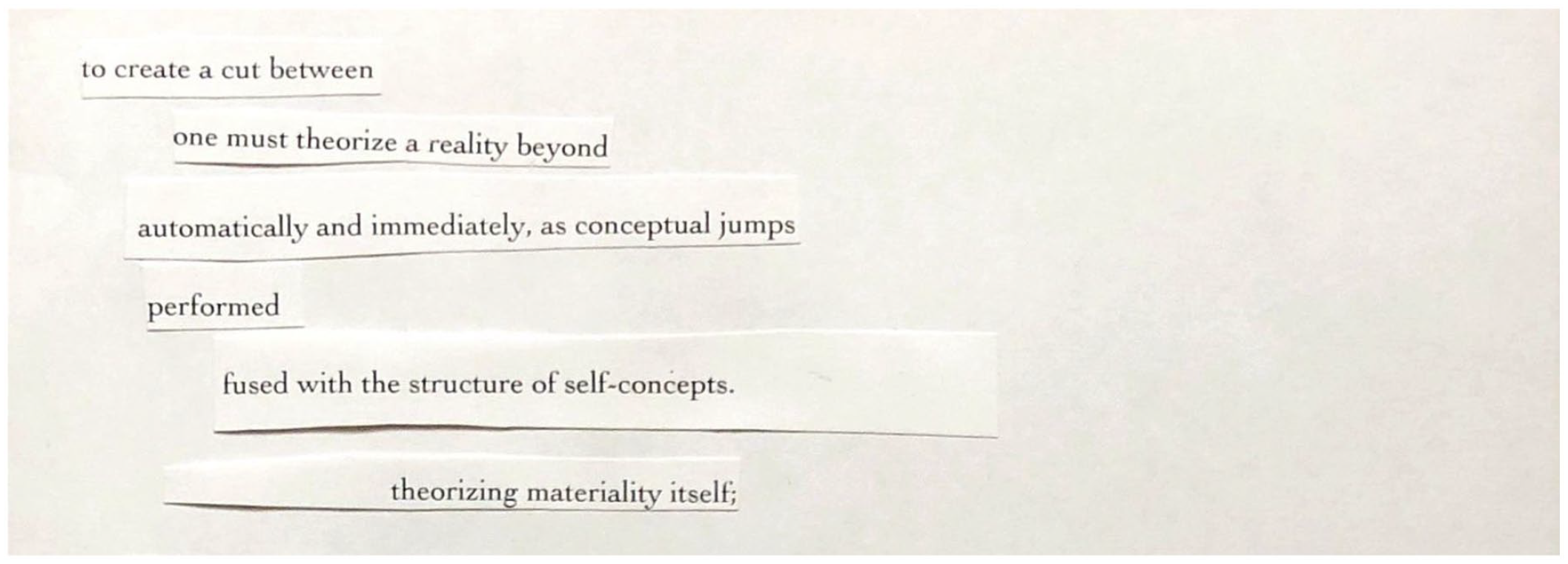
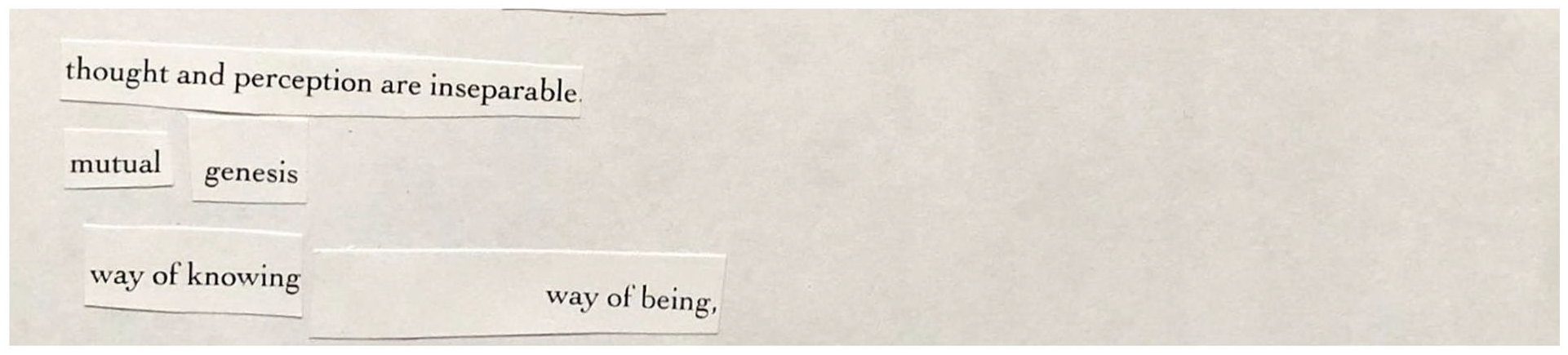
Mathematical thought and perception are inseparable. To separate mathematics from seeing the world is a futile enterprise. To understand an object as an object is to create a cut between the object and the world, 6 to theorize continuous duration 7 and a singular iteration despite different perspectives. To understand the persistence of an object, one must theorize a reality beyond the immediate—one must abstract and re-apply. These mathematical processes are so core to our understanding of the world that they go without notice, performed automatically and immediately, as conceptual jumps by which we see our world. “There is no such thing as a pure perception of an object . . .” 8 Mathematics is a way of theorizing materiality itself; our concept of what is real is co-constructed in a mutual genesis with mathematical thought and interaction with the world. Conceptions of self and world are always already in process in (material) discursive processes that cannot be reduced to the idea of a singular self, nor an abstract mathematics that exists as concept only.
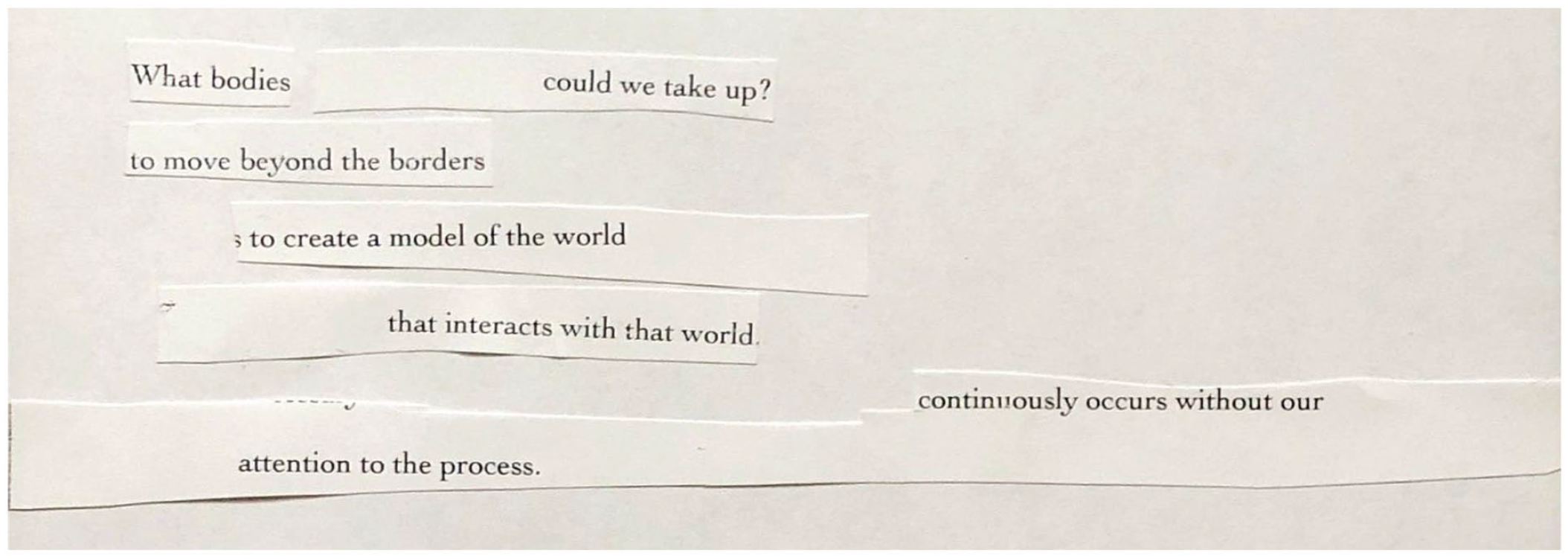
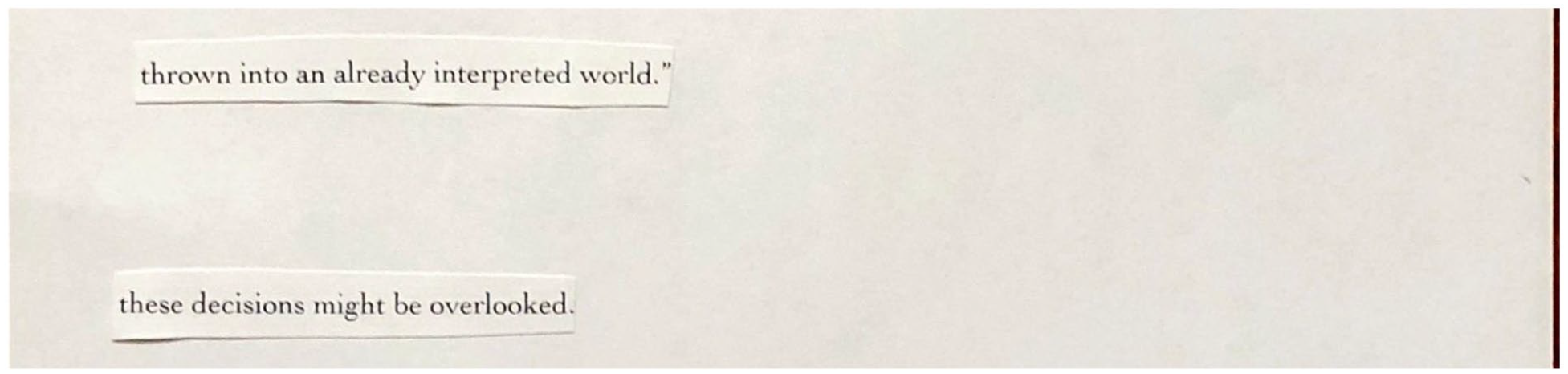
Mathematics is both a way of knowing and a way of being, an ontoepistemology. 9 “What if we consider the assemblage of child-cube-concept to be the body that emerges at that instant?” 10 “How are we knitted together in this particular body”? 11 How could we be? What bodies (assemblages) could we take up? A mutual genesis of observer and observed occurs. 12 This act of connection, of separation, of categorization, allows the perception and conception of an object (such an object can be a cube, a breeze, or a memory). Such conceptualization takes constant adjustment and maintenance 13 and need not be singular or complete. The self is a constantly changing assemblage but is not arbitrary. Children conceive of the discontinuous micro-events of various levels of conscious perception and imagination as unified under the understanding of a life, a continuous self, a continuous world—despite quite a lot of evidence to the contrary (dreams, sleep, things that happen that we cannot see). Such a concept is a life and death matter. To operate without such a concept is to move beyond the borders of sanity. Consciousness is dependent on an abstract theory of the world. Such abstraction is mathematics. 14 (We need not look to radical philosophers for such a definition. Even the Common Core practice standards state that to reason abstractly is to create a model of the world that interacts with that world.) And thus mathematics exists beyond the human species and mind, because humans are hardly the only ones with such models of the world, but more broadly because these abstractions interact with the world to recreate it. The interaction is ongoing, co-constructive, involved. 15 “Huhs” are “moments in which what is immediately conscious can’t be fitted with established and embodied associations.” 16 A “huh” moment is when children recognize that a re-theorizing of self and world is necessary. But the modification of self and world also continuously occurs without our attention to the process.
Mathematics is made of questions. These questions motivate our life. We look in amazement. We find structures all around us. We create new structures. Mathematics is fundamentally open, in process, partial, fragmented. It must be so in order as it is part of a world that is so. It is one way in which we can welcome this world with open arms. It probes. 17


This may sound surprising, since school mathematics is conceived as a discipline separate from language. But the act of categorization necessary to name an object is a mathematical process. Mathematics is a way to conceive and create new objects as real. Far from opposition to language and poetry, mathematics exists simultaneously with them, unified with them at their base. 18 What happens when new objects, concepts, and procedures are brought forward? Mathematics as not just modeling but enactment means that our conceptions matter because we are continually remaking this world.
Holding a cube is not separate from a social act. Mathematics does not exist separate from the larger contexts of society. Mathematics itself is both a product and producer of social force. It is not just the application of mathematics that is political, 19 but also mathematics knowledge itself. 20 Mathematics, society, resources, tools, and more combine to create, for instance, a two-inch wooden cube given to an infant. 21 The cube held in the baby’s hand is itself a product of sculpting a world into a concept and a concept into a world. 22 The tree is chopped, cut, dried, planed, and sanded into a cube as the cube concept emerges into the wood. We should not pre-suppose that the cube and tree approach each other from separate trajectories, from a real and an abstract. To do so is to pre-determine the creations/concepts that emerge. The forms occur as the cut is made, and these forms double back onto the cutting. 23 None of which is entirely in our control. Froebel’s gifts gave infants and toddlers spheres, cubes, and subdivisions of platonic solids by which a child comes to understand and classify her world. “We are biological and social creature who at birth are thrown into an already interpreted world.” 24 The cube does not exist solely as an object in the infant’s hands, nor does it exist solely as a concept in the infant’s mind. The cube spans between individual and collective hands and minds, between generations, between cultures. And yet the cube is also individually iterated as this cube.
By conceiving mathematics as ways of knowing and being 25 rather than a collection of things to be known. 26 A theory of mathematics as already embodied implies that all of us are already abstract thinkers. We make conceptual leaps in our daily life that co-construct the realities in which we live, like when we imagine the backside of an object we cannot see. Mathematical thinking and abstraction is not exterior to the self, world or daily life. It is integral to our perception. It is essential to our experience. 27 It isn’t really possible to be bad at math because it isn’t possible to not use math. We are all, already mathematical beings.
Footnotes
Declaration of Conflicting Interests
The author(s) declared no potential conflicts of interest with respect to the research, authorship, and/or publication of this article.
Funding
The author(s) received no financial support for the research, authorship, and/or publication of this article.
