




Abstract
This study examined the effects of male attractiveness, sexual attitudes, and victimization history on women’s ratings of sexual risk. Women with more liberal sexual attitudes rated vignettes as less sexually risky than women with more conservative sexual attitudes. There was an interaction between situational risk and attractiveness, suggesting the relationship between attractiveness and sexual risk ratings varies across high and low situational risk. Findings emphasize the importance of using high and low risk situations to evaluate sexual risk perception and of investigating variables that may moderate women’s risk perception.
Research has continually demonstrated that sexual assault is a prevalent problem among college-age women. In a landmark study, Koss, Gidycz, and Wisniewski (1987) found that 54% of women had experienced some form of sexual victimization since the age of 14, including 15% who reported an experience that met the legal definition of rape and 12% who reported an experience of attempted rape. Recent research continues to report an alarmingly high rate of victimization, with 20% to 25% of college women experiencing attempted or completed rape during their college years (Fisher & Cullen, 2000), and one in six women in the United States being raped in their lifetime (Tjaden & Thoennes, 2006).
In an attempt to better understand the mechanisms underlying sexual victimization and revictimization, research has placed increasing emphasis on women’s perceptions of potentially sexually coercive situations (Cartar, Hicks, & Slane, 1996; Gidycz, McNamara, & Edwards, 2006). Several researchers have hypothesized that women’s perceptions of risk may affect their risk of being sexually victimized. Specifically, it has been suggested that women who perceive less risk in certain situations may be at increased risk for sexual victimization (e.g., Gidycz et al., 2007; Marx & Gross, 1995; Norris, Nurius, & Dimeoff, 1996; VanZile-Tamsen, Testa, & Livingston, 2005). This emphasis on women’s judgments of risk is not meant to suggest that women are responsible for sexual victimization; that is, men are ultimately responsible for their coercive behavior. However, because attempts to reduce men’s coercive behavior thus far have been unsuccessful (Anderson & Whiston, 2005), researchers might benefit from investigating, in concert, men’s coercive behavior and factors that place women at risk for victimization to best protect women from harm.
There are several limitations to the extant literature on women’s risk perception, however. First, though the impact of sexual victimization history on risk perception has been studied frequently (see Gidycz et al., 2006, for a comprehensive review), few studies have examined variables other than victimization history that also may moderate women’s risk perception. Potential moderators include women’s sexual attitudes and beliefs, which have been shown to be related to victimization risk perception (Yeater, Viken, Hoyt, & Dolan, 2009; Yeater, Viken, McFall, & Wagner, 2006), and physical attractiveness (Agocha & Cooper, 1999; Cartar et al., 1996). A more thorough investigation of such moderators may more fully illuminate the factors that affect women’s risk perception.
Second, the majority of these studies have used vignettes that depict only high-risk situations to evaluate women’s risk perception (Gidycz et al., 2006). Gidycz et al. (2006) called for the use of low-risk situations in sexual risk perception studies to examine whether women at risk for sexual victimization evidence similar responses to low- and high-risk situations. This approach, also called “stimulus sampling,” has been used in social psychology research (Wells & Windschitl, 1999). Stimulus sampling is the utilization of a variety of stimuli that vary on a construct of interest, a method necessary when variations in that construct are thought to affect the dependent variable.
Physical Attractiveness
One variable that has yet to be examined in relation to women’s risk perception is male attractiveness. Extensive research has examined physical attractiveness of both men and women and the physical attractiveness stereotype (PAS; see Langlois et al., 2000, for a review). Findings from these studies indicate that attractive people in general are seen as more socially desirable, happier, and sexually warmer than unattractive people (e.g., Dion, Bersheid, & Walster, 1972; Feingold, 1992; Langlois et al., 2000). While the PAS is pervasive, it is evident that in many cases, attractive people do not actually have many of the traits ascribed to them (Feingold, 1992). If people use physical attractiveness as a cue to make inferences about personality traits that are false, it is possible that the physical attractiveness stereotype may lead to inferences that prevent accurate assessment of risk in social or dating situations. This appears to be the case in certain situations.
When asked which attributes are most important in determining the overall attractiveness of a romantic partner, both men and women overwhelmingly indicated that it was important to know about physical appearance. The agreement on the importance of this trait was stronger than any other trait (Fishbein, Hennessy, Yzer, & Curtis, 2004). For instance, when one is attracted to a romantic partner, they are less likely to see that partner as a health risk (e.g., likely to have a sexually transmitted disease; Hennessy, Fishbein, Curtis, & Barrett, 2007). In addition, when men and women were given information about both the physical attractiveness and the sexual history of a potential romantic partner, they weighed physical attractiveness more heavily than sexual history when judging how desirable a partner was and how likely they were to have sex with that partner (Agocha & Cooper, 1999). Thus physical attractiveness was a more salient cue than sexual history when deciding whether to engage in potentially risky future sexual behavior (Agocha & Cooper, 1999).
This overreliance on physical attractiveness also is evident when women are asked to evaluate the coerciveness of a man’s behavior. In one study, women were presented with vignettes asking them to imagine themselves in situations involving varying levels of sexual coercion with men who were either described as unattractive or very attractive (Cartar et al., 1996). While situations high in sexual coercion were seen as coercive regardless of the attractiveness of the man involved, situations medium and low in sexual coercion were seen as more flattering when the man was attractive than when the man was unattractive.
This research indicates that attractiveness is a powerful cue leading to several inferences. Many of those inferences are made in the presence of more concrete contradictory information, even when that information may indicate the potential for risk. Given that the physical attractiveness stereotype affects inferences even in potentially risky situations, it is reasonable to hypothesize that physical attractiveness of men may influence women’s risk perception for social situations in which there is a risk for sexual victimization.
Sexual Attitudes and Beliefs
An additional variable that may influence women’s perception of sexual victimization risk is their sexual attitudes and beliefs. Though this variable has not been thoroughly examined in the context of risk perception, some preliminary research suggests it may moderate women’s risk judgments. Previous research examining risk perception and attitudes found that high-sensation seeking participants identified less risk and were less fearful when imagining several types of risk, including sexual risk (Gerrard, Gibbons, Benthin, & Hessling, 1996). There is also evidence that participants who endorse more permissive sexual attitudes and beliefs are more likely to engage in sexually risky behavior (Seal & Agostinelli, 1994). Research examining the relationship between sexual attitudes and judgments of sexual victimization risk also has found that men and women with more liberal sexual attitudes and beliefs estimate risk to be lower in dating and social situations relative to men and women with more conservative sexual attitudes and beliefs (Yeater et al., 2006, 2009). Overall, these findings suggest that sexual attitudes and beliefs may influence women’s perceptions of victimization risk in dating and social situations.
Victimization History
Of course, the moderator most frequently investigated in the risk perception literature is sexual victimization history (for a comprehensive review, see Gidycz et al., 2006). Research suggests that once a woman has been victimized, her chances of being revictimized increase dramatically (Gidycz, Coble, Latham, & Layman, 1993; Gidycz, Hanson, & Layman, 1995; Messman-Moore & Long, 2003). In fact, women with a history of sexual assault are twice as likely to be raped in the future as women without a history of sexual assault (Gidycz et al., 1993). Several researchers have suggested that victimization history may be related to women’s perception of risk in dating and social situations. Thus far, findings have generally been mixed; with some studies finding a relationship between risk perception and sexual victimization (e.g., Marx & Gross, 1995; Soler-Baillo, Marx, & Sloan, 2005; Wilson, Calhoun, & Bernat, 1999), and other studies suggesting that the two are unrelated (e.g., Breitenbecher, 1999; Yeater et al., 2006). For instance, when women were asked to say when a man has gone too far in an audiotape of a dating situation (Marx & Gross, 1995), victimized and revictimized women took longer to respond, leading some researchers to conclude that victimized women may demonstrate impaired risk perception (Soler-Baillo et al., 2005; Wilson et al., 1999).
Several other studies have found no differences in risk perception between victimized and nonvictimized women, however (Meadows, Jaycox, Orsillo, & Foa, 1997; Messman-Moore & Brown, 2006; VanZile-Tamsen, et al., 2005). Breitenbecher (1999) found no connection between women’s identification of risk factors in a videotaped vignette and either victimization history or sexual victimization incidents 5 months after the initial study. In addition, Yeater et al. (2006) found no differences between victimized and nonvictimized women’s risk judgments when they rated sexual victimization risk in vignettes depicting dating and social situations. Finally, Naugle (2000) found that victimized women actually rated three videotaped vignettes (each a different social situation with an ambiguous ending) as having more risk than nonvictimized women. The risk perception literature, however, has been plagued by method variance, leading to mixed findings that make it very difficult to understand what role victimization history plays in women’s risk perception.
Current Study
The goals of the present work were to evaluate whether the attractiveness of men, sexual attitudes and beliefs, and a history of sexual victimization affected women’s judgments of sexual risk. To investigate these effects, attractive and unattractive photographs of men were paired with vignettes varying in their degree of situational risk (high vs. low), and women were asked to rate the level of sexual risk depicted in each vignette. Based on previous research, we hypothesized that women would judge sexual risk to be lower for low situational risk situations with attractive men than for low situational risk situations with unattractive men and that attractiveness would not influence women’s sexual risk ratings for the high situational risk situations. We also hypothesized that women with more liberal sexual attitudes and beliefs would rate the situations as less risky than women with more conservative sexual beliefs. Due to the mixed findings in the literature regarding the relationship between victimization history and risk perception, no directional hypothesis for the effect of victimization history on women’s sexual risk judgments was made.
Method
Participants
Participants were 141 undergraduate women between the ages of 18 and 24 recruited from the psychology subject pool at a large, Midwestern university. This age group was chosen because women aged 16 to 24 have the highest victimization rates (Bureau of Justice Statistics, 1984). The mean age of the women was 19.3 (SD = .10). Eighty-six percent of the women described their ethnicity as White (n = 120), 6% as African American (n = 8), 3% as Asian (n = 4), 2% as Hispanic/Latino (n = 3), and 4% as other (n = 5). The majority of the women were single (96%, n = 135) and either freshmen (55%, n = 77) or sophomores (29%, n = 40). Because the vignettes depict situations that heterosexual or bisexual undergraduates between the ages of 18 and 24 might face when dating or interacting socially with men, one woman who reported her sexual orientation as homosexual was excluded from analyses.
Stimuli
Vignettes
In previous research (Yeater et al., 2006; Yeater, McFall, & Viken, 2011), 1 a set of written vignettes was developed that described a wide range of problem situations that undergraduate women might face when dating or interacting socially with men. The vignettes were written to be nonoverlapping and independent; consequently, they describe diverse situations (e.g., date, party, bar, school event), types of relationships with the man described (e.g., boyfriend, acquaintance, stranger), putative risk factors for sexual victimization (e.g., alcohol use, sexual activity prior to or during the date), and contextual cues signaling a possible impending assault (e.g., man making verbal threats to obtain sexual activity, touching the woman without her consent, attempting to isolate the woman socially, attempting to get the woman intoxicated). The vignettes also were written to depict varying levels of risk for having an unwanted sexual experience. Thus some vignettes describe situations in which the possibility of sexual involvement with the man is imminent, requiring some immediate action by the woman to decrease any risk of an unwanted sexual experience. Other items describe situations in which the possibility of sexual involvement with the man is more remote, thus allowing the woman more time to act to decrease risk of an unwanted sexual experience in the future.
In the previous research, undergraduate women were asked to rate (a) how common they thought the situations were for college-age women (1 = uncommon, 6 = extremely common; Yeater et al., 2009), and (b) how risky the situations were in terms of the woman described having an unwanted sexual experience (1 = not risky, 5 = completely risky; Yeater et al., 2006). An unwanted experience was defined as “an experience you will feel bad about, be hurt by, or regret later.” This broad definition of unwanted sex was used instead of one that included words such as sexual coercion or assault, as research shows that women often adhere to stereotypes of rape (e.g., stranger rape) when considering risk for victimization (e.g., Gordon & Riger, 1989; Hickman & Muehlenhard, 1997). Moreover, these words were excluded to avoid participant priming (Wilson et al., 1999).
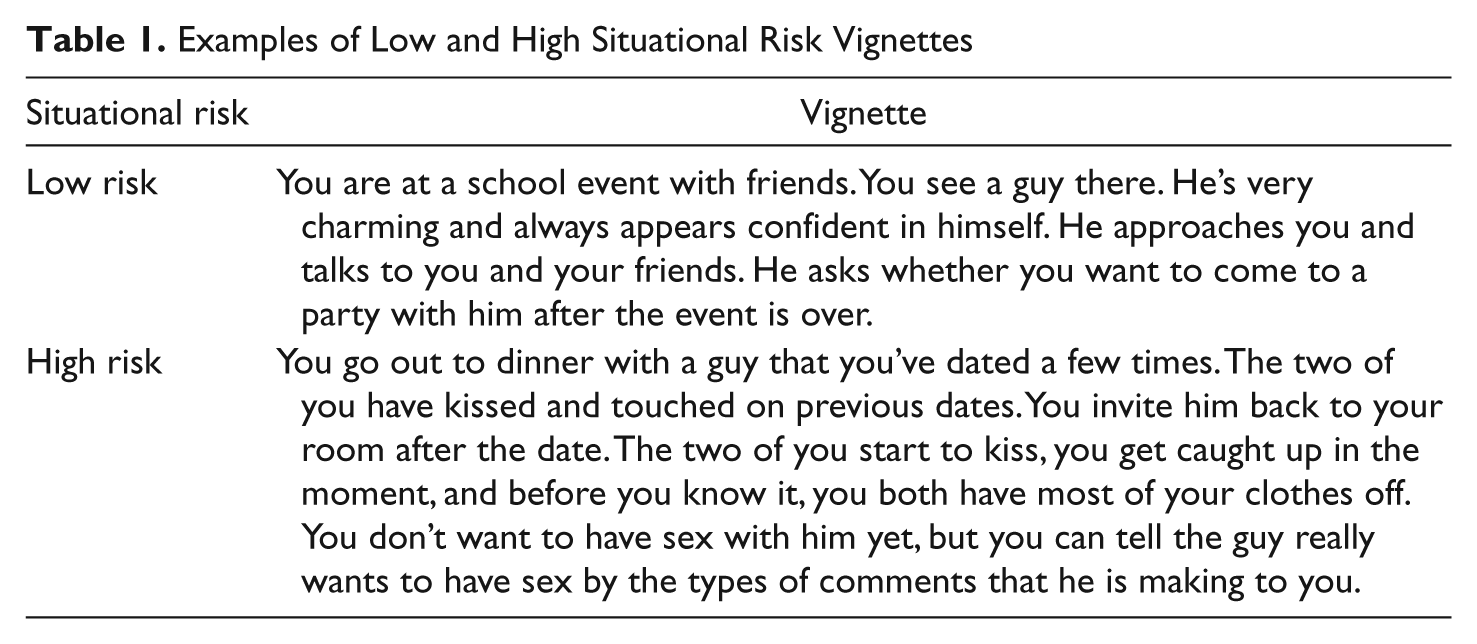
To select the vignettes for use in the current study, they first were plotted to determine visually which vignettes were above the mean on the common dimension, as more common situations were expected to be more relevant to women’s real life experiences. The more common vignettes then were divided into high situational risk situations and low situational risk situations using a median split of the risk ratings. Thus a set of 20 unique vignettes was used in the current study, 10 that were low situational risk (risk ratings from 1.8 to 3.1), and 10 that were high situational risk (risk ratings from 3.3 to 4.4). An example of a low situational risk and a high situational risk vignette are provided in Table 1.
Examples of Low and High Situational Risk Vignettes
Photographs
The photographs used in the current study were gathered from a larger set rated for attractiveness by a separate sample of undergraduate women recruited from the psychology subject pool at a large, Southwestern university. The women were asked to rate how attractive each man was using a Likert-type scale (1 = very unattractive, 2 = somewhat unattractive, 3 = neutral, 4 = somewhat attractive, 5 = very attractive). The women were instructed to remain silent while rating the photographs to eliminate influencing the ratings of others. The 10 most attractive and 10 least attractive photographs were chosen for the current study. In the attractive group, 70% of the men described their ethnicity as White (n = 7), 20% as Hispanic/Latino (n = 2), and 10% as other (n = 1). In the unattractive group, 50% of the men described their ethnicity as White (n = 5), 20% as Hispanic/Latino (n = 2), 10% as Asian (n = 1), 10% as Native American (n = 1), and 10% as other (n = 1). Chi-square analyses revealed no significant differences in the ethnicity of the attractive and unattractive men (p = .675).
The 20 vignettes were divided into a High Risk block with 10 vignettes and a Low Risk block with 10 vignettes based on the method described above. The 20 photographs were divided into Attractive and Unattractive blocks based on their attractiveness ratings. The Attractive block was comprised of the 10 most attractive photographs (attractiveness ratings from 3.4 to 4.4) and the Unattractive block was comprised of the 10 least attractive photographs (attractiveness ratings from 1.1 to 1.3).
The two blocks of vignettes (high and low risk) and the two blocks of photographs (attractive and unattractive) were then divided in half randomly, creating a total of eight subblocks. Each subblock had either five vignettes or five photographs. The subblocks of photos were paired with the subblocks of vignettes, creating four unique orders. The order of block pairings within each order remained constant across trials. Across the four orders, each subblock of vignettes was paired with every subblock of photographs.
Measures
Demographics Questionnaire
This self-report measure asked participants for their age, ethnic membership, and academic status.
Sexual Experiences Survey (SES)
Participants’ past incidents of sexual victimization were assessed using the SES (Koss et al., 1987). The SES is a 10-item self-report questionnaire developed to measure various degrees of severity of sexual victimization (i.e., unwanted sexual contact, sexual coercion, attempted rape, and rape) since the age of 14. The SES uses behaviorally specific definitions of sexual assault and asks participants to indicate whether the event occurred by choosing one of two dichotomous response options (i.e., no or yes). An example item from the SES includes “Have you had a man attempt sexual intercourse (get on top of you and insert his penis) when you didn’t want to by threatening or using some degree of force (twisting your arm, holding you down, etc.) but intercourse did not occur?” The SES possesses good internal consistency (α = .74) and 1-week test-retest reliability (r = .93) (Koss & Gidycz, 1985). The SES correlates .73 with responses obtained by an interviewer (Koss & Gidycz, 1985), suggesting that the SES is a reasonable measure of self-reported sexual victimization. Only victimization experiences since the age of 14 were evaluated because while childhood sexual abuse (CSA) is a very serious phenomenon, most studies that have included it as a predictor of risk perception have either found that CSA does not predict deficits in risk perception or does not provide predictive power independently of adult victimization (e.g., Breitenbecher, 1999; Messman-Moore & Brown, 2006; Naugle, 2000; VanZile-Tamsen et al., 2005; Wilson et al., 1999). For example, Vanzile-Tamsen et al. (2005) and Messman-Moore and Brown (2006) found no effect of CSA on risk perception. While Wilson et al. (1999) did find a relationship between CSA and risk perception, there were no differences between women with CSA and adult victimization and those with just adult victimization, so CSA and adult victimization were collapsed into one category.
Following the common scoring procedure for the SES, participants were assigned to a severity category based on the most severe victimization experience they reported having since the age of 14. With respect to frequency of sexual victimization, 37% of participants reported no victimization experiences (n = 52), 29% reported unwanted sexual contact (n = 41), 14% reported coercion (n = 19), 6% reported attempted rape (n = 8), and 14% reported rape (n = 20). There were no significant differences in risk perception between the victimization categories (i.e., unwanted contact, coercion, attempted rape, and rape) F(3, 83) = 1.56, p = .204); thus, for purposes of statistical analyses, participants were categorized as either victimized or nonvictimized. This type of categorization is not uncommon in the risk perception literature (e.g., Naugle, 2000; Soler-Baillo et al., 2005, Yeater et al., 2006).
Sociosexuality Scale (SS)
Participants’ willingness to engage in uncommitted sexual activity with others was assessed using an adapted version of the SS (Bailey, Kirk, Zhu, Dunne, & Martin, 2000). The SS includes 7 items from the Sociosexuality Orientation Inventory (SOI; Simpson & Gangestad, 1991), and 13 items from Eysenck’s (1976) study of the genetics of sexual behavior. Higher scores on the SS indicate greater acceptance of permissive sexual beliefs and behaviors. The full scale of the SS is correlated highly with the SOI and has alpha coefficients of .88 for men and .85 for women (Bailey et al., 2000). A factor analysis of the SS found only one factor accounting for the shared item variance. The first 15 items of the SS are given typically in yes-no response format. In the current study, a 4-point Likert-type rating scale was used for each item (1 = strongly agree, 2 = agree, 3 = disagree, 4 = strongly disagree). Scores were created by averaging participants’ responses to the items. An example item from the SS includes “Sex without love (impersonal sex) is highly unsatisfactory.” In the current study, the internal consistency of the SS was .88.
Procedure
Participants were selected from the psychology subject pool. All participants were compensated with research credits for their participation. They were told that the purpose of the study was to investigate women’s perceptions of dating and social situations. Participants were seen in groups of 2 to 6, during which they completed their questionnaires under conditions that allowed them to give their responses privately. Specifically, participants were provided with sufficient space between them and their fellow participants to ensure that their responses remained anonymous and confidential.
Groups of participants were assigned randomly to one of the four orders. They first were given a packet of written vignettes. A photograph was then projected onto a large screen for 30 s using a computer with Microsoft Powerpoint and a projector, and participants were asked to imagine themselves in the first vignette as well as to imagine that the man in the photograph was the man described in the vignette. They then were asked to rate the risk of having an unwanted sexual experience (defined as “an experience you will feel bad about, be hurt by, or regret later”) using a 5-point Likert-type scale (1 = not risky, 2 = slightly risky, 3 = moderately risky, 4 = very risky, 5 = completely risky) by circling the appropriate number given after the vignette in the packet. After participants provided their risk rating, the next photograph automatically appeared, and they repeated the task with the next vignette in the packet. Once they finished their ratings, participants completed the demographics questionnaire, the Sexual Experiences Survey, and the Sociosexuality Scale.
Data Analytic Strategy
The data were analyzed using a repeated measures General Linear Model (GLM) with two within-subjects factors, one between-subjects factor, and one continuous factor. 2 The within-subjects factors were level of situational risk (high vs. low) and attractiveness (attractive vs. unattractive), the between-subjects factor was victimization history (victimized vs. nonvictimized), and the continuous factor was sociosexuality.
Predicted effects (i.e., the interaction between risk and attractiveness and the effect of sexual attitudes and beliefs on risk ratings) were tested using directed tests, in which .04 of alpha was allotted to the predicted direction, and .01 was allotted to the unpredicted direction. Unlike one-tailed tests, directed tests do not exclude the possibility of rejecting the null hypothesis in the unpredicted direction and are appropriate alternatives to two-tailed tests when clear predictions are offered (e.g., Rice & Gaines, 1994).
Results
Each participant’s risk ratings were averaged into four different summary scores: (a) a mean sexual risk rating for the high situational risk vignettes paired with attractive photos; (b) a mean sexual risk rating for the high situational risk vignettes paired with unattractive photos; (c) a mean sexual risk rating for the low situational risk vignettes paired with attractive photos; and (d) a mean sexual risk rating for the low situational risk vignettes paired with unattractive photos. Thus every participant was assigned a mean sexual risk rating for each subblock of vignettes that they rated.
Results revealed a significant main effect of situational risk on sexual risk ratings, F(1, 137) = 126.3, p < .001, with participants rating the low situational risk vignettes as less risky (M = 2.67, SE = .071) than the high situational risk vignettes (M = 3.33, SE = .076). There was also a significant interaction between attractiveness and level of situational risk, F(1, 137) = 3.21, p = .047, indicating that the relationship between photo attractiveness and rated risk varied across high and low situational risk. Figure 1 depicts the interaction between attractiveness and situational risk.
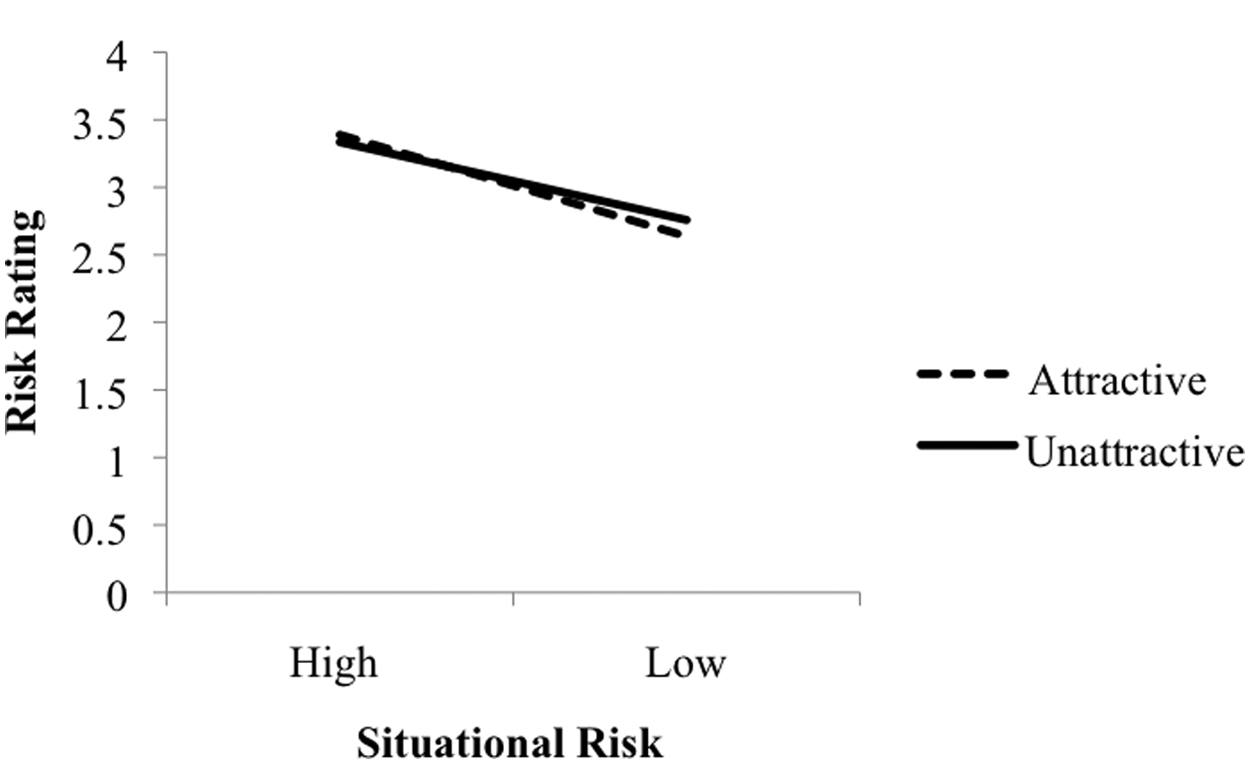
Mean risk ratings as a function of attractiveness and situational risk level
Follow-up simple effects tests revealed no significant differences between risk ratings of high situational risk vignettes with attractive men (M = 3.35, SE = .080) or high situational risk vignettes with unattractive men (M = 3.31, SE = .089), F(1, 137) = .301, p = .365. Participants rated the low situational risk vignettes with unattractive men as having more sexual risk (M = 2.74, SE = .100) than the low situational risk vignettes with attractive men (M = 2.60, SE = .066), though this simple effect also did not reach conventional levels of significance F(1, 137) = 2.38, p = .078.
There was also a main effect for sociosexuality, F(1, 137) = 3.18, p = .048, with participants reporting more liberal sexual attitudes and beliefs rating the vignettes as having less sexual risk than women with more conservative sexual attitudes and beliefs. Finally, victimized and nonvictimized women did not differ significantly in their risk ratings F(1, 137) = 2.67, p = .105.
Discussion
This study investigated several moderators of women’s risk perception, including male attractiveness, women’s sexual attitudes and beliefs, and sexual victimization history. This study was novel in that it utilized several vignettes varying in risk rather than just a few, and actual photographs of men rather than just written descriptions. Additionally, the study extends previous research by including moderators of women’s sexual risk perception that have not been widely investigated in previous work.
Findings of the current study indicate a significant interaction between male attractiveness and situational risk, suggesting that the relationship between attractiveness and sexual risk ratings varies across high and low situational risk. However, while low risk vignettes with unattractive men were rated as riskier than low risk situations with attractive men, this difference was not statistically significant. There was no difference in ratings of high-risk vignettes with either attractive or unattractive photographs.
It is possible that women attended primarily to features other than attractiveness of the man in the photograph when determining their risk of victimization. The vignettes used in the current study were designed to represent many different problem situations college-age women might encounter; thus they are diverse and contain multiple contextual cues of risk. While this increases ecological validity, it also presents a number of cues to which women may have attended in addition to male attractiveness. Future research may further examine these cues to determine which ones women weigh most heavily when appraising risk.
Our findings also suggest that women with more liberal sexual attitudes and beliefs judged risk to be lower than women with more conservative sexual attitudes and beliefs. This is consistent with previous research (Yeater et al., 2006, 2011), and suggests that women with more liberal sexual attitudes may be at increased risk for sexual victimization if, that is, their lower estimates of risk correspond to high-risk behavior. Indeed, there is evidence that risk perception strongly predicts women’s behavioral intentions, such that women who perceive more risk also say that they intend to behave with more resistance in a scenario in which a man becomes sexually aggressive. (VanZile-Tamsen et al., 2005). Women’s sexual attitudes and beliefs have not been extensively studied in the sexual risk perception literature, and these findings emphasize the importance of expanding the focus beyond victimization history when investigating individual differences in women’s risk perception.
Finally, we found no differences between victimized and nonvictimized women in risk perception. The lack of a significant effect for victimization history in the current study was not due to insufficient power, as there was a power of .81 to detect differences as modest as d′ = .50. Thus, if there are differences between these two groups in this population, they are likely to be quite small, at least, that is, when using this set of vignettes to measure women’s sexual risk appraisal. These findings are consistent with some previous research, which suggests that victimized women do not differ from nonvictimized women in their risk judgments (Breitenbecher, 1999; Meadows et al., 1997; Messman-Moore & Brown, 2006; VanZile-Tamsen et al., 2005; Yeater et al., 2006, 2009).
One strength of the study is the use of both high and low risk vignettes, as opposed to a few high risk vignettes, which allows researchers to evaluate women’s risk perception across a variety of dating and social situations varying in risk (Gidycz et al., 2006). The results of this study indicate that women do appraise risk in low and high risk situations differently, suggesting that the use of vignettes varying in risk is important in more fully understanding women’s perceptions of dating and social situations. The use of vignettes varying in risk may be valuable in future research, as there was an interaction between attractiveness and situational risk in the current findings. Low and moderate risk situations may be particularly important to investigate, as situations that culminate in a sexual assault often appear innocuous initially.
Another strength of the study is the use of actual photographs rather than asking women to imagine the attractiveness of the man in the situation, which may increase the ecological validity of the study. Finally, this study expands on previous research by investigating the effects of attractiveness and sexual attitudes and beliefs on women’s sexual risk judgments. While there has been some previous evidence that more liberal sexual attitudes and beliefs predict lower risk ratings (Yeater et al., 2006, 2009), this moderator has yet to be widely investigated, and future research is needed to more fully elucidate the relationship between sexual attitudes and beliefs and risk perception.
However, there are some limitations of this study. The sample of women is primarily White, preventing the extension of these findings to minority women. Future research is needed to determine whether these findings also are evident among ethnic minority women. Future research may also benefit from the use of moderate risk vignettes to further investigate the role of attractiveness in women’s risk judgments. Additionally, while college women are at high risk of sexual victimization (Fisher & Cullen, 2000), the findings from this study may not generalize to other women who are at risk for sexual victimization.
The findings of this study may have implications for sexual assault prevention. It may be beneficial for programs to identify and target women’s sexual attitudes and beliefs. This could be particularly important because recent research suggests that women with more liberal sexual attitudes respond less effectively to high-risk dating and social situations (Nason & Yeater, 2010). It is important, however, to acknowledge that women are not to blame for victimization. Targeting sexual attitudes may simply provide one additional avenue of intervention to help protect women from harm.
More broadly, prevention efforts may be made more effective by discussing novel factors that may influence women’s risk perception, such as the attractiveness of the man in the situation. Women may perceive attractive men as safer or determine that the risks of a situation with an attractive man are outweighed by the benefits. If this is the case, prevention efforts may benefit from addressing this issue with women. Ultimately, research must continue to focus on the processes underlying sexual victimization as well as variables moderating these processes to better inform prevention efforts. Once these processes are identified, prevention programs may more effectively aid in protecting women from sexual victimization.
Footnotes
The authors declared no potential conflicts of interest with respect to the research, authorship, and/or publication of this article.
The authors received no financial support for the research, authorship, and/or publication of this article.
Notes
Bios
References
Supplementary Material
Please find the following supplemental material available below.
For Open Access articles published under a Creative Commons License, all supplemental material carries the same license as the article it is associated with.
For non-Open Access articles published, all supplemental material carries a non-exclusive license, and permission requests for re-use of supplemental material or any part of supplemental material shall be sent directly to the copyright owner as specified in the copyright notice associated with the article.
