



Abstract
The purpose of this article is to explore whether gender-blind sexism, as an extension of Bonilla-Silva’s racialized social system theory, is an appropriate theoretical framework for understanding the creation and continued prevalence of rape myth acceptance. Specifically, we hypothesize that individuals who hold attitudes consistent with the frames of gender-blind sexism are more likely to accept common rape myths. Data for this article come from an online survey administered to the entire undergraduate student body at a large Midwestern institution (N = 1,401). Regression analysis showed strong support for the effects of gender-blind sexism on rape myth acceptance.
In a 2007 U.S. Department of Justice study, Krebs, Lindquist, Warner, Fisher, and Martin (2007) found as many as one in five undergraduate women experience an attempted or completed sexual assault during their college years. The high rates of victimization found among college women highlights a number of enduring gender inequalities that persist in higher education. These include restrictions of movement for women (Fisher & Sloan, 2003; Sheffield, 2007; Warr, 1985), the stigmatization of rape and sexual assault survivors (Ahrens, Campbell, Ternier-Thames, Wasco, & Sefl, 2007; McMahon, 2007, 2010), and the lack of institutional supports for women who seek justice (N. Anderson, 2014; Kramer, 1994; Pérez-Peña & Taylor, 2014; Sanday, 2007).
We argue that a pervasive gender-blind ideology that serves to explain/justify women’s subordination underlies these inequalities. Furthermore, we believe this ideology is best understood not as the consequence of sexist attitudes on the part of prejudiced individuals, but as both the reflection of a patriarchal social system conducive to rape and sexual assault and the “organizational map” (Bonilla-Silva, 1997) that guides how individuals act toward gender and gender inequality within that system. The purpose of this article is to explore whether gender-blind sexism, as an extension of Bonilla-Silva’s racialized social system theory, is an appropriate theoretical framework for understanding the creation and continued prevalence of rape myth acceptance (RMA).
Racialized Social System Theory: Beyond the “Prejudice Problematic”
In 1997, Bonilla-Silva called for a structural interpretation of racism to address what he saw as important limitations in the “idealist” view of racism that prevailed at the time. He argued this view confined the study of racism to the field of social psychology by reducing it to an individual-level phenomenon rooted in psychological dispositions. With its emphasis on structure, racialized social system theory diverges from social-psychological studies of racism that have historically focused on the “prejudice problematic” (Wetherell & Potter, 1992): identifying the nature and extent of prejudice to develop prejudice reduction interventions (see also Dixon & Levine, 2012).
In contrast to the dominant view at the time that racism was best defined as a set of beliefs held by individuals who could potentially lead to prejudice and discrimination, Bonilla-Silva (1997) argued,
Although “racism” has a definite ideological component, reducing racial phenomena to ideas limits the possibility of understanding how it shapes a race’s life chances. Rather than viewing racism as an all-powerful ideology that explains all racial phenomena in a society, I use the term racism only to describe the racial ideology of a racialized social system. That is, racism is only part of a larger racial system. (p. 467)
Bonilla-Silva’s racialized social system theory posits that after a society is racialized, a set of social relations and practices develops at all levels of society based on racial distinctions. Taken together, these relations and practices constitute the racial structure of a society. Out of this racial structure, a racial ideology evolves. However, as Bonilla-Silva points out, this ideology is not simply a reflection of the racialized system. Instead, it “becomes the organizational map that guides actions of racial actors in society. It becomes as real as the racial relations it organizes” (p. 474). In subsequent works, Bonilla-Silva (2001, 2003) referred to the ideology of color-blind racism as the “new racism” in the post–Civil Rights era.
According to Bonilla-Silva (2006), “The central component of any dominant racial ideology is its frames or set paths for interpreting information” (p. 26, emphasis in original). Color-blind racism manifests in four frames used predominantly by Whites to interpret information about race: abstract liberalism, naturalization, cultural racism, and minimization of racism. Abstract liberalism relies on the basic principles of political and economic liberalism to explain racial matters: for example, the justification of Whites’ opposition to forced integration based on the liberal belief that all individuals should have a “choice” of where they want to live. The naturalization frame explains racial phenomena in terms of natural occurrences. For instance, the choice to date only partners of the same race is rationalized not as racism but the belief that people are “naturally” attracted to others of the same race. Cultural racism relies on culturally based arguments to explain racial inequality such as the belief that Black children perform poorly in school because “Black culture” does not value education. Finally, minimization of racism is based on the notion that discrimination is no longer a major determinate of life chances for racial minorities; therefore, what appear to be racialized outcomes can be explained away by factors other than racism.
Like color-blind racism in the post–Civil Rights era, contemporary gender-blind sexism operates in a political climate in which blatant sexism is supposedly rejected, yet sexist ideologies, policies, and practices continue. This “modern sexism” (Benokraitis & Feagin, 1986) is predicated on the assumption that because society is now “post-gender,” what sexism remains resides only in individual acts of prejudice or discrimination on the part of sexist persons who are out of touch with mainstream beliefs about gender. In other words, individuals can be sexist, but not social systems or policies. Following the theoretical model of gender-blind sexism originated in the work of Stoll (2013), we suggest that within the present “post-gender” era of assumed social equality, individuals generally interpret information about gender, much like race, through the frames of abstract liberalism, naturalization, cultural sexism, and the minimization of sexism.
The Frames of Gender-Blind Sexism
At the most fundamental level, abstract liberalism asserts that no demographic group should be singled out for special treatment; instead, every American should have access to equal opportunities or have autonomous choice in matters of residence or access to resources (Bonilla-Silva, 2006). When it comes to race, Whites tend to use abstract liberalism to explain their opposition to policies, such as affirmative action, intended to address racial inequalities, if in fact such policies are viewed as “privileging” certain (non-White) groups over other (White) groups. When it comes to gender, individuals can rely on abstract liberalism to reject policies such as the Lilly Ledbetter Act or the Violence Against Women Act, if such initiatives are seen as benefitting, or impinging on the rights of, one particular gender over another. Like racial equality, gender equality is assumed to be a zero-sum game.
From a naturalization perspective (Bonilla-Silva, 2006), segregation is not the result of racism but “biological” or “natural” phenomena; the reason that individuals tend to self-segregate is not because they are socialized to identify primarily with their racial group but because “like attracts like.” Obviously, there is also widespread appeal for using this same logic when it comes to gender, although in the case of gender (as opposed to race presently), there tends to be far less stigma for privileging biological explanations of social differences. The common wisdom is that although socialization may account for some differences between boys and girls, they are essentially hardwired differently (e.g., Sax, 2005; Stoll, 2013).
Just as cultural racism relies on culturally based arguments to explain racial differences, cultural sexism relies on culturally based arguments to explain gender differences. The same logic used to buttress claims about gender and sexism using the naturalization framework is still present, but unlike naturalization, which views these differences as the outgrowth of organic or biological processes, cultural sexism views differences as the result of social processes that distinguish certain types of men and women. Within this frame, deviation from traditional gender role socialization based on hegemonic masculinity, emphasized femininity, and homophobia (Connell, 1987) is generally called on to justify the unequal station of boys and girls and women and men in the larger society, as well as the unequal station of those who are straight and those who are gay, lesbian, bisexual, transgender, or otherwise gender or sexual non-conforming.
Finally, minimization of racism seeks to explain away current racial disparities, if they are acknowledged at all, as the result of factors that have nothing to do with racial discrimination. According to Bonilla-Silva (2006), minimization of racism is evident in statements such as “It’s better now than in the past,” or “There is discrimination, but there are plenty of jobs out there” (p. 29). Similarly, minimization of sexism uses the same logic when it comes to gender: Gender inequality either does not exist anymore or, if it does exist, it is due to reasons other than institutional sexism. For example, the reason that women are more likely to major in psychology as opposed to engineering is not because women are tracked out of engineering fields or because women who enter them tend to be marginalized (Bobbitt-Zeher, 2007; Colander & Holmes, 2007); it is because women are just not as good as men at math and science. Note that, much like with race, individuals often rely on any combination of gender-blind frames to explain why this is the case: (a) Women and men have the same educational opportunities today, women simply do not choose to go into male-dominated fields (abstract liberalism); (b) women, unlike men, do not have the spatial skills required to go into math and science fields (naturalization); and/or (c) women prefer fields such as psychology as opposed to engineering because they are more interested in building relationships than building cities (cultural sexism).
Taken together, the frames of color-blind racism and gender-blind sexism reflect commonsense notions about race and gender that are used to justify and explain contemporary racial and gender inequality (Bonilla-Silva, 2006; Stoll, 2013). The common frames, styles, and stories that comprise these ideologies operate like “cul-de-sacs,” according to Bonilla-Silva, because once people filter information through them, they explain racial (and gender) phenomena following a predictable route (p. 26). In this way, color-blind racism both reflects and perpetuates a racialized social system. In the same fashion, gender-blind sexism reflects and perpetuates a patriarchal social system. For example, with regard to sexual assault, the commonsense notions we rely on to make sense of (and rationalize) women’s victimization are often referred to as rape myths.
Previous Research on RMA
According to Lonsway and Fitzgerald (1994), rape myths are “attitudes and beliefs that are generally false but are widely and persistently held, and that serve to deny and justify male sexual aggression against women” (p. 134, emphasis in original). Over the years, researchers have uncovered a number of important findings related to RMA including the ability of persons to endorse rape myths while acknowledging the negative effects of rape (Buddie & Miller, 2001). In fact, RMA has been documented among persons who work in occupations that are supposed to support rape and sexual assault survivors, including counselor trainees (Kassing & Prieto, 2003), police officers (Page, 2010), and clergy (Sheldon & Parent, 2002). Furthermore, Basow and Minieri (2011) found RMA to be the strongest predictor of how participants perceived rape, including to whom they assigned blame, and whether or not sex was warranted based on the circumstances of an encounter. Similarly, Eyssel and Bohner (2011) found that the higher the RMA of participants, the more likely they were to believe that men accused of rape were not guilty. McMahon’s (2010) research suggests that college students who support rape myths are less likely to intervene as bystanders in potentially threatening situations. In addition, RMA can prevent women from defining unwanted sexual encounters as rape; in Peterson and Muehlenhard’s (2004) study, several women rejected this label although their experiences were well within the defined parameters of sexual assault:
Participants who believed that women who are sexually teasing deserve to be raped and who viewed their own behavior as sexually teasing were less likely than other participants to label their experiences as rape. Similarly, participants who believed that it is not really rape if a woman does not fight back and who did not fight back were less likely than other participants to label their experience as rape. . . . When asked about how they labeled their experience, several participants explicitly rejected the label rape because there was no penile penetration. (p. 140, emphasis in original)
Finally, RMA has been correlated with traditional notions of masculinity and femininity (Kassing & Prieto, 2003; see also Chapleau, Oswald, & Russell, 2008; White & Robinson Kurpius, 2002), homophobia (Kassing, Beesley, & Frey, 2005), and a higher proclivity to rape (Chiroro, Bohner, Tendayi Viki, & Jarvis, 2004).
Although an impressive body of literature exists documenting the nature and extent of RMA (see, for reviews, Edwards, Turchik, Dardis, Reynolds, & Gidycz, 2011; Iconis, 2008), very little of this research has sought to develop a theoretical understanding of its prevalence. This is despite Lonsway and Fitzgerald’s (1994) call for scholars to “move beyond the simple documentation of empirical relationships to the thoughtful examination of the etiology and role of rape myths in an articulated theory of culturally supported sexual aggression” (p. 159; see also Chapleau et al., 2008). For example, although research has consistently shown that men have higher levels of RMA than women (e.g., Aosved & Long, 2006; Devdas & Rubin, 2007; Franiuk, Seefelt, & Vandello, 2008; Iconis, 2008; Kassing & Prieto, 2003; McMahon, 2010; Yamawaki & Tschanz, 2005), little scholarly attention has been paid to structural reasons that underpin this finding (for two important exceptions, see Kahlor & Eastin, 2011; Suarez & Gadalla, 2010) beyond feminists’ claims that rape myths are more prevalent in male-dominant societies, which perpetuate a culture of violence (e.g., Yodanis, 2004).
Previous research (including some of the aforementioned studies) has found statistically significant relationships between RMA and ambivalent sexism (Glick & Fiske, 1996), modern sexism (Swim, Aikin, Hall, & Hunter, 1995), and neosexism (Tougas, Brown, Beaton, & Joly, 1995). These studies have been important to our understanding of contemporary sexism, but it is our evaluation that a deeper understanding can be gained by combining the individual strengths of these scales into one that aligns itself with the frames of gender-blind sexism. Gender-blind sexism situates ideologies about gender and gender inequality not as “free-floating” (Bonilla-Silva, 1997, p. 469), but as structurally contingent (Lorber, 1994; Risman, 1998). We believe our formulation offers a holistic view of the ways that sexism operates in a post-gender society. The Ambivalent Sexism Inventory, Modern Sexism Scale, and Neosexism Scale were developed to identify particular types of sexism. However, the frames of gender-blind sexism allow for the possibility of several variations of contemporary sexism in a “post-gender” society, whether benevolent, hostile, or other. This is because the goal of adopting a gender-blind sexism framework is to explain how these various types of prejudices are used interchangeably to reproduce the status quo.
Although we believe gender-blind sexism holds much theoretical promise, the purpose of this article is to examine this supposition. To do so, we explore whether gender-blind sexism is an appropriate theoretical framework for understanding the creation and continued prevalence of RMA. Specifically, we hypothesize that individuals who hold attitudes consistent with the frames of gender-blind sexism are more likely to accept rape myths. We test this hypothesis by exploring the relationship between our Gender-Blind Sexism Inventory and RMA.
Method
Sample
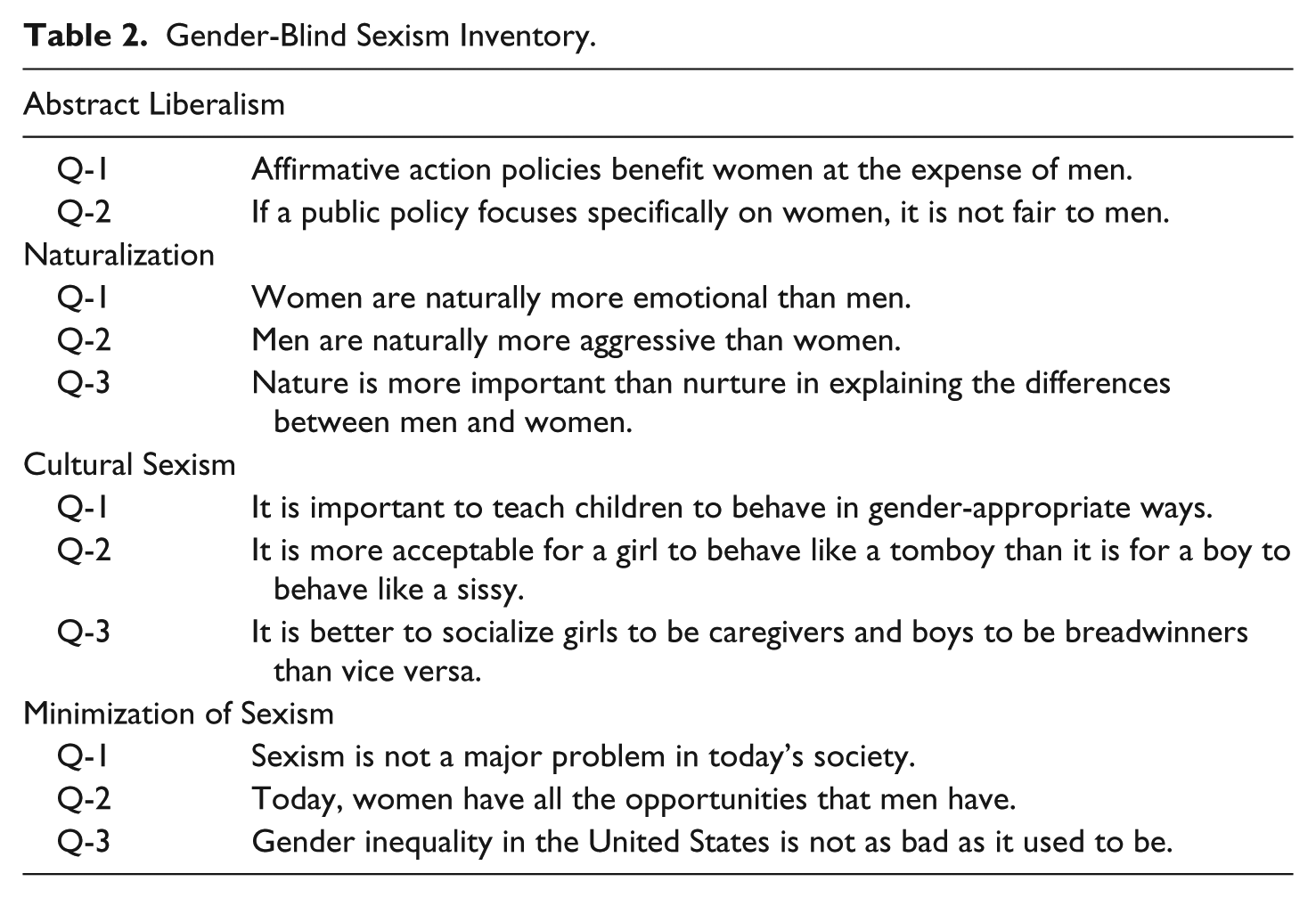
To test the relationship between gender-blind sexism and RMA, the entire undergraduate population at Midwestern University (a pseudonym) was invited to complete an online survey. The survey contained a number of items that were taken or adapted from the Illinois Rape Myth Acceptance Scale (IRMA; Payne, Lonsway, & Fitzgerald, 1999) and/or developed based on the suggestions of other scholars (e.g., Remick, 1993; Sivakumaran, 2005; see Table 1). For example, research has found RMA is correlated with systems of inequality other than sexism, including racism, classism, and heterosexism (Suarez & Gadalla, 2010). Therefore, we created a number of items to capture rape myths related to race, class, gender, and sexuality, distinguishing our measure of RMA from other commonly used instruments, including the IRMA. In addition, several gender-blind statements were constructed (Table 2) that reflected the frames of abstract liberalism, naturalization, cultural sexism, and minimization of sexism. Finally, the survey contained several demographic measures.
Rape Myths.

Gender-Blind Sexism Inventory.
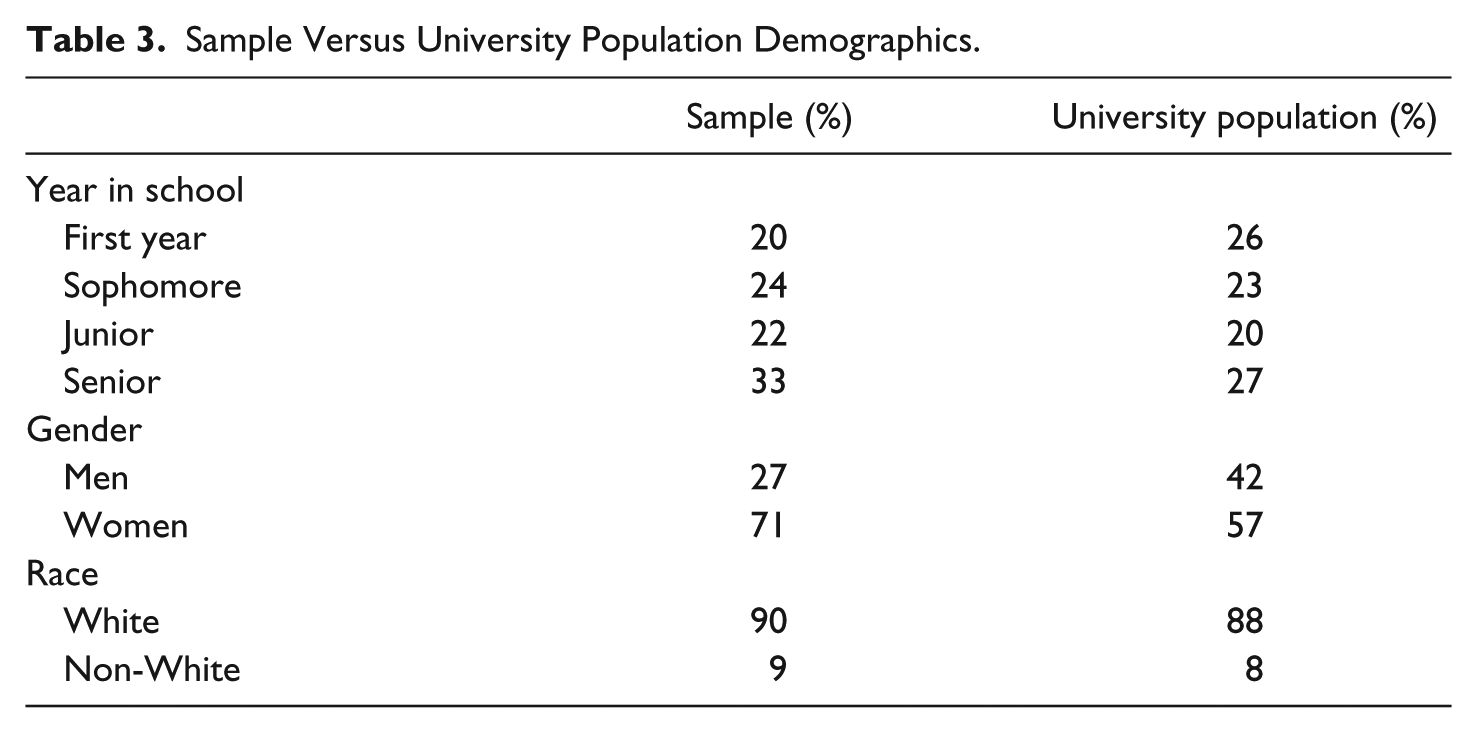
The survey remained open for students to complete for 1 month. Three, weekly email reminders regarding the survey were sent after the initial invitation in an effort to secure the best possible response rate. As a further attempt to increase our response rate, we offered potential incentives. Those who completed surveys had the option to enter an anonymous drawing for one of 30 US$10 gift certificates. The gift certificates were evenly divided between a local coffee house, restaurant, and co-operative. In the end, 1,401 surveys were completed representing a 17% response rate of the 8,187 undergraduates invited to participate. Although this was a lower response rate than we would desire, comparing our sample with the university population indicates little potential for nonresponse bias. Table 3 shows our sample characteristics relative to those of the campus, and indicates that most sample characteristics were representative of the campus population, although more women at Midwestern University completed the survey than men.
Sample Versus University Population Demographics.
Variables
Measured variable
Our Gender-Blind Sexism Inventory is based on tenets of several measures correlated with RMA. These include the Ambivalent Sexism Inventory (Glick & Fiske, 1996), the Old-Fashioned and Modern Sexism Scale (Swim et al., 1995), and the Neosexism Scale (Tougas et al., 1995). Glick and Fiske (1996) developed the Ambivalent Sexism Inventory to capture instances of both benevolent and hostile sexism. In contrast, the Modern Sexism Scale and the Neosexism Scale focus on traditional notions of gender discrimination as manifest in sexist attitudes toward policy and practice. Following Campbell, Schellenberg, and Senn’s (1997) challenge to “examine the association between sexist attitudes in interpersonal relationships (as measured by the Ambivalent Sexism Inventory) and sexist attitudes in the public sphere (as measured by Neosexism)” (p. 100), we adapted items from these instruments to link our inventory to the frames of gender-blind sexism. For example, we altered items from these scales to explicitly attend to policy for our abstract liberalism frame. Although these may seem like small changes, they were necessary to capture whether individuals adhered to or rebuked any or all of the frames of gender-blind sexism.
Reliability statistics on our inventory were mixed. As an overall scale, the items had a Cronbach’s alpha of .801, indicating relatively high reliability. The alphas for each individual frame, however, were somewhat lower. The alphas for each frame, in descending order, were .698 (naturalization), .641 (minimization of sexism), .638 (cultural sexism), and .623 (abstract liberalism). Although Hair, Anderson, Tatham, and Black (1998) suggest a cutoff of reliability at .7, they indicate that scores between .6 and .7 could also be considered in the lower realm of acceptability. In addition, each of the individual frames is represented by a low number of items. The naturalization, minimization of sexism, and cultural sexism frames include three items each, whereas the abstract liberalism frame includes only two. Prior research has indicated that a low number of items can result in a downward pressure on measurements of reliability (Tavakol & Bennick, 2011). Taken together, and following Cortina’s (1993) argument that “dimensionality notwithstanding, alpha is very much a function of the number of items in a scale, and . . . it must be interpreted with number of items in mind,” (p. 102) we interpreted the alphas for each individual frame to be acceptable. 1 To create our measure of gender-blind sexism, we transformed the gender-blind statements listed in Table 2 into a Gender-Blind Sexism Inventory (strongly disagree = 1, disagree = 2, neither agree nor disagree = 3, agree = 4, strongly agree = 5). After summing scale points across the items, the composite index ranged from 11-15.
Criterion variable
To create our measure of RMA, we transformed the rape myths listed in Table 1 into a rape myth index (strongly disagree = 1, disagree = 2, neither agree nor disagree = 3, agree = 4, strongly agree = 5). Cronbach’s alpha for these items was .917, indicating high reliability. Summing the scale points across items resulted in an index that ranged from 28-140.
Control variables
Previous research has found RMA to be related to several variables, making them relevant to control for when examining the relationship between gender-blind sexism and RMA. For example, studies have consistently shown that men are more likely than women to accept rape myths (e.g., Aosved & Long, 2006; Devdas & Rubin, 2007; Franiuk et al., 2008; Iconis, 2008; Kassing & Prieto, 2003; McMahon, 2010; Yamawaki & Tschanz, 2005). Similarly, several scholars have documented the positive correlation between religious beliefs and RMA (see, for example, Edwards et al., 2011; Franiuk & Shain, 2011; Freymeyer, 1997; Sheldon & Parent, 2002). The research on the relationship between race and RMA has often been conflicting. Some studies have shown racial differences (e.g., Burt, 1980; Giacopassi & Dull, 1986; Mori, Bernat, Glenn, Selle, & Zarate, 1995), whereas others have found little to no significant racial differences (see, for example, Carmody & Washington, 2001). Although little research has been conducted on the effects of year in school on RMA, Sawyer, Thompson, & Chicorelli’s (2002) study on RMA among intercollegiate student athletes found that freshmen and sophomores accepted rape myths more than juniors and seniors. Even less work has explored the effects of sexual orientation on RMA. However, at least one study has shown that heterosexual men are more likely than their female counterparts or gay men to accept rape myths (Davies and McCartney, 2003). Based on this research, we control for these five variables in our analysis and code them as follows: gender (male = 0, female = 1), religion (Christian = 0, non-Christian = 1), race (White = 0, non-White = 1), year in school (freshman/sophomore = 0, junior/senior = 1), and sexual orientation (heterosexual = 0, non-heterosexual = 1). 2
Results
To test the relationship between gender-blind sexism and RMA, we first regressed our individually indexed frames (Model 1: Abstract Liberalism, Model 2: Naturalization, Model 3: Cultural Sexism, and Model 4: Minimization of Sexism) on the rape myth index while controlling for gender, religion, race, year in school, and sexual orientation (Table 4). Table 4 contains the coefficients for each term in these regression models along with an indication of significance. Each of the four models was statistically significant at the .000 level. The level of variance in the criterion variable explained by each model is as follows: Model 1, 28.2%; Model 2, 27.7%; Model 3, 31.6%; and Model 4, 26.5%. Each of the individual frames was statistically significant in their respective models at the .000 level and, in each model, gender and year in school were statistically significant correlates with RMA as men were more likely than women, and freshmen and sophomores were more likely than juniors and seniors, to indicate support for rape myths. In the case of Models 1, 2, and 4 (Abstract Liberalism, Naturalization, and Minimization of Sexism), religion was also a statistically significant correlate with rape myth support as Christians were more likely than non-Christians to indicate support for rape myths by factors of .099, .073, and .118, respectively.
Regression Coefficients for the Individual Frame Models Predicting Rape Myth Acceptance.
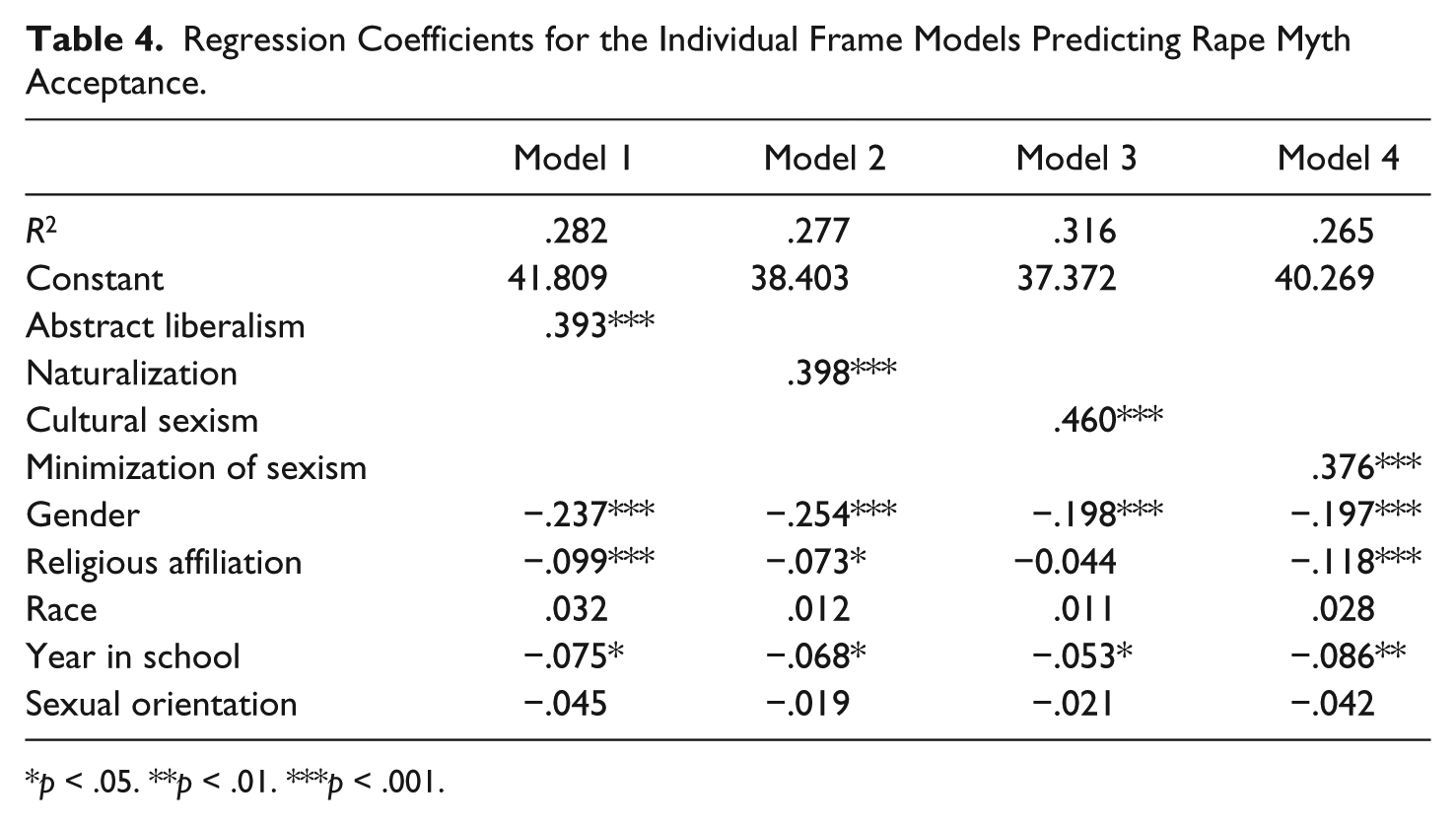
p < .05. **p < .01. ***p < .001.
Although it is important to consider the relationships between the individual frames of gender-blind sexism and RMA, consistent with Bonilla-Silva’s (2006) theorizing, we argue it is the frames taken together that collectively comprise the post-gender ideology that gives rise to RMA. As such, our next step was to regress our Gender-Blind Sexism Inventory on the rape myth index while controlling for gender, religion, race, year in school, and sexual orientation. Our overall model was statistically significant at the .000 level, and the variance explained in the criterion variable increased to 44.0%. Table 5 contains the coefficients for each term in the regression model along with an indication of significance. As hypothesized, our Gender-Blind Sexism Inventory was statistically significant (p < .001). Specifically, as respondents moved from disagreement to agreement with gender-blind sexism, there was a corresponding increase of support for rape myths by a factor of .621.
Regression Coefficients for the Indexed Model Predicting Rape Myth Acceptance.
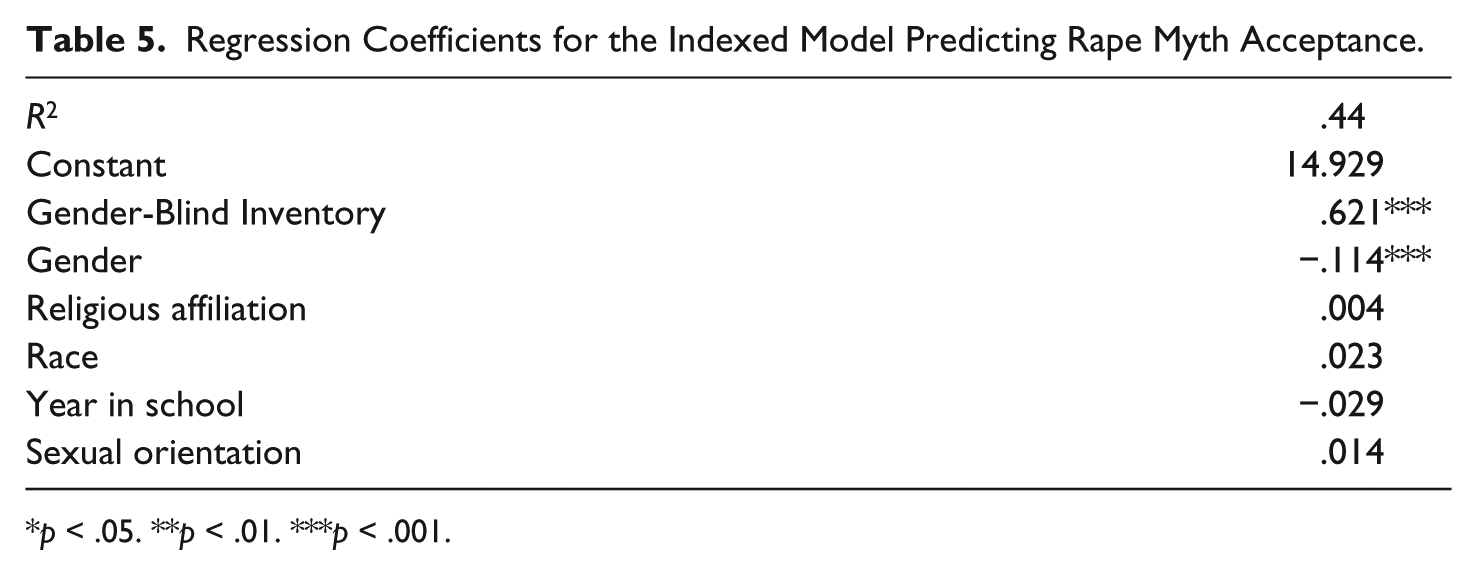
p < .05. **p < .01. ***p < .001.
When combining the individual frames into a Gender-Blind Inventory, religion and year in school were no longer statistically significant correlates with RMA and sexual orientation and race remained unrelated as well. Consistent with other research, however, gender remained a statistically significant correlate of RMA (p < .001) even with the Gender-Blind Sexism Inventory in the model. Controlling for all other variables, women were less likely than men to indicate support for rape myths. As respondents moved from male to female, the likelihood of accepting rape myths saw a corresponding decrease by a factor of .114, perhaps due to the fact that women are more likely to be victims of sexual assault. As Yodanis (2004) points out, “Not every woman needs to be a victim of violence for violence to control the lives of women” (pp. 671-672). In other words, gender may be a function of exposure, direct or indirect, to sexual assault.
Discussion
Limitations and Directions for Future Research
To begin, it is important to acknowledge certain limitations of the current study. Although our sample was reflective of the university population, indicating little potential for nonresponse bias, our response rate (17%) was much lower than we would have desired. As previously discussed, we used several strategies to maximize our response rate. These strategies include attaching potential incentives for participation via gift card drawings, leaving the survey open for a reasonable time, and sending out several reminders for invitees to participate. Future researchers should consider additional strategies as they aim for a higher response rate than we were able to achieve. For example, a review of the literature (Nulty, 2008) has shown that online surveys typically suffer from much lower response rates than do paper surveys. Future researchers looking to replicate this study might consider moving to a paper survey to increase response rates. Future researchers might also consider shortening the survey. Including demographic information, our survey contained 55 items. Out of the 8,187 undergraduates invited to participate, 1,809 began the survey but only 1,401 completed the instrument. This is a 23% failure rate and dropped what would have been a 22% response rate to 17%. Review of the failures did not indicate any particular question or portion of the survey as problematic. Thus, it is possible that the overall length of the survey was a factor in our low response rate.
Even if our response rate was higher, the fact is that the population from which the sample was drawn is largely homogeneous in relation to religion, race, and sexual orientation. Because our population (and thus, our sample) contained so few individuals who did not identify as Christian, White, or heterosexual, we were forced to collapse these categories, forgoing the level of nuance we would have liked. In addition, the generalizability of our findings is in question due to the homogeneity of the sample. Therefore, we suggest researchers consider using a more diverse sample of participants in the future.
Finally, it should be noted that this study was exploratory in design. As stated, our goal was to find whether gender-blind sexism is an appropriate theoretical framework for understanding the creation and continued prevalence of RMA. Although we found statistical support for our Gender-Blind Sexism Inventory, scholars including Bonilla-Silva (2006) have argued that qualitative methods, and triangulated methods in particular, are perhaps best suited for studying sensitive topics such as racism and sexism in an era of “post-racial” and “post-gender” politics. Therefore, we suggest that in addition to collecting survey data, future research should explore the parameters of gender-blind sexism using other methodological approaches.
Conclusion
Because the politics of gender-blind sexism relegate rape and sexual assault to individual-level problems, the solutions that universities offer to deter both are almost exclusively rooted in individual-level approaches. In fact, scholars have long encouraged schools to endorse these types of strategies. In the late 1980s and early 1990s, Adams and Abarbanel (1988), for example, called on universities to implement security procedures such as effective lighting, landscaping designs, and self-locking dormitory doors to prevent rapes, while Bachman, Paternoster, and Ward (1992) urged educators to appeal to the morality of college men to reduce their proclivity to rape (for more recent examples, see also Baugher, Elhai, Monroe, & Gray, 2010; Kress et al., 2006). Although we concede that a few individualistic strategies can help deter some offenses, our study finds that attitudes toward rape and sexual assault are structurally contingent. Thus, we believe any long-term solution to decrease sex crimes on college campuses must include a concerted effort to dismantle systems of privilege and oppression including gender-blind sexism (e.g., Kassing et al., 2005).
To begin this work, colleges and universities must be willing to implement policy changes that codify an institution’s refusal to tolerate sexual violence. For example, universities should specifically name rape and sexual assault as offenses in student codes of conduct. More importantly, universities need to enforce these policies. According to “Not Alone,” the First Report of the White House Task Force to Protect Students From Sexual Assault (2014),
And in all too many instances, survivors of sexual violence are not at the heart of an institution’s response: they often do not have a safe, confidential place to turn after an assault, they haven’t been told how the system works, and they often believe it is working against them. We heard from many who reached out for help or action, but were told they should just put the matter behind them. (p. 7)
Indeed, the U.S. Department of Education’s Office for Civil Rights has seen an exponential rise in the number of alleged Title IX violations associated with universities’ mishandling of sexual assault complaints (e.g., N. Anderson, 2014; see also About Know Your IX, 2013; Farrey & Noren, 2014; Gonzalez, 2013; Kingkade, 2014). When sexual assaults are systemically mishandled, it not only discounts the significance of crimes against women but also subtly reassures men that universities would rather have these incidents disappear than hold perpetrators accountable. However, Bachman et al. (1992) found that college men who believed there would be stiff sanctions for committing rape and sexual assault were less likely to do so.
Furthermore, policies and practices addressing sexual harassment and inequality in hiring, promotion, and tenure decisions must exist alongside those addressing sexual assault. In addition, universities must guard against gendered wage gaps among faculty and staff, resist the marginalization of disciplines such as women’s and gender studies, and work toward equality in recruitment, representation, and retention across disciplines where women have been historically underrepresented. In other words, colleges and universities must be diligent in ensuring their students, staff, and faculty live and work in an environment free from all forms of sexual discrimination.
Finally, colleges and universities need to be aggressive in socializing students, faculty, administrators, and staff about what constitutes inappropriate sexual behavior. Research clearly indicates that ambiguities remain as to what women and men believe defines rape (e.g., Peterson & Muehlenhard 2004; Ward, Chapman, Cohn, White, & Williams, 1991). As Warr (1985) points out, the importance of consent must be emphasized; men must learn to specifically ask their partners whether they want to engage in sexual behaviors; and schools need to be clear that the absence of a “yes” in a sexual encounter means “no,” instead of the other way around (p. 71). As this study clearly shows, however, decreasing RMA requires a fundamental understanding of the ways that systems of privilege and oppression operate. Therefore, students, faculty, administration, and staff must be taught how the intersections of race, class, gender, and sexuality underpin common rape myths. According to J. Anderson (2007),
Dismantling rape myths is critical to the work of ending rape. While we won’t find many individuals who would stand up and claim that it is O.K. to rape, when people imply that victims deserve it, question a victim’s credibility, or hold up rape myths and rape-supportive attitudes and beliefs as truth, that is exactly what they are saying. (p. 3)
In sum, dominant group members have a vested interest in developing ideologies to explain racial and gender inequalities in a society they purport to be “post-racial” and “post-gender.” As Bonilla-Silva (2006) points out, if the ultimate goal of the dominant race is to maintain their position of privilege within a racialized society, they must develop rationalizations to account for the status of minorities. This is also true with patriarchy. To maintain power, authority, and privilege, dominant group members must develop rationalizations to account for the status of women, men of subordinated masculinities, and any other persons who are gender or sexual non-conforming (Connell, 1987). This is why scholars must incorporate an analysis of patriarchy as well as other systems of privilege and oppression when studying the pervasiveness of RMA (e.g., Aosved & Long, 2006). As researchers who have studied the prevalence of rape and attitudes toward sexual assault have long argued, what is missing in the literature is not empirical evidence documenting the pervasiveness of RMA, but a theoretical model that helps explain why it is these beliefs remain so prevalent (e.g., Edwards et al., 2011; Lonsway & Fitzgerald, 1994). We believe the frames of gender-blind sexism provide a particularly useful theoretical model for explaining the persistence of RMA in a “post-gender” society.
Footnotes
Acknowledgements
The authors thank Carol Miller, PhD, as well as the Violence Prevention Office and the Statistical Consulting Center at the University of Wisconsin–La Crosse.
Declaration of Conflicting Interests
The author(s) declared no potential conflicts of interest with respect to the research, authorship, and/or publication of this article.
Funding
The author(s) received no financial support for the research, authorship, and/or publication of this article.