




Abstract
Previous research has shown that short-term mating orientation (STMO) and hostile sexism (HS) selectively predict different types of sexual harassment. In a priming experiment, we studied the situational malleability of those effects. Male participants could repeatedly send sexist jokes (gender harassment), harassing remarks (unwanted sexual attention), or nonharassing messages to a (computer-simulated) female target. Before entering the laboratory, participants were unobtrusively primed with the concepts of either sexuality or power. As hypothesized, sexuality priming strengthened the link between STMO and unwanted sexual attention, whereas power priming strengthened the link between HS and gender harassment. Practical implications are discussed.
In recent years, sexual harassment has received increasing attention in North America and Europe. National and international surveys show that sexual harassment is still a prevalent problem in the workplace (European Union Agency for Fundamental Rights, 2014; Ilies, Hauserman, Schwochau, & Stibal, 2003) and in other environments (e.g., Barak, 2005; Chawki & el Shazly, 2013). Because male sexual harassment of women is the most commonly observed gender constellation (Berdahl & Moore, 2006; Koss et al., 1994), we focus our research on male perpetrators and female targets.
Extensive research on the effects of sexual harassment has documented various negative consequences on targets’ mental and physical health (Nielsen & Einarsen, 2012; Rospenda, Richman, & Shannon, 2009), job performance, job satisfaction, and career opportunities (Chan, Chun, Chow, & Cheung, 2008). It is thus important to examine the personal factors underlying men’s motivation to sexually harass women as well as the context factors that facilitate such motivations to be translated into action. These are the objectives of this article. We directly build upon previous research (Diehl et al., 2012) that has identified two distinct motives for sexual harassment: generalized hostility toward women, as reflected in hostile-sexist attitudes, and sexuality, as reflected in short-term mating orientation (STMO). In the current study, we experimentally tested the influence that certain contextual cues may have on the likelihood for each of these two motives to guide men’s engagement in two specific types of sexually harassing behavior.
Conceptualizing Two Types of Sexually Harassing Behavior
Existing definitions of sexual harassment usually cover a range of interpersonal behaviors with a sexual connotation or referring to the target’s gender that are unwelcome and have negative consequences for the target (e.g., Fitzgerald, Swan, & Magley, 1997). An influential classification of different types of sexual harassment, based on earlier work by Till (1980), was proposed by Gelfand, Fitzgerald, and Drasgow (1995). It empirically distinguishes three main types of sexually harassing behaviors: unwanted sexual attention, gender harassment, and sexual coercion. In our present research, we focus on the first two types, which are not only usually less severe than sexual coercion but also much more common (e.g., Fitzgerald, Magley, Drasgow, & Waldo, 1999; Richman et al., 1999). Unwanted sexual attention comprises a range of sexually connoted behaviors, including repeated unrequited requests for dates, sexual remarks, intrusive messages, touching, and sexual imposition (Gelfand et al., 1995). Gender harassment includes behaviors “generally not aimed at sexual cooperation; rather, they convey insulting, hostile, and degrading attitudes about women” (Gelfand et al., 1995, p. 168). A typical example of unwanted sexual attention would be sexualized remarks about a target person’s physical appearance; a typical example of gender harassment would be sexist jokes targeting women as a group (Eyssel & Bohner, 2007).
There are two important differences between unwanted sexual attention and gender harassment that are relevant for appreciating their underlying motives: First, unwanted sexual attention may typically be understood as interpersonal behavior directed at one particular, individual woman, whereas gender harassment represents intergroup behavior (Tajfel, 1978). Thus, even when gender harassment is directed at an individual woman, the derogation inherent in such behavior is still at the level of her gender group, emphasizing the inferiority of women (as a group) compared with men. Second, unwanted sexual attention typically has a sexual component whereas gender harassment does not. With these differences in mind, we now take a look at two general approaches aimed at explaining sexual harassment.
Two Motives Underlying Two Different Forms of Sexual Harassment
Two broad fields of research address instrumental functions of sexual harassment. According to the sociocultural approach, sexual harassment serves to maintain political and economic male dominance by suppressing women on an intergroup and on a societal level (see, for example, Samuels, 2004). By contrast, the evolutionary approach conceives sexual harassment as a misunderstanding between women and men that arises from gender differences in sociosexual behavior (see, for example, Studd, 1996). Thus, in terms of underlying motivations on the perpetrator side, sociocultural theory suggests a power motivation based on misogynist ideology such as hostile sexism (HS), which is used to bolster men’s greater structural power in society and keep women in a subordinate position. HS may be defined as negative, prejudicial beliefs about women, including the conviction that women are inferior to men but try to dispossess men of their power (Glick & Fiske, 1996, 2001). Evolutionary theory, however, proposes that sexual harassment is often sexually motivated. Because men, as compared with women, typically exhibit a much greater STMO, which may be defined as an interest in spontaneous sexual encounters without a long-term commitment (Buss & Schmitt, 1993; Schmitt, 2005), they also show behaviors aimed at making sexual contact that women may perceive as transgressions.
Going beyond views of the sociocultural and the evolutionary approach as competing positions (cf. Eagly & Wood, 1999; Thornhill & Palmer, 2000), Diehl and colleagues (2012) were the first to propose that the two approaches may be useful for predicting different types of sexual harassment and may thus complement each other. They demonstrated that the two proposed motives of power and sexuality were empirically independent of each other and that each motive showed a specific pattern when measured to predict different types of sexual harassment. Diehl et al. used a refined version of the computer harassment paradigm originally developed by Dall’Ara and Maass (1999; see also Maass, Cadinu, Guarnieri, & Grasselli, 2003; Siebler, Sabelus, & Bohner, 2008), and introduced two different types of harassing materials to operationalize unwanted sexual attention and gender harassment, respectively. In the course of their study, male participants interacted with a computer-simulated (but allegedly real) female chat partner and could repeatedly choose to send her sexist jokes (representing gender harassment), sexualized personal remarks (representing unwanted sexual attention), or nonharassing messages. To operationalize the sexual and the power motive, respectively, men’s STMO and HS were assessed using a questionnaire. Participants’ STMO predicted only unwanted sexual attention in the form of sending sexualized remarks to the female chat partner. STMO, however, did not predict gender harassment in the form of sending sexist jokes, as this behavior would not be effective in serving a sexual motivation. Participants’ HS, on the contrary, predicted both gender harassment and unwanted sexual attention, suggesting that a hostile motivation might not only lead to discriminatory behavior to intimidate women but also to individualized sexually offensive remarks. This pattern of results suggested that both motivational structures are valid predictors of sexual harassment, and that sociocultural and evolutionary accounts may complement each other rather than forming competing explanations.
Implicit Contextual Activation of Power and Sexual Motives
The main aim of the present study was to replicate and extend the work of Diehl and colleagues (2012) by investigating situational cues that might increase the relative impact of power and sexual motives on sexually harassing behavior. We chose an experimental approach, which is an important next step for several reasons: First, an experimental study may provide further evidence for the differentiability of the two motives underlying sexual harassment. Second, it allows for stronger inferences about the causal role of the two motives. Third, it may shed light on contextual features that render these motives accessible and thus increase their likelihood of guiding behavior. An experimental approach may thus also offer important insights for practical interventions.
Potential causal variables at the level of mental representations, such as the two motives under investigation, can exert an effect on behavior only to the extent that they are cognitively accessible (Schwarz & Strack, 1981). We therefore predicted that the influence of sexual versus power motivation on unwanted sexual attention and gender harassment, respectively, should be more pronounced if the causal motives are made salient before participants’ sexually harassing behavior is assessed. As the temporally salient motives are considered to be determinants of individuals’ actions, such differential strength of motivation–behavior links as a function of motivation salience would be strong evidence for a causal effect of each of the two motives under investigation (see Schwarz & Strack, 1981). This approach to substantiate causality has been successfully applied, for example, to test the impact of ideologies on group members’ behavior during an intergroup interaction (Vorauer, Gagnon, & Sasaki, 2009) or, closer to the current work, to assess the causal influence of rape-related beliefs on men’s rape proclivity (Bohner, Jarvis, Eyssel, & Siebler, 2005, Study 1; Bohner, Reinhard, et al., 1998).
Social cognition research comprehensively shows that priming with subtle, even subliminal, environmental stimuli can increase the cognitive accessibility of certain concepts and thereby influence social perceptions and behavior (Bargh, Chen, & Burrows, 1996; Higgins, 1996). In particular, semantic primes and images have been shown to affect perceptions of others (Higgins, 1996), construals of social situations (e.g., Kay & Ross, 2003), interpersonal processes (Fitzsimons & Bargh, 2003), and motivated behavior (Bargh, Gollwitzer, Lee-Chai, Barndollar, & Trötschel, 2001). Some priming studies have addressed environmental cues that activate gender stereotypes in social perception and behavior (e.g., Banaji & Hardin, 1996), such as gender-stereotypical images in television (Lazier-Smith, 1989), music clips (e.g., Sprankle, End, & Bretz, 2012), or video games (Yao, Mahood, & Linz, 2010). Rudman and Borgida (1995), for example, found that males who had been primed with television commercials portraying women as sex objects engaged in sexualized behavior during a staged interview of a female confederate. In a similar vein, research by Bargh, Raymond, Pryor, and Strack (1995) suggests that the priming of power-related words may increase the likelihood that men perceive female targets in more sexualized terms. Yet, little is known to date about priming effects on existing motivational structures underlying sexual harassment and their impact on corresponding behavior. Investigating such priming effects should be particularly important from a practical point of view, given the prevalence of situational cues and potentially related harassment in contexts such as the workplace (Berdahl & Moore, 2006) or the Internet (Barak, 2005).
The Present Research
On this theoretical and empirical basis, we now examine the consequences of a specific activation of power and sexuality motives with regard to sexually harassing behavior. As motive activation arouses and directs behavior to achieve certain motivational goals, we argue that the activation of a power motive versus a sexual motive plays a crucial role in explaining how certain motivational dispositions are ultimately translated into sexually harassing behavior. To examine the causal pathways between sexual motivation and unwanted sexual attention as well as between power motivation and both types of harassment, we apply the paradigm introduced by Schwarz and Strack (1981). Specifically, we aim to establish causality by testing whether making one of the two motives temporally salient differentially strengthens the respective motivation–behavior link. Despite some evidence that the presence of sexually explicit or power-related cues may lead to sexual harassment, neither the interplay of those situational cues with related motivational dispositions nor the causal role of the latter in bringing about harassing behavior has been examined to date.
In the present study, we manipulated the relative accessibility of the two motives by priming male participants, in two different experimental conditions, with either a poster depicting “sexy women,” to activate participants’ sexual motivation, or a poster depicting “powerful men,” to activate participants’ power motivation (for a similar method, see Bohner & Wänke, 2004). To study different forms of harassing behavior as dependent variables, we used the established computer harassment paradigm (Diehl et al., 2012), and to operationalize the two motives, we assessed men’s STMO and HS, as did Diehl and colleagues (2012). By subtly varying situational cues as key variables, we aimed to influence the extent to which preexisting, motivational dispositions predict different forms of sexually harassing behavior. As priming with certain situational cues may additionally lead to an increase of the critical attitude or the critical behavior, we also tested for such main effects of the priming, although they were not part of our hypotheses (cf. Bohner et al., 2005; Bohner, Reinhard, et al., 1998).
Moreover, we note that motives are usually defined as individual dispositions, which are stable over time and relatively independent of situational influences (e.g., Heckhausen, 1989). This can be confirmed at least for STMO, which has been shown to be relatively stable for periods of up to 1 year (Penke & Asendorpf, 2008; Simpson & Gangestad, 1991). There are also fairly stable gender effects in sociosexuality across nations and cultures (Schmitt, 2005) and even evidence that sociosexuality is heritable (Bailey, Kirk, Zhu, Dunne, & Martin, 2000), which might also indicate its stability. Accordingly, we expected the priming in our study to lead to higher correlations between each motive and its corresponding behavior rather than to mean differences between priming conditions.
Hypotheses
We expected to replicate the double dissociation of two motives, power and sex, in the prediction of two different forms of sexual harassment, gender harassment and unwanted sexual attention, found by Diehl and colleagues (2012):
Importantly, we further hypothesized that different situational cues would selectively strengthen the paths between the underyling motives and the respective form of harassment:
Method
Participants
Eighty-five heterosexual male students (18-46 years of age; M = 24.66, SD = 4.66) at a German university from different subject areas were recruited in the main university hall and volunteered to participate in a computer chat study that allegedly tested “memory processes in interactions at the workplace.” Data from seven additional participants were excluded because they either indicated a homosexual orientation (n = 4) or expressed suspicion concerning the cover story used in the experiment (n = 3).
Design and Procedure
Before participants were seated in separate laboratory cubicles, they followed the experimenter along a hallway where, depending on experimental condition, one of two posters was displayed on the wall. One poster was designed to prime the concept of male structural power; it was titled “Powerful Men” and included pictures of high-ranking politicians. The other poster was designed to prime the concept of sexuality; it was titled “Sexy Women” and included pictures of women wearing lingerie. The two posters were swapped in random intervals so that participants were randomly assigned to the power priming condition (n = 41) or the sex priming condition (n = 44).
Still in the hallway and with the participant’s permission, the experimenter took his photograph to be uploaded into the computer network; this served to increase the credibility of the following chat procedure. When the photo was taken, all participants were positioned in such a way that they had to look in the direction of the poster to ensure that they would notice it. Later, participants were informed that due to a hardware error their picture could not be uploaded, so that the participant’s picture never appeared in the chat; this was done to give participants the feeling of sufficient anonymity.
The study consisted of two separate parts. The first part comprised the computer chat paradigm. We used the same cover story as Diehl et al. (2012) to increase the credibility of the chat situation and the sending of preformulated messages to the chat partner. Specifically, participants were led to believe that multiple participants were taking part in the experiment simultaneously, and from multiple simulated chat partners, the computer ostensibly chose “Julia” (a name rated as very attractive; Rudolph, Böhm, & Lummer, 2007) to connect with. Participants saw a picture of Julia, an attractive, White German in her mid-20s, on the screen. After exchanging some preliminary information with Julia, they learned that one of the chat partners would be chosen at random to be the active “sender” and the other to be the passive “receiver”. Then the computer program always informed the participant that he was chosen as the sender, and that his task would be to select and send, in each of several trials, one out of three short messages to their chat partner, who allegedly was assigned the passive part in the chat, only receiving the chosen material. Each participant learned that both he and his chat partner would later be asked to recognize the materials in a memory test, and that previous studies had found gender differences in memory performance. This information was provided to increase the credibility of the cover story (memory processes) and to set the stage for both a sexual motive (by presenting an attractive female chat partner) and a hostile motive (by creating a competitive intergroup situation between men and women, see Dall’Ara & Maass, 1999; Maass et al., 2003; Siebler et al., 2008). In 20 trials, participants were then asked to select material from 20 matched triples of jokes and remarks. There were 16 critical triples consisting of one sexist joke, one sexually harassing personalized remark, and one neutral joke or remark, and four completely neutral filler trials. The participants could select one of the stimuli by clicking on the corresponding “Send this one” button. After a variable delay, the next triple was shown. After the last trial, the computer ostensibly disconnected from the chat network, and in the second part of the study, participants completed a questionnaire measuring their HS and STMO. (The questionnaire also contained additional items that will not be discussed here.) Then participants completed an awareness check, were thanked, fully debriefed, and received 4 euros for their participation. Procedures were approved by the Ethics Committee of the German Association of Psychology (DGPs).
Materials and Measures
Priming by wall posters
To ensure that the priming would be subtle and unobtrusive, we designed two posters in the style of scientific conference posters to be displayed in the hallway of the laboratory, as is customary to do with former conference posters displayed in many corridors all over the university. The posters were printed in portrait A0 format and in color. All text was written in German, and complemented by figures displaying the ostensible results of scientific studies.
To activate the concept of male structural power, one of the posters was titled “Powerful Men” and reported a fabricated study about the representation of men in the media and in motion pictures. Approximately one third of the poster was covered by several pictures, depicting Daniel Craig in the role of James Bond, and national as well as international politicians (e.g., German Federal Minister Thomas de Maizière, and U.S. President Barack Obama), portrayed torso or whole-body, and alone, by two, or in a group. All of them wore suits, and no other power- or aggression-related items were shown.
To activate the concept of sexuality, the other poster was titled “Sexy Women” and reported a fabricated study about the influence of female models on consumer behavior. Approximately one third of the poster was covered by several pictures depicting female models in advertisements for lingerie (e.g., by labels such as “Calvin Klein”) and for alcoholic beverages (German brewery “Bitburger”). All women wore lingerie or bikinis and were portrayed whole-body with focus on their body; one of the pictures showed neither head nor legs. Copies of the posters used in the study may be obtained from the first author.
In an awareness check immediately after the experiment, participants were asked if they remembered the topic of the poster they had seen. Using a funnel sequence of questions, we started by asking if anything had attracted participants’ attention before starting the experiment, then if there was anything on the walls that they may have noticed, and finally if they could remember what was displayed on the poster and the title of the poster.
Selection and scoring of harassing materials
We used the same material as in Diehl et al. (2012), which had been pilot tested with n = 40 (20 male, 20 female) participants. They matched 16 triples containing one critical joke, one critical remark, and one neutral item such that in each triple (a) a sexist joke was always matched with an equally harassing and unpleasant personalized remark and (b) the neutral item was either a nonharassing joke matched in funniness with the harassing joke, or a nonharassing remark. For example, one critical triple read as follows: “Women are like ties: You choose them under insufficient lighting and then you have them around your neck” (sexist joke), “I read in the newspaper that kissing makes people happy. May I make you happy?” (harassing personal remark), “Two tomatoes are crossing the road. A car runs over one of them. The other turns around and shouts: ‘Come on, Ketchup!’” (nonsexist joke).
From the 16 critical trials, we derived two separate harassment measures. The total number of sexist jokes sent was used as a behavioral measure of gender harassment (Cronbach’s α = .77), and the total number of offensive remarks sent was used as a behavioral measure of unwanted sexual attention (α = .73).
Individual-difference variables
Both the HS and the STMO items were taken from established measures of the respective construct, whose validity has been established in previous studies. STMO was measured using a German translation of the 10-item STMO subscale of the Sociosexual Orientation Inventory (Jackson & Kirkpatrick, 2007) that measures attitudes in favor of casual sex and the desire for short-term sexual relationships (item example: “I can imagine myself enjoying a brief sexual encounter with someone I find very attractive”; response scale from 1, do not agree at all, to 7, agree completely). After reverse-scoring where appropriate, item scores were averaged for each participant to form an index of STMO. In the present study, the STMO scale was highly reliable (α = .91).
HS was measured using five items from the HS subscale of the German version (Eckes & Six-Materna, 1999) of the Ambivalent Sexism Inventory (Glick & Fiske, 1996)—specifically, Items 4, 5, 11, 14, and 16. The underlying construct reflects overtly negative evaluations and stereotypes about women, dominative paternalism, competitive gender differentiation, and heterosexual hostility (Glick & Fiske, 1996). An item example is “Women seek to gain power by getting control over men” (response scale from 1, do not agree at all, to 7, agree completely). Item scores were averaged for each participant to form an index of HS. In the present study, the HS scale showed good reliability (α = .83).
Results
Descriptive Statistics and Zero-Order Correlations
During the 16 critical trials, 80% of the participants sent at least one sexist joke, and 71% sent at least one sexually offensive personalized remark (observed range from 0-12 for each variable). Overall, participants sent more sexist jokes (M = 2.85, SD = 2.78) than sexually offensive remarks (M = 1.99, SD = 2.21), t(84) = 2.29, p = .03. Descriptive statistics of all principal measures are displayed in Table 1.
Descriptive Statistics and Zero-Order Correlations of Principal Measures for Full Sample and Separated by Condition (Priming of Sexuality vs. Power).
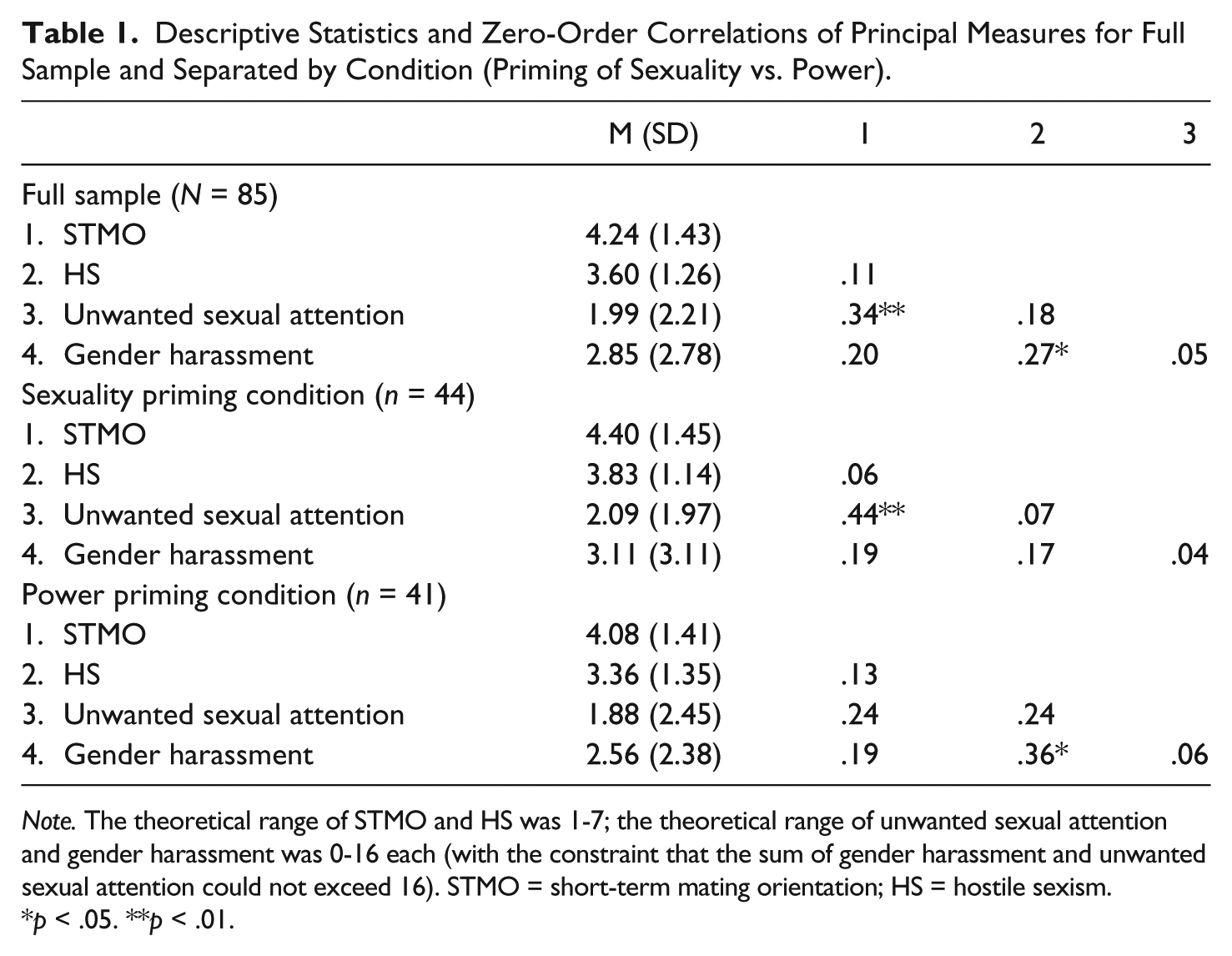
Note. The theoretical range of STMO and HS was 1-7; the theoretical range of unwanted sexual attention and gender harassment was 0-16 each (with the constraint that the sum of gender harassment and unwanted sexual attention could not exceed 16). STMO = short-term mating orientation; HS = hostile sexism.
p < .05. **p < .01.
Correlation analyses showed that, in line with H1 and H2, STMO and HS were differentially correlated with the two behavioral measures of gender harassment and unwanted sexual attention, respectively. As can be seen in Table 1 (top panel), STMO was significantly positively correlated with unwanted sexual attention scores but not with gender harassment scores, whereas HS was positively correlated with gender harassment scores but not with unwanted sexual attention scores. Finally, the two predictors, STMO and HS, were independent of each other, and the same was true for the two behavioral measures of gender harassment and unwanted sexual attention. Separate correlation analyses for each of the priming conditions showed that, in line with hypotheses, the correlation of STMO and gender harassment was more pronounced after priming sexuality, whereas the correlations of HS and each of the harassing behavior scores tended to be higher after priming power (see Table 1, middle and bottom panels).
Double Dissociation of Two Motives Predicting Two Types of Sexual Harassment
To simultaneously test the differential links between the two predictors STMO and HS on one hand and the two types of sexual harassment on the other hand (H1 and H2), a path analysis was conducted using AMOS 22.0 for Windows. In the model, displayed in Figure 1, the two paths reaching significance were those between STMO and number of offensive personal remarks sent, and between HS and number of sexist jokes sent, respectively. All other paths were nonsignificant, ps > .10. These analyses fully support H1, showing a specific effect of STMO on unwanted sexual attention, and partly support H2, showing a specific effect of HS on gender harassment but not on unwanted sexual attention. The two predictors STMO and HS were uncorrelated, and so were the two behavioral measures of unwanted sexual attention and gender harassment, which is in line with the theorized double dissociation.
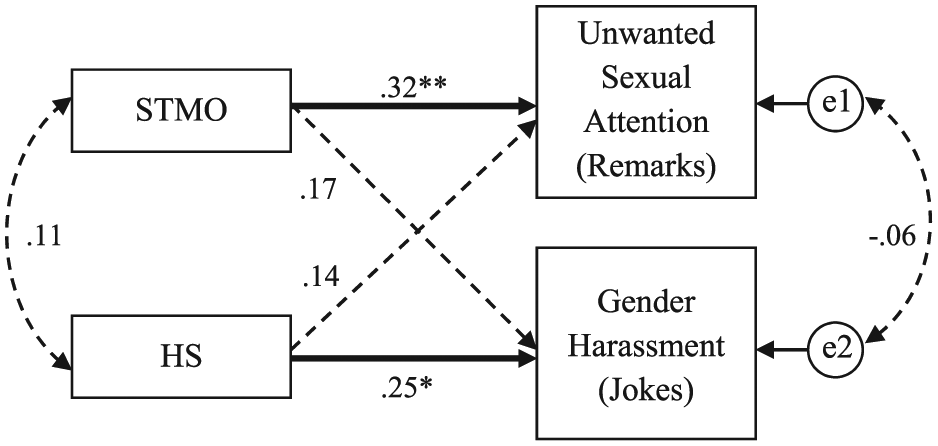
Double dissociation of two motives predicting two forms of sexually harassing behavior (full sample: N = 85).
Priming Effects on the Relative Strength of Motive-Behavior Links
Preliminary analyses
The awareness check revealed that 34 participants correctly remembered the title of the poster they had seen; 17 participants remembered having seen a poster, but were not able to recall the topic or title; and 18 participants did not remember having seen a poster at all. Sixteen participants chose to leave the response boxes on the awareness check blank. Importantly, the level of awareness (coded 0 = remembered nothing, 1 = remembered poster, but no detail, and 2 = remembered poster and title; treating data of participants who did not answer as missing values) was independent of the priming condition, t(67) = 1.25, p = .21, Mpower = 1.40, SDpower = 0.87; Msexuality = 1.14, SDsexuality = 0.82, and was uncorrelated with participants’ motivation and behavior, both ps ≥ .21.
We then analyzed potential mean differences between the two priming conditions. At the motivational level, there were no mean differences between participants having seen the poster depicting “sexy women” and participants having seen the poster depicting “powerful men,” either in STMO, t(83) = 1.01, p = .31, or in HS, t(83) = 1.74, p = .09. If anything, the trend for HS was in an unexpected direction, with participants reporting somewhat higher HS after sexuality priming (M = 3.83, SD = 1.14) than after power priming (M = 3.36, SD = 1.35). At the behavioral level also, there were no mean differences between conditions, either for the number of sexist jokes sent, t(83) = 0.92, p = .36, or for the number of offensive remarks sent, t(83) = 0.44, p = .66.
Also, we tested the homogeneity of variances in the two priming conditions. Both for the predictors, STMO and HS, and for the dependent variables, number of sexist jokes sent and number of offensive remarks sent, variances were equal in the two priming conditions, Fs(1, 83) ≤ 1.73, ps ≥ .19, Levene tests.
Hypotheses tests
We then tested the theorized role of the priming by conducting two more path analyses, for the sex priming condition and the power priming condition separately. Within the sex priming condition (see Figure 2), the only path reaching significance was the one between STMO and number of sexualized remarks sent. All other paths were nonsignificant (ps ≥ .20). This is in line with our H3, which predicted priming of sex to specifically strengthen the link between STMO and unwanted sexual attention harassment. In the same condition, the link between HS and gender harassment was substantially weaker and nonsignificant. Within the power priming condition (see Figure 3), conversely, the only path reaching significance was the one between HS and number of sexist jokes sent. All other paths were nonsignificant, ps ≥ .14. This generally supports our H4, which predicted priming of power to strengthen the effect of HS on both forms of sexually harassing behavior, although only the specific link between HS and gender harassment reached significance. The expected link between HS and unwanted sexual attention was descriptively stronger than in the sex priming condition, but still nonsignificant. In the same condition, the link between STMO and unwanted sexual attention was substantially weaker and nonsignificant. These analyses therefore show, in line with H3 and H4, a specific effect of activating a sexual motivation on the relationship of STMO and unwanted sexual attention and a specific effect of activating a power motivation on the relationship of HS and gender harassment.
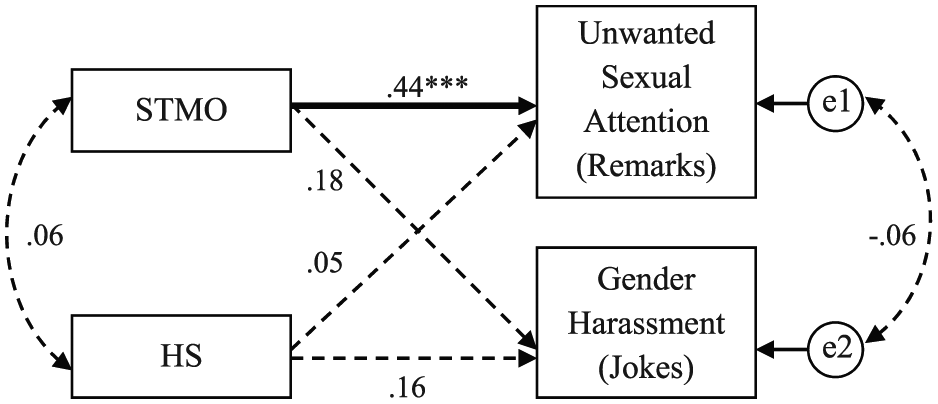
Double dissociation of two motives predicting two forms of sexually harassing behavior after activating a sexual motive (n = 44).

Double dissociation of two motives predicting two forms of sexually harassing behavior after activating a power motive (n = 41).
Discussion
The current study shows that a subtle contextual variation may influence the implications of preexisting motives for actual sexually harassing behaviors. Overall, we replicated the double dissociation of two different motives, power (generalized hostility toward women) and sex (a preference for short-term mating strategies), as predictors of two different forms of sexual harassment, gender harassment and unwanted sexual attention (Diehl et al., 2012). Going beyond this replication, our study also provides first evidence for a causal relationship between these two motives and different forms of sexually harassing behavior.
As reported by Diehl and colleagues (2012), STMO specifically predicted the number of sexually offensive remarks sent to a female target in a computer chat paradigm, and HS predicted the number of sexist jokes sent. However, somewhat diverging from previous results, we found no significant link between HS and unwanted sexual attention. The current data instead show an even clearer pattern of the predicted double dissociation, with two distinct motives being linked with only one type of sexual harassment, respectively. This may be due to the fact that the overall model in the present study was based on a sample composed of two conditions in which we subtly activated either one of the individual motivations. According to this logic, the specific activation of one of the motives at a time might lead to a stronger differentiation in the overall model. With hindsight, to provide a more diagnostic comparison with the previous study by Diehl et al., it would have been useful to include a control condition without priming. However, when designing the current study, we had opted against an additional condition to study larger subsamples in each of the priming conditions and thus to maximize statistical power for the path models.
These considerations notwithstanding, the current study provides further support for our hypothesis that two distinct motives underlie sexual harassment and that these motives are indeed differentially linked to two forms of sexually harassing behavior: As sociocultural theory suggests (e.g., Samuels, 2004), a power motive predominantly leads to gender harassment, whereas a sexual motive predominantly leads to unwanted sexual attention, lending support to an evolutionary account (e.g., Studd, 1996).
Sexual Harassment in Context
The current study shows that, apart from individual motivations, contextual features matter in predicting sexual harassment. Differentially activating the two motives for sexually harassing behavior did not lead to higher motivation to sexually harass per se, but to a more specific pattern of how motivations and harassing behaviors were linked: After activating a sexual motive, only STMO significantly predicted unwanted sexual attention, while the role of HS became negligible. Conversely, after activating a power motive, HS significantly predicted gender harassment, while STMO was no longer a relevant predictor in the model. Thus, each of the two main paths (from STMO to unwanted sexual attention and from HS to gender harassment) was stronger after the activation of the respective motive. With these data, the current study provides first evidence that both motives can be triggered by situational cues and thereby strengthened in their impact on sexually harassing behavior. These findings not only confirm the predicted causal relationship between the two motives and sexual harassment (see Schwarz & Strack, 1981) but might also offer initial suggestions for implementation in work policies. In fact, Fitzgerald, Drasgow, Hulin, Gelfand, and Magley’s (1997) influential model of sexual harassment in organizations acknowledges the prominent role of context as a facilitating factor for sexually harassing behaviors. Many researchers have emphasized the importance of organizational climate (for reviews, see McDonald, 2012; Pina & Gannon, 2012), which emerged as the strongest predictor of sexual harassment in a recent meta-analysis (Willness, Steel, & Lee, 2007). However, it was also noted that all 41 studies included in the meta-analysis had operationalized organizational climate “as an individual perception rather than objective characteristics of organizations or work groups” (Willness et al., 2007, p. 144). The current study thus provides a model for how changes in the objective context might influence actual sexual harassment.
Interestingly, we found no differences between participants who remembered the posters and those who did not. Thus, independently of awareness, priming affected the interplay of motives and behavior for our participants. Although some research on person perception suggests that priming effects may be attenuated or even reversed when primed individuals are consciously aware of the priming episode (Strack, Schwarz, Bless, Kübler, & Wänke, 1993), other research has shown that consciously and nonconsciously activated goals produced comparable effects on participants’ responses (Chartrand & Bargh, 2002). With regard to possible areas of application for the current research, it might be instructive to know that situational cues may affect the motivation–behavior link independent of people’s awareness of those situational features. Even subtle contextual features may impact behavior and therefore should be considered, for instance, in the arrangement of workplaces and work equipment free from sexism and sexual harassment.
Methodological Improvements on Previous Work
From a methodological point of view, the current study further substantiates the computer chat paradigm as a reliable, subtle, and ethically viable way of measuring sexual harassment in the laboratory (see also Dall’Ara & Maass, 1999; Diehl et al., 2012; Maass et al., 2003; Siebler et al., 2008). The extended version of the paradigm, proposed and tested by Diehl and colleagues (2012), offers a useful approach to measure different forms of critical behavior simultaneously, and thereby permits conclusions about connections or differences between these forms of behavior. Unfortunately, however, the study by Diehl et al. (2012) was limited by its correlational nature, allowing only for tentative causal conclusions. The current study is a significant improvement on this previous work by testing the causal assumptions underlying the suggested double dissociation of two motives (sex and power) as predictors of two forms of sexual harassment (unwanted sexual attention and gender harassment) in a more stringent way. By combining the extended version of the computer chat paradigm with an experimental manipulation, we hope to encourage the investigation of a variety of other research questions that can be flexibly tested in the field of sexual harassment. The current methodology also offers an approximation to experimentally capture a form of online harassment that becomes more and more prevalent and problematic in modern societies (Barak, 2005; Chawki & el Shazly, 2013).
A further refinement of the computer chat paradigm that would be interesting for future studies could be the implementation of a reaction time measure as an additional dependent variable. If men who are high in STMO were also faster in sending sexually offensive remarks, and men who are high in HS were also faster in sending sexist jokes, this would provide further support for the specificity of the two links between motives and forms of behavior (for a study combining type of response and response time, see Bohner, Siebler, et al., 1998).
Limitations of the Current Study
One important limitation of the computer harassment paradigm used in this study is the restriction of choices in the chat situation (see also Diehl et al., 2012). We cannot rule out with absolute certainty that participants would send fewer harassing remarks or jokes if they had a larger range of choices also including more nonharassing options. Statistically, two out of three options in each of the critical trials were harassing options, so one could argue that sexually harassing behavior was facilitated by the method. It is important to stress, however, that participants always had one nonharassing option to pick, and that our hypotheses were related to complex multivariate patterns rather than individual behavior rates.
Another limitation pertains to the sample of the current study, which consisted of university students. Although we do not assume that male students fundamentally differ from other males in their gender-related attitudes, motivations, and behavior, it would certainly be useful to complement our study with work on more general populations. In addition, field studies in work settings (see the section “Practical Implications”) should be conducted to gauge the generalizability and scope of the observed effects.
Similarly, the experimental method we used merits further scrutiny in terms of its realism. Despite its many similarities to real-life online conversations, some aspects of the computer harassment paradigm, such as the strict separation of sender and receiver roles and the restriction to select preformulated messages rather than formulating one’s own, are lacking in mundane realism. At the same time, the low rate of suspicion we usually obtain and the interest expressed by participants in debriefing conversations suggest that the method has high experimental realism. Variations of the method also allow for increasing its mundane realism, for example, by including verbal feedback that is apparently sent by the female chat partner (see Siebler et al., 2008).
Practical Implications
As suggested previously, the current insights might inform intervention programs against sexual harassment and work policies aimed at preventing sexual harassment (for one of few programs designed to prevent sexual harassment in the workplace, see Bell, Quick, & Cycyota, 2002). Our results show that sex-related environmental cues may increase the likelihood of sexually motivated men to actually sexually harass women through unwanted sexual attention, whereas power-related cues may increase the likelihood of hostile-sexist men to engage in gender harassment. Converging with previous research and theorizing (Diehl et al., 2012; Samuels, 2004; Studd, 1996), this suggests that sexual harassment, including harassment in the workplace, might be tackled from at least two angles: (a) by addressing the root, that is, personality variables motivating sexual harassment on the perpetrator side (e.g., by inducing empathy; Diehl, Glaser, & Bohner, 2014), or (b) by addressing the facilitating factors, that is, the context in which sexual harassment occurs. Although a combination of both approaches should generally be most effective, there may be situations in which one of the two would be more feasible. Whereas the idea of interventions aimed at individual difference variables (e.g., rape myth acceptance; Bohner, Siebler, & Schmelcher, 2006; Flores & Hartlaub, 1998) is not new, a rather straightforward intervention addressing context factors would be a ban of provocative posters (stimulating a sex motive) or a less power-focused work environment for the whole company. Of course, such interventions should be accompanied by both formative and summative evaluation research, to complement our laboratory findings with estimates of comparable effects in real-life settings.
Although previous research has addressed the effects of presenting women in sexualized or objectified ways (such as in wall calendars depicting scantily clad women) on the activation of gender-stereotypic perceptions and also on sexually aggressive behavior (e.g., Rudman & Borgida, 1995), the impact of power-related cues on male sexually harassing behaviors has received much less attention to date (but see Bargh et al., 1995). Such developments, although certainly a step in the right direction, may obscure our view of lingering issues surrounding sexual harassment and sexism in our societies more generally. In the context of television commercials, for example, some studies have found a significant change in the depiction of women but not men (Allan & Coltrane, 1996). According to the current work, however, displaying men as particularly powerful may be as equally detrimental as displaying women as sex objects.
Footnotes
Acknowledgements
The authors gratefully acknowledge the contributions of Selina Helmke, Pia Kobusch, Michael Papendick, and Nina Vanselow.
Declaration of Conflicting Interests
The author(s) declared no potential conflicts of interest with respect to the research, authorship, and/or publication of this article.
Funding
The author(s) disclosed receipt of the following financial support for the research, authorship, and/or publication of this article: This research was supported by Deutsche Forschungsgemeinschaft (DFG) grant BO 1248/9-1 to Gerd Bohner and the DFG Interdisciplinary Graduate School on “group-focused enmity”, grant number GRK 884.