



Abstract
This study investigates the influence of traumatic events on the mental health of North Korean refugee women by examining the prevalence and severity of posttraumatic stress disorder (PTSD), depression, and anxiety in comparison with their male counterparts (women = 496; men = 131). Our results suggest that women are at greater risk of developing mental health problems than men. In particular, symptoms of PTSD and anxiety were higher among women who experienced forced repatriation to North Korea, which is operationalized as a constellation of gendered traumatic incidents such as sexual abuse, rape, witnessing infanticides, and forced abortion. The policy implications of our results and suggestions for future studies are discussed.
Introduction
Feminist theories of crime and victimization argue that women and men experience a significant gender disparity in the case of crime and victimization. For example, nowhere is the differential gender experience more visible than the victimization of sexual violence, including rape. There tends to a great disparity between men as offenders and women as victims of sexual abuse (Akers, 2000, p. 230; Chesney-Lind, 2006; Daigle & Mummert, 2014).
Women's victimization of sexual violence is more conspicuous in a patriarchal society. They are more likely to be forced to accept submissive and passive gender roles. In such a society, women, unlike men, are more likely to experience victimization of sexual violence and/or to fear its possibility. Such conditions could negatively impact women's mental health. This type of experience and vulnerability is gendered. Women and men might have very different perceptions of risk assessment of and stresses from surroundings (Akers, 2000, p. 229; Chesney-Lind, 2006; Daigle & Mummert, 2014).
North Korea is an extremely patriarchal society that contradicts its official propaganda. It is a large feudal patriarchal family. Its leader is considered the big father and everyone else his children. Power is highly concentrated in the leader and state security organs that loyally support the regime. In such a patriarchal society, both women and men suffer from fear of violent victimization as well as become subjects of brutal violence from state organs such as the police, the criminal justice system, and state security services. However, unlike men, women are also subjected to horrendous sexual violence from the same state organs. In every step of the state punitive processes, they are extremely vulnerable and helpless from the handling of state organs filled with the absolute majority of patriarchal male officials. Women are more likely to experience the fear of sexual violence than men. This means that compared to men, women are generally exposed to the risk of double victimization by both physical and sexual violence as well as the fear of being victims of such violence. Indeed, many academic research studies and reports from international nongovernmental organizations (NGOs) confirm that at least 84% of North Korean refugee women trafficked for the sex trade were victims of sexual abuse and assaults (Korea Future Initiative, 2019, p. 20). In addition, many academic studies examining North Korean refugees report that almost one in four North Korean refugee women was victimized by sexual abuse such as rape, sexual harassment, and sex labor in both North Korea and third countries (Kim et al., 2017; Noh & Lee, 2020, p. 3). 1 It is generally known that women show a higher prevalence of posttraumatic symptoms and depression than men. Studies have reported that women experience posttraumatic stress disorder (PTSD) for a longer time and develop more severe levels of PTSD symptoms than men (Breslau, 2002; Gill et al., 2008). A marked gender disparity has been reported not only among the general population but also among refugees and victims of crime or natural disasters (Hollander et al., 2011; Kira et al., 2010; Schubert & Punamaki, 2011). With respect to the refugee population, scholars suggest that the experience of both physically and sexually violent events during premigration and perimigration are significantly associated with their physical illness and mental health problems. Some recent studies examining mental health problems among refugees have revealed that being a refugee woman is a substantial risk factor for various mental health problems such as PTSD, depression, suicidal thoughts, and somatization disturbance (Hollander et al., 2011; Jarallah & Baxter, 2019; Kira et al., 2010; Schubert & Punamaki, 2011).
Although many previous studies have paid substantial attention to the mental health problems and traumatic experiences of various groups of refugee women, those of North Korean women with intricate traumatic experiences remain less addressed (Emery et al., 2018; Noh et al., 2017; Shin & Lee, 2015). This is unfortunate because North Korean women escape from one of the most extremely abusive, brutal, and patriarchal societies on the planet (Cha et al., 2018; Emery et al., 2018; Kilovaty, 2015). The authors assume that they could be doubly, both physically and sexually, victimized compared to the North Korean men before and during the migration process from North Korea to South Korea; thus, their mental health is in great jeopardy. Under this assumption, the current study focuses on the gendered experiences of North Korean women and attempts to address their victimization impacts and mental health concerns.
Therefore, the current study aims to examine North Korean refugee women's experiences of traumatic events and their impact on the former's mental health problems. More specifically, based on the feminist criminological arguments, previous study findings on refugee women, and the anecdotal reports about North Korean women and society in general, this study hypothesized that experiences of North Korean refugee women are significantly traumatic and highly gendered. In this study, the traumatic and gendered experiences of North Korean women indicate both physical and sexual traumatic incidents are related to an increased risk of developing mental health problems. To examine this hypothesis, this study developed an analytical model to compare traumatic experiences and mental health problems in both men and women.
North Korean Refugee Women and Their Experiences of Traumatic Events in the Course of Their Journey Toward South Korea
To fully understand the psychological distress and trauma experienced by North Korean refugee women, it is important to understand their premigration and perimigration traumatic events and experiences. Since the mid-1990s, many North Koreans have left their home country, seeking refuge or a better life elsewhere. Their motives for leaving North Korea are manifold and have been changing over time (Kim et al., 2018; Song, 2015). However, economic difficulties and food shortages are the most frequently reported motivations (Fahy, 2015).
In the case of North Korea, women are the majority of refugees who escape from North Korea. Approximately 70% of North Korean refugees who leave North Korea are women (Ministry of Unification, 2020). One of the most persuasive explanations of this gender imbalance is the interrelation between patriarchal culture, poor economic conditions, and the unique sociopolitical system of North Korean society. The patriarchal socialist culture tends to load a heavier economic burden on women compared to men. In general, North Korean women are responsible for earning income for their families. It is a push factor that made the women cross the North Korean-Chinese border to find work or run cross-border trade during a domestic economic crisis in North Korea. Furthermore, Chinese sociocultural conditions, as a pull factor, also contributed to this gender imbalance in North Korean refugees. Due to the many years of the forced one-child policy in China, marriageable men greatly outnumber marriageable women. Such a problem of gender imbalance among the marriageable population is particularly serious in rural areas of China. Therefore, a great number of North Korean women have been recruited to be sold as sexual slaves, disguised as brides in forced marriages, to rural Chinese men. In addition, there is great demand for the sex industry in China because rapid urbanization has produced many single men in big cities. Some North Korean women have been sold into prostitution and cyber-sex slavery to meet this demand (BBC, 2019; Committee for Human Rights in North Korea, 2009, p. 16; CNN, 2019; Express, 2020; Insider, 2019; Kim et al., 2017, 2009; Korea Future Initiative, 2019; Lee et al., 2017, pp. 76–77;New York Times, 2019).
Generally speaking, North Korean women in comparison with men are at greater risk of becoming victims of sex trafficking and other types of sexually abusive crimes while they stay in China. It has been widely reported that a majority of North Korean women are often either trafficked into the Chinese sex industry or sold in a form of forced marriage, both of which are sexual slavery. On various occasions and in different settings, North Korean women in China have easily become victims of sexual exploitation (Cha et al., 2018; Kilovaty, 2015; Kim et al., 2009; Korea Future Initiative, 2019; Lee et al., 2017, pp. 76–77).
The punishment for unauthorized border crossing can be extremely brutal, torturous, and even lethal. Under the North Korean penal code, an unauthorized border crossing is considered a serious felony. Therefore, arrested or repatriated North Korean refugees are subjected to brutal investigative and successive judicial procedures including harsh penal punishment. Criminal arrestees’ and defendants’ civil rights for fair and just trials exist only on paper. In practice, criminal suspects or defendants are treated arbitrarily in every step of the investigation process and criminal proceedings, and typically are punished just as arbitrarily (United Nations, 2019, p. 11). Furthermore, the North Korean Ministry of State Security functions as a quasi-criminal justice system. In theory, the agency is designed to deal with only political criminals who are threats to the state, its socialist system and ideology. However, it often arbitrarily defines arrestees as political criminals and, thus, arbitrarily investigates and punishes anyone under its authority (von Denkowski, 2019, p. 511).
Deportation back to North Korea is a substantial threat or risk for North Korean refugees, both men and women, in China. If they are caught by the Chinese authorities, they are subjected to deportation. 2 Therefore, to reduce their risk of forced repatriation, North Korean refugees in China must conceal their identity, living under the constant fear “not only of being discovered by the Chinese authorities, but by anyone who turns them in as undocumented immigrants for payment of a reward” (Emery et al., 2018; Kim. et al., 2009; Margesson et al., 2007, p. 4; Noh & Lee, 2020). Thus, they are under the constant threat of physical and/or sexual abuse by the Chinese (Kilovaty, 2015).
After being forcibly deported back to North Korea, the refugees are detained for an intensive investigation of their motives for border crossing. Proving guilt depends exclusively on interrogation and confession. During the interrogation process, physical and/or sexual abuse is commonly and systematically used ( Commission of Inquiry, 2014, pp. 211–218; Kilovaty, 2015; Kim et al., 2018; Noh & Lee, 2020). After the trial, convicted refugees are sent to either a labor camp or an ordinary prison (Yun, 2010, pp. 186–187). 3 In any case, detainees could experience brutal and horrendous physical and/or sexual abuse and maltreatment. Both detention facilities are notorious for starvation, extreme physical labor, physical or sexual abuse, and disease (Commission of Inquiry, 2014, pp. 323–333). 4 Many inmates or detainees are arbitrarily or accidentally killed or injured, or contract illnesses (Yun, 2010, pp. 186–187).
North Korean women who are pregnant at the time of their forced repatriation from China face the additional victimization of forced abortion if their unborn child is suspected to have a Chinese father. Children of mixed races are believed to stain the purity and superiority of the North Korean race (Commission of Inquiry, 2014). 5 As a consequence, North Korean women who undergo forced abortion during the investigation and detention period suffer from severe physical and mental health problems (Kilovaty, 2015; Noh & Lee, 2020).
Despite their marriage to Chinese nationals, these North Korean women are not entitled to a residence permit in China, and therefore are subject to repatriation at any time if they are caught ( Commission of Inquiry, 2014 p. 16; Kilovaty, 2015). Accordingly, North Korean women forcibly repatriated to North Korea are at great risk not only to be severely punished, but also to be separated from their half-Chinese children born in China, as the North Korean government rejects the repatriation of children with or without Chinese fathers (Cha et al., 2018; Chang et al., 2008, p. 6; Kim et al., 2009; Noh & Lee, 2020).
Most North Korean refugee women in China prefer migration to South Korea or other Western countries to seek better and secure lives. However, their journey to South Korea, the United States, and other Western countries is risky and dangerous. They have to cross the huge landmass of China and neighboring countries, where the governments may send them back to North Korea if they are caught. Refugees travel along hidden routes, the so-called “underground railway,” which is hazardous and often illegal. Such routes are infested with profit-seeking trafficking brokers, dedicated NGOs, Christian missionaries, spies, and sometimes violent entrepreneurs. During the journey, refugee women face a greater risk of victimization by both physical and sexual abuse than men (International Crisis Group, 2006, pp. 14–18; von Denkowski, 2019).
Due to these relevant matters, studies have paid attention to the prevalence and severity of mental disorders among North Korean refugees, especially women, in South Korea. They have found that North Korean refugees exhibit much higher mental health problems than the South Korean general population (Lee et al., 2017, pp. 4–5). However, thus far, only a few studies have investigated refugees’ experiences of traumatized events during their hazardous journey to South Korea with a specific interest in the impact of traumas from repatriation to and detention in North Korea on refugees’ mental health (Kim et al., 2018; Yun & Kim, 2021). In particular, mental health problems associated with traumatic premigration and perimigration experiences, such as sexual assaults, rape, witness to infanticides, and forced abortion, among North Korean refugee women have drawn very little attention in empirical studies. Many anecdotal reports indicate that a majority of North Korean refugee women have been exposed to severe and repeated sexual and violent traumatic events before, during, and after migration; thus, it is important to empirically examine the effect of physical and sexual victimization experiences from the traumatic events of forced repatriation to North Korea on their mental health (BBC, 2019; Cha et al., 2018; CNN, 2019; Commission of Inquiry, 2014, p. 16; Express, 2020; Insider, 2019; Kilovaty, 2015; Korea Future Initiative, 2019; Noh & Lee, 2020; New York Times, 2019; von Denkowski, 2019).
Method
Setting
The data collection for this study took place between January 2011 and June 2011 at the South Korean Settlement Support Center for North Korean Refugees, commonly known as Hanawon, which plays a vital role in providing support for North Korean refugees. After they arrive in South Korea, all North Korean refugees are legally obligated to spend 12 weeks at Hanawon. During this period, they receive medical treatment, psychological counseling as a re-education program, and sociocultural training aimed at facilitating their social integration into South Korean society, as none of them has been exposed to South Korean society and culture. This controlled setting allows researchers to investigate the mental health of North Korean refugees before their exposure to South Korean sociocultural influences; thus, their traumatic experiences before and during their escape from North Korea can be examined separately from postmigration stressors (Kim et al., 2018).
The participants
During data collection, 905 North Korean refugees were housed at Hanawon. All participants were contacted, informed about the study, and asked for their voluntary participation. About 77.6% of the entire population in the Center volunteered to participate (702 refugees). Among them, 75 participants were excluded from the final analysis because they did not properly respond to instruments assessing mental health symptoms. The survey responses of 627 refugees were included in the final analysis (men = 131 [21%]; women = 496 [79%]). Trained researchers explained the objectives and procedures of the study to each participant. Confidentiality was assured before obtaining each participant's informed consent. Ethical principles stated in local regulations were observed and the Institutional Review Board of the Medical College at Catholic Kwangdong University reviewed the study.
Measures and Instruments
Native South Korean trained researchers, including psychiatrists and medical doctors, conducted the psychological assessment in face-to-face interviews. Several standardized and verified instruments measuring mental health disorders and problems were used in this study, such as the Impact of Event Scale-Revision (IES-R), the Center for Epidemiological Study-Depression (CES-D), and Beck's anxiety inventory (BAI) scale. First, North Korean refugees’ PTSD symptoms were examined using the 22-item IES-R, which is a widely used instrument for assessing traumatic experiences and PTSD symptoms. The IES-R used in this study was a Korean version with confirmed validity and reliability in South Korea. With this psychological instrument, participants reported their PTSD symptoms including key PTSD diagnostic criteria such as intrusion, avoidance, and hyperarousal on a five-point scale ranging from “not at all” to “extremely.” The total score of all items indicates the level of PTSD symptoms (Cronbach’s alpha = .97). According to prior studies that tested the validity of the IES-R, a score of 18 or above indicates a tentative demonstration of the risk for current PTSD symptoms. A score of 24 or more indicates a clinical concern for possible clinical PTSD (Kawamura et al., 2001).
Depression symptoms were measured by the CES-D using a Korean version of the self-administrated instrument. The CES-D assesses the frequency of depressive symptoms during the prior week on a four-point scale ranging from “extremely rare” to “most of the time.” Summed CES-D scores were used to measure the degree of depression among participants (Cronbach's alpha = .98). Previous literature on CES-D validity indicates that the cutoff CES-D score for identifying individuals at risk for clinical depression is 16 or greater (Lewinshon et al., 1997; Roth et al., 2008).
The BAI was used to measure anxiety symptoms in North Korean refugees. The BAI is a 21-item self-report inventory assessing symptoms of anxiety over the prior week on a scale ranging from “never” to “extremely.” A summed score of 16 and above is considered to be the cutoff for clinically significant anxiety symptoms among North Korean refugees according to the BAI manual (Beck & Steer, 1993) (Cronbach’s alpha = .87).
The most important independent variable in this study was traumatic repatriation incidents experienced by North Korean refugees. As described above, the North Koreans are exposed to extremely traumatic experiences such as torture, physical and sexual abuse, life-threatening forced labor, and forced abortions during their interrogation and imprisonment in camps after their repatriation to North Korea. In particular, it is known that many forcibly repatriated refugee women are at greater risk of experiencing more gendered traumatic torture and incidents including sexual abuse, rape, harassment, and the witnessing of infanticides and forced abortion
Other demographic and clinical measures relevant to psychological problems used in this study include age (year of birth), gender (male = 1, female = 0), educational attainment in North Korea (1 = not graduated from elementary–middle school, 2 = graduated from elementary–middle school, 3 = graduated from high school, 4 = graduated from college and beyond), perceived socioeconomic status before leaving North Korea (1 = low, 2 = middle, 3 = high), social support (number of family and friends in South Korea), number of countries crossed on their escape route, smoking quantity (number of cigarettes/packs per day), alcohol use disorders identification test scores for measuring hazardous alcohol problems (Cronbach’s alpha = .89), and the Pittsburgh Sleep Quality Index to measure participants’ quality of sleep. (Cronbach's alpha = .93).
Analysis and hypotheses
The statistical data analysis was performed using SPSS 19.0. First, descriptive data analysis, correlation analysis, and bivariate regression analyses were performed to provide information regarding the characteristics of the dependent and independent variables as well as participants’ demographic characteristics (Tables 1-3). Next, a series of regression analyses were conducted to examine the mental health problems of women and men in separate analysis models (Table 4).
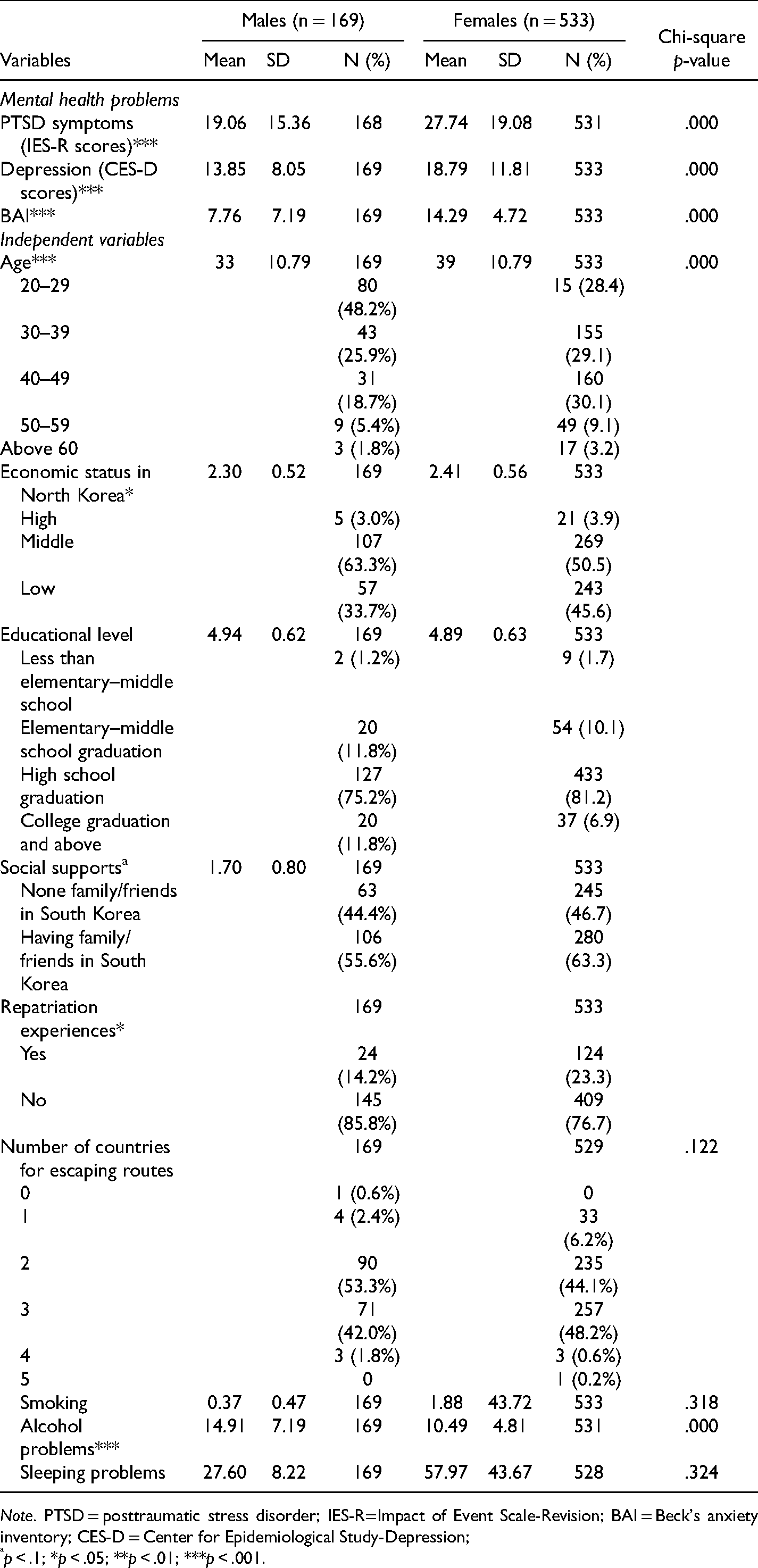
Descriptive statistics and mean difference test for variables among North Korean refugees (n = 702).
Note. PTSD = posttraumatic stress disorder; IES-R=Impact of Event Scale-Revision; BAI = Beck's anxiety inventory; CES-D = Center for Epidemiological Study-Depression;
p < .1; *p < .05; **p < .01; ***p < .001.
Correlation matrix among variables (n = 627).

Note. (1) PTSD, (2) depression, (3) anxiety, (4) repatriation experience in NK, (5) age, (6) economic status in NK, (7) educational level, (8) social supports, (9) number of countries for escaping routes, (10) smoking, (11) alcohol problems, and (12) sleep problems. TSD = posttraumatic stress disorder; NK = North Korea.
†p < .1; *p < .05; **p < .01; ***p < .001.
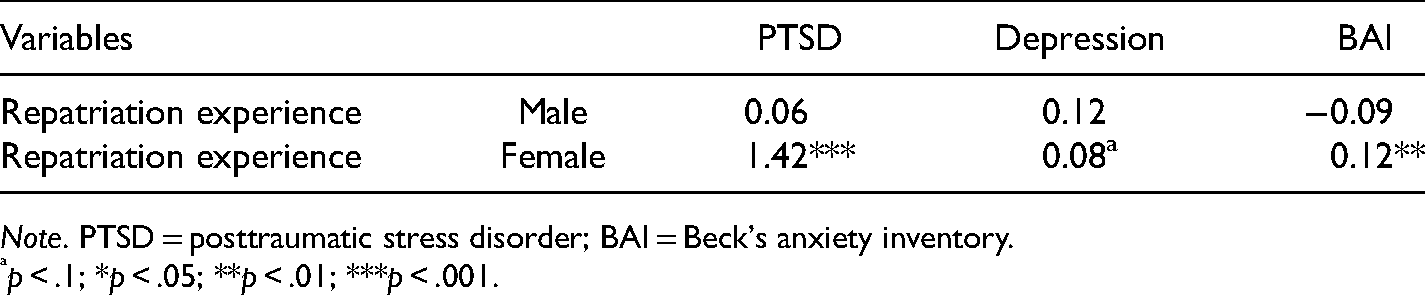
Bivariate analyses between mental health problems and forced repatriation experience by gender (n = 627).
Note. PTSD = posttraumatic stress disorder; BAI = Beck's anxiety inventory.
p < .1; *p < .05; **p < .01; ***p < .001.
Multilevel regression model assessing the impact of traumatic events on PTSD, depression, and other types of psychological problems among North Korean refugees (n = 627).

Note. PTSD = posttraumatic stress disorder; CI = confidence interval; SE = standard error; NK = North Korea.
†p < .1; *p < .05; **p < .01; ***p < .001.
This study examined two hypotheses. Based on the previous literature review, we first hypothesized that the prevalence of mental health problems among North Korean women refugees is higher than that among men. This is because of the complex and accumulated gendered trauma and victimizations in the patriarchal North Korean society and during the premigration period in third countries. Second, traumatic experiences of forced repatriation are associated with more severe mental health problems among North Korean refugee women than their men counterparts. With the feminist criminological theory framework pointing out the differential gendered experiences between women and men, we hypothesize that repatriated North Korean women are at a greater risk of being exposed to traumatic experiences, such as severe physical punishment, including torture, and sexual victimization, including sexual assault, rape, and sexual harassment during their repatriation and detention, which may have a greater impact on the development of serious mental health problems among refugee women compared to men who are only exposed to physical victimization. In this study, the repatriation experience indicates a hazardous setting in which collective and systematic gendered victimization against North Korean refugee women has occurred. Based on this hypothesis, we predicted that North Korean women who experienced repatriation may have higher levels of mental health problems than men.
Results
Descriptive data analysis results
Table 1 shows the results of the descriptive data analysis of the independent and dependent variables. The sample consisted of 79% women (n = 469) and 21% men (n = 131), with an average age of 39 and 33 years, respectively. More than half of the participants reported having a middle-class economic status before they departed from North Korea (women = 50.5%, men = 63.3%). Regarding educational attainment, the highest educational level attained by the majority of participants was high school graduation (women = 81.2%, men = 75.2%). A majority of the participants reported having family members and friends in South Korea (women = 63.3%, men = 55.6%). One out of five participants (21.1%; n = 148) reported having been forcibly deported back to North Korea at least once. More women than men had repatriation experiences (women = 23.3%, n = 245; men = 14.2%, n = 24).
Among the demographic variables, two variables showed statistically significant gender differences in mean comparison: economic status in North Korea (p < .05) and repatriation experiences (p < .05). Women reported a higher average economic status before escaping from North Korea. Additionally, a greater number of women reported repatriation experiences. These findings are consistent with previous studies; notably, men are less likely to successfully make their journey to South Korea if they have once been repatriated back to North Korea (Kim et al., 2018; Noh & Lee, 2020; Yun & Kim, 2021). One of the potential explanations is harsher punishment, including the execution of repatriated male refugees in North Korean penal practices. Due to this harsher punishment, men are thought to have less chance to survive and/or attempt a second escape once repatriated. 6
The results of the mental health assessment showed that women reported serious levels of mental health problems compared to men, although both male and female study participants suffered from clinically significant levels of PTSD. Average IES-R scores were higher for refugee women than their male counterparts (women’s IES-R mean score = 27.74, men’s IES-R mean score = 19.06). These gender differences were highly statistically significant (p < .000). The results suggest a high prevalence of PTSD symptoms among North Korean refugees in general, while refugee women run a greater risk of being diagnosed with severe PTSD than their male counterparts. Such a high prevalence of PTSD among North Korean refugees is not surprising given their multiple traumatic experiences before and during migration to South Korea. Higher rates of PTSD in women compared to men are commonly found in other community surveys and other studies on the mental health of North Korean refugees. The gender differences in our study could be because the North Korean refugee women are especially vulnerable to sexual violence and forced abortions, which are both extremely traumatizing victimizations.
The average scores of CES-D indicating levels of depression were 13.85 for men and 18.79 for women. The mean score for men is below the threshold for clinical depression (CES-D mean 16 or above), while the mean score for women is above the cutoff score. Accordingly, gender differences in the mean CES-D scores were significant (p < .000). North Korean refugee women report higher levels of depression than their male counterparts. This finding is similar to other studies. However, the overall CES-D scores for both women and men are not very high when compared to other studies examining depression among refugee populations in other countries.
One possible explanation for the relatively low depression scores for both genders is that our sample consists of North Korean refugees who only recently arrived in South Korea and thus, were not yet exposed to South Korean society. First, it seems that symptoms of depression often develop sometime after refugees arrive in a safe country as a consequence of unprocessed traumatic experiences and severe postmigration stress, according to prior studies (Bogic et al., 2015). Second, most of our study participants might have transited to several countries before reaching South Korea, a dangerous journey taking several months or even years. During that time, they had to endure a tremendous amount of brutality due to their illegal status as well as harsh and exploitative working conditions. Therefore, individuals suffering from clinical levels of depression would have been unlikely to survive along the road and complete this long and perilous journey. Lastly, our sample is collectively housed in Hanawon, a resettlement support institution run by the government. Thus, they may have bonded with fellow refugees, administrative officials, and staff, which may have lowered the depression level in our sample.
On the other hand, the BAI scores estimating anxiety levels were below the threshold of clinical significance for both men (BAI mean score = 7.76) and women (BAI mean score = 14.29) and the gender differences were significant (p < .000). Again, North Korean refugee women reported significantly higher levels of anxiety than men. This finding is similar to those of prior studies examining North Korean refugees’ mental health problems (Shin et al., 2016). Overall, a comparison of all three mental health-related measures in this study suggests that North Korean refugee women are more vulnerable to developing PTSD, depression, and anxiety symptoms than their male counterparts.
Correlation matrix and bivariate analysis
Table 2 shows the correlation matrix among the variables used in this study. Repatriation experiences are positively and significantly related to levels of PTSD and anxiety symptoms (r = 0.14** and 0.09*, respectively). There are also significant correlations between PTSD and age (r = −0.19**), economic status in North Korea (r = 0.10**), and social supports (r = −0.10**). Anxiety is associated with age (r = −0.16**) and social support (r = −0.08*). These findings indicate that older participants with a higher economic status back in North Korea, who have a lower level of social support in South Korea, and who experienced repatriation, are more likely to have PTSD and anxiety symptoms. It shows that depressive symptoms are significantly associated with alcohol problems (r = 0.07*). Additionally, the correlation analyses indicate potential comorbidity among certain types of mental health problems. There are high positive correlations between depression and PTSD (r = 0.71**), between anxiety and depression (r = 0.67**), and between anxiety and PTSD (r = 0.73**). In fact, such comorbidities are frequently reported in other clinical studies (Orsillo et al., 1996; Wanklyn et al., 2016).
Table 3 shows the results of bivariate regression analyses between mental health problems and forced repatriation experiences by gender. For North Korean refugee men, none of the results are statistically significant, but this may be partly due to the small number of male participants who reported having been repatriated at least once. Among the North Korean women, refugees with experiences of forced repatriation showed significantly higher levels of PTSD (Beta coefficient = 1.42; p < .000) and anxiety (Beta coefficient = 0.12; p < .01) than those without repatriation experiences.
Multivariate regression analyses
A series of multivariate regression analyses were conducted to determine whether there was a gender difference in identifying significant factors predicting North Korean refugees’ mental health problems (Table 4). All models were analyzed separately for both women and men. The following models yielded statistically significant results: for men, the level of PTSD symptoms was predicted by sleeping problems (Beta = 0.51***) and for women, the level of PTSD symptoms was predicted by repatriation experiences (Beta = 0.11**), age (Beta = −0.17***), and social support (Beta = −0.10*), respectively. In addition, economic status in North Korea (Beta = 0.07†) is a significant factor for women at a p-value of .1. North Korean refugee men with a high level of sleep problems are at a greater risk of developing severe symptoms of PTSD than those with lower levels of sleep problems. On the other hand, among the North Korean refugee women, the risk of severe PTSD symptoms increases with age as they have more experiences of forced repatriation, and have less social support from their family and friends in South Korea.
Depression symptoms were predicted by repatriation experience (Beta = −0.17*), alcohol problems (Beta = 0.14*), and sleeping problems (Beta = .44***) for men, and alcohol problems (Beta = 0.20*) for women. Again, educational level (Beta = 0.08†) and social support (Beta = -0.08†) were significant factors for women's depressive symptoms at a p-value of .1. This means that the North Korean refugee men who reported a high level of sleep problems are at a greater risk of developing depressive symptoms. In addition, North Korean refugee men and women with serious alcohol problems are at a greater risk of developing depressive symptoms. This finding is consistent with the literature on the relationship between alcohol consumption problems and depression.
Notably, repatriation experience is negatively associated with the risk of depression in men, indicating that having repatriation experiences may reduce the risk of developing depressive symptoms. However, repatriation experience was not significantly associated with depressive symptoms in women. This finding partly supports the study hypothesis that repatriation experiences to North Korea would worsen mental health problems for the North Korean refugee women compared to their male counterparts. However, such results on the depression symptoms of North Korean refugee men require cautious interpretation. This is due to the following two reasons. First, the average scores of CES-D indicating depression for men are below the cutoff scores for clinical depression. Second, the sample size of men reporting repatriation experiences to North Korea is small.
The model measuring the predictability of anxiety symptoms showed that North Korean women suffer more severe anxiety symptoms as they become older (Beta = −0.14***), if they have more experiences of forced repatriation (Beta = 0.11*), and if they have fewer friends and family members in South Korea (Beta = −0.08). On the other hand, the North Korean refugee men with no repatriation experiences (Beta = −0.18**), a smaller number of people for social support in South Korea (Beta = −0.12*), greater sleeping problems (Beta = −0.58***), and higher frequency of cigarette smoking (Beta = 0.16*) are at greater risk of developing anxiety.
Again, similar to the results of the regression models assessing depression symptoms, the direction of repatriation experience is negatively associated with anxiety for men, while it is positively associated with anxiety for women. This finding supports our hypothesis that forced repatriation to North Korea is a gendered traumatic event exacerbating North Korean women's mental health problems because of the greater risk of experiencing various sexual assaults, including rapes and abuse during the forced repatriation process that is succeeded by interrogations and punishment. However, this result needs to be interpreted cautiously. As already mentioned, among the North Korean refugee men and women in our sample, average anxiety levels are below the threshold for anxiety disorders, and the sample size of men who experienced repatriation to North Korea is relatively small. Further implications of this finding are discussed in the following section.
Discussion
The current study examined two hypotheses regarding gender disparity in mental health problems and the effects of forced repatriation on mental health problems among North Korean refugee women and men. It tested whether the prevalence of mental health problems is greater for women than men and whether the North Korean refugee women are at greater risk of developing mental health problems because of the effects of repatriation experiences than North Korean refugee men. Overall, we found supportive evidence for these two hypotheses. First, the North Korean refugee women reported greater levels of PTSD, depression, and anxiety symptoms than their male counterparts. This finding is consistent with prior studies showing a greater prevalence of mental health problems in women than in men, both among refugee populations and general populations.
Second, the experience of forced repatriation as a traumatic event had a greater impact on PTSD and anxiety, excluding depression, among North Korean refugee women than their male counterparts. The results partly support our second hypothesis, suggesting repatriation experiences as gendered assaultive traumatic events that exacerbate women's mental health problems. According to various official reports, academic articles, and media reports, repatriated North Korean refugees face a wide range of violence including torture, brutal punishments, executions, and sexual abuse under the custody of the North Korean authorities. However, the experiences of women and men differ. The men typicallyexperience only a physically traumatic event, whereas the women face not only physical but also traumatic sexual victimization. The findings of the current study confirm that North Korean women experience a differentially gendered traumatic event, and thus, forced repatriation is a significant threat to the mental health of North Korean refugee women.
Regarding the insignificant relationship between forced repatriation and depression, we provide a probable explanation. This finding may be either because of the distinctive characteristics of the participants who successfully escaped to South Korea, or because they were exposed to minimal resettlement stress and stressors in their destination country. In addition, the nature of communal life in Hanawon may have a substantial impact. All newly arrived North Korean refugees must experience community life in the facility to prepare for a new lifestyle and the sociocultural environment of South Korea. Thus, it is probable that North Korean refugees may be temporarily protected from depression due to communal support and the busy schedule of facility life. However, the current study does not provide concrete support for this inference. Perhaps a subsequent study that directly examines this question is needed.
We assume that this finding may not be limited to North Korean refugee women. Many refugee women from various countries may experience similar types of gendered traumatic events (e.g., sexual assaults and rapes), not only during their premigration and perimigration processes, but also during their accommodation in asylum camps. There are accumulated reports about sexual abuse, violence, human trafficking, and other criminal victimizations of girls and women in asylum camps. This is because most refugee women and girls are from countries where patriarchy is a major social principle. Moreover, they are physically housed in a refugee camp where patriarchy is still the dominant sociocultural force. In addition, there is rampant violent and uncivilized behavior in refugee camps. All of these factors threaten the mental and physical health of refugee women because women are at greater risk of gendered traumatic incidents than men. Therefore, examining and understanding gendered trauma and incidents against women during their premigration and perimigration processes are important and imminent tasks among scholars and refugee health services. This will certainly help to improve the mental health of refugee women during the migration and resettlement processes.
Additionally, we found some gender differences in several predictors associated with North Korean refugee men and women's mental health problems. These findings also confirm our hypothesis regarding gender disparities. Women's mental health, compared with that of men, is more often affected by demographic factors. In contrast, sleep quality problems greatly and significantly affected men's mental health. More interestingly, unlike the women refugees, men with repatriation experiences appeared to have reduced levels of anxiety and depression, which was opposite our expectation.
These findings were interesting. However, such results need to be cautiously interpreted when considering the sociocultural context of the highly patriarchal North Korean society. We propose some plausible explanations for these unexpected findings, such as the limitations stemming from the use of diagnostic categories and measurement instruments developed and tested with Western populations. The instruments we used to assess posttraumatic stress, depression, and anxiety are widely used and recognized as valid and reliable in Western and Westernized societies including South Korea. However, cultural anthropologists, critical psychologists, and scholars of refugee studies have long questioned the cross-cultural validity of symptom-based diagnostic categories such as PTSD, which were developed by North American and European scholars by examining White, Western, and middle-class patients (Henrich et al., 2010).
Some argue that many non-Western cultures lack a medical concept of mental illness, and may consider speaking about one's inner thoughts and feelings to be socially inappropriate, especially for men idealizing toughness and masculinity. In the patriarchal North Korean society, for example, masculinity is the dominant value for men (Jung, 2002; Kim et al., 2017; Park, 2012a, 2012b). In particular, North Korea's patriarchal cultural values underscore ideal masculinity through the myth of a brave Korean warrior who overcomes physical and mental adversity, sacrificing his life to defend his country (Kim et al., 2017). Accordingly, talking about one's negative and feeble feelings and thoughts in the presence of another person is considered to be less manly and thus shameful for North Korean men. Feelings of sadness, anxiety, helplessness, and desperation are incompatible with this masculine ideal (Jung, 2002; Kim et al., 2017; Park, 2012a, 2012b). Therefore, we may be unable to uncover the mental health problems of North Korean refugee men during a psychological assessment because they are less likely to report such negative feelings to interviewers who are strangers to them. They may pretend not to be depressed or anxious due to their traumatic experiences. Moreover, men with repatriation experiences may perceive themselves as strong men who have overcome all life-threatening challenges during their journey. Thus, forced repatriation experiences could reduce their mental health problems. This might also explain the low levels of PTSD, depression, and anxiety among the North Korean male participants.
If this explanation is true, this could be further evidence of gender disparity in mental health and the relationship between traumatic events of forced repatriation and mental health in a patriarchal society. In the patriarchal sociocultural context, women and men undergo differentially gendered experiences of traumatic events, which are physical only for men but both physical and sexual for women. Simultaneously, the same patriarchal context requires differentially gendered coping strategies for similar traumatic events. Men are required to talk less about their traumatic events and consider the experience as a badge. In contrast, according to gender roles, women are expected to be more willing to talk and seek help from others.
This study has some limitations. As mentioned earlier, we could not use culture- and gender-sensitive psychiatry instruments to assess the mental health of our sample. Moreover, the cross-sectional data require a careful interpretation of the results when making causal inferences. Finally, the measure of repatriation experiences in this study does not collect detailed information from the participants regarding gendered assaultive traumatic incidents such as rape, witnessing their own children's murder, and coerced abortion. It is operationalized with a question asking about the participants’ repatriation experiences. If the participants had one or more experiences, it was assumed that the women might have encountered gendered traumatic experiences during the repatriation process and imprisonment. This assessment is drawn from the findings of a rigorous content analysis; therefore, it is quite reliable and applicable because sexual assaults and violence against women in North Korean labor camps and prisons are well-known facts. However, we failed to use a measure developed from an instrument representing gendered assaultive experiences as a major independent variable. Nevertheless, our findings provide important evidence of gender roles in the development of trauma-related mental disorders among refugee women, especially those who survived sexual abuse and were violently traumatized.
Future research on refugee mental health should focus on developing culture-sensitive diagnostic categories and measurement instruments, especially gender-sensitive questionnaires for those from non-Western and patriarchal societies, to collect longitudinal data. Researchers could draw on valuable expertise in the field of transcultural psychiatry (Schouler-Ocak et al., 2018) and from scholars developing and evaluating multidisciplinary treatments for traumatized refugees (Stammel et al., 2017). Finally, we suggest that future studies use or develop a measure containing detailed information about gendered traumatic experiences for refugee women escaping from an extremely harsh society such as North Korea.
Overall, our study findings suggest that we need to develop a deeper understanding of how gender and other demographic and migration-related factors interact with and influence mental health among refugee populations. The role of gender in the interplay between social variables and mental health outcomes also needs to be further investigated to form a comprehensive understanding of the major impacts of traumatic events. Thus far, the results emphasize the importance of providing gender-sensitive care services for the refugee population, especially those with severe traumatic experiences.
Footnotes
Declaration of Conflicting Interests
The authors declared no potential conflicts of interest with respect to the research, authorship, and/or publication of this article.
Funding
The authors received no financial support for the research, authorship and/or publication of this article.
