




Abstract
Research on the effectiveness of protective orders indicates that they have only marginal protective value for the victim. This exploratory study investigated how the physical distance and temporal distance between the victim and offender corresponds to the percent of protective order violations. Results indicated that the percent of protective order violations was reduced to virtually zero when the victim and offender lived 25 miles or more apart. Surprisingly, this condition held for all types of contacts examined (physical, telephone, and cyber). The study concludes with a discussion of the policy implications of the findings and suggestions for future research.
Keywords
Introduction
Intimate partner violence (IPV) is a public health crisis that is estimated to affect over 1.8 million victims a year (Tjaden & Thoennes, 2000). A national survey conducted in the United States indicated that approximately 35.6% of women have been the victim of rape, physical violence, and/or stalking by an intimate partner in their lifetime, and approximately 24.3% of women have experienced severe violence in the form of being hit with a fist, beaten, or slammed against something (Black et al., 2011). Additionally, two-thirds of women who had been physically abused reported that they were repeatedly victimized by the same partner (Langen & Innes, 1986).
This exploratory study was prompted in part by a review of the infamous O.J. Simpson murder case. As reported by mainstream newspapers such as the New York Times, Los Angeles Times, and the Chicago Tribune, Nicole Brown Simpson had been the victim of repeated assaults and threats on her life by her husband. Information retrieved from Nicole's journal describes numerous instances of life-threatening incidents perpetrated by her husband, including beatings during sex and throwing her out of a moving car. Prior to the murder, police were called by Nicole Brown Simpson over eight times regarding threats, intimidations, and beatings by O.J. Prior to the alleged murder, O.J. Simpson lived a mere two miles from his wife.
One option commonly used by potential victims of IPV is to petition the court to issue a protective order (PO) against a potential offender. Protective orders (POs) have been available as a remedy to potential victims of IPV since 1988 (Finn & Colson, 1998) for all 50 states, territories, and the District of Columbia and are the most widely used legal strategy to thwart repeated domestic violence incidents (Ballou et al., 2007; Dejong & Burgess-Proctor, 2006; Jordan, 2004; Logan et al., 2005). The objective of these court orders is to establish conditions of association between the victim and offender, and they may specify conditions regarding contact between the parties, communication by phone or social media platforms, property provisions, conditions of support, and visitation privileges when children are involved (Gondolf, McWilliams, Har, & Stuehling, 1994; Kelitz, Hannford, & Efkeman, 1997; Weisz et al., 1998).
One condition that is routinely imposed by the courts is the amount of distance that the defendant must maintain from the victim. While prior research on domestic violence has explored various dimensions of both the offender and victim, and offense characteristics, no research has been conducted on the amount of distance between the offender and victim and its relationship to PO violations. The present study calculated the distance between the victim and offender for reported violations of POs. Distances were assessed both geographically and by travel time by vehicle. Additionally, results from the study were assessed as a means of identifying an optimal distance between the offender and victim that would minimize the likelihood of a PO violation.
Literature Review
IPV includes a litany of offensive behaviors including physical abuse, psychological abuse, sexual assault, and stalking (Alaggia et al., 2009; Richards et al., 2018). The definition of IPV may also include several no-contact offenses such as texting, phone calls, and the abuse of various social media platforms (e.g., Facebook, Twitter, Tumblr, Instagram, Snapchat). IPV encompasses both traditional and non-traditional relationships to include intimate partnerships; heterosexual and same-sex relationships; married, unmarried or divorced couples; and casual dating relationships (Gover, 2011). Russel, Chapleau, and Kraus (2015) note that the most severe forms of IPV occur among heterosexual couples when the victim is female.
The consequences of IPV have far-reaching effects that are injurious to individuals, family units, and society overall (Coker et al., 2002; Max et al., 2004; Stewart et al., 2016). IPV accounts for the highest incidence of injuries for girls and women between the ages of 15–44 years and is the primary cause of homicide for women throughout the world (Allen & Fox, 2013; Mills, 1998; Novello et al., 1992; Stout, 1989; World Health Organization, 2013). Numerous health consequences may also result from IPV including reproductive disorders, unwanted pregnancies, sexually transmitted infections, and emotional trauma such as depression, anxiety, and post-traumatic stress disorder (Black et al., 2011; Coker et al., 2000; Drossman et al., 1995; Golding, 1999; Hathaway et al., 2000; Jordan et al., 2008; Wyshak, 2000).
The procedure for obtaining a PO usually occurs in a civil court, without the assistance of an attorney (pro se) and can be granted by a judge or magistrate without the defendant being present (ex parte). One feature of POs is that the court can craft the order to fit the unique needs of the plaintiff. For example, the court order may specify the amount of distance (usually expressed in feet) that the offender must maintain from the victim. Other provisions might include forcing the offender to vacate the residence of the victim, and removal of any firearms the offender possesses (Dejong & Burgess-Proctor, 2006; Eigenberg et al., 2003; Logan & Walker, 2009).
While the court has a great deal of discretion in tailoring POs to the needs of the victim, the criteria on which these decisions are made are somewhat nebulous. There are no established criteria by which the conditions ordered by the POs are made (Fisher & Rose, 1995). States vary widely in how POs are processed and the protection afforded to victims. For example, Tversky and Kahneman (1974) note that the conditions of POs by judicial authorities tend to be made based on “heuristics” such as educated guesses or stereotypes. The use of heuristics may facilitate expediated and simplistic decisions, but this approach is likely to ignore the value of evidence-based criteria that include factors such as women with children (Carlson et al., 1999; Harrell et al., 1993), short relationship time periods (Carlson et al., 1999), history of severity of violence in the relationship (Cattaneo & Goodman, 2005; Harrell et al., 1993), perpetrator age (Klein, 1996), offender's prior criminal history (Cattaneo & Goodman, 2005), and stalking (Harrell et al., 1993; Logan et al., 2007).
The effectiveness of POs is a matter of controversy. Some studies suggest that POs are an effective countermeasure for violence. For example, an 18-month study conducted by McFarlane et al. (2004) found that sexual assaults of women decreased by 70% among women who applied for a PO, and these women were three times less likely to be the target of an assault by the offender as compared to women who did not file a PO. Agnew-Brune et al. (2017) suggest that there is a “dose response” phenomenon as measured by the amount of time that the PO remains in effect. They note that violence against the victim decreases exponentially the longer the PO remains in effect. Dugan (2003) analyzed domestic violence legislation and found that states where stricter statutes existed accompanied by more aggressive law-enforcement approaches were associated with a decreased likelihood of victims experiencing violence.
Findings from other studies on the effectiveness of POs suggest that the susceptibility to violence remains high even after the PO is issued. Several studies suggest that from 23% to 70% of victims experience violence after the PO is issued (Carlson et al., 1999; Harrell & Smith, 1996; Kelitz et al., 1997; McFarlane et al., 2004; Tjaden & Thoennes, 2000). In a review of 32 studies across several states Spitzberg (2002) found that the PO violation rate was approximately 40%. A study conducted by Logan and Walker (2009) of 750 women from multiple jurisdictions found over 60% of the women with POs experienced violent episodes following the court order for a PO.
A review of the literature indicates there is a great deal of variability in the rates of PO violations. The lack of clarity regarding the effectiveness of POs is no doubt influenced by methodological issues such as how violations of the PO are defined, the time period that violations were measured, sample attrition rates, and place of violation (i.e., work, home, or school) (Cattaneo & Goodman, 2005; Harris et al., 2001). Logan and Walker (2009) note that several factors influence the validity of studies including how abuse is measured (Cattaneo & Goodman, 2005; Harris et al., 2001; Hotaling & Buzawa, 2003), how re-abuse is measured (e.g., 6 months or 2 years), whether abuse includes psychological abuse, and whether shelter samples or community samples are studied (Logan & Walker, 2010).
Many of the studies are based on convenience samples with a small number of subjects. Furthermore, it is likely that a high percentage of violations go unreported. For example, Hotaling and Buzawa (2003) found after comparing victim reports to official data that upwards of 49% of violations go unreported to law-enforcement authorities. The diversity of methodological approaches and the shortcomings of some of the research on POs make it difficult to determine the overall effectiveness of POs in curbing IPV.
The Crime Proximity Hypothesis
The literature surrounding the investigation of the mobility of offenders, or more specifically, the distance offenders travel to commit an offense, is known by several different names such as journey-to-crime, distance-to-crime, crime mobility, and crime places (Brantingham & Brantingham, 1995; Nichols, 1980; Phillips, 1980; Pizarro et al., 2007; Smith et al., 2009; Townsley & Sidebottom, 2010; Weisburd, 2004; Weisburd et al., 2012). In general, this research falls under the rubric of “environmental criminology.” Historically, criminologists such as Guerry (1833) and Quetelet (1842) constructed maps detailing where crimes occurred across large geographic areas. During the first quarter of the 19th century, criminologists such as Thasher (1927) and Shaw and McKay (1972) focused on the geographic distribution of crime and its relationship to community social disorganization, prompting a major theoretical perspective in criminology and sociology. A study conducted by White (1932) was among the first to document that the distance-to-crime was short, especially for violent crimes such as homicide, burglary, assault, and crimes with a sexual component. More recent studies on violent crimes confirm White's findings (Fritzon, 2001; Santtila et al., 2008).
However, Weisburd (2004) contends that research focusing on distance-to-crime as a crime reduction strategy was largely ignored by criminologists until the 1990s. This was due to the finding made by several studies showing that that the opportunity to commit crime was so prevalent that there was little to be gained by investigations of this type. For example, Sutherland (Sutherland et al., 1992), among others, argued that this approach had limited value as a crime-prevention strategy since the opportunities to commit crimes such as burglary were so numerous that its importance paled in comparison to dispositional characteristics of offenders addressed by theories such as Routine Activities as a crime-prevention strategy (Cornish & Clarke, 2014).
According to Weisburd (2004), traditional approaches to crime prevention began to lose their appeal due to a growing body of literature that suggested that there was little evidence that criminal offenders could be rehabilitated (Jeffrey, 1971; Kelling et al., 1974; Martinson, 1974; Spelman & Brown, 1984; Wilson, 1980). This trend continued through the mid-1990s until prison populations were overwhelmed due to policies such as minimum-mandatory sentencing policies, increased emphasis on the sale and possession of narcotics, three-strikes legislation, and a renewed interest in more progressive approaches to crime reduction such as community policing (Marvell & Moody, 2001).
More recently, several studies documented that the average distance offenders travel to commit crimes from their residence is on the average within a two-mile radius (Costello & Wiles, 2001; Rengert et al., 1999; Rossmo, 2000). Several studies focused on the “distance-to-crime” subject for specific offenses. For example, the sale of drugs appears to occur in closer proximity to an offender's home as compared to other offenses (Eck, 1992; Johnson, Taylor, & Ratcliffe, 2013) Research on violent crimes as compared to property crimes indicates that they occur closer to the perpetrator's residence. This may be because many violent crimes occur in a residence that the perpetrator and victim share, or to the advantage that short distances have in establishing or maintaining a relationship. Various studies that focused on the crime of burglary indicate that offenders burglarized residences in close proximity to where they live (Cromwell, 1991; Rengert & Wasilchick, 1985; Reppetto, 1974; Snook, 2004; Vandeviver et al., 2014). Numerous studies of rape victims cite evidence to support the claim that rape commonly occurs between victims and offenders who know each other (Black et al., 2011; Crawford et al., 2008; Fisher, 2000; Jones et al., 2004; Warshaw and Cosgrove, 1989). Various forms of rape such as date rape, marital rape, and drug-facilitated rape are disproportionately represented by parties who are acquainted with each other as compared to rapes committed by strangers (Allison & Wrightsman, 1993; Alston, 1994; Bell et al., 1994; Koss, Dinero, Seibel, & Cox, 1988, Rossmo et.al 2004). Rossmo (2000) and Warren et al. (1998) note that the distance between victim and offender is influenced by several variables such as the residential location of the victim and offender, locations where potential victims congregate, and environmental features. A study conducted in the Dallas, Texas area by Ackerman and Rossmo (2015) found that the median distance between offender and victim for rape was four miles.
Overall, research on distance-to-crime reveals that the distance traveled by offenders to commit various sorts of crimes is short. Zipf (1949) maintains that the relatively close proximity between offenders and victims is due to what he referred to as the “least-effort-principle.” According to this principle, an offender takes the path of least effort and resistance in locating a suitable target for crime. With the exception of Sherman and Weisburd's (1995) study of the deployment of law-enforcement personnel for hot-spot enforcement, most of the research on distance-to-crime has been exploratory and descriptive in nature.
Research Question
The research question for this exploratory study investigates whether there is a certain distance that PO violators should live from their victims that would significantly reduce the probability of PO violations. It is assumed that someone living next door to a victim would find it easier to violate a PO than someone living 100 miles from the victim. Our interest in this article is to determine if there is some optimal boundary between those two extremes. More specifically, the focus of this exploratory study is to determine whether there is an optimal distance between the residences of the offender and the victim that will reduce the likelihood of a PO violation.
Data
This study used seven years of data from the Unified Police Department of the Greater Salt Lake County area for the years 2011–2017. The Unified Police Department is the second largest law-enforcement agency in the state of Utah. It employs over 385 staff members and serves eight different communities and townships in Salt Lake County, Utah. The Unified Police Department is charged with serving and enforcing civil POs for all the areas it serves.1
Data for this research came from 624 police files of offenders who violated POs. The study focuses solely on intimate relationships between female victims and male offenders. Offenders include husbands, ex-husbands, boyfriends, and ex-boyfriends. The records for other offenders were excluded, that is, male victims with female offenders, records with incomplete addresses, and violations involving other family relationships such as child/parent or siblings (a total of 141 records were eliminated). A total of 483 records were complete and met the criteria for inclusion in the study.
The types of contact violations listed in the files include physical contact violations, telephone calls, emails, texts, and social media contacts. For this analysis, emails, texts, and social media were combined into a single type of contact labeled cyber contacts. This new grouping results in three categories of contacts: physical, telephone, and cyber.
Four new variables were created from the database. The first two variables, driving distances and driving times, were calculated using the addresses of offenders and victims from the police records and Bing Software distance calculations (Microsoft Corporation, 2020). Distances between the residences of offenders and victims range from <1 mile to 67 miles, with driving times ranging from a mean of 4.9 minutes to a mean of 72.7 minutes. The other two variables used were the ages of the offender and the victim at the time of the violation. Ages were calculated using the date of birth and the date of the PO violation. The mean age of male offenders is 37.7; the mean age of female victims is 35.0. Most of the offenders in the sample had previous violations. Fifty-three percent had three or more violations with an overall mean of 3.5.
Results
To discover the distance beyond which few offenders violate a PO, a scatterplot was created using all contact and relationship groupings combined to find the distances between the residences of offenders and victims along with the percent of overall offenders for each driving distance (Figure 1). The scatterplot clearly shows that as the distance between offenders and victims increases, the percent of offenders decreases. The plot also identifies two distinct distributions: a decreasing trend where the distance is <25 miles and a flat line trend for distances over 30 miles. A natural break occurs between 25- and 30-miles distance, those offenders who live less than 25 miles from their victims and offenders who live more than 30 miles from their victims. Each group was then analyzed independently, and reference lines were added to the plot to facilitate the tracking of points across the entire range of both the vertical and horizonal axes.
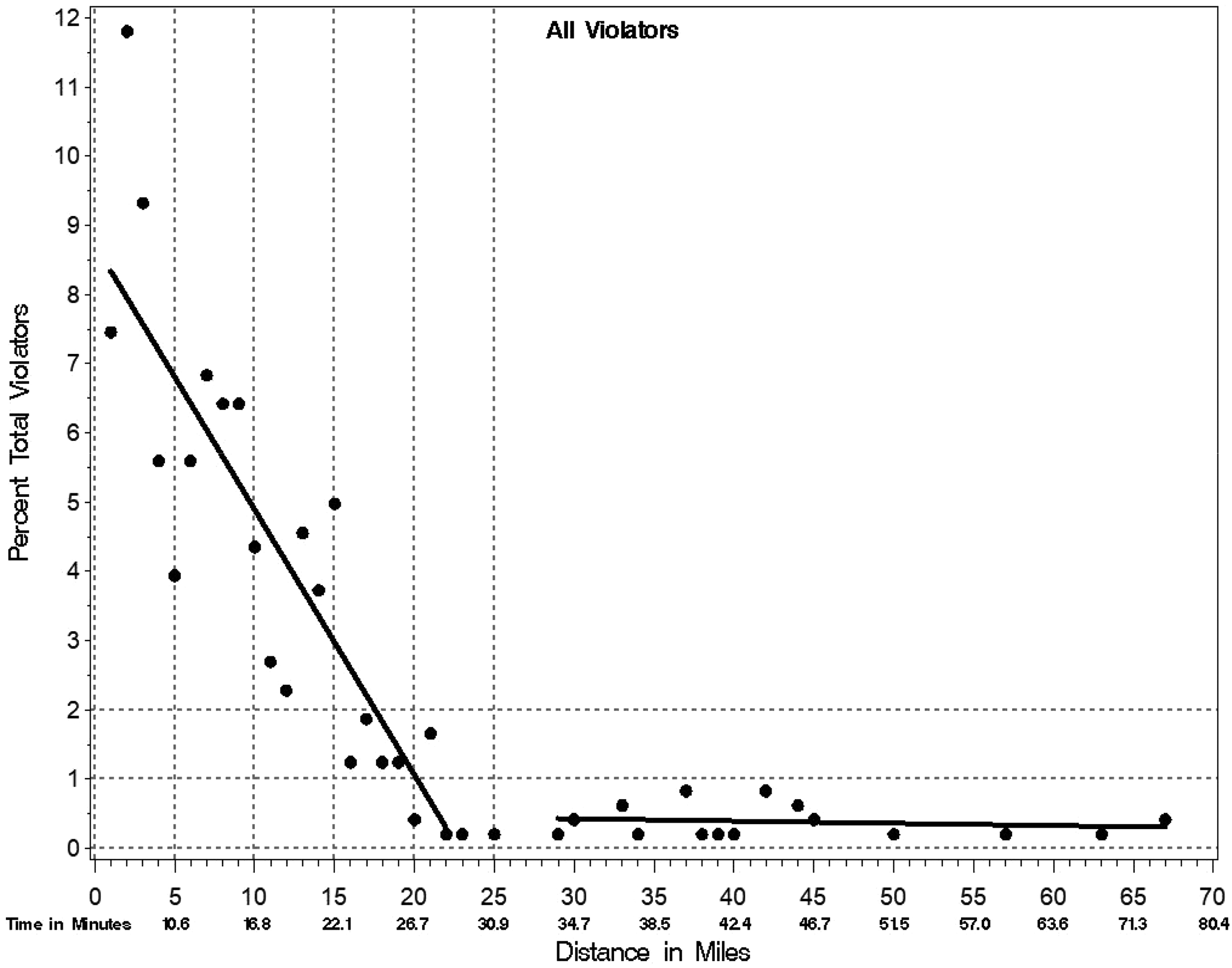
Scatterplot showing all violators and mean driving times. As the distance between the offender and victim increases, the percent of violators decreases, and the driving times increase.
Two regression lines were independently created on the scatterplot to show the change in the percent of offenders by distance. The regression line for distances below 25 miles decreases at a mean percent of 4.06% for every 10 miles distance (n = 483, p-value <.01). That is, for every 10-mile increase in the distance between the offender's home and the victim's home, there is just over a 4% decrease in offenders. For distances more than 25 miles, the regression line remains flat, and the percent of offenders at each mile is less than 1%. In addition to distances, the horizontal axis includes the mean driving time for each 5-mile distance. The drop in offenders at 25 miles represents a mean driving time of 30.9 minutes showing that the percent of violators decreases to near 0 when offenders live more than 25 miles or about 30 minutes away from their victims.
Intimate Relationship Groups4
Relationship types are divided into the four groups (husband, ex-husband, boyfriend, and ex-boyfriend). Figure 2 is a scatterplot of the data which includes percentages for each of the four groups compared to distances from offenders to victims. As in Figure 1, there are two basic distributions in Figure 2, one before and one after the 25-mile break. Regression lines were calculated independently for each of the four relationship groups and for the two distance groups. The patterns for husbands, ex-husbands and ex-boyfriends are very similar, decreasing in percent of offenders at 4.20% (n = 113, p-value <.05), 3.22 (n = 172, p-value <.01) and 3.70 (n = 159, p-value <.01) per 10 miles, respectively. Boyfriends who violate a PO live at greater distances from their victims, and their offenses decrease at a lower 2.2% per 10 miles for distances up to 25 miles. The slope of the regression line for boyfriends is not statistically significant; however, it follows the same general decreasing pattern as the other relationships. The lack of significance may be due to the small sample size (n = 39). There were no boyfriend offenders in our sample beyond the 25-mile data break. The regression lines beyond 25 miles are similar for husbands, ex-husbands, and ex-boyfriends with less than 2% for most offenders, thereby reaffirming the 25-mile distance as a boundary for PO violations by intimate partners.
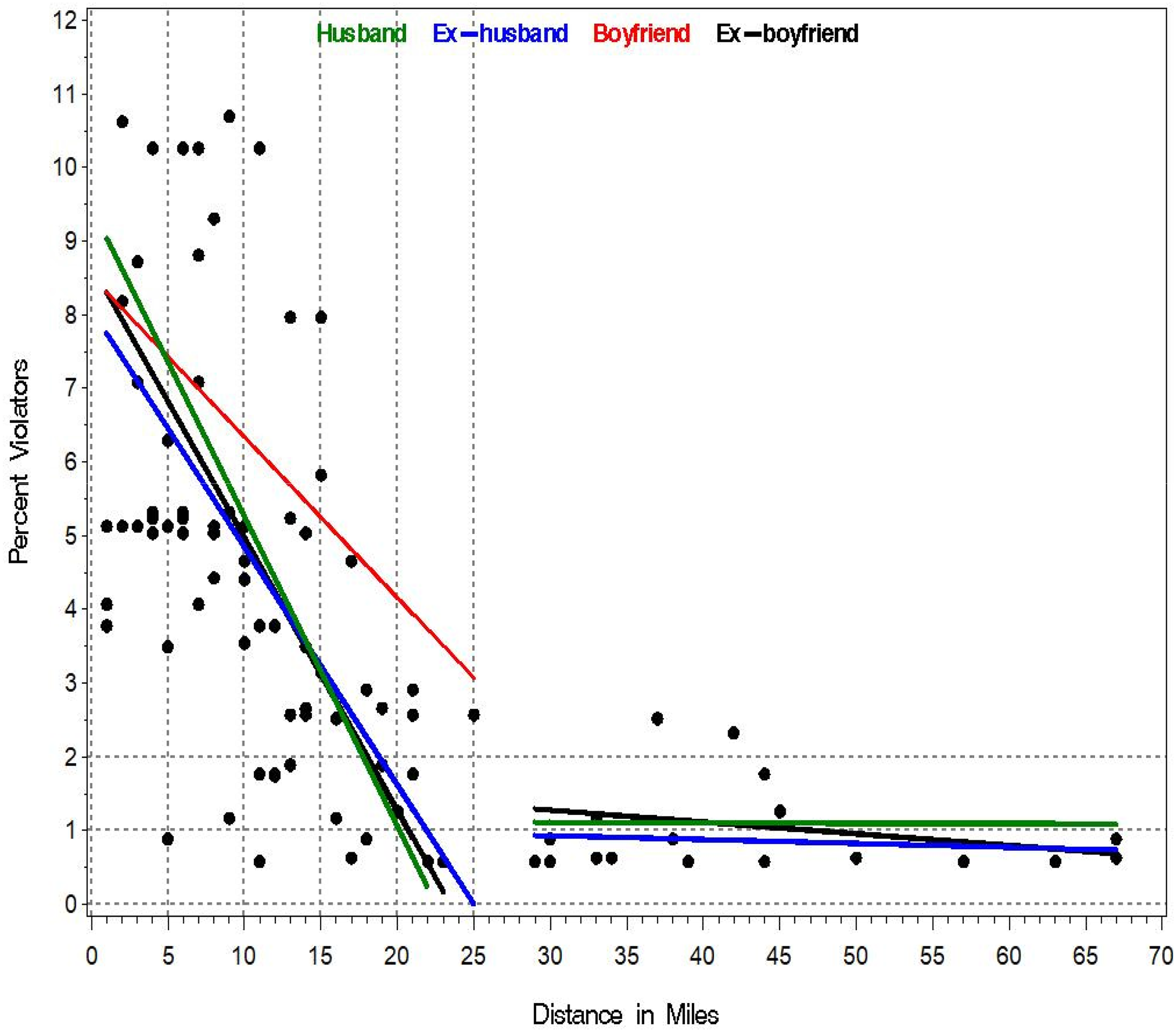
Scatterplot showing four offender relationship groups: husband (green), ex-husband (blue), boyfriend (red), and ex-boyfriend (black). As the distance between offender and victim increases, the percent of violators decreases regardless of the relationship between the offender and victim.
Types of Contact
The types of contact made by offenders were divided into three groups: physical contact, telephone contact, and cyber contact (emails, texts, and social media). Regression lines were calculated for these three types before and after the break in the data at 25-miles distance (Figure 3). Physical contact begins at a higher percent than the other types of contact and decreases at the most rapid rate of 4.02% per 10 miles (n = 249, p < .01). For physical violations, the Salt Lake County Unified Police Department database does not include the location of the assault. We realize that physical violations do not necessarily take place at the victim's home. They may occur at the victim's work, church, gym, or other locations. However, we assume that if the offender lives in close proximity to the victim, the location of the physical violation is nearby as well. This assumption is supported by a Bureau of Justice Statistics report on family violence that occurred between 1998 and 2002 (Durose, et al., 2005). The report states that nearly nine out of 10 incidents of family violence took place in or near a residence, either the residence of the victim or the residence of a friend, relative, or neighbor of the victim. Findings indicate that 73.5% of family violence took place at or near the home of the victim with an additional 15% occurring at the home of a friend, relative, or neighbor. According to the report, the majority of spousal violence (78.1%) and boyfriend/girlfriend violence (64%) occurred in the victim's home.
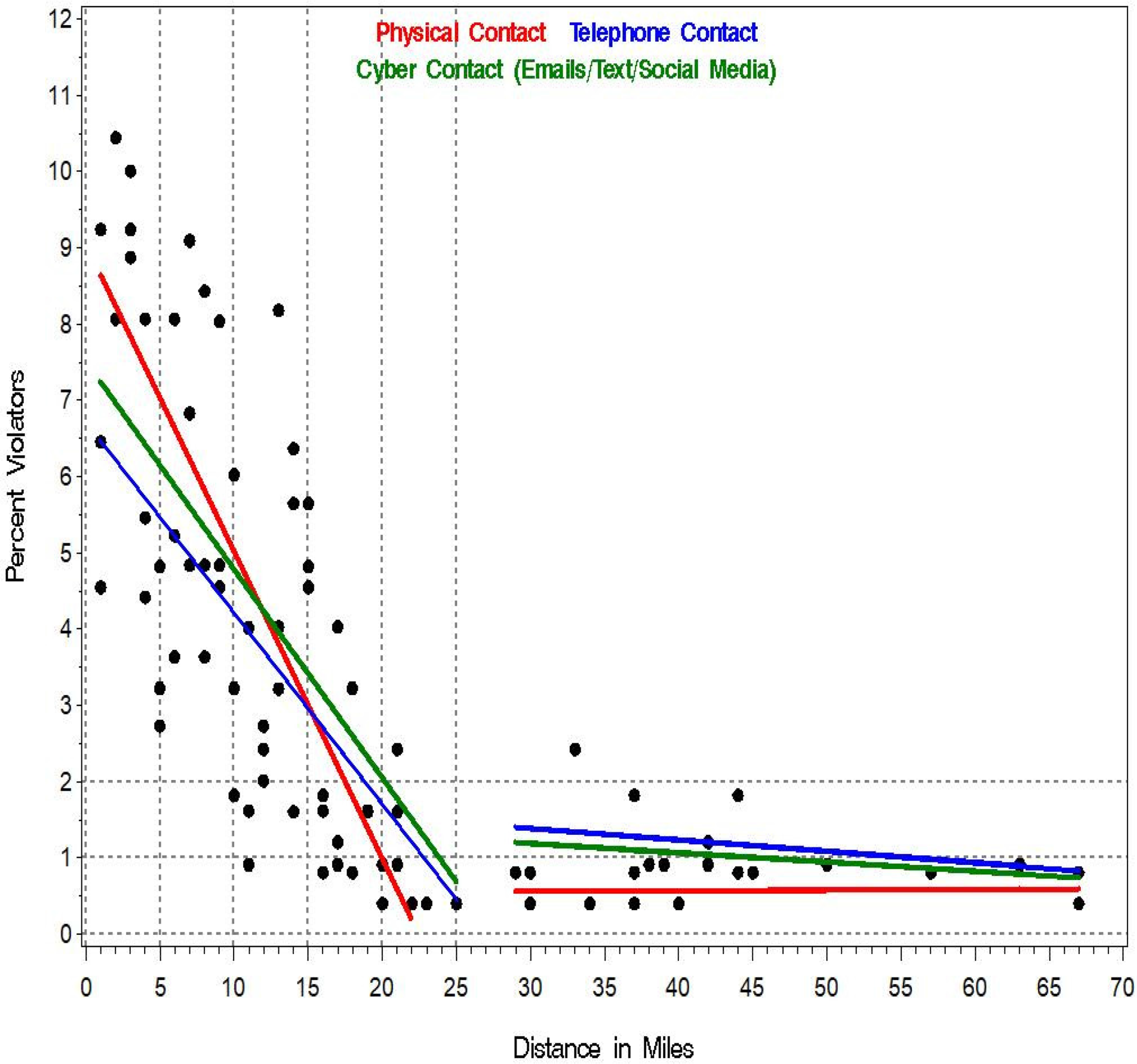
Scatterplot showing the type of contact violation: physical contact (red), telephone contact (blue) and cyber contact (green). Cyber contact includes emails, text, and social media. As the distance between the offender and victim increases, the percent of violators decreases regardless of the type of contact.
For other types of violations (telephone or cyber), the location is not an issue and could originate from any distance. Telephone contacts and cyber contacts are very similar in both the percent of offenders at each distance and the percent of decrease. Telephone violations decrease at 2.5% per 10 miles (n = 110, p < .05). Cyber violations decrease at 2.74% per 10 miles (n = 124, p < .01). Telephone and cyber contacts decline at about half the percentage of physical contacts. The slopes for all three contact violation types (physical, telephone, and cyber) beyond 25 miles is basically flat, remaining at less than 2% of violators.
The surprising finding here is that nonphysical contacts follow the same distance pattern as physical contacts even though contact by telephone, email, text, or social media can be made from any distance. One possible reason for this lack of difference is that an offender must be close enough to his victim for a threat to be meaningful. If the offender lives far away, the victim can hang up or ignore the contact without fear of immediate physical reprisal. Another possible reason is that beyond 25 miles the offender and victim are less likely to encounter each other by accident and trigger strong emotions that provoke violence. Thus, the 25-mile break tends to serve as a boundary for all contact types. Table 1 is a summary of statistics for all regression lines including the sample size, R-squared, the slope, and the p-value.
Summary Containing Sample Size, R-squared, Slope of the Regression Lines, and p-values for all Violators, Intimate Offender Relationships and Types of Contact.
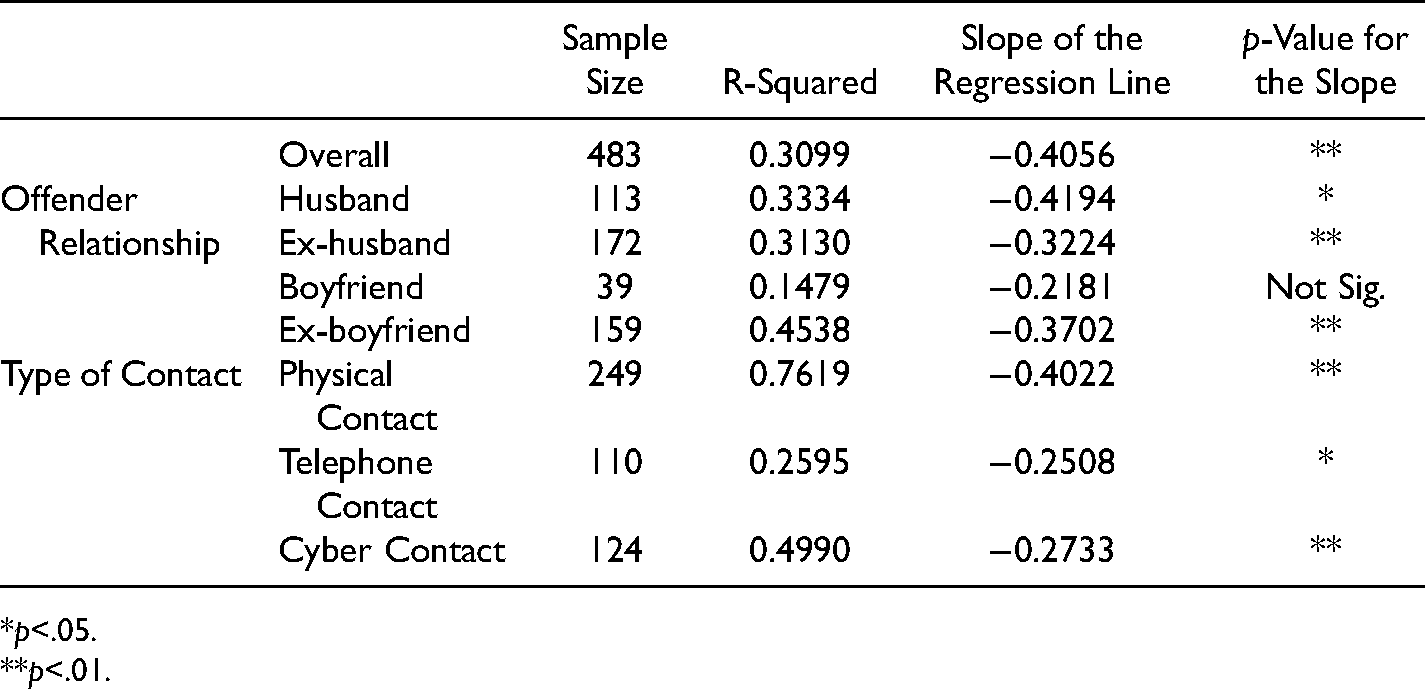
*p<.05.
**p<.01.
Discussion
The results of this study indicate that the amount of distance between the victim and offender is potentially a crucial factor in preventing IPV after a PO has been issued. Common sense dictates that an excessive distance between the offender and victim (e.g., 100 miles) substantially reduces the likelihood that a physical attack on the victim will occur. Hence, the question is not “does distance make a difference,” but rather “how much distance” makes a difference? The results of this study demonstrate quite clearly that the “safe protective distance” for the sample studied is approximately 25 miles between the offender and the victim. An unanticipated finding of the study is that the 25-mile barrier applies to nonphysical types of violations as well (i.e., phone calls, emails, texts, and social media).
Judges who issue POs wield considerable discretion in imposing conditions with which potential offenders must comply to avoid more severe sanctions including incarceration. For example, some sex offenders have been ordered to place a sign on their front lawn declaring that a “sex offender lives here.” Some judges have ordered repeat driving under the influence (DUI) offenders to acknowledge their transgression by an indication on their license plate. Given our fragmented criminal justice system, the authority vested in judges to craft conditions of specific deterrence depends on such factors such as court jurisdiction, statutory law, and sentencing guidelines. As it is, judges routinely impose distance limitations between offender and victim, but this is usually expressed in feet rather than miles. In the absence of empirically based guidelines, distancing decisions seem to be made on the basis of speculation and unfounded assumptions about what constitutes a “safe zone” for victims.
It would be improper to impose a 25-mile distance restriction for all offenders when POs are issued, and this should be reserved for offenders who are deemed “high risk” for PO violations. In addition to the findings on distance, this study suggests that offenders in certain types of relationships, specific types of contacts in certain age brackets, and with a history of prior criminal activity (including prior violations of POs) might be candidates for the high-risk designation. Instruments such as the Spousal Assault Risk Appraisal Guide, the Domestic Violence Inventory, and the Domestic Violence Risk Appraisal Guide have been created to predict various forms of IPV risk. However, none of these instruments has used the proximity between the victim and the offender as an indicator. Perhaps the distance between the victim and the offender could be used as one of the indicators thereby increasing the overall predictive utility of IPV risk-appraisal instruments.
Admittedly, this study has limitations. Data for this study were based on a specific county in the state of Utah. Whether the findings of this study could be generalized beyond the study sample is dependent upon additional research. It is possible that the “safe distance barrier” may be shorter or longer depending on a specific state or community. Temporal distance may also vary depending on the location. For example, the time to drive 25 miles in a populous city such as Los Angeles will be greater than the drive time in a less populous state such as Wyoming.
Additional research should be done to not only substantiate the findings of this study, but to further clarify what factors might predict protective order violations. The relationship between temporal and spatial distances also needs to be clarified as they relate to reducing protective order violations. Doing so would perhaps provide judicial authorities with an additional tool to use in preventing the occurrence of PO violations and other forms of intimate partner violence.
Footnotes
Declaration of Conflicting Interests
The authors declared no potential conflicts of interest with respect to the research, authorship, and/or publication of this article.
Funding
The authors received no financial support for the research, authorship and/or publication of this article.
