



Abstract
Abuser-initiated workplace disruptions are experienced by women who are in abusive intimate relationships. However, workplace disruptions may be prevented with targeted workplace supports. Using pilot data, this study examined relationships between workplace disruptions and workplace supports. Crosstabulation and Fisher’s exact test results were stratified by race to understand potential racial discrimination of survivors. Findings revealed supports are associated with infrequent workplace disruptions for Black women, but White women were extended a wider variety of supports, even with frequent disruptions. Discussion of results is applied to workplaces and policy makers seeking to better support employees experiencing partner violence.
Introduction
Intimate partner violence (IPV), or the experience of physical, sexual, emotional, or mental abuse, is a severe public health problem affecting women of all racial and ethnic backgrounds (Centers for Disease Control & Prevention, 2020). The scope of IPV is broad: a 2010 review of global prevalence, which included 141 studies from 81 countries, found 30% of women ages 15 + years have experienced IPV (physical and/or sexual) during their lifetimes (Devries et al., 2013). Along with being the leading cause of injury for women 18 – 44 years, IPV can have major short- and long-term impacts for survivors, such as employment instability (Devries et al., 2013; MacGregor et al., 2019). Half of large employers (employing 1,000 or more workers) in the United States reported an incident of IPV in the workplace, and 32% of state government agencies reported incidents of IPV in the workplace (Department of Labor, 2006).
Individual female IPV survivors lose an average of $100,000 throughout the course of their lives due to costs of medical and mental health services, criminal justice involvement, and lost productivity (Peterson et al., 2018). Costs are likely higher for Black women, who are known to experience abuser-initiated workplace disruptions resulting in employment instability at higher rates than their White counterparts (U.S. Equal Employment Opportunity Commission, 2021). Even though more than 90% of CEOs agree that IPV impacts employment, only 13% believe their companies should play a part in addressing IPV (Corporate Alliance to End Partner Violence [CAEPV], 2007). However, workplace supports offered to survivors during periods of abuse by coworkers have been shown in previous research to help them maintain employment (Swanberg et al., 2006; Yragui, 2008). The purpose of this study was to determine how race impacts the supports women receive in the workplace when experiencing IPV as well as how they relate to specific forms of abuser-initiated disruptions. Additionally, what kind of workplace supports have a significant impact on disruptions and what could help survivors maintain employment were examined.
Literature Review
Workplace Disruptions
Workplace disruptions, or “control and sabotage that is specifically directed at interfering with work” (Brush, 2002, p. 744), are experienced by more than half of all IPV survivors (Postmus et al., 2012; Reeves & O’Leary-Kelly, 2007). Examples include the following: sabotaging childcare, workplace stalking, undermining skills needed at work, harassment via social media and online platforms during work hours, and demanding attention or sex when the survivor is trying to work/leave for work. Previous research has found the most common abuser-initiated workplace disruptions are picking fights when survivors needed to work and keeping survivors from sleeping before working (Brush, 2002; Showalter & Dillard, under review). In a study of women receiving social services (N = 135), 92.5% of women who reported that their partner was disrupting their work were also experiencing physical IPV (Alexander, 2011). In other words, workplace disruptions are not only common among survivors but are also linked to extremely dangerous and life-threatening forms of IPV (Alexander, 2011).
Workplace Supports
Previous research has found that the adverse effects of IPV on employment can be reduced with workplace supports or protective factors that decrease IPV (Staggs et al., 2007; Yragui, 2008). When coworkers or managers connect survivors with community resources, alter their workload or schedules, as well as offer a listening ear, they help an estimated 72% of survivors to maintain employment (Swanberg et al., 2006). In one qualitative study, a survivor recalled when her workplace allowed her to change her work hours to throw off an abusive partner: “I could come in later. I could work 9:30 to 6:00, or—so that he didn't know when I was coming and going” (Showalter & McCloskey, 2020, p. 16). Similarly, in another qualitative study of the entanglement of work and IPV (N = 34), one survivor explained feeling empowered by others at work: “The boss was trying to build me up, make me stronger I guess you could say. To stand up to him … ” (Borchers et al., 2016, p. 475). While a majority of survivors reported having at least one type of support in the workplace (Swanberg et al., 2006), the effect of individual supports on workplace disruptions is unknown.
Gender, Race, and Workplace Discrimination
Women consistently earn less and are treated differently in workplaces than men. Even well-educated professionals like physicians and attorneys have reported discrimination based on gender and parental roles (Adesoye et al., 2017; Plickert & Sterling, 2017). Workplace discrimination can be displayed overtly in the form of bullying, aggression, harassment, abusive supervision, or incivility as well as covertly through ostracism, interpersonal conflict, microaggressions, blockage of professional development, tasking of race/ethnicity ambassadors, and bias (McCord et al., 2018; Osseo-Asare et al., 2018).
Discrimination is likely heightened when women experience IPV, particularly for women who are Black. Qualitative research has found that some survivors experience discrimination and intolerance of IPV among managers and coworkers (MacGregor et al., 2020; Showalter & McCloskey, 2020). In a review of qualitative studies on survivors’ employment, researchers found 12 articles that mentioned survivors feeling judged by coworkers for experiencing IPV and nine articles that mentioned survivors hiding IPV from coworkers in fear of being fired or missing opportunities for advancement (MacGregor et al., 2020). Further, given that Black women are more likely to report violence (Cunradi et al., 1999; Hampton & Gelles, 1994; Rennison & Welchans, 2000; Sorenson et al., 1996; Tjaden & Thoennes, 2000) and that racial discrimination is the third most common type of discrimination in U.S. workplaces (U.S. Equal Employment Opportunity Commission, 2021), discrimination among Black survivors receiving and accessing workplace supports likely exists. Since social supports can improve the well-being of Black women experiencing IPV (Bukowski et al., 2019), more research is needed on how Black women are receiving and accessing supports in the workplace compared to their White counterparts.
Theoretical Support
To explore the effect of workplace supports on survivors’ workplace disruptions, the current study draws from the social support theory buffering hypothesis. The theory suggests that social support “buffers” or relieves stress of threatening events through perceptions that others will intervene in harm and offer assistance in the face of stressful events (Cohen & Wills, 1985). Accordingly, it is believed that workplace supports could potentially affect workplace disruptions both by preventing the disruption through perception of support and by providing a solution to individual disruptions (Cohen & Wills, 1985). Further, Cohen and Wills (1985) state that support is most effective when it is specific to the stressor. Thus, the aim was to understand specific disruptions by looking at individual items in crosstabulations. The use of the social support theory buffering hypothesis is also justified given its usage in closely related research (see Yragui et al., 2012).
Methods
Design
The current study was cross-sectional in design and conducted both in person and online through a Midwestern IPV advocacy and service agency. The survey took ∼45 min to complete and included items of IPV, workplace disruptions, workplace supports, mental health problems, demographics, and employment variables. Participants received a $20 gift card for their time and participation. Due to the availability of IPV advocates for emotional support and lack of personally identifying questions, the study was considered exempt by relevant Institutional Review Boards (IRBs). Researchers completed all IRB trainings and requirements to conduct the study. No personally identifying information on participants was collected so that all survey data could remain anonymous. All participants were recruited in a secure location and were able to choose a safe location to take the survey (e.g., on paper with the researcher or online). Participants had access to licensed counselors in case they experienced emotional distress. Consultation with family violence experts at the agency determined that research procedures were safe for participants.
Recruitment and Current Sample
Participants (N = 41) were recruited by posting and distributing flyers to survivors in addition to discussing the study with the researcher during onsite recruitment. Inclusion criteria were as follows: 18 years or older in age, identify as a woman, employed at some point during their experience of IPV, and not (at the time of the survey) having experienced cyberstalking due to the online platform used by some participants. Twenty-nine people (59.2% response rate) either declined to take the survey or did not meet inclusion criteria. The current analysis included all participants who identified as White (N = 19) or Black (N = 20) in the full sample.
Measurement
Workplace Disruption
Workplace disruptions were assessed with 16 different items asking participants to indicate how frequently each of the disruptions happened during their relationship. The items were developed using previous measurements (see Work/School Abuse Scale; Riger et al., 2000; and the Scale of Economic Abuse; Adams et al., 2008) and interviews with IPV survivors (Showalter & McCloskey, 2020). The measurement was validated in a related study using the current sample (see Showalter & Dillard, under review). Items included questions about the partner physically following survivors to work, watching or waiting outside of the workplace, texting or calling the cell phone and/or office phone, texting or emailing many times during work, sending unwanted messages on social media to the participant or coworkers while at work, and sabotaging the education or professional relationships needed for promotion. They also included questions regarding the participant's lack of confidence at work, missing days or weeks of work, being fired, and not being able to meet work-related long-term goals. Each item was scored on a 5-point Likert scale from 1 (never) to 4 (always). Given the small sample size and workplace disruption measurement in related research (see Brush, 2002), all workplace disruption variables were collapsed into two categories representing the occurrence of any of the workplace disruptions (scale responses sometimes, often, always, or rarely) or the absence of such (scale response never).
Received Workplace Support
Received workplace support was measured using the Intimate Partner Violence-Workplace Support Assessment (IPV-WSA; Yragui, 2008). The IPV-WSA scale was developed using social support theory, related literature, and interviews with IPV survivors (Yragui et al., 2012). The IPV-WSA contains 11 items asking the participants to indicate if they had or had not received various types of support related to domestic violence from a supervisor or coworker. The survey has been validated (see Yragui, 2008) and used in closely related research (Perrin et al., 2011). The items included the following: supervisors/coworkers approaching the participant and asking if everything is okay, treating the participant as if nothing was wrong, making a phone call to get help, listening to the participant's problems in a private place, lightening the participant’s workload but keeping the hours the same, giving information on domestic violence services, giving advice about the relationship, keeping everything confidential, giving paid time off to deal with an abusive relationship, asking what kind of help is wanted, and showing concern. Participants were also asked if they would have wanted each type of support; however, due to the limited sample size, only items that participants received were analyzed (i.e., support received = 1 and not received = 0).
Statistical Analysis
Bivariate analysis was performed using Fisher's exact test to explore potential relationships between workplace disruptions and received workplace supports. Given the small sample size (Breslow & Day, 1980), Fisher's exact test was the appropriate statistical test to examine the presence of associations of workplace disruptions and received workplace supports. Additionally, a Fisher's exact test needs to be utilized for 2 × 2 tables with an expected frequency of 5 or less in several cells (Rosner, 2011), which applied to this study. The two levels for workplace disruptions were having experienced any of the disruptions and not having experienced any of the disruptions. The two levels for workplace supports were having received support at the workplace and not having received support at the workplace. The results were stratified by Black and White participants. The software used for statistical analyses was IBM SPSS Statistics version 27.
Results
Descriptive Statistics
Descriptive statistics for all participants can be found in Table 1. On average, participants were 35 years old (SD = 10.62), had at least two others living in their household besides themselves (M = 2.54, SD = 1.97), and had an average income of $10,949.24 (SD = $14,756.41). The majority identified as non-Hispanic and had a high school education or less. Across all workplace disruptions, participants reported on average that abusive partners sometimes harassed them at work, and that they received on average about five different types of support from coworkers and managers (M = 5.78, SD = 5.02).
Descriptive Statistics.

Fischer's Exact Test
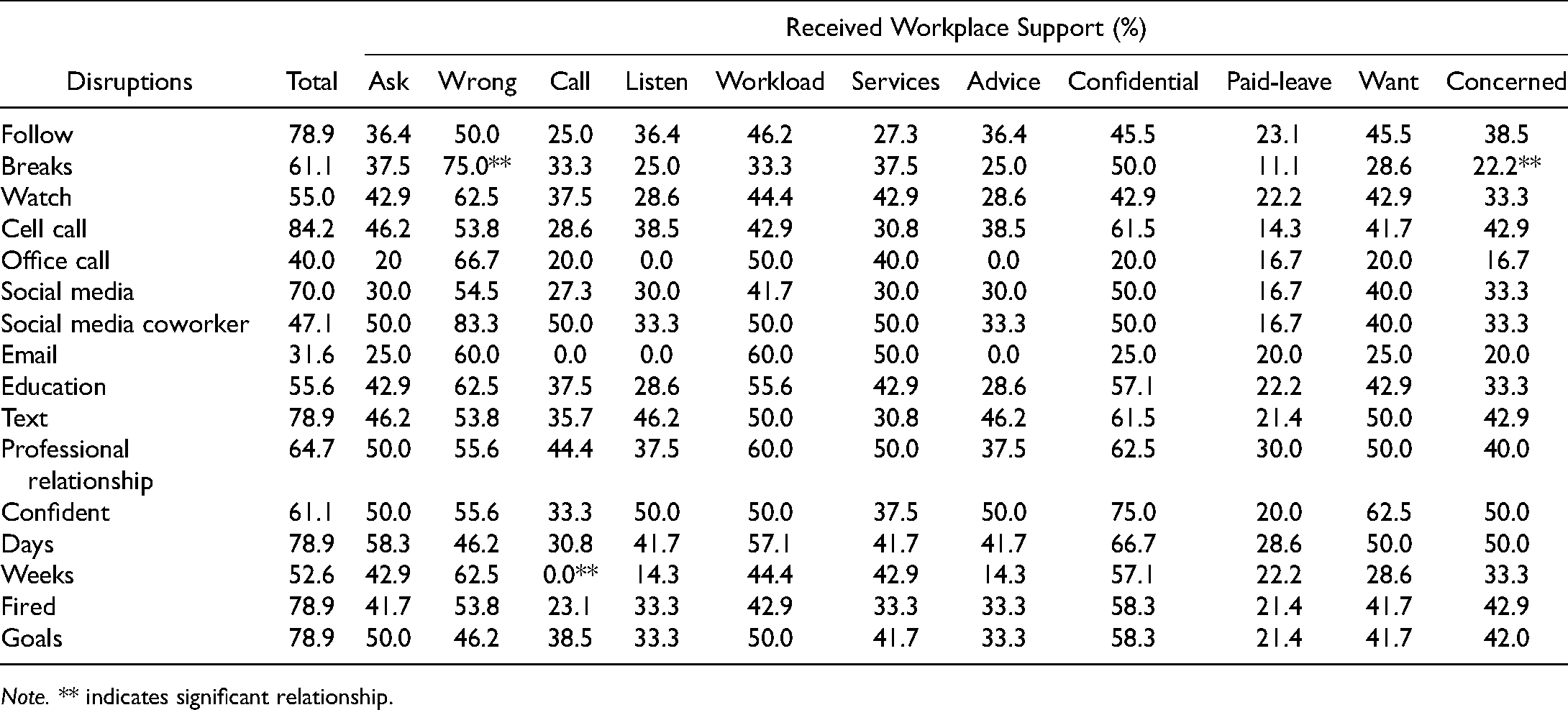
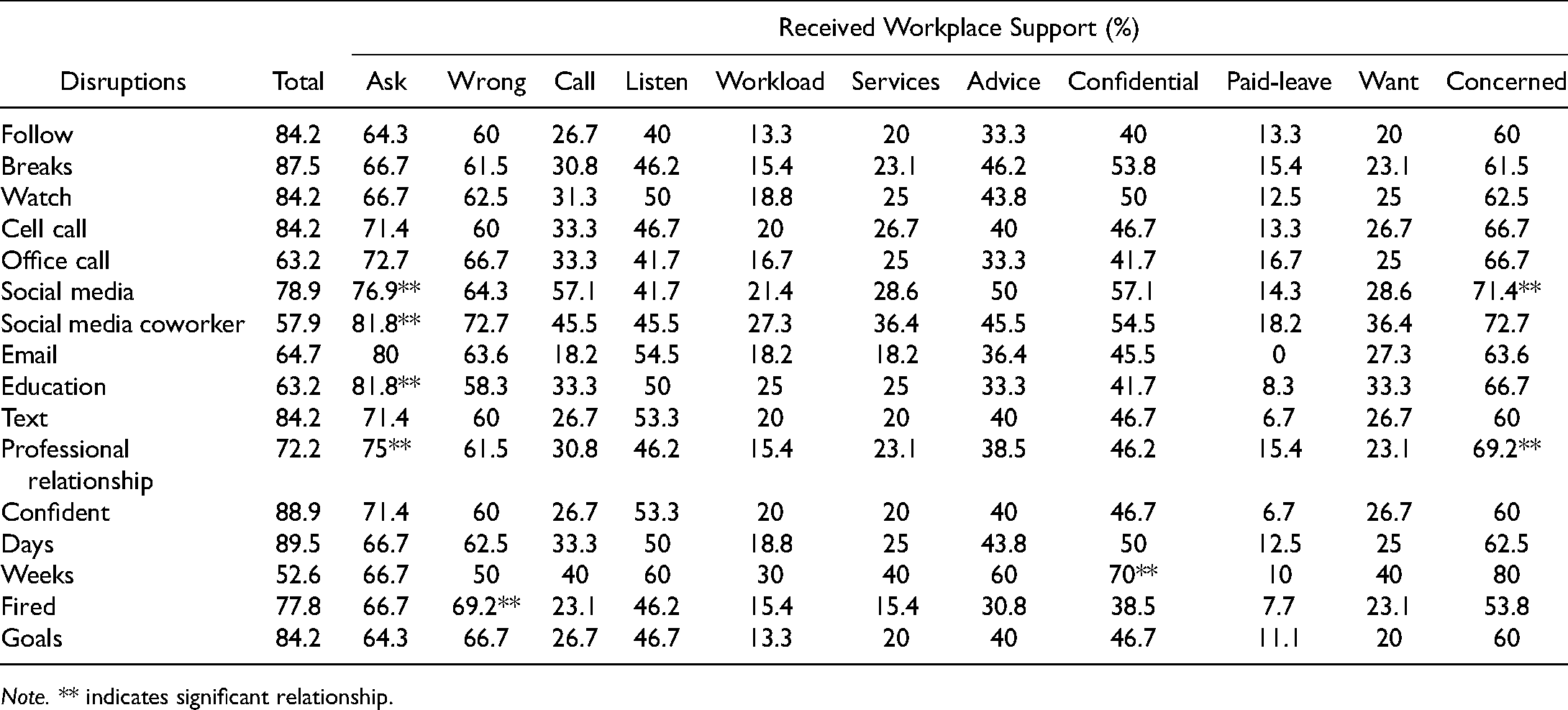
The bivariate results showed that several workplace disruption variables were significantly associated with received workplace support variables for both Black (Table 2) and White (Table 3) participants. For participants who identified as White, the results indicated significant bivariate associations between the partner sending unwanted messages to the participant on social media webpages and the coworker/supervisor approaching them to ask if the participant was okay (p = .015, two-tailed Fisher's exact test) and the supervisor/coworker showing concern for the participant (p = .023, two-tailed Fisher's exact test). Similarly, the partner sending unwanted messages to coworkers on social media websites was also related to the supervisor/coworker asking if the participant was okay (p = .035, two-tailed Fisher's exact test). Further, the abusive partner sabotaging the education or professional relationship the participant needed to be promoted was associated with the supervisor/coworker asking if the participant was okay (p = .035 and p = .019, respectively, two-tailed Fisher's exact test). Additionally, the partner sabotaging the professional relationship the participant needed to be promoted was related to the supervisor/coworker showing concern (p = .029, two-tailed Fisher's exact test). The participant missing weeks of work (five or more consecutive workdays) was also associated with the supervisor/coworker keeping the participant's problems confidential (p = .025, two-tailed Fisher’s exact test). Lastly, the participant being fired or laid off from their job was related to the supervisor/coworker treating the participant as if nothing were wrong (p = .029, two-tailed Fisher's exact test).
Black Participant Frequencies: Workplace Disruption Experiences by Received Workplace Support (N = 20).
Note. ** indicates significant relationship.
White Participant Frequencies: Workplace Disruption Experiences by Received Workplace Supports (N = 19).
Note. ** indicates significant relationship.
For participants who identified as Black, the results showed that the partner making the participant take frequent breaks or long lunch periods during work hours is related to the supervisor/coworker treating the participant as if nothing were wrong (p = .041, two-tailed Fisher's exact test) and to the supervisor/coworker showing concern for the participant (p = .041, two-tailed Fisher's exact test). Finally, missing weeks of work (five or more consecutive workdays) and the supervisor/coworker making a phone call to get help are also related to one another (p = .029, two-tailed Fisher's exact test).
Crosstab Results
Several differences can be observed in comparing the support Black and White participants received. For instance, on one hand, for almost all experienced workplace disruptions, the frequency that Black participants reported being approached and asked if they were okay was lower by at least 20% compared to White participants. Additionally, the frequency that Black participants reported being shown concern by coworkers/supervisors was lower by at least 20% for almost all experienced workplace disruption incidents than for White participants. On the other hand, the rate that Black participants reported having their workload lightened but hours kept the same was 20% or higher than for White participants for the majority of experienced workplace disruptions (see Tables 2 and 3).
Discussion
Results showed that Black and White survivors received different responses from coworkers when experiencing abuser-initiated workplace disruptions. Typically, Black survivors were offered support less often compared to White survivors. For example, White survivors received support that significantly impacted six workplace disruptions, whereas Black survivors received support that significantly impacted only two workplace disruptions. Additionally, the workplace supports of asking the participant if they were okay and showing concern were related to social media harassment for White survivors but not Black survivors. Previous literature has not investigated the use of social media to harass survivors at work, so this finding is important in showing how the disruptive effects of harassment may be reduced. Consistent with the social support buffering hypothesis (Cohen & Wills, 1985), it may be that the workplace supports White survivors receive are not only more frequent but also more likely to be perceived as helpful and thus have a greater impact. Although not investigated by the current study, White survivors may have racially/ethnically matched their supervisor at a higher rate and therefore had stronger relationships with them, as seen in related literature (Yragui, 2008).
Survivors’ receipt of workplace support is likely complicated by race. For example, Crosstab results showed that 0% of Black survivors who missed weeks of work had a coworker make a phone call on their behalf to contact help. Therefore, it is assumed that, because Black survivors were never offered a phone call to get them help (i.e., lack of support, see MacGregor et al., 2020), participants ended up having to take weeks off work. It is interesting to note that, overall, more than half of both White and Black survivors experienced workplace disruptions that were harmful to their career advancement (i.e., sabotaging education or professional relationships needed for promotion), but only White survivors were offered significantly impactful support. In this, IPV has the potential to have longer-lasting effects on Black survivors’ employment than on White survivors’ employment because they are not offered the same level/type of support.
Consistent with related studies, the current findings showed that informal support (i.e., showing concern) was significantly related to disruptions for both Black and White survivors (Perrin et al., 2011; Swanberg et al., 2006; Yragui et al., 2012). Specifically, in one of the only known studies utilizing the IPV-WSA, survivors recruited from community partners (N = 163) reported supervisors showing concern was their most desired form of support. It could be this type of informal or emotional support is also related to an increase in job satisfaction and reduction in psychological distress, as observed in a general sample of state employees (Sloan, 2012). Therefore, simply showing concern is a good place to start for employers and coworkers wanting to support IPV survivors experiencing workplace disruptions. In doing so, employers and coworkers could have a significant impact on survivors’ ability to maintain employment.
Implications
This study's findings demonstrated the protective effect of basic support systems/interventions on survivors’ work outcomes, of which employers should be made aware and put into practice. The study indicated that approaching a survivor to simply ask if they are okay or to show concern could have a direct impact on multiple abuser-initiated workplace disruptions. Supports like this should be offered to Black and White survivors equally. Specific supports discussed in this study can be used to help organizations find the right support strategies that match their workplace. Further, workplaces should be aware of the potential harmful effect of not showing support (acting as if nothing is wrong or not offering to call for help) on survivors’ employment.
Future research should include larger samples, which would allow the use of different statistical analyses to discover more about the directionality of the observed associations in this study. Mixed methods studies could also be helpful to confirm the results of this study and build upon them. Additionally, it may be worthwhile to conduct studies in larger companies versus smaller companies in order to identify existing support structures and how they are implemented. Similarly, differences in workplace support for survivors based on race and ethnicity should continue to be explored, as this study indicated inequities in survivors’ experiences. Specifically, qualitative research is recommended to examine differences in survivors’ lived experiences based on race and how workplace discrimination may have been compounded during periods of abuse. Further, quantitative studies could examine the long-term outcomes of support received and to identify additional requisite support.
Limitations
The study is not without limitations. First, the sample is very small, thus making findings ungeneralizable to the larger population of survivors. Additionally, due to the small sample size, the analysis was limited. Moreover, response categories of workplace disruption items had to be condensed in addition to using Fischer's exact test that does not show directionality in relationships. For this reason, it cannot be said for certain that survivors saw a reduction in workplace disruptions when receiving workplace supports. Further, it was not possible to account for differences in wanted and unwanted workplace supports even though the IPV-WSA allows for analyzing this. Second, participants were recruited from a shelter and represent a subpopulation of low-income women who are in crisis. With an average income of around $11,000 and nearly 70% having a high school education or less, it can be assumed they mainly work in minimum-wage or entry-level jobs that do not require higher education.
Conclusions
Despite the limited sample size, the results showed that Black IPV survivors are offered workplace supports less often than White IPV survivors. Further, the supports Black participants did receive had less of an impact on abuser-initiated workplace disruptions than the supports White participants received. It is therefore important for employers to pay special attention to Black employees experiencing IPV and to offer a variety of supports as described in this study. Moreover, lack of support was harmful to the careers of women of both races. The use of informal supports (i.e., showing concern or approaching to ask if they are okay) can have a significant impact on workplace disruptions experienced by survivors, thus helping them to maintain employment. Lastly, future research should continue to explore workplace supports directed at survivors using larger and more diverse samples.
Footnotes
Declaration of Conflicting Interests
The authors declared no potential conflicts of interest with respect to the research, authorship, and/or publication of this article.
Funding
The author disclosed receipt of the following financial support for the research, authorship, and/or publication of this article: This study was supported by funds from the University of Michigan School of Social Work during a Postdoctoral Fellowship.
