



Abstract
Using data received through the Freedom of Information Act, this observational study explores whether Army law enforcement personnel do not find probable cause in sexual assault cases at higher rates than in other serious crimes. The study compares sexual assaults, homicides, robberies, and assaults in the Army from 2008 to 2014 and July 2015 to 2017. For the first period, the study finds that the odds are 5.30 times greater that Army law enforcement will not find probable cause in a sexual assault case when compared to other crimes, and for the second period the odds are 4.39 times greater.
In a 2018 survey, 6.2% of women and 0.7% of men on active duty in the US military responded that they had experienced a completed or attempted sexual assault in the past 12 months (US Department of Defense, 2018). In Fiscal Year 2020, 4,624 cases of sexual assault were investigated. Of these, 798 (17%) resulted in charges preferred to court-martial, 255 (6%) were tried at court-martial, and 156 (3%) resulted in a conviction (US Department of Defense, 2021). This level of case attrition is similar to the level found in civilian jurisdictions (Lonsway & Archambault, 2012), and critics of both systems point to this attrition to argue that those who run legal systems believe the offenders and blame the victims, leading them to undervalue the cases and drop them (Bourke, 2007; Draper, 2014; US Commission on Civil Rights, 2013).
One aspect of the military justice system intensified the critics’ concerns. The prosecutorial decision was not made by a district attorney; rather, that power was held by a convening authority, usually a two-star commander. The accused was under the convening authority's command and critics feared that the convening authority would take no action in a case to protect the accused. If the victim was in the military, the victim was also likely to be under the convening authority's command and critics feared that commanders were not adequately protecting them. Because of these concerns, in 2021, Congress and the President agreed to take the prosecutorial decision away from commanders in sexual assault cases and give that role to independent military lawyers. However, this major reform may not achieve the desired effect. If military law enforcement officials are undervaluing sexual assault cases, then they may not be doing adequate investigations of sexual assault cases. Those case files could look weak to anyone who later reviews them—including independent military lawyers—and these officials may not pursue the case.
At the end of an investigation, military law enforcement personnel (investigators in conjunction with a military prosecutor) label each case according to their perception of the case's strength. This study measures that point and asks whether Army law enforcement personnel label sexual assault cases differently than other crimes of violence against the person. Using data received from the Army through the Freedom of Information Act (FOIA), this study measures the investigative finding for every penetrative and nonpenetrative sexual assault, murder, manslaughter, robbery, aggravated assault, and simple assault reported in the Army from 2008 to 2014 and July 1, 2015, to 2017. If military law enforcement personnel label more sexual assault cases as weak than they do with other crimes, then that would be consistent with the critics’ beliefs that legal actors undervalue sexual assault cases.
Overview of the Military Justice System and Investigative Findings
Other than the role previously played by the convening authority, the military justice system is similar to other American common law systems. Serious crimes are investigated by each service's detective agency. The accused is afforded most of the rights found in civilian systems along with some important rights not found elsewhere, like being provided a military defense counsel regardless of indigency. The military justice system only has jurisdiction over those in the military, unlike civilian jurisdictions that generally have jurisdiction over anyone in that territory. Jurisdiction over military members extends to crimes committed against any victim and generally extends to crimes committed anywhere in the world. A court-martial proceeds like a civilian trial and, other than the participants wearing uniforms, would be familiar to onlookers.
Military law enforcement investigators process cases in much the same way as civilian law enforcement. Central to this study, at the end of the investigation of a reported offense, Army law enforcement personnel (investigators in conjunction with a military prosecutor) make an investigative finding (US Department of the Army, 2020). There are three possible investigative findings. A “founded” case is one where there is probable cause supported by corroborating evidence (US Department of the Army, 2007, 2016). “Probable cause” is poorly defined in the law but generally means a reasonable belief that a crime occurred and falls below the threshold of “preponderance of the evidence,” which means more likely than not (Bacigal, 2004). An “unfounded” case is one where no crime occurred because the report was false or baseless as shown by an investigation (US Department of Defense, 2010b). The Army defines the space between founded and unfounded as “insufficient evidence.” While Army law enforcement personnel still use that label, the definition for that term comes from a regulation that is not available to the public. An earlier version of the regulation defined the term as the inability to determine whether or not an offense occurred or to establish probable cause (US Department of the Army, 1994). Both the “unfounded” and “insufficient evidence” labels indicate that military law enforcement personnel do not think that the important legal threshold of probable cause was met. These more precise labels are useful, though, because they indicate just how weak Army law enforcement personnel think the case is.
In civilian systems, law enforcement can drop a case by unfounding it or by clearing the case by exceptional means rather than by arrest. In both instances, the case will not go to a prosecutor. Only founded cases that are cleared by arrest move on. The process in the military is a little different. According to policy, military law enforcement investigators must send every sexual assault case forward for a disposition decision. In 2011, the Department of Defense reformed the process so that the investigative reports that were forwarded for a disposition decision would no longer include the investigative findings within the reports, although investigators would include the prosecutor's separate probable cause or no probable cause opinion in the report. This was to ensure that those findings would not bias those who might make decisions on the case later. Law enforcement investigators still report these findings to a centralized database, though, and this database is the source of the data for this study (US Department of Defense, 2011).
Literature Review
Case processing is generally measured at six points: victim report, investigative findings, case clearance, the prosecutorial decision, trial verdict, and trial sentence (Gregory & Lees, 1996). As noted above, sexual assault cases attrit at high rates, and according to feminist critical theory, bias causes this attrition (Bryden & Lengnick, 1997). The source of the bias is beliefs about gender roles and the acceptance of rape myths. Rape myths are attitudes about rape that are generally false, widely and persistently held, and justify male aggression against women (Lonsway & Fitzgerald, 1994). These include beliefs that only deviant men rape, men cannot control their sexual urges, women want or deserve it, women lie about rape, no harm was done, or that certain events do not qualify as “real” rape (Payne et al., 1999).
Several studies indicate that police officers hold high levels of rape myth acceptance (Sleath & Bull, 2017). A few have found low levels (Mennicke et al., 2014; Page, 2008), but the scale used in these studies does not capture the key rape myths that probably influence case processing and does not appear to have any published psychometrics, unlike the Illinois Rape Myth Acceptance Scale (McMahon & Farmer, 2011; Payne et al., 1999), which has widespread acceptance.
In theory, these belief systems enter the decision-making process through legitimate factors (Bieneck & Krahé, 2011). Researchers have focused on three clusters of facts: those related to the case (such as the use of a weapon, injury to the victim, forensic evidence available, witnesses available, or victim participation); those related to the victim's characteristics (demographics and behavior before, during, and after the assault); and those related to the defendant's characteristics (demographics and relationship with the victim) (Bouffard, 2000). A sexual assault case is more likely to make it through the system if the victim is physically injured or if a weapon is used, or if the evidence against the suspect is strong (where the strength of the evidence is often measured by the victim's willingness to participate and the availability of other witnesses and forensic evidence), or if the victim did not engage in risky behavior (Beichner & Spohn, 2012; Bouffard, 2000; Johnson et al., 2012; Kerstetter, 1990; O’Neil, 2019; Spohn & Holleran, 2001; Tasca et al., 2012). When these factors are present in a case, the case looks more like the image of “real” rape—an image that is itself shaped by rape myths (Frohmann, 1991; Page, 2008; Spohn et al., 2001). When present, the case is also more attractive for law enforcement and prosecutors because they may be more likely to get a conviction (Frohmann, 1997, 1991).
The flip side of this is that when these factors are absent, law enforcement may think that the offender does not fit the image of a deviant (deviants use a weapon or a high degree of force) and instead must be a good person caught up in a bad situation. Law enforcement may also think that the victim is not credible because her story does not fit their narrative of a “real” rape case, particularly if the victim behaved in ways before, during, or after the assault that was inconsistent with their expectations of how a victim should behave (Campbell et al., 2015; O’Neil, 2019) or if the victim has made inconsistent statements or has memory problems (Cuevas et al., 2018). If so, they may not pursue the case (Caringella-MacDonald, 1985; Jordan, 2004; Maddox et al., 2012; Quinlan, 2016). Inaction or improper action by law enforcement because of implicit bias can make the case look even worse. As they think the case is weak, law enforcement officers may decide not to spend much effort gathering corroborating evidence or locating witnesses, thus weakening the case further. The treatment of the victim by law enforcement, especially with hostile interrogations, may cause the victim to disengage from the case and ultimately end it (Campbell, 2005).
No clear body of evidence has emerged that sexual assault cases are treated differently than other serious crimes at these various points, though. Few studies have compared sexual assault case processing to other crimes and most of those that do are seriously dated. Further, many of these studies do not contain definitions of the studied offenses so the reader cannot know if only common law rape was included or if a broader range of sexual assaults was included. Estrich (1986) noted that early research on rape only measured a small subset of sexual assaults that look like “real” rape—forcible, penetrative assaults often committed by strangers. These would likely be treated more like other “real” crimes, such as homicides, robberies, and assaults. Cases farther removed from this narrow definition of sexual assault might be treated differently than other crimes and this early research would not detect that.
Three studies have looked at police handling of sexual assault cases. Phillips and Brown (1998) studied 10 police stations in England and Wales from 1993 to 1994 and reported that police charged offenders in 67% of crimes of violence against the person, 48% of robberies, and 51% of sexual offenses. The study did not define “sexual offenses” so it may include only forcible penetrative assaults or may include a broader range of sexual offenses. Roberts (1996) looked at Canadian cases from 1994 and reported that 11% of aggravated sexual assault cases were unfounded by police while only 2% of comparable assaults were unfounded. He also reported that from 1983 to 1992, the average unfounded rate for sexual assaults with no or slight physical injury was 15% but only 7% for similar assaults. In a dated study, Galvin and Polk (1983) looked at California in the mid-1970s and found that 77% of homicides were cleared by arrest, along with 25% of robberies, 55% of assaults, and 44% of forcible rapes.
Hypothesis
The hypothesis is that Army law enforcement personnel are more likely to label sexual assault cases as “unfounded” or “insufficient evidence” than in other similar crimes. The literature is not clear on this point but the closest study to this one (Roberts, 1996) found that Canadian law enforcement unfounded sexual assault cases at higher rates than assaults.
In addition to the literature review, an official Army report factored into the forming of the hypothesis. Official statements made by the Army's leadership in Generating Health & Discipline in the Force (US Department of the Army, 2012) appear to call for differential treatment of sexual assault cases. This report was written by the Office of the Provost Marshal General (the senior military police officer in the Army), issued by the Vice Chief of Staff of the Army, and was a follow-up report to a similar report that was published in 2010. Both reports dealt with a lack of discipline and high rates of suicide in the Army following several years of war. The audience was law enforcement investigators and commanders, and the goal was to identify high-risk service members and improve discipline. The report covered a large range of crimes with a focus on prosecuting offenders.
The report stated that a significant number of sexual assault cases were unsubstantiated in part due to false allegations. Nowhere else in the report did Army leadership highlight a class of victims as being potentially untrustworthy. In this report, Army leadership also cautioned investigators about being adversarial with suspected sexual assault offenders. They told investigators that they should not infer that an accused is guilty when they receive an allegation of sexual assault, to protect and balance the rights of the victim and the alleged offender, and to be aware of the presumption of innocence of the accused. Nowhere else in this report did they make similar statements that investigators should be careful with the offenders of other crimes or to apply the trial-level constitutional presumption of innocence within the investigative phase. If Army law enforcement investigators share in these institutional norms or follow this cautionary guidance, then they could be more likely to label a sexual assault case as “unfounded” or “insufficient evidence.”
Method
The research design was to compare sexual assaults of adults with other crimes of violence against adults. In 2007, Congress changed the military's rape statute from a common law model (sexual intercourse by force and without consent) to a reform model. Under the reform model adopted, consent is not written in as an explicit element of the offense; rather, the statute focuses on the level of force used by the offender (high or low) and the type of sexual actions that the offender committed (penetrative or nonpenetrative). Three military sexual assault offenses are penetrative and fall under that label for this study: rape (involves a high degree of force or threat, or intoxicating the victim without their permission such that the victim is substantially impaired), aggravated sexual assault (a lower degree of force or threat, or the victim is substantially incapacitated), and forcible sodomy. Generally speaking, penetration is the contact of the penis and the vulva, mouth, or anus, or penetration of the genital opening by a hand, finger, or another object with a specified intent.
Three sexual contact offenses are nonpenetrative and labeled as such for this study: aggravated sexual contact, abusive sexual contact, and wrongful sexual contact. Aggravated sexual contact involves the same high degree of aggravating circumstances found in rape. Abusive sexual contact involves the same lower degree of aggravating circumstances found in aggravated sexual assault. For both, the required sexual activity is an intentional touching, directly or through the clothing, of the genitalia, anus, groin, breast, inner thigh, or buttocks of another, or causing the victim to touch those body parts of someone else coupled with a specified intent. For the third offense, wrongful sexual contact, the sexual activity is the same as the previous two, but no force is required. Congress made some minor changes to the statute on June 27, 2012. The full text of the statute, before and after the change, can be found in the Manual for Courts-Martial (US Department of Defense, 2016).
Consistent with other researchers (Carpenter, 2017), the comparison cases involve violence against adults and are stratified further as murder, manslaughter, robbery, aggravated assault, and simple assault. Murder is a killing done with premeditation or intent to kill or inflict great bodily harm; while engaged in a dangerous act; or while committing a felony. Manslaughter includes an intentional killing done in the heat of passion, or an unintentional killing with culpable or simple negligence, or while committing a lesser crime. Robbery is the wrongful taking of property from the presence of the victim through violence or threat of violence. Aggravated assault includes those carried out with a dangerous weapon, those in which grievous bodily harm is intentionally inflicted, and maiming. Simple assault includes demonstrations of violence that create a reasonable fear of bodily harm, and assault consummated by battery that does not involve a dangerous weapon or the intentional infliction of grievous bodily harm.
Data were sought for 2008–2017 from the US Army through a request under the FOIA. The dataset came from information entered into the Army's Centralized Operations Police Suite Military Police reporting system, which migrated to the Army Law Enforcement Reporting and Tracking System on April 1, 2015 (US Department of the Army, 2015). The Army collects the data from the military police report using Department of the Army Form 3975. This record captures the initial report of the incident. Army military police officers record all information or complaints on this form.
The administrative transition between the reporting systems is readily apparent in the data. From 2008 to 2014, reports of penetrative sexual assault increased steadily from roughly 1,400 to 2,400 reports a year, and the first quarter of 2015 followed that trend. From 2008 to 2014, reports of nonpenetrative sexual assaults increased from roughly 900 to 2,000, and the first quarter of 2015 also followed that trend. Following the change in reporting systems, reports fell by about 200 per quarter for the rest of 2015 for both offenses and stayed at that trend (around 1,200 for penetrative sexual assault and 1,000 for nonpenetrative sexual assault) for the years 2016 and 2017. This is a 40% to 50% decrease following the system change. The other offenses in this study also showed significant decreases: murder was down by about 60%; manslaughter, about 50%; robbery, about 40%; aggravated assault, about 35%; and simple assault, about 30%.
Neither the substantive law, the investigative finding definitions, nor the codes changed on April 1, 2015. The FOIA request included all possible codes related to this project as reflected in the appropriate Army regulation, which was supplemented in 2012 with additional codes to reflect the new sexual assault offenses, and the regulation itself was updated in 2016. Further, several iterations of data requests occurred working directly with the FOIA clerks to ensure all requested offenses were included in the report. This issue in the data recording makes consolidating the data before and after the systems change problematic, and because of that issue, data are reported from 2008 to 2014 and from July 1, 2015, to 2017 separately.
The dataset for 2008–2014 has 117,314 observations, and July 1, 2015, to 2017 has 22,100 observations. This includes every homicide, robbery, aggravated assault, and simple assault that was reported and recorded in the Army for those periods. It also includes all unrestricted reports of sexual assault (both penetrative and nonpenetrative) for those periods. The Department of Defense allows restricted reports where victims can choose to make a report that allows them to access victim services without the reports being transmitted to law enforcement or the chain of command (US Department of Defense, 2013). Restricted reports are not included in this dataset. To get a sense of scale, in the Fiscal Year 2014, there were 6,131 reports where either the victim or the offender was in the military. Of these, 1,471 (24%) were restricted reports and 4,660 (76%) were unrestricted (US Department of Defense, 2015).
Each case is identified by a unique case file number. The data include the following explanatory variables: year, report date, subject rank, installation, offense code (published in US Department of the Army, 2007, 2016), and offense description. Citing a FOIA exemption, the Army did not disclose any information on the subject or victim, so the data do not include other potential explanatory variables such as race, sex, or age for either the victim or offender.
The subjects of interest were military offenders because the military justice system has jurisdiction over them from start to finish. Data on civilian offenders were removed because the military justice system lacks jurisdiction over them, and military law enforcement will transfer these cases to civilian law enforcement to lead the investigation. The data included unidentified suspects (6,796 for the first period and 1,325 for the second period) in cases where the subjects may have been military or civilian. The offense was likely reported to military law enforcement officers because it was committed on a military installation or because the victim was associated with the military. As military law enforcement officers likely processed these cases to the point of making an investigative finding, these observations were kept. Data on child sex offenses were removed using either the offense code or by searching for terms in the offense description that would identify child victims.
Potentially, cases with a domestic violence component should have been excluded from the comparison cases because they may have also been treated with a similar bias. In domestic violence cases, potential reasons for bias include beliefs that domestic violence is a private matter, marital violence should be tolerated, and victims will not assist in prosecutions (Felson & Pare, 2007; Hester, 2006). The reasons are different from those found in sexual assault cases but are likely to be highly correlated (Berkel et al., 2004; Flood & Pease, 2009). The dataset included codes and offense descriptions that indicated whether the case had a domestic violence component and was coded thusly.
After data cleaning, for the period 2008–2014, there were 56,116 observations. By case category, there were 1,163 murder, 336 manslaughter, 699 robbery, 5,092 aggravated assault, 25,791 simple assault, 13,884 penetrative sexual assault, and 9,151 nonpenetrative sexual assault cases. For the period July 1, 2015, to 2017, there were 12,898 observations. By case category, there were 158 murder, 53 manslaughter, 119 robbery, 892 aggravated assault, 5,724 simple assault, 3,330 penetrative sexual assault, and 2,622 nonpenetrative sexual assault cases. For both periods, almost all of the deleted cases involved civilian offenders or child victims, or a combination of both.
Results
The investigative findings by category of cases for 2008–2014 are presented in Table 1 and for July 1, 2015, to 2017 in Table 2. The results support the hypothesis that Army law enforcement personnel are more likely to label sexual assault cases as “unfounded” or “insufficient evidence” than in other similar crimes. For the 2008–2014 data, Army law enforcement personnel did not find a probable cause (“unfounded” plus “insufficient evidence”) in only 5% of the comparison cases (murder, manslaughter, robbery, aggravated assault, and simple assault combined) but did not find probable cause in 24% of the sexual assault cases (penetrative and nonpenetrative combined). Only 1 in 20 of the comparison cases did not meet the legal threshold. Nearly 1 in 4 of the sexual assault cases did not. For July 1, 2015, to 2017 data, Army law enforcement personnel did not find probable cause in 10% of the comparison cases but did not find probable cause in 45% of the sexual assault cases (penetrative and nonpenetrative combined). Only 1 in 10 of the comparison cases did not meet the legal threshold, while nearly 1 in 2 of the sexual assault cases did not.
Investigative Findings by Category of Cases (Total and Percentage), 2008–2014.
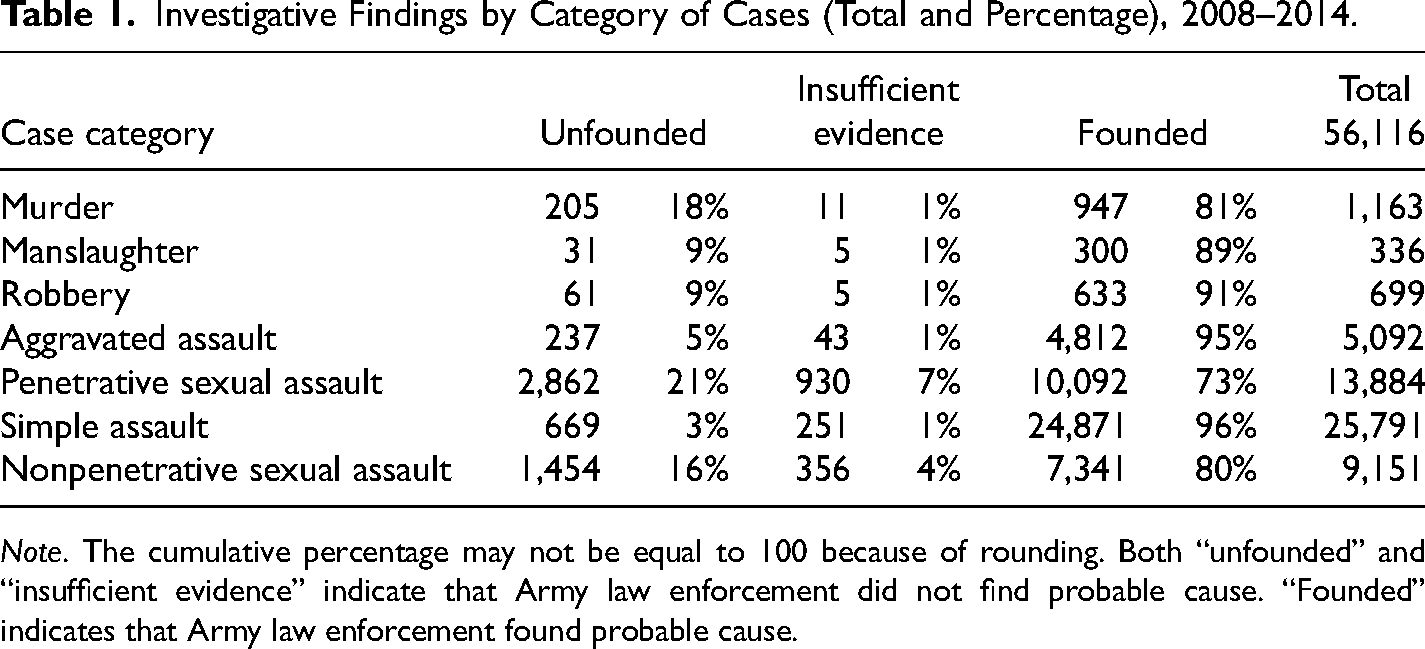
Note. The cumulative percentage may not be equal to 100 because of rounding. Both “unfounded” and “insufficient evidence” indicate that Army law enforcement did not find probable cause. “Founded” indicates that Army law enforcement found probable cause.
Investigative Findings by Category of Cases (Total and Percentage), July 1, 2015, to 2017.
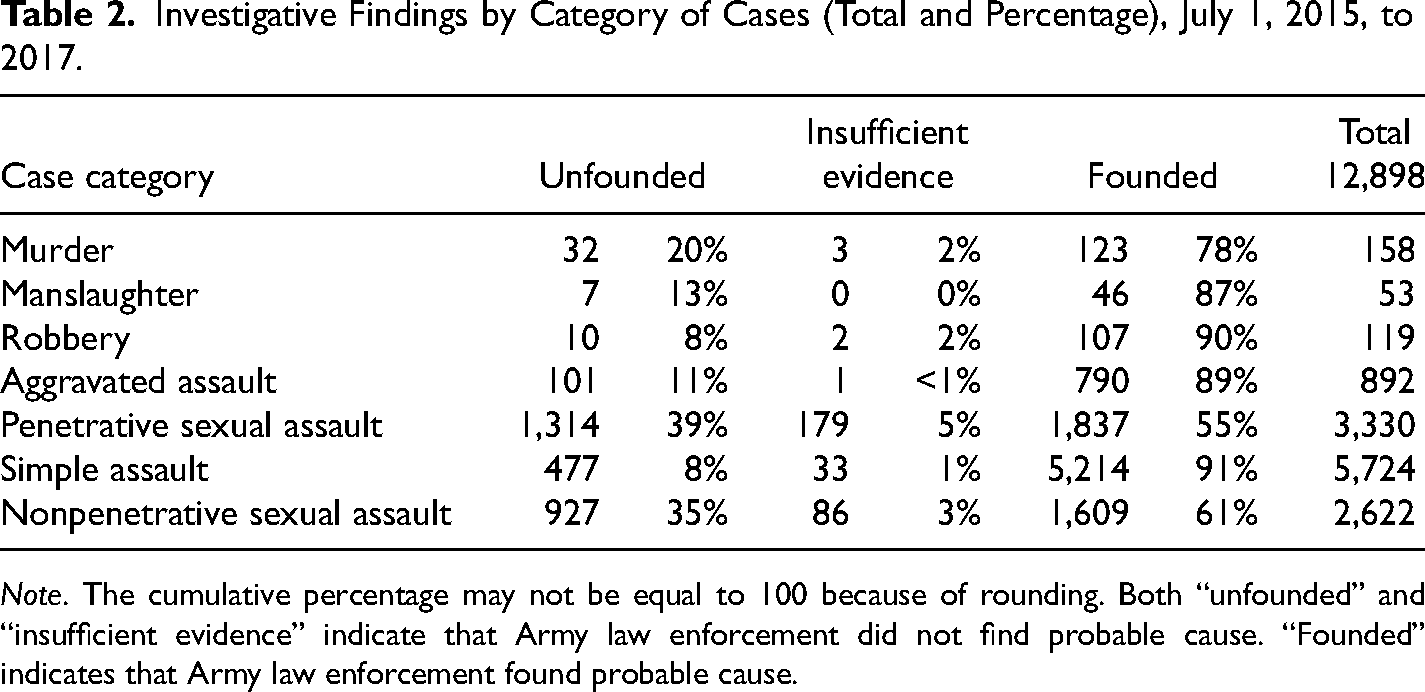
Note. The cumulative percentage may not be equal to 100 because of rounding. Both “unfounded” and “insufficient evidence” indicate that Army law enforcement did not find probable cause. “Founded” indicates that Army law enforcement found probable cause.
Odds ratios using two-by-two contingency tables are presented for the period 2008–2014 in Table 3 and for the period July 1, 2015, to 2017 in Table 4. For the period 2008–2014, the odds that Army law enforcement personnel would “unfound” sexual assault cases (penetrative and nonpenetrative combined) was 5.15 times greater than the odds for all comparison cases combined. The odds that they would find “insufficient evidence” was 5.87 times greater. The odds that they would not find probable cause was 5.30 times greater. For July 1, 2015, to 2017, the odds that Army law enforcement personnel would “unfound” sexual assault cases (penetrative and nonpenetrative combined) was 4.17 times greater than the odds for all comparison cases combined. The odds that they would find “insufficient evidence” was 7.95 times greater. The odds that they would not find probable cause was 4.39 times greater.
Odds Ratios of Sexual Assault Cases to Control Cases, 2008–2014.
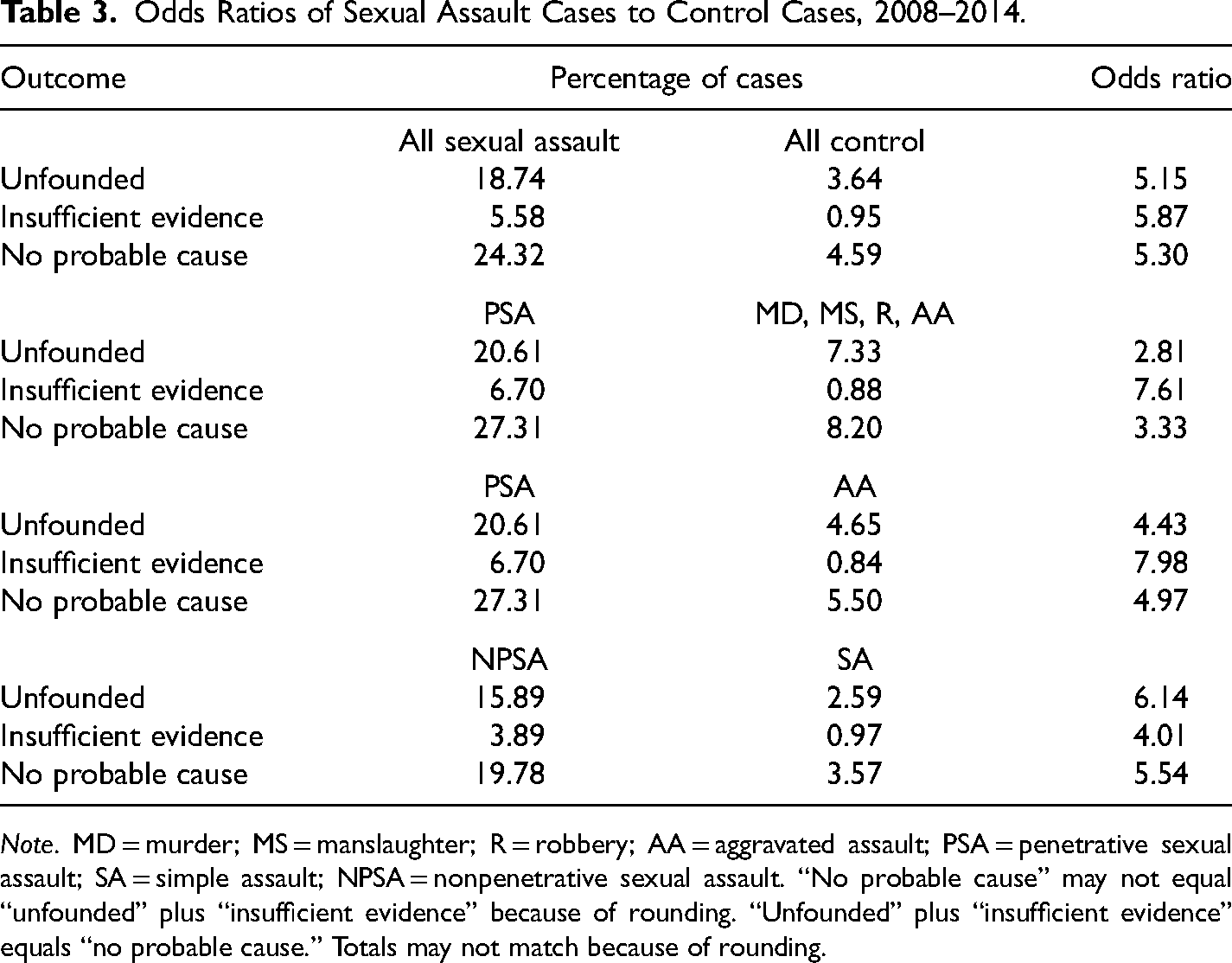
Note. MD = murder; MS = manslaughter; R = robbery; AA = aggravated assault; PSA = penetrative sexual assault; SA = simple assault; NPSA = nonpenetrative sexual assault. “No probable cause” may not equal “unfounded” plus “insufficient evidence” because of rounding. “Unfounded” plus “insufficient evidence” equals “no probable cause.” Totals may not match because of rounding.
Odds Ratios of Sexual Assault Cases to Control Cases, July 1, 2015, to 2017.
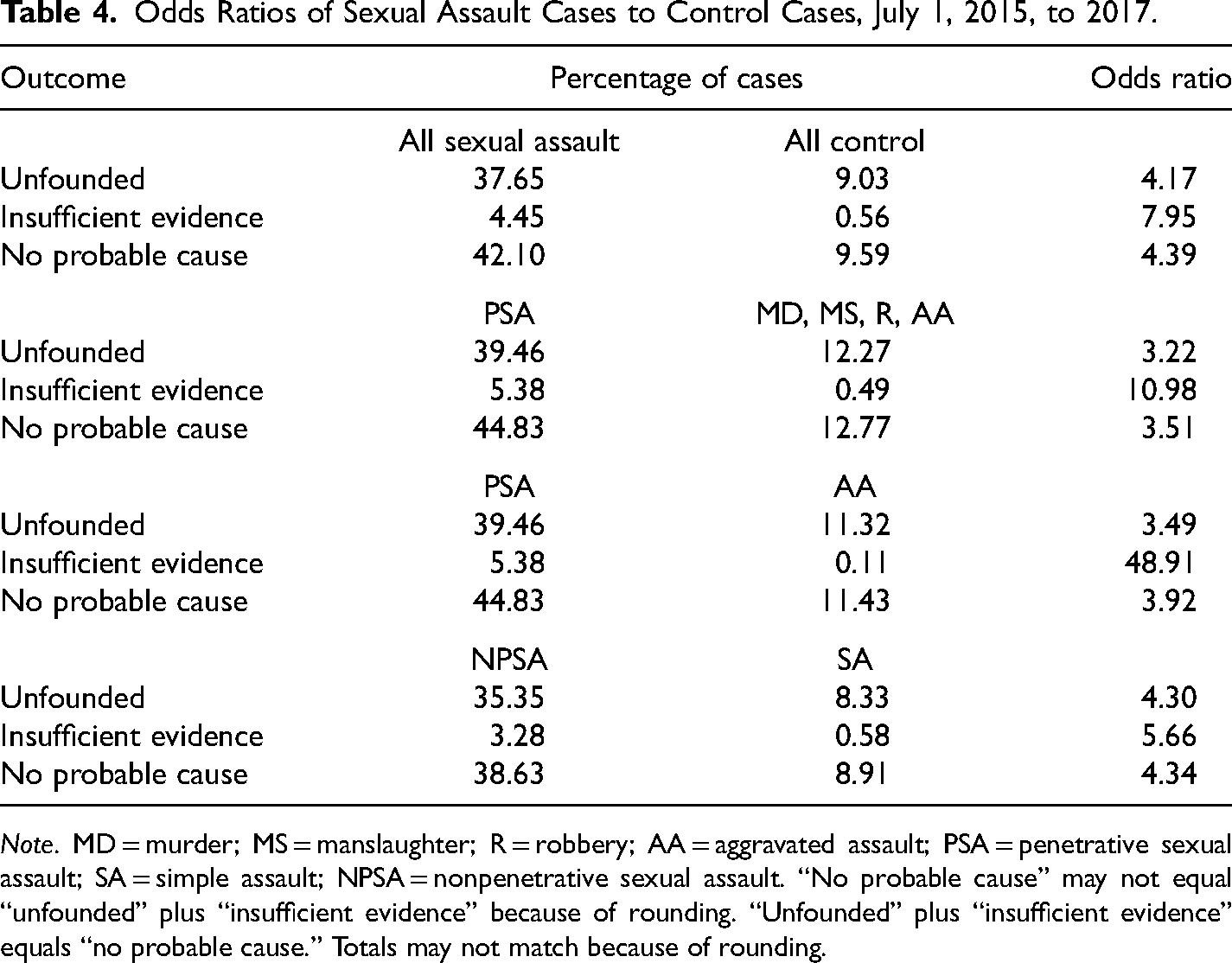
Note. MD = murder; MS = manslaughter; R = robbery; AA = aggravated assault; PSA = penetrative sexual assault; SA = simple assault; NPSA = nonpenetrative sexual assault. “No probable cause” may not equal “unfounded” plus “insufficient evidence” because of rounding. “Unfounded” plus “insufficient evidence” equals “no probable cause.” Totals may not match because of rounding.
Refined comparisons between offenses based on severity—penetrative sexual assault to the other most severe cases; penetrative sexual assault to aggravated assault; and nonpenetrative sexual assault to simple assault—do not change those results in a meaningful way. For the period 2008–2014, the odds that Army law enforcement personnel would unfound penetrative sexual assault cases was 2.81 times greater than the odds for the other most severe cases (murder, manslaughter, robbery, and aggravated assault combined); for insufficient evidence, 7.61 times greater; and for no probable cause, 3.33 times greater. Comparing penetrative sexual assaults to aggravated assaults, the odds that they would unfound penetrative sexual assault cases was 4.43 times greater; for insufficient evidence, 7.98 times greater; and for no probable cause, 4.97 times greater. Comparing nonpenetrative sexual assaults to simple assaults, the odds that they would unfound nonpenetrative sexual assaults was 6.14 times greater; for insufficient evidence, 4.01 times greater; and for no probable cause, 5.54 times greater.
For July 1, 2015, to 2017, the odds that Army law enforcement personnel would unfound penetrative sexual assault cases was 3.22 times greater than the odds for the other most severe cases (murder, manslaughter, robbery, and aggravated assault combined); for insufficient evidence, 10.98 times greater; and for no probable cause, 3.51 times greater. Comparing penetrative sexual assaults to aggravated assaults, the odds that they would unfound penetrative sexual assault cases was 3.49 times greater; for insufficient evidence, 48.91 times greater; and for no probable cause, 3.92 times greater. Comparing nonpenetrative sexual assaults to simple assaults, the odds that they would unfound nonpenetrative sexual assaults was 4.30 times greater; for insufficient evidence, 5.66 times greater; and for no probable cause, 4.34 times greater.
Like the sexual assault cases, murder appears to be an outlier with “unfounded” findings. However, there seems to be a systemic reporting issue in murder cases involving wrongly inputted codes. For one of these cases to be unfounded, it would have to be false or baseless; however, there is a dead body, so investigators know something happened. False or baseless would mean that the death was not an intentional homicide (the homicide was the result of an accident, for example), the homicide was justified or excusable (it occurred in combat, during law enforcement operations, or in self-defense, for example), or the death was not caused by another person (suicide or natural causes, for example). But there are codes for those situations in the Army regulation that Army law enforcement personnel should have used to track those deaths rather than entering a code for murder (these codes do not exist for other crimes, just homicide) (US Department of the Army, 2007, 2016). Very likely, in situations involving a death under these circumstances, Army law enforcement investigators inputted the case code for murder and then “unfounded” that case rather than inputting the correct case code for one of those other circumstances and then labeling those as “founded.”
The cases with a domestic violence component, along with the no probable cause findings for those cases, are listed by category in Table 5 for the period 2008–2014 and Table 6 for the period of July 1, 2015, to 2017. Few sexual assaults were coded for domestic violence while a substantial percentage of assaults were. Considering the high degree of intersection between sexual assault and intimate partner violence revealed by surveys (National Center for Injury Prevention and Control, 2011), this suggests that victims of domestic assault may not be reporting associated sexual violence. Next, across the categories that have sizable numbers of domestic violence cases (aggravated assault and simple assault), domestic violence cases have lower rates of no probable cause findings. These rates are also much lower than the unfounding rates in penetrative sexual assault and nonpenetrative sexual assault. This evidence is inconsistent with the theory that domestic violence cases are processed with a bias similar to that found in sexual assault cases.
DV Cases by Case Category and No Probable Cause Finding, 2008–2014.
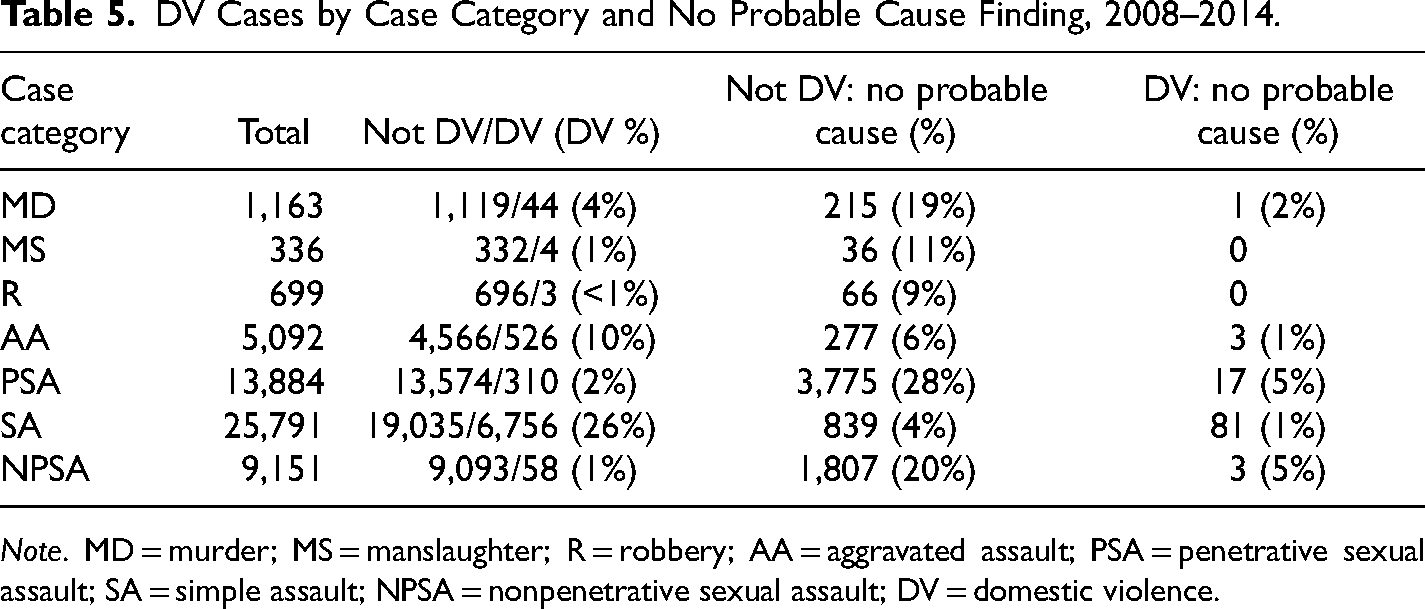
Note. MD = murder; MS = manslaughter; R = robbery; AA = aggravated assault; PSA = penetrative sexual assault; SA = simple assault; NPSA = nonpenetrative sexual assault; DV = domestic violence.
DV Cases by Case Category and No Probable Cause Finding, July 1, 2015, to 2017.
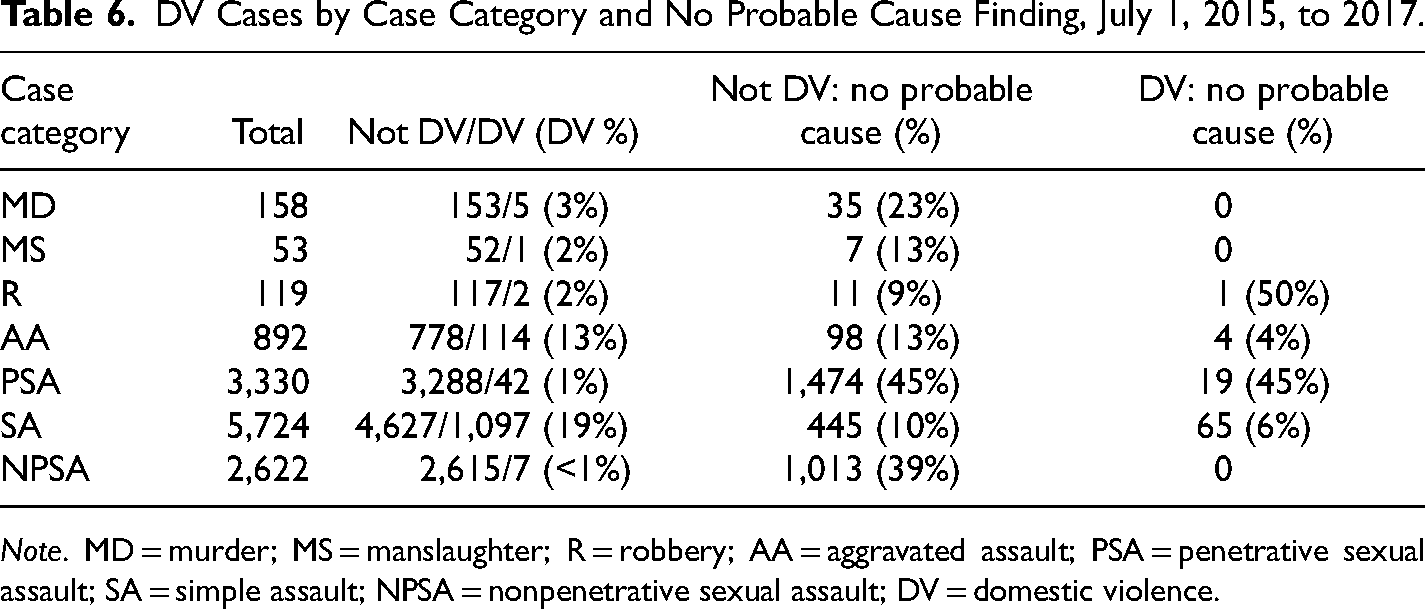
Note. MD = murder; MS = manslaughter; R = robbery; AA = aggravated assault; PSA = penetrative sexual assault; SA = simple assault; NPSA = nonpenetrative sexual assault; DV = domestic violence.
Discussion
Limitations
The data have significant limitations. There is no ready explanation for why the change from the Centralized Operations Police Suite Military Police system to the Army Law Enforcement Reporting and Tracking System caused an interruption in the data. The no probable cause rates were much higher in the second period, but readers should not interpret that to mean that military law enforcement personnel changed their investigative findings behavior before and after April 1, 2015. The only thing that changed was the tracking system. Importantly, the data from both systems indicate that Army law enforcement personnel failed to find probable cause in sexual assault cases at much higher rates than other comparable crimes, and the odds ratios are generally consistent between the two.
The data also only contain unrestricted reports, and roughly 1 in 4 reports is restricted, with 74% of them for assaults that occurred after the victim joined the military (US Department of Defense, 2014). By definition, we do not know much about these reports. If these masked cases disproportionately fit the narrative of “real” rape, then their inclusion may have led to higher rates of founded cases.
Next, the data do not allow for causal inferences. The data do not contain variables related to the case, the victim, or the defendant that can be modeled to find relationships between those variables and the outcome judgment, and one cannot comment directly on what might cause the differential treatment of these cases. Further, some researchers question whether sexual assault cases should be compared to other cases when using counterfactual reasoning to generate causal inferences. Bryden and Lengnick label this criticism “the equivalent crimes fallacy,” which they argue is the faulty assumption that if there is no bias, then crimes of comparable severity should have similar rates of attrition. The argument is that nonstranger sexual assaults comprise the vast majority of sexual assaults and consent is central to these cases (“victim said, suspect said”) but it is not central to homicide, robbery, or assault. As such, the results of this study should be limited to stating that the evidence of differential treatment is consistent with the feminist critical theory that bias causes attrition, and not that the results demonstrate a causal relationship between bias and attrition.
Future Directions
The results of this study show that Army law enforcement personnel process sexual assault cases differently than they process other serious crimes against the person, and the difference is stark. The question then is, why? One explanation is that Army law enforcement personnel are investigating these cases thoroughly and without bias, and there is something else about sexual assault cases that leads to these results. The Department began specialized training in sexual assault investigations in 2009 (US Department of Defense, 2010a). The Army started using interview techniques in 2010 that accounted for the effect of victim trauma on memory, and that technique was incorporated into mandatory training for those investigators that handled sexual assault beginning in 2014 (Cuevas et al., 2018; US Department of Defense, 2014). In addition, starting in 2009, the Army established a program for Special Victims Prosecutors. These are military prosecutors with special training in sexual assault prosecutions that should also assist in the later stages of the investigation when the finding decision is made (US Department of Defense, 2010a). This degree of training would suggest that Army law enforcement personnel might not be biased, and some other factor causes the difference in labeling treatment.
Another explanation—consistent with feminist critical theory—could be that Army law enforcement personnel are biased despite this training, even if they are well-meaning. For example, Generating Health & Discipline in the Force was issued after many of these reforms had taken place. The bias could be subtle: looking at those definitions, one theory could be that Army law enforcement personnel are reversing normal investigative presumptions in many sexual assault cases and might be applying stricter legal standards to sexual assault cases than to other cases, consistent with the statements found in Generating Health & Discipline in the Force.
Normal investigative presumptions are that the person making the report is telling the truth and that the subject committed a crime. Law enforcement investigators then start an investigation to see if a crime occurred, rather than setting out to prove that a crime did not. They are likely to start by being adversarial with the accused and trusting the victim. Army law enforcement personnel appear to have followed those normal investigative presumptions in manslaughter, robbery, and assault: 89% to 95% of those cases were founded from 2008 to 2014, and 87% to 91% from July 1, 2015, to 2017. They believed the report and did not believe the case was false, baseless, or no crime occurred.
However, Army law enforcement personnel unfounded large percentages of sexual assault cases (20%–24% in the 2008–2014 data and 35%–38% in the July 1, 2015–2017 data). A reasonable inference is that they did not believe the victim in those cases: if they believed the victim even somewhat, they could not label the case as false, baseless, or no crime occurred. Importantly, according to the formal definitions, these figures should not include cases where the victim decides to not cooperate with a prosecution (US Department of Defense, 2010b). If the victim decides not to cooperate that might affect the decision to prosecute but should not affect the investigative finding.
The results also suggest that Army law enforcement personnel may apply the “probable cause” standard more rigorously in sexual assault cases than in the other cases. In assault cases, for example, Army law enforcement personnel appeared to apply the legal standards correctly. The offense was either “unfounded” at a very low rate, or the offense was “founded” at a very high rate. Based on the label definitions, this would indicate that once Army law enforcement personnel believed the victims (and so rejected the “unfounded” label), they then decided that there were reasonable grounds to believe a crime occurred (and so used the “founded” label). There was very little space between “unfounded” and “founded”—only 1% to 2% of these cases were labeled “insufficient evidence,” across both data periods.
In these cases, even where there may have been competing evidence that favored the suspect's story, Army law enforcement personnel did not appear to use the label “insufficient evidence” to reflect that competing evidence. That is because the definition of “probable cause” allows room for competing evidence. The contested or exculpatory evidence can even weigh more heavily toward the offender's story and the case can still satisfy probable cause. All that is required is that it be reasonable for someone to believe a crime occurred, and if someone believes the victim, then it is reasonable to believe a crime occurred.
In contrast, it appears that Army law enforcement personnel may have applied a more rigorous application of “probable cause” to sexual assault cases. There, 7% of penetrative and 4% of nonpenetrative sexual assaults (2008–2014) and 5% and 3% (July 1, 2015–2017) were labeled “insufficient evidence.” Based on the label definitions, this would indicate that Army law enforcement personnel believed the victims (and so rejected the “unfounded” label), but unlike in the assault cases, they thought that evidence was not enough to satisfy probable cause. They might have thought of sexual assault cases as “victim said, suspect said” and required that the “victim said” outweigh the “suspect said.” However, that is the stricter standard of “preponderance of the evidence,” which means more likely than not. Probable cause does not require that it be more likely than not that a crime occurred—the exculpatory evidence can outweigh the inculpatory evidence and probable cause can still be satisfied.
If Army law enforcement personnel are reversing these investigative presumptions, then that could be the moment when they start treating these cases differently than other cases. And if military law enforcement personnel are applying a more rigorous definition of probable cause in sexual assault cases than in other cases, then that could be a moment where they continue differential treatment of these cases. Qualitative research should explore those moments. This might allow for an inference that bias causes the differential treatment of investigative findings in Army sexual assault cases—or this research could provide evidence that is inconsistent with the existence of bias, such that some other factor or factors cause the differential treatment.
Venema (2016) conducted an experiment on civilian police officers where she measured their acceptance of rape myths and found that their acceptance of rape myths was associated with lowered intentions to take the case seriously. Researchers could do a similar experiment on a sample of military law enforcement personnel (investigators and prosecutors). Researchers should measure levels of rape myth acceptance. The subjects would get “victim said, suspect said” situations in sexual assault cases and comparison cases where the evidentiary conditions are controlled. Researchers would then measure the subjects’ presumptions about victim credibility and offender innocence in sexual assault cases as well as in the comparison cases, provide the subjects with the standard definition of probable cause, and measure the subjects’ outcome judgments. Researchers would look for relationships between levels of rape myth acceptance, presumptions of victim credibility and offender innocence, and outcome judgments across the case categories.
Unfortunately, conducting human research within the Department of Defense by external researchers is difficult (US Department of Defense, 2020). To expedite the research, Congress should immediately direct the Department of Defense to conduct the above-described research.
Conclusion
The results of this study show that Army law enforcement personnel process sexual assault cases differently than they treat other violent crimes against the person. Are sexual assault cases different? Or do the legal actors just think these cases are different—and that then affects how they process the cases? If the answer is that military law enforcement is biased, as feminist critical theorists would argue, then military law enforcement may be compiling biased case files (ones that portray the victim as not credible and that fail to fully investigate the offender's behaviors) on a large percentage of reported sexual assaults.
Answering this question is critical. During the first period of this study, Army law enforcement personnel believed one in four penetrative sexual assaults did not rise to the level of probable cause, and one in five nonpenetrative sexual assaults did not. During the second period, Army law enforcement believed almost half of penetrative sexual assaults did not meet this standard, and over a third of the nonpenetrative sexual assaults did not. If otherwise meritorious cases are being investigated under the belief that they have no merit, then those cases will look weak to anyone reviewing them downstream—the preliminary hearing official, the person making the prosecutorial decision in the case, and ultimately the judge or the members of the panel who hear the case.
Footnotes
Declaration of Conflicting Interests
The author declared no potential conflicts of interest with respect to the research, authorship, and/or publication of this article.
Funding
The author received no financial support for the research, authorship, and/or publication of this article.
