




Abstract
Drawing on a qualitative case study consisting of interviews with Danish police trainees, patrol officers, and police detectives, this article explores police endorsement of myths surrounding male-perpetrated intimate partner violence against women (IPVAW) and its influence on police response to IPVAW incidents. The findings show that police officers begin to believe in the myths to cope with negative emotions arising from repeated exposure to IPVAW victims, who do not behave according to expected norms of being cooperative, responsible, and innocent. This makes police officers meet victims with skepticism, low spirit, and hopelessness, making them refrain from initiating further criminal investigations, opening criminal cases, and pursuing arrests.
Introduction
Intimate partner violence (IPV), defined by the World Health Organization (2012) as “physical, sexual, and emotional abuse and controlling behaviors by an intimate partner” (p. 1), is a serious public health issue affecting millions of people worldwide. Research on this issue follows two dominant theoretical perspectives, which disagree about the causes and motives of the violence and the presence of gender symmetry. Family violence researchers see IPV as a type of family violence committed almost equally by men and women as a way to handle conflicts within the family. By contrast, feminist researchers see IPV as an expression of the patriarchy, where men use violence to exert control and power over their female partners (Johnson, 2001; Lawson, 2012; Peters, 2008).
Johnson (2001) argued that both theoretical perspectives are valid but that they are examining different populations owing to selection biases in both types of research. Family violence researchers use mostly survey methods, in which they sample couples who engage in “common couple violence” where disagreements can escalate into violence (Johnson, 2001). Feminist researchers commonly examine a clinical female population from shelters and other facilities who are experiencing one-sided “patriarchal terrorism” with women using violence only or mostly in self-defense (Peters, 2008). In the present study, we employed a feminist perspective and focused on male-perpetrated intimate partner violence against women (IPVAW). Accordingly, men commit IPVAW as one of several tactics to achieve power and control in their intimate relationships and to keep their female partners in a submissive position. Thus, IPVAW is a product of the patriarchy that systematically oppresses women through a value and belief system that justifies male systemic dominance (Ali & Naylor, 2013; Berggren et al., 2021; Dobash & Dobash, 1979; Lawson, 2012).
A main factor that explains IPVAW is gender inequality. As such, it is surprising that Scandinavian countries, known to be some of the most gender-equal countries in the world, have a disproportionately high prevalence of IPVAW (Gracia & Merlo, 2016). For example, estimates have shown that while 22% of all women in the EU have experienced lifetime IPVAW, the proportion is 28% in Sweden, 30% in Finland, and 32% in Denmark—the highest prevalence in the EU (European Union Agency for Fundamental Rights, 2014). Nordic countries having both high levels of gender equality and a high prevalence of IPVAW have been labeled the Nordic paradox (Gracia & Merlo, 2016).
Despite the high prevalence of IPVAW in Denmark, only 5% of IPVAW victims report the violence to the police (Ottosen & Østergaard, 2022). Studies in other countries show similarly low reporting rates, attributing them to IPVAW victim perceptions that the police are not willing or able to help them (e.g., Childress et al., 2022; Decker et al., 2019; Wolf et al., 2003). Furthermore, a significant body of international research has documented that victims of IPVAW who do contact the police often feel blamed, dismissed, and not taken seriously, and in some cases, even experience hostile and callous police response (e.g., Harper et al., 2021; Leisenring, 2012; Murvartian et al., 2023).
Although second-wave feminism in the 1970s succeeded in making IPVAW a social problem suitable for police intervention in the United States and some European countries (Fleming & Franklin, 2021; Harrison & Esqueda, 1999) with attendant changes in policy and response (Lutze & Symons, 2003), many victims of IPVAW continue to experience grave problems when contacting the police. Shortcomings in police response have been explained by the patriarchal police culture (Lockwood & Prohaska, 2015), police officers’ limited comprehension of the complexity of IPVAW (Murvartian et al., 2023), and their stereotypical and misogynistic beliefs about IPVAW, which invalidate, stigmatize, and revictimize victims (Childress et al., 2022; Eigenberg et al., 2012; Fleming & Franklin, 2021; Murvartian et al., 2023). Commonly defined as IPV myths, these stereotypical beliefs “are generally false but are widely and persistently held, and which serve to minimize, deny, or justify physical aggression against intimate partners” (Peters, 2008, p. 5). The myths are about female victims and draw on gender stereotypes. They are inextricably linked to the patriarchy, as the myths serve to undermine and silence women's experiences (Fleming & Franklin, 2021).
Research on IPV myths is beginning to unpack the endorsement of IPV myths among law enforcement personnel. For example, recent studies have examined the prevalence of IPV myths in the police (e.g., Fleming & Franklin, 2021) and the consequences of these myths for police decision-making (e.g., Twis et al., 2018) and their approach to victims (e.g., Childress et al., 2022; Murvartian et al., 2023). However, with very few important exceptions (e.g., Murvartian et al., 2023), there is a dearth of scholarship that examines why some police officers begin to believe in these myths in the first place, combined with what consequences their belief may have for police response to case handling. Therefore, we aimed to address the following research question: How is initial belief in IPV myths formed in police officers and how do these beliefs influence police response to IPVAW incidents?
To address this question, we conducted interviews with 18 Danish police officers, consisting of police trainees, experienced patrol officers, and police detectives whose daily work involved responding to and investigating IPVAW incidents. Denmark presents an interesting case owing to the aforementioned Nordic paradox. Recent years have seen increased societal and political focus on IPV in Denmark, prompted by criticism of how the police have handled these cases. For example, a report conducted in 2020 by the Danish National Police itself showed that 34% of violence victims and 47% of rape victims were dissatisfied with how the police handled their cases because they did not feel that they were taken seriously (Rigspolitiet, 2020). Additional important political and legal changes were recently implemented with the criminalization of psychological violence in 2019 (Retsinformation, 2019) and the adoption of a consent-based rape provision in the Danish Penal Code in 2020 (Justitsministeriet, 2020a). Moreover, in 2020, the Danish Parliament settled on a new agreement for the Danish Police, focusing on improving police response to IPV victims by implementing trauma-informed police practice. This led to the recruitment of academically trained IPV experts across all police districts to train police officers in victim trauma reaction and enhance awareness of the social and security measures that can be offered to victims in supplement to legal measures (Justitsministeriet, 2020b).
In this study, we aimed to complement emerging research on IPV myths from a police perspective (e.g., Fleming & Franklin, 2021) by presenting a qualitative analysis of the formation and implications of police endorsement of IPV myths in a Nordic context. We focused on myths surrounding male-perpetrated IPVAW (hereafter, “IPV myths” and “myths about IPVAW”).
Theory: Myths About IPVAW
The emerging line of research focusing on the cultural myths that surround IPVAW shows that these myths are “inextricably linked to a male-identified, male-dominated, and male-centered structure responsible for the systematic oppression of women” (Fleming & Franklin, 2021, p. 408). The myths are thus a product of the patriarchy and focus on female victims. They serve the social function of minimizing the seriousness and scope of IPVAW, exonerating the perpetrator, and blaming the victim based on her character, behavior, or, according to the myths, unconscious desire to be battered. Thus, the myths transform innocent victims of a potentially deadly crime into women who unconsciously or consciously have decided to be in a violent relationship and, hence, are not actually victims (Peters, 2008).
Regarding the prevalence of myths and negative stereotypes of IPVAW victims, research has reported country-level differences (Tran et al., 2016). For example, they are widespread in the United States (e.g., Worden & Carlson, 2005). In Denmark, a recent report showed that although negative stereotypes about both male and female IPV victims are generally rare, one specific form of victim blaming is quite prevalent: 26% of men and 20% of women believe that victims who do not leave their abusive partners are partly responsible for the violence committed against them (Ottosen et al., 2022, pp. 85–86). In general, more men than women endorse IPV myths (e.g., Yamawaki et al., 2012). One of the reasons for this is that endorsement of IPV myths serves different individual functions for men and women: For men, the myths serve a defensive function as a way to avoid blame, whereas for women, the myths protect them from feeling threatened by anticipated harm (Peters, 2008).
Police Endorsement of IPV Myths
Given that the police function as “gatekeepers” of the criminal justice system, they have the power to facilitate investigation and validate victims’ stories of abuse. This highlights the importance of elucidating police endorsement of IPV myths, including how these affect police response to IPVAW incidents (Logan et al., 2006). For example, IPV myths include stereotypes of what it means to be a “proper” battered woman and that victims who do not live up to these stereotypical beliefs “may be categorized not as victims, but as accomplices to domestic violence” (Harrison & Esqueda, 1999, p. 130).
Additionally, in a police ride-along study, DeJong et al. (2008) found that despite their progressive views on IPV, American police officers hold patriarchal attitudes toward women, tend to simplify IPVAW, presume victim noncooperation, and engage in victim blaming. Twis et al. (2018) additionally found that police endorsement of IPV myths is linked to the fact that coercive control as part of a violent relationship often remains undetected by the police. Norwegian research likewise shows that police officers rarely open criminal cases or make arrests owing to the complexity of most IPV cases, where victims rarely share their stories (Aas, 2009) and where coercive control, which is an element of psychological violence, is extremely difficult to prove (Aas, 2019). As such, police officers often feel frustrated, inadequate, and irritated, and begin to mistrust victims and engage in victim blaming (Aas, 2009), which can be interpreted as myth endorsement.
In a recent study, Fleming and Franklin (2021) provided evidence that being a man, having increased trauma misconceptions, having decreased perceptions of preparedness to respond to IPV incidents, and having more experience with responding to IPV incidents are all significant predictors of IPV myth endorsement in the police. Fleming and Franklin (2021) explained the correlation between experience and IPV myth endorsement with police officers becoming more cynical with time because of repeated exposure to victims who do not behave in accordance with expected norms. This finding confirms prior research that shows that many police officers feel frustrated when dealing with IPVAW victims (Aas 2009; Johnson, 2004) and that they struggle to understand victim trauma reactions (Franklin et al., 2020) and overall victim behavior (Lockwood & Prohaska, 2015).
Despite the paradox of IPV myths being endorsed in an institution like the police, which was created to help people, including IPVAW victims (Crowe & Murray, 2015), research is only beginning to focus on how the endorsement of IPV myths influences police response to IPVAW incidents. One of the few studies that have examined this showed that police endorsement of stigmatizing IPV myths, although often unconsciously or implicitly exercised, makes police officers more likely to blame victims, minimize their stories of abuse, and doubt their credibility. When victims are met in such a manner, they feel blamed, unprotected, and alone, and some victims even decide not to cooperate with the police (Murvartian et al., 2023). Research in the adjacent and more developed area of rape myths has shown similar findings (e.g., Garza & Franklin, 2021; Hansen et al., 2018; Page, 2010; Venema, 2019). Hence, myths in policing create a vicious cycle where the police meet victims with skepticism, which makes victims uncooperative. This perceived uncooperativeness frustrates the police and results in their conscious or unconscious adoption of myths, which makes them even more skeptical of the individual cases they encounter.
Research on IPV myths has mostly been conducted using quantitative methods, which has extended the current understanding of what IPV myths are (Peters, 2008) and their prevalence (e.g., Fleming & Franklin, 2021; Yamawaki et al., 2012). However, scholars have called for qualitative examinations of how police endorsement of IPV myths relates to increased experience with responding to IPV incidents (Fleming & Franklin, 2021) and influences police response (Twis et al., 2018). Responding to these calls, we conducted a qualitative analysis involving police officers with different levels of experience in handling IPVAW incidents. Our analysis aimed to contribute qualitative knowledge on why police officers begin to believe in IPV myths and how these beliefs influence their interactions with IPVAW victims.
Method
Participants and Data Collection
We adopted a qualitative case study approach to generate an in-depth and multifaceted understanding of the formation and implications of police endorsement of IPV myths. Taking an interpretive epistemological approach to our case study (Cunliffe, 2011), we were particularly interested in exploring the complexities of police officers’ experiences and meaning-making in responding to IPVAW incidents from different perspectives, to understand individual and shared social meanings.
The case study consisted of two data sets of in-depth interviews with police officers from the Danish police force. Data set A included interviews with 10 police trainees, who began their police training in early 2020. Danish police education lasts 2 years and 4 months and alternates between theoretical education at a police academy and in-service practical training in police districts. The purpose of these interviews was to elucidate how police trainees perceive victims of violence—victims of physical, psychological, and sexual violence, including victims of IPVAW. We also examined how they understood their role in relation to these victims. The second author obtained research access through the Danish National Police after a lengthy process, including a criminal background check. Interviews were conducted as “talking-whilst-walking interviews” (Anderson, 2004) in the outdoor environment surroundings of Denmark's two police academies in December 2021, which was in the month that followed their 11-month-long in-service probationer training. All interviews focused on police trainees’ experiences of working in patrol and helping victims of violence
Data set B included interviews with eight police officers: five patrol officers and three police detectives. The purpose of the interviews was to examine the discretion of police officers in IPVAW cases. The first author obtained research access through four of Denmark's 12 police districts. Individual interviews were conducted at four police stations in October and November 2021. The interviews focused on their experiences of handling IPVAW cases, unpacking their decision-making and understanding of IPVAW and IPVAW victims. Specifically, each interview began with questions about the participants’ background, such as experience in the police force, and proceeded asking them about the process from initial contact with the victim to the case being dropped or taken to court. We then asked them to describe what usually goes well and badly when handling IPVAW incidents, what aspects they focus on, and how they make decisions in IPVAW incidents. Toward the end of each interview, we asked participants about their feelings when handling IPVAW incidents and how they perceive it (e.g., why they think IPVAW happens). Interviews lasted 70 min on average and were audio recorded and transcribed verbatim. All participants were Caucasian. Two of the five patrol officers were women, and all three police detectives were women, which underlines the gender distribution of patrol and investigative units specialized in IPV and rape in the Danish police force. The patrol officers were all in their late 20s and police detectives, in their early 40s.
We also interviewed two academically trained IPV experts working in the police. These interviews served primarily as sources of background knowledge for our analyses. IPV experts are often not trained police officers and cannot open criminal cases or interrogate victims.
Combining the two data sets, our data consisted of interviews with police officers who had different levels of experience in handling IPVAW incidents and who worked in eight of the 12 police districts in Denmark. All interviews were conducted in Danish; we translated all quotations from the interviews into English, taking care to preserve the nature of the expressions of the participants. The participation of all police officers was anonymous and voluntary. At the beginning of each interview session, we informed the officers that their responses would be treated with confidentiality and used for this study only, after which we sought their consent. To protect participants’ anonymity, we used pseudonyms for all names. Furthermore, we removed or changed any identifying details of individual officers to preserve their privacy and diminish potential risks. Table 1 presents the participants’ demographic details.
Participant Demographics.
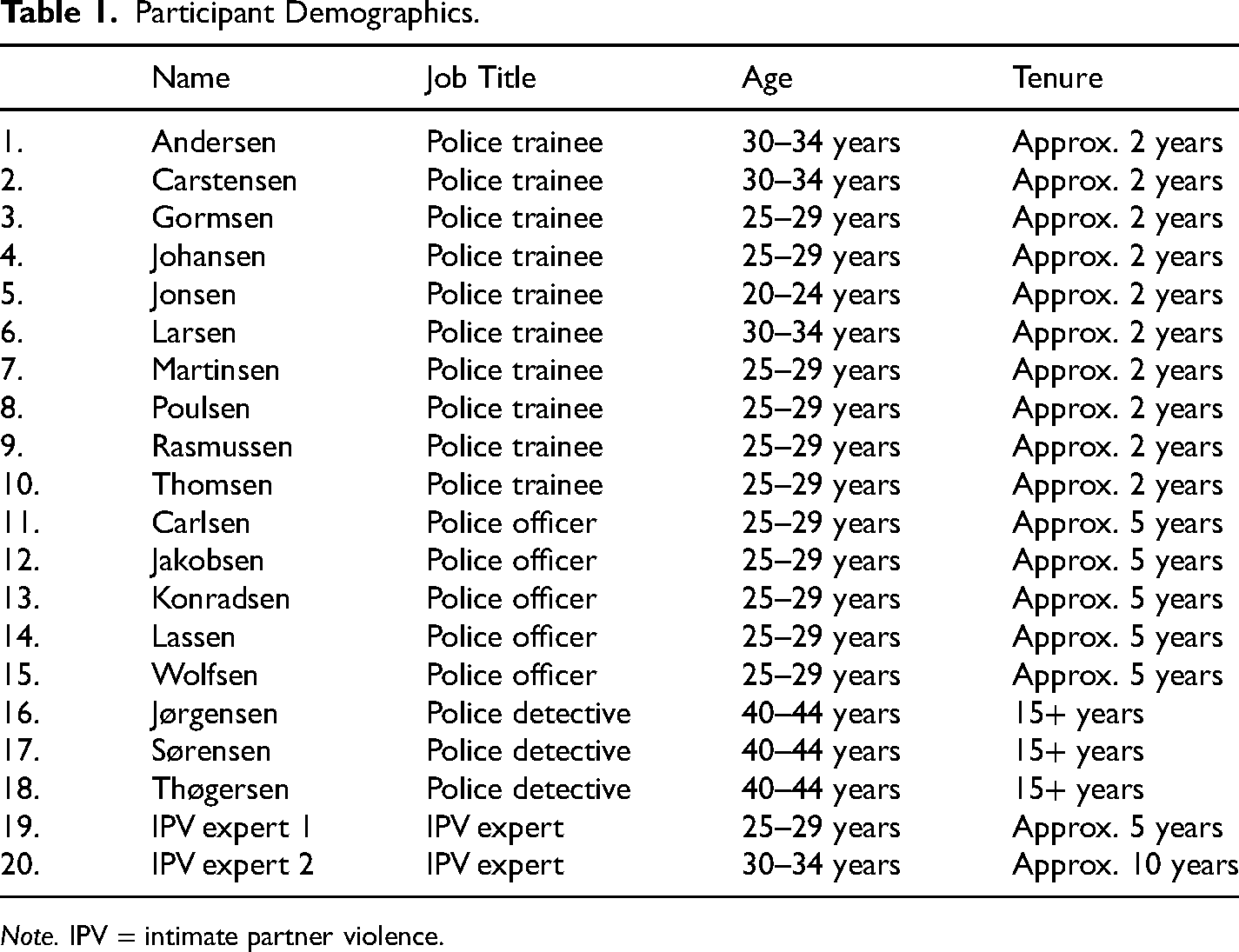
Note. IPV = intimate partner violence.
Data Analysis
Data analysis was conducted using thematic analysis inspired by Braun and Clarke (2006). After familiarizing with the data through close readings of the transcripts and writing two-page summaries of each interview, we generated initial codes from the entire combined data set. Using these codes, we created analytical themes that focused on the specific IPV myths presented in the data, when an endorsement of these myths occurred in police work, and what consequences the myths had for police decision-making. We identified five IPV myths in the data: (a) victims do not want help; (b) victims are partly responsible for their own victimization; (c) IPVAW is not that serious; (d) victims lie about their experiences; and (e) some types of violence in relationships are not “real” IPVAW. Our analysis focused on the first three.
Since the endorsement of IPV myths among professionals is often unintentional and implicit in nature (Murvartian et al., 2023), we—inspired by Doolin (1998)—complemented our interpretive epistemological approach with a reflective and critical stance. Specifically, although our participants would not always be aware of their own endorsement of IPV myths, we sought to incorporate a more critical view of some of the statements revealed in the interviews while taking into account the wider social and political environment that has shaped our case.
Moreover, given that our participants had different levels of experience in handling IPVAW incidents, they informed different parts of the research question of our investigation. Overall, the part about how initial belief in IPV myths is formed in police officers was mostly covered by the police trainees, as they were new to dealing with victims of violence and in the process of developing coping strategies. The part about how belief in IPV myths influences police response was mostly covered by the patrol officers and police detectives because they had more experience in handling IPVAW cases compared with the police trainees. In our analytical work, however, data from both police trainees and experienced patrol officers and detectives informed our understanding of the research question as a whole.
Findings: Formation and Implications of IPV Myths in Policing
Initial Formation of Belief in Myths
Police officers encounter many challenges when handling IPVAW incidents. Among our participants, these challenges often resulted in negative emotions, such as confusion, frustration, annoyance, and hopelessness, which they tried to cope with by beginning to believe in IPV myths.
Uncooperative Victims
The most common challenge when handling IPVAW incidents was that victims often did not want to cooperate with the police in a criminal investigation, and if they did, they often recanted their statements days later, resulting in the collapse of the case. All of the participants in this study had repeated experiences with the aforementioned. For example, police trainee Poulsen met with a woman who had fled to a women's shelter. The woman wanted to inform the police about the abuse she suffered from her husband, and she showed Poulsen her injuries: “We sit there for a while, (we are) listening to her, ready to file a report. But then she says that she doesn’t want us to write the report, and then we’re like: ‘But then why have you contacted us?’” It turned out that the woman merely wanted to inform the police about the violence in case she was beaten up again or killed. However, this strategy confused Poulsen: “I thought that was rather strange. Why she contacted the police, I still don’t fully understand.”
Another example was police trainee Rasmussen who met with a woman who had called the police after being severely beaten by her husband. The woman gave a full statement and agreed to leave the husband, and Rasmussen opened a criminal case for further investigation. The next day, however, the woman called Rasmussen, wanting to recant her statement: That was quite frustrating because you know it's probably not the first or the last time that happens. You feel kind of powerless that you can’t do anything. It was good that she wanted to report him, for her own sake. But then when she changed her mind the next day, you feel like it was a waste of time, because it does take some time to open such a case.
As shown in Poulsen's and Rasmussen's descriptions, handling uncooperative victims was confusing, annoying, and frustrating for police officers. They reported feeling powerless and that they were wasting their time in these situations, primarily because they could not live up to the organizational goals set for their work. While police officers in these incidents do accomplish the main police task of averting danger for the victims—at least in the present moment—they cannot live up to police objectives of bringing criminal activity to an end, investigating it, and building a case for prosecution (Lovbekendtgørelse nr, 2019; Volquartzen, 2020). These objectives are not fulfilled because police officers cannot pursue them without victim cooperation. Negative emotions of feeling powerless and inadequate thus arise from being unable to live up to these objectives of their police role. However, the negative emotions were a personal burden that police officers must carry. Police trainee Thomsen said as follows: Often, there is just nothing you can do about it. You just know that it will end like it always does, no matter how hard you try to help her. It's painful. Like, oh, I really wish I could help you, but I can’t if you won’t let me.
Many of the police officers similarly described how they felt a deep sense of hopelessness and sadness in these cases and that they expected all IPVAW incidents to end with them being unable to help the victims. These painful emotions may arise because, for most of our participating police officers, the main motivation for joining the police force was to help people in need. Being unable to help victims in IPVAW incidents, they seemed to feel that their role and identity as police officers were profoundly challenged. Some police officers even described that their professionalism and sense of justice were tested, or that they felt like a fool when handling these cases because nothing good came of their hard work. The issue with uncooperative victims thus challenged both their ability to live up to the organizational objectives of their work and their sense of professional identity.
Thus, uncooperative victims triggered many negative emotions in police officers. Some of them sought to alleviate these negative emotions by adopting IPV myths because these myths offered alternative explanations for victims’ intention not to cooperate, explanations that focused on the victim rather than police inadequacy. For example, believing in the myth that victims do not want help shifted responsibility for uncooperative victims away from police officers and onto the victims. Patrol Officer Konradsen said: It's very frustrating when you meet a victim who doesn’t want to report (her partner), even if it's obvious that she's been abused. You can’t get through to them. You want to help them, but if she won’t let you, it's very, very difficult. That's one of the biggest frustrations, that you can’t do anything if they don’t want to be helped.
Konradsen dealt with her frustration by invoking the myth that victims do not want help. The myth helped her change the notion of the problem: the problem was not that she was unable to make victims feel safe enough to open up and accept help but rather that these victims simply did not want help. With this cognitive maneuver, police officers alleviated their negative emotions of frustration, powerlessness, hopelessness, and inadequacy, by effectively blaming the victims for their own victimization while also minimizing the problem: since these victims did not want to be helped, IPVAW was less of a priority for law enforcement.
The victim-blaming myth about victims being partly to blame for their own victimization similarly shifted responsibility away from the police (and the perpetrators) and onto the victims. For example, Police Trainee Gormsen said: It's very frustrating when they don’t want to press charges. We often say to them, ‘Can’t you see that it's wrong and dangerous what he is doing to you?’ ‘You can’t live like this.’ We do everything we can to get them away from the abuse, but they
Gormsen was clearly frustrated and felt powerless when victims did not want to cooperate nor leave their violent partners. To relieve these painful emotions, she invoked the myth that victims are to blame for their own situation. She engaged in victim blaming to resolve her own self-blame for not helping the victims. Similar to the myth that victims do not want help, the victim blaming myth also minimizes the problem—IPVAW victims are not seen as innocent and worthy of police intervention. Thus, the minimization myth, emphasizing that IPVAW is not that serious, is also present when police officers encounter uncooperative victims.
No Evidence of the Violence
Police officers often invoked the minimization myth when they encountered IPVAW cases characterized by a lack of obvious evidence of violence. Given the difficulty in obtaining a conviction in these cases, many police officers tended to decide not to open a criminal case because they believed doing so would be a waste of their time. This often happened if the victim did not want to file a report. For example, Patrol Officer Wolfsen said, It's just very difficult if she does not want to cooperate, because then our options are very limited, unless she has bruises up and down her legs and arms and throat like the woman I mentioned before. In that case, I could see that something had happened. You can’t see that in the trifles.
Wolfsen explained that she could not do much without obvious evidence of the violence and victim cooperation. To relieve any negative emotions Wolfsen may be experiencing for not being able to help these victims, she talked about the incidents as “trifles,” or not serious or dangerous for the women. Notably, in the same interview, Wolfsen said that IPVAW is serious and that victims are in great danger because they can end up being killed. Wolfsen may thus be invoking the minimization myth in situations that are made difficult to handle owing to lack of evidence and victim cooperation and where she feels guilty for giving up on victims who clearly need help.
The minimization myth was also used in cases of psychological violence. In these cases, victims are typically cooperative and report the violence themselves, but police detectives often struggle to find sufficient evidence to bring the case to court. These cases are extremely frustrating for detectives, who wish that victims were better at collecting evidence of psychological violence, such as by making audio recordings of their partner's verbal abuse. Police Detective Jørgensen said, “We hope that we can help them by spreading the word that it is important to save whatever proof they might have, if they experience this type of violence.” Such statements come from a good place—the detectives want to help victims obtain justice. However, collecting evidence of violence can be dangerous for victims if the abuser finds out that this is happening. Thus, asking victims to collect evidence without acknowledging the danger that this can entail minimizes the seriousness of this type of IPVAW.
Victims Acting Irresponsibly
In cases where victims were perceived to act irresponsibly, police officers similarly invoked both the minimization and victim-blaming myths. This often happened in cases where victims met or got back together with a violent expartner. For example, Police Trainee Martinsen shared a case about a woman whose exhusband had been violent and attempted to kill her. She had filed a restraining order against him. However, one evening, she invited her exhusband over for a drink, which resulted in him trying to strangle her. He then left, and she called the police. When Martinsen and his colleague arrived, they saw dark bruises around her neck. Martinsen felt sorry for her, but he also felt very frustrated with the woman because she had invited the exhusband over, despite knowing how dangerous he was. Martinsen was convinced that she would continue doing this, putting herself in danger and wasting police time. To deal with his frustrations, Martinsen blamed the woman for her own victimization and minimized the seriousness of the potentially lethal act that had been committed against her. The victim-blaming myth is seen in his annoyance with her decisions: We found out that she had called him because she was bored. I said to her: ‘If you have filed for a restraining order against him and if you feel threatened by him, then you need to stop contacting him.’
To Martinsen, since she continued to contact him, while knowing that violence was a regular possibility, she was partly responsible for her own victimization. The victim blaming shaped how the incident was handled: the victim explained what had happened but did not want to make a formal statement. Although she had visible injuries, Martinsen decided not to open a criminal case, nor did he arrest the exhusband, whom they later found wandering the streets. Martinsen did not even scold the exhusband or tell him to leave the woman alone. Rather, he saw him as a “poor thing” and let him go. This treatment was in stark contrast to how he treated the woman, telling her to stop contacting the exhusband, which shows that Martinsen, in this case, blamed the victim more than the abuser.
Moreover, although there was evidence of attempted murder, Martinsen decided not to open a formal criminal case for investigation, showing the minimization myth at work. He explained his decision as follows: If they don’t want to hurt their partner by cooperating in a criminal case against him, then of course we can still make a criminal case, but then we ruin it for them. Because when a case goes to court, it will cost them money that they don’t have and it's also psychologically hard to go through. It's also not good for their case of getting their children back, when they are placed outside the home (…) Of course, we can arrest him but we usually only do this when we witness the fight ourselves, because being arrested is a big use of force. Otherwise, there really must be reasonable suspicion.
In this statement, Martinsen did not acknowledge the seriousness of the abuse that was inflicted upon the woman. Rather, he was concerned with how expensive a criminal case would be, how it would look in the eyes of child protective services, and how invasive an arrest would be for the perpetrator. The safety, needs, and legal rights of the victim in this case did not appear to be at the top of his mind. He additionally failed to acknowledge that she had survived an attempted murder and that there was indeed “reasonable suspicion” of the violence owing to her injuries and the excouple's history with IPVAW. Martinsen minimized the violence and blamed the victim for not wanting to file a report, thus making the incident ill-suited as a criminal case.
Unclear Victim and Perpetrator Roles
For our participants, complex cases with unclear victim and perpetrator roles brought confusion and frustration, which they dealt with by invoking the victim-blaming myth. Many police officers said that it was difficult at times to figure out if an incident was only a verbal argument or if someone had been victimized, and in such a case, whom? At times, they believed that the victim had played a role in the abuse. For example, the more experienced police detectives said, “In relationships, there are often conflicts and they go both ways. It's never just one person” (Police Detective Thøgersen). “What signals has she been sending?” (Police Detective Sørensen). “In some cases, both partners have instigated the violence” (Police Detective Jørgensen).
Incidents were even more complex if victims were not completely honest, which made it difficult for police officers to fulfill their main objectives (Lovbekendtgørelse nr, 2019; Volquartzen, 2020). Patrol Officer Lassen said: It's difficult to find out what has happened and why. Often, we do not have any other evidence but their explanations, so we compare them, but sometimes they try to make their story better than what the truth actually is. Sometimes we end up wasting a lot of time building a formal criminal case that then turns out to be completely wrong because we find out that both are responsible for what happened.
Lassen described how these cases were confusing, frustrating, and difficult to handle and that police officers could be wasting their time by misunderstanding the situation. Some police officers would take their time to figure out what was going on and whether the woman was only violent in self-defense. However, often they would simply assume that both the man and the woman had “played an equal part” (Police Trainee Gormsen) in the violence. Thus, the victims were not seen as “ideal victims” (Christie, 1986) or as “proper battered women” (Harrison & Esqueda, 1999) but instead as “accomplices” (Harrison & Esqueda, 1999) in the violence.
In this way, police officers ended up blaming victims for their own abuse and did not see them as the wronged party deserving of help from the police and legal system. Police Trainee Gormsen said, “Women often call to say, ‘My husband has done this and that,’ and then we arrive and find out that they have played an equal part. Then she is not a wronged party anymore.” The victim-blaming myth appeared to offer relief from the emotional distress that arose from working on these cases by providing simplified explanations of complex cases. By invoking this particular myth, police officers could disavow any responsibility they had for handling these cases because these victims were no longer perceived as being in need nor worthy of their help.
In sum, our findings showed that police officers were repeatedly exposed to victims who did not behave according to the expected norms of being cooperative, responsible, and innocent. Given that these victims were not “ideal victims” (Christie, 1986) and did not behave as “proper battered women” (Harrison & Esqueda, 1999), they were extremely difficult to deal with, which generated negative emotions, such as confusion, frustration, powerlessness, and hopelessness in police officers. Some police officers began to believe in IPV myths because these provided simplified explanations. The myths relieved some of their emotional distress by minimizing the seriousness of the situation and removing any blame the police officers felt for not being able to help the victims. Therefore, belief in the myths could be interpreted as a coping mechanism arising from the pressing need to deal with difficult and complex encounters with victims. Belief in the myths had implications for police response to IPVAW incidents and on how victims experience encounters with the police.
Implications for Police Response
All three IPV myths, namely, that victims do not want help (Myth 1), victims are partly responsible for their own victimization (Myth 2), and IPVAW is not that serious (Myth 3), had serious impacts on police decision-making and their overall attitudes and approach toward victims of IPVAW. The most apparent effect was that police officers often did not make arrests, initiate further criminal investigations, and open criminal cases. However, each myth provided different justifications for these decisions.
Implications of Myth 1: Victims Do Not Want Help
Many of the participating police officers were aware of the myth about victims not wanting help but did not want it to affect their response to IPVAW incidents. For example, Patrol Officer Lassen said, “You have to try to forget that victims sometimes recant their statements when you meet new victims so that you can meet them without a negative attitude.” Nevertheless, our data provided evidence that the myth affected the decision-making of many of our participants since they did not make arrests, initiate further investigations, nor open criminal cases if they believed that a victim did not want to be helped.
They justified these decisions by saying that they wished to respect the victims’ wishes. For example, Patrol Officer Carlsen said, “It's a dilemma. An ethical dilemma. Should we ruin their relationship when they don’t want to report it?” Other justifications were that launching a criminal case without a cooperative victim would be a waste of time because such cases would never stand in court. However, Danish police officers are obligated to make a criminal case if they suspect violence. In practice, however, this did not always happen. Even with clear evidence of the violence, such as injuries, police officers refrained from opening a case if they believed that the victim did not want help. Patrol Officer Jakobsen explained: We’re obliged to open a criminal case if we suspect that she has been abused regardless of her participation. But obviously, if she denies making a statement and he says that nothing happened and they agree that she tripped and hit her face on the dining table, then there's nothing to do. Because it's plausible that that could happen.
Jakobsen explained that even if there are injuries, opening a criminal case without the victim's cooperation would not be sensible because the injuries can be explained in other ways and thus cannot be used as evidence of the violence.
Even witnesses to the violence could not guarantee that a criminal case would be opened if police officers were convinced that the victim did not want help. For example, Police Trainee Andersen shared how he handled a case with a woman who was choked, spat on, and humiliated by her partner in front of her friends, but who still did not want to file a report. Andersen accepted her wishes and did not try to persuade her because he knew it would be a waste of time: We did not push her to report him because if we do that, the victim will definitely call us and recant everything they said. So, it has got to be when she's ready. But maybe she’ll never be ready. And if she doesn’t want to report him, there's nothing I can do for her.
Andersen did not open a case despite having witnesses who could attest to the violence. Invoking the myth, he prejudged the victim and expected her to recant her statement if she gave one. Most of our participants had similar beliefs, and many talked about the prejudgment of their colleagues: “You see in many colleagues that they lose patience because they know how it will end” (Police Trainee Thomsen).
Belief in the myth, however, also affected police response to victims who did want to cooperate and file a report because police officers expected that even cooperating victims would not continue to cooperate. The participants commonly expressed statements such as “I expected that as soon as she was discharged, she would recant her statement” (Police Trainee Jonsen) and “You just know that tomorrow they will be good friends again, and then she will come and want to recant her statement” (Patrol Officer Wolfsen). Therefore, victims who want to report an (ex)partner for violence may encounter a police officer who does not take them seriously. Some officers even described that they have advised victims not to report the (ex)partner. For example, Police Detective Sørensen said, “During the first conversation I have with her, I can sense if she is sufficiently motivated for a criminal case.” If a victim was not “sufficiently motivated,” Sørensen would turn them away, saying, “Try to get away from your partner first, before pressing charges.” Thus, the myth not only has consequences for victims who do not want to report the violence to the police, but it also causes some police officers to meet cooperating victims in a dismissive manner, at times even refusing to open a criminal case because they have given up on helping these victims beforehand.
Implications of Myth 2: Victims Are Partly Responsible for Their Own Victimization
Victims who were deemed responsible for their own victimization were met with a skeptic police response. For example, Police Detective Jørgensen said that although she tried not to let the myth affect her, she often ended up being very skeptical when questioning victims: I try not to think about it (if the victim has contributed to the violence and if she is hiding it) because it affects my interrogation too much. But of course, I must ask her about the more complicated things. ‘Why did he do it?’ ‘You just said he was inside the bedroom, but then how can he hit you in the living room, if he was inside the bedroom?’
Thus, when the myth is at work, victims get the impression that the police do not believe them, which, in turn, often makes them less cooperative, as this kind of police response can be retraumatizing (Childress et al., 2022; Murvartian et al., 2023). Uncooperative victims are a major source of frustration and feelings of powerlessness among police officers, who seem to cope with these negative emotions by believing in the myths. A vicious circle is thereby created, where police officers’ belief in IPV myths has several constraining consequences, which end up reinforcing their belief in the myths.
One important consequence is that some victims are transformed into people who are not actually (ideal) victims after all (Christie, 1986; Peters, 2008) but rather perpetrators (Harrison & Esqueda, 1999), who are not worthy of police effort: When we get there, my partner and I usually talk to a party each, and then we get together and talk about whether they’re equally bad, or whether we actually think there's something for us to handle. (Patrol Officer Wolfsen)
Wolfsen emphasized that if the violence was mutual, then there was nothing for the police to do because such incidents were not a job for the police. As soon as peace and order have been reestablished, patrol officers drive off without opening a criminal case or examining if it is, in fact, mutual violence or if the woman used violence in self-defense. These incidents are rarely recognized in the legal system. This Danish practice is opposite the mandatory arrest policies used in North America that leads to many dual arrests (e.g., Fraehlich & Ursel, 2014; Hirschel & Buzawa, 2002).
Danish police officers explained their decision-making by saying that mutual violence was incomprehensible in the Danish legal system, because “it's difficult to be the injured party and at the same time the person who is charged in the same criminal case” (Police Detective Jørgensen). Charging both is therefore “a mess” (Patrol Officer Konradsen). Consequently, victims who fight back are rarely acknowledged in the Danish legal system because they are not seen as innocent and worthy of help and, thus, they are not perceived to be “real” victims.
Implications of Myth 3: IPVAW Is Not That Serious
Belief in the minimization myth caused some police officers to perceive violence as a “trifle” (Patrol Officer Wolfsen) or “a one-time thing” (Patrol Officer Carlsen). Patrol Officer Carlsen elaborates on this: Should we open a case if it's just a punch on the shoulder? Because if they have been married for 7 years and the kids weren’t home during the fight, then it is tough telling them when they get home that dad has been arrested, especially if mom and dad could have solved their issues themselves.
To Carlsen, the couple could deal with their issues on their own, and it would be sad to ruin their relationship with a criminal case if the violence was not that serious. He expressed more concern with keeping the family together, and he seemed convinced that the kids would be better off this way. Thus, some police officers believed that a criminal case would be harder and more damaging for the victims than getting legal help and social support.
Additionally, belief in the minimization myth caused some police officers to talk cooperative victims out of filing a report. Police Detective Sørensen said: One of my most important tasks is to inform victims about the process if she files a report. Sometimes, I even say, ‘Are you sure this is what you want? You can wait to file a report.’ I do that if I sense that she is not motivated enough, or if the violence has not yet been severe enough.
Sørensen stated that victims will regret filing a report and drop their case if they are not motivated enough for a criminal case or if the violence has not been severe enough. Sørensen thus would try to talk them out of filing a report. The minimization myth was at work when it caused police officers to believe that victims were better off handling their issues on their own and when victims of less severe violence were seen as those who would not persist in their cooperation.
Thus, our findings showed that belief in IPV myths as a strategy to cope with negative emotions had serious implications for how police officers responded to IPVAW incidents. Police officers often decided not to initiate further criminal investigations, open criminal cases, and make arrests. Similar discretionary actions have been reported (Aas, 2009). The myths provide police officers with justifications for their dismissive response.
Discussion
Formation of IPV Myths Endorsement as a Coping Strategy
In this study, we examined the formation of police endorsement of IPV myths and its consequences. From a feminist position, IPV myths support the systemic male oppression of women by blaming the victims, exonerating the perpetrators, and minimizing the seriousness and scope of IPVAW (Fleming & Franklin, 2021; Peters, 2008). Therefore, the formation of IPV myths in society is a product of the patriarchy. Emerging research similarly emphasizes that patriarchy is a main explanatory factor of the formation of IPV myths in police work. For example, Murvartian et al. (2023) argued that given that professionals are part of societies with patriarchal values, they adopt stigmatizing myths that portray female victims negatively. However, although police officers from the same departments are part of the same patriarchal society and masculine police culture, belief in IPV myths varies greatly among police officers (e.g., Fleming & Franklin, 2021). The patriarchal society is therefore not the whole reason that police officers begin to believe in IPV myths.
We complemented the feminist interpretation of IPV myths with a microoriented focus on police officers’ emotional experiences of dealing with complex IPVAW incidents. Our findings revealed that police officers’ belief in IPV myths most likely emerges as a coping mechanism because the myths alleviate negative and difficult emotions by providing simple explanations for the challenges that officers face in handling IPVAW incidents. At the same time, the myths reduce the responsibility of police officers to respond to IPVAW incidents. Murvartian et al. (2023) similarly reported that IPV myths present a particularly welcome solution for police officers when they find themselves in situations that are ambiguous—that is, where they have to make decisions without knowing all the facts. Providing simple interpretations of IPVAW, the myths are embraced by officers who do not have a good grasp of the nature of IPVAW. Our microoriented focus on myth formation can explain why not all police officers begin to believe in IPV myths although they are all exposed to society's patriarchal views. Some police officers are repeatedly exposed to more complicated IPVAW incidents than others and, in these situations, they may try to cope with their negative experiences by believing in patriarchal myths. Fleming and Franklin (2021) also showed that more experienced police officers are more inclined to endorse IPV myths, probably because they have become more cynical from repeated experiences with victims who did not live up to expected norms.
Research has similarly found that police officers struggle to understand IPVAW victims’ actions and reactions (Franklin et al., 2020; Lockwood & Prohaska, 2015) and that they experience a great deal of frustration when interacting with these victims (Aas, 2009; Johnson, 2004). For example, Aas (2009, 2019) demonstrated that police officers experience great challenges when trying to turn IPVAW incidents into criminal cases because psychological violence is difficult to prove and IPVAW victims rarely cooperate. Similar to our findings, Aas (2009, 2019) found that these difficulties led to police officers feeling negative emotions of frustration and inadequacy, causing some of them to distrust and blame the victims. While this is a clear sign of myth endorsement, Aas (2009, 2019) did not apply this term to explain these processes.
Therefore, the main contributions of our study were as follows. We connected police officers’ negative emotional experiences in IPVAW incidents with myth formation in police work, and we demonstrated that police officers’ belief in myths surrounding IPVAW may be better understood with a combined structural view of the patriarchal culture and a microoriented view of police officers’ emotional experiences. While the former makes IPV myths easily available, the latter interprets the endorsement of these myths as a strategy for coping with difficult emotions. Our findings additionally showed that police officers’ belief in IPV myths had dire consequences for victims of IPVAW, who are often met with skepticism, low spirits from loss of hope, and even rejection. These reactions of police officers reduce victims’ willingness to cooperate, which further frustrates the police, leading to increased IPV myth endorsement. In this vicious circle, police endorsement of IPV myths thereby fuels itself and continues to support the patriarchal oppression of women.
Nordic Paradox and Politics of Denial
The apparent contradiction of coexisting high levels of gender equality and high IPVAW rates in several Nordic countries, including Denmark, has been labeled the Nordic paradox (Gracia & Merlo, 2016). Denmark presents a particularly interesting case in which to examine IPV myths because the report showing high IPVAW rates in Nordic countries compared with the rest of the EU (European Union Agency for Fundamental Rights, 2014) was critically condemned by Danish media for being unreliable. For example, Leine et al. (2020) cited Karin Helweg-Larsen, a former senior researcher from the Danish National Institute for Social Research, who called the report “grotesque,” “misguided,” and “untrustworthy” on Danish media. Accordingly, the only reason that high IPVAW rates had been found in Nordic countries was that Nordic women were so equal to men that they simply “put up with less” and thus reported more actions as violence compared with women from other EU countries. Referring to different subjective interpretations of violence, Helweg-Larsen undermined the quality of the report (Leine et al., 2020).
However, to prevent different interpretations of violence in the different EU countries, the EU report used objective behavior-oriented questions to measure IPVAW, such as whether one had ever been hit, stabbed, or burned. Using the same questions and methods across countries made the survey applicable for a comparative analysis of the EU countries (Gracia & Merlo, 2016). Moreover, research has indicated that the high IPVAW rates in Nordic countries cannot be explained solely by differences in what women report as violence (Wemrell et al., 2019). Nevertheless, the narrative that Danish women “put up with less” prevailed in Danish media, resulting in societal denial of the high prevalence of male violence committed against women in Denmark. Instead, cultural explanations positing IPVAW as culturally determinant projected male violence against women onto migrant non-White men, masking IPVAW as an integration issue that had no place in the allegedly gender-equal society of Denmark.
This debate in Danish media has led a small group of Danish researchers to conclude that there is a politics of denial in Denmark with respect to the problems around IPVAW (Leine et al., 2020). Denialism is a concept from social psychology that refers to people and communities denying events that have otherwise been empirically validated to avoid unpleasant and upsetting facts. The politics of denial is about avoiding facing the fact that IPVAW rates are high in Nordic countries because accepting it will destroy the national narratives of gender equality (Leine et al., 2020). The effect of this politics of denial, however, is the minimization of IPVAW, with female victims being blamed for their own victimization while male perpetrators are excused.
The politics of denial is a manifestation of the IPV myths at work at the societal level—by denying the troubling and disturbing facts of high IPVAW rates, negative feelings are avoided. As with our participants, IPV myths function as a collective strategy for coping with difficult emotions at a national level. However, denialism is most likely one of the reasons that the Nordic paradox exists. The resistance to understand IPVAW as related to gender and the tendency to see it as related to immigrant groups are obstacles to IPVAW intervention and prevention (Wemrell et al., 2019), where hardly any action has been done to solve or reduce the problem until very recently. For example, rates of intimate partner homicide have remained stable for several decades, while rates of other crimes have gone down, including other forms of homicide (Vaaben & Thomsen, 2022). Therefore, IPV myths, the Nordic paradox, and the politics of denial in Nordic countries are all connected phenomena and should be examined as such, while focusing on the negative emotions that are associated with acknowledging IPVAW as a serious and widespread issue.
Future Research and Practical Implications
The politics of denial has also influenced Nordic research about IPVAW. While the high IPVAW rates in Nordic countries constitute a critical reason for examining police handling of IPVAW incidents, this research area has remained underexplored. For example, the scarce Nordic literature on police responses to IPV (against both male and female victims) has not paid specific attention to IPV myths, tending to explore other topics, such as risk assessment guides (e.g., Aas, 2014; Belfrage et al., 2012; Storey et al., 2014; Storey & Strand, 2017), the specialization of police response (e.g., Aas, 2014, 2020), and the complexity and difficulties of IPV incidents (Aas, 2009, 2019). Therefore, we suggest that future research focus on the endorsement of IPV myths in the police and in Nordic societies in general. Such research would elucidate that denialism is taking place and perhaps even reduce it by compelling people to face the realities of IPVAW. Such awareness would help shift attention from victims’ alleged wrong behavior and subjective interpretations of violence to the real-world problem of gender-based violence.
Recognizing that the police are not only part of the problem but also part of the solution, we further suggest that future research on IPV myths focus on the negative emotional experiences of police officers when handling IPVAW incidents. As we have shown, emotions are a crucial factor in understanding police endorsement of IPV myths and attendant response. However, we found that the police organization, although aware of the many critical events that police officers must handle, does not offer support to police officers to help them understand why certain victims trigger everyday frustration, confusion, and powerlessness. Thus, personnel found it difficult to talk about the strong emotions and moral ambiguity they felt around the work with IPVAW victims. Consequently, any admission of the emotions and pressure experienced from work was primarily private to maintain emotional control (Daus & Brown, 2012).
We suggest that the police organization include IPVAW incidents in psychological debriefing sessions. In the Danish police, only traumatic incidents, such as major traffic accidents, police chases, train suicides, and police shootings, are included in debriefing sessions. Meanwhile, there is a pressing need for the police organization to take care of police officers’ repeated experiences of frustration, confusion, inadequacy, and powerlessness that arise when handling IPVAW incidents. The individual IPVAW incidents may not always be traumatic in themselves but their cumulative effects become traumatizing over time and, if the police organization does not help them deal with their emotional distress, police officers would be forced to find their own ways of coping with the work.
Conclusion
The main contribution of our qualitative examination of police endorsement of IPV myths is its call for attention to the emotions of police officers and its influence on police response to IPVAW incidents. Drawing on interviews with Danish police trainees, patrol officers, and police detectives, we showed that police officers often experience negative emotions, such as frustration and powerlessness, when handling IPVAW incidents because victims do not live up to expected norms of being cooperative, responsible, and innocent and because evidence of violence tends to be missing. To cope with these painful emotions, police officers begin to believe in IPV myths that minimize the violence and blame the victim. Therefore, police endorsement of IPV myths should be understood as a strategy for coping with difficult and negative emotions. However, the endorsement of these myths makes police officers meet IPVAW victims with skepticism and low spirit from loss of hope, as well as makes them refrain from initiating further criminal investigations, opening criminal cases, and making arrests.
Footnotes
Authors’ Note
We are very grateful to the Danish Police and especially the participating police officers and trainees for letting us into their world. For their excellent and constructive feedback, which helped sharpen the contribution of this article, we thank the two anonymous reviewers and Violence Against Women Editor Dr. Claire Renzetti.
Declaration of Conflicting Interests
The authors declared no potential conflicts of interest with respect to the research, authorship, and/or publication of this article.
Funding
The authors disclosed receipt of the following financial support for the research, authorship, and/or publication of this article: This work was supported by the Danish Victim Foundation (Grant numbers: 19-610-00062 and 22-610-00196).
