




Abstract
We quantify how social detachment (measured as neither working nor attending school) of low-income African-American and Latino young adults relates to their teen neighborhood conditions. Data come from retrospective surveys of Denver Housing Authority (DHA) households. Because DHA household allocation mimics quasirandom assignment to neighborhoods throughout Denver County, this program represents a natural experiment for overcoming geographic selection bias. Our multilevel, mixed-effects logistic analyses found significant relationships between neighborhood safety and population composition and odds of social detachment of low-income, minority young adults that can be interpreted as causal effects. The strength of these relationships was often contingent on gender and ethnicity, however. We draw conclusions for macroeconomic, income-support, subsidized housing and community development policy.
A recent report by the Social Science Research Council revealed a startling and worrisome statistic regarding young adults.
Nationwide, more than 5.8 million young people—about one in seven teenagers and young adults between the ages of 16 and 24—are neither working nor in school. Rather than laying the foundation for a productive life of choice and value, these disconnected youth find themselves adrift at society’s margins, unmoored from the systems and structures that confer knowledge, skills, identity, and purpose. The problem of youth disconnection is serious and costly, both for young people themselves and for society. It is also a problem that worsened significantly during the Great Recession; after a decade of relatively stable rates, the rolls of the disconnected surged by over 800,000 young people between 2007 and 2010. (Lewis and Burd-Sharps 2013, p. 1)
This sobering situation is undoubtedly influenced by large-scale macroeconomic forces related to technological advances, deindustrialization, unionization, returns to education, international trade, and disparities in compensation that have differentially affected U.S. metropolitan areas (Danziger and Ratner 2010; Galster 2012a; Massey 2007; Mollenkopf 2005; Wilson 1996). There also seem to be clear intermetropolitan associations between detachment and poverty rates, unemployment rates, and low levels of educational attainment (Lewis and Burd-Sharps 2013). Intrametropolitan variations in residential context may also play an important role, however. In particular, we think it vital to explore the degree to which conditions within urban neighborhoods influence youths’ chances of being detached from society as young adults.
Our study aims to advance our understanding of this vital empirical issue by utilizing a natural experiment related to the Housing Authority of the City and County of Denver (Denver Housing Authority [DHA]) that mimics random assignment. We analyze data from administrative sources and data we have collected from extensive surveys with current and former DHA tenants who are African-Americans or Latinos, which provide retrospective information on family characteristics, residential histories, and outcomes for their children.
Our research question is as follows:
Neighborhoods and Young Adults’ Employment and Education: Theory
Several theories, most notably socialization and human capital theories, have posited the relationship between youth’s early labor force experience on subsequent labor force attachment. According to socialization theory (Coleman 1984), youth who are exposed to working roles during adolescence acquire not only a taste for work but also become more connected to the world of work. Furthermore, such exposure serves to motivate youth and change their expectations and aspirations for future achievement within the work world. Human capital theory emphasizes the labor market skills and heightened productivity accrued through early work experience and job training (see summary in Alon, Donohoe, and Tienda 2001). According to both perspectives, youth who do not engage in early work experiences have lost opportunities to acquire valuable labor market skills and habits that, in turn, place them at a disadvantage when they choose to enter the labor market as young adults. Furthermore, Alon, Donohoe, and Tienda (2001) suggested that it is not only the amount and timing of early work experience that shape subsequent labor force attachment but also the stability of these early work experiences is critical to labor force attachment in adulthood. Indeed, Modestino (2013) argued that youth who suffer “involuntary detachment for the labor force early . . . experience wage scarring, more frequent future spells of unemployment and lower lifetime incomes” (p. 2).
Although there are growing concerns about the labor market prospects of college graduates in this post–Great Recession period (Shierholz and Edwards 2011), education continues to be viewed as a protective factor for young workers (Fernandes-Alcantara 2012). Youth may decide to pursue education because of currently limited employment opportunities and the growing need for more education to be successful in the labor market (Fernandes-Alcantara 2012). The returns to future employment associated with rising high school and college wage premiums have increased the incentives to remain in school rather than in the labor force (Barnichon and Figura 2013). Youth can choose among alternative employment and educational pathways, including attending school full-time, working full-time, enlisting in the armed services, working and attending school simultaneously, or engaging in unpaid work experiences such as internships or apprenticeships to enhance work skills. Increased competition from immigrant workers has strongly affected young workers’ labor force attachment as well (Smith 2012). Finally, access to parental work networks also has been tied to increased labor force attachment: Youth who have more than one employed parent and/or access to other working adults in their extended family networks are more likely to be attached to the labor force (Fernandes-Alcantara 2012).
Besides macroeconomic and family factors, neighborhood context also can affect youths’ development in many ways that might affect their social detachment as young adults. Such effects may transpire through a variety of causal mechanisms that can occur through social interactions within the neighborhood, biological processes within the neighborhood, and/or by actions of others located outside of the neighborhood; for extended discussions, see Jencks and Mayer (1990); Duncan, Connell, and Klebanov (1997); Gephart (1997); Friedrichs (1998); Sampson (2001); Dietz (2002); Sampson, Morenoff, and Gannon-Rowley (2002); Ioannides and Loury (2004); Briggs et al. (2011); and Galster (2012b). The potential intraneighborhood social mechanisms include socialization and social control (norms, peers, and role models), networks, social disorder, exposure to violence, and competition. The potential intraneighborhood biological mechanisms involve environmental exposures. The potential extra-neighborhood mechanisms are stigmatization, institutional resources, and accessibility. Because these mechanisms are well known, we describe them only briefly:
Socialization: Youths may develop attitudes, values, behaviors, and expectations about school and work as a result of interactions with neighborhood peers and role models. Some types of collective socialization may reinforce normatively these developments, while other types (perhaps arising within kin or cultural groups) may operate in offsetting fashion.
Networks: Youths may gain different amounts of information about skill-enhancing and employment opportunities, depending on the degree to which they rely on local social networks and the resources these networks can access.
Social disorder: Youths may be able to take advantage of a different range of skill-enhancing and employment opportunities, depending on the degree to which they feel secure leaving their homes and traversing their neighborhoods.
Exposure to violence: Exposure to neighborhood violence may lead to adverse physical responses (like ill health from stress), psychological responses (like posttraumatic stress syndrome), and inhibitions to speech communication, all of which may impede subsequent labor market and educational performance.
Competition: Youths may intensify their work efforts in a neighborhood context of greater economic competition and status-seeking.
Stigmatization: Prospective employers may evaluate young adult job applicants raised in certain locales based on the reputation of the places (a version of “statistical discrimination”), especially if they have no prior employment history.
Environment and health: Neighborhood-based variations in exposure to ambient noise, toxins, lead, or other pollutants can affect mental, physical, and behavioral development and the severity of asthma and other diseases, thereby affecting labor market and educational performance.
Institutional resources: Public and private institutions controlling important services and facilities may vary in their quantity and quality on the basis of neighborhood context, thereby differentially affecting youths’ opportunities to develop skills and credentials.
Accessibility: Neighborhoods may offer different degrees of access to employment information and work sites themselves, due both to geographical proximity and public transportation disparities.
While current scholarship is not decisive, it suggests that several intra- and extra-neighborhood mechanisms above may be operative (Dietz 2002; Ellen and Turner 2003; Galster 2012b; Sampson, Morenoff, and Gannon-Rowley 2002; Van Kempen 1997) and that different mechanisms may have varying salience across different groups (Burdick-Will et al. 2010; Clampet-Lundquist et al. 2011; Galster, Andersson, and Musterd 2010). Of course, there may be both positive and negative synergisms operating among the various causal processes in any given neighborhood context.
Neighborhoods and Young Adults’ Employment and Education: Evidence
Most of the early multivariate studies using nonexperimental data observe nontrivial partial correlations between various measures of neighborhood context and several measures of young adult labor market performance (Andersson et al. 2007; Buck 2001; Holloway and Mulherin 2004; Musterd and Andersson 2005, 2006; O’Regan and Quigley 1996, 1998; Urban 2009), though some do not (Drever 2004; McCulloch 2001; Musterd, Ostendorf, and de Vos 2003). More recent and statistically sophisticated studies employ instrumental variable, differencing, fixed effect, or comparisons of siblings techniques to correct for the well-known geographic selection problem, 1 yet come to no consensus. Several studies using U.S. data (Bayer, Ross, and Topa 2008; Cutler, Glaeser, and Vigdor 2008; Dawkins, Shen, and Sanchez 2005; Vartanian and Buck 2005; Weinberg, Reagan, and Yankow 2004), several using Swedish data (Galster, Andersson, and Musterd 2010; Galster et al. 2008; Hedman and Galster 2013; Musterd, Galster, and Andersson 2012), one Scottish study (Van Ham and Manley 2009), and one French study (Sari 2012) find nontrivial neighborhood effects on various labor market outcomes. However, three U.K.-based analyses (Bolster et al. 2007; Propper et al. 2007; Van Ham and Manley 2010) and one from the United States (Plotnick and Hoffman 1999) find minor, if any, neighborhood effects and instead suggest selection dominates.
Evidence from natural experiments involving subsidized housing in North America reaches mixed conclusions about the existence of neighborhood effects. Analyses of the Chicago Gautreaux public housing desegregation program by Rosenbaum (1991, 1995), Rubinowitz and Rosenbaum (2000), and DeLuca et al. (2010) find evidence of neighborhood effects on labor market outcomes; Oreopoulos’ (2003) analyses of public housing residents in Toronto do not. 2
There has been only one true random assignment experiment of relevance here: the well-known Moving to Opportunity (MTO) demonstration (Ludwig 2012; Orr et al. 2003; Sanbonmatsu et al. 2011). Although designed as a demonstration for providing rental vouchers and mobility assistance to residents of distressed public housing, MTO often has been viewed primarily as a test of neighborhood effects. MTO revealed no statistically significant differences in idleness (neither working nor in school) between youth aged 15 to 20 whose parents were assigned initially to low-poverty neighborhoods compared with comparable youth from parents in the control group living initially in public housing in deprived neighborhoods; even more surprisingly, employment rates for the former group were significantly lower (Gennetian et al. 2012). MTO has been seen by many as the “gold standard” study, so these findings have been interpreted in some circles as definitive proof that neighborhood context has little impact on the young adult prospects of low-income, minority youth (e.g., Smolensky 2007, p. 1016).
Nevertheless, numerous issues have been raised about the efficacy of MTO as a vehicle for testing neighborhood effects (cf. Briggs et al. 2011; Briggs et al. 2008; Briggs, Popkin, and Goering 2010; Burdick-Will et al. 2010; Clampet-Lundquist and Massey 2008; DeLuca and Dayton 2009; Ludwig 2012; Sampson 2008; Sanbonmatsu et al. 2006; Turner et al. 2012). The debate focuses on five domains. First, although MTO randomly assigns participants to specific treatment groups, it neither randomly assigns characteristics of neighborhoods initially occupied by voucher holders (except maximum poverty rates for the experimental group) nor characteristics of neighborhoods in which participants in all three groups may move subsequently. Thus, there remains considerable question about the degree to which geographic selection on unobservables persists. Second, MTO may not create adequate duration of exposure to neighborhood conditions by any group at any location to observe much treatment effect. 3 Third, MTO overlooks the potentially long-lasting and indelible developmental effects upon youth and adult experimental group participants who spent their childhoods in disadvantaged neighborhoods. Those who potentially have been less damaged by some of our most intractable concentrations of disadvantage may benefit more from residence in more advantaged places. Fourth, it appears that even experimental MTO movers rarely moved out of predominantly African-American-occupied neighborhoods near those of concentrated disadvantage and achieved only modest changes in school quality and job accessibility. Thus, they may not have experienced sizable enhancements in their opportunity structures. Fifth, many participants in MTO may not have been expected to evince much labor market activity in any neighborhood context without additional assistance. About one-quarter of the MTO families were headed by an adult unable to work because of a disabling or chronic illness, while many more needed child care and transportation that, likewise, were not in the package of supports offered in the experiment. Thus, despite its theoretical promise and conventional wisdom notwithstanding, MTO may not have provided definitive evidence about the potential employment and educational effects on low-income, minority young adults from prolonged residence as adolescents in multiply advantaged neighborhoods.
Our study aims to advance our understanding of this vital empirical issue by utilizing a natural experiment related to the DHA that provides a variety of analytical advantages. First, the DHA allocation process mimics random assignment, as demonstrated in Online Appendix A. Second, DHA dwellings are located in a wide variety of neighborhood environments (which we measure with an unusually rich set of indicators, not just poverty rate). Third, residents assigned to DHA public housing typically reside there for over five years (over twice as long as the average tenure observed in the voucher based MTO), thus providing sustained exposures to neighborhoods. Fourth, given the ethnic composition of the DHA residents, we have adequate sample sizes to stratify analyses by Latino and African-American youth (unlike MTO or other natural experiments).
The Natural Experiment Involving Public Housing in Denver
In addition to its large-scale, conventional public housing developments, the DHA has operated since 1969 a program providing approximately 1,500 low-income families with opportunities to live in scattered-site, single-family and small-scale, multifamily units. These units are located in a wide range of neighborhoods throughout the congruent City and County of Denver, whereas the (modestly scaled, well-maintained) conventional developments are typically located in less advantaged neighborhoods. The high-quality public housing dwellings located in a variety of neighborhoods, well managed by a consistently high-performing housing authority, distinguish the situation in Denver from those in the MTO sites and in other cities with more problematic public housing contexts. From 1987 onward, as applicants (who met certain basic eligibility criteria) came to the top of the public housing waiting list, they were offered a vacant DHA unit (in either conventional or scattered-site programs) with the number of bedrooms appropriate for their family size and gender of children. If they did not accept this unit, they were offered the next similarly sized unit that became available (typically after a nontrivial wait). If applicants did not accept this second unit, they dropped to the bottom of the queue, creating a wait of a year or more.
As detailed in Online Appendix A, we conducted a variety of statistical tests to ascertain whether the initial assignment of households to a DHA dwelling unit (and neighborhood thereby) mimicked random assignment of household to neighborhood. We concluded that, conditioned on ethnicity for which we control in our models, the DHA allocation process produced a quasirandom initial assignment of households across neighborhood characteristics.
The quasi-randomness of this initial DHA assignment potentially erodes over time as some residents selectively leave their initial locations while others selectively stay. Thus, three potential sources of geographic selection based on parent/caregiver unobservables might arise post initial assignment. First, DHA households can voluntarily transfer between scattered-site and conventional public housing developments. This occurred rarely, however, as documented in Online Appendix A. Second, a substantial part of our information comes from households no longer residing in DHA housing, and their subsequent locations were likely not randomly chosen. 4 In these cases, cumulative contextual exposures will be a combination of randomly assigned and (to some degree) selectively chosen neighborhood characteristics subsequent to assignment. To the extent that the former contexts are sufficient to rupture the correlation between unobservable parent/caregiver characteristics affecting child outcomes and neighborhood characteristics they experienced, estimates of neighborhood effects will not be substantially biased (an assumption made in MTO). A third potential source of selection relates to those who do not move out of their DHA housing for an extended period. Perhaps their unwillingness or inability to move out of DHA is related to some unobservable parent/caregiver characteristics that also may be connected to child outcomes being investigated.
To investigate the degree to which selective moves subsequent to DHA residence and selective remaining in DHA residence may affect our measurement of neighborhood effects, we replicate our analyses for two overlapping samples of youth about whom we gained information through our survey (described below), what we label “ever” and “mostly” in DHA:
“Ever in DHA” sample includes youth whose family was assigned to their first randomly assigned DHA dwelling before they reached age 18 and spent at least one year between ages 14 and 18 residing in that dwelling.
“Mostly in DHA” sample includes youth who spent a majority of years between ages 14 and 18 residing in their DHA dwelling.
The “ever in DHA” sample is most analogous to the sample analyzed in MTO inasmuch as both randomly assigned and any subsequent neighborhoods were allowed to influence observed outcomes. Most of the contextual exposure the “mostly in DHA” sample of “stayers” had accumulated involved the randomly assigned neighborhood; this is not necessarily true in the “ever in DHA” sample as it some includes “movers” who selected out of the DHA-assigned location before the high school neighborhood exposure period under investigation.
A further important feature of our natural experiment is the comparatively long exposures children in DHA households had to their assigned neighborhoods. Our sample of households had a 6-year mean (5 median) DHA residential duration, approximately twice as long as reported for the MTO experimental group (M = 2.7 years, median = 3.3 years). Recent works by Wodtke et al. (2011), Crowder and South (2011), and Moulton, Peck, and Dillman (2012) stress the importance of taking into account the length of time youths are exposed to particular neighborhood contexts, lest one underestimate the true effects that neighborhoods have on them.
The use of natural experiments inevitably raises questions about the generality of results. We believe that our findings can fairly be generalized to low-income, Latino and African-American families who apply for and remain on the waiting list long enough to obtain public housing and then accept an offer. As such, it may not be fully generalizable to the population of minority families who obtain subsidized rental housing and certainly may not be to the larger population of minority families who qualify for housing assistance but do not obtain such. Nevertheless, it is similar in several respects to—yet considerably more general than—the populations forming the samples for the oft-cited MTO-based scholarly studies noted above. As amplified below, however, we note that Denver has neither the extreme concentrations of poverty nor the massive, dysfunctional public housing estates that plague many major American cities, which were the frames within which the MTO samples were drawn.
Data Collection in Denver
Denver Child Study Survey of Current and Former DHA Households
Most information we analyze here come from the Denver Child Study survey that we developed and fielded during 2006 to 2008. Details of this survey, sampling, participation rates, and so forth, are presented in Online Appendix B. Our team successfully completed 710 interviews with the parents or primary caregivers (“caregivers” hereafter) of eligible households whose surveys subsequently passed our rigorous data verification and reliability processes. Youth analyzed here were (current or past) members of these 710 households, who were ages 18 to 33 by the time of our survey, and whose parents’ were assigned by DHA before the given child reached age 18 (N = 323 with information on all variables used in multivariate analyses in our “ever in DHA” sample).
Characteristics of Caregivers and Households Analyzed
Our survey collected information on a wide variety of caregiver and household characteristics that we employed as controls; these are described in detail in Online Appendix B and listed in Table 1.
Descriptive Statistics of Sampled Families, Youth, Their Adolescent Neighborhoods, and Their Young Adult Social Detachment.

Note. DHA = Denver Housing Authority; HS = high school.
We believe that this battery of characteristics adequately controls for the wide range of caregiver and household contextual dimensions related to role modeling, youth supervision, parenting behavior, attitudes, norms, and economic resources that mold youths in ways that would affect their subsequent social attachment as young adults.
Caregiver and household characteristics for our sample youth as portrayed in Table 1 clearly reflect their disadvantaged circumstances. Their mean income was $13,630, 5 41% were not employed full-time, 35% had no high school diploma, and 42% had only a high school diploma. Of the caregivers, 6% were disabled. Sample households often faced challenges: 16% of caregivers were self-reported regular alcohol, marijuana, and/or drug users; 24% exhibited symptoms of depression; they faced on average 1.2 incidents of acute financial crisis; and a quarter had no health insurance while the focal youth was aged 14 to 18. In all, 15% were born outside of the United States. 6
Characteristics of Youth and Their Social Attachment During Young Adulthood
Our survey asked caregivers to supply information about all their children with whom they had lived in DHA public housing for at least one year. The focal question for this study asked, “Since turning 18, has _[youth]_ primarily been working full-time, working part-time, not working but attending school, or neither working nor attending school?” We identify those neither working nor attending school as socially detached; 16% to 17% were in this category (depending on sample). Note that this is slightly greater than the “one in seven” national figure that began this article. Youth characteristic control variables and the outcome we analyzed are listed in Table 1. Controls include gender, ethnicity, age at time of survey, mean number of siblings during high school, and whether they were the first-born child. 7 The young adults in our analysis range in age from 18 to 33 at the time of survey (average age 22) and are almost evenly divided by gender and ethnicity: Latinas(os) comprise 24% (29%) and African-American females (males) 24% (23%), respectively. We controlled for the macroeconomic prospects youths faced by measuring the percentage change in U.S. Gross Domestic Product during the year the youth turned age 18.
Characteristics of Neighborhoods Experienced During Ages 14 to 18
We obtained a wide variety of neighborhood data from three sources. Details are provided in Online Appendix B, and descriptive statistics are presented in Table 1. The first source was the decennial U.S. Census, where we used Neighborhood Change Database consistently bounded census tract geographic scales from 1970, 1980, 1990, and 2000 Censuses. 8 We gathered indicators that have been widely employed in prior research on neighborhood effects, including percentages of households moving in during the prior year, non-Hispanic African-American population, Hispanic population (regardless of nativity), foreign-born population (regardless of nativity), homes built before 1940, and mean occupational prestige based on the General Social Survey prestige score weighted by the observed proportional distribution of occupations of employees in the tract. We also employ a neighborhood social vulnerability index, the sum of census tract percentages of poor, unemployed, renters, and female household heads; for further explanation, see Online Appendix B.
The second source was subjective indicators based on responses of the parents interviewed in our Denver Child Study. 9 For each neighborhood in which they lived while they were raising children, we asked the parent to respond to a battery of questions related to the location’s assets and liabilities. 10 From the responses, we devised three composite indicators (neighborhood social capital, social problems, and institutional resources) and two dichotomous measures of the presence of hospitals or health clinics and negative peer influences in the neighborhood. 11 The social capital index (range = 0–6; Cronbach’s α = .747) was incremented by “one” for each of the following respondent descriptions of people in the neighborhood: could get together to solve neighborhood problems, would watch out for their children and property, knew them and their children by name, they and their children could look up to them or could be counted on in times of trouble, and whether the respondent participated in any organizations located in the neighborhood (e.g., block clubs, tenant groups, religious organizations, and the like). The neighborhood social problems index (range = 0–5; Cronbach’s α = .79) was incremented by “one” for each of the following conditions: people selling drugs, gang activity, homes broken into by burglars, people being robbed or mugged, and people getting beaten or raped. We used item response theory (IRT) analysis to generate a latent factor scale of neighborhood resources present during late adolescence. Resources included parks, recreation centers, mentoring or counseling centers for children, and good police protection. Higher values indicate higher probability of neighborhood having these resources within the neighborhood.
The third source of neighborhood information was the Denver-based Piton Foundation’s Neighborhood Facts Database, which provided small area-based, annually measured information culled from administrative databases that are not provided by the census. We employed violent crimes and property crimes reported to police per 1,000 population and confirmed cases of child abuse and neglect per 1,000 children. These Piton Foundation data are aggregated to 77 named areas consisting of two census tracts, on average, and, thus, are measured at a larger spatial scale than our census-based data.
Creation of Analytical Databases
We spent considerable effort cleaning, reconciling, and augmenting the survey data. When our audits revealed inconsistencies or omissions in the responses, we attempted to contact respondents again and seek clarifications. Information provided by respondents on their residential histories was cross-checked with residential location information contained in the DHA administrative databases and LexisNexis files.
Once residential history information obtained on the survey was verified for accuracy, we geocoded each address, using the U.S. Bureau of the Census’ American FactFinder website utility. In cases where respondents could not recall specific addresses but only proximate cross-streets, we verified these locations using MapQuest and then identified the corresponding census tract using the aforementioned census website showing tract boundaries. This procedure provided the census tract corresponding to each location in respondents’ residential histories, which, in turn, permitted us to match each location to the aforementioned battery of neighborhood indicators for census tract neighborhoods. We were able to successfully link 92% of the residential locations identified by respondents. We then transformed these data for households and neighborhoods into the format of a child-year unit of observation. We aggregated information across child-years 14 to 18 to obtain measures of developmental context during late adolescence.
Analytical Approach
We employ both standard and multilevel, mixed-effects logistic regression models to estimate the odds of social detachment, based on time-invariant predictors and time-varying predictors measured as averages during ages 14 to 18. Specifically, we estimate a standard logit model employing robust standard errors to account for clustering of children in the same family. 12 As a robustness check, we estimate a multilevel, mixed-effects logit model 13 specified as one level conditional on a set of family random effects ui:

where H is the logistic cumulative distribution function, i represents the focal individual, j represents the individual’s family, yij is the binary economic outcome, xij represents the covariates, and β is their associated regression coefficients. As this is a random intercept only model, zij is a scalar of 1. When the number of observations within each cluster (i.e., family) is small and unbalanced across clusters, as it is in our study, mixed-effects models likely provide less biased parameter estimates (Cheah 2009). In our case, both forms of logit models produced indistinguishable sets of results.
Results
Estimated multilevel, mixed-effects logit odds ratios and standard errors for models predicting whether the young adult neither worked nor attended school since turning age 18 are presented in Table 2 for both samples of residential histories in DHA. To aid comparability across indicators, we present results for normalized continuous predictors.
Multilevel, Mixed-Effects Logit Model Odds Ratios for Social Detachment as Young Adult.
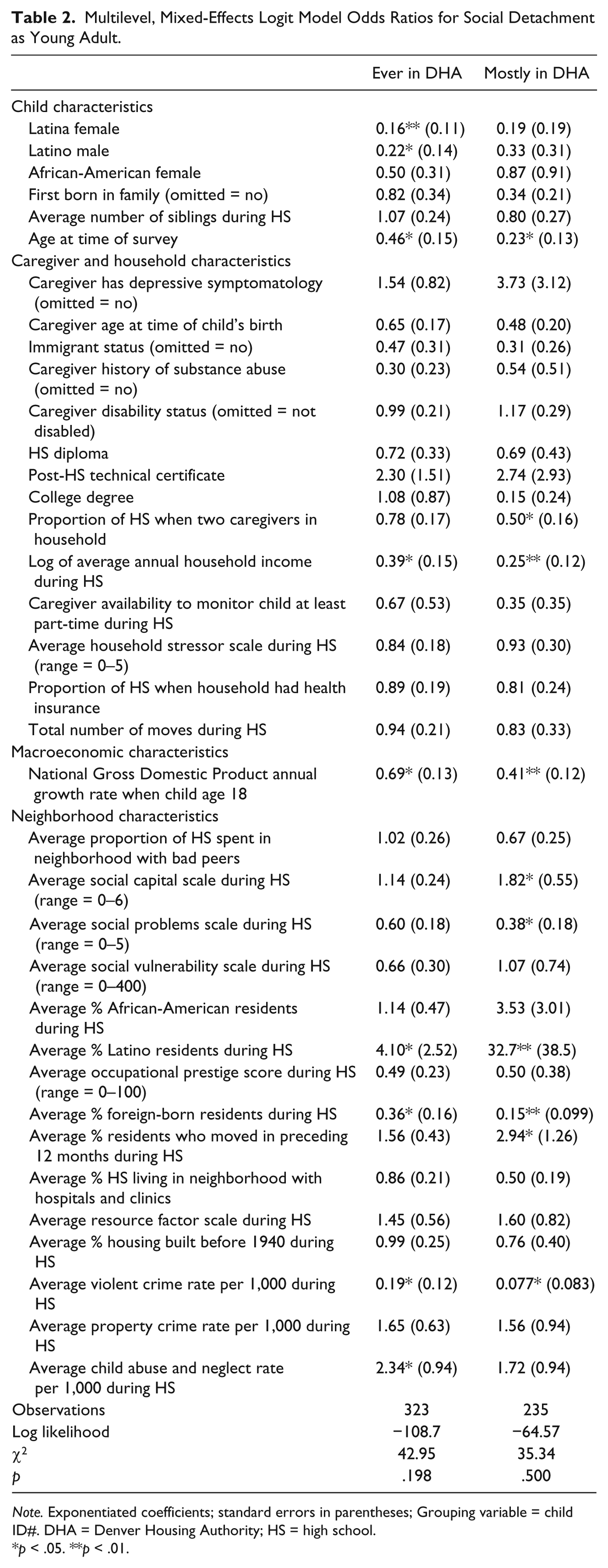
Note. Exponentiated coefficients; standard errors in parentheses; Grouping variable = child ID#. DHA = Denver Housing Authority; HS = high school.
p < .05. **p < .01.
Consider first the significant individual-level, family-level, and macroeconomic predictors. Ethnicity appears to matter. Compared with African-American males, young adult Latinas were 81% to 84% less likely and Latinos 67% to 78% less likely to be socially detached, depending on the sample. 14 This evidence corresponds with many other indicators documenting the persistently inferior economic prospects and quality of life experienced by young African-American males in the United States (Lewis and Burd-Sharps 2013). Those who were older at the time of survey were substantially less likely to be socially detached: 54% to 77% lower odds for a standard deviation–higher age. This likely indicates that our sample minority young adults eventually found work and/or postsecondary educational options as they matured. 15 Young adults whose families had a one standard deviation–higher income while they were in high school exhibited 61% to 75% lower odds of being socially detached, consistent with a vast literature on the relationship between family income and child outcomes (e.g., Haveman and Wolfe 1994, 1995). Families with higher incomes probably offered their children a more substantial set of financial, informational, and perhaps psychological resources that could have led to their improved physical and mental health and educational achievements, all of which enhanced their prospects for young adult social attachment via employment and/or postsecondary schooling. Although not robust across both samples, there is some evidence that the presence of two caregivers in the household during high school lowered the odds of young adult social detachment, perhaps by as much as half. Finally, as would be expected, a more robust economy when entering adulthood predicted much lower odds of social detachment: 31% to 59% lower odds per standard deviation–higher Gross Domestic Product.
Of central importance to our study are the results for neighborhood indicators, which we briefly present here but discuss fully in the following section. The ethnic composition of the neighborhood proved strongly predictive in both samples. A standard deviation–higher percentage of Latino residents during high school predicted at least a threefold increase in the odds of social detachment, whereas an equivalent variation in the percentage of foreign-born residents predicted from a 64% to 85% lower odds of such. Surprisingly, a standard deviation–higher violent crime rate during high school predicted 81% to 92% lower odds of social detachment. In one or the other analysis samples, there were also statistically significant indications that the odds of social detachment were greater for young adults who spent their high school years in neighborhoods with higher residential turnover, child abuse rates and social capital, and lower levels of social problems.
To understand these aggregate patterns more fully, it is helpful to disaggregate our models further by ethnicity and gender, 16 given theory and evidence suggesting heterogeneous neighborhood effects (Galster, Andersson, and Musterd 2010; Pinkster 2008; Sanbonmatsu et al. 2011; Sharkey and Faber 2014; South 2001). 17 We also find that such heterogeneity is substantial when we stratify our models and reestimate parameters; for parsimony, we highlight only key distinctions. The relationship 18 between social detachment and (1) Latino neighbors is stronger for men and for African-Americans, (2) foreign-born neighbors is stronger for men but similar across ethnic groups, (3) violent crime rates is similar for both genders and stronger for Latinos, and (4) both turnover rates and child abuse rates is stronger for women and for African-Americans.
Two additional features of neighborhood context emerged as significant predictors of detachment for a particular stratum, which were not apparent in the aggregate patterns. For African-Americans, percentage of African-American neighbors was strongly positively correlated with detachment. For women, neighborhood occupational prestige was strongly negatively correlated with detachment.
Discussion
In overview, we find that several aspects of neighborhood context are statistically and substantively important predictors of young adult social detachment, though typically not identically for all gender and ethnic groups. Indeed, we would note that standardized (beta) coefficients for key neighborhood context variables discussed below are of the same order of magnitude as those for family income and Gross Domestic Product, suggesting that context effects are not trivial. Below, we organize the discussion around thematic categories of neighborhood context.
Neighborhood Ethnic and Socioeconomic Composition
We have identified several important relationships between Latino (regardless of nativity) and foreign-born (regardless of ethnicity) composition of the neighborhood’s population and young adult social detachment. For both samples, higher percentages of foreign-born neighbors were associated with lower odds of neither working nor attending school, but higher percentages of Latino neighbors were strongly associated with the opposite consequence. For African-Americans, higher percentages of their own-group neighbors were associated with higher odds of neither working nor attending school. Recall that all these results appertain controlling for the nativity and ethnicity of the youth in question (with only Latino youth being less likely to be unattached in the “ever in DHA” sample).
We think that results for foreign-born neighbors likely reflect their proeducation and prowork values and their ability to more closely monitor teen activities (such as drinking, using drugs, unprotected sex, crime) that might risk future educational and employment prospects. Of interest, we could detect no significant statistical differences in these aforementioned relationships between African-American and Latino teens. This suggests that the mechanism(s) behind the observed relationship transcends intragroup culture. Norms and values might well spread from neighboring immigrant students to others in the neighborhood and/or classroom, of course. Moreover, immigrant households may have more adults from multiple generations and more adults who are not in the workforce, on average. This cadre of home-based adults may provide more opportunities for supervised study and recreation in homes for not only their own children but neighboring ones as well.
Results for percentages of Latino and African-American neighbors may have multiple causes. We think a persuasive potential cause may be that minority neighborhoods are more likely to have active underground/informal economies, thus providing networks and role models that more easily lead teens into young adulthoods of detachment from mainstream society. Another may be that minority youth from more identifiable minority neighborhoods in Denver are stigmatized and thereby have more opportunities foreclosed. Yet another may be that such neighborhoods are less healthy (we could not control for environmental pollutants), yielding inferior health outcomes that erode prospects for postsecondary education and employment. Finally, we cannot discount the possibility that such neighborhoods convey the opposite set of norms as those described above for immigrant neighborhoods.
As a majority of foreign-born residents of Denver are Latino (primarily of Mexican origin), this raises the issue of net effects in neighborhoods inhabited by Latino immigrants. Comparison of the estimated parameters shows that the Latino effect dominates. For each standard deviation–higher percentage of Latino immigrant neighbors, we estimate that the odds of a teen eventually being socially detached as a young adult will be 48% greater. 19
Residing in a neighborhood with higher occupational prestige was strongly associated with reduced chances of being socially detached as a young woman. This result can be understood from the perspective of local networks, norms, and role models. Neighborhoods that surround their low-income, minority teen women with higher prestige workers more likely expose these women to norms and role models that encourage education and work, and to networks of information about these productive opportunities and the “soft skills” required to take full advantage of them. These results are also consistent with those produced by recent qualitative research on both the MTO and Gautreaux programs. Some low-income, minority MTO caregivers in low-poverty (presumably, higher prestige than originally occupied) neighborhoods stressed during interviews the value of adult role modeling of work habits for their teens and the “soft skill” enhancement that improved their employment prospects (Briggs et al. 2011; Briggs, Popkin, and Goering 2010). This mimics results from Gautreaux that showed how higher economic expectations in advantaged neighborhoods positively influenced lower-income African-American teen in-movers (Rosenbaum, DeLuca, and Tuck 2005).
We are unsure why these occupational prestige results were only exhibited for women in our sample. We speculate that because low-income, minority girls are more likely to stay in school and less likely to have been involved with the criminal justice system, they may be more prone to see themselves as having more potential for upward mobility than boys. They, thus, may be more attuned to potential role models and find collective norms regarding education and employment more influential. Given that the vast majority of our sample children come from female-headed households, it also may be that girls are more effectively steered by their mothers to potential, higher-status women role models in the neighborhood.
Neighborhood Safety and Stability
Our results indicate that “neighborhood safety” should not be viewed as a homogeneous, unidimensional construct. We have found that rates of child abuse and neglect on one hand, and violent crime and social problems 20 on the other, appear to generate distinctive consequences. For low-income, minority young adults, living during high school in a neighborhood with higher child abuse rates (especially for African-Americans and females) seemed to enhance their prospects for social detachment, but living in one with higher rates of violent crime and social problems (especially for Latinos) seems to have the opposite effect.
The former relationship is expected. Prior research (Coulton et al. 2007) has suggested that high child abuse and neglect rates are emblematic of neighborhoods with weak collective norms and social structures for supporting the healthy, holistic development of children and youth. This interpretation is buttressed by our finding related to residential instability, which also has been shown to degrade neighborhood intergenerational closure (Sampson, Morenoff, and Earls 1999). It is no surprise that such neighborhoods provide weak launch pads for young adult success.
The observed inverse relationship between neighborhood violence and social detachment is unexpected, however. One possible explanation works through the indirect effect of family responses to neighborhood violence that (perhaps unwittingly) enhance educational performance and prosocial behaviors during high school. If fear of violence induces more caregiver monitoring and/or self-imposed restrictions on teens’ movements outside of home and school, a consequence may be superior high school performance and reduced incidences of antisocial and risky behaviors, which, in turn, could lead to greater odds of postsecondary schooling and employment. In other work (Galster, Santiago, and Lucero 2014; Galster, Santiago, Lucero, and Cutsinger 2014; Galster, Santiago, Stack, and Cutsinger 2014), we have identified statistical relationships corresponding to these arguments. Considerable ethnographic research documents the efforts of low-income parents to protect their children from exposure to violence (Anderson 1999; Furstenberg 1999; Galster and Santiago 2006). Even if these caregiver actions do not alter their teens’ behaviors or educational achievements, they may build stronger social bonds with their children that result in less social detachment. Another explanation may be spurious correlation. It might be that schools and public or private agencies of all kinds offered compensatory services and facilities in more violent Denver neighborhoods, enhancing educational performance in secondary schools and thereby boosting early adult chances for success and social attachment.
Comparing Our Results with Those from MTO
Given its salience, the findings from the MTO analysis should be compared with those from the current study, though we acknowledge at the outset that precise comparisons are impossible due to fundamental differences in the two studies’ purposes, analytical designs, samples, outcome measurements, and neighborhood measurements. In the domain of young adult educational and employment outcomes, we find strong neighborhood effects, whereas MTO found essentially none. MTO found several positive impacts of lower-poverty neighborhoods on adolescent females that might payoff in superior young adult educational and employment outcomes, however, though not for adolescent males. By contrast, we found that certain features of neighborhood context had stronger effects on young adult males (percentages of Latino and foreign-born neighbors), some had stronger effects on young adult females (turnover rates and child abuse rates), and others had similar effects on both genders (violent crime rates). We think that there are several reasons for these differences.
First, there are differences in the samples of low-income families investigated. In MTO, all families were selected from dilapidated public housing located in extremely disadvantaged neighborhoods where they typically had lived for many years; in our study, all families were selected from well-maintained public housing located in a wide variety of neighborhoods. If, indeed, there are durable damaging effects on children from living in concentrated disadvantage (Hedman et al. 2013; Sampson, Sharkey, and Raudenbush 2008), the MTO design reduces the potentially salutary impacts of subsequent environments.
Second, the neighborhood “treatments” differ substantially. MTO offers uncontrolled, “bundled” treatments: a disadvantaged public housing development neighborhood, a nonpublic housing development neighborhood, and a census tract with less than 10% poverty (at least for a year), followed by whatever neighborhood bundles of attributes voucher holders subsequently choose. 21 Our study disentangles variations in exposure to a wide variety of distinct attributes comprising the neighborhood bundle. If particular neighborhoods contain two attributes that generate countervailing effects on a given outcome (such as percentages of Latino and foreign-born residents), they may be canceled out by the MTO design. As our distinctly gendered results testify, “unbundled” aspects of the neighborhood environments can have distinct impacts.
Third, treatment exposure (both in terms of consistency and duration) is lower in MTO because many control families were forced to move as their public housing was demolished and the two experimental groups used vouchers. By contrast, our sample spent a considerable time in public housing and did not participate in the voucher program. As a consequence, our sample of households had a 6-year mean (5-year median) DHA residential duration, approximately twice as long as reported for the MTO experimental group (M = 2.7 years, median = 3.3 years). Theory suggests that several neighborhood effect mechanisms require a minimum duration of exposure before their impact will occur (Galster 2012b). Furthermore, even if the average context is the same during a period of a child’s life, two places well-above and below average may yield very different consequences for a child than the one that was consistently experienced. For instance, two cases having the same mean but different variances of the given neighborhood indicator may not create identical “exposure” to that indicator; longer-duration exposure, thus, creates an important difference in the consistency of exposure.
Fourth, though many measures in MTO rely on self-reporting and parental reporting (as do we), MTO also has some outcomes measured with administrative records. We see no reason why reliance on caregiver recall would bias measured neighborhood effects upward, however.
Fifth, youth were living in quite different metropolitan contexts in MTO and our study. MTO sites were Boston, New York, Baltimore, Chicago, and Los Angeles. Our study was conducted in Denver, which has many demographic and geographic features that make it unlike any of the MTO sites. Denver is a newer, faster growing (except for Los Angeles) metropolitan area. It has no concentrated, impoverished, heavily disinvested African-American ghetto. In 2000, African-Americans represented only 11% of the overall population, whereas Latinos comprised 32%. Ethnic segregation is lower. Denver has a unified city–county government and, thus, has much less geographic variation in local fiscal capacity and public services than in the other sites. All of these distinctions imply that Denver offers quite different opportunity structures, local cultural norms, public expectations, and institutional supports than the MTO sites. They may play themselves out in complicated ways that manifest themselves in greater power for neighborhood effects.
Conclusions, Caveats, and Urban Policy Implications
We have probed the urban neighborhood–based origins of the increasing social detachment of young adults. An innovative public housing program instituted by the DHA provides a unique opportunity to explore this issue because it mimics a quasi-random assignment of families to neighborhoods. Our logistic analyses found several statistically and economically significant relationships between teen contextual indicators and odds of social detachment of African-American and Latino young adults from low-income families that we think can be legitimately interpreted as causal neighborhood effects. The strength of these relationships was highly contingent on gender and ethnicity, however.
Although we could not measure directly the causal processes that could link teen context with later social detachment, we think our results are consistent with several, not–mutually exclusive possibilities. These include collective norms, role modeling, peers in local networks (especially related to underground economies), and individual as well as collective parental behavioral adaptations related to monitoring and restricting activity spaces of teens.
We urge circumspection in interpreting these results, inasmuch as these models make several simplifying assumptions about neighborhood effects (Galster 2012b). First, we measure average neighborhood conditions experienced during adolescence, thus potentially obscuring more extreme conditions that might be present during a few years that have particularly potent impacts. Second, we do not investigate lagged or cumulative aspects of context, especially the potential durable impacts of early childhood neighborhood environments (Musterd, Galster and Andersson 2012; Sampson, Sharkey, and Raudenbush 2008). Third, though our neighborhood measures are comprehensive compared with most neighborhood effects research, we have not explored neighborhood indicators related to environmental pollution or job access (O’Regan and Quigley 1996, 1998; Raphael 1998) due to unavailable information. Fourth, they do not provide direct measures of the causal processes that may link the distal environment to individual behaviors and outcomes. Although we have attempted to draw reasonable inferences from our statistics about these processes, they are hardly definitive. In a similar vein, we have not attempted to probe here potential ways in which neighborhood context may affect adolescents’ exposure to violence, anti- and prosocial behaviors, nutrition, health, and schooling, which might reveal more about underlying causal mechanisms between the relationships we have observed between adolescent neighborhood and young adult economic outcomes. We hope to address these latter shortcomings in future work through structural equation modeling.
Other caveats of our research should also be noted. Our results appertain only to a single metropolitan area, the idiosyncrasies of which we have previously noted. Thus, our findings may not be generalizable to larger metropolitan areas with more concentrated, disadvantaged African-American ghettos and Latino barrios that are reinforced by distressed public housing estates. We have only a parsimonious set of control variables related to characteristics of sample youth and the schools they attended (cf. Sykes and Musterd 2011). We are less concerned about the latter, however, because one of the potential influences of the neighborhood operates by altering which schools are attended; by omitting them, we avoid “over-controlling” our model. Finally, we recognize that this study focuses on only one young adult outcome: social detachment. In companion papers (Galster, Santiago, and Lucero 2014; Galster, Santiago, Lucero, and Cutsinger 2014; Galster, Santiago, Stack, and Cutsinger 2014), we explore a wider variety of indicators related to the employment and educational outcomes for low-income, minority teens and young adults.
Despite these limitations, we believe that our study holds several policy implications. First, it clearly supports the conventional wisdom that lack of family resources and a dearth of employment opportunities are primary determinants of young adult social detachment for urban African-American and Latino young adults. This, in turn, points to the importance of more vigorous full-employment and income-support (such as earned income tax credit) macroeconomic policies. Second, our study contributes to the formulation and reform of assisted housing and community development policy. Our findings suggest that well-formulated and targeted assisted housing and urban revitalization programs could potentially yield substantial social payoffs by changing the residential context of low-income, minority teens, either by changing their current neighborhoods and/or by changing where they reside. Our study has pinpointed particular attributes of the residential environment that seem most predictive, thus giving a strategic guide to policy makers as to which directions and investments are likely to yield the greatest improvements in young adult attachment to society.
Footnotes
Acknowledgements
Profs. Tama Leventhal and Xiaoming Li served as expert advisors to this project. Stefanie DeLuca, Lisa Gennetian, David Harding, Jens Ludwig, Jeff Morenoff, and seminar participants at the University of Michigan and Glasgow University contributed helpful conversations related to our analytical strategy. The authors also gratefully acknowledge the programming assistance of Dr. Albert Anderson and the research assistance of Jackie Cutsinger, Andy Linn, Kim Kostaroff, Georgios Kypriotakis, Rob Mehregan, Ana Sanroman, and Lisa Stack. Lydia Taghavi from the U.S. Department of Housing and Urban Development provided unpublished administrative data on Public Housing Authority resident incomes. Anonymous reviewers forwarded many helpful suggestions.
Authors’ Note
The opinions expressed herein do not necessarily reflect those of our funders.
Declaration of Conflicting Interests
The author(s) declared no potential conflicts of interest with respect to the research, authorship, and/or publication of this article.
Funding
The author(s) disclosed receipt of the following financial support for the research, authorship, and/or publication of this article: This research was supported by grants from the National Institute of Child and Human Development (5R01 HD47786-2), U.S. Department of Housing and Urban Development, MacArthur Foundation, Annie E. Casey Foundation, and Kellogg Foundation.
Notes
Author Biographies
References
Supplementary Material
Please find the following supplemental material available below.
For Open Access articles published under a Creative Commons License, all supplemental material carries the same license as the article it is associated with.
For non-Open Access articles published, all supplemental material carries a non-exclusive license, and permission requests for re-use of supplemental material or any part of supplemental material shall be sent directly to the copyright owner as specified in the copyright notice associated with the article.
