




Abstract
Service representation—the extent to which elected officials act as ombudsmen and engage in casework to assist their constituents with problems—is a crucial aspect of contemporary democratic representation. The local level of government is a potentially fruitful location in which to explore the practice of service representation. Despite this, service representation in local governments is understudied. Using data from interviews with 52 sitting councillors and a survey of 589 sitting councillors in Canadian cities, this article explores both the commitment of councillors to service and influences on time committed to service. This research finds that service representation is an important but secondary role of Canadian councillors. Furthermore, councillors elected in wards commit more time to service than councillors elected at-large, and councillors with strong service role perceptions also commit more time to service.
The notion of service representation—the extent to which representatives act as ombudsmen and engage in casework to assist their constituents with their problems—is an important theme in the overall study of democratic representation (e.g., Eulau and Karps 1977; Pitkin 1967). 1 This focus, however, has not been pronounced in the study of local government and politics. Although there has been substantial attention paid to the roles that councillors may assume, including as service representatives (e.g., de Groot, Denters, and Klok 2010), there has been very little analysis of the actual representational behaviors of councillors (but see Welch and Bledsoe 1988). This is particularly true in Canada (e.g., Eidelmann and Taylor 2010; Mevellec 2009).
This article explores the service roles of city councillors in Canadian cities. It draws on interviews with 52 councillors and a survey of 589 sitting councillors to address two research questions:
Drawing on both interviews and the existing literature, this article explores the influence of both electoral institutions (especially the use of wards and at-large systems to elect councillors) and individual role perceptions (defined as the aspects of councillors’ positions they define as particularly important; Klok and Denters 2013) on the commitment of councillors to service.
This research is rooted in an institutionalist framework. Institutionalist approaches explain the behaviors of political actors by exploring the roles of formal and informal institutions in shaping and refracting both the goals and the behaviors of those actors (Thelen and Steinmo 1992). In this study, city councillors as representatives are situated in institutional contexts within which they pursue their own goals to produce distinctive approaches to the task of representation, specifically some that are strongly committed to service and those that are less committed to this role. In particular, building upon prior findings (e.g., Clingermayer and Feiock 2001; Klok and Denters 2013; Welch and Bledsoe 1988), the focus here with respect to explanatory variables is on (1) the formative role of ward and at-large units of election and representation, and (2) the individual role perceptions of councillors regarding the importance of service. Both the relevant literature and theoretical considerations (outlined below) suggest two testable hypotheses:
Any analysis involving consequences of ward and at-large systems of election and representation in Canadian cities calls to mind the contested nature of both democracy and representation in those cities. Canadian cities followed in the footsteps of the turn-of-the-century U.S. reform movement that sought to remove party politics and patronage from city politics (e.g., Anderson 1972). The goal of “reformers” was to separate and create a dichotomy between public administration and politics in local government. This Wilsonian dichotomy was successfully perpetuated in both the United States and, later, Canada to the extent that it was seen as both “a self-evident truth and a desirable goal” (Kernaghan and Siegel 1987; Sayre 1958).
As Stewart and Smith (2007) noted, the reformist movement rejects constituency-based forms of representation and is instead associated with at-large units of election and representation. This movement continues to manifest not only in nonpartisan politics in most Canadian cities but also most prominently in diversity of institutions: Canadian cities employ ward, at-large, and hybrid systems that provide an ideal setting in which to test their effects on the behaviors of individual councillors (see Sancton 2011, chap. 9).
Most importantly, the contested nature of local politics and democracy in Canada cuts to the core of what roles councillors should assume. This is true with respect to both focus and style. In terms of focus, reformed electoral institutions contain incentives for councillors concerned with reelection to shift their attention from small-scale neighborhood and community concerns to citywide issues. At-large systems, argued Welch and Bledsoe (1988, p. 55), are “. . . designed to encourage members to look upon the city as a whole as their primary constituency rather than smaller groups of neighbourhoods, fellow ethnics, partisan, or other constituents” (also see Banfield and Wilson 1963, pp. 94–95). In terms of style, those who view city government as settings in which democratic and political conflict takes place view councillors as political and representational actors; in contrast, the reformers who view local governance as a simple matter of public administration must view councillors as administrators, at best directors on boards. Thus, diversity in both institutional configurations and the role perceptions of councillors should have significant consequences for how those councillors conduct themselves as representatives. This article contributes to this ongoing discussion by reporting on the consequences of both institutions and role perceptions for the service behaviors of councillors.
This analysis is important for this reason and another: The responsibilities of the municipal level of government in Canada, as in most other democracies with local-level governments, are “closer to the people” than those of the federal and provincial governments in the sense that these responsibilities—water, local roads, sewer, solid waste, and so on—are more likely to affect the day-to-day lives of citizens than the responsibilities of the other levels of government. Furthermore, the scale of city politics is more intimate than that of other levels of government, and this, in turn, is affected by the electoral system employed. Clingermayer and Feiock (2001), for example, theorized that ward councillors are more likely than at-large councillors to receive casework requests given the higher likelihood of a personal connection between councillors and constituents. Welch and Bledsoe (1988) confirmed the effect of this more intimate scale of representation, reporting both that councillors are more likely than Members of Congress and state legislatures to be contacted personally, and that few have staff to handle personal requests. This suggests the presence of an environment in which individual councillors’ ability to successfully address their constituents’ problems and concerns is greater than for their counterparts at other levels of government, incentivizing casework to construct a resilient local “personal vote” (e.g., Oliver 2012). This research confirms the view that city councillors have significant scope to address the service needs of their constituents, with Canadian councillors reporting that they regularly respond to service requests by providing information about city government, connecting constituents with city services or the local civil service, or by arguing on their behalf to the local city service.
The analytical focus of this article on Canadian cities is useful for two reasons in particular. First, focusing on Canadian cities addresses an important gap in theoretical understanding of the representational perceptions and behaviors of Canadian councillors. As Mevellec (2009, p. 773) noted, “. . . there are very few Canadian studies on the daily activities of local politicians that could improve our understanding of their craft.” In addition, the focus in this article on the roles of councillors answers the call from Taylor and Eidelmann (2010) for greater scholarly attention to be paid to local political leaders in Canadian cities, given that the smaller scale of local politics ensures that political outcomes cannot be separated from individual actors.
The second benefit of a focus on Canadian cities is that previous findings regarding the representational perceptions and behaviors of councillors in the United States can be tested in another state, an important task in the subfield of comparative politics. This analysis tests the possibility that theories about processes of representation developed in U.S. cities travel to other settings. In so doing, this study adds a crucial additional case study to the cumulation of knowledge about representational roles and behaviors in local settings overall (e.g., Egner et al. 2013), an important contribution given that Canadian local politics is not often explored in a comparative context (but see Sancton 1983).
Service Representation
The crucial starting point in the contemporary study of representation is the distinction made by Pitkin (1967) between what she terms descriptive and substantive representation. Descriptive representation concerns the extent to which elected officials resemble those they seek to represent. In contrast, substantive representation is concerned with the behaviors representatives engage in to represent their constituents. Scholars of city politics in Canada have focused substantial attention on descriptive representation, investigating in particular whether women and new Canadians are adequately represented on city councils (Gavan-Koop and Smith 2008; Gidengil and Vengroff 1997; Simard 2008; Tolley 2011; Trimble 1995). The same is true of studies of the composition of U.S. city councils, in which a strong emphasis is placed on the consequences of electoral institutions for the descriptive representation of women (e.g., Herrick and Welch 1992), African-Americans (e.g., Engstrom and McDonald 1981; Karnig and Welch 1982), and Hispanics (e.g., Welch 1990). As these studies readily acknowledge (e.g., Andrew et al. 2008), however, descriptive representation does not guarantee that the interests of different groups are represented on city councils. In contrast to studies of descriptive representation, studies of substantive representation in Canadian cities—how councillors actually go about representing electors—are absent.
Eulau and Karps (1977) argued that the key to substantive representation is responsiveness: Representatives must be responsive to the needs and wishes of their constituents in the sense that they must regularly learn about and act upon those needs and wishes. Eulau and Karps distinguished between four distinctive types of representational responsiveness: policy, service, allocative, and symbolic. Service responsiveness consists of casework in which representatives secure benefits for individuals or groups of constituents and assist them in solving problems. Eulau and Karps’ definition of service responsiveness includes a number of activities: listening and responding to constituents’ concerns and problems, including in town halls or public meetings; intervening between constituents and the civil service; and advocating for their constituents to the civil service and government. The latter two types of service responsiveness fall into the category of “casework.” These theoretical developments have resulted in a substantial literature on the representational activities of U.S. representatives, particularly their service activities at both the national (Grimmer 2013) and state (Jewell 1982; Smith 2003) levels.
Institutional diversity at the local level has allowed for the analysis of service roles and activities to be accounted for, in part, on the basis of the presence of wards and at-large systems, in addition to other institutional characteristics such as chamber size. Heilig and Mundt (1984), for example, demonstrated that ward councillors are more likely to be oriented to service than councillors elected at-large. In a similar but more ambitious study, Welch and Bledsoe (1988) found that the presence of wards is related to more time spent working on service requests from constituents. Finally, Clingermayer and Feiock (2001) found that ward representatives perform more casework for constituents than councillors elected at-large, in part because the former group tends to receive more requests for assistance from constituents. This literature has been complemented by the development of a parallel European literature exploring the service roles and activities of local councillors in the United Kingdom (e.g., Rao 1998; Snape 2004) and other European states (e.g., Klok and Denters 2013).
Methodology and Case Selection
A sequential exploratory multimethod design—a two-stage research design in which qualitative data collection and analysis is followed by quantitative data collection and analysis, and subsequent integration (see Creswell 2003)—was developed in this project. This included, first, interviews with a sample of sitting councillors in Canadian cities and second, an online survey of these councillors. This multimethod approach was selected for two reasons. First, very little has been written by scholars about processes of substantive representation at the local level of government in Canada. Qualitative methods, such as interviews, are particularly appropriate for the generation of theory, and so were employed here. Second, the subsequent use of a survey, the wording of which was often derived from the interview transcripts, allowed several hypotheses generated from the interviews to be tested. The sequential, exploratory multimethod design used was therefore able to leverage both the theory-generation strengths of qualitative approaches and subsequently the hypothesis-testing strengths of quantitative approaches to data collection and analysis.
The interview format was semistructured, with an interview schedule consisting of a list of questions and themes that councillors were asked to speak to. 2 The danger of an unstructured interview format is that subsequent data cannot be compared; this potential problem was addressed by the addition of a structured component to the interviews (see Small 2009). Nevertheless, councillors were given leeway to expand on their answers and introduce personal anecdotes, producing rich narratives that informed the subsequent quantitative research and findings.
Interviews with city councillors were conducted both in person and by telephone throughout 2012 and 2013. Councillors were invited to participate to maximize variation on a number of variables that were as a result of a literature review thought to influence representational approaches and perceptions. These included institutional (e.g., ward vs. at-large units of representation), ecological (e.g., city size and density), and individual (e.g., gender, time in office) variables. All 179 sitting councillors from Montreal, Ottawa, Toronto, and Greater Vancouver (Burnaby, Coquitlam, Delta, Richmond, Surrey, and Vancouver) were invited to participate. 3 Ultimately, 52 councillors agreed to be interviewed, for a response rate of 29%. Variation was achieved on all variables of interest with the exception of city size: The average population of the cities councillors were interviewed in was higher than the average of all Canadian cities. This potential bias was corrected by the subsequent use of a survey.
Interviews can generate both theory and hypotheses about the practice of substantive representation. But the results of small-n studies are not representative, and so such hypotheses cannot easily be tested. Accordingly, the second quantitative approach to data collection and analysis in the overall sequential exploratory multimethod design was to survey Canadian city councillors about both their perceptions and behaviors with respect to representation. One important value of the multimethod approach employed here is that the response options available to respondents in the survey were often generated organically from prior interviews rather than from similar studies in other jurisdictions. This ensured that patterns identified during the interviews for this project could be tested through the use of a representative survey. 4
The online survey of sitting municipal councillors was conducted in February 2014. All councillors in Canadian cities with populations more than 20,000 with online contact information were sent invitations. Out of 1,841 invitations, 589 councillors responded, for a response rate of 32%. This response rate is similar to or better than response rates in other surveys of representatives (e.g., Herrick 2011). An online survey format was selected because all councillors provide email addresses on Canadian city websites, eliminating any potential for bias resulting from undercoverage of groups without email addresses or Internet access (Van Selm and Jankowski 2006). In addition, online surveys have significant reach and are inexpensive to conduct.
Time Committed to Service Representation
The first research question is as follows:
When interviewing councillors, it becomes clear that many draw a simple distinction between what they refer to as “city hall work” and “ward work” or “community work.” The latter types of work are more likely to be of the casework variety: taking calls from constituents and attempting to assist them in addressing their problems. Councillor Josh Colle from Toronto summarized this distinction well:
I think that as city councillor in Toronto, you wear two distinct hats. Part of it is you are a community advocate. Kind of an ombudsman, where you are bringing forward concerns of a constituent. So there is that role and then the other hat is what you do down here [at city hall] and [that] is more supposed to be more about policy and creating (for lack of a better term) legislation.
To these policy and service functions can be added the communication function. Representation requires that representatives both learn of the needs of constituents and communicate their representative accomplishments back to those constituents. Communication is, thus, key—Indeed, Jewell (1982) viewed communication itself as an integral aspect of representation.
Councillors vary substantially in their time commitments to the service role. To some councillors, service is paramount and they, therefore, spend a substantial amount of time working on these issues. When I asked Councillor Mary Deros in Montreal how she would describe her role as councillor, she gave a clear indication of the prominence of the service role: “Customer service related to municipal responsibilities. Customer service at the highest level.” Other councillors see themselves as legislators and focus on broader policy issues—The time these councillors commit to service is, therefore, likely to be limited. Councillor Bruce Hayne from Surrey expressed this view well:
I’m more on the policy side of things. The bigger picture economic development/transportation issues. Those type of things, rather than “I need a ditch widened in my backyard” or whatever it might be. Those are obviously important issues for each citizen, but I get personal satisfaction out of doing the bigger picture stuff.
In the survey of Canadian city councillors, respondents were asked to report the hours spent per week, on average, “helping constituents with problems,” “studying or developing policy or meeting with other policy makers,” and “keeping in touch with constituents.” These are well-established statements designed to elicit responses on the amounts of time spent by representatives on their service, policy, and communication functions, respectively (e.g., Herrick 2011). 5 Although other studies include questions asking representatives how important each of these roles are to them, the use of time as an indicator is useful as it measures behavior rather than self-perceptions that may not in fact be reflected in the actual work practices of the councillors.
Figure 1 reports mean amounts of time per week spent by councillors on each of these functions:
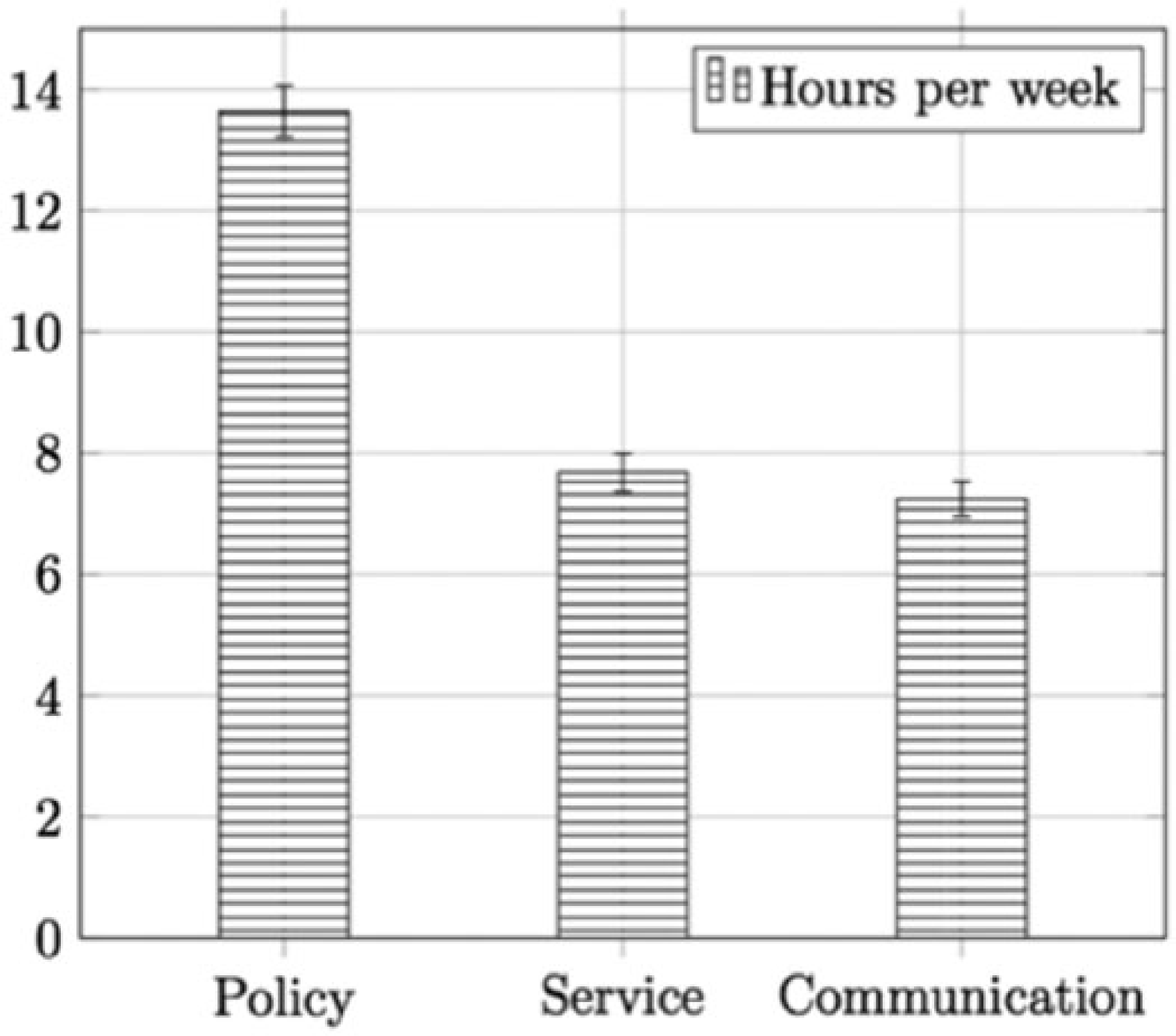
Hours per week spent on service.
The mean number of hours per week spent on service requests is 7.68, which comprises 25% of councillors’ time spent (SD = 7.4 hours). The majority of councillors report spending 10 hours or less per week on service requests; however, only two report spending no time whatsoever on this task. A minority of councillors spend a substantial amount of time per week on service requests. Roughly 10% of all councillors report spending 20 hours or more per week on service. This finding confirms that there is significant diversity in councillors’ service responsiveness to their constituents.
Time spent on service requests can also be compared with other functions of councillors. Councillors, on average, spend the greatest amount of time on policy issues. On average, councillors spend 13.64 hours per week on this policy function (SD = 10.0 hours). Time spent on service is on average slightly higher than time spent on communication: 7.24 hours per week on average (SD = 6.9 hours). In total, councillors spend most of their time (46%) performing policy work, and roughly a quarter of their time working on service (25%) and communication (24%).
Two findings are significant. First, although service is a prominent part of the job description of city councillors—taking up approximately 25% of their time on the job—it is on average a less demanding aspect of the job than policy work. Canadian councillors spend most of their time in city hall learning about, debating, and voting on “big picture” issues rather than engaging in casework for their constituents.
It is possible to compare this time spent with those of other representatives, but the extent to which clear comparisons can be made is limited given differences in measurement. Norris (1997), for example, noted that by the 1990s, British Members of Parliament (MPs) were spending, on average, a third of their time on service representation, which is higher than the proportion for Canadian councillors. In contrast, a survey of U.S. state representatives by Herrick (2011) found that they spend, on average, roughly five to eight hours per week on service. The average time spent by Canadian councillors falls into this range. As is the case here, Ellickson and Whistler (2001) found in their survey of U.S. state representatives that the most time was spent on policy work. This was followed by time on service work.
Second, there is substantial variation in the time councillors spend on their service roles. Some councillors are strongly committed to service, whereas others prioritize other functions (particularly their policy function).
Explaining Commitment to Service
The second research question is as follows:
This section develops a model that draws on institutional and role-oriented explanations to help account for variation in councillors’ commitment to service representation.
Institutions play an important role in shaping the behaviors of representatives at all levels of government. A particularly important aspect of this institutional environment relates to the unit of election and representation: Are representatives elected from single-member constituencies, multimember constituencies, or without the presence of geographically defined units of election and representation? The crucial distinction in Canadian cities is between councillors elected at-large and those elected in wards. There is a well-developed comparative literature demonstrating the importance of representational institutions for a range of representational outcomes (e.g., Bradbury and Mitchell 2007; Feiock and Clingermayer 1986; Freeman and Richardson 1996; Heitshusen, Young, and Wood 2005; Mcleay and Vowles 2007). In an early study, Heilig and Mundt (1984) demonstrated that council members in American cities with districts were more likely to see themselves as service oriented ombudsmen than councillors elected at-large. Of particular relevance, however, are findings from a study by Welch and Bledsoe (1988) of American local councillors, in which it was found that councillors elected in wards spend roughly 4% of their time more on service than their counterparts elected at-large (also see Clingermayer and Feiock 2001).
This discussion then leads to the following hypothesis:
All councillors in Canadian cities are elected either in wards or in at-large systems. There are two exceptions to this simple distinction. First, some councillors are elected in dual or even multimember wards. Second, some cities, such as Thunder Bay, Dieppe, and St. John’s, employ hybrid systems where some councillors are elected in wards while others are elected at-large for the city as a whole. These potentially complicating factors are eliminated by simply employing councillors’ responses to the question, “Are you elected at-large or in a ward/division?” In total, 70.7% of respondents were elected in wards or divisions whereas 25.6% were elected at-large. 6
Institutions shape representational behaviors, but so too do the goals and perceptions of the individual councillors themselves. Councillors have a range of responsibilities: monitoring and holding accountable the machinery of local government, developing public policy, representing the interests of their constituents, and acting as community advocates and leaders. The extent to which councillors embrace certain roles over others relies to some extent on which roles they see as important—How do they perceive their own jobs as councillors? There exists a well-developed literature on councillors’ role perceptions and orientations (e.g., Plüss 2014; Rao 1998; Snape 2004).
The roles councillors embrace affect their behavior, and this is found to be true for their service behaviors: Freeman and Richardson (1996, p. 49), for example, noted from their survey of U.S. state representatives that representatives who “place a high value on casework are far more likely to spend time on it.” Similarly, Klok and Denters (2013) explored the relationship between role perceptions and role behaviors in a large survey of European councillors, and found a correlation between the importance councillors place on service and their perceptions of their own effectiveness in achieving it. 7
This discussion then leads to the following hypothesis:
Councillors bring a range of role perceptions to their positions as councillors. In the survey, a service role perception was probed by asking councillors to rate the importance of “acting as an advocate for citizens.” This is a well-established indicator of service role perceptions (e.g., Klok and Denters 2013). Furthermore, the use of the word “advocate” in the interviews for this research was strongly associated with casework and councillors’ service role; the use of the word “advocate” in the survey as an indicator for service was also, therefore, drawn inductively from the interviews for this research. The results for this question were subsequently transformed into a dichotomous variable for the purpose of analysis. 8
I first use t-tests to determine whether hours spent on service differ between councillors elected in wards versus at-large and with strong service role perceptions versus without. I then conduct a regression analysis including a range of control variables to test the resiliency of these two independent variables of interest. Both tests validate both hypotheses.
Figure 2 plots the time per week committed to service for councillors elected in wards and at-large, and with strong service role perceptions and without. Bars labeled “Yes” indicate councillors elected in wards and councillors with a strong service perception; bars labeled “No” indicate councillors that were not elected in wards and who lack a strong service perception.

Hours per week spent on service, by election in ward and strong service role perceptions.
There are significant differences in the time spent on service between these groups. Councillors elected in wards spend two hours and one minute more per week engaged in service than councillors elected at-large (p = .00, two-tailed). Councillors with a strong service role perception spent two hours and 12 minutes more per week engaged in service than councillors without such a role perception (p = .00, two-tailed). Both bivariate tests, therefore, substantiate both hypotheses.
Table 1 presents a regression model that incorporates a range of control variables to ensure the effects observed for the variables of interest can withstand the inclusion of controls. Control variables fall into three categories: institutional, ecological, and personal. Descriptive statistics for these variables and descriptions of the survey measures can be found in the appendix.
Influences on Time Committed to Service Role (OLS).

Note. This analysis suffers from survey attrition and dropped cases: As several questions were near the end of the survey, several respondents had dropped out. This resulted in a lower number of respondents included in this analysis. I tested for selection bias in the resulting sample in two ways. First, I regressed stayers versus dropouts as the dependent variable on several key explanatory variables (Gender, Birth year, Party or Slate, Years Served, Elected At-Large, Chamber Size, and Quebec). Birth year, Party or Slate, and Years Served all produced statistically significant results; however, the coefficients were very small, with the result that the change in probability of dropping out was essentially meaningless. There was, however, a statistically significant relationship between Quebec residence and dropping out: Councillors in Quebec had a 10.7 percentage point higher probability of dropping out than non-Quebec councillors. I then estimated a Heckman sample selection model (see, for example, Heckman 1976) with, given the previous check, Quebec residence as the selection variable. While the coefficients for some variables changed slightly with the inclusion of this selection variable, no variables changed in terms of meeting the threshold for statistical significance. OLS = ordinary least squares.
Two institutional control variables are included. First, running for office with either a party or slate is included as a control variable. The expectation here is that a candidate elected or serving with a party has less incentive to construct a local personal vote through measures, such as casework, because their own reelection prospects are likely to be tied to the fate of the party. This became clear during interviews conducted for this project with councillors in Vancouver and Burnaby, where municipal parties are important actors in local politics. In addition, voters within the context of a party system are likely to draw on party or slate labels as heuristics to assist them in reaching a vote decision, reducing the importance of any individual candidate’s previous service work to the outcome of the election (see Cutler and Matthews 2005). Parties and slates are not particularly common in Canadian local elections; however, as Sproule-Jones (2008) argued, nonpartisan rhetoric of candidates for local office may sometimes mask informal organizational linkages to provincial or even national parties.
Second, a dichotomous variable indicating whether councillors’ positions are full-time or part-time is included. Past findings (e.g., Herrick 2011) indicate that councillors in full-time and otherwise professionalized positions spend greater time on casework; I have the same expectation here. 9
Several ecological control variables are also included in the model. Certain ecological settings are thought to generate more casework requests and, therefore, demand more time of local councillors. In particular, dense urban communities, low socioeconomic status, and racial and ethnic minorities have all been found to be associated with greater service requests visited upon local representatives (e.g., Ellickson and Whistler 2001; Jewell 1982; Johannes 1984; Thomas 1992). Councillors in complex urban wards or cities must cope with greater service demands—This was also observed in the interviews in this project, where urban councillors described being inundated with service requests whereas councillors from sparser and more affluent suburban areas enjoyed fewer service demands and so were more free to focus on broader, “big picture” policy concerns.
These expectations are explored with the inclusion of three variables: a variable for population size divided by 1,000 for ease of interpretation, the percentage of immigrants in the city, and the average household income for each city. 10 The latter two measures are collected from the 2011 National Household Survey. It is expected given the prior review of the relevant literature that higher populations and a high proportion of immigrants are expected to increase service demands. In contrast, average income is expected to be negatively related to time councillors spend on service.
Finally, several individual-level variables are included in addition to the presence of a service role perception. First is gender. Women are generally found to spend more time on constituency service and casework than males (e.g., Richardson and Freeman 1995; Thomas 1992). Second is total years in office. There is some evidence that long periods in public office provide incumbents with greater familiarity with the service needs of their districts, which produces more time committed to service; however, this finding is contested (e.g., Jewell 1982). Furthermore, Clingermayer and Feiock (1994) found that long-serving ward councillors receive fewer service requests than neophytes, suggesting that constituents over time come to see councillors as unreceptive to service requests. Third is ideology. Councillors on the left—those who favor greater government spending and intervention—are thought to be more willing to spend time on service requests than councillors who favor a more limited role for government (Cain et al. 1982). Finally, progressive ambition—the desire on the part of councillors to occupy higher political office such as federal office—is associated with “show horse” behavior such as media appearances and speeches. We, therefore, expect progressive ambition to negatively affect the time councillors spend on “work horse” behaviors such as service work (Hibbing and Thomas 1990). In contrast, static ambition—the desire to remain in the same public office—is more likely to be associated with “work horse” behaviors, so the expectation here is that static ambition leads to more time spent on casework.
Table 1 presents two ordinary least squares (OLS) regression models where average hours spent on service per week is regressed on the variables outlined above. Model 1 is a simple model allowing for straightforward interpretation of the effects of the two variables of interest. In contrast, Model 2 includes an interaction term for ward election and service role perceptions that tests for an interactive relationship between these two variables in the influences they exercise on hours performed on service.
Model 1 explains an impressive 41% of variation in the dependent variable. Both explanatory variables of interest—ward and service role perception—produce statistically significant results, with the coefficient in the correct (positive) direction. This result is upheld when a range of control variables are included. Both the bivariate and multivariate tests, therefore, substantiate both hypotheses. Both institutions and individual role perceptions are important to shaping the service and casework behaviors of city councillors.
Three control variables are noteworthy for reaching levels of statistical significance. First, as expected, running with a party or slate is associated with lower subsequent time spent on casework. Councillors who ran with parties or slates spend one hour and 44 minutes less a week working on service than councillors elected without such affiliations, net of other factors. It appears that a party or slate affiliation makes casework—a crucial component to the construction of a local personal vote—less important than for councillors without parties to assist in their reelection. Second, full-time positions have a high-magnitude influence on casework, with full-time councillors spending eight hours and 36 minutes a week more on casework than councillors who work part-time. As the total time spent in the their roles as councillors increases, so too does the time spent on service responsibilities and casework. Finally, the presence of immigrants is positively related to time spent on service, with every 1-point increase in the percentage of immigrants in a city associated with eight minutes per week more spent on casework, net of other factors. Notably, a service role perception is the only individual-level factor that exercised an influence on time spent on casework.
Preliminary analysis suggested that the inclusion of an interaction term for ward election and service role perceptions would enhance the explanatory power of the model, as the values of hours spent on service work do differ for the two values of the dichotomous values of the interaction term (0 = 6.68 and 1 = 9.07). Furthermore, this result is significant in a t-test (p = .00, two-tailed). However, Model 2 demonstrates that this interaction term does not exercise a statistically significant effect on the dependent variable. Furthermore, inclusion of the interaction term does not increase the overall explanatory power of the model.
Conclusion
This article explored the practice of service representation and casework in Canadian cities. The goals of the article were to determine, first, the commitment of councillors to service and, second, the factors that influence time committed to service. It was found that the service role is a secondary yet prominent concern of councillors in Canadian cities. On the basis of interviews with city councillors and a literature review, it was hypothesized that both institutions (ward vs. at-large methods of election) and individual role perceptions would be crucially important to shaping the service commitment of Canadian councillors. These hypotheses were substantiated.
The local level of government is a potentially fruitful location to study the service behaviors of elected officials. This is because local governments are often responsible for many of the policy domains about which citizens would seek service assistance from their representatives. Furthermore, the smaller scale of municipal politics ensures that individual councillors may be more effective at assisting constituents with service requests, incentivizing this activity on their part. Despite these arguments, service at the local level of government has not been explored in a comparative manner. This article adds a Canadian case study to the inquiries of service representation in American cities but should also lead to studies of local service representation in other countries or, ideally, based on cross-national data collection.
This research, therefore, sets the stage for further inquiries into the representational behaviors of city councillors in Canada and elsewhere. In particular, exploration of the other three forms of representational responsiveness identified by Eulau and Karps (1977)—policy, symbolic, and allocative—would cast new light on processes of representation at the local level. Such studies would do so in two ways. First, they would extend insights found at other levels of government and at the local level in the United States to local government in a range of democracies. Second, further exploring the importance of role perceptions to shaping representational behaviors would harness the substantial literature on councillors roles (particularly in Europe) and explore the consequences of role perceptions for representational outcomes. Such a research program would lead to an enhanced understanding of substantive representation and, thus, democracy at the local level of government.
Footnotes
Appendix
Acknowledgements
I am grateful to both the editors and anonymous reviewers for their comments on this article. In addition, I wish to acknowledge the research assistance provided by Johanu Botha, Lukas Froese, Davis Hirsch, Ali Kimlinger, John Kraemer, Michael Nerbas, and Bryce Vincent.
Declaration of Conflicting Interests
The author(s) declared no potential conflicts of interest with respect to the research, authorship, and/or publication of this article.
Funding
The author(s) received no financial support for the research, authorship, and/or publication of this article.