




Abstract
Facing both neoliberalism and the persisting legacies of developmentalism, many South Korean cities continue to subscribe to strong growth-first ideologies, despite their deindustrialization and aging populations. The growth orientation in cities, however, is far from being limited to South Korea. In fact, the recently emerging discourse on urban shrinkage, which has been West-centric so far, is questioning the bias toward growth in cities, and calling for a paradigm shift. This article brings together the literatures on shrinking cities and urban politics to illustrate how an East Asian city, transforming from a developmentalist to an entrepreneurial city, could seek a development alternative to the one based on the neoliberal competition for capital. Specifically, it examines the case of Totatoga, a culture-led urban revitalization project in a declining, old commercial district of Busan. It explains how a new kind of state–society collaboration opportunely explored a development path other than growth.
Introduction
Globalization is leading to a new spatial consequence of increasing interurban inequality between those cities that have successfully integrated into the new global economic network and those that have not (Scott and Storper 2003). Urban scholars have focused on the former under the rubric of “global cities” for some time, but the latter unplugged cities are also very much present, manifesting shrinking population and economic downturn, as they fail to find a niche in the global economy. Framing urban shrinkage as the other part of the spatial manifestation of globalization, there has recently emerged a literature on shrinking cities (e.g., Martinez-Fernandez et al. 2012; Pallagst, Wiechmann, and Martinez-Fernandez 2014; Wiechmann and Pallagst 2012). Against the neoliberalism that highlights the intercity competition to attract global capital in urban development agendas, this literature argues that such growth-dependent strategies do little to improve the urban conditions of the shrinking cities, and hence calls for a paradigm shift. Understandably, much of the shrinking city literature is based on the European and U.S. cities that have undergone urban shrinkage for some time as their prior industries relocated overseas without new capital moving in. Yet, in today’s intensifying globalization, urban shrinkage is no longer an isolated problem for a few old industrial cores. Due to highly mobile capital, cities elsewhere, including in Asia, also increasingly need to grapple with the changing circumstances that introduce urban shrinkage as a real and immediate challenge.
In fact, for many of the East Asian cities, as swiftly as they have developed under the strong developmental states’ growth agendas compared with the cities in the West, they appear to face equally fast-approaching urban shrinkage, with their deindustrialization and unprecedented rate of aging population. Yet most East Asian cities’ governments still adhere to lingering developmentalist legacies, on one hand, and are quickly embracing the neoliberal ideologies highlighting the competitive market logic on the other. 1 In this article, referring to the city of Busan of South Korea (hereafter “Korea”) as a case, we explore how an East Asian city could be shrewd in its urban shrinkage, overcoming the growth orientation stemming not only from neoliberal urban policies but also from its legacy of developmentalism.
Specifically, we focus on a culture-led urban revitalization project, Totatoga, which exhibits a different path of development that uses arts and culture in a way that is not dominated by growth priorities under the state-led political environment. Carefully planned by nonstate actors, and assisted by collaborating local government since 2010, it has prioritized local cultural activities and community engagement to bring life back into the old downtown of Busan. It stands out from other local artist residency programs in Korea, where artists more often than not have chafed under rigid administrative control and procedures, achieving little in terms of local development, let alone community benefits (Y.-H. Kim 2014). It also notably departs from conventional urban revitalization strategies under the influence of the growth orientation, such as flagship types of cultural facilities (Evans 2005), or cultural spaces that cater to real estate interests (Markusen and Gadwa 2010). By explaining the governance structure of the project and its other success factors, we explore one of the possible ways by which shrinking East Asian cities could create an alternative development model despite a strong developmentalist tradition and neoliberal influence.
The remainder of this article is structured as follows. We first lay out the literatures on shrinking cities and urban politics, exploring them as the key framework; our research goal and methodology follow, connecting the theoretical discussions to our case. We then contextualize the case by introducing Busan, including its recent structural changes and cultural policies. The subsequent sections examine Totatoga in detail, and based on the case analysis, we discuss how Totatoga is a progressive alternative model of urban revitalization, and why it was achievable. Finally, the article concludes by highlighting the implications of Totatoga for the shrinking cities and urban politics literature, as it suggests a new kind of state–society collaboration in East Asia amid the challenges of urban shrinkage.
Overcoming Cities’ Growth Paradigm
Urban Growth Questioned
Understanding of the political economy behind urban development in the last half-century has been dominated by the idea of pro-growth coalitions, with concepts and theories first developed in the United States, then tested widely in other countries. Referred to as “growth machines” (Logan and Molotch 1987), where the place-based urban elites form growth coalitions to increase land rents, or as “entrepreneurial cities” (Harvey 1989), where local governments transform from being “managerial” to “entrepreneurial,” cities have been accustomed to planning for growth, assuming its continuation. Under the “new urban politics” (Cox 1995), local governments “marketize” their cities with the promotion of commercial megaprojects, gentrification, and private consumption, in the hopes of capturing capital and building their competitiveness (Hackworth 2007). In particular, inner-city areas, with the collapse of the manufacturing industry, are frequently chosen for “prestigious” projects with strong property interests mainly for the rich and business elites, while excluding local residents (Marcuse and van Kempen 2000; Swyngedouw, Moulaert, and Rodriguez 2002).
Although there have been some criticisms that saw the limits of the pro-growth coalitions as the main interpretation of urban development dynamics, especially when examining the Western European cities that showed more restrictive urban growth policies (e.g., Fainstein 2001; Harding 1994), the growth paradigm today seems to be getting an even stronger hold on cities across the globe amid intensifying neoliberal globalization (Swyngedouw, Moulaert, and Rodriguez 2002). The neoliberal ideologies, which emphasize competition and predominantly evaluate cities as the engines of growth through a market-oriented lens, have led to the rising roles of the private sector in urban policies (MacLeod and Jones 2011). In fact, it has been argued that there are now fewer options in policy agendas for cities, as the corporate interests dominate local development decisions under the justification (or the necessity) of having to compete amid globalization (Brenner and Theodore 2002; Dryzek 1996; Peck 1998). Cities are manifesting “growth obsession” and consider the inability to constantly showcase a growing population and economy as failure (Leo and Brown 2000). Hence, it is not a surprise that even the shrinking cities continue to be planned as if they were growing (Sousa and Pinho 2015). Against this trend, the literature on shrinking cities has begun to question the existing growth-centered planning paradigm.
The shrinking cities discourse underscores that presupposing growth and hoping to rekindle it via the traditional growth-oriented planning strategies are not likely to bring successful and sustainable solutions because of the changed economic and population structures (Sousa and Pinho 2015). A different development logic for shrinking cities is needed (Großmann et al. 2013)—one that embraces both growth and shrinkage as concurrent urban phenomena (Wiechmann and Pallagst 2012). Instead of growth being a value-free ultimate goal, this new movement argues for “smart shrinking,” which is about prioritizing to improve the quality of life to achieve smaller but “better” places (Hollander 2011; Popper and Popper 2002). The idea is to adopt a positive outlook on urban shrinkage and consider new advantages to be found for local policy making, proactively seeking alternative development paths 2 and overcoming the growth coalitions.
This paradigm shift, however, is not easy to put into practice. Shrinkage has been considered as a “stigma,” and its discussion has been shunned in the local planning and political arena (Beauregard 2003; Reckien and Martinez-Fernandez 2011). Wiechmann and Pallagst (2012) noted how, even though many U.S. cities have for years employed various approaches to revitalize their declining urban inner cores, no active discourse of shrinking cities has arisen. Considering that East Asian cities have experienced astonishing rates of growth until recently (and are still surrounded by the celebration of it), one can imagine that their local governments would be even more hesitant to raise the issue of planning for shrinkage, despite their recent transformations marked by declining population and deindustrialization.
The Politics of Urban Development in East Asia
In the last half-century, East Asian cities grew under developmental regimes that not only thrived on but also legitimized their existence on the basis of state-led economic development and prosperity as the means for national survival (Castells 1992). Economic growth was the foremost goal, and cities were instrumental in achieving economic aims, supporting the state-led industrialization. Urban policy was thus focused on the construction of urban infrastructure to support economic production and growth, rather than on the welfare of the urban population, guided by comprehensive planning at the national level (B.-G. Park, Hill, and Saito 2012).
To these developmentalist cities, the growth-first ideology is far from being new, and “the place marketing typical of neoliberalism is not entirely inconsistent with a developmental ideology that prioritizes market-conforming methods to spur economic growth” (B.-G. Park, Hill, and Saito 2012, p. 22). What has changed for the East Asian cities, as neoliberalism has begun to locate and intermix with developmentalism, is the rescaling of the growth-oriented interventionist state from national to local, the increased presence of corporate interests, and the intensified commodification of spaces (B.-G. Park, Hill, and Saito 2012), but all of these continue consolidating the growth priority. Moving from one growth-first ideology to another, local governments end up attacking urban shrinkage with aggressive growth strategies—such as holding mega-events or building special economic zones, convention centers, mega-malls, and skyscrapers—an outcome that is not very different from that of the pro-growth coalitions in the Western societies.
While the overall growth priorities are similar, there exist some deviations in the pro-growth coalitions and the institutional conditions of the East Asian countries. For example, in both Taiwan and Korea, the role of local political leaders in the coalition is noted to be much more dominant, compared with local businesses and land-based elites. With the mayor taking a pivotal position in the coalition, the other “partners” resemble more closely a client under a patron–client network (Bae and Sellers 2007; C.-M. Park 2000; Tang 2003). Similarly, Chinese cities are found to increasingly manifest entrepreneurial governance that is dictated by the strong local government and mayor, whose political ascendancy is linked to their cities’ growth indicators (Wu 2002; Xu and Yeh 2005). In short, despite the transition, the legacies of statism persist in East Asia.
In addition to the mayor-centered growth coalition, the recent decentralization reforms of the previously highly centralized and authoritarian developmental states in East Asia have led to the persistent power of the national government, especially in regard to the control over fiscal resources. As local budgets become heavily reliant on central government transfers, local governments increasingly show a lack of financial discipline. Without much concern for producing a better-balanced budget, local politicians often end up pursuing reckless urban investment decisions for personal political objectives (C.-M. Park 2000; Xu and Yeh 2005).
Yet, at the same time, emerging from the developmental state’s economic growth has been the rise of civil society (with the expansion of a highly educated urban middle class), which has become increasingly vocal in urban affairs. Bae and Sellers (2007) and Tang (2003) both highlighted this newly rising urban middle class in East Asia as the key actors capable of expressing concerns for irresponsible growth, bringing antigrowth politics into the picture. The fact that it is the political mayors who predominate in the growth coalitions also allows for the urban middle class (as powerful constituents) to have significant influence on urban governance. What seems to be taking place is “the enlargement of democratic spaces to create alternative development paths” (Douglass 1998, p. 109).
Under the circumstances, urban shrinkage could provide the very specific physical spaces in which an alternative development can occur, as it leaves pockets of visibly declining areas that are neglected by developers and private corporations, and thereby invites the sectors of the society outside the growth coalition to take action to lead instead. The latter’s role in this case of urban shrinkage is not solely to restrict (or fight against) growth, but to find a different kind of urban development path. In other words, by tapping into this unexploited resource of the civil society in urban governance (Hospers 2013), shrinking cities might have an opportunity to implement development projects that are much more sensitive to the local public aims, rather than corporate interests.
Research Goal and Methodology
Based on the discussion presented thus far, on one hand, the urban growth coalition seems to remain strong, dictating how urban spaces are developed, even when shrinking conditions demand a different paradigm, according to the literature. This would be more likely for the cities in East Asia, where the growth-first orientation has been prevailing, with urban shrinkage only now beginning to unfold as a new challenge. On the other hand, actors other than the growth coalitions might emerge to play a more significant role, seizing opportunities in declining urban centers, especially given East Asia’s relatively recent rise of civil society. The goal of this research is exploratory in that it seeks to shed light on whether and, if so, how an alternative model might work in an East Asian city, surrounded by the growth-first paradigm and increasingly facing a new challenge of urban shrinkage. In particular, given the long-standing coalition between strong governments and capitalists that has largely transformed cities under the economic growth aims in East Asia, why and how could governments and the local society collaborate differently to cope with cities’ shrinking areas?
For this purpose, we have chosen the single case study of Totatoga—a culture-led revitalization project. Totatoga is important for our discussion because it allows an examination of what is possible as an alternative response to urban shrinkage in an East Asian context. It is an exception to the generally assumed promotion of growth agendas and strong government interventions in East Asian cities; it signifies the possibility of pursuing culture-led revitalization that is more bottom-up and noncapital-driven, as sometimes illustrated by selected cases in European or U.S. cities that have particularly low levels of real estate pressures (Markusen and Gadwa 2010; Sacco and Blessi 2009; Stern and Seifert 1998). In fact, culture-led urban strategies have become a globally popular trend in the cities undergoing economic restructuring, but more often than not, as a new type of urban entrepreneurialism, reinforcing growth politics (Miles and Paddison 2005; see also Daniels, Ho, and Hutton 2012 for Asian examples). They have been criticized for questionable outcomes, especially for the local community under the looming threat of gentrification (Smith 1996; Zukin 1982; Zukin and Braslow 2011). Totatoga not only avoided such pitfalls but also had an influence on the recent transition in Busan’s cultural policy, as will be illustrated in the next section, thereby suggesting a possible paradigm shift that is argued for by the literature.
For an in-depth examination of the governance arrangement and workings of Totatoga, with an actor-centered and contextually grounded approach, we did document analysis, made site visits, and conducted a survey and a total of 15 open-ended, in-depth interviews ranging from one to two hours each. Fieldwork was conducted in two phases: one in May 2011 and the other in December 2013 as a follow-up to observe any updates in the second round of Totatoga. The interviewees were the five key actors from the Busan City Hall and the Totatoga Management Center (“TMC”) 3 ; seven participating artists from varying art genres, who provided detailed stories of their motivations for joining Totatoga and their interactions with other Totatoga artists and the local community; and three local residents, including a landowner. 4 In addition to the interviews with artists, a survey was conducted in 2011, to which 40 (out of 49) artists responded. 5 We cross-checked the narratives of interviewees coming from different points of view, and also triangulated with newspapers, secondary literature, the survey results, and our impressions from the site visits. Through the detailed study and analysis of the case, we seek to understand the development processes and outcomes of an alternative model in the shrinking parts of what are otherwise widely assumed to be growth-driven metropolises in East Asia.
An Introduction to Busan—Its Urban Shrinkage and Cultural Policy
The problem of urban shrinkage for a late industrializer, such as Korea, is more relevant than one might think. Speedily industrializing and urbanizing under the growth-first ideology, Korea not only transformed its predominantly agricultural economy to a heavily industrialized one but also had its urbanization rate dramatically increased from a mere 28% in 1960, to 74% in 1990, to over 90% today. Pursuing Export-Oriented Industrialization, selected villages and farmlands, with the best industrial locations in the southeastern coastal areas, were transformed into industrial cities in a relatively short time (Chon 1992). As their rapid urbanization has been closely tied to the industrialization, their deindustrialization could easily lead to ruthless de-urbanization, unless successful industrial restructuring takes place. But most of the economic restructuring toward high-technology and knowledge-intensive industries and advanced producer services took place in the Seoul Metropolitan Area (SMA) (H. M. Kim and Han 2012). Today, the SMA includes nearly half of the total national population as well as Gross Regional Domestic Product (GRDP) (see Figure 1), far exceeding “the rest” of Korea (including Korea’s second metropolitan city—Busan 6 ).
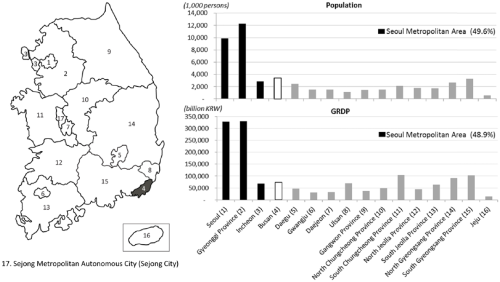
Population and GRDP (Seoul, six metropolitan cities, and nine provinces), year 2014.
Located at the tip of Korea’s southeastern coast, Busan is a major port city. It is the key metropolitan city of the southeastern industrial core, but the city failed to develop significant service functions compared with Seoul, or to join in the industrial restructuring. Its major economic takeoff took place during and after the Korean War (1950s–1960s), when its population and labor-intensive industries (such as textiles, footwear, and wig making) boomed with the war refugees flocking to the city. While the chaebol 7 branch plants of the capital-intensive industries (such as automobiles, ships, and petrochemicals) located in other new industrial cities near Busan in the 1970s, Busan’s economy continued to rely mostly on the labor-intensive small- to medium-sized industrial firms. Consequently, since the 1990s, the city has been experiencing rapid deindustrialization.
Busan did emerge as one of the world’s major container ports. It was the third largest port (in terms of container throughput) after Hong Kong and Singapore in 2002, although it was pushed back to fifth in 2003 by the rapidly growing Chinese ports of Shanghai and Shenzhen (Organization for Economic Co-operation and Development [OECD] 2009). The port activities alone, however, have not been enough to buoy the local economy. Failing to attain a strong presence in the national and global economy, Busan has not been designated as a global city in the United Nations (UN) or other statistical sources (Richardson and Bae 2014). In fact, Busan has been continuing to lose population (on average 40,000 per year) to the neighboring cities and to the SMA (S.-H. Park et al. 2012). Not only has the population been decreasing since the mid-1990s, but the city also currently has the largest elderly population in Korea (Seo, Cho, and Skelton 2015).
Amid the economic and social stagnation, the local government has been devising strategies for postindustrial transformation, with a vision to turn Busan into a maritime city 8 and an Asian gateway. Culture became important in its postindustrial strategies, especially with Busan’s successful hosting of Korea’s first international film festival in 1996. Since then, the idea of making Busan a cultural city has begun to take shape. In 2004, Busan was designated as the Cine Culture City; and among the seven major projects identified in the Dynamic Busan 2020 Road Map (2005), “Cultural City Project” was one.
Busan’s cultural policies closely resemble growth-oriented policies, and its first comprehensive plan (Busan Cultural Vision 2020), developed in 2007, focused on making huge and ambitious investments in cultural infrastructures, aspiring to put the city “on the map” in the global urban hierarchy. Some examples of attempted projects include a Guggenheim museum, an art center, a national library, the national ocean museum, and the Busan Art Biennale Space. Without having communicated with the central government first, the art center and the national library could not take place; and lacking a budget, the Guggenheim museum was unfeasible from the beginning (Cha 2014). Currently, the main issue being discussed is an opera house development plan (benchmarking Sydney’s opera house), hoping to trigger successful waterfront redevelopment as the city is relocating one of its old main ports (Cha 2014).
Busan’s pursuit of international attention-grabbing projects is understandable under the mayor-centered pro-growth coalition in Korea. While the industrial restructuring is highly difficult, the popularly elected mayor is seeking to showcase his efforts to keep Busan’s image of economic growth and prosperity as the second metropolitan city of Korea, and to continue to attract private capital to the city. However, such a prescription of megaprojects and international events, alongside its low fiscal independence rate of 56.4% and budget constraints, resulted in government inducing further investments into Busan’s newly expanding areas “that have easy access to private investment, rather than on the old downtown areas which suffer from lack of investment and are thus desperately in need of government support” (Seo, Cho, and Skelton 2015, p. 33). Consequently, old downtown areas manifest worsening shrinkage symptoms of high building vacancy rates, schools closing down, and an increasingly aged population 9 (S.-H. Park et al. 2012).
The problem of declining inner cities, in fact, began to surface in Korea’s deindustrializing cities in the 2000s, leading to the national government taking an interest in large-scale urban regeneration projects. Following the national trend, Busan recently launched a massive redevelopment project—the Sanbok Road Renaissance (2011–2020)—as part of its key policy agenda, with a budget of about US$150 billion. Seeking to revitalize local communities of densely populated shantytowns in the hilly areas of the city, the project centered on physical, livelihood, and cultural regeneration goals. It signals how Busan’s cultural policy is beginning to engage with major urban regeneration goals, aside from the growth-biased projects. A further sign of transition came in 2013, when Busan published its latest comprehensive plan titled Happy and Shared Cultural City through Enhancing Soft Power. The Soft Power initiatives 10 put emphasis on “community-oriented cultural practices [as] the forefront of mainstream cultural policies in Busan”; and on such a policy shift, according to a city official, the “Totatoga project had an influence” (interview, December 5, 2013).
Hence, Totatoga (which was launched in 2010) is important as a notable precursor to the new signs of a paradigm shift in Busan’s cultural policy, away from the neoliberal growth dominance. It also deserves attention for how local artists and a supportive government successfully collaborated to bring transformation to a shrinking downtown area centered on cultural (over economic and physical growth) intentions, outside the citywide cultural plans.
Culture-Led Inner-City Revitalization: The Case of the Totatoga Project in Busan 11
Bringing Arts and Culture to the Ailing Downtown
Totatoga was not an original plan of the city government. In April 2009, benchmarking other cities’ artist residency programs (referred to as “creative villages”), the Busan government secured a small budget of about US$330,000 for a similar project. However, it faced difficulty finding publicly owned space, with the district government suddenly changing its attitude toward the city’s initial plan to locate the project in one of its buildings. Thereafter, the project could not proceed because district governments were reluctant to let go of their properties, expecting that once committed, it would be difficult to get them back (Baek 2009). In the end, Busan managed to find two underused public buildings, and spent a total of US$80,000 in renovation to support three to four artists each. Having read a newspaper article about the government’s failed attempt and the leftover US$250,000, a local cultural planner (Cha, Jae-Keun) contacted the city government official, and developed a proposal for Totatoga (Cha 2011). In our interview, he commented,
We had to think of a model that could produce outcomes within the limited budget of US$250,000. The answer was rental spaces. But even for that, the budget was still restrictive. Hence, we proposed a collaborative model involving the government, property owners, and artists. Local building owners were asked to lower their rents. Artists were asked to put some investments in for necessary renovation, while their rents were subsidized by the government. (Interview, May 4, 2011)
What was the failure of a government-led cultural policy became a new outlet for a citizen-suggested project to take place, bringing flexible solutions. In terms of location, Jung-gu (“central district”) was selected, because of its cultural history as a place where a number of refugee artists had gathered together during the Korean War. It also had been the heart of Busan, before it began to lose its population and business activities in the 1990s, especially with the relocation of the City Hall, which led to many of its low-rise commercial buildings remaining vacant, giving the opportunity to launch Totatoga. The plan was simple. It sought to provide local artists with work studios by renting out vacant office spaces in Jung-gu, and in exchange, the invited artists were required to engage in revitalization activities for the inner city (interview with the TMC manager, May 4, 2011).
Totatoga started in early 2010 with 48 individual artists and 24 art groups from diverse genres of art, ranging from visual arts, filmmaking, and traditional dance to writing. Their workspaces were scattered in the area within walking distance, mostly on the second to fourth floors, following the rental availability. The project is run, overall, by the TMC, a nonprofit organization, with its operating expenses, such as the rent and personnel salaries, provided by the local government. Instead of civil servants, four to five local cultural planners and artists operate the Center. In the first year, Mr. Cha took the role of the Center director, which he soon handed over, in 2011, to a Totatoga artist, Kim Hee-Jin (a film director), strengthening the artist-led governance structure. Its main roles include welcoming visitors, providing administrative support for various festivals, events, and programs, and selecting and supporting Totatoga artists.
In its selection of the artists, TMC imposed specific criteria, with a goal of having young and motivated local artists play pivotal roles in initiating, and participating in, various activities such as local festivals, educational programs, street improvement projects, and so on. Totatoga depended on artists’ volunteerism, and its artists were not to settle for being the passive recipients of government rent subsidies. They were required to show strong commitment to engage with the local community (interview with the TMC manager, May 4, 2011).
Because Totatoga was a citizen-suggested solution to the leftover US$250,000, the local government did not have much expectation in regard to what kinds of outcomes it would bring (interview with a city official, May 4, 2011). Also, compared with other similar projects, Totatoga’s budget was negligible. For instance, the city of Incheon spent about US$40 to US$50 million to create its cultural village, and a number of Seoul’s district governments were planning to develop cultural villages with US$8 million budgets on average (J.-G. Kim 2010). Yet a vibrant cultural scene, which many other costly government-led projects failed to develop, began to emerge in Totatoga, attracting interest from a number of local governments and cultural institutions (J.-G. Kim 2012; H.-K. Kim 2013; Oh 2012). It also received international visitors—for example, from Shanghai, Kyushu, Yokohama, and Fukuoka (J.-G. Kim 2012). The Busan government, which only had a small role in the project as a funder, was indeed surprised by the unexpected attention and interest from other localities and media, heralding Totatoga as a cost-effective, alternative kind of urban revitalization strategy (interview with a city official, December 5, 2013).
Totatoga was initially designed as a three-year program, and after the three years, artists were expected to become financially independent and pay their own rent. Yet, given the unexpected attention it received, the local government decided to extend Totatoga (interview with a city official, December 5, 2013). The government halved the rent subsidy for the first-term artists, who had to either reduce the size of their spaces or pay half of the rent, and invited more artists. With a total of 55 individual artists and 15 art groups, the second round of Totatoga started in 2013.
Against the Developmental Impulse
Despite taking place amid policy circles still dominated by developmental sentiments, Totatoga did not seek to bring visible growth to the declining district. Becoming detached from Korea’s strong developmentalist policy tradition, it focused on nurturing and promoting the intangible cultural values of the district—and its development—in an incremental way.
First, Totatoga tries to minimize physical changes, unlike many other conventional urban cultural strategies employed for redevelopment. Being keenly aware of the potential negative impacts of gentrification accompanying arts and culture-led programs, Totatoga placed much emphasis on reviving the community spirit as its top priority, with an understanding that the urban regeneration will eventually follow at some point. For this reason, the project decided to use the existing old buildings’ upper floors without any physical improvements, and encouraged artists to renovate the interiors to their preferences (interview with the TMC manager, May 4, 2011). When visitors come to the area, they will not notice anything particularly special in terms of physical landscape, except for a few rather discreet Totatoga signs.
Second, Totatoga was able to overcome the landowners’ deep-rooted developmental sentiments in the area. Although the central district was in decline, the landowners of this historical center had strong pride in their assets, and expected their property values to increase at some point, especially seeing new urban megaprojects shooting up in other parts of Busan (interview with a landowner, May 3, 2011). This sentiment had been preventing the market rent from falling much, if at all (see Figure 2), despite their inability to find tenants for many years. Hence, it was not necessarily an easy decision for the landowners to lower their rents. In the circumstances, TMC played a skillful role, inviting the landowners to participate as donors in the meaningful project of revitalizing the old downtown. It also promised to reflect market changes in future rents, if the project were to continue. Over time, the landowners recognized the value of the project and signed the contract for a rent lower than the market rate, and also exempted TMC from deposit requirements, which was a significant contribution for Totatoga (J.-G. Kim 2010; interview with a landowner, May 3, 2011).

The yearly growth rate of market land prices (years 2001−2010).
Last, but not least, Totatoga seeks to revitalize the neighborhood’s public spaces and to create a cultural scene, by developing substantive “software.” Fostering communication between local artists and residents, it brings them together to carry out vibrant cultural activities (J.-G. Kim 2012). Since 2010, the community cultural program titled “Vitamin C” has been taking place during lunchtime or after-work hours, where individual artists offer various programs 12 that any interested residents (including downtown shop owners, seniors, and white-collar workers of the nearby financial institutions) can register for free. In our interview (December 6, 2013), a photographer explained that one of her most rewarding experiences as a Totatoga artist was giving photography lessons to local senior residents. After the program, their works were exhibited during the Totatoga festival and, collaborating with another “Vitamin C” program that offered poetry lessons, were published as a poetry book. Once a month, there is also a “Relay Cultural Chat,” where a Totatoga artist discusses his or her work in a seminar freely attended by other artists and residents. In addition to the various regularly held educational and cultural programs, exhibitions, and annual festivals, there have been spontaneous projects led together by artists and residents. For example, there was a street-level “Printing-1 Street Project” which, partnering with artists, local residents, and shop owners, involved painting the walls of the old downtown printing shops together, and street concerts to collect donations to refurbish a small alley (Cha 2014). Since 2014, small shop owners in the area and a film director have been jointly producing a number of short, “artsy” advertisement films for the shops. 13 These are just a couple of examples of many collaborative projects that materialized impromptu in Totatoga. Appreciating Totatoga as a “new model of local regeneration,” the Ministry of Culture, Sports and Tourism awarded it the first prize of the “Local Cultural Brand of the Year 2015” (Lee 2015).
All in all, Totatoga commits to improving the quality of urban life. The aim resonates well with the old downtown’s urban history, which was shared by local residents, artists, and landowners. A number of our interviewees indicated that they truly appreciated the district’s history as the cultural heart of the city:
I am very glad to be back here . . . When little, [we] used to come here to watch movies, eat and drink, and simply have fun with friends. Since the colonial period, this had been the heart of Busan, and where people’s memories lie. For this reason, this is the perfect place for artists. I don’t really want to see this place changing with new developments. (Interview with an artist, May 5, 2011)
The area today is slowly rebuilding its reputation as the arts and cultural center of Busan. Cafés and small restaurants have newly opened, and new independent artists have also started to move into the district on their own, to enjoy the network of the artist community, injecting new vitality into the area (H.-K. Kim 2013; interview with the TMC director, December 6, 2013). Land prices of the area also show definite changes before and since Totatoga’s beginning (see Figure 3), implying that the area is gradually shedding its previous image of a shabby downtown and beginning to experience a renewed sense of vitality. Mostly ranging between a 1% and 3% increase per year after Totatoga, it does not yet indicate gentrification. Nevertheless, TMC is aware of the possibility and is cautiously watching the new developments (interview with the TMC director, December 6, 2013). In hopes of slowing down the gentrification, some of the first-generation Totatoga artists purchased their spaces recently, continuing to use them as their own workspaces or to open up a small café. The artists themselves are also asking the city government to purchase the old Han Seong Baek building—one of the key historic buildings in the district (interview with an artist, December 6, 2013). Totatoga and its artists are keenly aware of how the development impulse pervades Korean cities, and are trying to come up with some countermeasures.

Land price changes in Joongang-Dong locating Totatoga (years 2006–2015).
Discussion: Totatoga as an Alternative Model
Totatoga revolves around people and their cultural activities, with an eye to the revitalization of the central district of Busan. Instead of physical changes or new economic activities, it prioritizes motivating local artists and residents to create together and enjoy the everyday cultural scene. Because the activities take place in the previously empty streets or underused private buildings, now turned into Totatoga artists’ workspaces, the project also has the significance of rejuvenating and expanding public spaces. Totatoga, in other words, is a strategy that aims to spark vibrant urban life and to build a viable community in the previously neglected old downtown, centered on public cultural activities. Underscoring its uniqueness of being a people-centered initiative, Cha referred to it as a “citizen regeneration” (interview, December 6, 2013; Cha 2011).
This alternative approach to countering urban decline in the old downtown was possible because Totatoga relied on local artists and residents, who came to have a different local understanding and mind-set from the growth-oriented urban elites and bureaucrats. They had a strong attachment to the declining downtown and were able to value its cultural history, while capital was quick to leave. This led them to find a creative way to address urban decline, moving away from big investments and physical renovation, toward enhancing intangible values of the locality. The new initiative came about when Busan’s continued dependence on growth-oriented strategies amid a different set of challenges of urban shrinkage was not effectively revitalizing the inner city in decline.
In fact, neglected by the growth coalition, Jung-gu readily provided the physical spaces where the new actors could come forth to develop and implement their urban project idea. It also showed how the actors perceived as typical rentiers, such as local commercial property owners, were able to take a different stance other than pushing for the intensified commodification of land. Not only that, amid the policy trend that resembles a growth machine at work, Totatoga indicated the possibility of the local government supporting a project that does not coincide with its mainstream growth agenda. What demands further attention here is how and why the government’s different kind of support in Totatoga contributed to its positive outcome.
As an official city government project, Totatoga had more legitimacy, which was useful (especially in the Korean context) when seeking collaborations with the landowners and the local community in the initial stages. It also provided a strong rationale for harnessing artists’ volunteerism to contribute to the society, in return for their publicly paid workspaces. However, the local government kept itself at arm’s length in the actual planning and implementation of the project. This supportive yet noninterventionist attitude was possible because Totatoga was initially suggested by a citizen, and was also far from being a pet project of the government, alongside its other high-profile cultural projects and events.
As a matter of fact, with the local artists leading the project, Totatoga was free from bureaucratic or political pressures to deliver quick and visible results. Given the scanty funds from the local government and limited attention from the media, the projects had to start “small and slow”—the two key characteristics that Mr. Cha emphasized as the secret to the success of Totatoga (interview, December 6, 2013). These two characteristics stand out as the very opposite of the mega-scale urban developments and the policies (driven by the strong state) focusing on fast achievements that have pervaded Korea.
What is particularly noteworthy is that even after Totatoga’s unexpected initial success, the local government did not seek to expand its role. Because its success has been built on the artists’ social network and community engagement, the local government came to value the way the project has been governed, and continues to remain a passive supporter. A local government official mentioned how the city government prefers the management to be run by the experts in the society, due to the budget pressures as well as the city’s lack of expertise with such cases as Totatoga (interview, December 5, 2013). Starting from being centered around local artists who put in place a different, more bottom-up type of governance structure, the local government is beginning to realize that an alternative model is possible—and may even be more desirable—for their shrinking areas’ urban revitalization projects. In fact, as mentioned earlier, in 2013 the local government announced its cultural plan—Happy and Shared Cultural City through Enhancing Soft Power—indicating a new paradigm in its cultural policy. Moving away from the previous cultural policies that were heavily infrastructure development-focused, led by the strong bureaucracy, the new plan’s main goals focused on local community-centered agendas, integrating culture into citizens’ daily lives and increasing government’s indirect support with the authority transferred to the private sector. Included in the plan is to expand artist residency programs that are each localized to particular shrinking areas within Busan, similar to Totatoga, and in 2013 alone, four new projects have been launched.
Therefore, instead of considering Totatoga as a mere exceptional case, we argue that it suggests a potential for developing an alternative governance model and strategy that can inspire a more progressive paradigm at the policy level. At the same time though, Totatoga is a relatively young project of six years, and given the likelihood of increasing gentrification pressure following its success, it still remains to be seen whether and how its notable relationship between artists, landowners, and the local government will evolve. But so far, the involved actors have shown strong will and interest to collaboratively pursue an alternative path to redevelopment, avoiding the all-too-frequent projects aimed at stimulating economic growth under market-dependent approaches. In short, Totatoga indicates how it is possible for a culture-led revitalization project to be carefully planned to (1) build on existing local actors and potentials, (2) motivate local engagement and enthusiasm, and (3) primarily target improving the locality by reviving its authentic cultural energy. As its local artists open the doors of their studios, Totatoga opens the way to a new kind of culture-led revitalization.
Conclusion
Cities have long been predominantly viewed through an economic lens, as “urban growth machines,” and, consequently, those who “made” cities differed from those who lived in them. Local citizens, more often than not, had little power over urban development decisions, which were led by the state and the corporate interests attempting to attract more people and capital, hoping to make cities prominent as well as profitable. Such a growth orientation has been argued against by the shrinking cities literature, which has been emphasizing a need for a paradigm shift in urban policies. Despite the general consensus for an alternative strategy, exactly how cities could pursue such strategies has been underrepresented in the literature.
The Totatoga case explored in this article contributes to the shrinking cities debate by explaining in detail the governance and operations of a successful alternative strategy that emerged when the conventional growth-driven strategies began to face limits, especially in an East Asian city context well known for its strong growth-first ideologies. Moving beyond criticizing the persisting growth orientation or calling for a different paradigm, we have sought to portray an example of what is possible: a creative solution to a shrinking downtown, focusing on improving the “use values” over the “exchange values” of urban land, which had not been happening with the prevailing public–private partnerships centered on furthering urban growth. We argue that Totatoga, focusing on enhancing local cultural assets and improving local residents’ urban experiences, unswayed by the growth agenda of wealth creation and land revaluation, highlights culture-led urban revitalization as one promising potential strategy for tackling urban shrinkage in an alternative way.
A final point: Totatoga indicates the possibility of building a more bottom-up state–society collaboration around an urban project, outside the mainstream policy that is still dictated by the developmental legacies and neoliberalism pushing for growth in Busan. It has shown the capability of the local government to engage differently with the society, adopting a much more supportive role than being interventionist. By being open to and cooperative with citizen-suggested ideas, the local government ended up effectively providing the opportunity to nurture artists’ volunteerism and motivation to try out an alternative revitalization model. The capacity of local citizens also surpassed their often-depicted roles of fighting against the growth coalitions in Asia; they demonstrated the potential to be an important partner with government in pursuing a different vision for their urban spaces. Whether (and if so, what kinds of) other varied state–society collaborations have been surfacing around urban projects in East Asian cities, amid their slowing down of economic growth and impending challenges of urban shrinkage, demands further examination. As Totatoga’s success has been conducive to the shift in Busan’s cultural policy, urban projects with meaningful outcomes that indicate departure from typical growth coalitions at work could provide inspiration and stir enthusiasm for further policy changes down the road.
Footnotes
Declaration of Conflicting Interests
The author(s) declared no potential conflicts of interest with respect to the research, authorship, and/or publication of this article.
Funding
The author(s) disclosed receipt of the following financial support for the research, authorship, and/or publication of this article: This research was supported by the Lee Kuan Yew School of Public Policy, National University of Singapore, and a grant (14AUDP-B077107-03) from the Ministry of Land, Infrastructure and Transport, Republic of Korea.