



Abstract
This quasi-experimental study analyzed the recidivism outcomes of 1,125 sexual offenders in two groups. The first group comprised 644 registered sex offenders who were convicted of a sex crime and at some point failed to register after release from prison. The comparison group contained 481 registered sex offenders released from prison during a similar time frame who did not fail to register after their release. The groups were then tracked for both sexual and nonsexual offenses to determine whether failure to register under Megan’s Law is predictive of reoffending. Failure to register was not a significant predictor of sexual recidivism, casting doubt on the belief that sex offenders who are noncompliant with registration are especially sexually dangerous. Few differences between groups were detected, but FTR offenders were more likely to have sexually assaulted a stranger and to have adult female victims, further challenging the stereotype of the child predator who absconds to evade detection. Potential policy implications are discussed.
Sex offenses are among the most serious and frightening crimes committed in the United States. Since the early 1990s, increasingly strict legislation has been enacted to track, monitor, apprehend, and punish sexual criminals. The Jacob Wetterling Act, passed by the U.S. Congress in 1994, established requirements that sex offenders must register addresses and personal information with law enforcement agencies. In 1996, Megan’s Law allowed for the public disclosure of registry information, and subsequent amendments to the Wetterling Act required states to post information about convicted sex offenders on Internet websites. In 2006, the Adam Walsh Act enhanced sex offender registration and notification (SORN) requirements by lengthening the duration of sex offender registration and increasing penalties for sex offenders who fail to register. Failure to register has been upgraded to a felony offense with a penalty of 1 to 10 years in prison (Adam Walsh Child Protection and Safety Act of 2006, 2006).
It is estimated that there are more than 700,000 convicted sex offenders required to register in the United States (National Center for Missing and Exploited Children, 2010). In accordance with the Adam Walsh Act, some sex offenders are required to confirm their addresses and other identifying information (e.g., employer, vehicle description, photo) with law enforcement agents four times per year, and others do so once or twice per year, depending on the crime of conviction. Sex offenders who fail to register are believed to be especially dangerous because they are presumably attempting to avoid scrutiny. The former director of the U.S. Sex Offender Sentencing, Monitoring, Apprehending, Registering, and Tracking (SMART) Office warned in a USA Today story: “The people you need to be worried about most are the ones who aren’t registering at all” (Koch, 2007, p. 1). Empirical data published to date, however, do not support that supposition (Duwe & Donnay, 2010; Levenson, Letourneau, Armstrong, & Zgoba, 2010). The purpose of this study is to examine the relationship between failure to register and sexual recidivism and to investigate the hypothesis that those who are noncompliant with registration are more sexually dangerous than properly registered offenders.
Background
Sex Offense Recidivism
Recidivistic sexual violence committed by known sex offenders is a legitimate cause for public concern and represents the rationale for registration and notification policies. Most incarcerated sex offenders will eventually be released from prison and some of them will reoffend. The U.S. Department of Justice reported the sexual recidivism rate, measured by arrests for a new sex crime, to be 5.3% over a 3-year period (Bureau of Justice Statistics, 2003). The largest recidivism studies, conducted by Canadian researchers and involving more than 20,000 sex offenders from North America and England, found an average rearrest rate of about 14% over 4 to 6 years (Hanson & Bussiere, 1998; Hanson & Morton-Bourgon, 2005). Over 15 years, 24% of known sex offenders were rearrested for a new sex crime (Harris & Hanson, 2004). Recidivism patterns vary, however, according to risk factors such as criminal history, victim preferences, and offender age. For instance, subgroups of pedophiles who molest boys sexually reoffend most frequently (35% over 15 years; Harris & Hanson, 2004).
Sex offenders are more likely to be rearrested for nonsex crimes than new sex offenses (Bureau of Justice Statistics, 2003; Hanson & Bussiere, 1998; Sample & Bray, 2003, 2006; Veysey, Zgoba, & Dalessandro, 2008). Though sex offenders are proportionately more likely than other criminals to commit new sex crimes, the vast majority of new sexual assaults are not committed by registered sex offenders (Bureau of Justice Statistics, 2003). For instance, in New York State, 95% of registered sex offenders were first time offenders (Sandler, Freeman, & Socia, 2008). There is no question that some sex offenders are dangerous and pose a continued threat to public safety. However, current legislation is broadly applied to all individuals with a felony sex offense conviction (Levenson & D’Amora, 2007; Zgoba, 2004), regardless of their risk for future sexual violence and despite much research suggesting that a majority will not go on to be arrested for sexually assaulting new victims (Bureau of Justice Statistics, 2003; Hanson & Bussiere, 1998; Sample & Bray, 2003, 2006; Veysey et al., 2008; Zgoba, Veysey, & Dalessandro, 2010).
Failure to Register
SORN laws clearly imply, through their emphasis on severe penalties for noncompliance, that sex offenders who fail to register (FTR) pose an increased risk to the community. In fact, the research literature does indicate that antisocial orientation and general self-regulation problems were strong predictors of sexual and nonsexual recidivism (Hanson & Morton-Bourgon, 2005). FTR could be a reflection of an antisocial rule-violating orientation, or it may be that FTR is a different type of failure—one prompted more by the registration process itself and the reintegration obstacles it poses (Levenson & Cotter, 2005; Levenson, D’Amora, & Hern, 2007; Mercado, Alvarez, & Levenson, 2008; Tewksbury, 2005).
Only three known studies have specifically explored the relationship between FTR and sexual recidivism. Researchers at the Washington State Institute of Public Policy tracked more than 12,000 sex offenders required to register between 1990 and 1999. The number of individuals convicted for failing to register steadily increased each year from 5% in 1990 to 18% in 1999. Sex offenders with FTR convictions were more likely to have higher subsequent recidivism rates (Washington State Institute for Public Policy, 2006). The vast majority of new convictions, however, were for general or violent felonies (38.5% and 15.8%, respectively). Sex offense recidivism for the FTR group was 4.3% compared with a 2.8% sexual recidivism rate for those who had complied with registration requirements (statistical significance was not reported). Although the rates of sexual recidivism were slightly higher for those who failed to register, the proportion of offenders who sexually reoffended was rather low in both groups.
Duwe and Donnay (2010) reported that FTR has become the most common recidivism offense for sex offenders released from Minnesota prisons. They examined recidivism outcomes of 1,561 released sex offenders who were required to register as predatory offenders in Minnesota. About 11% had been convicted of failing to register. FTR was not predictive of either sexual or general recidivism, but a FTR conviction significantly increased the risk of another FTR offense. The authors concluded that registration noncompliance did not appear to elevate the risk of sexual reoffending (Duwe & Donnay, 2010).
A study conducted in South Carolina involving 2,970 registered sex offenders did not support the hypothesis that sexual offenders who fail to register are more sexually dangerous than those who cooperate with registration requirements (Levenson et al., 2010). Specifically, 10% of the sample of sex offenders had registry-violation convictions across an average follow-up period of about 6 years. There were no statistically significant differences in sexual-recidivism rates between those who failed to register (11%) and compliant registrants (9%), and FTR did not predict sexual recidivism. Sex offenders with minor victims did have a higher sexual recidivism rate than offenders with adult victims, but age of the victim was unrelated to FTR. The authors concluded that FTR and sexual offending tap separate constructs, with FTR related to rule-breaking behavior and sexual offending driven by sexual deviance. Though both antisocial orientation and sexual deviance are pathways to sexual reoffending (Hanson & Bussiere, 1998; Hanson & Morton-Bourgon, 2005), failure to register did not predict sexual recidivism in this study (Levenson et al., 2010).
Failure to register is not necessarily synonymous with absconding. It is estimated that about 10% of probationers and parolees in the United States have absconded (Bureau of Justice Statistics, 2007), and some researchers have found that sex offenders are among those least likely to abscond (Williams, McShane, & Dolny, 2000). Prior offense severity does not appear to predict absconding, and several authors have concurred that absconders are not necessarily a high-risk criminal group (Mayzer, Gray, & Maxwell, 2004; Schwaner, McGaughey, & Tewksbury, 1998; Walberg, 2006; Williams et al., 2000). A study of fugitive parolees indicated that most absconded within the 1st year and that the two most prevalent reasons for absconding were drug relapse or a technical rule violation (Schwaner et al., 1998). Some absconders were drug-involved career criminals or impulsive, risk-taking individuals, but others were socially or psychologically impaired or were first-time offenders who, unfamiliar with the restrictions of parole, unwittingly violated their release conditions (Schwaner et al., 1998). Some violators were motivated to flee due to a perceived inability to comply with an overwhelming, complex, and rigid set of rules (Schwaner et al., 1998).
It is unlikely that all sex offenders arrested for FTR are willful violators and despite the claims of the U.S. Marshall’s Service, most FTR offenders do not appear to have absconded (Duwe & Donnay, 2010; Levenson et al., 2010). It has been reported that there are 100,000 registered sex offenders whose whereabouts were unknown (U.S. Marshals Service, 2007). Recent research, however, has not substantiated that claim; analyses of data from state registries estimated that approximately 4% of the nation’s 700,000 sex offenders might be noncompliant and that less than 2% were formally designated to have absconded (Levenson & Harris, 2011). Some “missing” sex offenders may not be truly missing; they may appear to be missing due to inadequate or incomplete address information, data-entry errors, lag times in updating registry information, unauthorized travel, or homelessness (Harris & Pattavina, 2009; Levenson & Harris, 2011). Sex offenders can be arrested for noncompliance at any time; some might fail to register their address immediately on release, but others might neglect to update registration information periodically as required. Some might be confused by complex registration laws, carelessly neglecting to fulfill registration requirements but continuing to report to parole or probation agents and remaining in their known locations despite their lapsed registration.
However, it would not be surprising if some sex offenders were motivated to avoid the stigma and collateral consequences of sex offender registration. It is well documented that many registered sex offenders experience unemployment, housing disruption, harassment, and social alienation as a result of SORN laws (Levenson & Cotter, 2005; Levenson et al., 2007; Mercado et al., 2008; Tewksbury, 2005; Tewksbury & Lees, 2006; Zevitz & Farkas, 2000). Furthermore, residential restrictions apply to registered sex offenders in many locations, severely limiting their housing options (Barnes, Dukes, Tewksbury, & DeTroye, 2009; Chajewski & Mercado, 2009; Zandbergen & Hart, 2006; Zgoba, Levenson, & McKee, 2009). Diminished housing availability increases the potential for homelessness and transience and might, in some cases, lead an offender to resist registering an address that does not conform to local residence laws.
The purpose of this study was primarily exploratory. Because little is known about registration violators, the first goal of the study was to describe the characteristics of a sample of sex offenders arrested for failure to register in New Jersey and to compare the characteristics of FTR and non-FTR groups. Next, we evaluated the role of registration noncompliance in contributing to general and sexual recidivism risk. Finally, we sought to identify factors associated with failure to register. This study is expected to add to the limited empirical literature informing our knowledge about failure to register. Because stringent registration requirements and severe penalties for noncompliance currently exist, it is important to ascertain the specific role that registration noncompliance may play when assessing risk for future sexual victimization.
Method
Sample
This project was developed using a quasi-experimental design consisting of 1,125 sexual offenders released from New Jersey state prison facilities between the years 1980 and 2008. The vast majority of sex offenders were released after 1990. The sex offenders comprised two groups. The FTR group included 644 offenders who committed a sex crime and failed to register after release from prison. This was a purposive sample, and it included the entire population of sex offenders who were released during the years 1980 to 2008 and failed to register under the provisions of Megan’s Law or the Sex Offender Act at some point during their tenure in the community (but prior to reoffending). 1 Because the sex offenders who did not register were less prevalent, meaning that there were so few across the time frame, the full population of 644 was included. The second sample contained 481 randomly selected convicted sex offenders released from 1990 through 2000 who did not fail to register after their release. This sample originally consisted of 500 randomly selected sex offenders but was reduced down to 481 due to operational issues (e.g., cases were removed due to issues including deportation or because they died). This sample came from the New Jersey Department of Correction’s Office of Information Technology. They queried the administrative, computerized records for the particular time frame and ran an algorithm to capture 500 sex offenders released during the respective years, with no failure to register charge. Records were fully examined to ensure that there was no overlap between the two samples. The non-FTR sample of 481 is approximately 10% of the full population of sex offender releases for the years 1990 through 2000 (there were approximately 4,900 released). All sex offenders were released from one of the 12 male prison facilities in New Jersey. The offenders were then tracked on reoffending behavior, for both sexual and nonsexual offenses, to determine whether failure to register under Megan’s Law is predictive of further reoffending.
The recidivism data were drawn from rap sheets from the New Jersey State Police Computerized Criminal History System and the National Crime Information Center’s Interstate Identification Unit maintained by the Federal Bureau of Investigation. Through these two sources, reoffense information was obtained for New Jersey, as well as all other U.S. jurisdictions (local, county, and national level) over the designated follow-up period. Therefore, criminal records did not only include offenses that took place in New Jersey but also include all U.S. territories, Canada, Mexico, and Interpol (agencies outside the United States contribute varying measures dependent on the particular agency, some provide arrests, whereas others provide charges or convictions). In one final effort to ensure comprehensiveness, offense histories were also abstracted from New Jersey Department of Correction’s Offender-Based Correctional Information System (OBCIS) to ensure that parole violations and technical violations were counted accurately.
The index offense for the FTR group was the sexual offense that preceded the failure to register and was attached to that charge, although the recidivism was coded after the FTR. For the non-FTR group, the sample of 500 sex offenders (later reduced to 481) was released between 1990 and 2000. The index offense for that sample of participants was the sexual offense attached to the release date provided by the NJDOC. Priors were counted before the respective offense, and recidivism was counted after the offense. Individual inmate case-record reviews were conducted, and 81 variables were extracted on each sex offender in the sample. Researchers had access to complete folders for the participants, which allowed for detailed information on each offender in the sample and in many cases provided for a full review of victim characteristics (see Table 1 for a subset of the variables captured). Earlier studies on sexual offense recidivism guided the inclusion of the chosen variables. A number of the variables included in the analysis are correlated with general recidivism; however, the majority were chosen for their place in sex offense recidivism research previously established (Hanson & Bussiere, 1998; Hanson & Morton-Bourgon, 2004).
Description of the Total Sample Characteristics (N = 1,125)
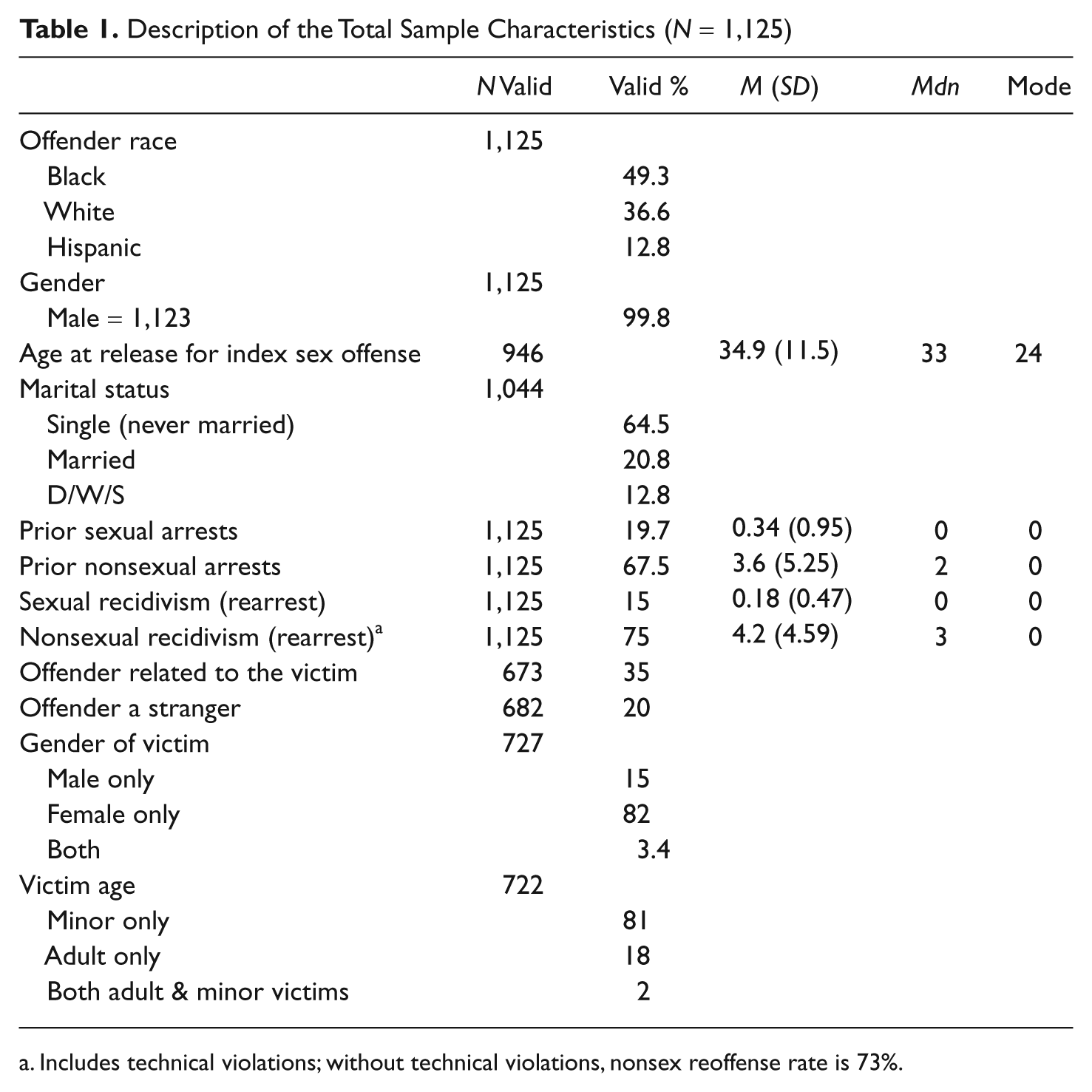
Includes technical violations; without technical violations, nonsex reoffense rate is 73%.
As can be seen in the appendix, the examined variables included, but were not limited to, demographics (e.g., date of birth, race, gender, marital status, alcohol/drug abuse history, employment information, educational status), extensive criminal history information (e.g., sentencing information, time served, charge information, prior criminal history, index offense information), victim/offense characteristics (e.g., victim/offender relationship, gender of victim, age of victim), and recidivism details. The number of rearrests, reconvictions, and reincarcerations was calculated by type of reoffense, both sexual and nonsexual. These numbers were left as raw numbers in the database for statistical purposes. The determination of whether a reoffense was considered sexual or nonsexual was based on the New Jersey criminal code, in conjunction with the description of the crime (when available). Furthermore, whether a crime was considered violent or nonviolent relied on the NJDOC Severity Index, which is modeled after the federal crime distinctions. Violent crimes included personal crimes (homicide, sexual assault, aggravated and simple assault, robbery, kidnapping, and any other person to person crime), whereas nonviolent crimes included property crimes, drug crimes, and public policy crimes. In addition, the date of the rearrest was recorded to analyze the time elapsed between release and reoffense. This became an arduous process as many sex offenders had unique trajectories of offending. For example, a sex offender could have been released from prison, recidivated with a sexual or nonsexual offense, returned to prison, re-released, and then failed to register. Others recidivated on release without failure to register, and some did not recidivate at all. The researchers located the index offense, and the information for each subsequent offense was entered in a linear fashion. The reoffense was coded, the type of reoffense was recorded (as well as the disposition), and the date of the reoffenses and a count of days since the release date was calculated. This sequence occurred with each subsequent offense for each participant in the sample. The database was created to account for the numerous offending patterns across the sample of offenders.
Data Analysis
Descriptive statistics were used to depict the characteristics of the sample. Group comparisons were analyzed using t tests and χ2 analyses. Multivariate logistic and Cox regression analyses were used to determine whether FTR was predictive of additional sexual and nonsexual recidivism and to identify factors predictive of FTR. A discriminant function analysis was also conducted.
Results
Descriptive Statistics
Descriptive statistics are illustrated in Table 1. The mean age of the offenders at the time they were released from prison for the index registry-eligible sex offense was 35 years of age (Mdn = 33 years). About half were Black (49%), 37% were White, and 13% were Hispanic. Most of the offenders had never been married (65%), 21% were currently married, and 13% were divorced, widowed, or separated. The mean number of prior sexual offenses was less than 1 (M = 0.34; Mdn = 0), and 80% of the sample had no prior sexual offense arrests. The mean number of prior nonsexual arrests was 3.6 (Mdn = 2) although 32% of the sample had no prior record for any nonsexual offense. Victim characteristics for index sexual offenses were available for about 60% of the sample; data indicated that 82% of the offenders had a minor victim (younger than 18), 82% had female victims only, and 15% had exclusively male victims. The victim was related to the offender in 35% of cases and was a stranger in 20% of cases. It is not uncommon for victim information to be missing in reviews of official U.S. corrections records, but victim data are likely to be missing more often when the victim is an adult (Levenson & Morin, 2006). A statistical review of the missing victim information was conducted, and there was no bias present among the variables; most importantly, there was no systematic bias between the FTR and the non-FTR groups on missing victim characteristics.
The average follow-up period was 11.92 years (SD = 4.07 years). At follow-up, the overall post index sexual recidivism rate was 15% and the overall nonsexual recidivism rate was 75%. This is much higher than the overall nonsexual recidivism rate of 36.3% described by Hanson and Bussière (1998). The current study, however, includes technical 2 violations, which were the most common nonsexual post-FTR recidivism offenses (27%). Other nonsexual recidivism arrests were for drug offenses (25%), property offenses (12%), violent offenses (8%), weapons (2%), and disorderly conduct (2%). Of the offenders in the FTR group, 114 (18%) had a sexual recidivism charge (10% of the total sample). Of the non-FTR offenders, 55 (11%) had a sexual recidivism charge.
Group Comparisons
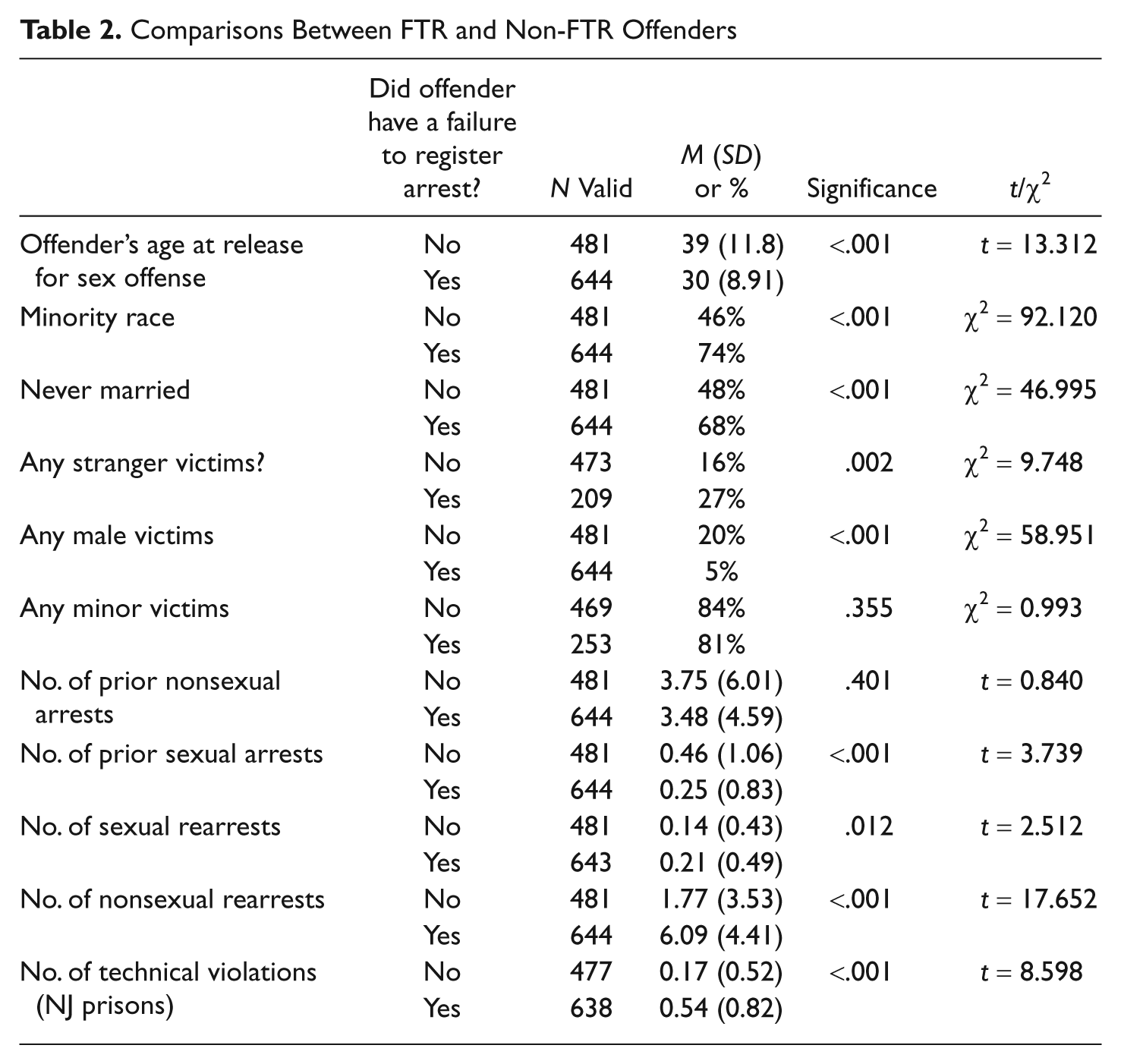
Table 2 compares the characteristics of FTR and non-FTR offenders as well as their relevant risk factors for sexual recidivism. FTR offenders were significantly younger and were more likely to be a minority race and never married. FTR offenders were more likely to have sexually assaulted a stranger and to have female victims only. They were not significantly more likely to have minor victims in their prior crimes. There were no significant differences between the groups in the number of prior nonsexual arrests, but FTR offenders had a significantly lower mean number of prior sex offenses. The FTR group did have a higher proportion and mean number of sexual and nonsexual recidivism arrests, but the average number of sexual rearrests was less than 1 in both groups (FTR = .21, non-FTR = .14). FTR offenders had a higher number of technical violations (M = .54 compared with .17, respectively). As with the number of sexual rearrests, the average number was less than 1.
Comparisons Between FTR and Non-FTR Offenders
Because bivariate analyses cannot take into account the influence of other variables, multivariate analyses were conducted to further illuminate the relationship between FTR and recidivism while controlling for relevant risk factors.
Logistic and Cox Regression
A multivariate logistic regression analysis was conducted using FTR as the dependent variable and the independent variables included in the analyses were chosen because of their empirical association with general and sexual recidivism risk (Hanson & Bussiere, 1998; Hanson & Morton-Bourgon, 2004; Harris & Hanson, 2004). Table 3 illustrates the influence of covariates including the number of prior nonsex and sex crime arrests, age at release, marital status (1 = never married), minority race (1 = yes), post index technical violations, and the presence of any stranger victim (0 = no, 1 = yes), minor victim (0 = no, 1 = yes), or male victim (0 = no, 1 = yes) in the index sex offense on whether an offender had a FTR charge.
Logistic Regression
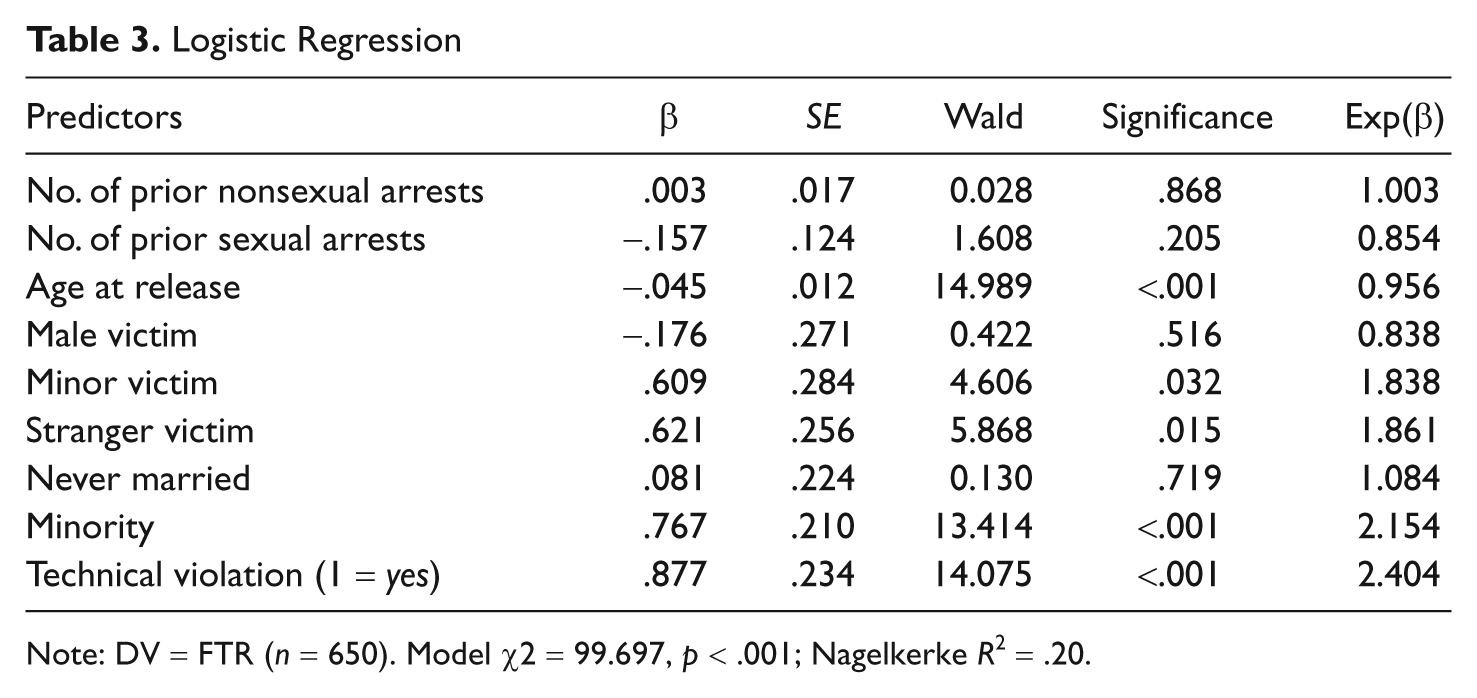
Note: DV = FTR (n = 650). Model χ2 = 99.697, p < .001; Nagelkerke R 2 = .20.
The Variance Inflation Factor (VIF) was calculated to assess for multicollinearity. The VIF indicates whether variables have such strong relationships with each other that independent effects cannot be established. Serious multicollinearity problems occur when VIFs are greater than 10 (Gujarati, 1995). All of the VIFs for the variables in the model were below two, indicating limited multicollinearity and thus more accurate regression coefficients. Missing data (most often victim characteristics) reduced the sample size to 650 when using the variables included in the analysis. Power analysis determined that the reduced sample size was sufficient to detect a medium effect size within a 95% confidence interval (two-tailed) using regression techniques with nine predictors (Faul, Erdfelder, Lang, & Buchner, 2007). It should be noted that logistic regression does not conform to the assumptions of ordinary least squares models because the errors of nonparametric variables cannot be normally distributed and cannot have constant variance (Fox, 1997). The R 2 is therefore somewhat artificial but gives a measure of the relative meaningfulness of the model, which in this case is modest.
The Wald statistic is calculated for each independent variable to determine the statistical significance of the value of β, the correlation coefficient which measures the strength of the relationship (Pampel, 2000). The odds ratio represents the change in the likelihood of the outcome for each unit increase in the independent variable and is represented by Exp(β) (Pampel, 2000). When Exp(β) is greater than 1, increasing values of the independent variable increase the odds of the event’s occurrence.
As can be seen in Table 3, the model was statistically significant indicating that this set of predictors was associated with FTR (χ2 = 99.697, df = 10, p < .001) and explained about 20% of the variance in the dependent variable. Younger offenders were more likely to fail to register with each additional year of age associated with a 4% decline in the likelihood of FTR. As the number of technical violations increased by one, the likelihood of FTR more than doubled. Having a minor victim increased the likelihood of FTR in this model, as did having a stranger victim and being of a minority race.
To more rigorously test the utility of the previous logistic regression model to predict failure to register, discriminant function analysis was performed. The statistically significant variables in the regression model for FTR were entered into the analysis. Panel A of Table 4 shows the discriminant function coefficients. The function revealed an eigenvalue of .165. Eigenvalues greater than 1 are generally considered to be a strong measure of the discriminating power of the equation (Klecka, 1980). Wilks’s Lambda also represents a measure of the discriminating power of the group of variables (Klecka, 1980), and in this case, was statistically significant (p < .05). The canonical correlation, representing the degree of relatedness between the groups and the discriminant function (Klecka, 1980), was found to be .38.
Discriminant Function Analysis
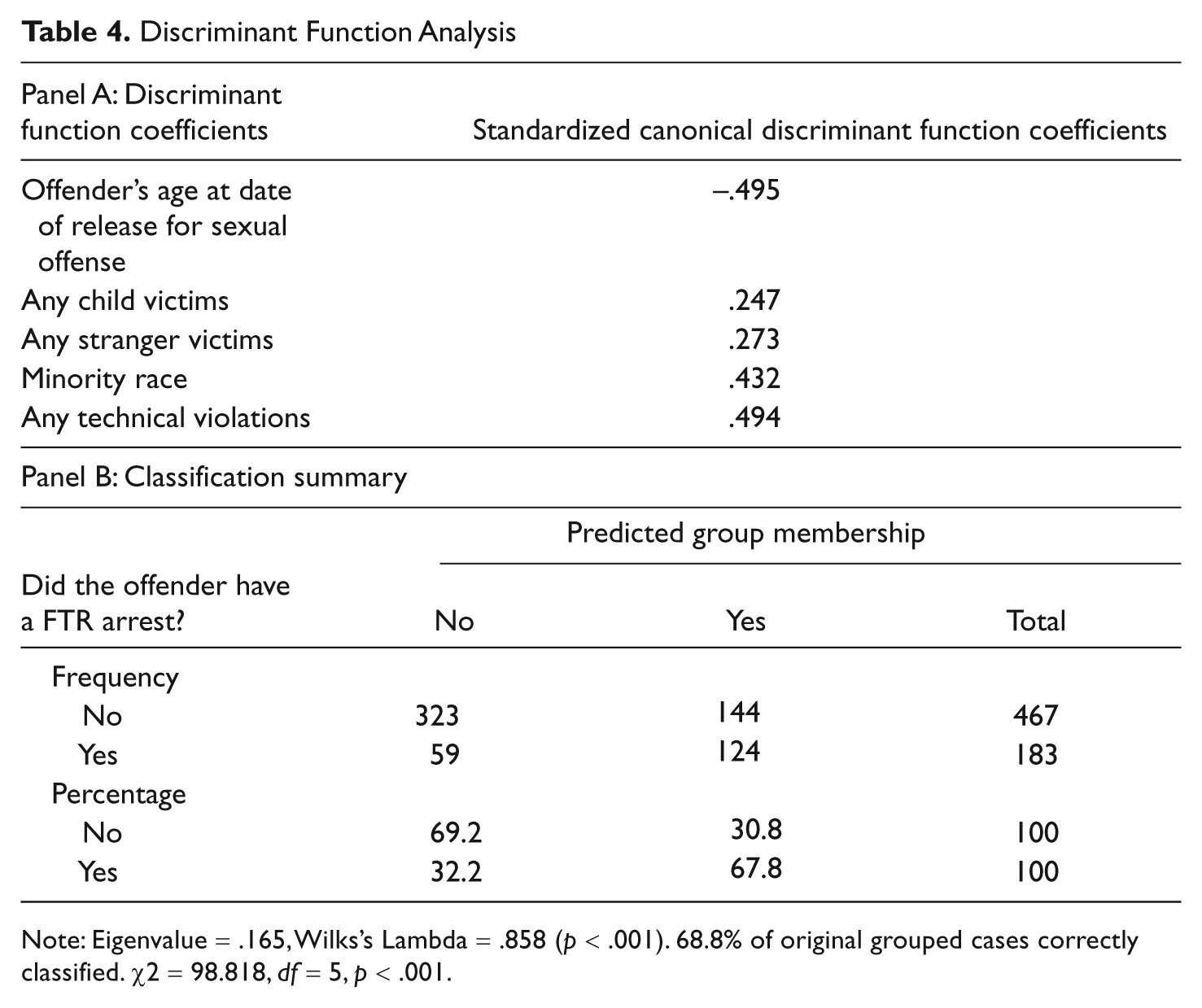
Note: Eigenvalue = .165, Wilks’s Lambda = .858 (p < .001). 68.8% of original grouped cases correctly classified. χ2 = 98.818, df = 5, p < .001.
The classification summary of the discriminant analysis is shown in Panel B of Table 4 and represents the ability of the model to correctly predict failure to register based on the significant variables in the regression equation. Group membership was correctly classified in 68.8% of the cases (χ2 = 98.818, df = 5, p < .05). In other words, failure to register was correctly predicted in more than two thirds of cases using only five factors: offender’s age at release, any minor victim, any stranger victim, minority race, and any technical violation.
In an effort to control for time at risk, two survival analyses (Cox regression) were examined to estimate the independent variables’ ability to predict both sexual recidivism and nonsexual recidivism (both measured by the respective arrest). Cox regression has an advantage over logistic regression, in that it estimates the influence of the independent variables while considering the varying time frames that offenders are at large within the community. As can be seen in Table 5, while considering variables associated with recidivism, as well as whether the participant had a FTR charge, the best predictor of whether an offender recommitted a sex crime is whether he committed a sex crime prior to the index offense. For every additional prior sex arrest, sex recidivism increased by 57%. In addition, the best predictor of nonsex recidivism is whether the offender had a prior criminal history of nonsex arrests. For every additional prior nonsex arrest, nonsex recidivism increased by 67%. FTR was not a significant predictor of either sexual or nonsexual recidivism. This finding indicates that over various time intervals, prior sexual deviance and general criminality are the best predictors of recidivism.
Cox Regression Models
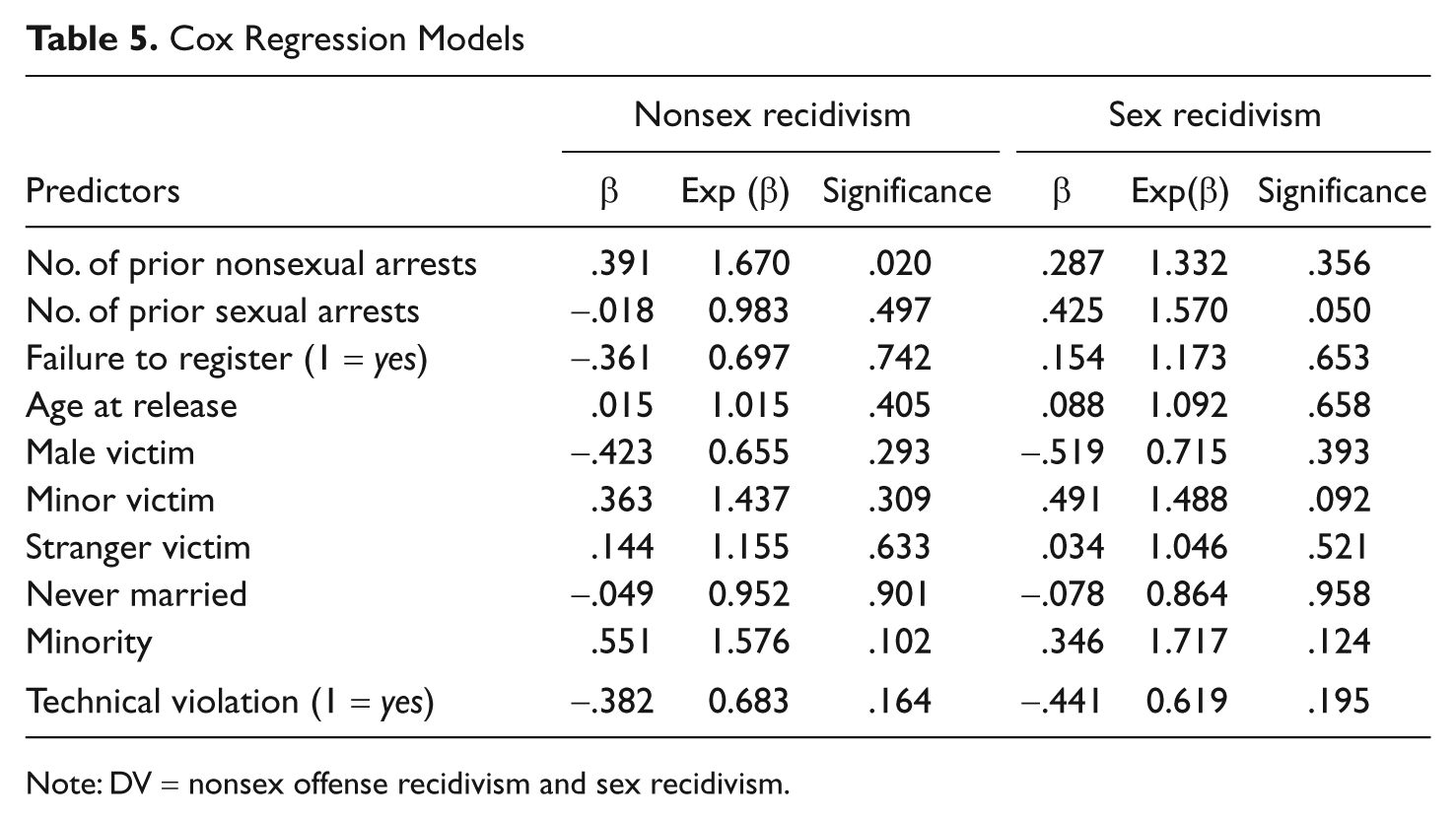
Note: DV = nonsex offense recidivism and sex recidivism.
Discussion
The overall sexual recidivism rate in New Jersey over the follow-up period was 15% which is consistent with large-sample studies over similar time frames (Hanson & Bussiere, 1998; Hanson & Morton-Bourgon, 2004). About 18% of the FTR group was rearrested for a new sexual offense, which is slightly above the average sexual reoffense rate but casts doubt on the belief that sex offenders who are noncompliant with registration are especially sexually dangerous. Congruent with prior research (Duwe & Donnay, 2010; Levenson et al., 2010), the participants were much more likely to be arrested for a subsequent nonsex crime than a new sex offense.
Group comparisons revealed that FTR offenders were younger and were more likely to be a minority race and never married. They were more likely to have sexually assaulted a stranger and to have female victims. There were no significant differences between the groups in the number of prior nonsexual arrests, but FTR offenders had a significantly lower mean number of prior sex offenses. The FTR group did have a slightly higher proportion and mean number of sexual rearrests, but the differences did not display practical significance; the average number of sexual rearrests was less than one in both groups. FTR offenders had a higher number of technical violations, suggesting that FTR is more a reflection of rule violating patterns than sexual deviance. Group comparisons also revealed that FTR offenders were not more likely to have minor victims in prior crimes, casting doubt on the stereotype of the predatory child molester who fails to register in an effort to evade detection. In sum, these findings paint a picture of the FTR offender as a young rapist of adult women, with a pattern of rule-violating behavior.
Finally, we sought to identify factors associated with sex and nonsex recidivism and failure to register. The only variables that predicted sexual recidivism and nonsex recidivism in the Cox regression models were prior sexual criminal history and prior nonsex criminal history, respectively. FTR was not predictive of sexual or nonsexual recidivism. Although we expected prior general criminality to be associated with FTR (Duwe & Donnay, 2010; Levenson et al., 2010; Washington State Institute for Public Policy, 2006), we speculate that increasingly complex registration rules make it more difficult for many sex offenders to remain compliant, even those without a historical pattern of rule-breaking behavior. Technical violations, however, were associated with FTR suggesting that sex offenders who failed to register had difficulty complying with other types of supervision rules as well. Having minor victims, in combination with the influence of other risk factors such as younger age, stranger victims, minority race, and rule-violating behavior, contributed to the likelihood of failing to register. It appears that the coexistence of risk factors and characteristics associated with behavioral noncompliance contribute to the risk of FTR for child abusers.
A lack of cooperation with registration requirements may be a manifestation of general criminality, defiance, carelessness, or apathy rather than sexually devious intentions. In fact, research on probation noncompliance and absconding points to the influence of factors such as unemployment, substance addiction, unstable housing, and marital status on poor community reintegration (Mayzer et al., 2004; Nelson, Deess, & Allen, 1999; Williams et al., 2000; Willis & Grace, 2008). Furthermore, psychological factors have been found to interfere with responsivity to interventions (Andrews & Bonta, 2007) creating a plethora of potential variables related to personality pathology, intelligence, mental illness, peer influence, coping skills, and treatment progress that might affect sex offender registration outcomes (Levenson et al., 2010). Unfortunately, our data set did not enable the inclusion of these psychosocial variables in the analyses.
One important consideration is that, we were unable to distinguish true absconders from other types of registry violators. Although registration failure can certainly suggest the possibility of a desire to “go underground,” it may in some cases demonstrate inadvertent noncompliance (Harris & Pattavina, 2009). It is possible that intentional registration violators are those who truly abscond from probation or registration, whereas inadvertent violators are more likely to be caught and convicted of failure to register because they are not necessarily attempting to evade authorities. Offenders may fail to report an address change for various reasons but should be considered willful violators only after failed attempts to locate them (Harris & Pattavina, 2009). Future research should make efforts to clarify how noncompliant registrants might differ from those who have truly absconded. Recent research suggests that fewer than half of registration violators are designated by states as absconded (Levenson & Harris, 2011).
Implications for Policy and Practice
When considering the practical implications of this research for clinicians, criminal justice professionals, and policy makers, the recent case of Phillip Garrido in California provides a good example of the misguided national emphasis on registration compliance. Garrido, a registered sex offender, kidnapped an 11-year-old girl in 1991 and held her captive in his home for 18 years even as he complied with registration requirements, even while on parole, even while wearing an electronic monitoring device. Likewise, in Ohio, Anthony Sowell raped and murdered 11 women and buried them in and around his home—all while complying with sex offender registration. These sensationalized cases illustrate that registration and notification laws will not prevent dangerous people from committing egregious crimes and may not realistically provide an impediment or a deterrent to future acts of sexual violence. Although we see that about 18% of the FTR offenders in this sample had a new sexual recidivism charge, 82% of FTR offenders were not rearrested for a subsequent sex crime. Thus, the emphasis on registration compliance as a means to deter recidivism may be misguided.
In fact, the movement to register more sex offenders for longer durations is likely to become counterproductive. The nationwide accumulation of sex offenders is nearing three quarters of a million registrants (National Center for Missing and Exploited Children, 2010). As the numbers grow, law enforcement resources are spread thin, and the ability of the public to discern truly dangerous offenders is diluted. In a time when budgets are overburdened and correctional institutions are reconsidering sentencing options for other technical breaches and nonviolent offenses, increased penalties for FTR seem counterintuitive. Vast fiscal and personnel resources are required to update technology, enforce registration rules, and incarcerate violators, despite mounting evidence suggesting that failure to register as a sex offender does not seem to raise the risk for sexual reoffending (Duwe & Donnay, 2010; Levenson et al., 2010). For example, in New Jersey, pending legislation is posed to increase incarceration penalties from 18 months to 5 years for failing to register as a sex offender. Within this particular sample from New Jersey, 530 sex offenders who were noncompliant did not go on to commit another sex offense. Recently published costs estimate the average annual state incarceration rate as US$38,700 per inmate (New Jersey Department of Corrections, 2009). This would yield an annual cost of more than US$20 million and US$100 million over 5 years. Given other published reports questioning the cost-effectiveness of Megan’s Law (Zgoba, Witt, Dalessandro, & Veysey, 2009), this study raises additional questions as to whether that would be money well spent.
The current results also call into question the relevance of enhanced registration policies to offender dangerousness. Longer registration durations and retroactive registration implemented by the Adam Walsh Act contradict empirical data. Research suggests that sex offenders who have spent long periods of time in the community without reoffending are at reduced risk (Harris, Phenix, Hanson, & Thornton, 2003). In fact, Harris et al. recommended that “the expected offense recidivism rate should be reduced by about half if the offender has 5 to 10 years of offense-free behavior in the community . . . ” (p. 63). It is also clear that sex offending declines with age (Barbaree & Blanchard, 2008; Barbaree, Langton, Blanchard, & Cantor, 2009; Hanson, 2002). Thus, the emphasis on registrant compliance for an aging sex offender population over longer registration periods (25 years to life for most offenders) is likely to create an inefficient distribution of resources and is unlikely to contribute meaningfully to community safety.
In a similar vein, the Adam Walsh Act (AWA) requires states to incorporate a rigid offense-based tier system even though the reclassification of sex offenders under the AWA scheme results in enormously inflated numbers of level three “high-risk” offenders (Harris, Lobanov-Rostovsky, & Levenson, 2010; Harris & Pattavina, 2009). For instance, in Ohio, which previously classified 73% of sex offenders as “sexually oriented” lower risk offenders and 18% as habitual or predatory, the AWA reclassification assigns only 16% into the low-risk category and reclassifies 40% as tier-three offenders (Harris et al., 2010; Harris & Pattavina, 2009). Empirically derived risk factors have demonstrated better utility than Adam Walsh Act tiers in identifying sexual recidivists (Freeman & Sandler, 2009). Unfortunately, contemporary policies may sacrifice precision in targeting the most dangerous offenders in favor of more inclusive procedures that provide only the illusion of safety by capturing a wide net of lower risk individuals. Legislators have good intentions and victims and their families have compelling stories to tell, but experts such as criminal justice researchers, psychologists, and correctional case managers should have a stronger voice in offering evidence to inform practices designed to protect communities from repeat sexual violence.
Rather than a one-size-fits-all approach, criminal justice practices should be more carefully tailored to individual risk and offense patterns of each offender. Individualized case management relying on empirically derived risk assessment might offer more return on the investment than the sweeping policies in existence today. In fact, most studies investigating the effectiveness of sex offender registration and notification policies have found that they fail to meet their goals of reduced sexual recidivism (Letourneau, Levenson, Bandyopadhyay, Sinha, & Armstrong, 2010; Sandler et al., 2008; Vasquez, Maddan, & Walker, 2008; Zgoba, Witt, et al., 2009). The two studies that detected a decline in recidivism attributable to SORN laws were conducted, notably, in states with risk-assessment procedures that employ enhanced monitoring for those posing the highest threat of repeat sexual violence (Duwe & Donnay, 2008; Washington State Institute for Public Policy, 2005). As most sex crimes are committed by first-time offenders not previously found on a registry (Sandler et al., 2008), it is perhaps unsurprising that an emphasis on publicly identifying known offenders does little to alter rates of sexual violence.
Limitations
This study, although addressing a relevant and understudied topic, has some limitations given its exploratory nature. Generalizing results from studies on sex offender recidivism can be complicated by varying research designs and statistical methodologies as well as by state differences in laws, definitions, procedures, and practices. Although the current findings from New Jersey may or may not generalize to the entire U.S. sex offender population, they are consistent with findings from Minnesota and South Carolina (Duwe & Donnay, 2010; Levenson et al., 2010). Readers are reminded that the current study was conducted by drawing a purposive sample of 644 FTR offenders and a comparison group of 481 sex offenders without FTR, so the 58% FTR rate does not reflect what might be expected to naturally occur in the general sex-offender population.
Associated with the previous concerns are the potential inadequacies of secondary data. This study relied solely on data drawn from official records. It is well known that official records underrepresent the frequency of criminal behavior in the community, particularly incest and child molestation, and potentially the dependent variable here, failure to register; but official reports continue to provide the most reliable and readily available count of sex crimes. To operationalize sexual and nonsexual recidivism, a decision had to be made as to whether rearrests, reconvictions, or reincarcerations would be used as the measure of reoffense. Ideological arguments exist on either side as to the validity and reliability of the various measurements. Employing “rearrest” as the measurement of recidivism holds the chance that the offender was wrongfully accused, arrested, or charged, and charges may subsequently be dropped, leading accordingly to an overrepresentation of recidivism. However, employment of “reconviction” or “reincarceration” as the level of measurement may lead to an underrepresentation of the true level of reoffending since sometimes offenders plea-bargain to lesser offenses, or charges may be changed or dropped due to technicalities or weak evidence. Given that sexual assault is an underreported crime, we decided to use rearrest as the indicator of recidivism to provide the most inclusive representation of reoffending. This measure is conventional and consistent with other sexual recidivism research (Hanson & Bussiere, 1998; Harris & Hanson, 2004).
Another important problem that has long plagued sex-offense research and is linked to the previous limitations is the low base rate of repeat sexual offenses. Notwithstanding the limitations of the criminal justice system to detect all reoffending (including FTR, since the researchers are only aware of those failures that have come to the attention of the authorities), sex offense recidivism rates are consistently found to be much lower than commonly assumed. Generally, sexual recidivism rates range from 5% to 14% in shorter follow-up periods (3 to 6 years) (Bureau of Justice Statistics, 2003; Hanson & Bussiere, 1998; Hanson & Morton-Bourgon, 2004) to about 24% over 15 years (Harris & Hanson, 2004). Consistent with prior research, 15% of the current sample was arrested for committing another sex crime after the index offense over an approximate 12-year follow-up period. These relatively small base rates may limit the ability of statistical tests to detect the effects of interventions.
Summary
The purpose of sexual offender legislation is to protect the community, primarily children, from sexual violence. The key goal of sex offender registration laws is to decrease or prevent repeat sex crimes by increasing public awareness of the presence of sexually dangerous individuals. Accordingly, the public has been led to believe that these laws will enhance their safety and that those offenders who do not comply pose the greatest threat. Available research, however, including the current study, casts doubt on the assumption that sex offenders who are noncompliant with registration are especially sexually dangerous. As states consider increasing their current sanctions for failing to register, they should take into account the potential incarceration of a large number of offenders who are unlikely to go on to commit a new sexual offense. To definitively state that failing to register as a sex offender is not linked to future sexual recidivism is cautioned. However, these results are consistent with a growing body of research suggesting that sexual reoffending is largely unrelated to registration noncompliance.
Footnotes
Appendix
Variable Descriptions
| Variable | Measure | Value |
|---|---|---|
| Offender demographics | ||
| Race | Categorical | Black, White, Hispanic, Other, unknown |
| Marital status | Categorical | Single, married, divorced, widowed, separated, unknown |
| Age at release | Continuous/raw | — |
| Alcohol/drug abuse history | Categorical | Yes or no |
| Employment history | Categorical | Yes or no |
| Education grade level | Continuous/raw | — |
| Prior criminal history | Continuous/raw | — |
| Sentencing information | ||
| Sentence length | Continuous/raw | — |
| Time served | Continuous/raw | — |
| Charge information | Categorical | 1st, 2nd, 3rd, 4th degree |
| Violent classification | Categorical | Yes or no |
| Index offense | Categorical | Rape, sexual assault, endangering welfare of child, criminal sexual contact, lewdness, luring, incest, child molestation, exhibitionism, voyeurism |
| Victim/offense characteristics | ||
| Victim/offense relationship | Categorical | Stranger, family, acquaintance, friend, unknown |
| Victim gender | Categorical | Male only, female only, both |
| Victim age | Continuous/raw | — |
| Recidivism details | ||
| Rearrests | Continuous/raw | — |
| Reconvictions | Continuous/raw | — |
| Reincarcerations | Continuous/raw | — |
| Type of recidivism | Categorical | Sexual, nonsexual or both |
| Date of rearrests | Date | — |
| Numeric calculation of days between rearrest + release | Continuous/raw | — |
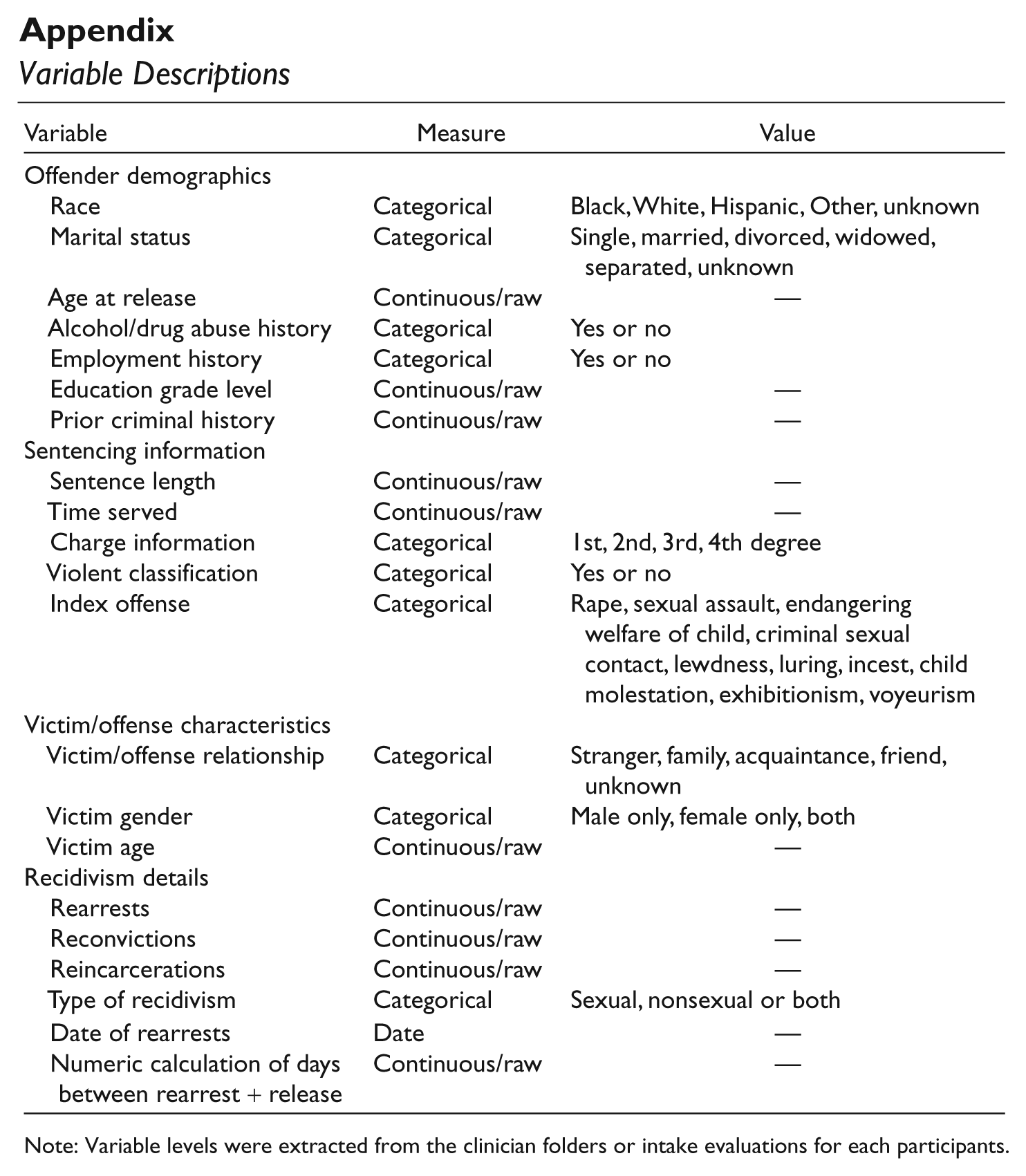
Note: Variable levels were extracted from the clinician folders or intake evaluations for each participants.
Acknowledgements
The authors would like to thank the New Jersey Department of Corrections, specifically Melissa Dalessandro and Sabrina Haugebrook, for their data-collection expertise.
The opinions expressed herein are solely those of the authors.
Declaration of Conflicting Interests
The author(s) declared no potential conflicts of interest with respect to the research, authorship, and/or publication of this article.
Funding
The author(s) received no financial support for the research, authorship, and/or publication of this article.