



Abstract
The aim of this study was to test the hypothesis that South Carolina’s sex offender registration and notification policy influenced juvenile sex offense case plea bargains. Two types of plea bargains were examined: initial sex offense charges amended to nonsex offense charges and amended to lower severity charges. Comparison analyses were conducted with juvenile assault and robbery offense cases. Archival data on cases involving 19,215 male youth charged with sex, assault, and/or robbery offenses between 1990 and 2004 informed analyses. Of these youth, 2,991 were charged with one or more sex offense, 16,091 were charged with one or more assault offense, and 2,036 were charged with at one or more robbery offense. Generalized estimating equations (GEE) were used to model changes in the probabilities of plea bargain outcomes across three time intervals: before policy implementation (1990 to 1994), after initial policy implementation (1995 to 1998), and after implementation of a revised policy that included online registration requirements (1999 to 2004). Results indicate significant increases in the probability of plea bargains for sex offense cases across subsequent time periods, supporting the hypothesis that South Carolina’s initial and revised registration and notification policies were associated with significant increases the likelihood of plea bargains to different types of charges and to lower severity charges. Results were either nonsignificant or of much lower magnitude for the comparison assault and robbery analyses. Suggestions for revising South Carolina and national registration and notification policies are discussed.
Keywords
Sex offender registration and notification policies aim to deter sexual offending, reduce sexual recidivism, provide law enforcement personnel additional tools for investigating alleged offenses and provide community members with information to increase their and their children’s safety. Despite these aims, a growing body of research generally fails to support the efficacy of these policies. For example, of 14 studies examining policy effects on recidivism, 10 reported no significant effects on violent and/or sexual recidivism (Adkins, Huff, & Stageberg, 2000; Letourneau & Armstrong, 2008; Letourneau, Bandyopadhyay, Sinha, & Armstrong, 2009b; Letourneau, Levenson, Bandyopadhyay, Sinha, & Armstrong, 2010; Sandler, Freeman, & Socia, 2008; Schram & Milloy, 1995; Vásquez, Maddan, & Walker, 2008; Veysey, Zgoba, & Dalessandro, 2009; Zevitz, 2006; Zgoba, Witt, Dalessandro, & Veysey, 2009). By comparison, just two studies reported reduced sexual and violent recidivism that might be attributable to policy effects (Duwe & Donnay, 2008; Washington State Institute for Public Policy, 2005) and one study suggested increased sexual recidivism that might be attributable to policy effects (Freeman, in press). Prescott and Rockoff (2008) separately examined the effects of registration versus notification on recidivism. Their models suggested that registration laws might reduce sexual recidivism whereas notification laws might increase sexual recidivism.
Research also has examined whether registration and notification policies exert unintended effects. Of particular concern is that registration and notification policies perceived as unduly harsh might influence judicial case procedures (e.g., see Logan, 2009). Two studies have examined whether state registration and notification policies influenced adult plea bargains. One study found that adults were significantly more likely to plead guilty to amended (nonsex) offenses following South Carolina’s initial policy enactment and again following its modification to require online notification (Letourneau, Levenson, Bandyopadhyay, Armstrong, & Sinha, 2010). A second study found no effects on adult plea bargains following enactment of New York’s registration and notification policy (Freeman, Sandler, & Socia, 2009). Letourneau and colleagues hypothesized that these discrepant outcomes were due to differences between the two state’s policies. In particular, South Carolina’s harsher policy was hypothesized as driving the increase in plea bargains for that state’s adult defendants.
Another study examined the influence of South Carolina’s policy on judicial case processing of juvenile sex offense cases (Letourneau, Bandyopadhyay, Sinha, & Armstrong, 2009a). In that study, we reported that South Carolina’s registration and notification policy was associated with a significant decline in the likelihood of solicitors 1 prosecuting youth charged with sex offenses. For cases that were prosecuted, the policy was associated with a significant increase in the likelihood of guilty determinations. We hypothesized that the reduced likelihood of solicitors prosecuting juvenile sex offense cases was due to their reluctance to subject some youth to South Carolina’s harsh registration requirements. We further hypothesized that the increased rate of guilty determinations might be due, in part, to solicitors amending initial charges to lesser (nonsex) offense charges at adjudication as part of plea bargain negotiations.
In the present study, we test the hypothesis that South Carolina’s registration and notification policy was associated with increased probabilities of plea bargains. We also examined plea bargain outcomes for juvenile assault and robbery offense cases to address the possibility that any observed changes in sex offense plea bargains might apply to violent offense cases in general. All models controlled for extra-legal factors shown to influence juvenile case processing, including youth age, race, and prior offenses (e.g., McCarthy & Lindquist, 1985; Minor, Hartman, & Terry, 1997) and previously shown to predict the likelihood of solicitor decisions to prosecute juvenile sex offense cases (Letourneau et al., 2009a). We were unable to control for extra-legal variables specific to decisions makers (e.g., solicitors) that might influence juvenile case dispositions, such as their beliefs, personalities, and demographic characteristics have been less often studied (e.g., Davis, Severy, Kraus, & Whitaker, 1993). However, research findings suggest that defendant variables are stronger predictors than decision maker variables (Davis et al., 1993). Thus, the present study seeks to determine whether juvenile sex offender registration and/or public notification influenced case outcomes after controlling the effects of youth age, race and prior offense history.
Method
South Carolina’s Registration and Notification Policy
South Carolina’s sex offender registration and notification policy was initially implemented on January 1, 1995. Charges that trigger automatic registration and notification requirements include most sex offenses for which juveniles can be adjudicated, and range from noncontact offenses (voyeurism, indecent exposure) to serious sex offenses against adults (e.g., criminal sexual conduct) and minors (e.g., criminal sexual conduct with a minor). Youths adjudicated delinquent of sex offense charges are required to register their personal information, including home and school addresses, with the local sheriff’s office twice per year for life (i.e., registration). For all registered youth ages 12 and older, authorities inform their schools, their victims, and nearby child-oriented businesses of the youths’ registration status (i.e., targeted notification). Other individuals or businesses may request registration status information on specific youth. South Carolina’s initial registration and notification policy was amended in 1999 to include lifetime online notification. Online notification requirements apply to all registered adult offenders and to some registered juvenile offenders, including those with prior sex offenses and those for whom the dispositional judge recommends online notification.
Sample
A total of 19,215 male youth ages 6 to 21 years when charged with sex, assault, or robbery offenses between 1990 and 2004 contributed data to the analyses. The majority of youth (90%) had been charged with just one offense type. Youth had assault offense charges (73%), sex offense charges (11%), robbery offense charges (6%), assault and sex offense charges (5%), or assault and robbery offense charges (5%). No youth had all three types of charges. The sample was African American (66.3%) or White (32.5%) and the mean age at first charge of any type was 14.7 years (SD = 1.5 years). Of youth charged with one or more sex offenses (n = 2,991), 59% were African American, 40% were White, and the mean age at initial charge was 14.4 years (SD = 1.6 years). Approximately 6% had accrued more than one sex offense charge over time (range of 2 to 5 charges) and approximately 5% had any assault or robbery offense adjudications prior to their first sex offense charge. Of the youth charged with at least one assault offense (n = 16,091), 67% were African American, 32% were White, and the mean age at initial charge was 14.7 years (SD = 1.5 years). Twenty percent of these youth had accrued more than one assault offense charge over time (range of 2 to 9) and less than 1% had any sex or robbery offense adjudications prior to their first assault charge. Of youth charged with one or more robbery offenses (n = 2,036), 88% were African American, 11% were White, and the mean age at initial charge was 15.2 years (SD = 1.3 years). Approximately 8% had accrued more than one robbery offense charge over time (range of 2 to 4) and 10% had any sex or assault offense adjudications prior to their first robbery charge.
Procedures
All data were extracted from the South Carolina Department of Juvenile Justice (DJJ) Management Information System in collaboration with the South Carolina Budget and Control Board Office of Research and Statistics. Only cases initially charged between January 1, 1990 and December 31, 2004 were included in the present study. This timeframe permitted examination of cases processed during Time 1 (T1), which included the five years prior to registration (January 1, 1990 through December 31, 1994), cases processed during Time 2 (T2), which included the four years following initial implementation of the registration policy (January 1, 1995 through December 31, 1998), and Time 3 (T3), which included the five years following implementation of online notification (January 1, 1999 through December 31, 2004).
All DJJ cases involving sex, assault, or robbery offense charges and that were associated with final adjudication decisions were included in the analyses, with minor exceptions. Exceptions included cases that involved female defendants (which were rare, especially for sex offense cases) and cases that appeared to involve very young (< 6 years) or old (> 21 years) juvenile defendants. In addition, cases with multiple charges within an offense class (e.g., two or more sex offense charges filed on the same date), were removed from consideration due to difficulty in linking initial to final charges. Just 8% of sex offense cases were removed due to multiple charges, resulting in a final count of 3,176 sex offense cases that informed analyses (the number of cases exceeds the number of youth because some youth were charged with more than one sex offense over time, as noted earlier). Likewise, just 6% of assault cases were removed due to multiple charges, for a final count of 20,424 cases informing the assault analyses and just 4% of robbery charges were removed, for a final count of 2,212 cases informing the robbery analyses. Charges filed against minors in general sessions (adult) court were not included in the analyses for this study. All data were de-identified prior to being made available for analysis. Study procedures were approved by the Medical University of South Carolina’s Institutional Review Board and by the South Carolina Department of Juvenile Justice.
Variables Included in the Models
Data extracted from DJJ records included prosecution and adjudication dates, labels for initial (prosecution) and final (adjudication) charges and final disposition outcomes. All initial charges were classified as sex, assault, or robbery based on their charge labels (see Letourneau et al., 2009a for more details on classification of charges). Adjudication charges included these and other types of charges, as detailed subsequently. Severity ratings for charges also were included in the data; these ratings represent the number of years an adult would likely be sentenced to serve in jail if convicted of a similar charge (Barrett, Katsiyannis, & Zhang, 2006; Letourneau et al., 2009a). Charge severity can assume one of seven unequally spaced values between 2 and 25. Specifically, sex offense severity ranges from 2 to 21, assault offense severity ranges from 2 to 25, and robbery offense severity ranges from 5 to 21.
Two types of plea bargains were coded, including cases in which the initial charge was amended to a lower severity charge at adjudication and cases in which the initial charge was amended to a different type of charge at adjudication (e.g., if an initial sex offense charge was amended to an assault offense charge). We included changes in charge type because most sex offense charges, including many lower severity charges, trigger lifetime registration and notification requirements in South Carolina. Thus, for defendants pleading guilty, the primary way to avoid registration and notification is to plead guilty to nonsex offense charges.
Three covariates included in all analyses were the youth’s age at initial charge, a dichotomous indicator for the youth’s race (Minority or Nonminority), and a dichotomous indicator for prior violent (i.e., sex, assault, or robbery) offense adjudications (any or none). Although potentially a continuous variable, the “priors” variable effectively functioned as a dichotomous variable (e.g., 94% of youth with sex offenses had no prior violent charges and 5% had just one prior). Similar results occurred for the youth with assault and robbery offenses. Charge severity was dichotomized to control for low (2, 3, 5, 8) versus high (15, 21, 25) severity charge offenses and included as a covariate in models estimating the likelihood of pleading to another type of offense (charge severity is not included in models estimating the likelihood of pleading to lower severity charges).
Data Analytic Procedures
Generalized estimating equations (GEE) methods (Liang & Zeger, 1986) were used for modeling the effects of registration and notification on plea bargains. GEE provides robust and consistent marginal/population-averaged parameter estimates and standard errors (Stokes, Davis, & Koch, 2000). Moreover, this analytic method is characterized by two strengths that lend themselves to the needs of the present study. First, unlike other regression methods, GEE is able to accommodate repeated, correlated binary responses. In the present study, some juveniles had multiple offenses, all of which contributed to the analyses. Second, the GEE method uses an estimating equations approach (versus, for example, a maximum likelihood method) for model fitting and can accommodate large databases such as the one informing the present study’s results via readily available software like PROC GENMOD in SAS. Readers are referred to our earlier publication for a more thorough discussion of the rationale for using GEE versus alternative analytic approaches (Letourneau et al., 2009a).
Two primary outcomes were examined with GEE: (a) whether an initial charge was amended to a charge of a different offense type and (b) whether an initial charge was amended to a lower severity charge. The main objectives of the analyses were to evaluate the magnitude of the changes, if any, in the probabilities of these outcomes across the three time intervals of relevance: T1 (pre-registration period from 1990 to 1994), T2 (initial registration period from 1995 to 1998), and T3 (online registration period, from 1999 to 2004). Models estimated the comparisons of outcomes at T2 versus T1 and T3 versus T2. A linear contrast then estimated the comparison of outcomes at T3 versus T1. All covariates (youth age, race, prior violent offenses, and charge severity) were centered at their means. To control for a possible linear increase in the log likelihood of pleading over time we ran a series of models with integer charge year added to the set of already reported predictors. The addition of linear charge year did not alter results of models and was a significant predictor in just one of the six models (pleading from a higher severity assault offense to a lower severity offense 2 ). We therefore report only the results of the original models that did not include linear charge year.
The adequacy of each GEE model was assessed using an adapted Hosmer and Lemeshow (HL) goodness-of-fit test. This adapted test is an extension of the typical HL goodness-of-fit test used with ordinary logistic regression and is appropriate for models examining repeated binary response data as in the present study (Horton et al., 1999). The adapted HL goodness-of-fit test statistic has an approximate chi-squared distribution when models have been specified correctly.
Results
Descriptive Results
Before reviewing the GEE results, descriptive information is provided regarding plea bargains. Of all cases with initial sex offense charges, 73% were not amended (i.e., these cases retained a sex offense charge at adjudication); 24% pleaded out of type (i.e., to a nonsex offense charge, 92% of which were also lower severity charges); and 3% pleaded to a lower severity sex offense charge. The percentage of cases that were not amended declined over time, from 84% at T1 to 73% at T2 and to 65% at T3.
Of all cases with initial assault offense charges, 90% were not amended; 1% pleaded out of type, 8% pleaded to a lower severity charge, and 1% pleaded to a lower severity nonassault offense. The percentage of assault cases that were not amended remained essentially unchanged over time (91%, 90%, and 89% at T1, T2, and T3, respectively).
Of all cases with initial robbery offense charges, 82% were not amended; 3% pleaded out of type, 4% pleaded to a lower severity charge, and 11% pleaded to a lower severity nonrobbery charge. The percentage of robbery cases that were not amended declined slightly following the first time period (84%, 81%, and 82% at T1, T2, and T,3 respectively).
Information on the type and severity of nonsex offense charges to which sex offense charges were amended is presented in Table 1. In the great majority of cases, charges were amended to assault offenses, of which the most common was aggravated assault and battery. Noncontact sex offenses were often amended to other types of offenses, including public disorderly conduct, disturbing schools, simple larceny, and trespassing.
Type, Frequency, and Severity of Nonsex Offense Charges to Which Initial Sex Offense Charges Were Amended.

Notes: AGASBA = assault and battery of a high and aggravated nature. AGASLT = assault of high and aggravated nature. ATMPII = attempt to commit a category II offense. ATMPIII = attempt to commit a category III offense. DISTSL = disturbing schools. PETLAR = simple larceny. PUBDIS = public disorderly conduct. SIMA&B = simple assault and battery. SIMASL = simple assault. TRESPS = trespassing.
Information on the type and severity of nonassault charges to which assault charges were amended is presented in Table 2. The small subgroup of cases amended to nonassault offenses was characterized by significant variability with respect to adjudication charges. Of the small subgroup of robbery cases amended to nonrobbery charges, most amended charges related to theft (see Table 3).
Type, Frequency, and Severity of Nonassault Offense Charges to Which Initial Assault Offense Charges Were Amended.
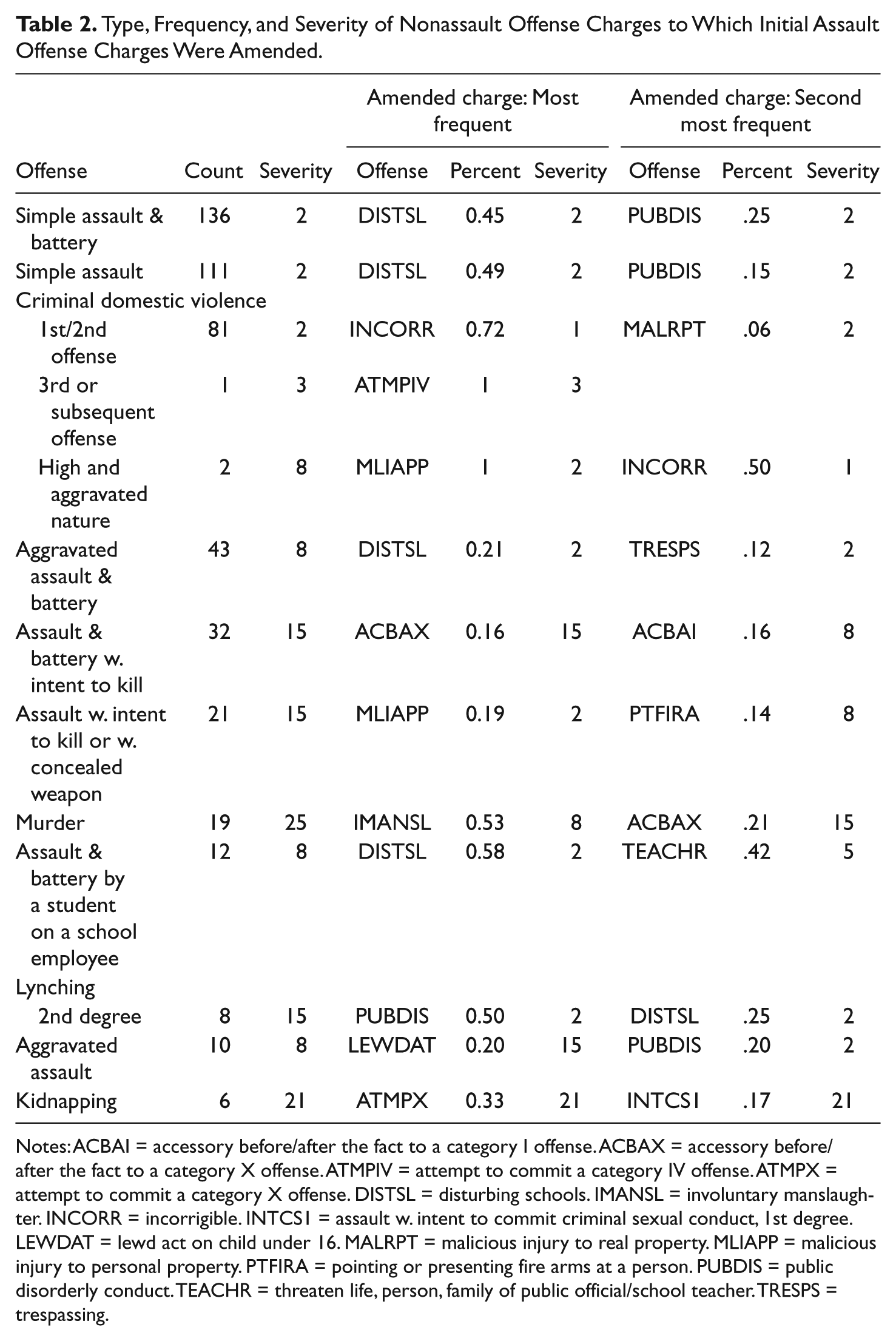
Notes: ACBAI = accessory before/after the fact to a category I offense. ACBAX = accessory before/after the fact to a category X offense. ATMPIV = attempt to commit a category IV offense. ATMPX = attempt to commit a category X offense. DISTSL = disturbing schools. IMANSL = involuntary manslaughter. INCORR = incorrigible. INTCS1 = assault w. intent to commit criminal sexual conduct, 1st degree. LEWDAT = lewd act on child under 16. MALRPT = malicious injury to real property. MLIAPP = malicious injury to personal property. PTFIRA = pointing or presenting fire arms at a person. PUBDIS = public disorderly conduct. TEACHR = threaten life, person, family of public official/school teacher. TRESPS = trespassing.
Type, Frequency, and Severity of Nonrobbery Offense Charges to Which Initial Robbery Offense Charges Were Amended.
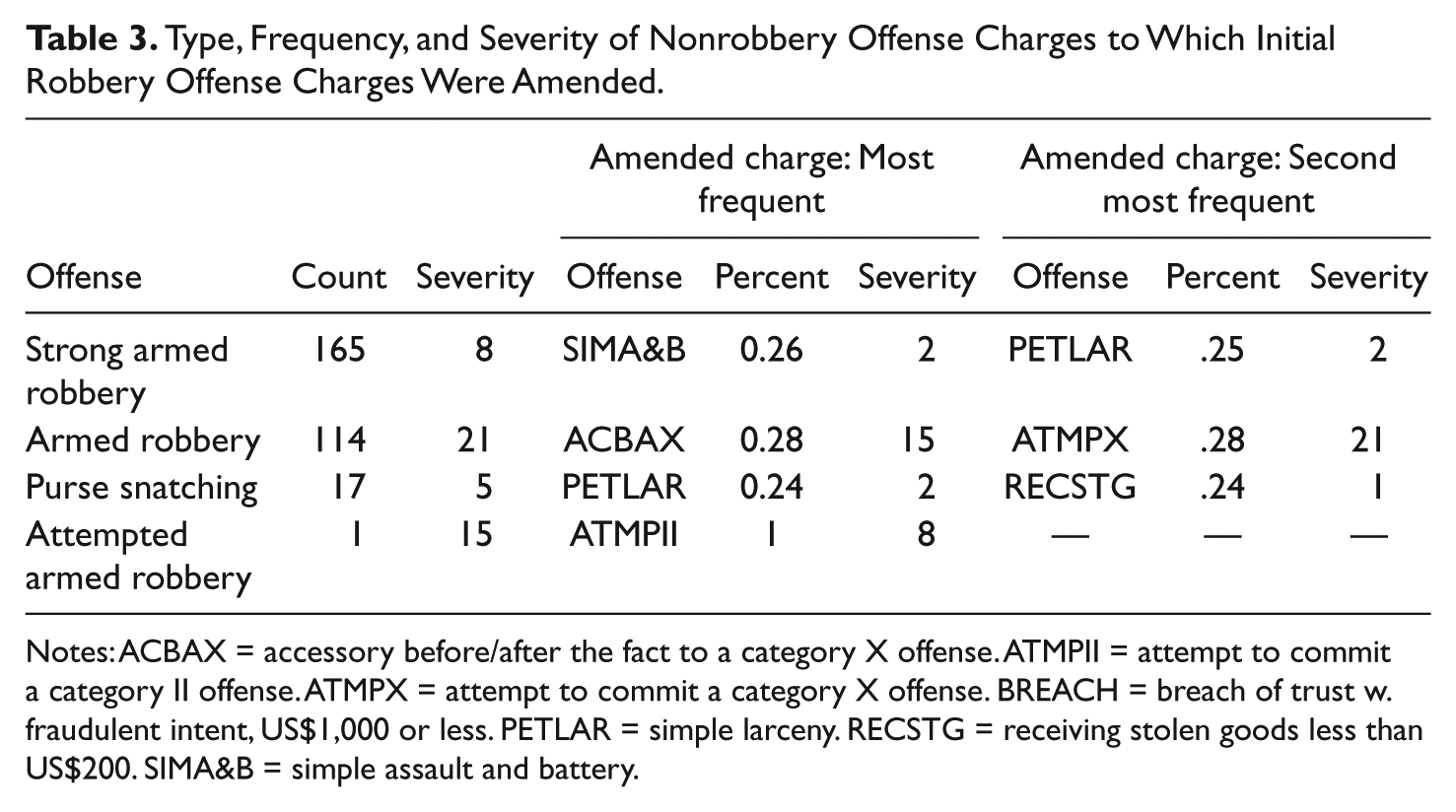
Notes: ACBAX = accessory before/after the fact to a category X offense. ATMPII = attempt to commit a category II offense. ATMPX = attempt to commit a category X offense. BREACH = breach of trust w. fraudulent intent, US$1,000 or less. PETLAR = simple larceny. RECSTG = receiving stolen goods less than US$200. SIMA&B = simple assault and battery.
GEE Results
Models estimating the probability of cases being amended to a different charge type or a lower charge severity are presented first for cases with sex offense charges, then for assault and robbery offense charges. Results for all models are summarized in Table 4 and depicted in Figure 1. Goodness-of-fit tests for the GEE models are presented in the text. All tests except one were characterized by nonsignificant results, supporting adequate model fit.
GEE Parameter Estimates For Plea Bargain Analyses in Juvenile Sex, Assault, and Robbery Offense Cases. Revised results table—20120504.
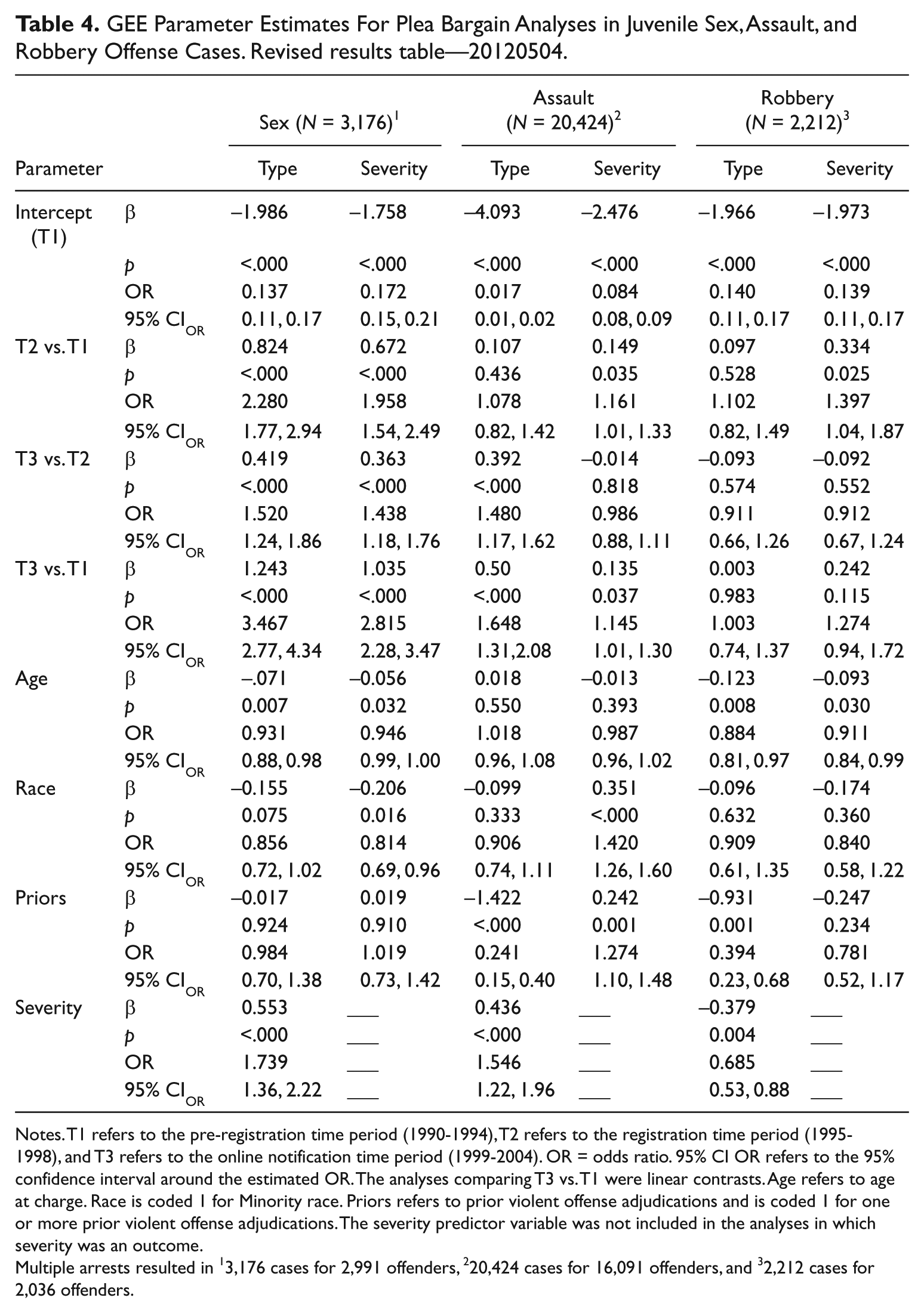
Notes. T1 refers to the pre-registration time period (1990-1994), T2 refers to the registration time period (1995-1998), and T3 refers to the online notification time period (1999-2004). OR = odds ratio. 95% CI OR refers to the 95% confidence interval around the estimated OR. The analyses comparing T3 vs. T1 were linear contrasts. Age refers to age at charge. Race is coded 1 for Minority race. Priors refers to prior violent offense adjudications and is coded 1 for one or more prior violent offense adjudications. The severity predictor variable was not included in the analyses in which severity was an outcome.
Multiple arrests resulted in 13,176 cases for 2,991 offenders, 220,424 cases for 16,091 offenders, and 32,212 cases for 2,036 offenders.

Estimated likelihood of plea bargains to charges amended per type or severity for juvenile sex, assault, and robbery offense cases.
Sex offense cases, charge type
There was statistically significant evidence of increases in the likelihood of plea bargains to nonsex offense charges from each time period to the next (Table 4, column 3). Specifically, there was a 128% increase in plea bargains to nonsex offense charges from the T1 to T2 and an additional 52% increase from T2 to T3. These results are depicted in Figure 1. Model results also indicated that two covariates were significantly associated with plea bargains to nonsex offense charges: youths’ age at charge and the dichotomized charge severity indicator. Specifically, each 1-year increase in age at charge accounted for an estimated 7% reduction in the odds of plea bargains to nonsex offense charges. There was a 74% increase in the odds of plea bargains to nonsex offense charges for youth with higher versus. lower severity charges. The goodness-of-fit test yielded a Chi χ2 value of 7.00 and a nonsignificant p-value of 0.67.
Sex offense cases, charge severity
There was statistically significant evidence of increases in the likelihood of plea bargains to lower severity charges at each time period (Table 4, column 4). Specifically, there was a 96% increase in plea bargains to lower severity offense charges from T1 to T2 and an additional 44% increase from T2 to T3 (see Figure 1). Model results also indicated that youths’ age at charge and Minority status were significant predictors. Each 1-year increase in age at charge accounted for a 5% reduction in the odds of plea bargains to lower severity charges. There was a 19% decrease in the odds of plea bargains to lower severity charges for Minority versus Nonminority defendants. The goodness-of-fit test yielded a Chi χ2 value of 13.04 and a nonsignificant p-value of 0.16.
Assault offense cases, charge type
Model results (Table 4, column 5) indicated statistically significant evidence of some increase in the odds of plea bargains from assault to nonassault offense charges from T2 to T3. However, as depicted in Figure 1, the magnitude of this change was trivial (i.e., recall that the percent of cases associated with plea bargains from assault to nonassault charges was 2%, 2%, and 3% for T1-T3, respectively). The indicator for prior violent offense adjudications and charge severity were also was significant predictors. Specifically, there was a 76% reduction in the odds of plea bargains to nonassault offense charges for youth with prior violent offenses compared with youth with no such priors. There was a 55% increase in the odds of plea bargains to nonassault offense charges for youth with higher versus lower severity charges. The goodness-of-fit test yielded a Chi χ2 value of 6.95 and a nonsignificant p-value of 0.64.
Assault offense cases, charge severity
Model results (Table 4, column 6) indicated statistically significant evidence of an increase in the likelihood of plea bargains to lower severity charges from T1 to T2. Again, as depicted in Figure 1, the magnitude of change was trivial (i.e., recall that the percent of assault cases associated with plea bargains to lower severity charges was 8%, 9%, and 9% for T1-T3, respectively). Youth race and prior violent offenses were significant predictors in this model. There was an estimated 42% increase in the odds of plea bargains to lower severity charges for Minority versus Nonminority youth, and an estimated 27% increase in the odds of plea bargains to lower severity charges for youth with prior violent offense adjudications versus those without such priors. The goodness-of-fit test yielded a Chi χ2 value of 15.06 and a significant p-value of .005, suggesting that the number and/or type of covariates in this model are inadequate to explain the increase in charge severity from T1 to T2.
Robbery offense cases, charge type
Model results (Table 4, column 7) indicated no statistically significant differences in the odds of plea bargains from robbery to nonrobbery offense charges between time periods. Age of youth, prior violent offenses, and charge severity did significantly influence these plea bargains. Specifically, each 1-year increase in age was associated with an estimated 12% reduction in the odds of plea bargains from robbery to nonrobbery offense charges. There was an estimated 60% reduction in the odds of plea bargains for youth with versus without prior violent offense adjudications. There was an estimated 31% reduction in the odds of plea bargains from robbery to nonrobbery offense charges for youth with higher versus lower severity charges. The goodness-of-fit test yielded a Chi χ2 value of 14.79 and a nonsignificant p-value of 0.10.
Robbery offense cases, charge severity
Model results (Table 4, column 8) indicated statistically significant evidence of an increase in the likelihood of plea bargains to lower severity charges from T1 to T2. As depicted in Figure 1, this change was trivial and there was no significant change from T2 to T3. Youth’ age was also a significant predictor. Specifically, each 1-year increase in age at initial charge corresponded with an estimated 9% reduction in the odds of plea bargains to lower severity charges. The goodness-of-fit test yielded a Chi χ2 value of 11.28 and a nonsignificant p-value of 0.26.
Discussion
Results from the present study indicated marked increases in plea bargains for juvenile sex offense cases following initial enactment of South Carolina’s registration and notification policy in 1995 and following the 1999 revision for online notification. Previously, we reported that the probability of prosecuting these types of cases declined across these same time periods, whereas probability of guilty determinations increased (Letourneau et al., 2009a). We hypothesized that these earlier findings were attributable to the imposition of harsh registration and notification policies on juveniles. Specifically, we suggested that solicitor reluctance to prosecute juvenile sex offense cases reflected a protective concern that not all youth who committed sex offenses deserved the lifetime registration and notification requirements imposed by South Carolina’s policy. We also suggested that the increased rate of guilty dispositions was attributable to increased use of plea bargains, which also permit youth to avoid registration and notification requirements. The present study supports this hypothesis. Specifically, results indicated large and statistically significant increases in the probability of plea bargains following initial enactment of South Carolina’s policy and subsequent enactment of online notification.
Results from the comparison assault and robbery analyses further bolster this hypothesis. First, unlike sex offense cases, assault and robbery offense cases were rarely associated with pleading guilty to other charge types, suggesting that amending charges “out of type” is a sex offense-specific legal maneuver, presumably aimed at avoiding sex offense-specific legal consequences such as registration and notification. Second, whereas there were dramatic increases in the probability of sex offense cases plea bargaining to lower severity charges over time, changes assault and robbery offense cases were comparatively trivial, even when statistically significant (see Figure 1). Thus, although plea bargaining to lower severity charges is clearly not a sex offense-specific defensive strategy, findings nevertheless support the hypothesis that sex offense-specific factors were influencing this process.
Adding to our confidence that findings in this study are attributable to South Carolina’s registration and notification policy, several South Carolina solicitors have indicated that juvenile sex offenders are “hidden” to avoid the penalties imposed by this policy. Notably, one attorney told the first author that the family court judge in her jurisdiction had “forbidden” solicitors from bringing juvenile sex offense cases before his court. Although anecdotal, such comments in combination with our results suggest that South Carolina’s policy is exerting powerful yet entirely unintended effects on juvenile sex offense adjudication procedures.
Study Strengths and Limitations
Results from this study should be weighed in light of its strengths and weaknesses. Study strengths include inclusion of nearly all South Carolina juvenile sex offense cases associated with adjudications across a 15-year period of time, inclusion of several covariates that might influence plea bargain outcomes, and comparison analyses with assault and robbery offense cases to address the potential influence of alternative (nonspecific) factors on plea bargain outcomes. The most significant limitations of this study are the nonexperimental study design and the risk of model misspecification. In particular, models could have been misspecified due to the absence of data on other relevant predictors such as decision maker characteristics (e.g., prosecutor or judge beliefs or demographic characteristics) at the individual case level and of any predictors at higher levels (e.g., jurisdiction). We partly addressed these concerns by including goodness-of-fit tests, which supported model adequacy in all but one model, and by including the comparison assault and robbery analyses which we believe supported the argument that South Carolina’s registration and notification policy exerted sex offense-specific effects.
Policy Recommendations
South Carolina’s registration and notifications policy makes few distinctions between juveniles and adults. Nearly all sex offense adjudication (juveniles) and convictions (adults) trigger an automatic requirement for lifetime registration and notification. All juvenile registrants are subjected to targeted community notification whereas all adult registrants and some juvenile registrants are subjected to lifetime online notification. Neither individual recidivism risk nor case-specific circumstances are permitted to influence registration and notification requirements and there is no mechanism for registrants to reduce the duration of requirements from life. Against this harsh reality, many South Carolina solicitors appear to have altered the manner in which they do business. Now, more than ever, juvenile sex offense cases are dismissed outright or—when formal adjudication is desired, initial sex offense charges are pled to nonsex offense charges. These findings are consistent with the broader criminal justice literature, in which it has been reported that policies perceived by judicial decision makers as unnecessarily harsh are under-enforced (e.g., see research on uneven enforcement of mandatory minimum sentences with adult offenders; McCoy, 1984; Zimring, Hawkins, & Kamin, 2001).
In summary, our program of research indicates that South Carolina’s registration and notification policy fails to deter new juvenile sex crimes (Letourneau, Bandyopadhyay, Armstrong, & Sinha, 2010), fails to deter juvenile sexual or violent recidivism (Letourneau & Armstrong, 2008; Letourneau et al., 2009b), and increases the risk that youth will incur new nonsex, nonviolent misdemeanor charges (Letourneau et al., 2009b). Other researchers have demonstrated that federal standards for juvenile sex offender registration fail to distinguish between youth who will reoffend or not (Batastini, Hunt, Present-Koller, & DeMatteo, 2011; Caldwell, Ziemke, & Vittacco, 2008) as do state-specific methods in New Jersey, Texas, and Wisconsin (Caldwell & Dickinson, 2009; Caldwell et al., 2008). The basis for these federal and state policy failures might lie, in part, with the low sexual recidivism rate of youth adjudicated for sex offenses (Caldwell, 2002; Vandiver, 2006). Indeed, results from one study indicated that the risk of sexual recidivism was statistically equal for youth treated in a residential facility for either sexual or nonsexual delinquent offenses (Caldwell, 2007). Thus, distinguishing between youth likely to sexually reoffend or not involves more than simply knowing that a youth has a history of such offending.
Given these policy failures, the avoidance of registration and notification requirements by some youth via dismissed or amended charges seems unlikely to harm community safety per se. However, there are additional potential consequences of these outcomes. For example, juveniles who have actually committed sexual offenses but whose charges were dismissed or amended to nonsex offense charges might not receive appropriate clinical services or supervision. Moreover, youth age and race influenced solicitor decisions to permit plea bargains, introducing the possibility of inequity. Rather than relying upon solicitors to protect youth from ineffective and possibly harmful legal policies, a more just and equitable solution would be to alter the onerous policies themselves. The available evidence from four state policies and the federal registration policy fails to support any community safety effect of juvenile registration or notification. More research evaluating other state policies would helpful. However, given the consistency of findings to date, we submit that youth adjudicated delinquent as minors should be exempt from sex offender registration and notification requirements until such time as empirically rigorous evidence emerges indicating that these policies can be crafted in such a way as to improve community safety.
Footnotes
Acknowledgements
The authors wish to thank Ms. Trudie Trotti, director of research and statistics, South Carolina Department of Juvenile Justice and Mr. Charles Bradberry, formerly senior statistician, South Carolina State Budget and Control Board, Office of Research and Statistics.
Declaration of Conflicting Interests
The author(s) declared no potential conflicts of interest with respect to the research, authorship, and/or publication of this article.
Funding
The author(s) disclosed receipt of the following financial support for the research, authorship, and/or publication of this article: This study was supported in part by the Centers for Disease Control and Prevention (R49 CE00567) and the National Science Foundation (SES 0455124). The conclusions expressed in this article are those of the authors and do not necessarily represent those of the funding agencies or South Carolina state agencies.