




Abstract
Published typologies of sexual homicide lack theoretical grounding and empirical support. They also conceptualize the phenomenon of sexual homicide as somewhat discrete, though offenders are not typically specialists. Here, we propose a model that situates the phenomenon of sexual killing into broader categories of antisocial behavior, positing three types of perpetrators of serial sexual homicides: competitively disadvantaged, psychopathic, and sadistic offenders. Using biographical data of 82 serial sexual homicide offenders, we tested our model as well as the influential organized/disorganized model. Principal components analysis produced five components consisting of offender and offense characteristics, and cluster analysis revealed three distinct groups of perpetrators (sadistic offenders, competitively disadvantaged offenders, and slashers), as well as a fourth, heterogeneous group; this cluster solution, however, may be unstable. In summary, there is only mixed support for either model.
The rate of sexual homicide is said to be anywhere from 3% (Firestone, Bradford, Greenberg, & Larose, 1998) to 22% (Burgess, Hartman, Ressler, Douglas, & McCormack, 1986) of all homicides. The literature, however, does not provide a uniform definition of this type of homicide, which likely accounts for the wide range of estimates of the sexual homicide rate. Researchers for the Federal Bureau of Investigation (FBI) have proposed that power, control, sex, and aggression are the crucial elements to consider when defining a homicide as sexual in nature (Burgess et al., 1986). Others have argued that sexual arousal to sadistic acts is the defining characteristic of this behavior and do not consider power or control to be critical (Firestone et al., 1998). And still others hold the position that premeditation of sexual violence, and no other aspect, defines a sexual homicide (Kocsis, Cooksey, & Irwin, 2002). Not only do these diverse definitions affect the estimated rate of sexual homicide, but they may also bias the interpretation of a homicide in favor of one’s preferred explanation for its occurrence.
The definition of sexual homicide used herein refers to those homicides in which sexual activity (including masturbation) occurs with the victim present before, during, or after death. This definition is highly inclusive, and it makes no assumptions about the motivational state of the offender at the time of the homicide, thus reducing potential bias. It also includes only those criteria that are readily measurable, such as evidence of sexual activity at the scene of the offense. Consistent with homicides in general (Daly & Wilson, 1988), the majority of sexual homicides are perpetrated by males (Meloy, 2000). For this reason, the offenders will hereafter be referred to in the masculine gender.
The Organized/Disorganized Typology
Along with the need for a universal definition of sexual homicide, it is important that a model designed to explain sexual homicide be developed to increase our understanding of the phenomenon. The most influential model to date was generated in the 1980s by a group of criminal profilers working for the FBI (Ressler, Burgess, & Douglas, 1988; Ressler, Burgess, Douglas, Hartman, & D’Agostino, 1986). Ressler et al. (1986) noticed two distinct types of crime scenes for sexual homicides: “Organized” scenes and “disorganized” scenes. Thirty-six convicted serial killers were interviewed to identify possible offender characteristics that clustered with either type of crime scene, with the intention of future scenes being used to create profiles of offenders. Applying the organized/disorganized model, offenders were categorized as belonging to one of the two types based on descriptions of their crime scenes. Through this, Ressler et al. (1986) generated characteristics of their organized and disorganized offenders.
According to Ressler et al. (1986), the organized crime scene evidences order and planning. The victim is often a stranger and there are distinct signs of premeditated actions aimed at avoiding detection. These include such aspects as a minimal amount of evidence present, the use of restraints and, in addition, a murder weapon that is brought to, and later removed from, the crime scene (Ressler et al., 1988). The homicide itself, however, is often eroticized and there are signs of ritualism and sadistic torture. Offenders associated with organized crime scenes are typically intelligent and socially competent (Ressler et al., 1988). Ressler et al. (1988) also argued that organized offenders hold steady employment and do not appear suspicious in character. Moreover, they are often living with a partner at the time of the offense. Finally, these offenders apparently experience stressors leading up to the offense, but are often calm during the murder. Overall, the organized offender is thought to be a vigilant person who commits a methodical and controlled murder.
The disorganized crime scene is opposite in appearance to the organized crime scene. Rather than being one of order and planning, it is chaotic and appears to be the result of little preparation or thought on the perpetrator’s part. The homicide is sudden and brutally violent, the body is mutilated and defiled after death, the corpse and murder weapon are present at the scene, and the offender who commits this type of crime is generally of below-average intelligence and often has grown up in an unstable home environment (Ressler et al., 1986, 1988). Ressler et al. (1988) argue that the disorganized offender is socially inept, often delusional, and sexually incompetent. Moreover, he is impulsive, and the sexual homicide is the fatal result of an explosively angry outburst that leaves the crime scene littered with evidence.
There are numerous other typologies designed to explain the behavior of sexual homicide offenders. Holmes and Holmes (1998), for instance, considered 110 cases of serial murderers and derived five categories of sexual homicide offenders, but the method used to derive the five categories was not made explicit. Rather, Holmes and Holmes describe taking into account variables such as background information, offender motivation, and crime scene characteristics in creating their typology. Another sexual murder typology was developed by expanding a previously derived model of rape to categorize sexual homicide, based on the personal experience of the researchers with different case studies (Keppel & Walter, 1999). In a third model, Kocsis et al. (2002) categorically rated offender variables relating to sexual homicide, including characteristics of the victims, offenders, victim-offender interactions, and crime scenes into a cluster analysis and found four patterns of sexual homicide behaviors. Finally, Beauregard, Proulx, and St-Yves (2007) used interviews of 36 sexual murderers, plus a review of their institutional files, to obtain crime scene and precrime data to develop a sadistic-versus-angry offender typology.
Published typologies of sexual homicide, including the organized/disorganized model, tend to be only weakly based in either (or both) theoretical or empirical research. Many of the typologies are a result of the clustering of variables with no particular hypothesis to test, and a majority of them are not systematically tested. The organized/disorganized typology, for example, is based on the experience of the researchers with no mention of the structure of the interviews given to the serial killers. Canter, Alison, Alison, and Wentink (2004) tested this typology and found that, rather than being a typology of sexual homicide offenders, the model was more effective as a continuum of organization. Although Canter et al. is the only published test of the typology, the organized/disorganized model remains the dominant typology of sexual homicide.
Sexual Homicide and General Antisociality
The parochial nature of the sexual homicide literature has resulted in a number of typological models that characterize the phenomenon as a specific problem, assuming no relation to other kinds of violent behavior. Yet, sexual or otherwise violent offenders are only rarely specialists; rather, they tend to commit a variety of crimes. Miethe, Olson, and Mitchell (2006), for example, found that only 5% of the arrested repeat sex offenders had arrests for only sexual offenses, whereas among violent offenders, only 1.4% had violent offenses. In another study, offenders labeled as violent specialists only had to meet a minimum requirement of 3 violent offenses out of a total of 14 offenses to be called specialists, and only 16 of 488 offenders met this criterion (Lynam, Piquero, & Moffitt, 2004). As with other types of violent crime, it is likely that sexual homicide is one of several antisocial behaviors that offenders engage in over the life course. For this reason, a realistic typology ought to consider the offense in the wider context of general antisocial tendencies. Here, we propose a three-path model of sexual homicide that is derived from past theoretical and empirical work on antisocial behavior, categorizing offenders into one of three types: Psychopathic, competitively disadvantaged, and sadistic offenders.
The criminology literature points to two general pathways generating lifelong criminal behavior, especially violent behavior. One path to violent offending involves neurodevelopmental insults caused by perturbations such as obstetrical complications (Harris, Rice, & Lalumière, 2001; Moffitt, 1993a). As a result of these insults, individuals suffer from cognitive deficits, including impairments to problem solving, learning, and memory. Offenders suffering from such insults are more likely to become life-course persistent offenders (Moffitt, 1993b). These developmental disturbances have been found to interact with parental antisociality and a disadvantaged neighborhood, leading to increased violence and aggressive behavior (Turner, Hartman, & Bishop, 2007). Effectively, these men are at a disadvantage when competing with same-sex rivals for status, resources, and mates (Daly & Wilson, 2001; Lalumière, Harris, Quinsey, & Rice, 2005). They may also have shorter life expectancies, which is predicted to lead to increased violence (Wilson & Daly, 1997).
The stable and persistent antisocial behavior that is the consequence of competitive disadvantage also leads to sexually coercive behavior. Competitively disadvantaged men are hypothesized to engage in a short-term mating strategy that involves many sexual partners, investing little effort in each partner (Quinsey & Lalumière, 1995). Competitively disadvantaged offenders who adopt this strategy face the difficulty of finding willing partners and may therefore respond with sexual aggression, sometimes leading to lethal violence (e.g., accidental homicide). The poor condition of these men could also negatively influence their ability or willingness to accurately interpret the signals of sexual interest, or lack thereof, from women.
Psychopathy is a second path to lifelong criminal violence (Harris et al., 2001; Lalumière et al., 2005). Psychopaths are manipulative, glib, selfish, and remorseless (Hare, 1991). They engage in impulsive and sexually promiscuous behavior, and display a high need for excitement. They begin their delinquent career at a young age and, as adults, have a highly versatile criminal background, partaking in instrumental, or goal oriented, violence and aggression (Serin, Malcolm, Khanna, & Barbaree, 1994). These offenders also display a life-course persistent offense history, but there is no evidence of competitive disadvantage. Indeed, Harris and colleagues (Harris et al., 2001; Harris, Rice, Hilton, Lalumière, & Quinsey, 2007) found that psychopathy may be negatively associated with a history of neurodevelopmental insults (or the two are not associated at all) and is therefore not pathological. Arguably, it is an alternative life strategy, wherein psychopaths hold little regard for and tend to take advantage of others (Harris et al., 2001; Krupp, Sewall, Lalumière, Sherrif, & Harris, 2011; Lalumière, Harris, & Rice, 2001; Lalumière, Mishra, & Harris, 2008).
Certain characteristics of psychopathy resemble a strategy of high mating effort, whereby individuals pursue a large number of sexual experiences (Harris et al., 2007). This involves sexual promiscuity and impulsive, thrill-seeking behavior to have many sexual encounters. Psychopaths invest only minimally in their partners; they also engage in sexual behavior, including sexual coercion, at early ages (Harris et al., 2007).
The two paths toward persistent antisociality share aspects of deviant, sexually coercive behavior. There is, however, another path to sexual coercion, if not general antisociality, that is based on an erotic attraction to sexually aggressive behavior: sadistic rape (Quinsey & Lalumière, 1995). Sadistic rapists are aroused by the physical and psychological suffering of others. They have elaborate fantasies and use excessive force and torture as a means of sexual stimulation (Pardue & Arrigo, 2008). Plausibly, a sexual preference for rape is likely to be the result of an abnormally strong connection between sexual desire and sex that involves the domination of the partner (Quinsey & Lalumière, 1995). Very little is known about the antisocial and personal histories of sadistic rapists, in large part because of the diagnostic difficulties associated with the construct of sadism (e.g., Marshall, Kennedy, Yates, & Serran, 2002).
An Alternative Model
The above paths pertain to general violent and sexual behavior. They could, however, be applied to the particular case of sexual homicide. Our notion here is that sexual homicide is not typically a specific phenomenon, but one manifestation of a more general antisocial character. Below, we propose a typological model, derived from the work of Harris et al. (2001) and Lalumière et al. (2005), that provides a more parsimonious typology than others published in the extant literature, yet is sufficiently broad to encompass a variety of cases. The typology has three kinds: competitively disadvantaged, psychopathic, and sadistic offenders.
As discussed above, competitively disadvantaged types are those life-course persistent offenders who experienced neurodevelopmental insults, as well as poor environmental conditions, early in life. These experiences set them on a path of lifelong antisocial behavior (Moffitt, 1993b). Such individuals are not well-equipped to succeed in prosocial activities, and so turn to an antisocial career at a young age. These offenders perform poorly in school, have low intelligence, begin their delinquent careers as juveniles, and have difficulty holding steady employment as adults. Finally, competitively disadvantaged offenders are likely drawn from low socioeconomic status environments and have poor future prospects.
Hypothetically, the crime scene that competitively disadvantaged offenders leave is in some disarray, much as that of the disorganized crime scene in the organized/disorganized model (Ressler et al., 1986). This is because competitively disadvantaged offenders would lack the mental capacity to fully plan and orchestrate an organized sexual homicide. These offenders engage in reactive violence whereby the homicide is spontaneous and explosive, a violent response to a perceived provocation or rejection. Moreover, they engage in a short-term mating strategy that involves sexual coercion because, as low quality men, they are expected to have limited access to desirable sexual partners. In extreme circumstances, these men may kill their victims rather than see them form mateships with rival males (Daly & Wilson, 1988; Wilson & Daly, 1992).
As competitively disadvantaged types, psychopathic offenders may engage in a variety of violent offenses, including sexual homicide. They are also expected to begin their criminal careers at a young age and to persist through adulthood. However, they should appear developmentally healthy, showing little to no evidence of neurodevelopmental perturbations (Harris et al., 2001, 2007; Lalumière et al., 2001). They are callous, manipulative, impulsive, lack remorse, and feel little empathy for others (Hare, 1991). They are also prone to casual and sometimes coercive sexual encounters (Harris et al., 2007). All of this makes them candidates for sexually violent behavior.
Sexual homicide crime scenes left by psychopathic offenders would reflect both order and disorder, a mixed type in terms of the organized/disorganized model. On one hand, these offenders are impulsive, so a homicide could be spontaneous, much as a disorganized offender. However, their life of criminal exploits equips them with the experience to commit an impulsive homicide that appears to have some planning and order to it, and they lack the cognitive deficits of their competitively disadvantaged counterparts, again allowing them to maintain some degree of order at the scene. Because the homicides of psychopaths are more often goal directed (Serin et al., 1994), psychopaths may have spent more time thinking about potential detection, their impulsivity notwithstanding. Finally, psychopaths are violent, lack empathy, and pursue exciting behaviors, so there may be some signs of sadism and torture.
Unlike competitively disadvantaged and psychopathic types, sadistic offenders are not expected to show a lifetime of criminal history. Rather, they have a strong sexual attraction to sadistic behaviors that eventually leads them to kill. Sadists spend much of their time fantasizing excessively over the humiliation and torture of others (Hill, Habermann, Berner, & Briken, 2006; Marshall et al., 2002), and so the majority of antisocial behavior engaged in by this group is likely to be of a sexual nature. Sadists may not have high criminal propensity, and will appear to lead relatively normal lives, holding steady employment and being involved in marital relationships. It is the presence of the overwhelming desire for sadistic acts that motivates these offenders to kill.
The crime scene of sadistic offenders is most likely aligned with the organized crime scene of the organized/disorganized model, but the degree of organization is only one of numerous aspects of a sadistic crime scene. These offenders spend hours fantasizing over every detail, so that when they eventually perpetrate their crimes, they are expected to behave methodically and meticulously. There is considerable evidence of sadistic activities such as humiliation, torture, and mutilation at the scene (Pardue & Arrigo, 2008). The scene, however, has little evidence pointing to the offender, due to the time spent in planning. As the sadistic offender gains immense gratification from the sexual homicide, he may keep a trophy or souvenir of the offense.
The aim of the current study is to test the fit of both the organized/disorganized and our alternative, three-path model to serial sexual homicide cases. We use serial offenders because the relevant biographical and crime scene data tend to be richer (as they are heavily researched), and their consistency in engaging in sexual homicide provides us with a strong test case for both models.
If the organized/disorganized typology accurately describes sexual homicide, then we can expect to find two groups of serial sexual killers with distinct characteristics: One group will show characteristics representative of the organized type, including planning, strangers as victims, little evidence at the scene, and the perpetrator will be intelligent and socially competent; the other group will show few signs of planning, large amounts of evidence, extreme overkill of the victim, and a perpetrator of low intelligence and social ineptitude.
Alternatively, if the three-path model is more appropriate, we predict there to be three clusters of serial sexual homicide offenders with distinct characteristics representing more of a continuum of crime scene organization, much as the results obtained by Canter et al. (2004). One group will show signs of competitive disadvantage: neurodevelopmental insults and poor school performance. They are not expected to show signs of sadism. A second group will show signs of psychopathy: thrill-seeking behavior, early onset of coercive sexual activity, and manipulative behavior. The third group will show signs of sadistic interests, such as torture of the victim and sadistic fantasizing, but otherwise low criminal propensity.
Method
Sample
The sample for this study consisted of all male serial sexual homicide offenders with biographies available from the TruTV website (www.trutv.com; see below) who met inclusion criteria. Only men were included in the sample because the vast majority of sexual homicide offenders were male and the research providing the basis for the proposed three-path model consists of analyses based almost exclusively on male offenders. To be included in the sample, the biography of the offender had to clearly state that sexual activity with at least one victim occurred before, during, or after death. That could include masturbation, oral, or penetrative sex. To classify the offender as a serial killer, another criterion was the commission of at least three homicides, which is consistent with the definition of serial homicide used by the FBI (Ressler et al., 1988); individuals who perpetrated only spree or mass killings were excluded. Of the 150 offenders with biographic information available on TruTV (and thus considered for inclusion in the sample), 82 met the inclusion criteria. The majority of the sample comprised offenders who acted alone. To avoid pseudoreplication when two offenders worked together, the offender included in the sample was the one who took the dominant or leadership role in the homicides.
Procedure
Each offender was coded on variables relevant to the organized/disorganized and three-path models. The coding sheet consisted of 118 variables in six categories: (1) developmental factors, with variables such as childhood trauma, physical deformities, and attractiveness; (2) family environment, including maternal rejection, parental antisociality, and social class; (3) adolescent behaviors, including school performance and age at first arrest; (4) adult characteristics, including relationship status, antisocial personality disorder (APD), and degree of sadistic and sexual fantasizing; (5) average characteristics of all sexual homicides committed by the offender, including crime scene variables such as evidence of humiliation or torture, presence/absence of physical restraints, and cannibalism; and (6) crime scene variables pertaining only to the final sexual homicide that the offender committed (coding form available from the authors on request). This last category was created because, hypothetically, the final sexual homicide would best represent the modus operandi of the offender, should the offender develop a more formulaic method to his offences over time.
Due to the difficulties of accessing primary data on offenses of this nature, case information for coding was drawn from three biographical sources. The first source was TruTV, a website that contained biographical details of all 82 offenders. The information provided on TruTV frequently included a historical account of the offender’s life, as well as details specific to their sexual homicide offenses. The second source was Wikipedia (www.wikipedia.org), that was used to gather the information which was absent from TruTV. Finally, those offenders who were included in the Encyclopedia of Serial Killers (Newton, 2006) were coded using the biographical information provided within it. Data from TruTV were used whenever information from the various sources came into conflict, because TruTV was considered the most reliable source, often cited by Wikipedia.
Some variables, such as the degree to which ritualism was present at the homicide, required the rater to make a subjective judgment. Juan Corona, for instance, buried his victims on the north side of a tree whereas Jeffrey Dahmer decapitated his victims and boiled the skin off the skulls to keep as a shrine, or drilled holes in his victims’ heads in an attempt to make them into zombies. Both displayed ritualism, but Corona was rated as some ritualism present whereas Dahmer was rated as displaying considerable ritualism, because Corona’s acts did not seem to be as elaborate or meticulous as Dahmer’s. Information on the reliability of coding is presented below.
The data collected on each offender through the coding sheets were entered into SPSS 17.0. Those variables with missing data for the majority of cases were removed. The missing data that remained were then dealt with in one of two ways. For information that would have likely been mentioned had the event occurred, such as cannibalism, missing data were considered as absent for that case. For information that involved a degree of judgment on behalf of the rater, or that would not always be mentioned had the event occurred (e.g., whether an offender appeared to have been calm or distressed at the time of the offense), missing values were replaced with the mean of the values for offenders who had information present for that variable (Tabachnick & Fidell, 2001). This was done for 11 variables.
The variables were then rated for their importance in defining the different groups from both models. As well, the number of offenders who had a value present for each variable was recorded. This was done because information was not equally available for each variable. From this, 33 variables were selected to be included in the analyses (Table 1). These variables were coded in one of three ways: (1) a dichotomous (0-1) scale representing presence or absence of the feature; (2) a trichotomous (0-2) scale representing a low, moderate, or high presence of the feature; and (3) continuous scales showing the degree to which a feature is present.
Variables Used in the Analyses
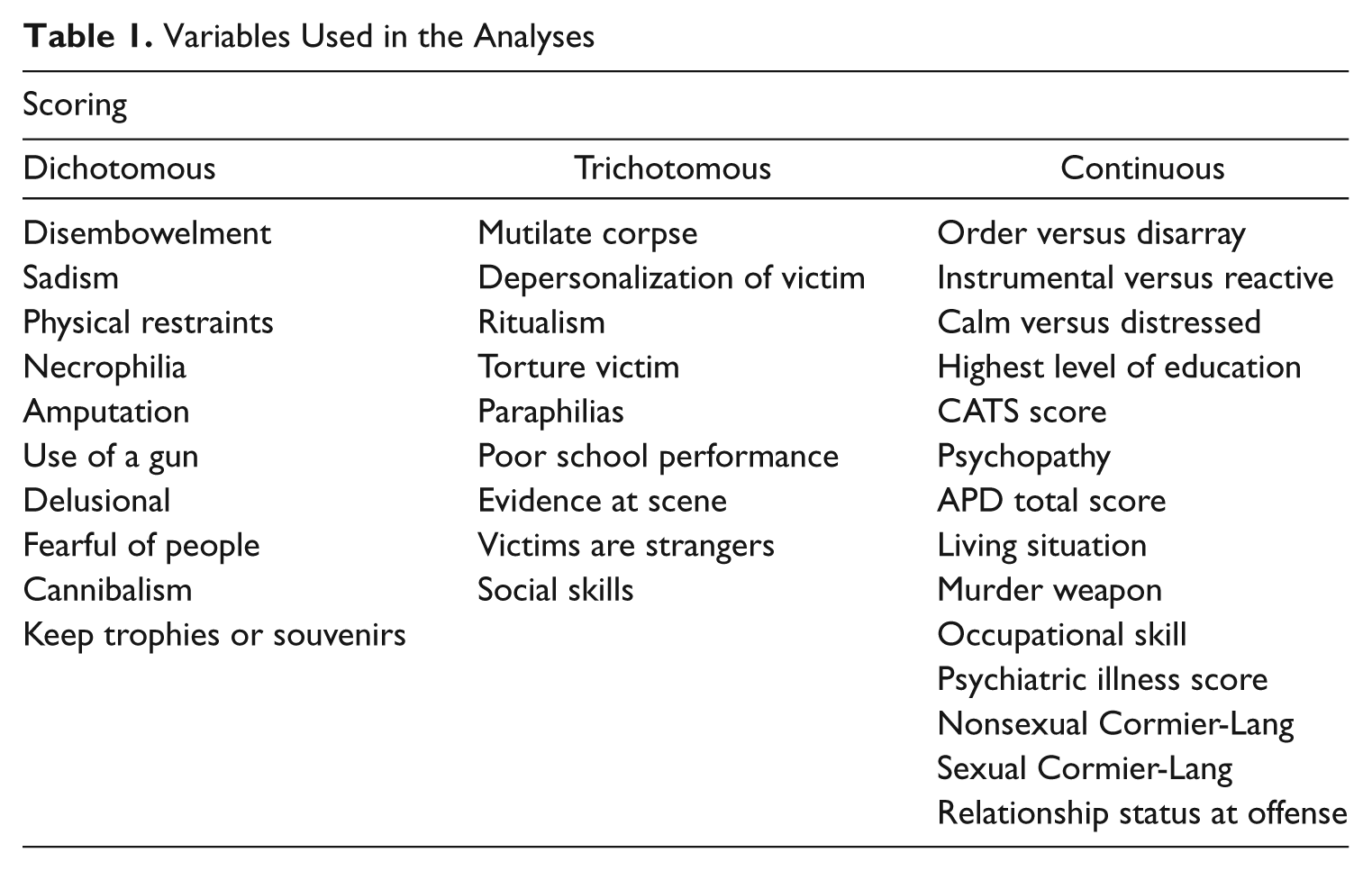
Sadism, for example, was coded as a dichotomous variable based on explicit mention of a sadistic aspect of the offense (e.g., the offender was sexually aroused by torturing the victim), or presence of sadistic sexual fantasizing so as to distinguish between violence with or without sadistic intent. Depersonalization of a victim, which was proposed as characteristic of disorganized offenders (Ressler et al., 1986), involved stripping a victim of his or her individuality through mutilating or objectifying a victim’s face; this variable was coded trichotomously (absent, some depersonalization present, fully depersonalized). Adeptness of social skills was also coded trichotomously (socially inept, adequate social skills, socially adept) and was operationalized as the degree to which the offender was inclined to, and/or succeeded at, engaging socially with others—that is, how personable, outgoing, or likely the offender was to seek out social situations. Finally, sufficient information was not always available to accurately score offenders on the Psychopathy Checklist Revised (PCL-R; Hare, 1991). Therefore, the PCL-R items were used as a guide to generate a general psychopathic trait score based on a continuous, 7-point rating scale, based on the biographical information provided; Hare (1980) found that an overall rating of psychopathy correlated .83 with the original version of the PCL. In addition, if the case information stated that the offender had been deemed a psychopath, this was coded as a high psychopathy rating on the scale.
The Child and Adolescent Taxon Scale (CATS; Harris et al., 1994) was used as a measure of childhood and early adolescent indicators of psychopathy. Antisocial Personality Disorder (APD) was coded continuously to determine the degree of antisociality of the offenders; one point was given for each Diagnostic and Statistical Manual of Mental Disorders (4th ed.)-TR characteristic (American Psychiatric Association, 2000). We used the sexual Cormier-Lang subscale to measure a combination of severity and frequency of sexual criminal offenses perpetrated by the offender, and the nonsexual Cormier-Lang subscale to measure the severity and frequency of all other offenses committed (Quinsey, Harris, Rice, & Cormier, 2006); one offender was a considerable outlier on the sexual subscale, and his score was reduced to one unit greater than the next most extreme score. Finally, both the sexual and nonsexual Cormier-Lang variables were skewed and so were transformed to log values to normalize their distributions. These were the only variables that were transformed, because the others could not be normalized. The principal components analysis that was used (see below), however, is robust to violations of normality (Tabachnick & Fidell, 2001).
Two people coded the 82 cases. The primary author coded 41, a research assistant coded 33, and both the author and assistant coded 8 of the same cases. Two of these eight cases were coded together for the purposes of training, and the remaining six cases were coded independently over the coding period, to test for inter-rater reliability. Average intraclass correlation coefficients (ICCs) were computed for the six offenders over the 33 variables entered into the analysis. Because three variables were invariant for one or both of the coders, they were not included (although their ICCs would have been close to 1.0). The resulting ICCs for the inter-rater reliability of the remaining variables used in the analysis had a mean = 0.58, a median = 0.62, and a mode = 1.00, suggesting modest agreement between coders.
Results
As there were 33 variables, but only 82 offenders in the sample, the variables were entered into a principal components analysis (PCA) to reduce them to a smaller number of components that represent the latent associations among them (Tabachnick & Fidell, 2001). This also provided an opportunity to examine any patterns among offender and offense characteristics. Promax rotation was used to allow correlations among the components because there was no a priori reason to believe the components would be uncorrelated. The factor scores were derived using the Anderson-Rubin approach because it yields scores that are not correlated with each other, even if the components themselves are correlated. This was done because the factor scores were to be entered into a cluster analysis (see below), which requires that the scores be uncorrelated, even if the components themselves are. After rotation, the PCA converged on a solution composed of nine components. Examination of the change of slope on the scree plot indicated that the first five components were most appropriate for further analysis (Table 2). Because we used an oblique rotation, it would be inappropriate to compute the total variance explained by the components we obtained in our solution. Indeed, the correlations among the five components reached as high as .36.
Structure Matrix of the First Five Principal Components

Note: Values in italic indicate the strongest association for each variable-component combination and, therefore, membership to the component in their respective columns.
We labeled the five components as follows: slashing, sadistic, instrumentality/order, poor school performance, and antisociality. Slashing consisted of high loadings for mutilation, disembowelment, and depersonalization of the corpse, as well as acts of ritualism done by the offender at the crime scene. The sadistic component had high loadings for acts of sadism, paraphilias, torture of the victim, and the presence of physical restraints used to control the victim. Instrumentality/order had high loadings for instrumentality, order, and the offender having a calm affect at the scene. Conversely, then, if an offender scored low on this component, he would have displayed reactive behavior and left a disarrayed crime scene, being distressed during the murder. Poor school performance consisted of high loadings for poor scholastic achievement, a low level of education, and a high score on the CATS 1 . Finally, the antisociality component showed a strong association between APD score and a general psychopathy score.
Next, if the differences between coders were to affect the scores the offenders received on variables, we would expect a bias in factor scores in the PCA. Because the two coders are represented by a dichotomous variable, we used this as the response variable in a logistic regression, where the predictor variables were the five component factor scores. None of these components significantly predicted the coder (all ps > 0.137), thus showing no bias between coders. Therefore, inter-rater differences appear not to introduce systematic bias into the coding.
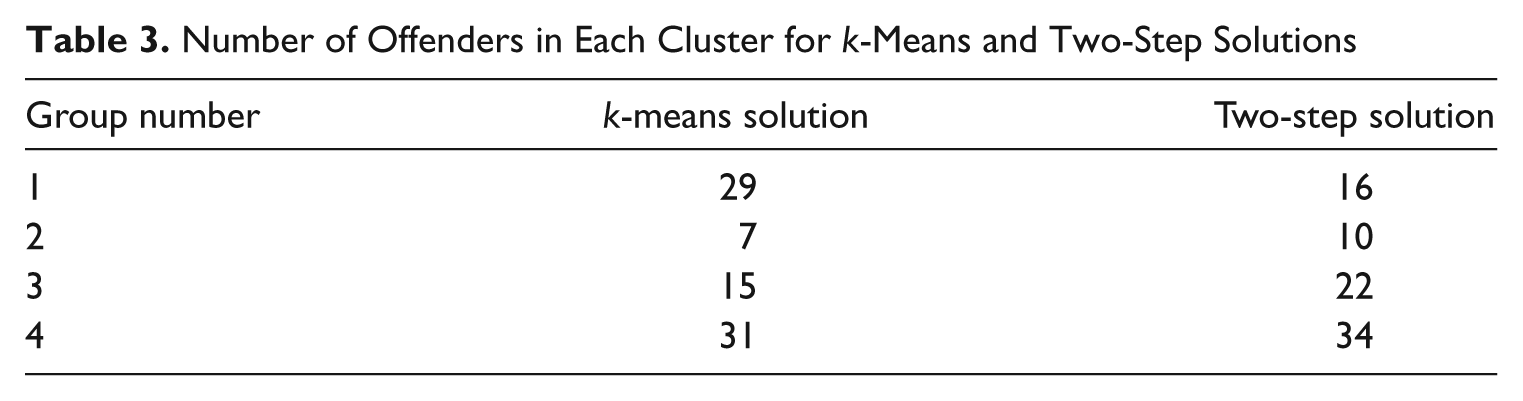
The five components were then entered into two cluster analyses. Cluster analysis was chosen because it clusters offenders into relatively distinct groups (Aldenderfer & Blashfield, 1984; Everitt, Landau, & Leese, 2001) thus giving an impression of the offender “types” in the sample. The components were first put into a k-means clustering algorithm that was forced to return two-, three-, four-, and five-cluster solutions. Each component was plotted against every other component, and the individual points were delineated by cluster membership for each of the four solutions. These plots were inspected to discern which cluster solution best represented the distinct offender groups, essentially by identifying the solution with the least number of clusters that still gave an appearance of grouping. Based on inspection of the plots, a four-cluster solution was deemed to be the best fit. Table 3 shows the number of offenders in each cluster, and Figure 1 shows the mean factor score of each component for each cluster.
Number of Offenders in Each Cluster for k-Means and Two-Step Solutions
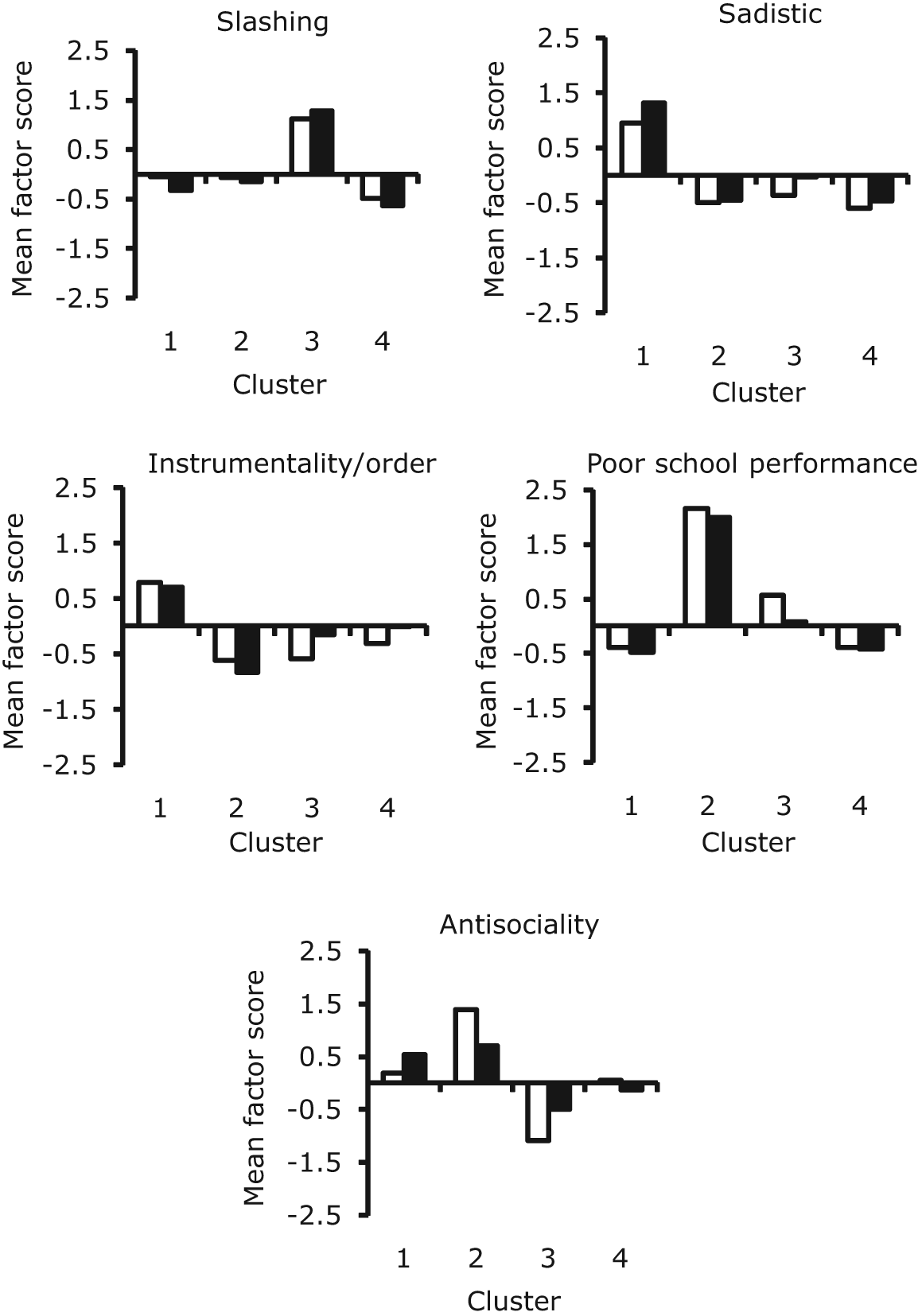
Mean factor scores for each cluster and component. Panels represent mean factor scores for k-means (open bars) and two-step (filled bars) solutions on slashing, sadistic, instrumental/order, poor school performance, and antisociality components
Briefly, Cluster 1 membership was associated with relatively high scores on the sadistic and instrumental/ordered components, Cluster 2 membership was associated with relatively high scores on the antisociality and poor school performance components, Cluster 3 membership was associated with relatively high scores on the slashing component and low scores on the instrumentality/order and antisociality components, and Cluster 4 membership was associated with relatively average scores on the instrumentality/order and antisociality components and low scores on the remaining components.
To seek confirmation of the four-cluster solution, an exploratory two-step algorithm was conducted using a log-linear distance measure and Akaike’s Information Criterion (AIC). As with the k-means solution, this analysis obtained four clusters (Table 3 & Figure 1). To examine agreement between the solutions, an adjusted Rand index (ARI) was computed (Hubert & Arabie, 1985). The ARI is a measure of the similarity, accounting for chance, of cluster membership between analytical solutions. An ARI of zero indicates that any similarity between the two cluster solutions is due entirely to chance, whereas an ARI of one indicates perfect agreement of group membership between the two solutions, beyond chance expectation. The ARI obtained in our data was 0.42, suggesting a moderate degree of agreement between cluster solutions that is well above chance levels. As a final check of solution stability, we replicated the two-step cluster analysis with a different distance measure, Euclidean distance. This solution, however, yielded a single cluster rather than four, suggesting that the four-cluster solution may not be stable.
Discussion
The results of the PCA indicate some degree of association among offense variables, as would be required for a typology of offenders. Likewise, the results of the cluster analyses indicate clustering among offenders based on components derived from offense variables. However, the four-cluster solution may be unstable, so caution should be taken in its interpretation. With this in mind, we discuss the implications of these results for sexual homicide typologies.
The PCA results showed a degree of fit with aspects of the models as well as some discrepancies. On one hand, the slashing component contained both organized and disorganized variables. Ressler et al. (1988) predicted that organized offenders would engage in ritualistic behaviors, whereas disorganized offenders would display mutilation and disembowelment of their victims. However, ritualism, mutilation, and disembowelment loaded positively on the same component; thus, these behaviors frequently co-occurred and were therefore carried out by the same offenders. On the other hand, the three-path model proposed that these same behaviors would occur in the sadistic group. However, these variables form their own component that is only slightly correlated with the sadistic component (r = .23), providing little support for sadistic types who also behave ritualistically, mutilating and disemboweling their victims. The results of the cluster analyses also fail to find a compelling association between scores on the slashing and sadistic components.
A priori, the three-path model predicted the existence of a sadistic component, and a resulting sadistic type. By its very nature, torture and sadism ought to load on the same component, and physical restraints on the victim are often a necessary aspect of torture. It is interesting, however, that paraphilias loaded highly on this component, as it suggests that offenders who score highly on this component might not be limited to sadism, but suffer from other paraphilias as well. This is consistent with previous findings indicating that deviant sexual fantasies were significantly more common among sadistic sexual aggressors of women as opposed to nonsadistic sexual aggressors (Proulx, Blais, & Beauregard, 2007). Furthermore, in previous work, sadistic sexual murderers have also displayed significantly more deviant nonsadistic sexual behavior at the crime scene, including necrophilia, than did nonsadistic sexual homicide offenders (Proulx et al., 2007). These findings suggest that offenders who display sadism may be more inclined to also engage in deviant nonsadistic sexual behavior that could be considered paraphilic.
Instrumentality, order, and a calm affect reflect the predictions of both typological schemes. Poor school performance and low level of education also fit with that predicted by both Ressler et al. (1988) and our own model. A high score on the CATS does not run exactly counter to the competitive disadvantage aspect of the three-path model (i.e., that the offenders who performed poorly in school also started a delinquent career early in life). However, the CATS tends to have a slight positive correlation with psychopathy rather than adult criminality more generally (Book & Quinsey, 2004), and in the current study it loaded highly on the antisociality component as well as the poor school performance component.
As can be seen from Figure 1, individuals belonging to the first cluster scored most highly on the sadistic and instrumentality/order components, suggesting that these individuals are sadistic types. Individuals belonging to the second cluster scored most highly on the antisociality and poor school performance components, suggesting that they are antisocial types, including perhaps both psychopathic and competitively disadvantaged men. With greater statistical power, it is possible that this cluster could be partitioned into these two further distinct subtypes. Individuals belonging to the third cluster scored most highly on the slashing component, and also relatively low on the instrumentality/order and antisociality components, suggesting that these men are slasher types. Given that they are not especially instrumental, antisocial, or sadistic in their behavior, their violence may stem from any number of unspecified psychological disorders, or from other factors that have yet to be analyzed. Finally, individuals belonging to the fourth cluster score near the mean on the poor school performance and antisociality components and below the mean on the remaining components, suggesting that they are a heterogeneous group of men that are difficult to categorize in terms of our variables.
Although there was moderate overlap between the two clustering algorithms, any residual disparity indicates heterogeneity among offenders within offender types as a function of the five components used in the current study. Certainly, this appears to be the case with individuals belonging to the fourth cluster, who seem (as a group) not to be particularly unique with respect to any behavioral component. Moreover, although the results of the cluster analysis indicate that some sort of typology emerges from the data, the lack of cluster stability (and the enormous variety of typologies in the literature) suggests that a typology of sexual murderers may not be a profitable theoretical enterprise. Further empirical research is needed to clarify these issues.
Limitations and Future Research
One limitation to the study was the quality of the case information. We used mainstream media sources because of difficulties in acquiring primary data on serial sexual homicide offenders. The biographies available from TruTV.com varied from case to case in their level of detail. Although many cases contained sufficient historical and offense related data, others were less complete. Moreover, the cases found on TruTV.com may be biased toward the salacious and the extreme: more interesting cases, for instance, may have been more comprehensively investigated and reported on than other cases. Thus, it is unclear to what degree the data provided on TruTV.com is concordant with information gathered in police files, and hence the validity of these data are equivocal. However, journalistic sources are typically based on publicly available court documents, which include police files, and prior research in the area has used such sources successfully (Canter et al., 2004). In any case, future studies should continue to explore issues of sexual homicide typologies using more complete data, such as official records and personal interviews with police officers, offenders, and the offenders’ associates. The use of a more complete data source will also allow for a more precise evaluation of the presence or absence of psychopathy and/or APD, which had to be estimated with the data available for the current study. Such information may give a more robust and accurate depiction of the offenders and their crime scenes.
A related issue is that of inter-rater reliability. Our analyses suggest that agreement between the two coders was modest. We tested for bias between the coders by using a logistic regression to examine whether coder identity predicted component scores, but found none. Thus, the imperfect degree of inter-rater reliability in our study may have been partly responsible for the equivocal results of the cluster analyses, though it is unlikely that they had any systematic effect on either the cluster analyses or the PCA.
Our sample size was inarguably small for use in a PCA, and so there is a risk that the results of the analysis will not generalize fully. Nonetheless, the variables included in the analysis typically demonstrated high, and faithful, loadings on the five components, giving support to the validity of the results. Future research may wish to compile a larger sample from other sources.
Researchers may also wish to focus on whether useful distinctions between sexual homicide offenders and other offenders exist, rather than just distinctions among sexual homicide offenders. The models tested here, and the others raised in the literature, should continue to be subjected to empirical scrutiny. We chose to examine serial sexual murderers because we reasoned that a typology that cannot account for career specialists—those most likely to behave with intent and to establish genuine offense patterns and habits—is not a particularly powerful typology. However, it is of course plausible that our findings were biased as a result of our sample, which may differ in important ways from a sample of nonserial sexual homicide offenders. One could thus examine the same variables coded here and apply them to nonserial sexual homicide, as this would give insight into the applicability of the hypotheses generated by the various models to sexual homicide offenders more generally.
Conclusion
Both the organized/disorganized model and our three-path model of sexual homicide were tested in this study. The analyses produced five components of offender and offense variables, and evidence of four distinct clusters or types. These results provide at best only mixed support for both typologies, suggesting that neither model properly “carves nature at its joints.” Thus, future research should strive to further investigate sexual homicide by testing the validity of other models; it should also consider the possibility that any typology will fail to properly capture the variance among sexual killers, because they are too heterogeneous and unspecialized, as has been found elsewhere.
Footnotes
Acknowledgements
The authors thank Michael Seto, Grant Harris, and Vern Quinsey for providing numerous helpful comments, and Ashley Ykema for help with data collection.
Declaration of Conflicting Interests
The author(s) declared no potential conflicts of interest with respect to the research, authorship, and/or publication of this article.
Funding
The author(s) disclosed receipt of the following financial support for the research, authorship, and/or publication of this article: This work was funded in part by the Social Sciences and Humanities Research Council of Canada.
Notes
References
Supplementary Material
Please find the following supplemental material available below.
For Open Access articles published under a Creative Commons License, all supplemental material carries the same license as the article it is associated with.
For non-Open Access articles published, all supplemental material carries a non-exclusive license, and permission requests for re-use of supplemental material or any part of supplemental material shall be sent directly to the copyright owner as specified in the copyright notice associated with the article.
