



Abstract
The routine activities of a sample of 147 incarcerated sexual offenders were studied. During interviews conducted between 1994 and 2000 in a province of Canada, data were collected on the participants’ time involvement in a variety of activities in the weeks preceding their index sexual offense(s). Using latent profile analysis, a typology of lifestyles of sexual offenders was created. Five distinct profiles were identified. The inactive loner was characterized by little time involvement with their romantic partners and social activities. The social traveler spent the highest time driving and reported the highest number of friends. The single walker reported the highest amount of time walking around. The partyers’ lifestyle was centered around alcohol and drugs. Finally, offenders from the familial homebody profile spent most of their time at home. Differences between profiles were investigated with regard to characteristics of index sexual offense.
Introduction
Marshall (1996) reported the case of Tom who offended sexually against 420 boys aged 10 to 14 over a period of 26 years. Tom kept detailed diaries of what he did every day, no matter what the activity was. At his trial, the prosecutor decided to have the diaries presented as evidence. After 30 min of tedious reading, the judge asked that only the passages describing offenses be read to the court, because much of the diaries were consecrated to the description of anodyne events such as an interaction with a colleague at work. Further analyses of Tom’s journals revealed interesting findings; Tom spent only 8% of his waking hours hustling or offending against boys. In his remaining waking time, Tom engaged in prosocial activities. He worked as an accountant, spoke to neighbors, visited friends, and even volunteered 3 hr a week reading to residents of an old people’s home. It may come as a surprise that a sexual offender as prolific as Tom would spend such little time actually engaging in criminal behavior. Very few sex offenders are as compulsive diary writers as Tom. However, Tom’s case illustrates well how little is known about the routine activities of sex offenders. The present study investigates the nature of the routine activities of sexual offenders and, more generally, how they use their time.
Routine Activities Theory
In 1979, Cohen and Felson proposed a new theoretical approach to understanding the 1970’s crime trends. Instead of focusing on characteristics of offenders to understand their motivations and predispositions to commit crime, they looked at the circumstances under which specific crime incidents happen. They noted that, unlike activities involving other types of interaction, criminal activity is specifically defined by the antagonism of the actors involved. The burglar and thief steal valuable property, the violent perpetrator causes physical injury, and the sexual offender gets sexual gratification, all against unwilling victims and to the detriment of their victims’ interest. Because of this opposition between offenders and victims, specific elements are required for the successful completion of a crime. Cohen and Felson (1979) proposed a simple framework of analysis: Opportunities for predatory crimes 1 happen when likely offenders and suitable targets converge in time and space, in the absence of capable guardians to prevent the violations.
The first element, the likely offender, has “both criminal inclinations and the ability to carry out those inclinations” (Cohen & Felson, 1979, p. 590). Because routine activities theory is not interested in explaining criminal motivations, this element is taken “as given” or assumed to be present (Cohen & Felson, 1979, p. 589). It is considered that there is a pool of likely offenders ready to commit a crime given the presence of the two other elements: suitable targets lacking capable guardianship. A suitable target is the second element. The use of the word “target” (as opposed to “victim”) reflects the similar status of both persons and property in routine activities theory; they have characteristics that render them desirable in the eyes of offenders (Clarke & Felson, 1993). Targets are desirable because they have monetary value in property crimes, represent outlets to express hatred or frustration in violent crimes, or fulfill sexual desires/desires for power and control in sexual crimes. In addition, targets are in ‘‘attractive conditions’’ that render them suitable for victimization (Wang, 2002). The last element is the absence of a capable guardian. Guardians can be persons or objects. Cohen, Kluegel, and Land (1981) defined guardianship as, the effectiveness of persons (e.g., housewives, neighbors, pedestrians, private security guards, law enforcement officers) or objects (e.g., burglar alarms, locks, barred windows) in preventing violations from occurring, either by their presence alone or by some sort of direct or indirect action. (p. 508)
Capable guardianship takes many forms, but has one constant character—it prevents the occurrence of a crime. It is the absence of a capable guardian that creates an opportunity for predatory crimes. These three elements—motivated offender, suitable target, and absence of capable guardianship—are all necessary for the successful completion of a predatory crime.
An important feature from routine activities theory is that these three elements must converge in time and space. Cohen and Felson (1979) argued that routine activities are a central component to understanding this convergence of the three elements in time and space. Cohen and Felson defined routine activities as “any recurrent and prevalent activities which provide for basic population and individual needs . . . so long as their prevalence and recurrence makes them a part of everyday life” (p. 593). They listed “work, . . . the provision of . . . food, shelter, sexual outlet, leisure, social interaction, learning and childrearing” as examples of routine activities (Cohen & Felson, 1979, p. 593). Both victims and perpetrators of predatory crimes have routine activities, most of which are noncriminal. Indistinctly of their criminal or law-abiding status, individuals need to sleep, go to the grocery store, and interact with others. Brantingham and Brantingham (2008) noted that “Individuals have a range of daily routine activities . . . [that] occur in different nodes of activity such as home, work, school, shopping, entertainment or time with friends, and along the normal pathways between those nodes.” (p. 83). They proposed an interesting framework to understand the settings of one’s routine activities; they identified three principal “nodes” of activity—home, work/school, leisure—and a fourth component “pathways” linking those three nodes together (Brantingham & Brantingham, 2008, p. 85). Unlike the Brantinghams’ crime pattern theory that is deeply rooted in a spatial analysis of crime incidents, the present study does not consider the geographies of routine activities, but adopts their classification system to categorize routine activities. We used the categories (home, work, leisure, and transportation) to evaluate various aspects of the lives of individuals, both in the review of the literature and in the study conducted. This classification was preferred because of its exhaustiveness; there are few, if any, aspects of one’s everyday activities that cannot be included in one of those categories. Various activities, whether they constitute home life, work, leisure, or transportation, routinely structure and take place in the lives of individuals; those routine activities determine where people are at different moments of the day.
Issues With Routine Activities Studies in Sex Offending
Most studies that have looked at routine activities involved in sexual crimes have examined victims’ routine activities (e.g., Belknap, 1987; Deslauriers-Varin & Beauregard, 2010; Jensen & Brownfield, 1986; Maume, 1989; Tewksbury, Mustaine, & Stengel, 2008). These studies present several limitations. First, all of these studies use demographic data to represent specific aspects of lifestyle. None of these data directly measure lifestyle; demographic data are only proxies of lifestyle. Sherman, Gartin, and Buerger (1989) noted that “most tests of routine activities theory lack independent measures of the lifestyles in question and substitute presumed demographic correlates for them” (p. 31). Questions do not ask participants to report what they do during their days, how they use their time, or how often they are not at home. Instead, inferences are made about how time is used based on demographic characteristics. For example, from a routine activities standpoint, it has been argued that younger and single people are more likely to engage in activities outside their homes, getting more frequently in contact with likely offenders while lacking capable guardianship. Another problem with the use of demographic data to measure routine activities is that these data are often dichotomous or categorical; therefore, it can only capture limited bits of one’s routine time use. Even if interesting differences can be encompassed by such measures of lifestyles, they might very well result in many meaningful nuances being lost; after all, time invested in an activity and consistency of investment are more accurate measures of routine activities. Finally, routine activities theory and its investigation with regard to sexual offending have consistently made a distinction between being at home and being out. Felson (1994) wrote that “time spent in family and household settings is less risky than time spent away from those settings” (p. 39; see also Rodgers & Roberts, 1995, p. 363). Numerous studies have established that sexual abuse occurs in contexts where the offender has a relationship with his victim (Bureau of Justice Statistics, U.S. Department of Justice, 2000; Kilpatrick, Edmunds, & Seymour, 1992). Addressing this issue in a context of sexual abuse of children, Young (1997) wrote, In their routine daily activities children, particularly young children, are touched, caressed, bathed, undressed and dressed by adults. In these, and in other contacts with children, adults have the joy and the responsibility of education and nurturing. Such routines, because of their normal everyday characteristics, also afford the opportunity of sexual exploitation. (p. 286)
The particular dynamics involved in sexual offending—an offense that corresponds clearly to the definition of predatory crime by Cohen and Felson (1979) but has the particularity of being often committed by known perpetrators—justifies the need for the present study.
Sex Offenders’ Routine Activities and Lifestyles
Although most studies have focused on the routine activities of victims of sexual crimes, to our knowledge, only one study looked at the routine activities of sexual offenders with a lifestyle typological approach. In their study, Blanchette, St-Yves, and Proulx (2009) identified three profiles of lifestyle for rapists and child molesters: the festive, the orderly, and the isolated. These three profiles were also put in relationship with modus operandi characteristics. The festive sex offender is described as a sensation seeker, partying being the most important aspect of his life. Most of his time is devoted to amusement, criminal activities, consuming drugs and alcohol, and going into bars, leaving him no time for a job or a serious relationship. The festive sex offender rarely owns a vehicle or his place of residence. As to the crime of the festive offender, it is characterized by a lack of premeditation, the consumption of intoxicants in the hours prior to crime, and the selection of a victim from a criminogenic environment. During the aggression, he typically uses physical force and a weapon, which explains the high level of injury to the victim.
The orderly sex offender contrasts severely with the festive offender. This offender is typically involved in a relationship and is living with a partner. He often owns his home and his car, presents a good personal hygiene, and apparently adopts a conformist lifestyle. Some may go to bars, but their social activities are limited. They are the least educated of the three groups, most often being also unemployed. Their crimes are characterized by careful planning, the selection of a known marginalized victim (e.g., prostitutes), the consumption of drugs and/or alcohol prior to crime, and the use of a weapon, inflicting injuries to the victim. They mainly derive their pleasure from the humiliation of the victim.
Finally, the isolated sex offender has basically no social life. Typically, he does not seek interactions with others and lives alone. He does not consume drugs or alcohol and rarely visits public places, except the place where he is employed. His crimes are generally premeditated but not necessarily triggered by deviant sexual fantasies. The victim is not preselected and is often a stranger. The offender approaches the victim coercively, and the sexual assault is characterized by a variety of sexual acts. Although interesting, this study suffers from the fact that it is still focused on the motivational aspect of both crimes (rape and pedophilia). Also, they used 20 variables to create the three lifestyle types without adequate theoretical justification regarding the choice of variables. Finally, most variables were dichotomous variables (yes/no) that can only measure routine activities in a limited way.
Because the routine activities approach emphasizes the convergence in time and space of the three elements for a criminal opportunity, it makes sense that the modus operandi of the offender during the sexual offense (how, when, where, who) would be associated with his noncriminal routine activities. In addition to Blanchette et al. (2009) who found modus operandi differences between sexual offenders’ lifestyles types, Brantingham and Brantingham (1993) reported “an activity bias linked to each offender’s routine activities and the nodal locations where the offender spends substantial amounts of time” among serial rapists (p. 282). These findings emphasize the importance of looking at noncriminal routine activities of offenders, and their locations and time investment to understand sexual offending.
The current study is exploratory in nature and adopts a rigorous quantitative approach to investigate the routine activities of sexual offenders. First, the routine activities and life habits of a sample of 147 convicted sex offenders are described. Second, profiles of lifestyles of sexual offenders are created based on various routine activities and time use variables. Third, the ability of those profiles to yield meaningful distinctions with regard to offenders’ crime characteristics is investigated.
Method
Sample and Procedures
The sample studied (N = 147) is a subsample of a larger sample of 613 male sexual offenders admitted between April 1994 and June 2000 to a maximum security prison where all inmates sentenced to 2 years or more are sent for assessment of their security level and intervention needs. The participation rate for the study was high; 93.0% agreed to take part in the study. The sex offenders participated in a semistructured interview measuring different aspects of their childhood experiences and criminality. In addition, some participants (N = 147) were also asked to fill out a lifestyle questionnaire. As there were no obvious distinctions between the participants who filled the lifestyle questionnaire from participants who did not, 2 we investigated whether the sample used for the present study (N = 147) was representative of the larger sample by comparing them with the rest of the larger sample on important characteristics. Results indicated similarities in their demographic characteristics. There were no significant differences with regard to age at the time of the interview (t-value = −0.13, p = .91), race (χ2 = 3.98, p = .11), and marital status (χ2 = 4.46, p = .44). Participants from both groups also had similar mean number of convictions of any type (15.61 vs. 15.83, t-value = −0.06, p = .95) and mean number of sexual convictions (4.67 vs. 3.94, t-value = −1.65, p = .101).
Among the sample studied (N = 147), 93% of offenders were White, and on average, they were 39.5 years old at the time of the interviews (SD = 10.9 years). Offenders had a mean number of 10.0 years of education (SD = 3.0 years). At the time of their incarceration, almost half of the offenders were single (49.0%), 31.1% were married or living with a common-law partner, and 20.0% were separated or divorced. Offenders were convicted of an average of 15.6 total charges 3 (SD = 20.2); of those, 2.1 convictions were nonsexual violence (SD = 4.0) and 4.7 convictions were sexual offenses (SD = 5.3). Prior to their admission to the prison during which the interviews took place, they had been detained on an average of 2.4 times (SD = 3.6). However, it should be noted that this incarceration was the first for more than half of the sample (54.5%). On average, the offenders had 3.6 different sexual victims, and only 39.3% of the sample of offenders had only one sexual victim. With regard to the age categories of sexual victims, 57.9% of offenders selected child victims, 29.0% selected adult victims, and 13.1% selected both child and adult victims.
Data and Measures
The lifestyle questionnaire was used to measure various aspects of the participants’ lifestyles and routine activities. Seven indicator variables were entered into the latent profile models. First, two variables measured time spent at home: weekly hours spent in company of a romantic partner 4 and weekly hours spent watching television. 5 Second, three variables captured involvement in social interactions and leisure activities: number of male friends, number of hours dedicated weekly to practicing sports (both individually and/or in team), and number of weekly hours spent in bars or taverns. This last variable also constitutes a measure of involvement in leisure activities that are possibly criminogenic, previous research having identified bars as “crime generators” considering the increased levels of crimes linked with such establishments (Gruenewald, Freisthler, Remer, LaScala, & Treno, 2006; Roncek & Maier, 1991; Spicer, Reid, Ginther, Seifi, & Dabbaghian, 2012). Finally, two variables measured the time spent in transportation: number of weekly hours spent driving and number of weekly hours spent walking around. The seven indicator variables entered in the latent profile analysis (LPA) model are continuous variables (a requirement of LPA) and were self-reported by the participants during their interview and while filling the survey. Specifically, participants were asked to report their routine activities in the few weeks that led to their index sexual offense.
It is important that the profiles found by the LPA procedure be not only statistically adequate but also conceptually sound. Therefore, it is important to investigate additional aspects of the profile solution. First, additional variables measuring aspects of lifestyle for which there were no continuous variables to include in the LPA models were used. Employment status at the time of the offense was considered (coded 0 = no job, 1 = a job), along with stability of work over time (coded 0 = unstable, 1 = stable). A participant’s work history was considered stable when one employment period had lasted 3 years or more. Regular use of drugs and regular abuse of alcohol were also included and coded dichotomously. Finally, two dichotomous variables measured whether the participant was going to strip clubs and having sex with prostitutes.
Second, variables about the offending characteristics against the index sexual victim are also included to investigate differences between profiles. With regard to victim’s characteristics, victim’s sex (coded 0 = female, 1 = male), victim’s age (coded 0 = 15 and less, 1 = 16 and more), and victim’s relationship with the offender (coded 0 = stranger, 1 = known) are considered. Whether the victim was under the influence of alcohol or drugs at the time of the sexual offense is added (coded 0 = no, 1 = yes). Three variables measured crime prefactors: consumption of alcohol by the offender in the hours preceding the offense (coded 0 = no, 1 = yes), consumption of drugs by the offender in the hours preceding the offense (coded 0 = no, 1 = yes), and viewing of pornography by the offender in the hours preceding the offense (coded 0 = no, 1 = yes). With regard to modus operandi, first, we considered whether the offense was a single sexual event or multiple sexual events with the same victim (coded dichotomously). Time of day is also considered (coded 0 = daytime, 1 = nighttime, 2 = both day and nighttime). A sexual incident taking place between 6 a.m. and 6 p.m. was considered “day” while “night” was the period between 6 p.m. and 6 a.m. Level of premeditation involved in the sexual crime was also included (coded 0 = no premeditation, 1 = nonstructured premeditation, 2 = structured premeditation). Nonstructured premeditation reflects a sexual incident in which the offender knew he would commit a crime without having planned the details; however, offenders with structured premeditation organize their sexual crime in details beforehand. The method of approach was another variable considered (coded 0 = seduction and trickery, 1 = coercion). The predominant affect during the offense was included (coded 0 = negative, 1 = positive emotions, 2 = sexual excitation). Negative affect comprises events in which the offender reported anger, guilt, boredom, sadness, anxiety and stress, fear, or confusion. However, positive affect is coded when happiness, love, or peace was reported. Finally, crime outcome was measured by four variables: victim penetrated anally and/or vaginally (coded 0 = no, 1 = yes), victim forced to perform sexual acts on the offender (coded 0 = no, 1 = yes), victim physically injured (coded 0 = no, 1 = yes), and variety of sexual acts during the sexual offense (coded 0 = fewer than six, 1 = six or more).
Data Analysis
LPA is a statistical technique that belongs to the family of mixture modeling (Collins & Lanza, 2010). Mixture models cluster cases based on underlying patterns in data. The aim of LPA is to identify discrete and mutually exclusive unobserved categories or profiles on the basis of indicator variables. In LPA, cases are clustered based on the relationship among a set of continuous indicator variables. The different patterns of values in the indicator variables are assumed to be determined by an unobserved latent construct—the different profiles. Similar to cluster analysis, LPA creates profiles based on the set of chosen variables, but uses maximum likelihood estimation to model profiles. LPA is superior to cluster analysis because it develops a probabilistic model by attributing profile membership probabilities to each individual case. LPA assumes local independence—that correlations among indicator variables are the result of the latent construct only. In the present study, LPA was used to uncover potential distinct underlying profiles of sexual offenders based on their routine activities and lifestyles.
LPA models were run using Latent Gold 4.0 (Statistical Innovation, Belmont, Massachusetts; Vermunt & Magidson, 2005). Six specific models were run, ranging from one- to six-profile solutions. Models including more profiles were not pursued, as parsimony is critical. The number of profiles was selected after consideration of a variety of model fit indices including the Bayesian Information Criterion (BIC). A lower BIC value indicates an improvement in the fit of the model. We examined additional measures, such as class error, number of parameters, and entropy to further evaluate model fit. Entropy values range from 0 to 1, and high values (>.90) are desirable as they indicate how discriminative the indicator variables to predict profile membership are. Seven indicator variables were used to investigate various profile solutions. Variables reflected characteristics of the lifestyles and routine activities of offenders. A total of six latent profile class solutions were conducted. Solutions ranging from one to six classes were estimated. Each model was estimated with 50 random start values and 250 iterations.
When conducting LPA, it is important that the solution selected presents not only adequate measures of model fit but also conceptual fit (i.e., interpretable and theoretically justified). Considering that visual inspection of the profile solution can help evaluate the conceptual fit of a model, we traced a profile plot of the solution selected. One-way ANOVA analyses were also used to compare profiles on the indicator variables. This served to validate the class solution by identifying the distinguishing characteristics among the profiles chosen and confirming that the differences among the classes were statistically significant. Finally, additional comparisons of the profiles on other variables were conducted with Pearson’s chi-square analyses for categorical variables and one-way ANOVAs for continuous variables.
Results
Description of Sex Offenders’ Routine Activities
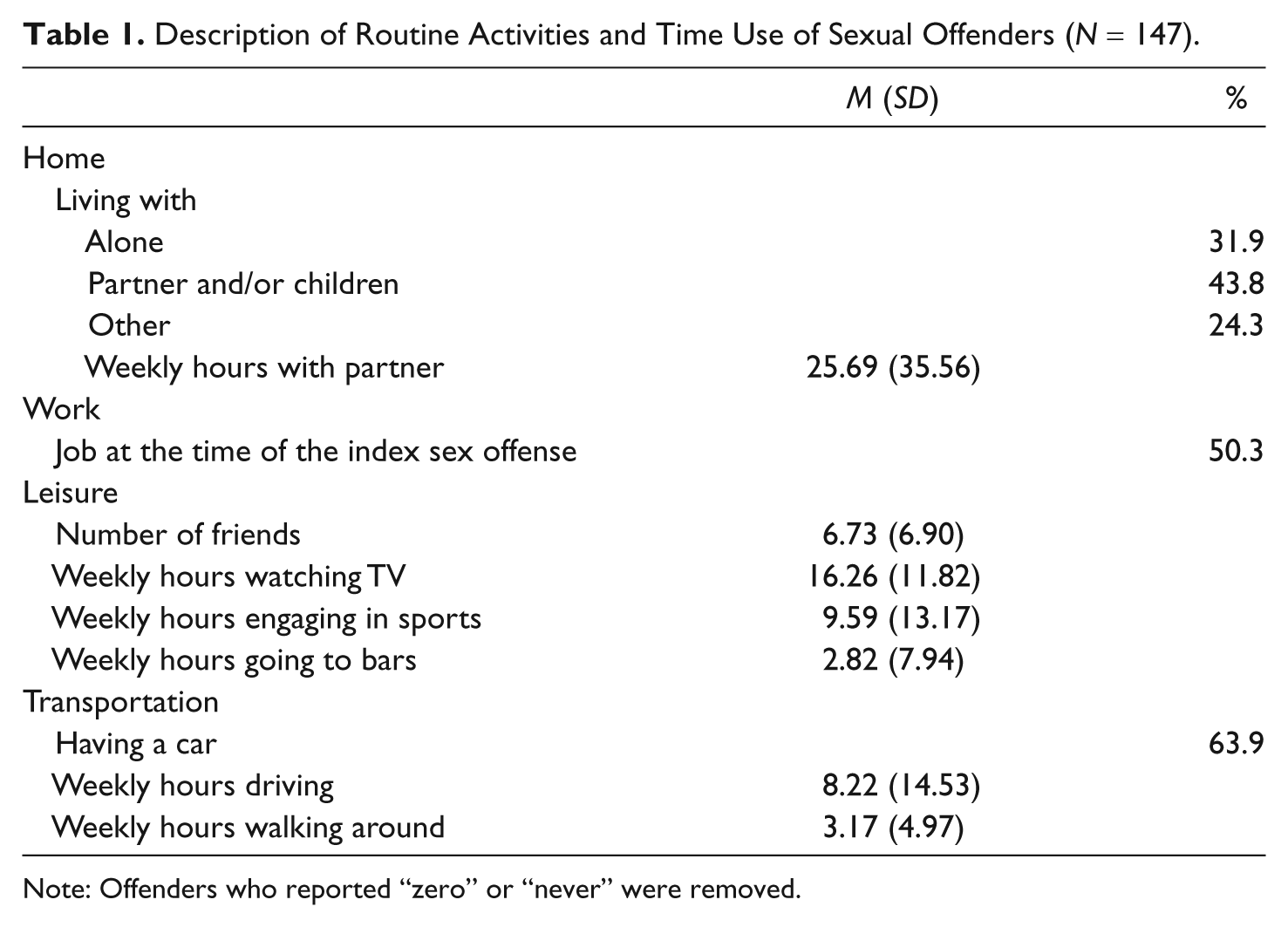
The first aim of this study is to describe the routine activities of sexual offenders, a step that is rendered necessary considering the lack of empirical research addressing this question. Results presenting the time use and routine activities of the 147 sexual offenders studied are reported in Table 1.
Description of Routine Activities and Time Use of Sexual Offenders (N = 147).
Note: Offenders who reported “zero” or “never” were removed.
With regard to their home life in the weeks prior to their index offense, results show that two thirds of sexual offenders were living with others (68.1%), most with a partner and/or children (43.8%). The last third lived alone (31.9%). On average, offenders spent 25.69 hr a week in company of their romantic partner (SD = 35.56). Work is the activity node we had the least information about. At the time of their index sexual offense, offenders distributed almost evenly between having a job (50.3%) and not having a job (49.7%). Moreover, additional investigation about employment history revealed that 25.9% of the sexual offenders studied never had employment lasting 3 years or more.
The results show the involvement of the sexual offenders in a variety of leisure activities. With regard to passive leisure, 6 they spent on average 16.26 hr a week watching television (SD = 11.82). While considering participation in active leisure, 7 the average sexual offender committed to the practice of sports, both in individual and team settings, spending more than 9 hr a week (M = 9.59, SD = 13.17). Number of friends is another measure of active leisure. On average, offenders reported 6.73 friends (SD = 6.90). Engagement in leisure activities that can be qualified as possibly criminogenic was also examined. On average, sexual offenders reported spending 2.82 hr a week in bars or taverns (SD = 7.94). However, it should be noted that almost half of the offenders (45.2%) indicated they “never” frequent those establishments.
Finally, time use of offenders with regard to their transportation was also investigated. Results show that 63.9% of the sexual offenders owned a car. Offenders’ average time spent driving each week was 8.22 hr (SD = 14.53). It should be noted that 43.8% of offenders committed no time to driving each week, but a small subgroup of offenders (14.3%) drove 20 hr or more. Transportation by walking was also considered; offenders spent on average 3.17 hr a week walking (SD = 4.97). Again, a small number of offenders (8.6%) reported walking around 10 hr or more a week. A subsequent Pearson’s chi-square analysis reveals a significant association between frequency of walking and having a car: Offenders who reported walking daily were more likely not to be owners of a car (51.7% against 31.9%; χ2 = 3.97, p = .046).
LPA of Sex Offenders’ Routine Activities
Various profile solutions were investigated with the LPA procedure based on seven indicator variables that reflect characteristics of the lifestyles and routine activities of offenders. A total of six latent profile class solutions were conducted. Solutions ranging from one to six different profiles were estimated. Table 2 presents the model fit measures of each model that was estimated. All profile solutions had similar entropy values, signaling that the indicator variables were fairly discriminant to predict profile membership. The five-profile solution was selected considering it presents a good fit based on the BIC value. In addition, the entropy value is satisfactory (0.85).
Model Fit Measure for Latent Profiles Defined by Offenders’ Lifestyles and Routine Activities.

Note: LL = log likelihood; BIC = Bayesian information criterion; Npar = number of parameters. Bolded values indicate the model selected after considering model fit measures.
To evaluate the conceptual fit of a latent profile solution, the profiles and their characteristics must be examined. Figure 1 presents the profile plot of the selected five-class solution. The plot presents the means of all five profiles on indicator variables rescaled to be in a zero to one scale (Vermunt & Magidson, 2005). This is particularly useful considering the indicator variables used in the present study have different ranges; because some routine activities require or are granted more time, a graphic presentation of mean values without the rescaling procedure would be meaningless, especially for variables with typically low time values. Table 3 presents the means of the five latent profiles on the indicator variables. Evaluation of the five classes yields five profiles that are fairly distinct from one another and that can be named, indicating that the model has conceptual fit.
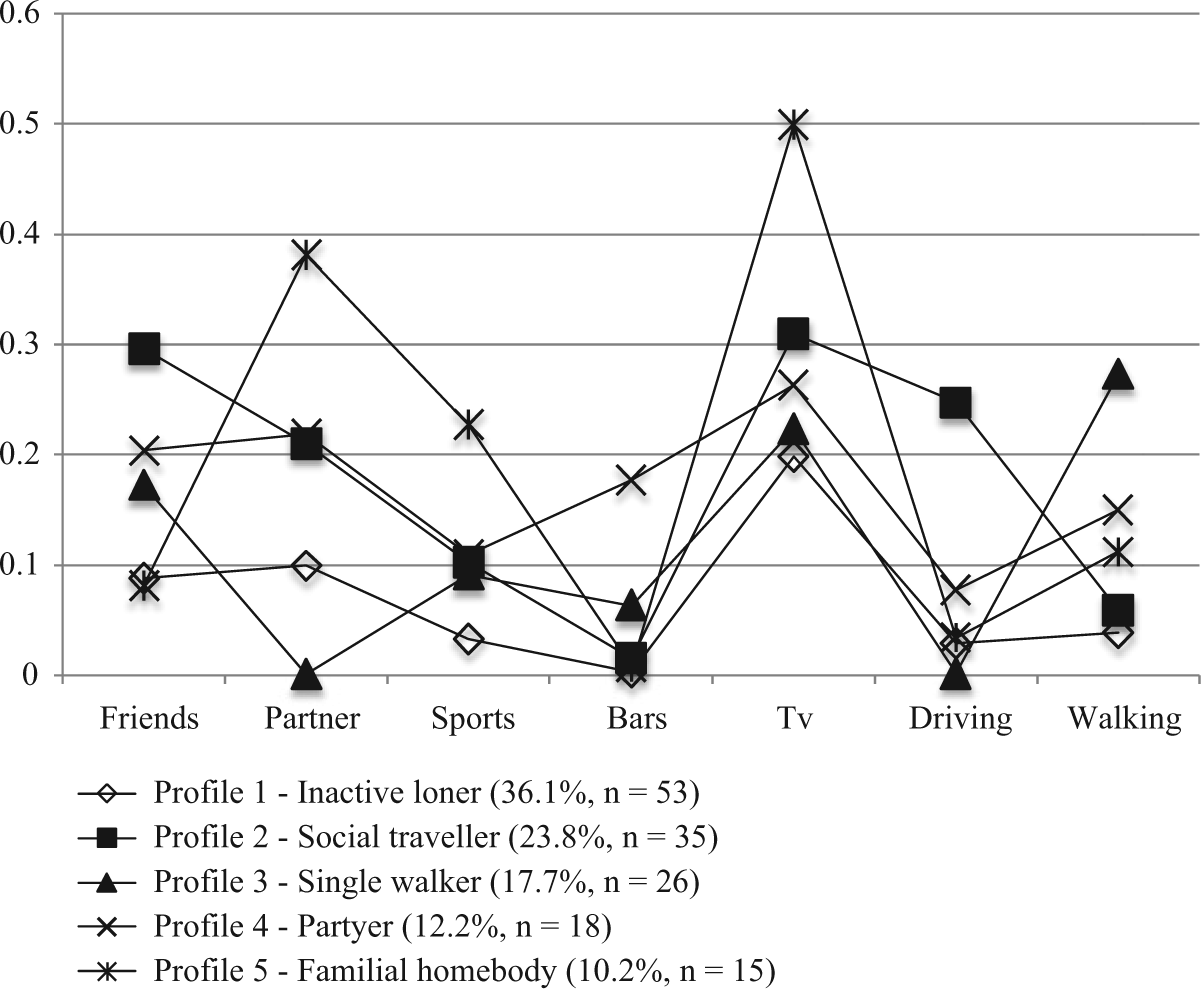
Profile plot of sexual offenders’ routine activities, five latent classes.
ANOVA Analyses: Comparing Means on Indicator Variables Based on Five-Profile Membership (N = 147).

Classes 1 and 2 are different.
Classes 1 and 3 are different.
Classes 1 and 4 are different.
Classes 1 and 5 are different.
Classes 2 and 3 are different.
Classes 2 and 4 are different.
Classes 2 and 5 are different.
Classes 3 and 4 are different.
Classes 3 and 5 are different.
Classes 4 and 5 are different.
p < .000.
Profile 1 (n = 53, 36.1%) was the largest subgroup identified by the LPA. This group is labeled “inactive loner” because the sexual offenders comprised in this group were particularly uninvolved in social activities. They are one of the subgroups spending the least amount of time with a romantic partner (M = 16.54, SD = 18.38; even if 47.1% of them were living with a partner or children), and they reported having few friends (M = 3.48, SD = 2.98). They did not go out in bars (M = 0.20, SD = 0.48), were generally uninvolved in sports (M = 3.63, SD = 3.74), and spent the least amount of time weekly watching television (M = 11.91, SD = 6.54). They were the subgroup of offenders who walked the least amount of time each week (M = 1.08, SD = 1.43), and they drove only limitedly (M = 3.01, SD = 3.23).
Profile 2 (n = 35, 23.8%) is labeled “social traveler.” Two aspects defined the sexual offenders comprised in this profile. First, social travelers reported the highest mean number of friends among all profiles (M = 11.76, SD = 10.32). Second, social travelers spent quite an important part of their time driving (M = 25.55, SD = 21.84). They also spent time each week in company of their romantic partners (M = 36.19, SD = 38.70), and they participated in sportive activities (M = 10.78, SD = 10.36). Social travelers did not frequent bar or taverns often (M = 1.10, SD = 1.68). They were the offenders who spent the most time in their cars, but spent little time walking around (M = 1.68, SD = 1.60).
Offender from Profile 3 (n = 26, 17.7%) are labeled “single walkers.” An important characteristic of this profile is the little time spent with romantic partners. Additional Pearson’s chi-square analyses reveal that 96.0% of single walkers were living without a partner and/or children, significantly less than in other profiles (χ2 = 20.73, p < .000). Even without a family life, single walkers were not isolated. They reported an average of seven friends (M = 7.04, SD = 5.57) and participated in sports for almost 9 hr a week (M = 8.98, SD = 11.17). Offenders classified in Profile 3 were the subgroup with the second highest mean number of hours spent in bars weekly (M = 4.54, SD = 4.94). They reported the lowest time driving (M = 0.22, SD = 0.74) but are the profile that spends the highest amount of time walking around each week (M = 8.13, SD = 8.92).
Sexual offenders in Profile 4 (n = 18, 12.2%) are identified as “partyers.” Their most distinguishing feature is the high amount of time they spent in bars and/or taverns every week (M = 13.18, SD = 18.21), more than any other profile. Additional Pearson’s chi-square analyses about this aspect yield nearly significant results indicating that partyers were the subgroup of offenders where drug use was the most prevalent (66.7%, χ2 = 9.18, p = .06). Partyers had romantic partners with which they spent time each week (M = 35.44, SD = 32.97) and reported many friends (M = 8.24, SD = 3.65). As to the time consecrated to transportation, they were not distinguished by the number of hours spent driving (M = 7.06, SD = 7.67) and walking (M = 4.76, SD = 4.17).
The least frequent profile (n = 15, 10.2%) is labeled “familial homebody,” considering the high amount of time consecrated to home activities by those offenders. They spent extensive amounts of time in company of their romantic partners (M = 65.07, SD = 57.98), more than offenders from other profiles. They were also the subgroup that consecrated the most time every week watching television (M = 30.35, SD = 15.73). Most of their time was spent at home, as they reported the lowest number of friends (M = 3.29, SD = 1.38) and spent the second lowest time in bars each week (M = 0.67, SD = 1.11). Among profiles, familial homebody offenders spent average amounts of time in transportation (driving: M = 3.36, SD = 4.63; walking: M = 4.76, SD = 4.17).
Additional Lifestyle Variables
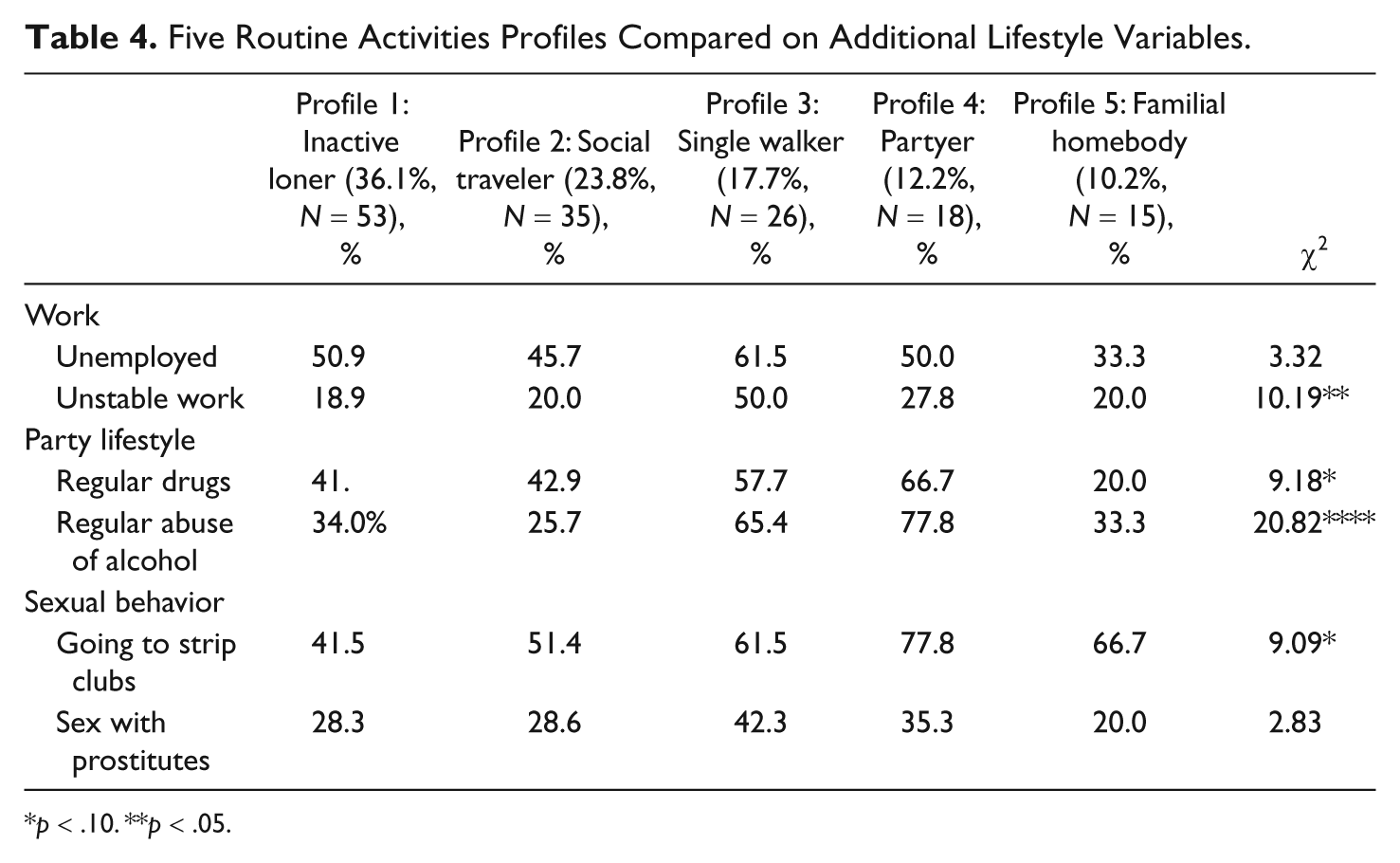
Because no continuous variable was collected to capture some interesting aspects of lifestyle, and therefore could not be entered in the LPA model, the occurrence of those variables across the five profiles identified during the LPA was investigated with Pearson’s chi-square analyses. Results are presented in Table 4. First, the status of offenders as workers was investigated. Results indicate no significant difference regarding the proportion of offenders that were working at the time of their index sexual offense based on profile membership (χ2 = 3.32, p = .51). However, significant differences appear when considering stability of work of offenders across the different profiles. Larger proportions of offenders in the single walker profile (50.0%) and partyer profile (27.8%) had a history of unstable work (χ2 = 10.19, p = .04).
Five Routine Activities Profiles Compared on Additional Lifestyle Variables.
p < .10. **p < .05.
Second, the party lifestyle was investigated in more detail. Significant differences between offenders from different profiles can be observed. Offenders from the single walker profile and from the partyer profile are distinct from offenders from the inactive loner profile, social traveler profile, and familial homebody profile. Single walkers and partyers were more likely to be regular consumers of drugs (single walker: 57.7%; partyer: 66.7%) and to report regular instances of alcohol abuse (single walker: 65.4%; partyer: 77.8%) than offenders from other profiles (drugs: χ2 = 9.18, p = .06; alcohol abuse: χ2 = 20.82, p < .000).
Third, differences across profiles with regard to risky sexual behaviors were investigated. Results indicate no significant difference among offenders of different profiles as to the use of prostitutes for sexual services in adulthood (χ2 = 2.83, p = .59). Results are nearly significant with regard to going to strip clubs. Higher proportions of offenders from the single walker profile (61.5%), partyer profile (77.8%), and familial homebody profile (66.7%) reported going to strip clubs in comparison with offenders from the inactive loner profile (41.5%) and social traveler profile (51.4%; χ2 = 9.09, p = .06).
Routine Activities Profiles and Offense Characteristics
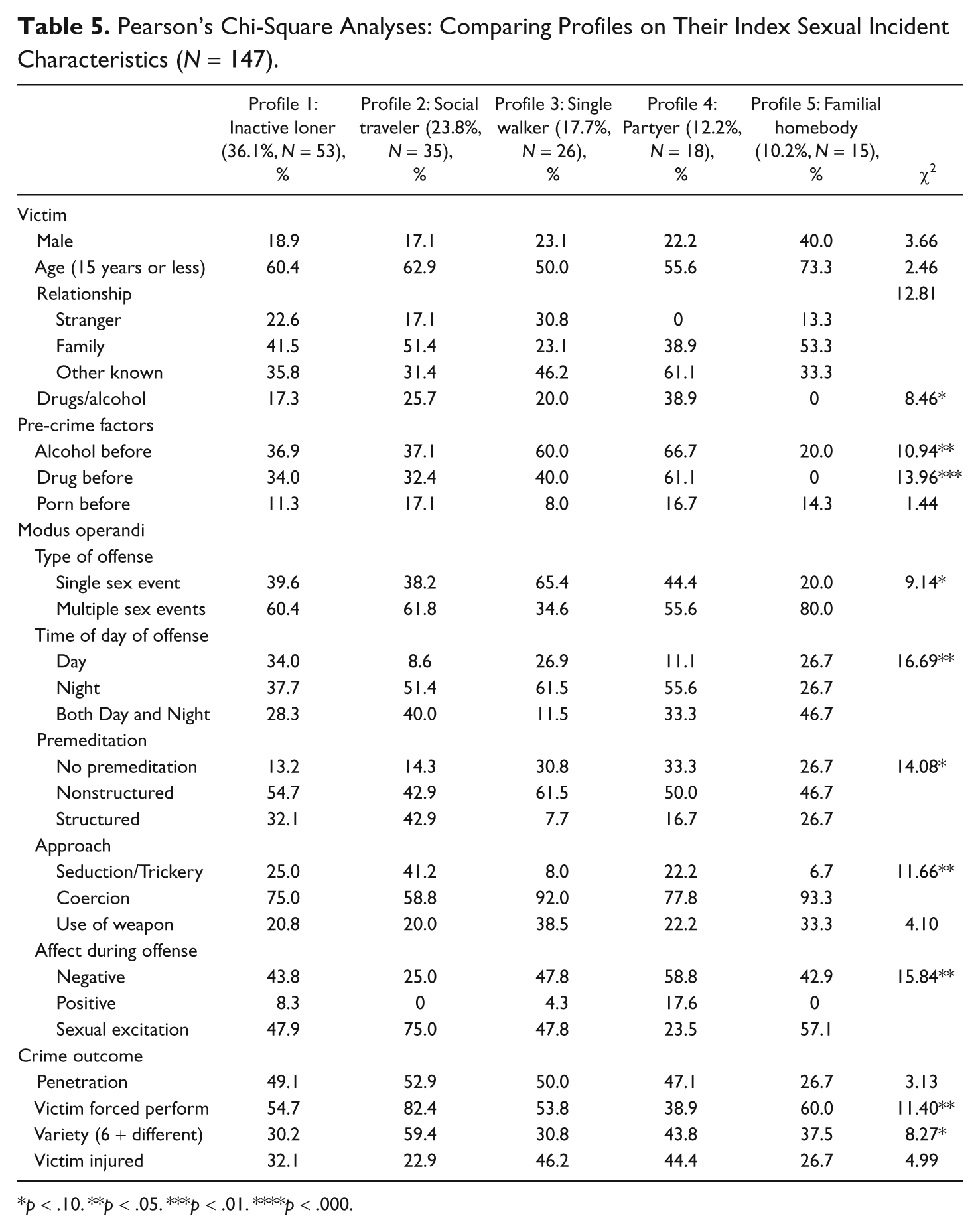
To investigate the conceptual validity of the five profiles identified with the LPA, it is important to analyze further the differences between the profiles in other sets of variable. First, we were interested in investigating whether the five profiles identified yield meaningful differences in the characteristics of the index sexual assault event. Results are reported in Table 5.
Pearson’s Chi-Square Analyses: Comparing Profiles on Their Index Sexual Incident Characteristics (N = 147).
p < .10. **p < .05. ***p < .01. ****p < .000.
First, differences in the characteristics of victims were investigated. Results indicate that sex of victims was not significantly different between profiles (χ2 = 3.66, p = .45), nor was victim age (χ2 = 2.46, p = .65) and whether the victim was a stranger (χ2 = 12.81, p = .12). Close to significant difference between profiles appears when considering whether the victim was under the influence of alcohol and/or drugs at the time of the offense (χ2 = 8.46, p = .08)
Differences in precrime factors between profiles were also investigated. Results indicate that alcohol consumption in the hours preceding the offense is different based on profile membership: offenders from two profiles—single walker (60.0%) and partyer (66.7%)—were significantly more involved in consumption of alcohol compared with offenders from other profiles (inactive loner: 36.9%, social traveler: 37.1%, familial homebody: 20.0%; χ2 = 10.94, p = .027). Offenders within the single walker profile (40.0%) and offenders within the partyer profile (61.1%) were also more likely to have consumed drugs in the hours leading to the sexual event (inactive loner: 34.0%, social traveler: 32.4%, familial homebody: 0%; χ2 = 13.96, p = .007). However, no significant difference was found between profiles when considering viewing pornographic materials before the index sexual offense (χ2 = 1.44, p = .84).
Third, specific modus operandi characteristics were investigated. Nearly significant differences are observed between profiles when considering whether the offense is a single sexual event or whether it involved multiple sexual events with the same victim. Offenders from three profiles—inactive loner (60.4%), social traveler (61.8%), and familial homebody (80.0%)—were more likely than single walkers (34.6%) and partyers (55.6%) to sexually assault their victim over a period of time (i.e., multiple sexual events; χ2 = 9.14, p = .058). Time of day of the sexual offense is also close to significant between profiles. Higher proportions of inactive loner offenders (34.0%) committed their offense during the day, while social travelers (51.4%), single walkers (61.5%), and partyers (55.6%) were more likely to offend at night, and familial homebody offenders were more likely to commit their sexual offense both at day and night (46.7%; χ2 = 9.14, p = .058). LPA profiles also yield significant differences as to the approach of the victim, with higher proportions of inactive loners (25.0%) and social travelers (41.2%) using seduction or trickery, while single walkers (92.0%), partyers (77.8%), and familial homebodies (93.3%) used coercion (χ2 = 11.66, p = .02). Profiles are also distinct with regard to the predominant affect during the sexual offense (χ2 = 15.84, p = .045). Social traveler offenders reported in significantly higher proportions sexual excitation as predominant (75.0%), as do familial homebody offenders (57.1%). Single walker offenders reported higher proportions of negative emotions as predominant. Finally, inactive loners and partyers both reported high proportions of both negative (inactive loners: 43.8%; partyers: 58.8%) and positive (inactive loners: 8.3%; partyers: 17.6%) affect as predominant compared with other profiles. The results obtained with regard to premeditation between profiles are only close to significant; offenders belonging to the inactive loner (32.1%) and social traveler (42.9%) profiles were more likely to demonstrate structured premeditation in their offense while single walkers’ (92.0%) and partyers’ (33.3%) sexual incidents involved no premeditation (χ2 = 14.08, p = .08). Finally, there is no difference found between the profiles regarding their use of weapons during the unfolding of the sexual event (χ2 = 4.10, p = .39).
The last type of variables investigated as to the characteristics of the index sexual incident was the outcome of the crime. Results indicate that different proportions of offenders forced their victims to perform sexual acts based on profile membership. Most social traveler offenders (82.4%) forced their victims to perform sexual acts on them, more than offenders from all four other profiles (inactive loners: 54.7%, single walker: 53.8%, partyers: 38.9%, familial homebody: 60.0%; χ2 = 11.40, p = .022). In addition, results also distinguish between profiles as to the variety of sexual acts perpetrated or requested by the offenders; however, the difference is only close to significant (χ2 = 8.27, p = .08). Offenders from the social traveler profile (59.4%) and partyer profile (43.8%) were more likely to perform on the victim or ask the victim to perform six or more different sexual acts than offenders from other profiles (inactive loner: 30.2%, single walker: 30.8%, familial homebody: 37.5%).
Discussion
The current study took a novel approach to understanding sexual offenders’ lifestyles. First, we conceptualized routine activities as time consecrated weekly by offenders to various activities. Continuous indicator variables were preferred, as they constitute a type of measurement more apt to reflect subtle but meaningful variations in routine activities, differences that traditional categorical or dichotomous coding cannot capture. In addition, theory guided the variable selection to measure various routine activities based on three important centers of individual activity (i.e., home, leisure, and transportation). Departing from traditional investigations of sex offenders that preclassified offenders based on the victim’s age and that focused specifically on sexual (or criminal) aspects of their lives, none of the routine activities selected measured criminality, and some were, in fact, prosocial. Finally, a rigorous and robust quantitative statistical technique was used to create offenders’ profiles based on their routine activities.
Noncriminal Time Use of Sexual Offenders
Considering the use of noncriminal indicator variables, we are in a unique position to analyze the noncriminal lives of sexual offenders. First, it should be noted that the sample of sexual offenders studied generally spent many hours weekly engaging in noncriminal activities. Simple descriptive analyses about the lives of sexual offenders show that they had friends and families and were involved in a variety of social activities. They spent time participating in sports (individuals or team) and watching television. Sexual offenders who had families spent a considerable number of hours in company of their loved ones. Finally, the offenders also spent time in transportation, some in transportation requiring low effort/investment (i.e., cars) and others in a type of transportation requiring a higher level of effort (i.e., walking). Distinctions in offenders’ lifestyle appeared when considering how many hours were consecrated to the different routine activities.
“Being Home” or “Being out”—Impact on Opportunities to Sexually Offend
When looking at the five types of lifestyle identified by the LPA, not all profiles seem to correspond to the standard criminal lifestyle. In fact, only one profile is compatible with the typical image of the “antisocial” criminal; offenders categorized in the partyer profile had unstable work, frequented bar establishments and strip clubs often, and were involved in alcohol and drug consumptions. From a routine activities perspective, previous research has understood “being out” often—what the partyers seem to do—as increasing opportunities to offend for a motivated offender, because he then comes in contact with a higher number of suitable targets lacking guardianship (Schwartz, DeKeseredy, Tait, & Alvi, 2001; Schwartz & Pitts, 1995). With regard to the partyer lifestyle identified, our results seem to indicate that offenders meet their victims while “being out,” considering that partyers were more likely to be intoxicated at the time of their index sexual offense, as were their victims (near significance), suggesting that their sexual offenses may be initiated in an alcohol-related context.
Most lifestyle profiles, however, reflect involvement from the offender in traditional “prosocial” routine activities: commitment to romantic partners, social attachment to friends, involvement in sportive activities, and movement between places. From a routine activities’ perspective, the number of hours spent in company of a romantic partner is linked with the offender spending more time at home, which should result in the likely offenders being presented with fewer opportunities to offend. However, social bonds to friends, participation in sports, and movement in one’s environment by driving or walking are all activities that should result in the offender being out more often. Offenders reporting staying at home for more activities should therefore be prevented from offending.
Our results do not support the traditional distinction between “being at home” or “being out” to understand opportunities to sexually offend. It would be an incorrect generalization to consider that offenders systematically searched for their sexual victims outside of their home settings. Such an approach ignores the dynamics involved in many sexual offenses. As presented in the literature review, studies have investigated the contexts of occurrence of sexual abuse, and results indicate that sexual offenders often know their victims (Bureau of Justice Statistics, U.S. Department of Justice, 2000; Kilpatrick et al., 1992). According to routine activities theory, the convergence in time and space of three elements—likely offender, suitable target, absence of capable guardian—creates a criminal opportunity when the routine activities of actors (offender and target) overlap. Brantingham and Brantingham (2008) noted that this overlap in routine activities is “clear when a victim of a personal crime is a family member or an acquaintance” (p. 87). The offender’s knowledge about the victim’s routine activities might help in the organization of the offense: “[n]ot only may offenders determine when the optimal time is present to victimize, they may control where and how to maneuver the victim to remove any and all capable guardians” (Sasse, 2005, p. 555). Contrary to most predatory offenses, our results indicate that offenders spending time at home or out of home are presented with a set of opportunities to sexually offend assuming they are so inclined. Opportunities are different but present in both cases.
Profiles and Index Sexual Incident Characteristics
We expected the differences between lifestyles to manifest in characteristics of the sexual event, at least in some aspects, considering the interview and survey measured routine activities in the weeks preceding the crime. First, most significant differences in the characteristics of index sexual offenses make sense while considering lifestyle characteristics, which contribute to establish external validity to the profiles. We argue that type of sexual event (single or multiple events with the same victim), time of day of the offense, and approach method of the victim are all functions of lifestyle. For example, it is not surprising that partyers, a subgroup of offenders characterized by their involvement with alcohol, were more likely to offend at night, when both they and their victims were intoxicated, and used coercion to approach victims before sexually assaulting them in single sexual events. In comparison, it also makes sense that the inactive loner offenders, who are characterized by low levels of involvement in most activities, offended in higher proportions than other profiles during the day, as they were less likely to be out of their home at night. Social travelers and single walkers were both more likely to offend at night, results that can be explained considering the high levels of social engagement of both of these profiles.
Our results also indicate that there were no significant differences between profiles with regard to characteristics of the victim in their index sexual offense. In particular, offenders from the five profiles were not different with regard to sex of their victims, age of their victims, and relationship with their victims. For example, offenders from the social traveler and the familial homebody profiles spent high levels of time at home, but were not significantly different from other profiles in their selection of a family member as a victim. Why this is the case is unknown and should be investigated further. Further research is needed, considering that little is known about different types of opportunities for sexual offending in similar lifestyle profiles, and about which opportunities are chosen and acted on.
Routine activities theory aims to “examine the manner in which the spatio-temporal organization of social activities helps people to translate their criminal inclinations into action” (Cohen & Felson, 1979, p. 589). By looking at time invested and locations of routine activities of sexual offenders, we found an association between the noncriminal daily lives of sexual offenders and how they committed their index sexual offense. When looking at preoffense behaviors in cases of child sexual abuse, Smallbone and Wortley (2000) noted that offenders often located their victim through their own home, their friends’ home, or through involvement in sporting or scouts organizations. Moreover, one of the most common ways of getting time alone with the child was while watching television. Offenders act on opportunities to offend available during their noncriminal activities. If anything, our results underline the importance of the noncriminal context of sexual offending in line with Brantingham and Brantingham (2008) who noted that “[w]hat shapes non-criminal activities helps shape criminal activities” (p. 79).
Conclusion, Limitations, and Future Research
The current study took a novel approach to understanding sexual offenders; we used variables measuring time involvement of offenders in different routine activities to distinguish profiles of offenders using a quantitative statistical analysis. The profiles obtained are conceptually interesting, but are not without limitations. First, the small sample size should be kept in mind and establishes the need for replication of the present study in larger samples. Small samples have been found to render statistical significance harder to reach. The number of nearly significant (p-value between .05 and .10) results obtained when comparing the five offender profiles on criminal event variables hints to the possible reduction of power that resulted from the small sample size.
Second, the measurement of time involved in transportation could be improved by also accounting for time spent in public transportation. In addition, two important routine activities variables were missing from our model. First, we could not include any measure of “work” in the models examined because no continuous variable measuring it was collected. Work is definitely an important part of an individual life and would arguably contribute to a typology—in addition to home, leisure, and transportation—by encompassing all important spheres of routine activities. In addition, it is important for researchers investigating routine activities of offenders to consider the dates of data collection to identify possible changes in time use that could have occurred since and determine the applicability of the findings to present offenders. In our case, no variable measured involvement with the Internet and social media. It should be noted that access to computers and the Internet was less spread at the time of the interviews than it is today. The way computers are used by offenders and its impact on sexual crimes remain to be evaluated. One could argue that an offender sitting in front of a computer cannot sexually abuse a victim, and that a high number of hours surfing the Internet would reduce contacts between motivated offenders and suitable targets lacking guardianship. However, recent findings about the use of technologies by sexual offenders seem to indicate offenders have embraced new technological means to get in contact with suitable targets (Wolak, 2011). The amount of time spent on the Internet as part of offenders’ lifestyles is definitely an important question that subsequent research should look into.
An expansion of the present study would require collecting information about the context in which the offender met his sexual victim(s). Because such variables were not collected in our study, questions such as “Are offenders from the partyer profile more likely to meet their victims in bars?” and “Are offenders from the single walker and the social traveler profiles more likely to meet their victim while in transportation?” are still unanswered. Evaluating differences in profiles as to activities of the victim at the time of the offense (similar to the approach taken in Deslauriers-Varin & Beauregard, 2010) and the activities of the offender would allow for a direct test about whether the “overlap” between routine activities of offenders, targets, and, in some cases, guardians is supported in sexual offending. It would also be valuable for future research to investigate not only the most frequent sexual offending opportunities offered in each profile but also the range of offending opportunities and how opportunities are chosen. To that end, Tom’s case, presented in the introduction, would constitute an interesting case study.
Finally, the present analysis constituted a cross-sectional analysis of lifestyles of sexual offenders. Offenders were questioned about their lifestyles during the few weeks preceding their index sexual offense. Whether these lifestyles were temporary or stable over time is unclear; in particular, the stable or unstable character of lifestyle might be dependent on lifestyle profile membership, and it remains to be investigated. Another interesting avenue for future research is in the comparison of sexual offenders’ lifestyle profiles with members of the general population and other types of offenders.
Footnotes
The author(s) declared no potential conflicts of interest with respect to the research, authorship, and/or publication of this article.
The author(s) received no financial support for the research, authorship, and/or publication of this article.